Transcript
Automated transcript · Written by software from the replay's audio. It can mishear names and figures; the replay is the record.
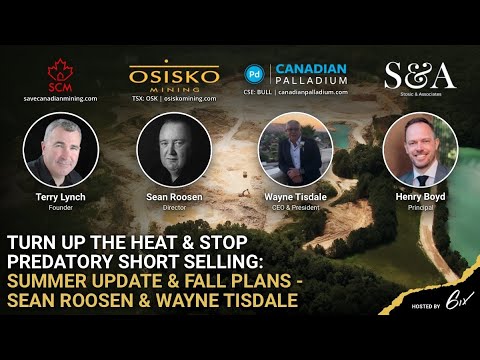
0:10 Good morning everyone. It's Terry Lynch. I'm here on the Save Canadian Mining podcast. And, you know, really super happy to have a great panel to help us understand what we're campaigning for and what the next few months might look like for us. I wanted to start the session off by introducing the panel, and first by thanking them for coming and being here and sharing their time. These guys are very busy and is all volunteer, and we certainly appreciate the time they're taking out of their day to make this happen. On my, as I go around the clock house here on my right, at least on my screen, is Wayne Tisdale. Wayne is a sort of A legendary figure in the junior mining world has done many, many projects, including Rainy River and U.S. Cobalt, among others. Now he's Canadian Platinum is probably the one that he's running at the moment.
1:12 But Wayne's been around for 30 plus years, been a very successful junior mining investor and developer, and certainly has got a wide body of knowledge to bring to a topic like this. Immediately under Wayne is Sean Roozen. Sean is the Chairman and CEO of Cisco Gold Royalties, and probably most famous for discovering and bringing to production Canada's largest producing gold mine, Canadian Marlborough. And Cisco has certainly been a huge monster home run. And Sean has, you know, Eric Sprott has been sort of our, one of our mentors on the way through, said, you know, I need to step back a little bit while I deal with some family things. And, you know, reach out to Sean because he's your man to guide us through. So I'm super happy that Sean's been able to step up and help us at Safety in the Mine to bring this issue to the front. Thank you, Sean.
2:06 Henry Boyd. Henry, I never dealt with a government relations person before in my life. This is the first time for me. So when we started this, we obviously didn't know what to do or how to lobby government to get change and I was lucky enough to be introduced by a friend actually 6x who was hosting the broadcast here introduced us to Henry and they're fine from Stossix and Associates and you know they've been amazing for us helped us really sort of understand the whole process, been very upfront, very clinical in how they do things, and certainly are very well connected in the halls of power, and have been able to help us advocate for our message. So thank you, Henry, for being here today.
2:49 So with the roundup, what I want to do is sort of set the stage, and I thought it might be interesting to recap, you know, why did we start Safe Canadian Mining? And you know, why are we all sort of on the call today? Why do we have 3000 plus followers? So maybe we could start with the slide presentation, Cam, that'd be great. So fundamentally what safe Canadian mining is all about is stopping predatory short selling. A lot of people think we're against short selling, which is not the case. Short selling in a very practical sense is a fine mechanism in the capitalist market and we're not against that. What we're against is predatory short-selling, which is an entirely different animal, and we'll talk about more of that as we
3:30 go through it. So basically, I think when we started, we started this over 2 years ago, so GameStop and Wall Street Bets and Reddit really were not a thing at that point, but It's been great for us that these guys have brought predatory short selling to the mainstream. Basically predatory short selling, my definition of it is, is when they basically don't dispose their short selling, they haven't borrowed the stock, so they're basically naked short selling and they're not being transparent about it. And that's happened all the time. It's obviously happened to these stocks, AMC, GameStop, and they popularized it and made it into memes and it got onto broadcast news. So it's become a thing. So that's been happening in our mining space for some time and it's interesting now that it's in the main domain.
4:24 What's really sort of compelling from the statistical perspective, we hired a really good research firm called Murrenbiel which is very well known in the mining space for the research. And we, you know, not being statistical experts ourselves, we said, is there any sort of statistical support for our view that short selling is, predatory short selling is impacting our market? We had to go do some research and this is what they came back. So over on the left hand side of the screen here, this is sort of, this is when basically the tick test was removed. And the tick test basically was around for 142 years since the very start of the stock markets, really, and it basically was a capital formation tool. And the idea was you were only able to short a stock if the stock was going up.
5:14 And they did that to obviously to support companies being able to raise money. And they got rid of that in October 2012. Basically at the time, they didn't specifically target the rule, they just took it out because the algorithmic trading that they allowed at that point in time needed to have 1 market and then they allowed multiple markets. So it was a technical issue. So they said, oh, we don't need this anymore, and they took it out. But You can see since that move was made when they took the tick test out that predatory short selling became a big thing. And ultimately, this discrepancy in valuation is pretty important. If you look at it, basically, Historically, which makes sense for mining stocks, they would have traded with the commodity.
6:04 So basically, trading at or above the commodity, this is sort of where we're at over here. And then you can see this gap. We're almost half the triple to get back to normal. That's just the gap now. So it's really savage. What does that mean? Well, obviously, it means that it's not linked to any sort of decline in commodities. We think that Since the TCS was out, the number of issuers has declined, number of equity capital has declined, and there's a dramatic drop in spending.
6:41 These are just more stats to support this, you know, from a statistical spot. I wouldn't spend a ton of time on these stacks at the moment, they're there, they're on our site, you can review them. But basically what we're seeing again and again, statistically speaking, is that these rule changes have enormously impacted our mining markets ability to raise capital and when we don't raise capital we can't advance our projects, we can't hire people. Mining is an amazing you know high payer for jobs and it and probably about 10% of our jobs are in the aboriginal communities. So now so more than ever that would be a very vital thing for us to be doing. So it's really you know critical that we sort of sort this up.
7:30 It was interesting we were you know we got a little headline you know back you know so we have been getting some exposure and people are starting to realize that this has become an issue and some of the bad guys are getting caught. This is Cormark and they had to pay a pretty heavy fine for facilitating sort of predatory short selling, really. And if you think CoreMark is the only security company doing this, you'd be sadly mistaken. But they just got caught and paid the price. But generally speaking, there is a problem. The problem is, you know, we need to change the legislation to make it much more difficult for this activity to happen. So what we're, you know, what we're all about here at safety mining is advocating for legislative change to make predatory short selling much more difficult. Ideally, we think the tick test would be the ultimate way to solve this.
8:25 You know, we've gone through why we think that's the case. However, you know, at this point, you know, after lobbying with the government for, you know, about 2 years, I don't think the tick test change is happening in this go-around Maybe that's something in later stages. We can get to but the government had a task force the Ontario modernization test modern Ization task force some bit of a mouthful to look at the Ontario Securities Act and come up with recommendations to make it more competitive. And so we've been able to lobby them and the government and to include some predatory short selling recommendations in their review. And afterwards, I'm going to ask Henry to sort of summarize that for us.
9:14 And basically, the 2 big things were they would effectively ban private placement use as a cover for short. In other words, if you've been short a company, you wouldn't be able to participate in the next private placement and cover your short. And that happens all the time in Canada. It's not supposed to happen. It's theoretically illegal right now, but it happens, trust me, every day. And then the other one, which we think would be pretty substantial, is they're recommending a new change in the transaction settlement process where basically right now in Canada, if you sell a stock, you have 2 days to sort of pay for your stock or deliver your stock, whatever your other buyer or seller.
10:01 And then there's this 10 day buffer period where it's like, hey, I forgot to deliver my stock, I left my homework at home or whatever, it's just an excuse. And what happens is you have another 10 days before it becomes a failed trade. Well, what's happening, you know, we think is that, you know, at the 11th day, T plus 2 plus 9, they flip it to the next, you know, numbered company, and they just keep on doing this and they don't mark their trades as short. And this is what leads to this horrendous negative divergence we see on our stocks, is that these guys just keep on flipping these stocks and it's actually never really payable. So it's uncostable, really. But there you have it. And obviously Wall Street vets and AMC and GameStop sort of showed this is happening large scale in the US. We know what's happened there and we know what's happening in mining. So, we're gonna be pushing the government to follow through with these changes because that would make a big impact. So that's sort of why we're fighting. So before we go any further, what I thought I would like to do is maybe start with you, Henry, you know, And just your perspective on the process here and where we're at and how it's looking.
11:24 Sure, yeah, thanks, Terry. And thanks for letting me be a part of this campaign. It's been a really learning, a huge learning experience for me too, from a financial markets perspective, as well as a mining sector perspective. I don't exactly have all that sort of technical expertise that this panel brings to it, but I do sort of know how government works and that's what I've been able to sort of contribute to this campaign. Terry's right, we've been at this for a while now. It's been 2 years. When we first, when Terry first came to me with this, we sort of brainstormed from a government process perspective what this would look like. Based on my sort of experience, working for 2 provincial ministers of Economic Development Trade, a former Premier and a former Deputy Prime Minister of Canada. I kind of had an idea of how government likes to do these things. In a best case scenario world, we thought it would just be a quick regulatory change.
12:11 They would introduce a regulation and the province does this twice a year, I think July 1st and January 1st, typically. It would have to go through cabinet approvals, of course, but it was hard to see what the opposition would be like when we first sat down and talked about the tick test. Shortly after we did a round of meetings with senior government officials, ministers, and the Premier's office, it was revealed that the government, the Minister of Finance was actually taking it upon himself to assign this Capital Markets Modernization Task Force to really take a look at the Ontario Securities Act. And, you know, the task force, you know, was staffed by, you know, 5 or 6 people from the financial market sector and they were tasked with interacting with organizations like ours to understand sort of what they should be recommending to the Minister of Finance in terms of changes to the Securities Act. And the Securities Act had been in place for 20 years and hadn't been updated in that time. So it was probably appropriate for them to do so.
13:13 So that shifted our focus. We weren't talking directly to government anymore. We were talking to this panel that was set up to specifically review it. And we had a couple of great presentations with the panel and we submitted our research. We made 2 pretty hefty submissions based on a lot of the research that we commissioned, as well as some, you know, intel gathering that we did through meetings with IROC themselves. We did have a sit down with the CEO of IROC. IROC, of course, was the regulator that repealed the tick test in 2012. We wanted to get a better sense of why they did that, what was associated with the decision making, and to feel them out on the tick test to see if they'd be open to looking at it again. Some of the information that they shared with us fed into our second submission and really sort of strengthened our argument around it.
14:01 Anyway, so after our 2 presentations, the task force panel, they took about a year to do all these consultations and to draft their initial set of recommendations. You know, frankly, we were a little bit disappointed in that initial set of recommendations. Terry mentioned 2 recommendations that we were quite proud of based on our consultations with them. The reference to the closing dates on short sales was one that we actually had to push quite hard for and didn't end up in the first set of these recommendations but did end up in the final set that went to the Minister of Finance. So this is kind of where we're at in the process where these final recommendations are being considered by the Ontario government right now.
14:46 We were encouraged by the Ontario budget, which was tabled in March of this year, that actually referenced the work of the task force. It made a couple of immediate recommendations around some organizational structure points around the Ontario Securities Commission. For instance, they're separating the role of the chair from the CEO, which is something that's kind of structurally significant. But they also committed in the budget to drafting legislation that would, you know, effectively change the Securities Act, hopefully to where we want it to be in terms of addressing predatory short selling.
15:21 So they've committed to doing this. We're anticipating the draft legislation to come out in the fall. This is just based on our sort of two-way communication with the Minister's Office. When that does happen, there will be room for more consultation. So, you know, we are quite heartened by how many people have galvanized around this campaign.
15:41 Not only, you know, junior miners, we have over 3,000, I guess, signatories on our petition. They all represent companies within the stakeholder base, but we also have significant advocacy bodies like the Ontario Mining Association, the Ontario Prospectors Association, and several more. So we have, I think, a critical mass here to really lobby for the changes that we want to see made. Our next opportunity to do that will be when the legislation is drafted and shared with the public. So, I want to put everybody sort of on notice about that. You know, from a legislative process perspective, we're expecting it to be sort of officially tabled in the fall. It has to go through the standard process, first reading, second reading. There will be a committee hearing usually on these types of pieces of legislation.
16:30 And the committee hearing is again, another opportunity for us and for our sort of coalition to come together and present to the MPPs reviewing the bill at that stage to advocate for the changes we want to see. Then it will go back to third reading and Royal Assent and we hope that that would happen sort of before the end of this calendar year but we might have to wait until the next one. But anyway, that's from a government process perspective, that's sort of what we're looking at. You know, we're kind of in the home stretch now. We've made significant gains. You know, government's paying attention to us. We have some, you know, recommendations on the table that are addressing some of our core issues. And it's just about sort of continuing the fight, getting everybody re-energized and continuing to sort of back our position here. Great, Henry, Thanks for that summary that pretty much summarizes it and gives us some insight.
17:23 I'm going to switch to Wayne, so we can go from small to big here, saving you for the cleanup role here, Sean. Wayne obviously runs a junior mining company, has run many in his career, he's probably running 2 right now. Wayne, what's it like every day out there, you know, in running your market and, you know, dealing with these predatory shorts? Give us a day in the life. Well, first off, most people don't realize that there's probably 10 alternate exchanges on the market. It's just not the TSX you're trading on, it's CSE. There's other exchanges out there and they're called dark pools and nobody knows what the bid. For example, yesterday I looked at the bid on one of our companies and it was trading at 20 cents and I just asked how many bots were in it. And so that shows bid 100,000, but there's actually 250,000 shares of bots trying to buy back what they had sold 4 cents or 5 cents higher.
18:23 And so people don't realize that there's all these different exchanges in here. And this is what needs to be cleaned up. This settlement rule will be a huge help because most of these bots are they're just computers they're run from offshore they go through the banks and that's why the banks want to make a fortune trading them because you get all this trading volume and they're just illegal shorts they just They just come and go as they please because we don't have a proper settlement rule or an uptick rule. It's not much fun. Unless you're on top of it, I would say probably 90% of the guys that run mining companies aren't. They just get devastated by what happens to their stock. Anytime there's volume in or news, they come out immediately. So it's just like a red flag. It's a tough day, every day.
19:09 So there you go from a veteran junior mining CEO, that's what he's seeing every day. Let's go over to Sean Roussin, who once was in that position. Now he's more of a senior minor and certainly more on the financial side of things. And Sean, you have a bit of a different oversight and overview and it'd be interesting to hear your perspective. Yeah, just for the record, I was introduced on the screen. My actual title is Executive Chairman of the Cisco Global Offices and Founder. And I'm CEO of the Cisco Development these days, which is more of a junior exporter developer. It's been a problem in the past, you know, short players had to do a lot of work to generate, you know, the foundation of a trade.
19:57 Now with the artificial intelligence and the amount of offshore activity that's in the stock market.
20:04 A person that could play 5 or 6 shorts in the past now has the computing power to play tens of thousands of them. They also play in time slots within the market that general market advocates aren't allowed to play. Like if you're an insider, you're not allowed to trade in your stock after 3.30, more like 3.15. And you see the level of activity on these short platforms go up extremely in that last portion of the day. The short to distort programs, you know, Reddit was a great highlight with GameStop of just exactly how distorted things are getting. And then, you know, the pendulum of that is if You can force a short cover, it's pretty spectacular, and then everybody goes and calls their lawyers and litigates, even though nobody did anything illegal on that side. But the illegal players are quite likely to litigate, which I think gives a social intimidation to the regulators. And, you know, I'll tip my hat to the regulators in Canada in terms of having set the stage to create this biosphere of the largest resource market in the world and to keep Flow Thru alive, of which we're probably the biggest user with almost 1 billion dollars of drilling carried out almost exclusively on First Nations territory in Canada because flow-through shares were there.
21:22 But as you say, we haven't protected the biosphere very well since 2010, 2011. And the fear is The cost of capital has gone up because obviously you're taking dilution because you're having to finance at lower rates. And the death spiral that ensues when you start covering shorts through financings, which you highlighted, Terry, in your presentation, which I think is key, Not being able to use those finances to cover those shorts, you should shut down some of that business because it's really foreign actors, on the most part, extracting easy capital from the shareholders, especially the retail shareholders in the Canadian markets. And then it starts to become its own weather pattern. Because everybody knows that these short players are in the stock, it dissuades institutional players and other people going, well, the markets are in Canada, aren't regulated properly.
22:13 We won't put any capital at risk there because the foreign actors are taking advantage of the weak regulation. So we won't play in that environment. So we're losing key players due to that weakness. And they're going to better regulated markets like the US where, you know, the ability for trouble to pursue you if you're an illegal shorter is significantly higher than it is here in Canada. And having such a big, you know, creative market of junior mining companies, which is the lifeblood of everything north of Toronto, You know, for the most part, it's logging and mining once you're 100 miles north of the U.S. Border. To have all those communities being taken hostage by these foreign interventions using AI, I don't think is the Canadian way. So I encourage all the regulators to really look at themselves and try and stand up and protect the biosphere that's been created. The banks benefit greatly from the work that we all do as junior miners. First Nations, the bulk of the dollars that get invested in those territories come through this biosphere.
23:14 And we really need to protect it. It is unique in the world. Yeah, very well said, Sean. And it's, you know, the one thing I hear loud and clear through that is, you know, the transparency issues. I mean, you know, the challenge is most of the general investment public has no clue that this is going on.
23:40 They still, you know, to the most part, look at their, you know, stock and trading on the TSXV or CSE and say, well, this is my market, but it's less than half the market as Wayne pointed out. And the machinations that these bots bring to the table has been a destroyer. When we had an interview with, we had Eric Sprott on a while back, and Eric said, the reason why we're not getting a strong mining market is that investors have been losing money. He says investors are instinctive. If they're losing money, they're not going to invest. You can see in those charts that we showed at the start, our stocks are dramatically off where they should be relative to the commodity price.
24:33 And that impacts our investors, it impacts our communities because we don't have the capital to invest and we can't make the investments we want to make. We can't hire the people locally. We can't generate taxes, both royalty taxes, employment taxes. Mining is a monster beneficiary in terms of driving tax in the country. These offshore funds, they don't pay any taxes, let me tell you. It's so, there's not a sort of a plus on the other side. These guys are just taking money out of everyone who's listening's pocket and it's just outright theft.
25:20 And now that it's been called out, most dramatically in the United States, and we've been at it for a couple of years before that, but obviously with less fanfare because we're a very humble organization and we started obviously with a mining focus. But I mean, hopefully now, now that we've shown this research and we've got some focus on it from the government perspective, they'll follow through and make these changes. And I mean, and obviously we're a mining focused organization, this is what we started in, but we expect the government, we know from talking with them that this will not be just a mining solution. This is a capital markets problem in Canada, to be honest with you. It's not just for mining, it's for energy, it's for technology, it's for biotechnology, it's for industrials, it's for the market because every sector has these issues.
26:20 Mining was super easy to target because we were chatting beforehand, I was chatting with Sean, and you look at a company's balance sheet and you look at their presentations and you can predict with high degree of accuracy when they're gonna go to the market for money, because it's a straight line calculation. And so that gives these bots even more ammunition to sort of push things down artificially, knowing that the companies that are, execute their business plan, need the capital. So none of these things are good. I mean, The good news potentially, I think, is that the governments are waking up, thankfully, and I think they're prepared to listen. There's many good things the governments do, as Sean talked about, the flow-through being a fantastic program that we've had for some time. It's given us an edge and helped us to continue to grow a world-class mining
27:21 industry here in Canada, and we certainly appreciate that. So if they could, I think, just clean this, you know, predatory short selling up, then, you know, these hedge funds that are great now are enemies in many ways. You know, these are, in many cases, the smartest guys in the room. These guys have got unlimited cash. They can hire the brightest minds. So these are not stupid individuals. Their mission in life is to make money for their people that control their headphones. And they're making it. But if we change the rules and now make that impossible, well, they're also going to be looking at how else do we make money. They're not going to stop making money. They're going to now look, I think, at the long side, which is where they should be because there's dramatic, I think, opportunity on the long side. So I think that's the positive is that as grim as this may sound to some investors, I think we're at the bottom of it right now, and we're, I think, gonna get some changes and the commodities are changing. So there's, you know, I don't want people to listen and think, hey, I should not be investing in mining right now because all this shenanigans are going on. Well, in fact, I would argue that now is the best time in history to invest in mining because the shenanigans have been discovered and are
28:41 now visible and there's probably going to be some changes and we got this commodity market coming. So at least that's my perspective. What do you think on that point, Sean, on the investment side? Is this a good time to be investing in money? Well, I think the chance of a so-called short squeeze based on being driven, the uptick rule will help, But the short squeeze probably comes mostly driven by commodity price. And I think, you know, as you said, we're headed into a commodity cycle, the likes of which most of us have never seen. So there's definitely a lot of strategic things going on in North American minerals in particular. As borders become more complicated, the international access to strategics becomes more vague and people are starting to focus more at home. We are well set to offer retail investors in particular a great run and welcome them back after they've been to the cryptocurrencies, the pot stocks, and the tech world. And we've seen tech valuations reach significantly stratigraphic levels that don't correspond to any particular business models outside of the tech space. So the commodity space always does come back and I think we're in a huge commodity boom. So now's the time to fix this. Now's the time to take advantage of these base prices that have been established and really get the next generation of retail players back into the space.
30:10 Junior Mining has been the lifeblood and made the fortunes of many Canadians and certainly provided some of the biggest characters we've ever seen. And a lot of the big companies started out that way. Barrick being one of them, started out with the Camflo mine in Val d'Or, and then ended up being the world's largest gold miner. Several other companies, Inco and Falcobridge started here, unfortunately, you know, in a weak moment and maybe a little bit of lax regulation. We lost those to Valet. We lost Elcan to Rio Tinto. We lost Nortel in an auction process. We lost BlackBerry. We invented the smartphone here and now we don't make any.
30:50 Right back to the Avro Arrow, Canadians have a long history of starting something and then losing control of it and not taking advantage of it for their shareholders and their population. I've been a big advocate of trying to keep the retail shareholders protected on the way in because they're certainly the best shareholders and the people that care the most. Amazon and the rest are not going to sponsor your kids' little league team or your daughter's figure skating competition, that's going to happen with local businesses. Head offices are a big problem in Canada. We're seeing them bleed out continuously. You know, we saw Barrick leave most recently, Gold Corp is gone, You know, and then in the tech space, we've seen McAfee and some of these other ones move. So if we're talking about building an economy sustainable for the next 2 to 3 generations, things like this uptake rule and keeping and protecting this biosphere, as you said, It's not just the mining sector, it's the bot sector, it's the incubation sector. It is the artificial intelligence sector as well, which has an incubation here in Canada.
31:53 So all these things need to be protected because these incubation ideas are what's going to create the next big company that comes out of Canada. And we've lost the ability to protect and nurture those things throughout this process. And Canada has a great history of entrepreneurship. And we've kind of taken the golden goose and named it here. And it's through our own doing. And it's quite simply undone through some regulatory changes in the near term. But we should be looking to attract capital and be the investment center of reference for a lot of these sectors, since we invented a lot of them, and now we're losing control of them, and the companies that we've generated on this are not benefiting the average Canadian through paying taxes.
32:39 So all these things I think feed into the central program and the problem of lax, basic Canadian approach, and oh, maybe it's too good for us, we should let somebody from Brazil run Sudbury. Maybe we should let Rio Tinto run Elk and you know maybe we should let BlackBerry you know get wiped out. I mean we have to stand up and protect what's Canadian and what's what's good for Canadian investors and you know I'm a bit of a nationalist on that front and I'm not shy about it. I applaud this government for everything they do to keep Canadian jobs going, and especially with my First Nations partners. We need the North to work, and this is key to it. Yeah, very well said, Sean. Very well said. Wayne, your perspective. Well, I think if we go back to 2012, you can sort of take the, when they put the uptick rule out, you saw a diminishing of our whole market. And I agree that we are going into probably the biggest commodity market we've seen in my lifetime anyhow.
33:41 And we should be prepared for it. And if we can get these rules in, I think we'd have a totally different market for the retail investor.
33:49 It's very difficult for the retail investor to understand the complexity of this problem because it runs every day. And as Sean mentioned, at the end of the day, it runs even differently because they get total control of the market. And I don't think that's what we intended to do. I think it just got away on us. And I think with what we're doing, we will change the perspective of how we deal with it. And the retail shareholder will be much more protected and be able to come back in the market and be confident that his stock and the investment he made is going to go forward. Yeah. Henry, from your view, you know, you're obviously dealing with government, talking with them every day. Do they get this? Do you think they understand, you know, what the impact is? I think they're starting to, Terry, and I think that's a credit to you and this organization and actually bringing this issue to the fore in their minds. Wayne said it's a very complex issue and retail investors don't even really understand what's happening. The same can be said for the political level and for government, I think.
34:46 And, you know, I think that's why what we're doing, the work that we're doing here is so important. We're educating government first and foremost as to what's happening out there. The importance of the tick test, what has happened to the junior minors and to the junior sectors in general when it was repealed in 2012. This is not common knowledge, right? And so, you know, we're going through an education process right now with government. They're very interested in hearing our side of it. You know, IROC was the one that sort of repealed it. And, you know, I don't want to talk, you know, I don't want to intimate anything negative about IROC. They've been absolutely wonderful to deal with. They've been open. It's sort of a very iterative conversation with them as well. But right now, I think we're just educating them. And we need to work with all parties to figure this out. It's part of the reason why our proposal was so defined on the junior markets. We want the tick test to be reinstated for small cap companies. We're not talking about sort of the wider stakeholder base. We're really trying to get along with everybody and come to government, the politicians especially, with a package that works for everybody.
35:53 And I can tell you that's probably our best shot at doing this, based on the political risk assessment that goes on in every minister's and every administration's mind when they're confronted with a proposal like ours. Yeah, I mean, it was interesting in our interactions with IROC, it was obviously super educational for myself to dig into the data, you know, and when we actually, you know,
36:20 you know, they made the move to eliminate the tick test without a lot of data. And now they seem to want a lot of data to change it back. But, and when we press them on the data, as it turns out, their own data, which is not in my view, completely accurate, doesn't capture in my view, the naked short selling at all. But even with their own data, they showed that short selling was indeed a problem. And we obviously made that part of the, that's I think why we got this second change, you know, when we made that submission to the second submission to the task force, showing that data, you know, that data hasn't been publicly released yet. At some point, IROC has told us that they're going to plan to release that and that obviously when the task force, you know, documents eventually come public, it'll get released at that point, if not sooner.
37:15 But we agreed to not disclose it in detail. We can talk about it, but not give the data. It showed that short selling was a problem. So it's like, this is not debatable anymore. Predatory short selling is a problem.
37:34 And there's some solutions. We think that the best solution would have been reinstating the tick test maybe you know I think you know industry you know I rock and you know I think they feel that that would disrupt or be more costly. I'm not really sure. I'm sort of like a plain speaker, and I'm like, hey, you guys made that problem by that change, so I don't care what it costs to fix it. You need to fix it. You got a problem, you got to fix it. But that's me. You know, and that's the practical reality of government is that, you know, they have to sort of manage the process, I guess, and you know, the solve, if these 2 recommendations come in, especially the transaction settlement, that will have a major impact and that will change the game and put real individual investors back in a great position where they can actually make wise choices on investing in individual companies that they like and have respect for and believe their presentations and they can have a chance to make serious gains.
38:45 And at the end, that's really what we're fighting about because we're all capitalists on this call. We get into this because we thought, hey, this whole sector's being threatened. I almost literally, when I started this idea, I was at PDAC 3 years ago, and it was on a Sunday. And, you know, 3 years ago, it was still, it was a very, very dark, muddy market. But I mean, we've all been through these down markets before, but it was like, you could have shot a cannon through the place. There was nobody there. So I'm in the booth aisle, Wayne, you've been there, Sean, you've been there with your booth mates that are on either side and you're chatting with them. I'm saying, guys, I know it's bad out there, but holy crap, I can't believe it's, like there's nobody here. And they said, you know, they say, well, they're charging 25 bucks to get in now. I said, you gotta be kidding. Remember when they put that in, it's like, I thought we paid for the booth, so these guys can come in for free. It's like, we can't give mining stocks away, and now we wanna charge people 25 bucks to get in here. I was like, losing my shit. I thought it was like so bad. Anyway, I thought to myself, well you know what, we're to blame for this because we let this stuff happen. I bought Save Canadian Mining domain that day. I thought because I was like, I don't know, mining was like 1% of my net worth.
40:01 I had thankfully diversified into other things, otherwise I wouldn't have been able to eat. So, you know, I, but I said to myself, before I go, we should try and do something to get, because mining is such a, mining is like hockey. It's part of Canada, you know, it really is and and it's You know to see it not prosper is just crazy because if there's one thing we've got we've got tons of minerals and we've got tons of You know good clean energy to power, you know So there's a reason to get passionate about saving the mining sector and making exploration possible because big companies generally don't explore. It's the small guys that do. You know that, Wayne, right? I mean, it's the juniors that find these deposits. Look, Wayne found Rainy River, you know, Sean, the Canadian market, you know. So so I mean, these these become ultimately multi-billion dollar enterprises that drive jobs for generations and pay billions in taxes.
41:03 All started because of some, you know, entrepreneur that got going, you know, and and was able to find a group of investors and Canadians, as Sean talked about earlier, have an appetite for this. We're historically, reasonably, while we're conservative in many other ways, we're aggressive speculative investors and we'll backstop companies and you need to have a number of these things happening before you find the Rainy River for the Canadian Markets. It takes time. You've got to have exploration capital and when that dries up, You don't get your minds because at the end of the day if the juniors aren't out there drilling and making you know You know poking holes and and and making discoveries, you know, the the mind development just doesn't happen, you know so it's it's a it's a it's a curious yeah I mean the other thing that people often forget is that a job is not just a job it's whether that job can be removed and relocated.
42:03 The mining industry, the good thing about mines is that they never move. They're where you find them. We've seen in the past, we've had governments invest hugely in tech companies and manufacturing companies, only to find that once the subsidies ran out, that those companies moved to California or to Mexico or to some other enterprise. The good thing about investing in mining is that we generate jobs that stay in Canada, that stay in communities, that pay taxes on the taxes and they can't be avoided or moved. So even if the company did get moved, the asset stays in place. And that's one of the fundamental things that I think gets lost in this translation is that the Amazons of the world have taken a good chunk out of the retail business and certainly reformatted Main Street in a way that's turned everybody into a so-called gig economy.
42:54 Creating real jobs that stay in these communities is almost an impossible task without either logging or mining. And certainly once you go to the north where the cost of living goes up, without mining it's near impossible once you get to the north because there is no logging there. Other than hydroelectric, there's really no other business. So as our governments become more and more, more and more supportive of our First Nations partners, this is a key thing to attracting that and getting the cost of capital down to where these communities and these resources and these projects can be competitive. But the cost of capital, other than the cost of, you know, to try and keep up with the cost of regulation because we have, you know, the timeline, the permanent mine has gone from 5 years to 12 to 14 now.
43:43 So the cost of capital and the time value of money is a big concern. But if we're going to develop this Canadian economy, the cost of capital and the access to that capital is the key driver for all of it. And there's a lot of cheap debt around, but they're only debt for projects that are mature. So how do you get projects that are capable of taking debt, well you need equity investment to do it. And without these key equity markets that just doesn't happen. So this is really about do you want to eat omelettes every day or do you want to have chicken 1 day. Yeah, yeah, they're a good thing. We've got to protect this incubation environment and we've got to keep, you know, keep the government focused on what's real and what's important in the long term, because, you know, the problem we've got with a four-year election cycle is it's hard for anybody to have long-term plans. Yeah. And our competitors, the Chinese, they operate on 25 and 50-year plans and they're eating our lunch because they actually think these things through.
44:40 The Chinese regulators are much more proactive in terms of protecting their industries and regulating consolidated monopolies than the West is at this point in time. Maybe they're catching up, but we certainly need to protect our biosphere. And my fear now is that with the current, as we've talked about here today, and Henry certainly highlighted, is the comprehension of how the Canadian economy is at an all-time low, I think. You know, my analogy is here is, you know, everybody now thinks the chicken comes from the fridge, which is fine, but I would like the average Canadian to understand where the fridge came from and why the light goes on when you open the door. Because if you're focused on the fridge being your chicken source, you should at least understand the fridge.
45:27 That's a great analogy, Sean. I wanna jump to this segment. We've got some questions from the audience and we just want to wrap up the session by answering a few of these questions and then I have final thoughts. So I'm going to go through a couple of these now. So I've got a question from Kerry. The question is, what is IROC's argument for continuing the repeal of the TIC test? I don't think it's being well explained here. Yeah, Kerry, so basically their argument is they say that when the TIC test was initially involved, the Toronto Stock Exchange was the only exchange in the country. I think there, maybe, I guess it was the Montreal Exchange. And so the TSE had the system in place so if the stock went up, you know, the tick was up, you weren't able to short it. When they allowed multiple exchanges now, I don't know, there's 14 or something like this out there. So, you know, the question is, what is the last price on a security? Because it could be any price on any of these exchanges.
46:37 And so, I mean, there is actually a technical workaround. You could develop software that would be able to, you should, it should really, in my mind, have a consolidated team. Everyone should know exactly what's being traded. It's ridiculous that we don't know that and investors don't know that, but that's the argument is that it would cost money to develop that and basically, In my mind, people are making money on this non-perfect flow of information. And the guys that are making that money don't want to sort of sort that out. So I think the tick test would be, It technically could be done, it absolutely should be done, but it's not being done because it would impact profit centers. That's my perspective.
47:28 And if I could just jump in here, Terry, I just want to sort of highlight what you said there. I mean, we have sort of received some formal responses from IROC as to the reason why they went through with this in 2012. And we've gone through, when IROC actually first posted that they were thinking about removing the tick test, they actually had to post it publicly, and they invited comments from the public. And it's all posted online and we've gone through all the submissions. It was sort of striking to me that, you know, nowhere even in the notice did it sort of highlight any of the risks associated with removing it as it pertained to the impact on small business and junior issuers. So first of all, they didn't acknowledge the risk in the notice. And second of all, when they conducted the consultation, there wasn't an organization like Save Canadian Mining that sort of put their hand up and said, hey, you know, we'd like you to sort of realize the potential impacts of this on our community.
48:24 There wasn't an organization like ours and certainly they didn't get any submissions that reflected a fear of the potential impact. All the submissions they received were from large institutions who were backing the removal based on, I think, just the removal of red tape in the capital market structure. So it's kind of a murky occasion. And I think what we can do, I think, as an organization, as a unified stakeholder at this point, is to push for at very least a review. I mean, this happened in 2012. In 2022, it'll be 10 years since they removed the tick test. There has been 10 years of data being collected on, I believe, IROC calls them non-highly liquid equities that are traded across all of these exchanges.
49:15 I think government and IROC should sit down and sort of take a look at this, do a forensic study on each sort of trade and how it's been impacted by the removal of this tick test. Because there wasn't an adequate, in my mind and I think in Terry's mind, there wasn't an adequate reason first as to why they were proposing it and there certainly hasn't been 1 I think since they removed it. Yeah good point Henry, I agree. Here's another question from Chuck. Chuck says there's only a passive reference to who in Canada from all of the offshore bots and There's so many pressures. The banks who make huge money in this, don't they become heavy hitters on the other side of the argument? How would government respond to this? So that's been obviously something that's been brought up to us. We're not naive. We understand, we're not obviously anti-big bank, because that would be a very stupid thing to do, because obviously the banks have many positive things they do for our economy and for our country.
50:16 However, there are components of the banks that are certainly on the other side of the equation here that they're making money hand over fist on the bot traffic and the bot deals. It's a detriment. I reached out to the banks to talk to them about Safe Canadian Mines, to have them as supporters, did not get any response. So they didn't say yay, they didn't say nay, they just basically ignored us. So, you know, I don't know what to take from that. I mean, obviously we're a very small organization, we're pushing forward, but we don't see them as the enemy necessarily, you know, because at the end of the day, they're going to benefit from a growing economy and a growing country. And these moves would definitely help the mining sector grow and our communities grow and therefore the banks grow. So this, in my view, is a positive for the banks and the overall plus and minuses in a bank's profitability is yeah, maybe their bots trading section would be short-term impacted, but the other sections of their bank would make a lot more money. So that's our hope, but we don't know.
51:34 That's where we're at on the banking side. Gonna do maybe one more question, then we have to wrap it up. What do you think from Mark, the supposedly pro-business mining, pro-jobs for government, Nazi reinstatement of the TIC test as a priority task force recommendation. Well, the task force was basically a consulting with individuals appointed by the government. So, these individuals have their own compass and they follow their own sort of agenda and they made recommendations. I think what happened is the industry people on that task force recommendation just felt that the task of actually implementing, getting rid of, reinstating the tick test was going to be too severe for industry and therefore it would be too costly.
52:35 My perspective has always been that's their problem, they created it, they need to deal with it, they should have fixed it. And we should have a transparent tape that shows every trade and every exchange and there should be a tick test that would solve it. And if it costs $50 million to get this software built to do that, I don't know, that's the sit of my butt. I don't know what it would cost, but I doubt it would cost anywhere close to that, but it costs what it costs. The cost of it not being there, you've looked at the graph. It's in the billions. So it needs to be fixed. We need to do something to help our capital markets and the tick test would be wonderful. But as an interim step, we've got to be humble. We've got to sort of say, hey, look, let's take a single or a double here. Getting the short selling stopped in terms of covering in the private placements would be huge, and getting this transaction settlement process would be huge.
53:27 That would manifestly change our market. So that's my thoughts on that. I'm gonna have to wrap it up here. And before we do, I just wanted to bring up that second slide deck, if you could pop that up. So the I'm hoping when you're listening to this, that you're thinking, hey, this is an issue I should get behind. Because at the end of the day, we're only as powerful as an organization by the people that support us, the individuals that support us, the companies that support us. And if you're wondering how you can help, I'm gonna tell you. So go to the next slide here, I guess I could. There it is. So why you should help, this is what I call the money shot.
54:16 This is a overview of the ratio of the TSXV over the S&P. So in a commodity bull market, look back here, it's in 2.5 to 3. Right now it's .25. Think about that. That's a 10-bagger move across the board in mining. So the commodity bull market's coming. So Wayne says it's going to be the best in his lifetime. I think Sean has the same view, I'm of the same view. So it's gonna be historic commodity move. If we get this commodity move and we actually got government changes, wow. I mean, the market will be ripping and investors will make a lot of money and we'll generate a ton of jobs, ton of taxes for our country.
55:05 So that's the incentive. What you can do to help. We are basically completely a volunteer organization. The only people that we pay money to is we pay money to Henry's organization, we pay money to the agencies that you know on the communication side that help us that's it and and we've raised this money generally speaking from a number of companies about 30 or 40 companies have supported us so far and a number of individuals that have, you know, also stepped up. So we're going to need to raise about another 200,000 just to clear up sort of our past sort of bills with some people that are kind enough to keep on working like Henry and to finish it off for the end of the year. So we'll go back out after this podcast. We'll send some solicitations out to our current supporters and hopefully some new company supporters and some new individuals.
55:57 Power Nickel, which is the company that I run, we're going to start off, we're going to donate 5,000 because honestly, from an IR perspective, I can't think of no more beneficial thing that I can do for my company's IR than to get these real changes made. If that happens, our stock will do very well and my shareholders will do very well. So I'd like to encourage the other companies to think about this when we push this out there. For individuals that are individual mining investors, go to our site, you can donate $20, $100, some number that would be helpful. And if you can, I think it would be sort of, again, in your enlightened self-interest because you're gonna be a beneficiary as an investor? The other thing you can do is you could spread the word.
56:43 We'll send out links to this podcast. If you could put it into your social media, you can send it to your friends. You know, I'm a CEO for Power Nickel, so I'm going to be sending it to my shareholders so they could get some understanding, some perspective of the market and help to educate. And then finally, you know, we're, securities in Canada are run provincially. So it's not a federal issue, it's a provincial issue. So I'd encourage you to reach out to your MPPs, reach out to your MLAs, and encourage them to get educated on predatory short selling and learn how to stop it. So that's my pitch. Before I go, I'm gonna get last word from the panel, but I do wanna say big thanks to our current round of supporters, obviously, Sean and Wayne and Henry that are on the panel here today. But we've had a lot of great people. Eric Sprott, certainly a friend of mine, our biggest single benefactor and a huge thought leader in the space had helped us get this far. And we certainly appreciate that help. So before we go, I just want to go once around the table.
57:51 Sean, final thoughts. Yeah, I got to jump. So I'll match your $5,000 with 3 of the Cisco companies, Cisco Royalty, Cisco Development and Cisco Mining. We'll each put in 5,000 to get the game going. And on a personal basis, I'll be there for a couple thousand dollars as well. And I'll go down the hall here and twist a few arms. Thank you so much, John. Henry. Yeah, Just quickly, we're at an inflection point here. The tick test is still on the table. It hasn't been part of the recommendations, but it's still alive. We're still calling for a review, and we have these recommendations from the task force that are going to end up in legislation in the fall. So we need to keep this group together. It's the first time that an advocacy group has been speaking on behalf of the junior mining community at the provincial level. And, you know, we're at the crux of it now and we need the support to keep going. Okay. Wayne?
58:42 Well, I have 2 companies that will donate $5,000 each and I'll throw it to myself and I'll get that done. And we need support to build this. This is the crossroad for us in Canadian mining. I mean, we need the support and we need to win this battle. And I think we're here. I agree. Well, listen, everyone, thank you for listening. Thank you for watching and supporting and please help us push it across the line and get this job. And everyone, have a great day and be safe and have fun out there. Cheers. Thank you, guys. Bye. You