Transcript
Automated transcript · Written by software from the replay's audio. It can mishear names and figures; the replay is the record.
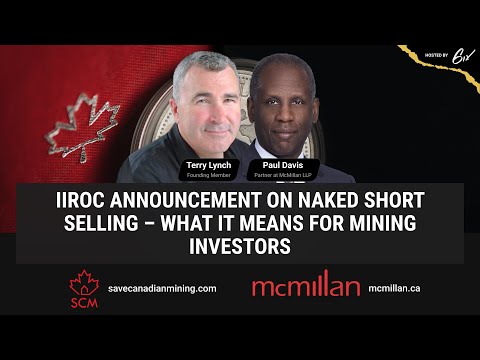
0:08 Good afternoon, everyone. I believe we're live now. This is the 1st Save Canadian Mining podcast in a few months. It's an important one. We wanted to bring you up to date with some developments that are happening in the field and we think they're relevant and would be of interest to our audience. Today, we're blessed to have on our podcast, probably that I would consider the foremost legal expert on short selling and the legal and framework in Canada. That's Paul Davis from MacDillman Binch. And I made some notes because I needed to make some notes because Paul's got quite a resume here. I'll just be brief, but he's a partner at Capital Markets and Securities, a specialist in M&A, and he's the chair of the Board of Partners.
0:57 And yeah, so we're very lucky to have Paul today. And if we could advance that slide, maybe 1 right here. Yeah, back, yeah. So, MacMillan Minch did a very important study on the short-selling environment in Canada. I think it was released in October of 2019, just when Save Canary Mining was getting going. So they were like, you know, the canary really about this issue and, you know, a thought leader and still are. And so that's an important document and very, And I think what we'll do for our readership is we'll, I'll give you the link in an email. And it's obviously not a small document, but it's got a lot of great information and it's sort of really sort of insightful to have it all in 1 spot.
1:49 And we're fortunate to have Paul here today. And Paul will guide us through some of his thoughts on it and MacDonald-Bench's thoughts on the matter. And we'll have some questions and stuff on the most recent IROC announcement that in mid-August that they basically gave a directive sort of discussing the predatory short issue and indicating that, well, they call it naked selling, naked short selling, and defined it a bit and said it's illegal and up for the
2:27 investment banks to sort of police it. In my view, they put the ball clearly on the investment bank liability wise. So we'll get into that in a second. But before we do, since this is our first time together in some time, I'm going to do a quick, you know, sort of rundown of CA Canadian Mining, why we came into existence and the cause we're fighting for. And I'll just run you through a couple of quick slides. So this is what we call the money slide from my perspective. We did a study, Murrenbilt is a very respected research outfit here in Toronto. We do a lot of work in the gold and silver space and the reserve space. So I commissioned them to do a study to try and get an understanding of the impact of what we think predatory short selling is causing in the markets.
3:21 And, you know, while no study is completely, you know, 100 percent proving any point, this one does, I think, go a long ways to sort of proving the direction of where we're at here. And that slide in particular is a great one. It basically, it shows that before the tick test, which was when we started, safety mining was the number 1 issue for us. Since then we've developed some other ways to skin the cat here. But in October 2012, the governments around the world sort of changed what had been a policy of exchanges around the world that if you wanted to short a stock, up until that point, the stock had to be going up. Which makes sense if you think about it in the exchanges were invented to allow companies to access more pools of capital and to allow investors to access more pools of opportunity.
4:12 So predatory short selling is in our view, a definition is when you sell a stock and you don't own the stock and currently and have no rights to acquire the stock to contractually or through options or whatever and still sell the stock and then you don't declare it. And so that's what we call predatory short selling. We're not against short selling. People think safe getting mine is against short selling. We're not. We think short selling is a great another side of the coin and it's important for capital market functioning. But predatory short selling, when you, when you sell a stock short and you don't have the stock to deliver in 2 days, then that's predatory. And that's what we see. So the study we did on this slide, what it showed was that basically we looked at the markets and the markets basically in mining, even though the predatory short selling is a problem across the board, not just in mining, but obviously we're a miner, so we focused on mining. We looked at the TSXV metals and mining index and at a combination of the basically the precious and base metals commodity indexes.
5:18 Before the tick test came in, in 2012, those indexes basically, we traded at or slightly above the commodity price indexes, which makes sense because mining is a commodity business. Since then, we've gotten all the way down to we're trading at about 35%. We're going to be updating this study. It's about a year and a half old now. So but we believe them to be relatively similarly priced right now, but we'll get that out in probably another 2 months. But that that's a significant loss. What does that mean? So we tried to do a little bit of calculating on that. And basically, almost $25 billion worth of market value in the market cap. And if you sort of look and say, what does that mean in terms of the loss?
6:08 It means could it cost us over 40 billion dollars in market cap? And that basically means that, You know, the companies aren't able to raise the capital that they would have otherwise raised. They aren't able to, you know, employ the workers. They're not able to pay taxes. And there's obviously a loss of investment return. So it's a significant sum. This is not a small number.
6:29 In the job side of things, A lot of people don't recognize this, but you know, probably about, you know, 10% of the workforce is indigenous. And if we're looking to certainly help our indigenous cultures in this country, one of the best ways we can do it is to promote mining. So they're getting disproportionately hurt by this. What does the research say? Summary wise, we basically, when we looked at it, we said the tick test has been removed. Stock prices are now about 2.5 times lower than historically. It's not linked to decline in commodities. And since they removed, the number of issues has declined dramatically and the equity capital has been reduced. And there's been about 62% drop in local spending.
7:16 So obviously pretty serious issues. These are slides that just back that up and we'll post it in the in the slide. We're starting to get some recognition or started really getting recognition in the in the US with the Wall Street bets and the GameStop and AMC and that sort of thing. And Predatory Sourcer has started to get caught. They've been caught in the US for some time. That's an ongoing situation. It's getting better in the US. We understand there's some pretty serious heavy lifting going on in the DOJ now, Department of Justice, and we're expecting some indictments to come down on a number of the short selling cases. You know, what is Canada doing?
8:02 Well, we've got this IROC announcement, but that's not protein, despite popular knowledge. The crickets, a little shot there, but crickets is There's not a lot going on here and we need to get something more going on. And I think that's probably a good segue to just get back to the question here of, you know, what IROC said. So I'm going to switch it over to Paul now because Paul, he's much more detail oriented as a lawyer should be in what IROC said, and they didn't say, so I'm gonna ask Paul. Paul, IROC came out with an announcement in mid-August. What did it say to you?
8:48 Thanks, Terry. Maybe it'd be good to do a little background to give a bit of context for IROC.
8:54 Under our securities legislation, if you do a short sale, you have to tell your broker it's a short sale. Both our securities legislation and IROC rules really impact investment dealers that are members of IROC. Both prevent manipulative and deceptive trading. Right. And and part of the IROC policies says that, you know, before making an order, a sale order,
9:22 you have to have a reasonable expectation of settling the trade. Otherwise, that's manipulative and deceptive trading. And the question, the old rule, the question was what does reasonable expectation meant? So IROC interpreted that to mean that it requires you, that you couldn't make a sale knowing that the securities cannot be borrowed, right? And When we wrote our paper in October 2019, that's one of the things we found truly, truly problematic. We made the bold statement that That's really nothing more than saying illegal short-selling is fine.
10:08 That sort of lax rule doesn't really come close to rules in the US or Europe and Australia. We did a comparison, which is actually cited in the Modernization Task Force report. We said that's one of the first rules that have to change. The studies that IROC had done, we thought, had to be redone because they really didn't address the real problems and that this created systemic risk. So the Modernization Task Force followed up on that and they recommended that that rule be changed, which is part of the universal market integrity rules of IROC. And they said, switch it to either 1 of 3 things. Either confirm that the security has been borrowed, which is more like Australia, like a hard bar rule.
10:54 Second, confirm that a bonafide arrangement has been made to borrow the security, which is more like the US, the locate rule. And the third, the lowest threshold was confirmed that there are reasonable grounds to believe that security can be borrowed so that it can be delivered on the settlement date. And that's what IROC recently adopted, that third rule. But it's a policy interpretation of their existing rules. And they picked the lowest threshold, which I think is a clear improvement from the current rules although it's still not clear what it means although they've given some guidance but it's not a hard kind of locate rule but it's certainly better than what we have before
11:32 and so I think that's a step forward But if you look at the proposals which are in our long report, and even in the Modernization Task Force, we still think there's a long way to go in order to make her rules as stringent as even the US rules. And as you and others may know, in the US, there are still significant short-selling problems, but their rules are far more stringent than ours. Still, even with this change. Yeah, no, I agree. And so I think that's sort of, you know, what was interesting to me when they when they put that out, it was not startling because they just clarified that that in fact was the rule.
12:26 I've talked to some of the securities exchange people provincially and they thought that was self-evident, that that was the rule. And they were surprised at the, you know, sort of the Twitterverse reaction to it. And, you know, but I thought the one thing it did is, I think it sort of transferred the liability over to the
12:54 investment banks. So that if they actually don't follow through and if you do actually bring evidence to them and they don't follow through, then it's clearly on them. So I thought that was important. Well, sorry to interrupt, though, but that it actually that obligation has always been. Remember, IROC only has regulatory oversight over its members, which are the registered investment dealers. So it rules only related to investment dealers to begin with. So the tightening of its rules impacted them. Other people are impacted by securities legislation, which is pretty broad, But obviously, and I think I say obviously, but from a securities lawyer perspective, it's really the registered dealers who have the real impact on this market, on the short selling market. And so, again, They've just tightened the rules for the people who they have regulatory authority over, but the rules existed before. They were just so lax.
13:58 We always point to this point. If you think about how many short-selling
14:05 enforcement actions have there been in Canada — and I think we counted 0 in 2019 — that tells you how helpful the old rules were. The question now is, do these new rules provide sufficient teeth to deal with naked short selling in its truest sense, or what you call predatory short selling.
14:25 We'll see. I'm just not certain it's enough. Yeah, well, you know, argument here in that it's not enough. I mean, we think they need to go further, both on this rule and just general transparency.
14:47 The fact that we don't know, for example. Every day, how many failed trades there are, that that's not a statistical piece of evidence. It's criminal in my mind. IROC has got this information and they have an ability to display this information so that we could actually look at it over the course of time. So we know when this thing is abnormal versus normal. And so there's a lot of information that could be given to market participants, investors, and companies that are looking at raising money, that could help everyone make a much better decision. But that's not out there. And so that would be very helpful. But I mean, You got to sort of, I guess, from my perspective, think, OK, you got to start somewhere.
15:36 And at least this is something. Now, I sort of took it as a company that's been plagued by these guys. I see it as, OK. So now if I can bring hard evidence to investment dealers that says, guys, here's documented proof that predatory short selling is taking place in my security, here's where it's taking place, and you need to close these positions. If they don't, well, then I fully expect IROC to to deal with them. And and and we'll see. Yeah. So let me say the one thing I should have said at the very beginning, which we do see in our paper, these are reflective of sort of my personal views, right? They're not my firm's views, notwithstanding I'm chair of the board of partners and they're certainly not our clients' views. They're my personal views.
16:25 You know, that's, in our paper, we focus on proposed changes we thought would be critical in dealing with systemic risk, which I personally think is a real issue we're focused on. And so, do these rules
16:45 empower individuals or issuers to then complain to investment dealers and that will cause them to change behavior? I'm not certain they do. What we have talked about in our paper are sort of 2 other key issues, including a stronger sort of locate before you enter into a short sale. 1 you talked about, which is transparency and the securities regulatory authorities have at least Ontario have daily reports on failed trades from CDS, right? The exchanges have data and in the US you can get data on failed trades, on short sales, and from our perspective it just seems strange that you have to wait twice a month for short sale data, and you can't get it daily, because the information is available. And there have been lots of reasons given as to why we can't have it daily. It's just not clear to me why that can't be available.
17:51 The second issue
17:53 is really, I think, one of the big issues is a compulsory buy-in, right? That's sort of a more ironclad way to address any concerns about naked or improper short selling. And we certainly have systems in place to do it and other jurisdictions have it. So it doesn't strike us as a big step in The Modernization Task Force made a recommendation regarding the buying. I'm not going to get excited about the time periods, provided it's reasonable, but I think those 2 issues in terms of full transparency and buying would allay a lot of concerns and would also provide people with information to better understand the short selling activity. And again, we've said this publicly, privately, We think short selling is critically important to the Canadian market. It's a question of liquidity.
18:52 It's also just on price discovery, unearthing problems. But the market really can't, we don't think, survive without it in terms of the liquidity, particularly such a small market. And so we think it's very important. But the more important it is, the more we would think you'd want transparency to make certain people can actually see what's going on. Yeah, I think that that's a good point. I mean, the, the, the, the a couple of things that I found in conversations with IROC, 1, the short selling they report twice a month, that's not really an accurate number. That's the number of honest people that have said, I'm not shorting or I am shorting and I'm shorting, you know, power nickel or whatever, money company or software company, whatever they want to do. That's fine.
19:43 Those are those are, as you say, important participants in the capital market environment. And that's quite legal. And we have no problem with that at Safe Canadian Mine. The problem is the guys that don't report. They're short selling. OK, And IROC either doesn't capture it or doesn't choose to capture it. I'm not sure which. OK. Because, you know, we had, you know, eventually when we made our presentation to the task force in Ontario on the modernization of the capital markets here. You know, we were interacting with IROC to get data to sort of, and it was a struggle to get this data. Eventually we got the data. And despite their assurances that short selling wasn't a problem, their data actually showed it was.
20:31 And We made this part of our submission under basically secrecy until the submissions become public because that was the way the data was given to us. But I mean, even within their, in my mind, their poorly constructed capture of short selling data, it showed short selling was a problem and causing a problem in small market cap stocks. But it doesn't seem to capture what happens when,
21:02 just to refresh for the consumers memory, is that when you buy or sell a stock, you're supposed to pay your money in 2 days or deliver the stock in 2 days. It's called T plus 2, okay? When you don't do it in T plus 2, you know, in Canada, it doesn't become a failed trade until 10 days later. T plus 2 plus 10. OK, most of insane, you know, you know, failed trade policies in the free world that I'm aware of. Europe is T plus 2 plus 4. I think the US is similar.
21:39 You know, so so obviously, we got to change that. And that was one of the, you know, recommendations from the task force was to go to a more European style thing with a T plus 2 plus 4, where it becomes a failed trade. But what happens, what we believe happens in the industry, and what we see happening on the market is,
21:57 right now, before the tenth day comes, these guys roll the trade over. They sell it again, they cover their first trade, and then it starts it again. And it's like, if everyone remembers the movie, "'Catch Me If You Can' with Leonardo DiCaprio, where he was writing checks, and it took 2 weeks or 3 weeks at the time for the technology to capture that he had a bad check. Well, it's like that right now in the stock market, I believe, where people are basically, they're never actually delivering the stock. They keep forward selling and GameStop
22:33 and ANC are much higher profile evidences of this in the United States. The one thing I know, what you're talking about is actually worse than you have articulated. When you talk about in Europe a T plus 6 or in the US a T plus 3 or a T plus 5, that then requires you to buy in. In Canada, the T plus 12, the 2 plus 10, only requires you to file a report. There's no compulsory buy-in that goes with it. So it's actually, even, I don't know about, you know, and I would never comment on things like rolling over, whatever, but even without that, you still don't have the legal protections that you have in Europe and in the US to deal with a reported failed trade.
23:25 So it's actually a lot simpler here. Yeah. Yeah. I mean, when we looked at the at the buy ins, you know, we had the conversation When we looked at the buy-ins, we had the conversation. I was with Eric Sprott and one of his staff members had been a CFO at a dealer. And he said, actually, the way they had understood it, the laws on the dealer level at the time, was that you only had to buy in if it was within 10%. If it was more than 10%, you weren't compelled to buy in. There was no and I don't know if that's true or not, but that's what that's what what what we had been given to understand. And clearly, you know, if your point is well made in is that if you're not forced to buy in at some point, and forced to buy in a market, then what is the disincentive?
24:23 What we're trying to do or what the market should be trying to do with this type of behavior is to basically people that do behave illegally and get caught, they should be, you know, and if the market goes against them, they should be forced to buy in at the highest possible price and suffer the biggest loss. So because these guys, these are Like the short, the predatory shorts, the people that are in my mind, in the minds of many mining executives, in the minds of many public company executives in
24:54 this country that are manipulating our markets, these are amongst the smartest guys in the planet. Because they're making tons of money and they can hire the brightest guys. So these are very smart people, make no mistake.
25:09 So when you see these settlements in the US, and I've had Wes Christian on, who's probably the most famous short litigator in the United States. And he's settled, I think, 10 or 11 cases between, you know, sort of, you know, plus, you know, 10 figures with, you know, the giants of the industry, the Goldmans and J.P. Morgans and etc. All that he can't really talk about other than he got a settlement. But these settlements, which sound like huge, you know, I mean, 10, 20, 30 million, some number like that, it sounds like, hey, that'd be a big number. But these are on settlements where there's, you know, $25 billion worth of trades. I mean, it's staggering. So this is just a cost of doing business. So, the system is really sort of wonky and
25:57 it's sort of scary in a way, in terms of dealing with the integrity of the entire market, which is, you know, which is where we're at. And like, when we approached it, we said, hey, look, we can't be all things to all people. We can't fix everything. So when we started SAP Canadian Mining, our focus was on, you know, mining caps or market caps of less than 250 million. And I think that's still principally not a bad spot to start just to show, hey, let's look at this micro market and try and fix that. OK, so at least is more efficient, fairer for the investor
26:31 and for the companies. And if it works there, then maybe we move it up the ladder. But because it's overall wise, it's not a massive number. I mean, but if, and people say, I can't believe they're shorting $20 million stocks, but yeah, they are. You know, there's just no question about it. But you know, you know, and, and the government, you know, and this is what we why we've been lobbying the Ford government in Ontario, because we felt that, you know, we're a volunteer group and didn't have the horses to, well, you know, lobby entire, you know, provincial securities network. So we focused on Ontario because we were here. And the Foreign Government, to their credit, has been open-minded and listening to it and had the task force and I think came back with some good recommendations in the task force, but they need to be put in place and they need to instruct their exchange, the OSC, to impose it on IROC and make sure IROC plays ball.
27:30 I mean, the good thing though is that, I don't think it's been widely reported, but there's lots of commentary coming from the Canadian Securities Administrators. And you know, whether through the Modernization Task Force or other avenues, I've no doubt that they're looking at this issue pretty thoroughly.
27:52 So we'll see what, if anything, they do to address this issue. But I think the first issue, though, is transparency, because you need to understand the problem. I know people have these views about how big or how small it is or how insignificant it is. Until you have the data, I think it's all conjecture and We need to get beyond conjecture to understand the real problem.
28:20 My only sort of non-scientific analysis is that if you have no enforcement action for short selling in this country with our rules, which are more lax than Europe, the US or Australia, then that's got to be a problem. Right? It's just, it's just got to be a problem. And, you know, it may be circular in a sense that the more lax the rules are, the more, the least, you know, there's not that much to enforce anyway. So that may present its own problems.
28:57 But I think that's one of, from our own analysis, one of the concerns, our market just can't be that different than other markets in the world, because I can't imagine, you know, we're less sophisticated and where you have a market, people will find ways to make money the right way or the wrong way. And so we need rules. And again, our focus has just been on systemic risk. Having the, we're not regulatory happy. We just want regulates for the sake of regulations but having minimum rules that address systemic risk. Yeah, I think that that would be phenomenal if we could get there. And I think, you know, the only way we're going to get there is through political pressure and through politicians realizing that this is causing significant job loss across the board in key industries, key industries that employ a lot of high paying jobs and disproportionately a lot of high paying jobs in key minority sectors like the aboriginal community that doesn't get a lot of great jobs. But this is one of the areas that they they they they're very competent in and can earn and and have high paying jobs and do phenomenal on. But that's being crushed because, you know, the markets, despite, you know, a bit of a, obviously, a commodity upswing here lately, especially in the battery metals, still hasn't translated into,
30:27 you know, enormous financings or very vibrant capital markets for money. And people wonder why. And, you know, when we did some interviews with Eric Sprott, who has been a benefactor of this organization from the start, and Eric, not to quote him, but to paraphrase him, He said, investors aren't stupid. He says they eventually figure out it's a rig game and they just opt out. And, and I mean, I'd hate to think of where the precious
30:55 metals market would be if Eric Sprott wasn't an investor, because he basically carried it the last number of years. And, and today when you know, now you would think with the shaky economy and inflation, et cetera, generally speaking broadly, you know, great conditions for precious metals hasn't been a major rebound, you know? And The reason why is there's not a ton of investor interest because
31:19 people haven't had any big wins. They've been generally losers, you know? So, and investors, as Eric said, they're not stupid. They eventually figured out, hey, the game's rigged, I'm not gonna play there. And that's really sad. You know, that's why, you know, honestly, I was gonna, when I started to save Canadian mining, I was all set to leave mining. Honestly, it was a small section of my portfolio. I've been in it for a long time. I just help a friend of the situation, put friends and family money and I was frustrated. And I remember we were in at PDAC and there was nobody coming. It was early on Sunday. I was talking with my booth mates and I said, God, I know it's bad, but I didn't realize it was this bad. And he said, well, you know, PEDAC, they just decided they're charging $20 and had to get in. I was like, I lost my mind. I said, you mean charging? It had always been free. And anyway, it made me realize that, well, again, they weren't dealing with this issue, PEDAC, which they should have. But, you know, and I thought to myself, well, before I go, I should try and and bring this to the front of people's attentions and try and make a difference. Because, you know, it's so sad. Canada used to be the leader in mining finance and advancement.
32:37 Australians are really coming on strong now. I think they've stolen a lot of our thunder and they'll continue to do so if we don't make some changes. We don't come up with better ways to protect our capital markets to allow new companies get because in capitalism all you want is good companies to get rewarded with capital and better prices and bad companies to ultimately you know have stocks go down and ultimately you know change your business or get new manager, whatever. But what happens with, unfortunately, with the, when you got markets that are trading literally at a third of their historic values, the distortion is across the board, good and bad are washed down. It's very hard for people to see. And the scary part with the predatory short action, and you see it like if you talk to companies, it's not just them selling shares they don't own. It's the spoofing and all these other things that come as part of the package.
33:31 And it really makes it tough on these mining companies that really should be blossoming right now, especially we're both in this probably the greatest commodity bull market in our lifetime and people should be getting to the long side of this thing. And I believe they would if they could actually see that, hey,
33:47 our investments are going to get protected. And that's the scary part. I mean, you mentioned an interesting thing about Australia, because in Australia, naked short-selling is not even possible, right? They don't even have a locate rule. You really have to have the unconditional right to have that stock. So it's just it's not even possible
34:05 to to do naked short selling or predator short selling. So it's interesting that you mentioned the difference between Australia and here in terms of the markets and I obviously again it's more conjecture. I don't know whether 1 is related to the other in terms of the protection of small cap mining companies or not. But I know from talking, if you look at valuations relatively across, I've looked at Nickel, because I'm in nickel and copper and lithium. And it seems to me like these guys have better valuations than the Canadian counterparts, on a sort of price per unit of commodity in the ground, which is just one way to look at it, but it's a fairly standard way.
34:50 And so obviously, if that stays for a long period of time, then why wouldn't you enlist in Australia and do your business there? And it's just so counterproductive. So this is the reason why the IROCs of the world need to, I think, be more assertive and why the securities exchanges and hopefully you're telling me that the Canadian Securities group. Administrator. Administrators, which is all the security exchanges where they come together as a group. It's got some deliberations going on. Hopefully they come back with some more teeth and some policies that will help to protect this market so that we can get back to just being good companies or bad companies based upon our drill results, which is really what we all want.
35:43 Nobody's asking for anybody to reward bad companies with good stock values. Yeah, and I think it's important. I mean, the one thing, though, I would note, which I know is sort of blasphemy on this podcast, but you know, we didn't argue for the return of the tick test because even the US, they only have it really as a circuit breaker mechanism If stocks crash in the other jurisdictions, they don't have it. Even though we have some concerns about Iraq's study that they did to get rid of it, We're not certain it's the best way to study it. When you look at the other jurisdictions, they have sought to address the problems through transparency, compulsory buy-ins, and ensuring that people actually borrow stock.
36:33 Right. And I think if we can if we can deal with those issues and also their issues about do you have. More enforcement rights and legal rights, shareholders does or shareholders do or issuers do for illegal short selling so that they themselves can bring actions, civil actions, that's something else we do explore a lot in the paper. But I think if we could address those other issues, I don't think the tick test would be as important because a lot of people have concerns about whether The tick test is too negative a consequence on short selling When you look at shorts versus long But you know, we didn't really spend a lot of time talking about it because we thought it'd be simpler to address the real concern by attacking it from the 3 areas that we focused on. Again, looking at doing our comparative study, looking at the US, Europe and Australia and the impact short selling has there?
37:36 Yeah, you know, when I started, you know, we're very obviously campaigning for restoration of the tick test as we saw it as a as a practically practical way to go forward. You know, As we went through the process, a couple of things were observed. At the end of the day, all we're trying to do is create a more vibrant capital market, a more efficient capital market, a more transparent capital market. We're not really fixated on any one solution. We're fixated on that objective of having a more transparent market that's fair to the participants. That being said, it's incongruent for me as an individual investor and most individual investors I talk to when they buy a stock, you know, they'll look at and look at the TSX feed price and the trading and they'll say, oh, they'll think that's the market. Well, that may be 35 or 40 or 50 percent of the market. The rest of the markets on these other exchanges and there are all sorts of different price discovery techniques. And to me, that makes no sense that we should have multiple markets in a country on a stock.
38:47 It's like, Or if we do, everyone should have access to all those markets. But they don't. What we're saying is if you're a rich hedge fund, you have access to double the markets that an ordinary investor does. How is that possible in capitalism? That's just not, it shouldn't be possible. I mean, it's just inherently unfair. And it creates distortions. And these guys drive trucks through it and have made billions doing it. And to me, that's, that's just nonsense. The tick test would act to sort of police that in my mind. But I mean I agree with you. At the end of the day we're not really trying to pick the one thing that solves everything. We're just trying to create a more vibrant capital market fair capital market. And you know let's get there as quickly as we possibly can.
39:35 And on the tick test where we're at now, we're saying, hey, it's high time we had a review of this, because that was put in very quickly with a thorough, proper review. Certainly, no companies had no clue as to what was going on. I remember speaking out against it back in the day, and I was stunned they were doing it, because I've raised money for companies all my life, and that was, I think, an important mechanism. That's why they put it in there. But I think we should have a review in the full light of day with transparency, with real numbers. And let's see, you know, but again, we're not we're not fast on any particular rule other than getting it right and making it fairer for companies and making much fairer for investors. But Paul, listen, while we're chatting, I'm seeing lots of questions coming up. And I think, you know, Cam, maybe we'll bring you in here now. Maybe let's go to the audience and see what their mindset is on the issue. Maybe there's some questions we could answer with Paul's help, you know, and speak to some of the questions that are out there in the community.
40:38 Oh, absolutely, Terry. And to the audience, I'd like to remind you, if you do have any questions, we're going to try and get through as many as we can with the time remaining. But you can ask them using Q&A chat on the right hand side of your screen. First question from Danny, would it not make sense to regulate the settlement system? Can't settle on a T plus 2, then a buy-in should be automatic after a certain grace period, much like they wanted to do in Europe. Thoughts guys? Well, I think what we have talked about and what's in the modernization task force is to have an automatic buy-in. I think there will always have to be exceptions, as there are exceptions now even in terms of how the short-selling rules apply, whether it's a market maker difference, etc. But other jurisdictions have an automatic buy-in subject to exceptions in Europe and the US. Funny enough, Australia doesn't have it because they don't need it because of the certainty you must have to have the stock. So failed trades are incredibly rare.
41:36 But no, I think it makes sense to deal with that on the settlement side, because it will solve a lot of the risk. Yeah, I mean, I think that makes sense. And the more I hear about the Aussie system of not letting it happen in the first place, the more of an advocate I am for that. Because the one thing I've found as I've gotten deeper into this issue is there's the nuances of these people that are, you know, the guys that are the, you know, the people doing the predatory short selling, they have figured out 1000 ways to fudge the system. And they will, you know, in the next set of rules, they'll figure that out too. So I think the Aussies, you know, do their credit and said, no, no, we're just going to make it impossible to do. And that sounds good to me, but that's just me. Fair enough. Another question. Why do you suppose IROC takes such a lax approach?
42:34 And have they ever provided an explanation? IROC would tell you that they're not taking a lax approach. They would give you their, you know, we're fully on board in protecting your interests. The reality is, you know, that, that, you know, you know, they, I don't know if they either don't appreciate the nature of the problem, or they don't want to appreciate it, which is sort of blasphemy for me to say, But I mean, it's questionable. I mean, honestly, at times you wonder, what's it gonna take to get these guys lit up? I mean, I do commend them for making that clarification and I did post that public. I praise them because I think that's, hey, maybe they're starting to wake up and God bless. You know, they're the enforcement in the country today. And, you know, so it's really, it's up for them. And if they would step forward and provide some leadership, then we'd be all for it.
43:30 IROC has publicly said that the rules it's put in place address the Canadian system, which is dramatically different than the US, because in their studies of failed trades, our failed trades are dramatically lower than the US. I think we spent a lot of time in our paper discussing kindly the problems with IROC studies. I mean, they are from our perspective, deeply flawed. But even, But our other point is, even if that's true, it seems a strange thing to say that when you studied this, how many years ago for whatever, 25 days, is that an indication of dealing with systemic risk because failed trades were low for a limited period of time? It just doesn't seem to make sense to us. But that is and has always been their rationale for having more lax rules because there's no problem here.
44:27 Yeah, and that's just, you know, the chicken and the old theory, you know, the sky is falling. I mean, to me, you know, and having gone through the frustration of dealing with them to get the data to talk to the task force, I know that, you know, what they say and what the data says is 2 different things. And I really believe that the way they construct the data isn't well done in terms of, you know, what is a failed trade? Well, you know, I mean, a failed trade to me is if you buy a stock and 2 days later you don't you don't settle that starts to take on the field trade. And as you say whether it's 4 days or 6 days or whatever you have some fairly narrow period of time. And at that point when it's done you know that's a failed trade you know. And unless there's some you know major exception you know that some some sort of systematic risk thing that comes into order, that should be public information on that. There should be, we should understand, is this an unusual number of failed trades or is this a regular number of failed trades etc.
45:33 And we're not getting that data and there's no reason why we shouldn't get that data. The data exists. Why would you not give us that data to tell us to trust us that we don't see it as a problem. We can clearly see it's a problem and it doesn't make us trust you when you don't speak to it. So that that's the problem and it really is disappointing you know to see that they still haven't woken up. Speaking of publicly available information, Craig wants to know what's the best publicly available source of open short positions on a TSXV or CSC stock? Well you see the reports, The IROC TSX reports, that's it. If it's interlisted or over the counter, you can get information from FINRA, you can get information on US exchanges.
46:24 Sometimes you have to pay for it, but some of that's even daily. But if it's a pure Canadian play, that's it's pretty. I know there are ways people sort of back-end stats and data from trading and shares outstanding and floats, but you know, that's, that's not from a lawyer's perspective, what I will call clinical data I can go to the bank on. So in Canada, it's very difficult. You know, and we looked at it a lot, you know, the data, you just can't get it here. You get this short report, which is, I said from, you know, sometimes back in the conversation that this is just a, that's the actually honest shorters. And we got no problem with those guys. They've actually declared it. And that's, they're the other side of the bet. And that's a fair part of capitalism.
47:09 It's not those people that we have an issue with. It's the people that are not declared shorts that are fundamentally short. And there's a lot of them. And it's interesting in the US, theoretically FinREN provides that data, very hard to get that data that's accurate because when you get in and you start to search, you realize that the way they construct their data is very tough. There's actually a group that we found actually, through the pathway here called buyins.net. And they've been scraping the data from FINRA for, I don't know, 20 plus years. And I consider them to be the best source of short data in the United States on particular issues.
47:57 And they have a, they obviously don't have a number on Canada because they can't get that number here. But they gather the information every day. And their view is that if you haven't gathered the information every day, you don't really get a thorough look at what the true short position is in the United States. That's their perspective. I believe it to be true. And they've come up with some numbers on based on historic, you know, proxy battles and different different things to interpolate US like inter-elastic Canadian stocks with US stocks and say if there's this many short in the US on this level trading, they suggest here's the number in Canada. Now again, this is because there's no hard evidence, it's hard to really say on this, but it does provide a guidance number and we've used that, you know, and we think they're more accurate than not.
48:52 Okay, fair enough. Pete wants t or sharing information wi and they can truth. I don not coordinating with Wes cooperating with West ch know, we think he's doing down there and happy to help him any way we can. But, you know, we're not, You know, we're a very small organization, Safe Canadian Mining. You know, obviously we share our research with them. When we have our updated research, we'll share that. But it's, you know, we're, you know, a very small research driven organization, I would say. Gary Clark has asked us, has anyone tested the rule? Which I hope has enough context by it that you can answer. You mean the new rule?
49:42 Presumably, Gary, if you have any context, you can type that in the chat. Yeah, I mean, presumably, I mean, It's a new rule, but it's fairly new and it'd be hard to understand how you test it, right? Because IROC is regulating its own members. We were registered investment dealers and so only IROC can answer that question. We're readying a test at Power Nickel. We're gathering a bunch of evidence, which we hope to have probably in, maybe we're 30 days out, And then we'll be presenting evidence to the investment banks where we see a compliance issue. And then we'll expect the investment banks to do the right thing and address the issue and close the trades.
50:32 If they don't, then A, we're gonna publish it so the world knows what's going on, and B, we'll be obviously forwarding it to IROC and hope that they will regulate these people. But obviously, from a public company standpoint, We're not looking to fight with any investment banks. God, you're a public company. You want your investment banks to be your friends. They're the access point to investors. So we want them very much to go from the short side to the long side on these deals. But we're going to do this. We've seen it done once before and it's got some new tactics. We'll see if it works. If it does, that will be shared within the Safe Janey Mining Network to our fellow companies there and to hope to help assist them and in their own particular courses of action and you know maybe that'll start a trend we hope.
51:26 Okay fair enough Christian has a question I'm gonna try and distill it as much as possible But it seems to him that banks and brokers are letting shares be borrowed without being the shares without being located to boot with. And it seems that there are these loopholes that are programmed almost like a feature. If health care equipment have critical ISO standards, how are banks and brokers having access to create synthetic shares from the market makers to boot with? There's a lot in that one. That one and there are some underlying assumptions which I won't touch. I mean, the rules are the rules. We have spent a lot of time and paper talking about the problems with our system compared to others. This one change doesn't solve the fundamental problems with our system. It's certainly a step forward.
52:18 But it doesn't solve the fundamental problems with our system. And I guess from my perspective, that's where I would leave it. Others may go further, but that's where I would leave it. Yeah. I mean, again, we have to, you know, bureaucracies like IROC move slowly, okay? And they probably have to for lots of reasons, that are frustrating to companies and individuals, but obviously they're administering it a lot. And so, you know, I give them some, you know, some sort of coverage or some sort of, you know, pass for that. But I think, you know, it's high time now as evidence is mounting, you know, not just in Canada, but evidence is mounting externally in the U.S. And other jurisdictions, that there is a serious problem here.
53:14 And you know, We need to not, you know, bare heads and say, OK, everything's OK here. No, it's not OK. You know, and you know, and it's OK that it's not OK, because that's the reality. OK, first admit there is a problem. That's that's the big start towards solving the problem. And hey, so what could we do to solve the problem? That should be the fundamental thing is, what's the blame game all about? How does it help me to blame IROC? It doesn't. It doesn't help my company, it doesn't help my investors. It's like, But IROC actually has the power to make, with some guidance from the Canadian securities regulators, the OSC, Alberta Stock Exchange, Quebec Securities Commission, BC Securities Commission, et cetera, to make constructive changes that actually could help investors, could help companies. And that's what we need to focus on. So it's not so much, you know, cause I've always been, my dad always had a good point. He said, hey, when you got a finger going at this saying, hey, you're the problem. Well, 3 of them are pointing back at you. That was an always struck with me.
54:16 The blame game is a useless game because that doesn't help anybody. Everyone gets defensive. I don't want Iraq to be defensive. I want them to be open. I want them to say you know what we've got a problem here and we have some tools that maybe need to be changed so that we can actually address the problem to make a more constructive capital market for Canada and make a better Canada. And that's really what we're trying to do here. Because to the extent that we can have a more constructive capital market, we'll have better companies, we'll have more investment, we'll create more jobs, we'll pay more taxes, our society can function better. That's what it's all about. And we need to sort of not focus so much on the blame game, but on the change game. That's what we need to be focused on. No, fair enough, Terry. And listen, I think we only have time for one more question.
55:02 I know there are more questions, so rest assured, everyone, I'll be passing over them to Terry directly so he can follow up with you after the fact. But Ross wants to know, Terry, does Safe Canadian Mining have a form letter or even some sample text that people can use to send complaints to their MPPs? You know, we don't, honestly, we, you know, as a very lean organization, we've got no paid people at paid to save money. We pay people for certain things, obviously, you know, people like 6X and some of the GR people we use. So we're pretty lean on that, but maybe that's something we could do and constructively that might be helpful. Certainly we need to sort of show the government that we do have support, and we do that in a number of different ways, but that's a good thought, and maybe that's something we can put together in the future.
55:53 Absolutely. Well, Terry, I wanna thank you for coming on. Paul, thank you for joining us as well today, but I want to, before we wrap up for the day, just provide you the opportunity for some closing remarks before we sign off. Well, before I go, I'm going to give my guest, and I want to first thank him, Paul. You know, it's not without some jeopardy that Paul comes on and talks. It shouldn't be. But, but I, you know, I talked to several other participants in the marketplace and everyone's scared. A lot of people are scared to talk about these issues and I give Macmillan Bench and Paul Davis, because they've been thought leaders in this space and it's not been an easy space to be a thought leader. So Good for you and good for Mellon Bench to do that. But Paul, over to you for your final thoughts. Sure. Thank you for that. No, it is a difficult space, but the one thing we've not been afraid to is write objective, we call them opinion pieces of some of our partners, particularly my view.
56:46 And at the end of the day, we personally, I act for short sellers, right? I do act for short sellers. We think it's an important part of the market, but we do see issues in terms of systemic risk. And that's why we wrote this paper. And that's why we continue to advocate regulatory changes because we do think when there's illegal short selling or what you call predator short selling, it can put the entire system at risk. And so while again, we think short selling is important for price discovery, it's important for liquidity, and there's nothing wrong with it inherently. We need regulations that protect the market. And certainly our clients won't be impacted by these changes because they're doing the right thing.
57:32 Thank you, Paul. Really appreciate you being here and appreciate your education for us. And I'll say once again, we'll put the link to the Macmillan Bench article in a Save Canadian mining email so folks can tap into that and it's really a well worth it. Well worthwhile. You're reading if you're an investor in the marketplace and help you to understand the issues for safe mini mining. You know, we're going to make a push here for the next 3 months or so. You know, I'm going to get back with the mining partners that supported us and hopefully some new companies that could come on board. We need to do a small amount of fundraising here to keep the GRR forces and the market media forces running so that we can expose this issue as best we can.
58:23 Nobody wants to make a career here. We really just wanna make a difference and get some changes fundamentally to the market that make it much more difficult to be a predatory short seller. So hopefully with the help of the audience and with the help of thought leaders like Paul Davis, we can do something and make a difference in securities law in this country and make a more fair and transparent market for companies and their investors. So again, thanks everyone for listening here today. And we'll look forward to engaging with other thought leaders in the space over the coming months as we try and drive this through to some actual legal changes sometime soon. Thanks again everyone and have a great day.