Robert Abraham
Fund Manager at SUPERMARKET INCOME REIT PLC
Replay available
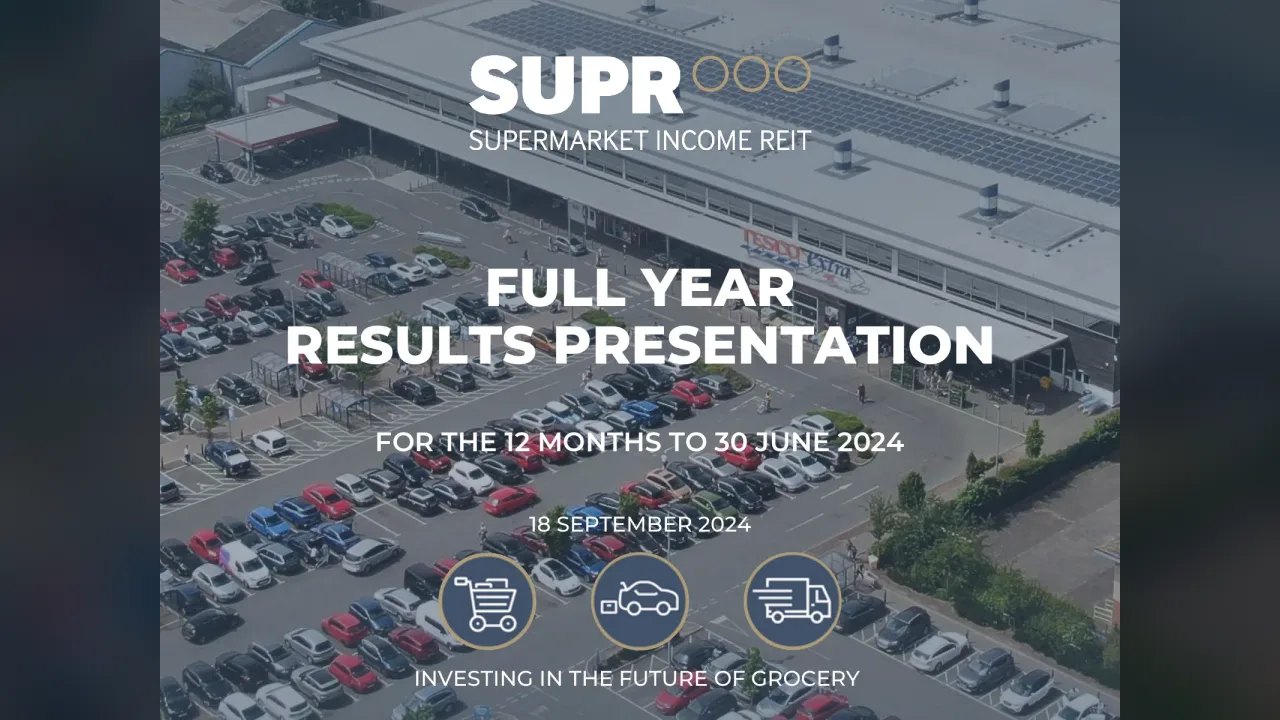
Full Year Results hosted by Supermarket Income REIT (LSE:SUPR) on Investor Meet Company, held 2024-09-19.
On 6ix: 6ix.com/event/supermarket-income-reit-plc-supr-full-year-results-1
Automated transcript · Written by software from the replay's audio. It can mishear names and figures; the replay is the record.
0:00 Good afternoon, and welcome to the SUPERMARKET INCOME REIT PLC investor presentation. Throughout this recorded presentation, investors will be in listen only mode. Questions are encouraged and could be submitted at any time by the q and a tab situated on the right hand corner of your screen. Simply type in your questions and press send. The company may not be in a position to answer every question it receives during the meeting itself. However, the company can review all questions submitted today and publish responses where it's appropriate to do so. Before we begin, I'd like to submit the following poll. And I'd now like to hand you over to Robert Abraham, managing director. Good afternoon, sir.
0:32 Thank you very much for the introduction, and thank you everyone for for joining us this afternoon. Very pleased to be presenting our results to you. I am joined I'm the fund manager for SUPERMARKET INCOME REIT at the Charter Capital, and I'm also joined by Mike Perkins, who is the finance director to SUPER. We will be turning the slides today, which was the basis of our results presentation that we gave yesterday morning. But I would say, we'll be looking to give a bit more kind of context and color around the content that we're able to necessarily do when we're when we're giving the formal results presentation and and kind of following the the script. So just to kind of take you through our our kind of key messages and the the kind of highlights from from the latest results, clearly still strong operational performance for us.
1:25 We are seeing strong performance from our tenants. We've got really good performance again in terms of occupancy, rent collection, and that just is is driving for us our income growth coming through, business performing fundamentally very well in what is a very strong grocery market. We've also then been making accretive acquisitions in The UK and France. We started the year running the business at lower leverage given this the the kind of broader macro backdrop, the challenging environment, the interest rate kind of look forward. We've now moved into a place where it it makes sense again to be deploying capital into accretive acquisitions.
2:13 We will come on to that later. But, really, the combination of those factors is me is meaning that we're able to deliver earnings growth at the moment. Earnings growth is a clear strategic priority for us,
2:26 and that's that will allow us to, number one, demonstrate that our dividend yield our very attractive dividend yield at the moment is sustainable, but also earnings growth will give us some capacity over the long term to be able to grow the dividend as well, which which we know is is important for investors. So on that note, I will hand over to Mike to take you through the the financials. Thanks, Rob. Good afternoon, everybody. Just starting starting with the key key highlights, key financial highlights for the year. We set out, a £107,000,000 in net rental income. Our adjusted earnings were 6.1p, and that was fully covered, resulted in fully covered dividend. Portfolio valued at £1,800,000,000, and our NPA per share was 87p and a loan to value of 37%.
3:19 So just looking at the income statement in greater detail, as I mentioned, net rental income of a £107,200,000 is up 13% year on year. And that that ink that growth of the income was really replaced that income from the from joint ventures that we we sold out towards the back end of last year. So turning to the driver of that growth in net rents, we've shown here is is the the charts or the movement in passing rents over the twelve months. You can see passing rents starts at a £100,600,000 at the start of the year. And as Rob mentioned, we've been making accretive acquisitions throughout the year, in both in The UK and then more recently in France, and they've contributed $5.24400000 pounds respectively to the rent roll.
4:07 But equally, we've been quite busy, or settling rent reviews. We've had 22 rent reviews that have settled in the year that have contributed a further £2,900,000 of rental income, and those rent reviews were settled 4% ahead of the previous passing rents. So all in all, and resulting in a £113,100,000 passing rents reported at June 30.
4:32 Rob mentioned earlier around the strong operational performance of our tenants. And equally, what we see here is is that's sort of bearing out where we have 100% occupancy, another period of 100% rent collection. And on the far right there, over 99% of our gross gross to net rental income margin, which is which is key as as we look to grow grow our rental income, be it for acquisitions or organically for rent reviews, that rental income flow straight down into into earnings.
5:04 And we and we focus you know, we're we're very focused on managing costs. Administrative expenses were £15,200,000 for the year, broadly flat year on year. But more importantly, how that's fed through down into how we monitor the business in terms of its operational efficiency is in the EPRA cost ratio. And what we set out here is is the upper cost ratio across peer group that consists of FTSE three fifty listed REITs. And as you'll see on this chart, we reported an upper cost ratio of 14.7%, which was an 80 basis points improvement from the prior year and really puts us amongst the lowest in the sector. And and we will be make targeting further operational efficiencies in the coming twelve twelve months and thereafter where we set our target to be the have the lowest EPRA cost ratio amongst the externally managed listed REITs.
6:00 So looking at adjusted earnings, 4.4% growth in adjusted earnings per share. And we set out here the the movement in the year and what the the driver of that growth. As I mentioned, we sold our interest in the Sainsbury's joint venture. And you can see in the first chart there, that resulted in a loss of earnings of 0.9p, but we managed to proactively replace that income that we've lost through the growth in our rent roll through the acquisitions and equally to the rent reviews that we settled in the period. And then finally, as I mentioned, with our targeted cost savings, that's in our decision to fix our interest rates in the period through the higher interest rate expectations, that has resulted in a further 0.3p growth in the EPS through net interest expense and and administrative costs.
6:49 So reporting an EPS of 6.1p per share, and that resulted in a fully covered dividend we set out here. We we declared and paid 6.0 six p dividend for the year, and as mentioned, fully covered. So moving to the balance sheet. The portfolio is valued at £1,776,000,000, which is a 5% increase in the year. Now that 5% growth is is mainly through acquisitions. We did see some some valuation decline, but that was mainly witnessed in the first half of year. But I'll take you through that in in more detail on the next slide. And a net per share of 87p and a a loan to value that we're very comfortable with at 37%.
7:38 Just looking at the the valuations, we really saw a stabilization of valuations in the in the second half of the year. This chart where we set out that the movement in the portfolio value at the asset level over the twelve months. In the first half, we invested £36,000,000 into two omnichannel supermarkets, and then the portfolio recognized a £54,000,000, deficit as the, yields in the portfolio moved out by by approximately 30 basis points. But then as we saw greater certainty around interest rates at the start of '24, we really feel like we've seen a floor in the valuations that gave us the confidence to go and invest a further £100,000,000, into eighteen eighteen omnichannel supermarkets.
8:26 And then the like for like valuations in h two were broadly flat, And that results in a portfolio valuation of £1,776,000,000, and that is a net initial yield of 5.9%.
8:42 So looking at the debt profile of the business, what we set out here is the maturity profile across the all of our committed facilities. We have very good, or no major refinancings until FY twenty six, and the facilities are well diversified by lenders and also by maturities. You know, conversations that we have with with new and existing relationship banks is very positive where they like the security of the income, the long length of the leases, which gives them confidence that the quality of our or the security of our income is is is sufficient. And the we've been able to generate £275,000,000 of new debt refinancings, demonstrating the the the attractiveness of grocery property within the in the debt markets.
9:35 So then looking at the the key statistics on our debt profile, including the post period end activity, the average maturity is now four years. Our drawn debt is 100% fixed at an attractive rate of 3.8%, and we are pleased that Fitch reaffirmed our BBB plus credit rating with a stable outlook. And looking at the more recent private placement that we we we completed post period end in in slightly greater detail, this was our first bond issuance, and there was £83,000,000 of of new senior unsecured notes. And what we utilize these proceeds to to effectively finance the the 17 assets, supermarkets that we acquired from Carrefour.
10:25 So that was resulted basically us a 100% leveraging or using a 100 and leverage to acquire those assets, meaning that we have a natural hedge where we have a euro denominated assets that's matched off against a euro liability. And that was a particularly pleasing fixed rate of 4.4% relative to an acquisition year of 6.3%. And we've managed to lock in that circa 200 basis point spread for seven years, and that has further improved the percentage of our debt stack that is now unsecured to where 76% of the port of our debt is now is now unsecured. Rob, should I pass you back for sustainability?
11:13 Yep. Thanks, Mike. So just to touch briefly on sustainability. So we announced a new sustainability strategy during the year with these three pillars you can see on the screen across the climate and environment, tenant and and community engagement, and also responsible business. You can see some of our credentials are under under each of these pillars. But, really, it's just about embedding sustainability into our strategy. And within that, we, for the first time, have set some science based targets for emissions reductions. So our scope one and two emissions to reduce by 42% by 2030. Scope one, two, and three, with scope three being the emissions of our tenants to reduce 90% by 2050.
12:05 So we benefit from the ambitious tenant commitments for net zero across their own operations by 2035. That would therefore influence our own scope three emissions, and scope three emissions make up around 98% of our emissions because we're a landlord with assets that are fully demised to the tenants. So, actually, we're we're fortunate to work in a operate in a sector where the tenants themselves are absolutely committed to making sustainability improvements. They are some of the largest consumers of energy in the country, And that means, of course, there is also a financial incentive for them to be improving energy efficiency. And that brings me on to the tenant investment into stores, which is driving EPC upgrades.
12:55 So we've got some examples on the page here. I'll just summarize and say, in each case, this is the tenants making multimillion pound investments into the stores, removing fossil fuels typically. They will be upgrading refrigeration, store refurbishment programs. The combination of these factors means that we see EPC uplifts. The assets themselves are improving, and that comes at zero cost to SUPER as a landlord, so a great place to be. And we've got on this page, you can see, in some cases, some quite short lease terms, eight seven or eight years. So that just gives you real confidence when the tenants are investing millions of pounds that actually they intend on being in that store longer than the seven or eight years, which, of course, we would say is the case anyway. We buy the best performing stores in the country. We are very confident that the operators will remain in each of our stores, but this is perhaps a very clear indication externally that that these these tenants expect to remain.
14:01 But but, yeah, in short, we benefit from from the tenants making investment into the stores, which as a landlord, it is is something that's that's fairly unique, I'd say.
14:14 So moving on now to the grocery market and portfolio. Again, so this will not necessarily be be anything new. It's something we've been talking to for a number of years now, but UK grocery is a strong growth sector, seen 35% of growth since SUPER's IPO in 2017. That's at a 5% compounded annualized growth rate. So strong growth. We saw 5.8 of grocery market sales growth last year or forecast for this year. So, yeah, we're we're in a growth sector, which is clearly very positive for us. Within that, we're also seeing online return to growth. So you can see on this page of online, of course, peaked in the pandemic in 2020.
15:01 And then as you might expect, there's kind of a more normalized environment returned. Shoppers started a bit less online, but, actually, we're now back past that pandemic peak in terms of total sales, exceeded the pandemic in in 2023 at 23,000,000,000, and actually is forecast to grow further and forecast to grow ahead of the total market. So online returning to growth within that, Tesco's and Sainsbury's, our key tenants, have 55%
15:31 online market share. So they've got a market share that's even greater in online than they do in in kind of the total grocery market. The discounters is something that gets talked about a lot in the in The UK media. We get questions from investors about the growth of the discounters. Actually, our view is they're reaching a maturity phase. Clearly, a very successful strategy. We like the business model. But but as you've you can see with those 2,000 stores now in 2023, then actually that rate of growth is starting to slow, and there's a couple of factors there. One is build costs are up significantly over the last few years, up sort of 35% or so, but also yields have moved out.
16:18 So the economics of developing new stores is is tougher to make stack up. It requires higher rents ultimately, And, clearly, Aldi and Lidl are reluctant to pay those higher rents. But if they want to grow at the rate that they're they're talking to externally, they would need to pay some higher rents to make that economic stack up. But also just thinking in simple terms, 2,000 stores now in the country. There are there is getting more and more difficult to find the sites. The the low hanging fruit are probably how I'd describe it. Those sort of early phase sites are are now gone.
16:56 94% of our portfolio already has a discounter within a ten minute drive time. So the discounters are already on the doorstep of the best performing stores in The UK. More stores, I would caution, may mean some cannibalization of that trade and may mean diminishing returns on each additional store. So we think it it it will get harder to grow, and and that's just why we're at the view they're reaching maturity phase. Not going anywhere, of course, very successful strategy, but we do think their their impact on the market now has been felt. There'll be some more growth to come, but we should start to see that that moderate, in the coming years. Turning to our our key tenants, Sainsbury's and Tesco, they make up 77% of our portfolio.
17:43 They are reporting strong sales growth. You can see there Sainsbury's left hand bar, 10.3% total UK sales growth. Tesco on the right, 7.7 total UK sales growth. And in each case, large format stores are growing ahead of that. So that's good news for us because we own large format omnichannel stores. They're capturing the most sales growth. That is only a positive for us. It means the tenants can afford to pay higher rents on those stores. So, yeah, good news from a from a landlord's perspective. And just tying back to that point of sustainability, where we're seeing through that strong revenue generation at the operator level, you're seeing 920,000,000 of forecast capital expenditure for Sainsbury's, 1,400,000,000 for Tesco.
18:35 That a lot of that is into their store estates. And I mentioned it already, but you've got initiatives like solar, EV, solar PV on rooftops. You've got EV charging. You've got energy efficiency. So we've got a picture there of a refrigeration upgrade, and then you've got store refurbishment. So all of that combining, as I mentioned earlier, improving our assets at no cost to us. So a good place to be as a landlord, and that is the benefit of owning what we describe as mission critical assets. The only way Sainsbury's and Tesco generate their sales is through their store networks. So they're they absolutely have to continue to invest in the store networks to stay competitive, in in what is ultimately an exceptionally competitive grocery market.
19:24 So then just bringing all of that together, we're seeing that that combined as long term tailwinds for market rental growth. So you've got the increased sales both in store and online. We've got the fact that there's outsized growth in the large format stores, and also just those challenges I mentioned of opening new stores that means existing space is increasingly valuable. So all of that combining just means store store rents become increasingly affordable and should give us, some good drivers for for market rental growth over the long term. So just turning to our portfolio. So led to the the leading supermarket operators, of course, in The UK, but now also France.
20:09 We're up to 73 supermarkets, and they're valued at a 5.9% net initial yield. 93% of our stores are omnichannel. We've got the 77% there waiting to Tesco's and Sainsbury's to the very best operators' investment grade covenants. And we've deliberately managed our exposure to Morrisons and as to keep that low, because of the the weaker covenants there. We like the stores we've got. They're still strong performing stores, but our our focus is on very much on having the best quality covenants in in the portfolio.
20:48 So then just turning to that investment into France. So, actually, this slide really is just to summarize when we're investing in The UK, what we look for, and how actually France has all, and Carrefour has all the same characteristics. So firstly, we're looking for that growth market.
21:08 We're looking for the fact that online is also growing, ahead of the total market, and it's growing through omnichannel stores. We look for leading operators with strong market share, investment grade covenants, so where we've got that really secure nature of high quality income. And then we're looking for operators who have the capital available to invest in their store estates and their online operations. And then finally, strategic tenant relationships. We've got very strong relationships with Tesco's and Sainsbury's. And by doing a off market, say, in a leaseback transaction with Carrefour, we were able to build a direct relationship there. So just taking you through that in a bit more detail, French grocery is also a strong growth sector, 20% of growth since 2017.
21:56 Again, you can see the same pattern here that French online market permanently enlarged through the pandemic twenty twenty. There, the significant step up in volume, but then continued volume growth thereafter. A interesting point at the bottom of the page there, 80% of online is fulfilled in France through click and collect, which is which is the opposite of The UK, actually, due to the lower population density. Of course, click and collect is fulfilled through store networks, and they're the type of stores that we've bought. So then just to just to touch on Carrefour as a as a strong tenant covenant. It's a global operator of significant scale, seventh largest grocer in the world with a 100,000,000,000 of annual sales.
22:42 That is ahead of Tesco in ninth. So just really highlights there the the the scale of the operation. It's a triple b rated, investment grade company. So, again, really strong covenant to have on the lease, and very much complementary to the Tesco's and Sainsbury's exposure that we have. Online is core to Carrefour's strategy. They've got a €3,000,000,000 online CapEx investment plan, into their into their, global online operations, and they've also got ambitions to triple their online sales, by 2026. So online absolutely core to their strategy, and that was a really important point for us. Just looking to the two markets, you can see here similarly concentrated across The UK and France.
23:32 Top six in each market has a has a share of over 80%, and you can see Carrefour highlighted there around 20% market share. So really kind of sitting in that, position equivalent to to say a Sainsbury's. So just then to to talk to the actual portfolio itself, as I said, €75,000,000 off market transaction directly with Carrefour acquired at a 6.3% net initial yield, financed with a 4.4% cost of debt. So you can see how that transaction is immediately accretive. Now I'll I'll I'll let Mike come back at at the end. I saw there were some questions on the on the financing. Mike can touch on how how we're thinking about that about that.
24:19 You've got 17 omni omnichannel stores. Again, primarily click and collect, weighted to to to North Of France there. Twelve year lease terms with annual inflation linked uplifts. Again, very much similar to what we target in The UK. You've got low rents of €7 per square foot, and that gives a low rent to turnover of 2.1%, so highly affordable rents. And just to kind of touch on an example of those types of stores, this is the store in Aviville, which is in Northern France. Ticks all the boxes of our investment strategy. Really interesting point there. Carrefour have operated from this site for fifty years.
25:04 So, again, just highlights these types of grocery sites, the long longevity of them, similar profile to our Tesco's and Sainsbury's in the portfolio where quite often they've been there for thirty or forty plus years as well. It's an omnichannel store with click and collect, and and we were able to get three years of of turnover information from the tenant. So just to support our underwriting of the the quality of these stores. So just to the investment market now, 2,000,000,000 of volumes last year. But, actually, when you break that down, the gold bar here is the sale and leaseback activity. And you can see for the first time well, on this chart since 2020, but for the first time in a long time, sale and leaseback was the largest or or or was a good half of the the volume in the year. That was by Morrisons, Asda, Waitrose.
25:57 They they've now completed those transactions and kinda secured the funding they needed, so we're not expecting there to be a a further kind of material supply of those types of assets. So, actually, you can see in the blue bar that our kind of usual volumes were were down. So in the context of that reduced supply, just to touch on SUPER's addressable market. So the two left hand columns here, you've got long lease investment grade, your Tesco's, your Sainsbury's trading at around a 5.3% net initial yield. You've got long lease, but a sub investment grade tenants in Morrisons and Asda. They're selling leasebacks pricing around six and a half percent.
26:44 So in each of those instances, either you're not getting any earnings accretion or you're getting earnings accretion, but you're not maintaining the covenant strength. And as I've mentioned, covenant strength is very important to us. It's very important to our investors that we've got that high quality income. So that's why our primary opportunity set over over the last year and looking forward is in Europe. And just on car four, I've mentioned that attractive spread to the cost of debt, and that compares very favorably to the equivalent type of assets you could buy in The UK. So we think the opportunity there is compelling. But before before doing any any more, we would be we are consulting with shareholders. We're looking to to gather views as to, whether there's there's support to amend the investment policy. So far, the feedback has been positive on that transaction.
27:38 And as I say, we think there's an opportunity there to do more. And then in The UK, opportunity. So this is where you've still got Tesco's and Sainsbury's on the lease. Again, investment grade covenants, pricing it around the yield of about 7% there. That's where you've got a lease term of maybe ten years or so remaining, perhaps slightly over rented, and that's why the the yield is discounted. That to us is just a very attractive spread and yield on the asset. You can see the spread is lower than than on the car four deal there, but you're generating that day one earnings accretion but maintaining your covenant strength. An example of that was our acquisition of Tesco Stoke, which was in March of this year, eleven year lease term, annual inflation linked up list, strong trading store, 52,000,000 a year of site revenue for Tesco. It's omnichannel with five home delivery vans.
28:38 So ticks all the boxes of our investment strategy, and acquired a seven and a half percent net initial yield. So it just demonstrates those value opportunities we're still able to to identify. And just on kind of future pipeline, we see it being a combination of these types of opportunities in The UK as well as opportunities in in Europe. So just to to wrap up on there, and and then we'll we'll turn on to to questions. So we're feeling we're feeling positive about the look forward. We've got the macro backdrop, which is improving. You have interest rates. Now the cutting cycle has begun, and that that should hopefully then drive some positive investor sentiment towards real estate, particularly given our our dividend yield up at 8%. Looks quite attractive relative to the sector.
29:33 We're then also feeling positive because of those tailwinds I mentioned earlier for market rental growth and those factors combining, which means we believe there's upside to come in our portfolio and our valuations. And then finally, it's really all about capital discipline. So the board continuously reviews the best use of capital at the moment. We are seeing attractive opportunities to deploy into acquisitions. And then, also, we are exploring opportunities to either recycle capital of assets we already own, but also looking at joint ventures and some potential opportunities there. So all options are very much on the table and remain under review between us and the board. So on that note, I will I will hand back to the operator for for questions.
30:21 Robert, Michael, thanks very much for your presentation this afternoon. Ladies and gentlemen, please do continue to submit your questions just by using the q and a tab situated on the top right hand corner of your screen. Just while the company take a few moments to review those questions submitted today, I'd like to remind you that recording of this presentation along with a copy of the slides and the published q and a can be accessed via investor dashboard. As you can see, we have received a number of questions throughout today's presentation. Can I please ask you to read out the questions and give responses where appropriate to do so? And I'll pick up from you at the end. Great. Thank you. Mike, I will I will lead the questions, and I will I will hand over some to you. So there's there's lots of questions as always. Some some very interesting ones in here. I think I might take this one first, which is regarding kind of some comments around reversion rents and the potential for kind of over rentedness in the portfolio and kind of how they they differ to our views. So what I would say is that we we don't shy away from assets that are over rented. We think our portfolio on the whole is is broadly rack rented.
31:33 The average rent to turnover on the portfolio is 4% with a average rent per square foot of £24. So on the whole, the portfolio is rep rented, but we do have some assets in there that are over rented. I mentioned the example in Stoke just before, where actually we think if you can acquire that at seven and a half percent yield, that's a very attractive yield for the Tesco covenant. You have no doubts over Tesco's ability to pay that over rent, and we get seven and a half percent yield day one, which is accretive to earnings compared to compared to a a yield on a fifteen year Tesco rep rented at 5.3%. And what we will do is model into our returns a rebasing of that rent to market at expiry, and we we fully model that in, and we think the market is fundamentally undervaluing opportunities like that. That is not to say that's what the whole portfolio is. We just have elements of that. Our portfolio yield on the whole is 5.9%.
32:30 That's very much an average. And there are assets within that that are valued down at near 5%, and there there are assets which are valued into the sevens and even towards 8% for the likes of some of the the Morrisons kit. So, yeah, we we fundamentally view the the portfolio as rack rented, and we we think there's some really good value opportunities out there where where you kind of move into some of the over rented strategy. To take the next one, Mike, I might give you this one, regarding the the France acquisition and funding the acquisition cost and also regarding net rental revenues after costs. Do we have a FX hedging program? Yeah. Yep. So happy to say that one.
33:17 We we financed the the French acquisition initially through an existing RCF. We we drew down in euros to fund the acquisition with a view that we can replace that sort of the or refinance the RCF with longer dated private placement that we could see that we could lock into an attractive low low debt cost of what we managed to complete at 4.4% for seven years. So the the funding is effectively now via the the private placement. So we have a we drew 83,000,000 or issued 83,000,000 of new senior notes, and and we used those proceeds to effectively acquire the Carrefour assets. So as I mentioned, we have now have it was effectively 100% debt funded.
34:03 So we've got a matching asset and liability. So the net translation or the foreign exchange exposure to the fund is very minimal on the sort of net asset level. And as Rob mentioned, we acquired those assets at 6.3% initial yield relative to a cost of funding of 4.4%. So the sort of net income that we're bringing in is that sort of spread of approximately 200 basis points, which on at the moment, these assets represent about 4% of the total portfolio. So at this scale, we haven't got any FX hedging program for that net income because it's approximately €1,000,000 a year that it's it's contributing. But if we if that if that does grow in the future, then we would look to consider FX hedging strategies to give us certainty around the the contribution to earnings going forward.
34:55 Thank you, Mike. Just one in from David here. Whilst we're on France and Carrefour, regarding Carrefour's ambitious online growth targets, how is your omnichannel store strategy aligned with future proofing your income from grocery operators shifting to more digital and delivery models? So this is something that's key to our strategy, actually. As volume goes online, it still goes through the store networks. Provided you've bought the omnichannel stores, then, actually, we're still able to capture that. So as Carrefour expands its online sales, that will be captured by our stores. As I mentioned earlier, in France, the majority actually of the volume is click and collect. Our stores have dedicated drive through click and collect functions, and so we are future proofed against that.
35:43 And that's been core to our strategy in The UK also. And what you've actually seen, it was an interesting point during the pandemic. So when online had peaked and grown significantly, the kind of dark store online only model, we saw Sainsbury's had one of those in Bromley by by which it closed. Asda closed two of theirs to instead focus on fulfillment through omnichannel stores, and that is all about the proximity to consumers that you get through a store network rather than a than a warehouse that is that bit further from your consumers. So, yeah, absolutely future proofs, and that is a key part of our of our strategy. Just then on to where should we go next? The one here from Mark, which I will take, rents are inflation linked, but your dividend increases have been well below average rental increases. Well, there's a couple of factors there at play. Of course, we have seen debt costs materially increase, and that has absorbed some of the growth in earnings.
36:51 And so the increases in dividend have been more modest recently. I think one of the important points for us is we're yielding 8% at the moment as dividend yield, and it was important to demonstrate to the market that was sustainable. And so, yes, 1% uplift to the dividend, but that is a sustainable level of growth in light of the increased debt costs. Our job now and our priority is to drive earnings growth going forward that will allow us to continue to grow the dividend and, hopefully, over the long term, grow the dividend more in line with our rental growth. And that will be achieved through the contractual rental uplift we have on the portfolio. So 80% of our portfolio has inflation linked rental uplifts, but also through acquisitions. And as we've mentioned, we're getting that kind of 150 basis points to 200 basis points spread between our acquisition yield and our cost of debt.
37:43 As Mike's talked to, we can lock in that cost of debt for the long term, and, of course, our rents rents then grow with inflation thereafter. So, actually, yeah, we're looking to to grow earnings over the long term, which will support that dividend. So that's but that is why over the last year, we kinda ran at lower leverage coming into the year. We've begun to take leverage back higher to make more acquisitions. Kind of near term, we would go back towards, call it, 40% LTV, which is around a $100,150,000,000 of acquisitions, and that will help us drive that that earnings growth. The there is one around capital recycling, of our asset sales or joint ventures. Could you give a bit more clarity around that? So, yeah. Look. We we have some really strong supermarket assets. There is, of course, a long list of potential institutional buyers, and there's a long there there are some parties who would very much like to work with SUPER as a sector specialist That could see us releasing some capital from the stores within the portfolio at the moment, whether by kind of seeding a JV and selling, say, a 50% interest in those or or selling assets outright.
39:01 The ambition there would be to sell at a yield which is below the yield which we redeploy that capital into and therefore generating a spread, and greater earnings accretion. But as as we've articulated, look. We the the same reasons we like the sector is the same reason there's a a long list of institutional capital interested in space. We still like the long term returns on our tighter yielding kit, but there is potentially an opportunity to to sell down some of that. We did, of course, do capital recycling, in the prior year because we sold our joint venture investment back to Sainsbury's. We sold out of that at a yield of 4.3%, and then we've redeployed a yield of north of 6% up towards seven percent, which has meant we fully replaced the the earnings that we lost through the disposal of the JV. So a good example of some capital recycling there.
39:54 Mike, question around why the NAV is 8% lower this year. Will there be any further NAV loss over the next one to three years? Yeah. So so the the driver of that NAV reduction was really in in the revaluation of the property portfolio. At the start of the year, the property the yield on the portfolio is 5.6%. We used this amount with yield shift. So as we mentioned, it's now valued at 5.9%. But really, the what we set out is that the the valuation decline was really seen in in h one, where there was less certainty around where the peak interest rates would be, and that results in that sort of valuation decline. But what we've seen in in the second half of this financial year is now that we've got greater certainty on where interest rates are going and equally where interest rates are even being in that first stage of the cutting cycle is the valuation stabilized.
40:50 So on a like for like basis, the portfolio is valued broadly flat in h two. Over the course here, it was down 3.2%, but that's relative to the MSCI or property index, which was down 4.5%. So we weren't the only real estate company where valuations would have drifted out slightly, but we're quite positive going forward that with these rates rate cutting cycle beginning that, hopefully, we've seen the bottom in in the valuation cycle and that the next valuation movement should be a positive one. Yeah. No. Just to echo that, I think, I would go as far to say we are we're quite confident now. We've seen the bottom, of the market. Too early to say that valuations will will be moving upwards immediately, but it as Mike says, we we feel like the next movement when it comes will be upwards. So that is why we've had the confidence to be buying assets once again and generating that earnings accretion.
41:47 But, yes, certainly, on the look forward, we're we wouldn't be we can't give forecast, but but we're we're, yeah, I would say, confident on kind of the current values and and and the outlook. What other questions have we got here? I think we've we've answered the point around kinda looking to grow the dividends and the plan for the business. I think I would just say that our our cost of debt at the moment is a 100% fixed. As that cost of debt unwinds, we will have contractual rental growth and earnings growth to offset that. So as long term kind of rates are currently forecast, our rolling cost of debt would be around 4.7 to 5% even even if you kind of modeled up to five to five and a half percent cost of debt.
42:38 We're we're looking ahead to a kind of fully covered dividend. That is where we're gonna be managing the portfolio to. And then, yeah, it's really can we grow the earnings in a way that will will will allow us to grow the grow the dividend, as I mentioned earlier. A question around buying assets rather than buying back shares. So this is something that is always continuously under review. We refresh our analysis, at least every quarter for the board at our quarterly board meetings, between, the accretion, the earnings accretion that can be generated through buying assets versus buying our own shares. One point I would make is if you think about it from a perspective of if we're looking to achieve a target LTV of, say, 40%, well, in getting there, if you buy back shares, you're increasing your debt without increasing your assets.
43:32 So, actually, for a for a target level of leverage, we could buy, say, for instance, 50,000,000 of shares, or we could buy 75,000,000 of assets. Now we can buy 50 we could buy 50,000,000 shares at an 8% yield, or you can buy 75,000,000 of assets at, call it, seven, seven and a half percent yield. The actual because of the greater quantum, you're you're getting greater earnings growth, particularly over the long term out of buying assets, but also, you're diversifying the portfolio. You're further growing the portfolio. So there's there's other benefits there. So that, as I say, is under review, if the kind of share price was to materially worsen, then, of course, those relative economics would would change. But at the current discount of kind of broadly 10 to 15%, then actually, no, the the kind of store acquisitions is is is generating greater earnings acquisition earnings accretion even.
44:31 So there's a question. If the store site availability is declining, what is the likely new avenue for sales growth? So this is an interesting point actually of sales growth for Tesco's and Sainsbury's is largely just coming from existing floor space, and that's really positive for us. It means the assets we own just think become increasingly important to our tenants. So we own their mission critical real estate. Some of our sites generate over a £100,000,000 a year of revenue to the operators, so they simply don't want to lose access to those sites. So, it's a real positive for us that, actually, economics of new stores don't stack up. Even if they did, there's a very limited number of new sites. You might have seen home based, Sainsbury's acquiring 10 home based sites, which tells you something about the economics of building new stores, also tells you something about the value of the existing buildings that are in densely populated residential catchments.
45:27 But 10 stores isn't gonna move the needle from Sainsbury's total portfolio size perspective. These are just infill stores because they already cover much of The UK. But, yeah, that's the difference in terms of there being real true like for like sales growth in our stores. That just makes rents increasingly affordable. What was next on there? Please, could you elaborate on the possibility of amending the investment policy regarding overseas acquisitions? Does that mean the Carrefour deal might not fit easily within the existing investment policy. Have any shareholders expressed concerns in this respect? I'd say on on on the most part, feedback from investors has been positive on the the the the strategy.
46:15 As I mentioned earlier, it's really just an extension of our existing, which is leading operators, omnichannel stores, top performing sites. And and for us, it currently sits in we have a 20% of the portfolio bucket where it's non UK supermarket exposure. Within that, we have Carrefour at 4%. We have our non grocery exposure at 6%. So we're we're already at 10% out of that 20% bucket. So it it makes sense to us now to to just amend to more explicitly refer to UK and Europe being a core part of the strategy. But we are, as I say, garnering that feedback from investors to to to ensure there's there's kind of sufficient support for doing that. But as I say, feedback so far has been has been positive on that deal.
47:10 There's another one here, from Dan around, where there's overrented properties that need to be reset in future. Does this create a cliff edge for the dividend, whereas at risk of a cut in the medium, long term? I'd say there is. Our our lease maturities are well spread. Our shortest lease at the moment is six years in in terms of our supermarkets, so there's nothing coming imminently. And as they're well spread, if you think about it from the perspective of if any single store were to reset in a year and that rent would rebase and call it, there was a 20% rent reduction. Well, actually, the rest of the portfolio and particularly the 80% that has contractual inflation linked uplifts will be getting rental uplifts in that year. So that provides plenty of capacity to offset, any any rent decline on a single store.
47:59 If there was a a year where there were more regears and and resets than than in others and there was a bit more of an impact on earnings, well, then we always retain the option of selling those assets post the regear at a yield of in the low fives with a new fifteen year lease to Tesco's and Sainsbury's. And then, of course, we could recycle that capital then into into more earnings accretive opportunities to replace those lost earnings, which is exactly what we did in the case of our joint venture investment with Sainsbury's. So in short, no no kind of concerns around that. Just one on I think we've answered most of these already.
48:44 There's just a couple of quick ones here. Are all the leases, FRI for repairing and insuring? Yes. In The UK, yes. They are. In, France, they are, double net, but then we also had a, and that's just kind of the the legal structure of the leases in France. But we also then had a a guarantee from Carrefour against any kind of works that were required to the building fabric to bring them up to scratch. So we we had yeah. That's very much Carthold's responsibility still. So, yeah, for us, it's kind of a a a light touch for for maintaining those assets. Question on competition on deals from PEI private equity. Can you give any color?
49:34 I would say, kind of private equity generally requires higher returns. They would look to what I would call the some some of the higher risk assets maybe, in the Astors and Morrisons, which are trading up at yields in the 8% because that's how how private equity can hit its targets. What we have seen is your return of more traditional supermarket landlords to our space in the year. So the likes of Aviva, LNG, pension funds buying back in at those kind of yields in the low fives. But there's a very diverse range of of parties that buy supermarkets. We've got The US funds like Realty Income that have been that have also been very active. So it's a it's a really kind of long list of potential buyers of of supermarkets in The UK.
50:24 I think I think that's there's one here maybe that we haven't answered. So is there an opportunity to further develop any noncore assets? So we looked in the past. I mentioned earlier kind of discounters developing on some of our stores. We acquired in a number of cases the land for free in these acquisitions. So we have the opportunity to still do some accretive development. We are in discussions. They had stalled, I would say, probably eighteen months ago because of the shift in build costs and the shift in property acquisition yields, property yields, there is now kind of those conversations coming back on board with perhaps the tenants willing to pay a higher rent to to make that stack up.
51:17 So it's it will always be a relatively small part of the portfolio in the context of 1,800,000,000 of assets, but it's something we're absolutely keen to do to really sweat those assets and generate greater returns for shareholders. I think that's I think that's everything. So, look, thank you everyone for for joining. As always, really good quality questions. So great to get that engagement. As always, do reach out via our our investor relations team if if there are any other questions or follow ups. But, otherwise, thank you, and we look forward to kinda catching up with you at the next cycle. Robert, Michael, thanks for updating investors today. Can I please ask investors not to close this session as you'll now be automatically redirected to provide your feedback in order that the management team can better understand your views and expectations?
52:05 This will only take a few moments to complete, and I'm sure will be greatly valued by the company. On behalf of the management team of SUPERMARKET INCOME REIT PLC, we'd like to thank you for attending today's presentation, and good afternoon to you all.
Follow Supermarket Income REIT PLC into a list and get an email when it puts out news.
Fund Manager at SUPERMARKET INCOME REIT PLC
CFO at SUPERMARKET INCOME REIT PLC