Robert Abraham
CEO at SUPERMARKET INCOME REIT PLC
Replay available
FY Results for the year ended 30 June 2026 hosted by Supermarket Income REIT (LSE:SUPR) on Investor Meet Company. Replay available.
On 6ix: 6ix.com/event/supermarket-income-reit-plc-supr-fy-results-for-the-year-ended-30-june-2026
Automated transcript · Written by software from the replay's audio. It can mishear names and figures; the replay is the record.
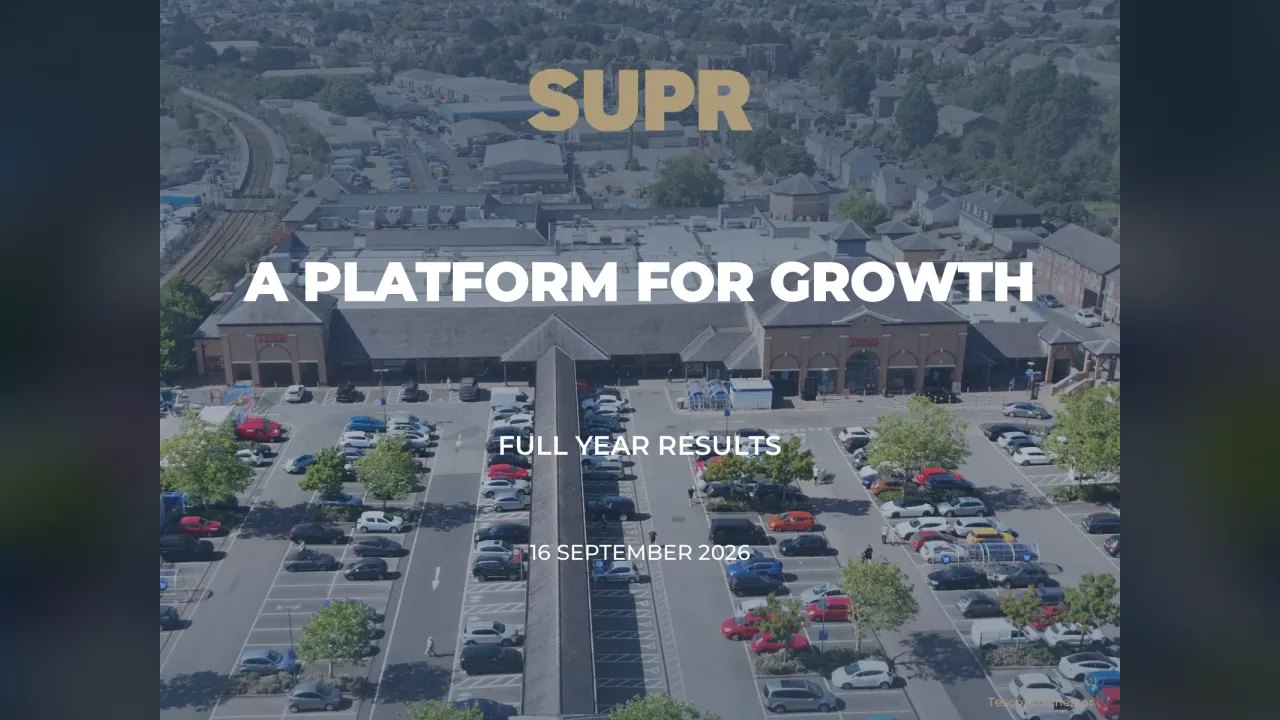
0:00 Good afternoon, and welcome to the SUPERMARKET INCOME REIT PLC investor presentation. Throughout this recorded presentation, investors will be in listen only mode. Questions and inquiries could be submitted at any time via the Q and A tab situated on the right hand corner of your screen. Please just simply type in your questions and press send. Before we begin, I'd like to submit the following poll. Now I'll hand you over to Robert Abraham, CEO. Good afternoon, sir. Thank you, and, good afternoon, everyone. Thank you for taking the time to join us. I've also got Mike Perkins, our CFO, with me. So, really, what we've been talking to in this set of results is establishing SUPER as a platform for growth over the last year, and beginning to deliver on that strategy to grow the business, and that is with a view to ultimately growing earnings and supporting our future dividend growth.
0:51 That's taken us now to 2,200,000,000 of gross value of the assets. We have scaled our joint venture in that time. So that 2,200,000,000 includes the 50% share of the joint venture we have. That number's up from 1,600,000,000 around a year ago. So as we've grown the portfolio, that has also been through earnings enhancing transactions, and that gives us now the capacity to increase the dividend for the coming year, by 2%. And that means that our dividend yield today, at the current share price is around seven and a half percent, and that is, of course, backed by very high quality income from the leading supermarket operators. So a very healthy dividend, and also the benefit now, that shareholders are seeing of that scale is our very efficient platform. So the cost ratio at 9.2%.
1:47 And with some of the latest growth we've been delivering, we think that 9.2% will well, we know it will continue to trend lower. So, this is all about delivering value for shareholders. And as we grow, shareholders will see the benefit of that. So just a quick overview of of how the portfolio looks today. A 140 supermarkets, 90% or so is in The UK still. So, by number, about 46 of the assets are in France, but they are smaller lot sizes, smaller value. Eleven year average lease length, 83% of our income is inflation linked. So get we get contractual rental uplifts along with inflation.
2:37 The portfolio is a 100% occupied, and around 75% of our income is investment grade. So very high quality, defensive income coming through on those attractive lease terms. And so it's been a highly active year of strategic progress for us. I've mentioned that we scaled the joint venture with Blue Owl. That's now at 855,000,000, and that was through a series of transactions in in different phases. That the scaling of the JV has released some capital, and that's, enabled us to make 676,000,000 of earnings accretive acquisitions since July last year. We've also been busy or Mike and the team have been busy undertaking a billion pounds of debt financings over the year, and that includes our debut public bond that was very well backed.
3:31 And then after the year end, we undertook some more proactive lease renewals, and that's proving sustainable rents, and we expect to be accretive, to total return. And then finally, we were delighted to raise a £100,000,000 back in July. The proceeds of that have now been fully deployed. And now this slide, shows it was a slide we had back in our interim results in March. Our ambition is to double the size of the portfolio, and at the top of the page is an illustration of how that portfolio might evolve as we grow. And you can see from 2,000,000,000 to 4,000,000,000, there's a way to a 10% allocation to grocery anchored retail parks, which we already own a number of those.
4:18 Also, 15% to European food stores. We're at 10% today. We see the range being broadly 10 to 20% in Europe. And then also grocery distribution, which was we bought our first logistics asset as in the our last in our most recent phase of deployment, and we see that being an avenue for potential growth in the future. But whilst we deliver that growth, we can maintain the attractive investment fundamentals of the current portfolio. So we expect to be around 90% grocery income. We expect to be around a twelve year average lease length, 80% or so being inflation linked, and 70% or so being investment grade. So, again, very high quality contractual long dated income.
5:07 And so we I mentioned we raised a £100,000,000 in July. That was our first equity raise since 2022. We've now fully deployed the proceeds of that in the space of just two months. And using those proceeds and the associated, debt financing, we've acquired nine high quality grocery properties for a total value of 222,000,000. 82% of that income is investment grade. 87% is inflation linked. And at a 6.6% net initial yield, that transaction is accretive to earnings and therefore also supports future dividend growth. And then lastly on this page, that scale also further reduces the already very efficient cost ratio that we have.
5:56 And to take you through a couple of examples of of what we've bought in that phase of deployment. So a Tesco store in Edinburgh on the left hand side there, large format, top performing omnichannel store, very much core product for us. Five years remaining on the lease and, at £33 a square foot, there's a good opportunity for us to renew that lease, in years to come, and unlock some value for shareholders. That way, in the middle of that first mission critical logistics warehouse that we've acquired, brand new build, Sainsbury's down in Avonmouth near Bristol. And with that brand new build, the tenant has also made a significant amount of capital investment in the fit out of that property. And then lastly, on the right, an M and S anchored retail park in Nottinghamshire.
6:46 This is an interesting opportunity because we've got, an upcoming open market rent review. And in that, we see some strong evidence to support pushing up the rent at that next review, particularly based on, some of the evidence showing from the home based stores that went vacant and being converted to food stores. So I'll talk some more to that later. But we've been clear then on the ambition to to grow the portfolio, and we've got a variety of capital sources to deliver that. So I've just talked to equity raising, and how we've just successfully done that, but also through joint ventures. And their benefit there is additional management fee income. We've also got really strong liquidity in the debt markets, and then also, capital recycling. So that can be outright store sales as well as potentially establishing some new joint venture vehicles.
7:41 So with that, I will let Mike talk through the numbers. Brilliant. Thank you, Rob. Good afternoon, everyone. So it has been an extremely busy year full of activity, and the the point for us is that activity has been designed to strengthen the business and and position us for future growth. So if I take you through some of the highlights, and then we'll go through them in more detail later on the slides, but at a headline level, 122,000,000, net rent income is up 6%. We've seen the EPRA cost ratio down to 9.2%, which is down three eighty basis points since the prior year. EPRA earnings was 5.7p, down 4%. Portfolio value of £2,200,000,000, we said that's up, 37% since, June 25.
8:32 A 7.5 NAV per share, which is marginally higher than June 25 at $8.7.1 pence. But total accounting return, strong at 77.5%, and that is income driven. So turning through the slides in slightly more detail. This chart on the left there just shows how active we've been. This, the first bar is the passing rent immediately prior to our, completion of the joint venture back in May last year, passed around of 117,000,000. And you can see, the, income that we've, lost, I guess, through the sale of assets into the JV, reduced pass through by £21,000,000.
9:17 But in those two boxes next to it, we've we've deployed 454,000,000 of capital in in this financial year, which started about £31,800,000 of of new of new rents. And that acquisition deployment was at 6.5% net initial yield. And then we've continued to see like for like growth in the portfolio to adding the further £2,100,000 to passing rents. And then looking forwards, the impact of the equity raise post year end, you can see another £14,800,000 of passing rents. So our pro form a today is 144,300,000 But those boxes on the right are still hugely important. We've got a really highly secure and efficient income profile, another period, again, of a 100% occupancy and rent collection.
10:09 75% of our income is underpinned by investment grades, covenants, and we have a sector leading 99.5% gross net income ratio. So really, really efficient, structure. And and what we've shown here is is the value that we've been able to create through the capital cycling. So we have transferred £635,000,000 of assets into the JV. And that chart on the left there, you can see we dispose of those at an average disposal yield of 6.2%. With the net proceeds we've received, we've recycled that into high yielding assets. So we've deployed at 6.8%. But the the kicker you get with the management fee on top of that creates a a spreads to our initial, of about 120 basis points.
11:02 And then what we've shown on the right there is how this translates into into earnings, and this is the annualized impact, on net income. So you can see the the the, assets that we've been acquiring out will more than offset the income we've lost, and then that additional management fee should give you about 0.3 p of additional earnings on an annualized basis, which is broadly about 5% on dividend cover. So, that should drive future earnings growth. And we for selling it into the JV, we still retain that 50% exposure. We've been recycling proceeds into high yielding assets, that recurring management fee, all driving future earnings growth. And then part of the the rationale for internalization was to create, a really efficient structure that was more aligned.
11:54 And we've shown on the left here the progress we've made since internalization, and that sort of 13.6% was the last reported cost ratio prior to internalization. You've seen that come down to 9.2% today, and that that is broadly around £4,000,000 of annualized cost savings. We are very much on target to deliver our sub 9% cost ratio for the next financial year. And we have been investing in the teams. We've made some hires into senior hires this year, but certainly future growth should be very, very, efficient for us, and not having to have, that low incremental cost. So you'd expect that 9% come down as as as we scale.
12:42 And then just going through our earnings here, so 4% reduction in EPS as we were redeploying the capital that we received following the JV and as we strengthen the balance sheet. So on the left there, you can see the cash drag on the assets that we transferred into the JV, reduced EPS by $3.03 0.3p. The increase in waste average cost there is largely due to our debut public bonds, which reduced earnings by 0.4p. But whilst that had a an initial impact on EPS, it has materially strengthened the balance sheet. We now have longer maturity profiles. We've got more diversified funding sources and increased the proportion of our debt that's fixed rate. And so then that was done at 5.125%, which was relatively attractive pricing.
13:35 But what we've shown in those three bars on the right, the the benefit, the management fee, the like for like net rents coming through, you can see it added to 0.1p respectively. And then that lower that cost savings driving earnings growth as well, which added another 0.2p. So whilst EPS is marginally lower for the year, we have positioned the business to operate in that higher interest rate environment, and expect to certainly see earnings growth coming through from next financial year. And then turning to the balance sheet, we continue to deliver the income led total return. The, the bar chart on the left there just shows the bridge in our, per share, over the year. So as as of June 25, our at per share was $8.7.1 pence.
14:23 We've debt per earnings, which were 5.7p. We paid dividend of 6.2p in the year and revaluation realized, unrealized gains. Our valuations were up on a like for like basis about 2.5%, and that translates then into about 2.8p of NAV growth, which has been partially offset by acquisition related costs as we have been acquisitive in this year. So NTA marginally are up by 0.4% to 8.7p a day, but a a 7.5% total accounting return. What what we wanna draw out on the right hand side here is this is, really what differentiates SUPR is is the quality of that return. So you can see SUPER's total return is broadly 90% from income, which is backed by investment grade covenants, and that is versus a a sector average of around 57%.
15:18 So what that means for us is that our returns aren't reliant on valuation movements. They are, certainly very resilient, and definitely, for us, a more reliable source of long term returns. And as Rob mentioned at the start, we've been very busy in debt capital markets, done approximately GBP 1,000,000,000 of refinances in the year. And what we've shown on the left there was our maturity profile as of June 25, where maturities were far more concentrated and our average, maturity of two point eight years. And the activity we've done since then, which includes our debut bond, include the refinancing of the RCFs that we undertook just after year end, We've improved that maturity profile to three point six years despite the passage of one year's time.
16:07 And importantly, no refinancings until June 28. And the refinancings that we did in the RCFs, we saw some, some healthy margin improvements. So our average cost of debt today is around 4.4%. 98% of that is fixed or hedged until June 28. So, we we can withstand any near term volatility in interest rates. We are well placed to to deliver that kind of earnings growth on that minimum 2% dividend target. And what is absolutely key for us is maintaining that BBB plus credit rating. We we've shown on the left there, we will manage LTV through the cycle. So post deployment of the equity raise, we are at 45 leverage, but we will still maintain a significant amount of headroom in our in our banking covenants.
17:03 The viability assessment would show you'd need to see a fall in valuation of about 27% before you sort of in breach of of a covenant. So we we we'll monitor that, but equally, we give equal prominence to net debt to EBITDA, which is something our rating agencies will look at. And our 7.8 times, net debt to EBITDA was is below the you know, significantly below the rating sensitivity and what you would expect to see as you get the full year's benefit of income from the assets we just acquired. We we would be operating at the lower end of that seven to eight times target. So, yeah, look, we're well placed to deliver our strategy. We have successfully deployed capital, completing £676,000,000 of earnings enhancing acquisitions.
17:55 We've built a scalable platform with one of the lowest cost ratios in the sector, and delivered a 7.5% total accounting return for this year, which is underpinned by highly secure investment grade income. And I'll hand you back to Rob to go through the market investment update. Thank you, Mike. So, look, omnichannel grocers continue to dominate the grocery market, and we have Tesco as our largest tenant on the left hand side, and we are Tesco's largest landlord. Their total revenue is £44,000,000,000 a year. Their market share in The UK is 28%, and that increases to 37% in the online channel. And at the strap line at the bottom there, omnichannel gross is the best place to win through scale.
18:44 And not only that, it's the scale of their large format store estates that cannot be replicated, that are a very high barrier, for other, operators to compete with. And so what we're seeing is omnichannel stores capturing the majority of sales growth. So on the left hand side, online is growing at double digits. This is from Tesco's full year results. The last two years, you can see that online growth very strong, and that gets fulfilled through the store networks. And it's the stores that we own that provide that, and then the large format stores that you combine online with. So in store sales in large format stores growing around 4% a year. And so and in that same time, convenience has been broadly flat. So omnichannel stores is where is the main driver of the growth.
19:33 That means it's profitable growth for the operators because they're not having to invest in creating new space to capture that like for like growth. Now the reason why consumers prefer these large format stores is because they provide better value and greater choice. And on the left hand side, Tesco Express, if you do your weekly shop there compared to in a large format store, the annual savings about £800. So on the right hand side, items in a large format store are often 10 to 20% cheaper. You get a much larger product range at 20,000 to 30,000 products. And not only that, the chance of the product you want being in stock is much higher at 91% plus, compared to 82% in convenience. So, what we're therefore seeing is that our portfolio level and so this is an example. This chart is the sales data from one of our stores in our portfolio.
20:32 We're seeing that, turnover grow over the last three years by 18%, and the rents are up only 12% in the same period. So that means the rent relative to the store turnover, that ratio has improved from 4.1% to 3.9%. And that means that as we get those contractual uplifts that you can see in the rent on the chart there, as we get those uplifts, it's absolutely affordable for the tenants. And now the omnichannel stores we we own are also great drivers of footfall. This is one of the retail parks we own in Bristol. We are extending and building a new little on the retail warehousing terrace. It's got a twenty year lease. It's got inflation in rent reviews, and the yield on cost is very attractive at 8%.
21:25 So this is just one of the ways we're able to actively manage the sites and drive value. And if we zoom in then on that retail warehousing lineup, what you can see is that we had Argos, which was paying rent but wasn't trading from the site because it relocated into the nearby Sainsbury's, and therefore that Argos, at the end of the lease, would have gone vacant. And then also concessionary lettings to one beyond and pound stretcher. So we combined those two units in the middle to create a new B and M on a ten year lease. We also renewed the Boots lease for five years. So that combined that with the Lidl, we've now got a 100% occupancy. We've added six years to the average lease length. We're now full of national retailers.
22:12 The rental income is up £400,000 a year, and we've also seen a or expecting a 10% valuation increase. So, very attractive returns, and this is just one of the ways that we can where we have greater site control that we can extract value. We also renewed two leases in July. Now these stores, large format, top performing omnichannel stores, reset the term to fifteen years in each case, so extensions of nine years and eight years respectively. In one case, the rent came down 15%, but, the other store renewed at passing rent, so the average reduction across the two was 7%. And worth noting that there were no, normally, you'd might get in other areas of commercial property, you get a rent free period.
23:05 So for a fifteen year term, that could even be eighteen months plus of rent free. There are no rent free periods here. There are no landlord capital contributions. So, and through these lease renewals, we expect the valuation of the properties to go up, which enhances our total return. And then aside from where we're renewing leases, we're also seeing, and I mentioned this earlier, the evidence where home based stores have been converted into new food stores. M and S particularly taking some of those. Sainsbury's also took 12 of those new twenty year index linked leases being signed at £24 and £28 a square foot. That is starting to feed into open market rent reviews, and there's a Waitrose example in Surrey where that store has seen a 16% uplift to open market review as a result of that evidence being seen elsewhere. So, in that context, our current rents are very much affordable, £23 a square foot, average rent to turnover of 4%, very affordable.
24:11 The investment markets, just some interesting data points that are being seen. We didn't buy these. They were bought by what you might call core capital, Sainsbury's in Hertfordshire with open market reviews of 5% net initial yield. That, has a fifteen year lease. And at 5%, it means the purchaser is expecting open market growth under the open market rent reviews. Also, Lidl same leaseback priced at a 4.8% net initial yield, so a very strong yield, relative to where you might see, the the the cost of money today. And then lastly, at Morrison's in Plymouth, twenty two years on that lease, 6.1% on the yield. So you get a bit of a discount, a bit of additional yield to reflect, the fact that the tenant is sub investment grade.
25:02 And so the point for us is we we looked at those opportunities, but we've seen better value elsewhere in the investment market. So we've, executed 676,000,000 of earnings accretive acquisitions across a range of strategies you can see on the page. And I mentioned earlier, as we grow, we can maintain the attractive fundamentals. So set a six and a half percent net initial yield, so it's accretive, thirteen year average lease length, 94% of the income is inflation linked, and 74% is investment grade. So, as I say, very much, supporting those attractive portfolio fundamentals. So in summary, we're well positioned to continue to grow from here. It's been a highly active year of significant strategic progress for us. We've been delivering on the business plan and the strategy that we set out.
25:55 We're also targeting a strong total return that is backed by high quality income. Of course, Sainsbury's, Tesco, investment grade type operators on long leases, with inflation linkage. So very much an income based return profile, which is very defensive. And we've also got these very interesting multiple avenues to grow and drive shareholder returns, across those different strategies. So thank you for listening to the presentation. With that, we will turn to the questions. There's one here which I think you talked to, but worth just being clear on percentage dividend cover for this year and where you expect it to be going forwards. Yeah. So dividend cover for this year was 93%.
26:42 For the reasons we set out, there was some cash drag as we were redeploying the capital and and the this uptick in debt costs as we, execute our bonds, and our financing strategy. But in terms of where where we are staying, they were kind of one off impacts. So we would, and as we messaged in our equity raises that we'd expect to be fully covered from the first full financial year after the equity raise, analyst consensus will have us very close to dividend cover for f y twenty seven and fully covered thereafter. So for us, the reason why we were talking to that sort of minimum uplift in our dividend guidance it is the key for us is that the dividend is sustainable. So 2% for us today is a sustainable dividend that we know we can cover with earnings, and then the kind of the next job because that that sorry. There's a question here around our dividend policy.
27:36 Is that sort of guidance of 2% is the minimum target now? Our job is to try and grow it by more like what we're getting at the top line in terms of inflation and passing that through. So, we've a lot of the work we've done this year is designed to kind of get that put get back to the point where our dividend is covered, and which we've we've done. We've shown that, and we'd expect the cover to come through in the next year next one, actually. Thank you, mate. I will take the the next one just about any evidence the top tier operators are looking to accelerate their efforts to own more of their own stores. So we continue to see Tesco buying individual stores in. They don't buy everything, but it does just give good evidence of exactly how strategically important these stores are to the operators. So Tesco bought about seven stores in the last year, so continues to do that. Sainsbury's, don't buy individual lots in the secondary market, but they did buy a joint venture back from us a few years ago.
28:39 So, yeah, very much proving, the strategic importance of those. There was a question, about our ambition to double in size and what time frame this might be on. So, look. We deliberately haven't given a time frame because the ambition to double in size, is an ambition, but it's not for the sake growth for the sake of it. It needs to be accretive. The numbers need to work, and, therefore, we will only grow if it makes sense to do so. That said, to double in size, we need to grow by £2,000,000,000 of assets. In the last year, we've acquired 676,000,000. So it gives you a sense that it it it in in the right environment, it it may take as little as two to three years, but it's it's certainly, we'll we'll need to stack up to do that for us to make that decision. Mike, maybe to you to take the second point of do you expect any material increase in leverage?
29:42 And then there's another related question just around what would need to happen for us to be under stress on the debt covenants. Certainly. So so as as we showed, leverage today is 45%, and I think that is probably more of a an an upper limit for us. It might be that if we wanted to execute a transaction that we might drift a little bit higher, but we're always looking to bring it back down to kind of 45% and below. As and as I said, we we do look at leverage in terms of maintaining that kind of covenant headroom. So if you look at the valuation reduction in order to breach covenant, it's about 27, 28%.
30:30 And you haven't you know, the last, post the mini budget, SUPR's, property values fell by 14%, and that was, certainly since then, we've seen our valuations broadly flat. I would probably add to that that we have sold, into the JV £635,000,000 of assets. They've all been at a premium to the prevailing book value. So we're very confident in where our valuations are. And then, obviously, we look to that kind of net debt EBITDA as well as another key key rating for us, and at low sevens, again, operating, with with significant headroom to our to our credit rating covenants. So we feel comfortable where we are today. But, yeah, I don't think you'd expect us to take leverage, materially higher where it is today.
31:17 Thank you, Mike. I will take the next one just about European food stores, which tenants in countries other than Carrefour, and what's our thoughts on concentrations Carrefour in the portfolio. Look. We are it took we did twelve months of work before we went into France. We need to make sure we really know our stuff before going into a new market. There's lots of considerations around structuring and tax tax aspects. So, we're working on that at the moment. The geographies that maybe seem more interesting or more likely at the moment would be Spain, Portugal, Ireland. The maybe bees would be Italy or Germany.
32:02 It really depends as well on the pipeline. A neat new geography way to go into a new geography may be to do it with an existing tenant. So, we would be open minded to say Carrefour in Spain perhaps, but it's early days on that front. We're certainly not rushing into it. You also saw our most recent raise in deployment was all in The UK, so the pipeline remains very strong in The UK as well. There's a question about the equity raise and why retail investors weren't given longer to participate. And, look, there's there's a a point here around when we raise capital in the current environment. The and and the the retail investors were given the same amount of time as the institutional investors, but it is a reasonably short window.
32:53 We were very pleased. We got about £10,000,000 of backing, so around 10% of the raise came from retail money. That, came through a retail book, which works with all of the major platforms. So the likes of Hargreaves, Lansdowne, AJ Bell, etcetera. And what I would say is you you just need to make sure you have the alerts on. We but in the current environment, we used to raise and keep the window open for two weeks at a time. But with so much macro volatility, you just don't know what's going to happen day to day. So we we we we just had to keep it reasonably short, which is the way the market has gone. That isn't to say it will always remain that way going forward. But, yeah, I would ask that you make sure you've got all of the alerts set up both to when we issue RNSs or or with the retail platforms to to give you the best chance of being able to participate.
33:55 Where next? I'm just Mike, there's CapEx. Yeah. So it's a question around how much CapEx we're investing in in new Liddell development. Now it it will be low single digit millions. We haven't in we had it was more of a forward funding, arrangement. So we haven't actually spent any money yet. We've got a commitment to buy it. We expect that to go in sort of, early next year. So it's it's sort of low single digit millions. The point of the little thing for us is that it's it's managing our estate effectively. So they're never gonna be massive needle moves in terms of capital we need to deploy or, impact on the wider portfolio, but it's just being being efficient and driving in a way where we can. So, yeah, sort of low single digit millions.
34:47 Thank you, Mike. Do you see the installation of car park solar similar to the 50% rule in France as a potential driver of cash generation not currently utilized in The UK market? So, yes, certainly, we know the operators are looking at carport solar, bearing in mind of our supermarket site, the car park is probably 75% of the whole site, and it it should be easier to put solar above car parking spaces maybe than on the roof of the store itself. So, yes, I think we will see that over time, particularly as solar panel technology has gotten better. There may well be an opportunity for us to fund some of that for the tenants. It depends, really. But, yeah, it's it's all a positive in that respect.
35:36 There was a question around, has the Jersey listing been positive for the company? Certainly, last year, we saw the Jersey register get to about 4% of our share register, which means we had 4% of share buying at a time, when, real estate markets were were or The UK listed real estate market was was, I think, fair to say, tough. So having a market that moves in different directions or in different ways to our core UK market is quite helpful, to have that, that ability to transfer shares into the JRC. Mike, do you wanna take the one on indexed, rent reviews? Yeah. Yeah. Certainly. So a question around kind of our our the the ability for us to capture inflation when if it exceeds materially the, you know, Bank of England's target. So, yeah, look, The the typical lead structure for us is there will be a cap and a collar.
36:38 Our average cap is 4%. So, yes, look. In periods where inflation runs ahead of that 4%, we don't capture all of it. But what that would mean and what we've seen in the past is that, you know, store level, performance will improve. So whilst you don't get all of the inflation capture, it makes our rents more affordable at the the sort of rent relative to turnover metrics. So, we'd expect to kind of as we said, it's it's not a bad thing for us. The one and four is is typical in these in these lease structures. And if there was a spike in inflation, we've seen in in previous, cycles is, yeah, it is momentarily, an increase, but it just makes our rents more affordable. So therefore, it pushes rents on for us.
37:25 So, yeah, hope that's answered the question. Thank you, Mike. That is all of the questions. Thank you all for taking the time, and thank you all for the support. We're very much, active on our plan to grow, but as we say, it needs to be accretive to shareholders. It needs to be driving value. But the pipeline's interesting, and we think there are opportunities there that will deliver value for our shareholders. And we've got various routes for funding that pipeline. So, I guess, watch this space, really. Perfect. Thank you, guys. Could you please ask investors not to close the session? It should now be automatically redirected to provide your feedback. On behalf of the management team of SUPERMARKET INCOME REIT PLC, we would like to thank you for attending today's presentation, and good
Follow Supermarket Income REIT PLC into a list and get an email when it puts out news.
CEO at SUPERMARKET INCOME REIT PLC
CFO at SUPERMARKET INCOME REIT PLC