Robert Abraham
CEO at SUPERMARKET INCOME REIT PLC
Replay available
Results for the six months ended 31 December 2025 hosted by Supermarket Income REIT (LSE:SUPR) on Investor Meet Company, held 2026-03-13.
On 6ix: 6ix.com/event/supermarket-income-reit-plc-supr-results-for-the-six-months-ended-31-december-2025
Automated transcript · Written by software from the replay's audio. It can mishear names and figures; the replay is the record.
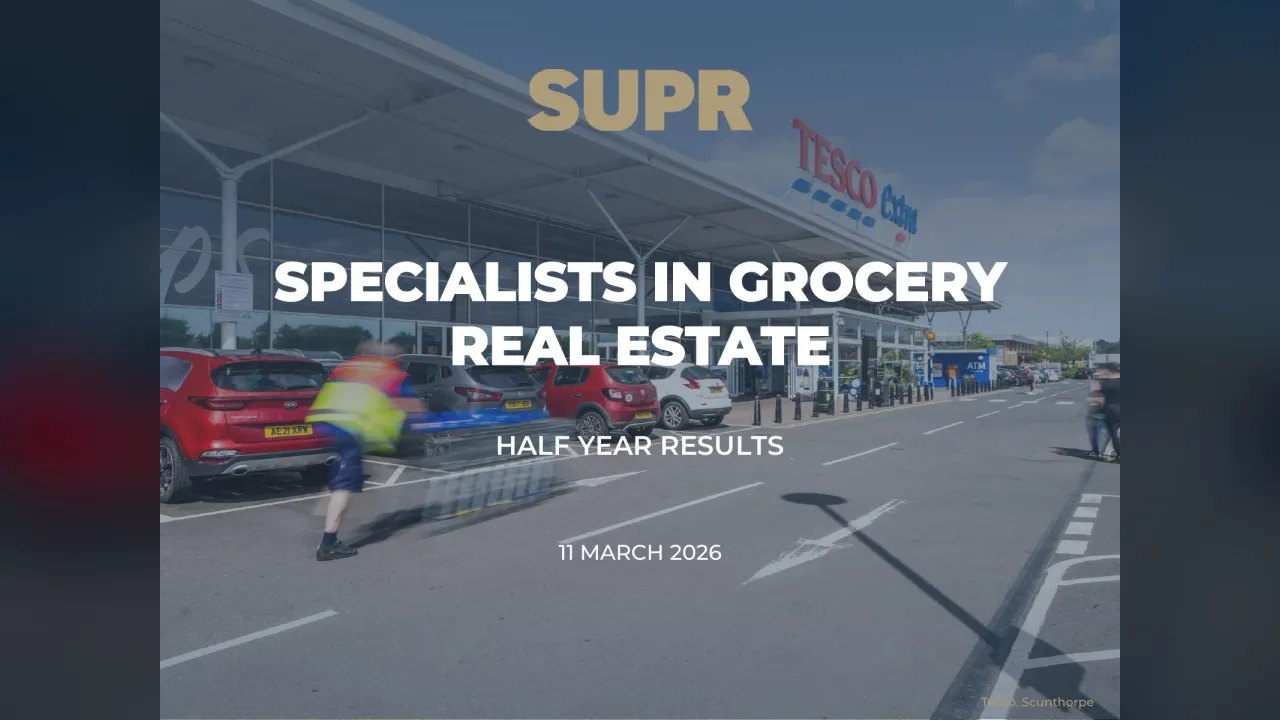
0:01 Good afternoon, and welcome to the SUPERMARKET INCOME REIT PLC Half Year Results Investor Presentation. Throughout this recorded presentation, investors will be in listen only mode. Questions are encouraged, and they can be submitted at any time using the Q and A tab situated on the top right corner of your screen. Just simply type in your questions and press send. Before we begin, I would like to submit the following poll. And I would now like to hand you over to CEO, Robert Abraham. Good afternoon to you.
0:28 Thank you, Alex, and afternoon, everyone. I'm also joined today by Mike Perkins, CFO. I will give you a brief strategic update about our growth plans first, and then we'll also hand over to Mike to take you through your numbers, and then I come they'll come back to me to to cover the market as well. And at the the the last, well, year for us has been about significant levels of activity, and that's all been about delivering on our strategy to grow earnings. The shareholders are now seeing the benefits of this as we've increased the minimum dividend uplift target from the next financial one year onwards to 2% per annum. And we're also positioned for further growth. So we've got an attractive near term pipeline of over 500,000,000.
1:19 And then just to take you through some of those proactive steps we've taken over the last year to create a platform for growth. So we've achieved much greater shareholder alignment, and that's through the internalization of management. Shortly after that, we completed our joint venture, and that's allowed us to undertake capital recycling, also generating management fee income. And during the period, we've scaled that joint venture out to 845,000,000, and that's really demonstrating our access to capital alongside the debut bond issue that that Mike will talk to shortly. We've also established a cost efficient and scalable platform. We now have a net per cost ratio of 9.2%, and that will continue to trend lower as we grow.
2:04 And we will be firmly among the sector leaders in that regard. And then to support this future growth, we've also been making investment hires. And just to take you through a couple of the the more more recent names that we brought into the business, you've got a depth of grocery, property expertise. So on the left there, Jamie Cowan, strategy director, thirty years in real estate, but the majority of which was in was with Sainsbury's. And that obviously, is hugely valuable to us as we look to underwrite opportunities both in terms of store formats all the way from convenience out to large format omnichannel, but also in terms of distribution and logistics and also in terms of driving value through rent reviews and and driving rental growth in the business.
2:56 And then on the right hand side, Justin Upton is head of investment. He was most recently chief investment officer at Urban Logistics, and so had worked with Mike in his previous roles.
3:09 And prior to that, had been a fund manager that invested in a diversified portfolio that included food stores and grocery anchored retail parks. So very much adding to our expertise and our specialism. So we've doubled down on that sector specialism. We now have a dedicated team of 18 across investment, asset management, finance, and investor relations. And, really, that is allowing us to underwrite opportunities for growth across grocery real estate. So in the left hand columns, there are UK food stores, and you can see that range of formats, and operators that we're working with. And we've got exposures there already, of course, but it's really about buying mission critical top performing food stores.
3:57 And sometimes that comes with adjacent retail. So what we're really talking about there is grocery anchored retail parks, and we have a number of those in the portfolio as well. And we absolutely have the in house capabilities not only to manage that, but also maximize returns. And then lastly, European food stores, which we've also taken to scale with our latest tranche of same leaseback with Carrefour. So, just as an example on the bottom of the page, some of those, operators leading operators that we see opportunities to work with. And so with our our plans to grow, we do have ambitions to double the sort the size of the portfolio in time. We've deliberately not given a timeline on that, because it would be opportunity led, but we are what we're talking to is being able to grow, but all the while maintaining those attractive investment fundamentals.
4:50 So 90% or so grocery income of which, with long leases on average of twelve years, 80% or so, being inflation linked, and then also that high quality of income, which is absolutely key to our, investment strategy being at 70% or so investment grade. And then along the bottom of the page, we've shown you an illustration of the portfolio evolution as we look to Dublin size, and you can see the core driver of the business and our growth will still be UK food stores, but with an allocation as we already do to grocery anchored retail, also to European food stores, and we're saying long term that will be 10 to 20%. But then the new addition there, that grocery distribution, and this is about where we can best allocate capital, and it will come down to where we can deliver the returns. But as we've shown on the previous pages, we've got the team, we've got the expertise, and we've got the relationships to deliver on those, and be able to underwrite and execute on anything in the grocery property investment universe.
5:59 So, yeah, that's an introduction of strategic overview. I'll I'll hand over to Mike to take you through the numbers. Great. Thank you, Rob. Good afternoon, everybody. Yeah. Look, as as Rob said, it's been an exceptionally busy period for the company. We've delivered against a number of our strategic initiatives, which are all designed to help support future growth for the business and ultimately to create long term value for our shareholders. But as expected, some of those have had a short term impact on earnings, but they do put us in a much stronger position in terms of the company's foundations and fundamentals to deliver ultimately sustainable returns. So if we start with the financial headlines, we'll go through each of these in greater detail as we go through the presentation, but the headline figures GBP 57,000,000 in net rental income, down 2%, pleasing to see the EPIC cost ratio of 9.2%, which is a reduction of four forty basis points period on period.
7:02 Dividends increased by 1% to 3.1p. And that bottom left there, 2,000,000,000 portfolio, which is a 20% increase since June 25. As you so you can see the activity that we've delivered in the periods. And then also pleasing to see a return to NTA growth, 8.7.5p, up 0.5%. And then that combined with dividends paid in the period, so you can see a 4% total accounting return, obviously, notwithstanding the fact that we've obviously been extremely acquisitive in the periods, but certainly see 4% being pleasing. And for us deliverable to certainly target somewhere between eight to 10% ongoing in terms of our total accounts and returns. So if we look closer on in the income statement, as I said, 2% reduction net rents income that's principally the principal driver of that really is around the timing gap between when we completed the joint venture back in May 25 and then the subsequent redeployment of the GBP 200,000,000 net proceeds. So if we start with the chart on the left, operationally, a strong period for us, 2019 rent reviews, 3.8% like for like uplift on an annualized basis.
8:20 And what we've seen and what we've said previously is that the rental income we generate will offset any regears. And obviously, we did three lease regears. There was about 8% of our rent roll at the start of 2025. So you can see the review income more than offsetting the rent reduction from those lease figures. Our per like for like net rental income was one percent for the periods. And you can see acquisitions added 6.2p, but that was offset by the disposals or transfer of the stores from our balance sheet into the joint venture, obviously, the cash drag on those. Now we used to have a highly secure and efficient income profile. It's another period where we've reported 100% occupancy and 100% rent collection. Pretty importantly, as Rob mentioned, terms of our investment fundamentals, 76% of our rent roll is investment grade and 99.5% gross to net rent ratio is one of the highest in the sector. So our gross rent is effectively our net rent.
9:24 Looking in greater detail, our admin costs, over GBP 2,000,000 of cost savings achieved in the first half. It's a 32% reduction in admin costs versus the prior periods. And what you can see from that chart, at 9.2%, our equity cost ratio now puts us firmly towards the low end of the peer group. Now what we are expecting is our target of being sub-nine percent, we very much are on target to deliver that for FY 2027. And obviously, as we scale the business, there will obviously be we are an efficient platform, so you should be able to see that cost ratio drive lower as we are able to as and when we're able to scale the business.
10:10 So looking through EPRA EPS, 2.7 for the half year versus GBP $3.00 in the prior year. And this just takes you through what are the key drivers of then, as I've spoken to on the slide previously, the transfer assets into the joint venture has led to a 0.2p reduction in EPS. And you can see in that middle column, the fee income we've generated plus the cost savings we've delivered have offset the increase in cost of debt, that 0.3 there. But that was for us, that was a proactive decision back in July to issue our debut bonds where we saw very favorable pricing for six year money and the opportunity for us to term out some of our debt stack at an attractive rate was something that we believe was firmly in the interest of our kind of medium term ability to deliver sustainable dividend growth. And finally, 0.1p just principally due to an increase in weighted average drawn debt versus the prior periods.
11:16 But at 2.7p, our dividend cover was 88%, absolutely in line with consensus. If you look at consensus for the full year, has us around sort of low 90% and then returning to full dividend cover from FY 2027 onwards.
11:35 And 20% increase in our portfolio value. Obviously, we've been very, very acquisitive in the periods. So you can see, if we look at that chart, the left hand columns there, $398,000,000 of capital that we've deployed at an attractive 6.5% net initial yields. And then what we've seen in our revaluation at the half year, 7,000,000 of net valuation surplus, that is a 1.3% like for like growth, which is 90 bps favorable to the MSCI All Property Capital Growth Index. And you can see post period ends, we've reflected in here the transfer of five stores into the joint venture, of which four have completed, and we expect the fifth to complete imminently.
12:21 And then we've made a £9,000,000 acquisition to give a portfolio value of just under £2,000,000,000
12:32 And looking at our per share, as I said, pleasing to see a return to growth of 87.5 p versus 87.1 p at June 25. And here, see, we are per earnings of £2.7 offset by 3.1p of dividends paid in the periods and then revaluation gains more than offsetting the acquisition costs. But importantly for us, that 4% toast accounting return is 88% of that is income, and that is underpinned by investment grade covenants.
13:08 So looking through turning to kind of how we fund the business from the debt side, we've been busy also in the debt capital markets diversifying our funding sources. Our maturity profile, which is set out here, our debt maturity of three years. There has been a question that's coming around near term refinancing. So if I potentially cover that one off here, you can see there's GBP 180,000,000 of debt refinancing in FY 2027. Obviously, only GBP 105,000,000 of that is drawn. And we expect to refinance that imminently as we look to put some secured financing in our joint venture. The proceeds of those will be used to pay down that facility that we've already pre hedged the facility in the joint venture, and that would be around a 5.2% cost of debt.
14:02 In FY 2028, there is we have GBP $450,000,000 of debt maturing, $284,000,000 benefits from extension options, which would push that out to FY 2020. And as I said, particularly pleasing in the period where we were able to issue our daily bonds, $250,000,000 at six years tender at a 5.1% coupon, particularly pleasing for us. So you can see on that right hand column, we've got over £350,000,000 of debt that had a ten or just over six years and fixed cost of debt of 5%. So very attractive from our perspective. And what we've been keen to do, you can see in the top right, the debt composition now, nearly 40% of our drawn debt is in the form of bond issuances and private placement notes, which just gives us access to a much greater pool of capital as we look to grow the business.
14:56 And importantly for me, it gives us the ability or flexibility to access different markets when the rates are favorable, we demonstrated with the bond issuance back in July. Weight average cost of debt, 4.8% today, very much now largely adjusted to the market rates. And looking at kind of our exposure to interest rate volatility going forward, 92% of our drawn debt is fixed or hedged. I'll expect that to go up to 100% in the next couple of months as we finish some refinancing work within the joint venture. And certainly, our we are very confident in our medium term weighted average cost of debt being sort of around 4.7% to 5%. The earliest hedge matures in June 28. The vast majority of our hedges are rolled off in June 29. And we have that some extend out to June 30. So we have mitigated our risk to volatility in the interest rate markets.
15:54 And we expect to have a higher degree of confidence in where our near term debt cost sits. And we remain absolutely committed to our BBB plus credit rating. You'll see on the chart on the left, we look at our leverage through two different lenses. We look at loan to value. Obviously, that's what all of our banking covenants are assessed with, but we also give equal prominence to net debt EBITDA, which is where Fitch, our rating agency, will give equal prominence to those two metrics. And we decided to take leverage to 43%. We wanted to we had a high degree of conviction in our pipeline. And ultimately, pipeline is scarce resource and we wanted to transact on those. So we've seen the leverage go up to 43%.
16:45 We wouldn't be taking leverage any higher than 45%. At this stage of the property cycle, we're very comfortable with that level of leverage, given that our income is backed by 75 investment grade covenants. We've got a significant amount of headroom in that loan to value before we were getting we'd ever get close to our covenants. And equally on the net debt to EBITDA, pro form a 8.2 times, we'd expect to see that come down to the lower end of seven to eight times within the next twelve months. And again, significant headroom. So you can see the rating sensitivity there of nine times, anything above nine times will start to put pressure on that BBB plus rating. So obviously, we're not going to do anything that would put our BBB plus rating under pressure, and we'll at all times be prudent and make sure we've got sufficient headroom in all of our covenants.
17:42 So as to summarize the financial performance for the half year, delivered material cost reductions, 32% reduction in overhead costs. We've made earnings accretive acquisitions, deploying GBP $398,000,000 of capital at a 6.5% net initial yield. And I'm very pleased to upgrade our dividend guidance to minimum 2% per annum uplift from FY twenty seven onwards. And I'll hand you back to Rob to go through, the market investment. Thank you, Mike. So UK grocery is one of the the world's most competitive grocery markets. So we've continued in this environment to see Tesco's and Sainsbury's growing market share.
18:27 That is coming from existing floor space. So we're seeing impressive sales growth on a like for like basis, which is great news for us as a landlord. It means the stores we own are seeing improved performance, and that supports, higher rents ultimately. Asda, still very much the third largest grocer in The UK, but we are seeing, a continued loss of market share. But there is a clear turnaround strategy, a new leadership and management, that is implementing that, and that they have the time to to do that. The only other name I'd maybe call out on this page particularly was Lidl, which has had impressive market share growth, but that is, of course, driven by new new store openings.
19:15 And I mentioned some of us there's challenges there, and we did we did buy a further 10 stores. This was 10 stores that we selected out of portfolio of 20, and it was into our joint venture with Blue Owl, and I'll come onto the the JV, in a moment. It was an accretive 7.4% net initial yield, and it's a direct selling leaseback with the operator. But as ever, the the absolute focus for for us is on strong trading established grocery locations, and you have that here with an average of twenty three years of trading history. And that means with these, the asset selection, we're absolutely confident in the alternative occupied demand. These are mission critical assets with low competition.
20:02 We also have set the rents very low at £19.90 on average per square foot, and that is highly affordable relative to the turnover performance of the stores.
20:13 And we've also got attractive lease terms of twenty five years with annual inflation linked uplifts. And it's the combination, the bottom left box here, the capital value per square foot, the combination of those low rents and that 7.4%, wide net initial yield means that the capital value is only £250 per square foot, and that's below replacement cost. And, also, if you had Tesco or Sainsbury's on the exact same lease terms and the same rents, that would be more like 4 to £500. So you can see the value we've been able to extract, and it's a great deal for us. And we we would be very keen to do more if if we get the opportunity. And it's the scarcity of new food store locations that supports demand from other operators.
20:59 Examples here on the left, Wolverhampton, over forty years, history of trading as a supermarket under multiple different grocers. And to to go through some of the history of this, 2004 was when Morrison's, merged with Safeway. The competition commission then mandated that a number of stores, had to be sold off by Morrison's. Waitrose, took 19 of those at the time, and that that this store was included in that 60,000 square foot Waitrose. They traded from this site for fifteen years. Ultimately, it was just oversized for a premium operator in that catchment. But in 2020, Tesco bought the site from Waitrose, and we know that Tesco have been looking to get into that catchment for twenty five years. So the point here is a strong food store location simply doesn't go vacant.
21:53 And then on the right hand side in that, demonstrating how difficult it is to get new grocery space was the deal that Sainsbury struck, to take 12 home based stores prior to the administration. So this provided a rare opportunity to get new floor space and that Sainsbury's paid a premium, as long as well as paying the conversion costs and also, having to apply for planning for a change of use and taking that planning risk. So it tells you,
22:24 the the lengths that Saint Bruce was willing to go to just to get this access to these catchments. And former DIY stores are not prime supermarkets, but you've still had examples here of rents upwards of £28 a square foot, so setting some strong evidence there.
22:42 And turning to online now. So, the online grocery market continues to grow. Last year, we saw online share being 12.2%, the highest we've seen since the the pandemic, And we all know what happened then, of course. And if you drill down into that growth on the left hand side of the page, you can see omnichannel grocers continue to dominate online grocery. Tesco and Sainsbury's with strong growth in this channel. And at the bottom left there, Ocado, yes, was the fastest growing,
23:15 but it is worth remembering on the right hand side of the page, Tesco's market share. So at the top of Tesco's, the light blue bar there, its online market share is more than double the size of Ocado's entire business. And then when you take account of also Tesco's in store sales, their business is 14 to 15 times larger than Ocado's with £44,000,000,000 a year of of revenue. So it's the omnichannel grocers that are best placed to win through scale, and scale is obviously so important in grocery, when it's all about that operating leverage. I know an interesting area of the market has been rapid online grocery. So this is where you can order products and get them delivered within thirty minute drive time.
24:02 That's now 10% or so of the convenience channel. And on the left, some failed disruptors. These guys have a number of years ago a few years ago now invested significant amounts in trying to establish their own, supply chains and dark store networks. That that ultimately failed. You've also seen Amazon Fresh in in its enter trying to enter the grocery market, and Amazon clearly an incredibly well capitalized business even even they've struggled to make inroads. On the right hand side, you can see it's the incumbent grocers that are are able to respond to this competition. They're utilizing the omnichannel store networks, and they've introduced their own rapid online grocery fulfillment at low cost through these existing supply chains and store networks.
24:54 So, what we're talking to here is that high barrier to entry, and they've also partnered with the third party delivery providers on the right hand side. It just means that the omnichannel store networks and supply chains create a very high barrier to entry and to disruption. And clearly, AI is disrupting many areas of the market at the moment. It just doesn't happen in grocery when it's the incumbents that are best placed. And it's this mission critical real estate that we own. On the left hand side of the page there, you've got Tesco's omnichannel fulfillment map. So the blue dots are the stores that they fulfill online home delivery from,
25:35 and also the green dots are these regional grocery distribution centers of which there's around 20 nationally, and that supports the entirety of the store network. So there's around 800 large format stores, around 3,000 convenience stores. And it doesn't matter if a product is sold in store online. It all goes through that same store network and the same distribution network. So, of course, when we're investing in these mission critical properties, we're talking to the tenants to to understand exactly how important they are to their their distribution network. And now to the JV, and and this is something I've seen in in the q and a, some some questions coming through. So we've scaled our joint venture now to 23 stores, and that was through a series of transactions, 845,000,000 of total value, six and a half percent net initial yield, really demonstrating the value of the platform and the sector specialism with a £2,000,000 a year management fee for these assets.
26:35 And in Blue Owl, we've got a very credible, partner with a significant amount of capital to deploy into real estate.
26:43 There has been some noise around the name recently relating to their private credit funds. These are a segregated part of the business to the real estate funds, and evidencing that has been the latest tranche of stores that we've moved across into the JV, which blew out funded, just shy of a 100,000,000, very recently for that. So, there is there is no impact on their ability to fund. There is no kind of credit risk to us because the JV is ultimately a ring fenced vehicle that means, the management fee income that we get paid is a distribution out of that vehicle. So, yeah, there's there's there's no impact there as to any kind of broader impact on on the Blue Owl business.
27:33 And we've taken those proceeds from the joint venture, and we've been recycling that capital into 398,000,000 of earnings accretive acquisitions since July. And on the left, you've got the range of, both store formats and operators that we've been deploying into. We've taken our French exposure to scale, and I'll come on to that in just a moment. But I mentioned earlier our ability to scale the business whilst maintaining those attractive fundamentals. So six and a half percent net initial yield, fifteen year average lease length, a 100% of which is inflation linked, and, again, that high quality of income with 70% being investment grade. And what we're targeting here is mission critical grocery property, and it's led to the leading grocers.
28:18 And a great example of that has been the next tranche of selling leaseback with Carrefour, €123,000,000. And this is a direct relationship with Carrefour, a great grocer to be working with. They've got dominant market share of 21%, total sales of €42,000,000,000 a year in France, and, again, the high
28:38 quality of income with the triple b credit rating. And then when you look to the store level, 20 a portfolio of 20 stores at 6.6% net initial yield, and Mike has spoken to our our financing activity. And the benefit you get with this is the lower cost of debt in euros. So 6.6% yield versus a cost of debt of 3.7%. You can see how it's meaningfully earnings accretive. But also in being a sale and leaseback, we get three years of trading history, and that means we're able to ensure that the stores are strong traders, but also the rents are set at a very affordable level. In this case, 2% rent to turnover. And, again, the wide yield and low rents means that your capital value per square foot is only a €139, which is well below replacement cost. So another very, good deal for us.
29:29 So as we grow, and I've I've talked to our ambition to double in size over time, but we're absolutely focused on the quality and returns and maintaining that capital discipline. So left hand side example here, a Tesco in Hampshire, on the face of it, affordable rents relative to the trading performance, so the returns would have stacked. But, actually, from a quality perspective, high site cover, high competition, and that combined also meant that the trading performance was pretty average. So it just didn't meet our quality criteria, but that was bought by a UK institution. In the middle, another Tesco example, fourteen years of inflation linked income, omnichannel store, top performer. So ticked all the boxes on that front, but it was materially over rented.
30:18 And where the pricing got to on that asset, we absolutely would have bought this one. However, where the pricing got to was just beyond we were probably 30 basis points or so behind on the net initial yield where they set price in the end. So we walked away from it just because we're focused on return. So that was about the discipline piece there. The last example on the right hand side, a Sainsbury's in Greater Manchester, sixteen years annual inflation linked. They strong performer. This is one we did buy, and it was in a truly off market transaction. So just demonstrating how our sector specialism does unlock these unique opportunities in the market for us. So just to bring that all together, we are now well positioned for that next phase of growth that we've talked to. We do operate in a highly defensive sector, and it's resilient through economic cycles. That's particularly relevant in given all of the geopolitical goings on at the moment.
31:12 So a very defensive asset class to be in its nondiscretionary spend. We also own a portfolio of mission critical food infrastructure assets within that market, and that comes with those attractive property fundamentals, and they're under triple net leases. We've now fully redeployed the proceeds of the joint venture, and that's allowed us to update our guidance to that target 2% minimum dividend uplift per annum from the next financial year onwards, and that is a sustainable level, with a with a plan for that to be fully covered and sustainably growing. And then with those ambitions to double in size, we have then an attractive pipeline, and that's enabled by our sector specialists in where we've made the investment in the team and the platform to ensure that we can underwrite and execute on any of these opportunities.
32:03 And as we've shown through our joint venture in the bond issue, we have the access to capital to deliver on that. So that's that's the presentation. We will now turn to the the q and a as well. Mike, there's a question here that you you talked to some of the financing. How will the the two times growth be financed with significant inflation and debt you're authorizing and LTV already at 43%? Will this be an equity raise? Yes. So as I think, as as we've said, look, we we do plan to to grow, but we're not incentivized to grow for the sake of scale. So any growth that we do will be will ensure that it is earnings enhancing for our shareholders.
32:50 Now yes, you're quite right, 40 at 3%, we're at the kind of upper limit of where we look to take leverage. So the avenues for growth really around if we will look to put some assets into the joint venture or indeed to have a new joint venture partner to release capital or, yes, we'd love to get back to raising equity for the business. But as we said, it would have to be accretive for shareholders for us to issue new equity. Obviously, we are looking at where our marginal cost of debt sits, and that will all be factored into any kind of raise economics. As we said, they will have to be accretive from earnings, and we want to make sure it's not dilutive to NAV as well. So I think it would be part of our analysis as and when.
33:37 As I said, we were very well protected with the debt that we've got drawn today. So we don't really see any material adverse implications from movement in interest rates on our ability to deliver that minimum 2% dividend uplift. But obviously, if if rates do jump materially, it might make a raise more challenging. So we look at other avenues to to to scale the business. Thank you, mate. I I will take the next one on lease renewals, and then I'll let you answer the questions around, the review basis, under the leases. So, the the question is, what were the exact releasing spreads on the three lease renewals in the period? And where these the only drivers dragging down the app for like for like.
34:23 So the the lease renewals were our three shortest leases in the portfolio with that six years remaining. Now, we have had some questions in the past around, affordable rents for our portfolio. And so we we took these three assets, which were yielding north of 7%. So they were over rented. The rents had run ahead of the affordable level on those properties, and we reset them. So we, renewed from six years back out to fifteen years, and we reduced the rents on average by 20%. And the there's a question here around on an asset by asset basis. So the range was broadly 16% rent reduction at the low and 25% rent reduction at the high. These were our most over rented assets in the portfolio.
35:11 But what we've been able demonstrate is that these were renewed at 13% above the value as ERV. So at the moment, on our portfolio, on the whole, our average rent to turnover is 4%. Our average rent per square foot is £24. These three lease renewals were were done at £28 per square foot. So demonstrating that, as we've always said, large format, top performing omnichannel stores can and will command higher rents on renewal. So that has been, I think, very well received by the investment market. But what it also tells you is, as I say, these were some of the most over rented stores, and we've been able to renew those leases and still show positive like for like rental growth on the whole. But, it did drag down the top line growth, but this was a bit of an outlier for us. It was 8% of the rent roll that renewed, and that was, I would say, probably an unusual amount for us to renew, particularly of over rented assets in one go.
36:12 But that was why we did it, was to demonstrate to the market that as we've always said, value is a too conservative. The market's fears around where rents will reset to are over baked. And as I say, I think it's been very well received by the market. Mike, over to you just on the renewal basis or review basis. Yeah. So so in in terms of kind of the the the lease structures that we have, approximately 80% of our leases are inflation or index linked. We have about 18% that are open market and then 2% that are fixed, broadly kind of in that sort of range. Of those ones that are inflation linked, the vast majority review annually.
36:58 So just under 60% of the portfolio has an annual rent review. The balance of those are majority five yearly review patterns. We have one seven yearly. But just going jumping back on the kind of the 3.8% like for like increase, that's obviously on those leases that renewed in the period. So if 50% of our leases have a rent review in the period, obviously, the portfolio is slightly less the impact isn't going be 3.8%, it's slightly more diluted. So in terms of kind of like for like, we were 2.1% last year. We're obviously 0.8%, but had the impact of the lease renewals in there. Without those, we would have been again more like that 2%. So if we're getting broadly just over 3.5% like for like growth in our rent reviews, we should be able to deliver anywhere from two to 3% top line growth, going forward.
37:54 I I will take the the next one around, more more information on the on the two times increase in the portfolio. So look, Deliberately, we haven't set a timeline on the doubling in size, but what I would say is, and that's because it will be opportunity led. And as Mike said, we are not incentivized to scale for the sake of it. So we'll only do it as and when it's accretive to do so. But we've talked to a near term pipeline of 500,000,000. Obviously, some deals will always fall away. So a reasonable assumption might be that we land 50% of that. So 250,000,000. That would give or take grow our portfolio by 10%. And I think that's a reasonable assumption for the next six to twelve months.
38:39 And therefore, that might give you a feel for our ability to grow, but we also, as a proof of that, we deployed 400,000,000, just shy of 400,000,000 in that capital recycling. We've done it over the last six months or so. So, again, I I think demonstrates our ability to deploy capital at pace and maintain the quality and do it in an accretive manner. But the the reason we have not given a a timeline on that doubling in size is because we are not scaling for the sake of it. So if if it doesn't make sense to to do that, we won't. What we're saying is there are avenues to grow, and we absolutely have the ambition and the capability to do it. But the timing will ultimately be flexible, and it will depend on market conditions and and how the pipeline evolves.
39:29 I I would just take, another one here just about, selling leasebacks and and why the operators are doing it. There's there's another question around, dividend growth, Mike. So maybe you can work out if we've answered that sufficiently already or not. I just coming to the sale and leaseback, piece. So the reason for the grocers doing it is is ultimately balance sheet driven. So if you think about the fact that Tesco and Sainsbury's did all of their sale and leasebacks in late nineties, early two thousands, and that means that they own 60% or so of their properties today. Historically, as for Morrison's always owned 85, 90%. So the same leasebacks they're undertaking are to reduce leverage in the business. And from as this perspective, for instance, we we managed to get those stores. We think they're very good value because they are losing market share, and there's a lot of noise around the covenant, which meant that the buyer pool was was more limited than it might otherwise have been.
40:31 But this is where our sector specialism comes in. Our ability to identify the best stores, which we've got absolute confidence in their long term value as a supermarket location. So, yeah, it's just a financing exercise for the operators, and, we're yeah. A great you're you're absolutely right, though. It's a great source of pipeline for us. And then I just take the question dividend. What what quarter dividend we paid in '26 and '27, except the '27 is guidance based. What we committed to in our report, dividend per share for FY 2026 was going to be 6.18p, and that was a 1% uplift from the prior period. And what we're saying is that we are going to a minimum uplift for FY 2027 will be 2%, which takes you to £6.3 in terms of pence per share, and that's something that we absolutely believe is sustainable going forward.
41:34 There was just a question around a follow-up on the inflation leases. Just to be clear, the typical lease structure for us in here is that you'll see a cap and a floor on your leases, and the average cap for us is about 4%. Average floor is just under 1%. So, yeah, we will capture the inflationary uplift within those boundaries if, yeah, when we see periods of high inflation and we've seen it before where it gets to say 10%, we obviously won't capture anything above the 4%. But what that means is then our store rent becomes that much more affordable for the operator. So that is what your typical lease structure for us will look like. Thank you, Mike. If I take the question, around future growth of business, outside The UK, look. Yeah. For us, we haven't yet determined kind of a specific geography to come next. What we're looking at is, opportunities where we have similar characteristics to The UK. Carpool is a great example of that. As I said earlier, dominant market share, investment grade, omnichannel, strong performing stores.
42:42 And working with an operator allows us to get a really good understanding of the market. We can also select the stores, and get the trading performance data. So we will follow that same pattern. There is a portfolio in the market at the moment that spans a couple of geographies in Europe. So that's interesting to us. There's a lot of work to do in understanding the legal structures to also understand the tax tax structuring aspects. So, yeah, we're we're not we're not necessarily signposting specific job for you next, but we're we're doing our homework as you'd expect to work out exactly where the best opportunity, would be. In terms of there was a follow-up question on, given the new leases were so materially ahead of ERV, why was that not recognized by the valuers to drive the overall portfolio valuation more than plus 1.3%?
43:36 And I think from our perspective, valuers are cautious, conservative. They're backwards looking. On the stores that we renewed the leases on, we did see capital value increase on those of 10% or so. But it's our job, is to educate the market and valuers and investors, alike as to affordability of rents, and to see that reflected in ERVs and property values. But that will take time, I think. But it's it's very helpful for us to to have had that evidence produced by those lease renewals. Wanna hear about what percentage of the current portfolio is over rented and by what quantum? Look. I'd say, as I mentioned earlier, on on average, 4% rent to turnover, average rent square foot of 24 pounds. So, on the whole, it's rent rented.
44:28 There are, an there is an element of the portfolio that is more over rented. That is largely now all in the joint venture with Blue Owl. So we've reduced our exposure on an individual store basis, but we just think these are incredibly good value. And we've demonstrated our ability to manage that through lease renewals and resets at the end of the of the leases. So, don't be surprised if we continue to buy more of it. If we can get ten years of inflation linked income from a investment grade covenant like Tesco's or Sainsbury's with a day one yield of six and a half percent, that income profile is really attractive, and you still hit you still achieve a total property return of 10 to 12%. So it's a very attractive investment strategy for us.
45:14 Mike, any So on the question around the dividend growth and the 2% seen as a modest ambition, I think what what it has obviously been a very transformational period for the company. We knew what the main drop for about twelve months. The the sort of we knew what the drivers of the share price weakness centered around term dividend cover. And clearly, previously, the dividend growth had been at 1% as we were offsetting the higher cost of debt. And I think where we've come to today is a step change where we are confident that we can deliver a minimum sustainable nice. Key for us is sustainable covered dividend of 2%, and that's pretty much a minimum. Our ambition is to ultimately pass through the rental growth we're getting on the top line through to earnings and therefore dividends to our shareholders.
46:15 That's kind of something that we are working hard on, but notwithstanding the point the amount of efforts that's got into getting to a point where we are today, where we are very comfortable with that 2% increase, and it's our job to drive that income profile so we can deliver something, as I said, more in line with inflation going forward. Conscious of time, but I'll just try and ruffle through the last couple of questions here. One one about, business rates on the large stores you you hold. So, there was some headlines around business rates, more recently. Look. The the point here is as a as a proportion of an operating cost for a large format store, business rates, is not hugely material. So the, the impact of, those business rate rises, if they were absorbed by the operator, you're looking at store EBITDA margin going from, say, 12% to 11.7%.
47:09 Now the reality is because it affects all of the operators pretty consistently that actually, it again, it's consumers that pay the price. The from a landlord perspective, one of the positive aspects of being invested in grocery is that it's nondiscretionary. And, ultimately, operators just have no option but to pass through cost increases to to consumers. So, yeah, it's it's not an area of concern. We we own the top performing stores that absolutely could absorb it, but in practice, in reality, we we expect it to be passed through to consumers. And then last one, what will future growth delivers? Your emphasis on affordable rents suggest limited upside. Is there significant growth opportunity? So that, our our target return is that eight to 10% through the cycle.
47:57 That is absolutely in line with our peers, and we're we're very confident in our ability to deliver that. We have a very attractive income return element, and it's backed by investment grade covenants. But we're we remain, very, very positive on the prospects for our the type of assets we own. The trading performance we're seeing is very strong. We own the best performing stores in the country. So, yeah, there's there's there's a a really attractive growth opportunity for us. So, look, thank you everyone for for listening in. Thank you for the very good questions, and we we look forward to presenting you in again in due course. That's great, Robert. Michael, thank you for updating investors today. Could I please ask investors not to close this session as you'll now be automatically redirected to provide your feedback, which will help the company better understand your views and expectations.
48:49 On behalf of the management team, we would like to thank you for attending today's presentation, and good afternoon to you all.
Follow Supermarket Income REIT PLC into a list and get an email when it puts out news.
CEO at SUPERMARKET INCOME REIT PLC
CFO at SUPERMARKET INCOME REIT PLC