Thomas Abraham-James
CEO at PULSAR HELIUM INC.
Replay available
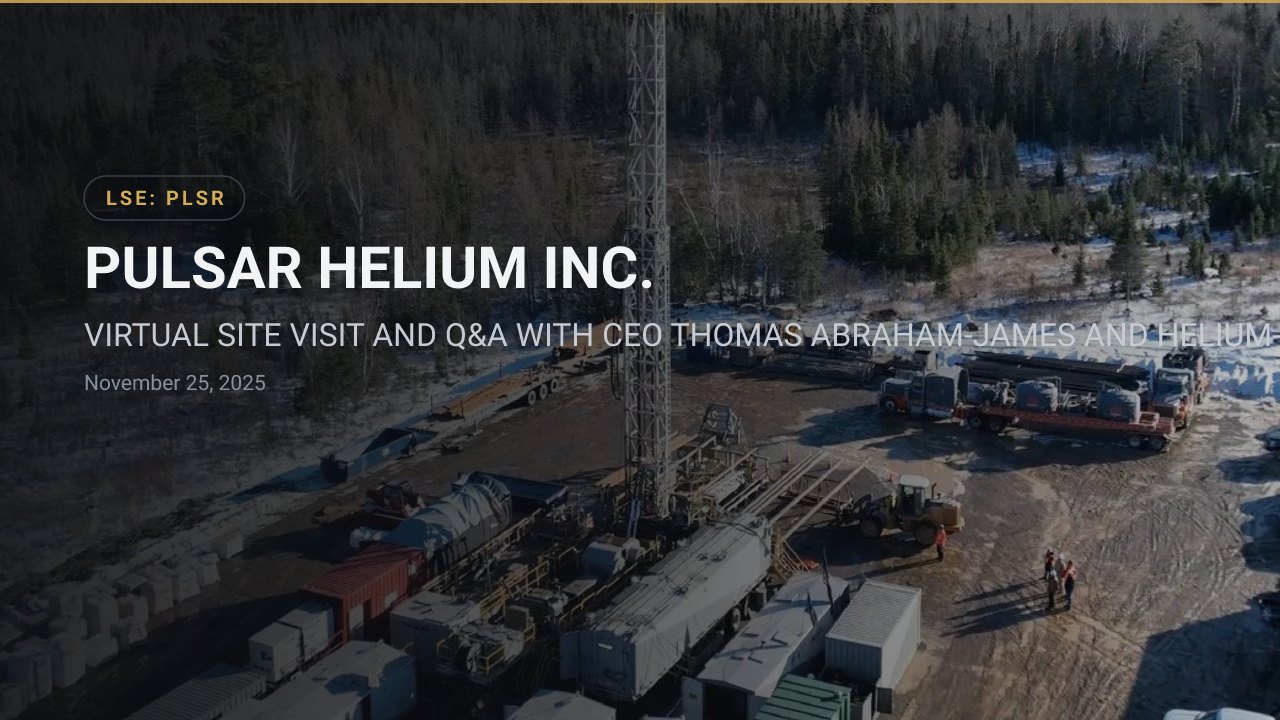
VIRTUAL SITE VISIT AND Q&A WITH CEO THOMAS ABRAHAM-JAMES AND HELIUM-3 ADVISOR DR PETER BARRY hosted by Pulsar Helium (TSXV:PLSR) on Investor Meet Company, held 2025-11-25.
Automated transcript · Written by software from the replay's audio. It can mishear names and figures; the replay is the record.
0:02 Good afternoon, ladies and gentlemen. Welcome to the PULSAR HELIUM Virtual Site Visit and Q and A with CEO, Thomas Abraham James and Helium three advisor, Doctor Peter Barry. Throughout today's recorded meeting, attendees will be in listen only mode. Please submit your questions. You can submit them at any time just using the Q and A tab situated on the right hand corner of your screen. Please simply type in your questions at any time and press send. Given the significant attendance on today's call, the company may not be in a position to answer every question received during the meeting itself. However, we will publish all those responses on the Investor Day company platform. Before we begin, we'd like to submit the following poll, and I'm sure the company will be most grateful for your participation. And before we go into the q and a session, which I know is incredibly valued to all of you on today's call, we'd like to just play you a short video. We're in the woods in Lake County, Minnesota, one of the larger counties, and we're exploring for helium gas.
1:26 And we're here for the first six foot hole being dug on top of perhaps a 5,000 foot hole. Welcome to the Topaz site here, a helium project in Northern Minnesota. And as the name suggests, it's all about helium. Helium three is something that we had an inkling maybe here. The geological conditions are certainly correct. We made sure that we sent the analysis of the gas to multiple laboratories because helium three is notoriously difficult to analyze for. And when we received results that correlated well with one another, we were then confident that the helium three was indeed present in the gas. We've just started drilling the Jetstream number three well, and so we've got a new drill program which is about to start, and that's all about increasing the size of the discovery that we've already made with our first two wells where we've made the Helium 3 and c 02 discovery.
2:30 The Helium 3 discovery is absolutely phenomenal. Long time veteran of the oil and gas industry. My name Steve Campbell. I've got a petroleum engineering degree. I've drilled approximately 3,500 wells across the whole United States. We are anticipating drilling down to approximately 3,500 feet with this drill and capturing all that core. We'll take the core to a lab, and we'll do XRF, XRD work on it. The geologist will look for all the different types of mineralogy in the rock, and then we'll also search for micro fractures and macro fractures in this rock. If you guys read the news, you know that the Chinese have gone to the moon and they're trying to capture helium there.
3:16 With this helium three here, that's gonna be able to provide infrastructure for the military, the new AI, semiconductors, fiber optics business. Helium is used in a lot of critical things in our life. MRI to keep people healthy. It's used to make chips, computer chips. It's also used to cool, like for quantum mechanics. There are people looking at mining it from the moon, and we have it right here. The h three right here. And so what we have here is this jet stream number one. The first well that we drilled here, but it has been set up for production. So this is a production ready well. So what we see here at the wellhead could then connect to any potential helium and CO two producing facility. Yeah. And the same with jet stream number two, is just off in that direction. That is also set up for production.
4:14 With the the wells that we're drilling now, these are for resource, really, to determine the you get to a volume that would then warrant going to production. Helium is one of these quirky commodities, but one that slowly, the population is, is is realizing is very important to the technology that we have and for the future. And it's also very different, to most commodities that people are aware of. We're talking about something that's inert, non hazardous, non toxic, and the footprint is small. What we need to show people is this kind of exploration can go on and it doesn't degrade the the environment.
5:02 There's a lot that goes into making sure that it doesn't. And I think there's a perception out there. They think that every hole in the ground is gonna pollute and and it doesn't. What we're trying to do is delineate the size of the reservoir and try to essentially map the the natural fractures that are in the formation because the the gas molecule resides in the poor throats of the rock. So if we can delineate the size of the reservoir, then we can determine where the boundary limits are and not go any further. In the oil and gas industry, there were services in every small little rural community or town, and that's what essentially populated those towns, and it helped their their economics.
5:48 Here, probably the closest thing if we needed supplies is Minot, North Dakota. So that's about a eight, nine hour drive and a pickup over here. That's been the biggest struggle. So all of our services have to come from out of state, with exception of the rig because these guys do this on a routine basis here in in the Minnesota area. We are the first mover in a brand new district. So I guess you could say it's it's more or less open in all directions. The objective now is to find sufficient gas to warrant going into initial production. What's exciting about it is how we can help The US economy and also supply a product that AI, semiconductors, and not allow on foreign competition to come in and supply this.
6:47 We'd I'd like to keep everything possible in The United States. We know that there is demand for it out there. It has very important implications for quantum computing, computing, for national security, and for energy as well. And it's something that is incredibly rare here on earth. So we're very happy to make the discovery. And with any luck, we'd like to see Minnesota being a more viable option for helium three than the moon is. Ladies and gentlemen, I do hope that gave you a brief insight into the PULSAR HELIUM opportunity and the site visit itself. I'm delighted to bring back up on camera, if I may.
7:35 There we go. Thomas Abraham James, CEO and Scientific Helium three advisor, Doctor. Peter Barry. Thank you both for your time this afternoon, and welcome. We did receive an awful number of questions from investors ahead of today's call, and I can already see a number of questions coming in today from Lorenzo, from Rex and a whole bunch of others. But maybe we could just dive straight in, Thomas, if it's okay. The first question reads as follows. In October, you announced a Helium three discovery. Was this the world's first verified terrestrial discovery? Pete? Yeah. Well, this is you know, we were really excited about, the amount of helium three that we measured. So we're able to measure the three to four ratio in these samples. And when you combine that, very high three four ratio of around, point zero nine with the total amount of helium, so there's there's h e l four concentration is up to about 15%.
8:32 So when you combine those, the amount of helium three is is, significant. So, yes, we're very we're very excited about, the overall amount of helium and helium three in the system. Thanks, Pete. Let's turn to the next question, relunar helium three. Given the return flight to the moon can cost over a $100,000,000, once PULSAR hits Earth based helium three production, how might this impact the price of helium three? Well, that one's, I guess, the big unknown, isn't it? So with with helium three, it's very limited here. There is current supply and but it's it's extremely limited. So to have, I guess, a potential new source of helium three, what would that do to pricing?
9:18 We will see. But we know that the the demand case, the use case for helium three is only increasing. And, really, there's no alternative or viable alternative to the current supply source apart from, you know, once again, the moon, where the US government has been also, you know, financing companies to to look at that. And so, you know, perhaps should it work for us in Minnesota, viable opportunity, perhaps. But in terms of pricing, if the demand keeps going the way it is, I mean, really, who can tell? Thanks, Thomas. What led you to look for Helium three at the Topaz site? Was it by chance? Or was there an indication in the world data that the element may be present? And what is your best assumption on the source of the helium three?
10:06 Yeah. I think I could probably take that one. Yeah. Really, like, the tectonic geological setting is really perfect to have a high high helium three relative to helium four. We know that we're in this sort of failed continental rift, setting, so, that's indicative of of the the continent actually rifting apart and liberating, you know, volcanic, deep volatiles, magmatic volatiles. We also what's of note of this well is that they're also it's c o two rich. Right? So, like, a lot of, helium wells are nitrogen rich. This this particular, location in Minnesota is c o two rich, which is also indic indicating, that it's magmatic in origin. And we have that sniff of helium three, which we think is is coming from very deep within the earth.
10:57 Thanks, Pete. Do you anticipate testing for helium three at the property in Michigan's Upper Peninsula? And will all new appraisal wells be tested for helium three as standard? And if I may, add a follow on. When can we expect helium three readings from Jetstream two, three and four? Yeah. With that, so with Michigan, we have announced that we've entered into an arrangement and exclusivity period to acquire leases in Michigan. So that process is not yet being finalized, but it's in in process right now. So we anticipate that all going well. So that transaction will be closed in, you know, the not too distant future. And and certainly, the the the reason that we like that that part of The US is that it's really a continuation of the geology that we see at our Topaz project in Minnesota. It's quite regional. And Pete was just talking about the Midcontinent rift, and that certainly extends into the Upper Peninsula.
11:55 The the helium itself, so the the helium four, the source rock for that appears to be present there as well. And then you've had that deep sort of, you know, mantle tapping from the the rift. So I I see no reason why it shouldn't have similar potential, in Michigan as well. But as for the the testing of, other wells, I'll let Pete talk about that. But, of course, we'll be looking at all of them. Yeah. Absolutely. We actually have, you know, some plans in the next couple weeks to go out and collect some samples. And as any wells come online, you know, we'll able to collect samples for analysis, you know, in my laboratory where we have a a noble gas mass spectrometer, which is specialized to measure the helium three to helium four ratio, and we can determine absolute concentrations as well as those ratios.
12:43 Then we also have agreements with a number of of government labs, national laboratories, the USGS to also verify those results. So we're we're actually able to to make these measurements in academic institutions as well as as government labs to really, you know, QA, QC any results that we get. But, yeah, the answer is absolutely. As soon as we have, flowing well, you know, we're happy to to sample and analyze straight away and and share that data with the community. Thanks. Thanks, Pete. Next question around bottom hole pressures, and there are already similarities between JET stream three and four. Should jet five yield similar results and the wells are proven to be connected? Should this be considered as positive? Well, certainly, with moving on to jet five, which is not far away.
13:31 So with that one, you know, we've got obviously, we've had a wonderful success to date with Wells one through to four, and long may that continue. We've certainly got a lot of subsurface information, so we're not exactly going in blind. So so, certainly, the expectation is is that, you know, jet five will hopefully find additional gas there. The pressure's really nice to see that jet three and four had, you know, very high pressure indeed. And, really, with the the next phase, so with when jet four is complete, which is not far away, then we'll be going in and beginning the the testing of jet three, jet four, both of them together. So a number of downhole tools and then, you know, surface wellhead pressure, flow testing, gas sampling, which Pete's mentioned as well. So all those things. And then we will then be able to look at the other wells and see, okay. You know, as, say, you know, one of the wells flows, what happens to the pressure in the other well? And that will then tell us if there's connectivity between the wells. So that data, we're not too far away from having.
14:36 Thank you, Tom. Is the helium in isolated pockets within the field or influence? And whilst I'm here, what's the working lifespan of Topaz? Well, look, at this moment, it really goes back to the previous question that we had to do the downhole test to be able to answer that question. Is it individual pockets or one large connected reservoir? We're almost there. But what we do know is that this does seem to be quite extensive. We do know that the the the helium source rock is is quite vast. So, really, you know, it is it compartmentalized or not? We'll find out. But what does work in its favor is that we do know that it appears to be quite a large system. So, yeah, not not too long to wait for that one. Thank you. Again, two questions in one, so apologies for this. But given the scale of the company's ongoing work program, is the cash in the bank and credit line sufficient to finance all of that? And secondly, and if you know yet, regarding the appraisal program, is the company planning to share a map of the planned well locations so shareholders can see how far PULSAR is stepping out away from Jetstream one? Yeah. Good question. So certainly, yeah, actually, with that map, that'll be coming up very soon. So we'll make sure that everyone's aware of that when it comes out so that that map won't be too far away.
15:52 But then in terms of the company's cash position, so we announced just the other week that a major shareholder exercised their warrants. So that brought in a good amount of money for the company. On top of that, we have a project financing facility that's been extended to us from University Bank in Michigan for an additional $4,000,000 So the company is in a good financial position to execute what we've told everyone that we're going to be doing. Great. Just turning to Jetstream two. What are the plans and time scales for the cleanup of the rock dust? Yeah. The rock dust. So with that one, what we're gonna be doing is with Jet three and four, we're gonna be using what's called an optical televiewer. So for lack of a better words, it's a video camera on a stick, and that goes down the wells, and it it basically takes high resolution images of the well and and the the fractures and and so on that are there. And what we'll be doing is we'll be putting that down jet stream number two. So we did flush that well out with with water and nitrogen, and it's it seemed to have a little it was, you know, a little bit of receptive to that, but still seems to be somewhat constrained.
17:01 So, really, what will happen is is that in the coming weeks, we'll then use that optical televiewer and just see exactly what it is that seems to be the problem with that well. And then once we have that information, then we'll then, yeah, plan accordingly to do the necessary. Great. Couple of questions now on Jetstream three, if that's okay. What drilling technique was used, and it's the same for Jetstream four? And did it create fine rock dust as encountered in Jetstream one and two? Yeah. We used quite a different drill method for for this one. So three, four, and ongoing with this program. We're using a a diamond coring rig. So it's wireline drilling. So in the video before, we saw the rig itself. So that's it. With that one, so we do not anticipate that there will be any issue when it comes to the drill fines or the rock dust because for for for number two, the the drill method we used was an air hammer. And so what that does is it pulverizes the rock. And with a lot of it, you get a very fine rock flower, which is the dust that we've been talking about. And so that can, you know, block off some of the the fracture systems.
18:09 Whereas with the Jet three, four, and ongoing, you get, you know, sticks of rock. You get drilled core. So it's quite different, and so, therefore, the the, you know, the the rock dust is not anticipated to be an issue. And just sticking with Jetstream three, can it be used as a producer? And will cleanup be necessary on what else needs to be done to use it as producer? And and I guess they're asking for the same for Jetstream four. Yeah. Well, for for all of them coming up, to be honest, so with this program look. They were set up to be for for resource definition, really, for finding additional extensions to the reservoir, the gas bearing zone. Very pleased with the results that we've seen to date, so the the the high pressure there.
18:56 Could it be used for production? Well, look, the the the wells are are cased down to a certain depth, and then it's open hole from that point. So perhaps, I mean, after we do the testing and we we we look at the characteristics and so on and, you know, if there's an opportunity to utilize those wells, then, yeah, of course, we'll we'll take it. But at this moment, I I can't answer. But the diameter is a little bit less for these wells. So once again, because they're really they were just for for resource definition. But if they're flowing nicely, why not? Thank you. When is your current projected timeline to start production? Tell us that. Yeah. Well, we've really ticked the box for a couple of things. So is the gas present? Yes. It is.
19:44 Is the gas composition of interest? Yes. It is. Does it naturally come to surface? Yes. It does. And so, really, the the last thing that we need to identify is a volume of gas that then justifies going into production. And so that's what we're currently embarking upon. The drill program will go off into next year, into q one of next year. And really, at the end of that, we hope to have the answer. And so what I can say is that, you know, really, it's the intention of the drill program to get to that point. And then to get into production, you're looking at for fabrication of a plant, so we're looking at getting a brand new plant from a very respectable group, which is Chart Industries, to make something specific for our project fit for purpose, And then really for the fabrication and then commissioning of that, you're looking at roughly twelve to eighteen months for that process.
20:36 Okay. Well, look, let's stay with the drilling program. Why is the current program for 10 wheel wells and not say seven or eight to prove out the potential resources? If if if anyone could tell me exactly how many wells are required, that would be great. That would save a lot of budgeting headaches. But look. What what we've said with this program is it would be up to 10 wells. We don't believe that any more than that should be necessary, but, of course, it's all results driven now that we're stepping out from the the wells that we already know have shown gas. It may well be less than 10. So we're currently on hole number two out of the up to 10 program. So we really wouldn't be drilling any more than we would need. So nothing unnecessary.
21:21 So once we have a level of comfort that the volume appears to be sufficient, then we'll probably then switch off and and then go and, you know, look at the production potential. Thanks, Tom. What is the percentage of helium discovery at Helium three? And is there enough to consider it to be commercially viable? Yeah. That's a good that that's a good question. So, yeah, we'd see it's we know that there's, there's approximately 19, parts per billion helium in in this reservoir. And the way that we come to that is we know that there's approximately 15%, helium four, and then we know the three to four ratio. And there's, you know, there's approximately a a million times more helium four atoms than there are helium three. When you combine that information, you can have an absolute concentration, of of helium three. So we're excited about, you know, the the the prospect of it being commercially viable, yeah, because it's it's it's so high. It's it's very it's very rare to see, you know, that that sniff of deep mantle magmatic helium three in combination with such exceedingly high helium concentrations.
22:34 So that's what makes this this particular, location in Minnesota so unique. Thanks, Pete. Slightly longer question, but I'll read it as it stated. Given that Helium three is 25% lighter than Helium four and less abundant, when you access the gas pocket by drilling, wouldn't the helium three be hard to capture? In another words, it's the first gas out of the drill hole. That's the first part of it. The second part, if I may, what would your plans be to capture the helium three in greater concentrations? It's my understanding that helium is a byproduct of uranium decay. And have you explored further the possibility of uranium? Yeah. That's a good question. So, you know, I I mean, my understanding from from repeated sampling is that the that the three and the four are well mixed within the system in that, you know, we we consistently measure the same helium three to helium four. So, as far as as preferential removal of of four, three relative to another, if it's a well mixed system, you're just producing gas, and then it's a matter of of separation at the surface.
23:41 And, with regards to the question about, yes, it is you know, helium four is the byproduct of uranium and thorium decay. There's a radiogenic decay, which produces helium four. But we think that the helium three, again, due to, this the the three to four ratio being slightly above typical values that we see in Earth's crust, we think it's actually, you know, this deep primordial helium. And, you know, like I said earlier, the the sort of tectonic setting supports that. The fact that this is a c o two rich well supports that. So the helium three itself is is likely not derived from any, radiogenic processes. Thank you, Pete. Helium three, the isotopic ratio encountered in jet stream one was around naught point naught nine RA.
24:31 HELIX Exploration encountered 0.75 in their n as well. Can you explain about the importance and significance of the RA ratio? And is PULSAR's RA far inferior to HELIX's 0.74? Or this completely wrong. Yeah. I think I think the interpretation there's there's some subtleties to the interpretation, and I think it is it is wrong to say that there's even though there's a higher RRA value, there's more helium three in this HELIX well. So the the RRA value, that's like the unit that we described to just to say, to to give the three four ratio, and it's just the the the three four ratio that we measure in a gas sample relative to air. So that's what the RA means relative to air.
25:18 And air is very well understood what that ratio is. So, yeah, as you point out, they measured, I think, 0.74. I have a little spreadsheet in front of me. 0.74 in this HELIX well, and we measured 0.09. Right? So there's approximately eight times higher three four ratio in the HELIX well. But the really critical thing that you need to remember is is that it's about the total amount of helium that's flowing. So, again, we've measured 15% helium concentrations in in this in the in the Jetstream well in Minnesota, whereas the HELIX well is something is I think it was reported as 1.2%. So there's 12 times more helium, and that's both helium three and helium four that's flowing well mixed out of that well. So when you combine those two bits of information, it's not it's not solely about what the absolute three to four ratio is. It's the three to four ratio and the concentration of those gases.
26:15 So if you if you can if you take all the information together, there's more helium three, in in, the Jetstream system is my understanding. And Great. Another bit of information is, yeah, you have to you have in the system that Tom just spoke to is, like, understanding the overall reservoir size. Right? And I don't I don't have that information about it wasn't included in that question, but that's another important consideration. Like, how big are these reservoirs? Great. Thanks, Pete. I know you touched on warrants a moment ago, but have all the warrants been exercised? Yeah. Most of them have. So at the moment, there's about 4,000,000 of them still outstanding. So yeah. So major shareholder, they exercised 15,500,000, and the balance is roughly about 4,000,000 at the moment.
27:08 Thanks, Tom. Do you have the results of the rework of Jetstream two? So that's what we'll find out in the next couple of weeks when we put the optical televiewer down the Jetstream number two well to see exactly what the problem may be. So that video log going down the well should be able to image up exactly what needs to be done. Great. Thank you. Slightly longer question. Recent communications have indicated up to 10 wells Q1 of the scope or commercially and up to 16 wells possibility more than a year to drill due to ground conditions. Can you clarify the expected number of wells and time frame to determine if you have enough data for a third party updated resource to determine commerciality?
27:57 Current resource that we have is based on half a well, effectively. So that was the original jet stream number one before it was deepened. So we could update the resource effectively at any time. So but what we'd like to do is complete this next phase of drilling that we have underway. So that is drilling up to an additional 10 wells, of which we've completed two of them. Are we gonna draw all 10? We don't know. It may not be necessary. Let's find out. But certainly then, after that, we would have all the data that one would expect. So downhole logs, optical televiewer, gas samples, pressure readings, flow rates, and all of that will then be handed across to the independent third party estimator for that resource update.
28:47 So that would be occurring at the completion of this current phase of drilling. Thank you. Is the Topaz project prima prima dial helium rather than the product of radioactive decay? Yeah. I can I can speak to that one? Yeah. That our understanding that it it it probably is primordial in nature. And, again, that's, you know, by looking at the three four ratio, the helium three to helium four ratio and the fact that it's it's above these sort of crustal production ratios that you would expect. So there's, we we we sort of know what the crustal end member looks like in typical systems. And the fact that it's elevated to that is indicative of, a deep magmatic primordial component. And, again, that's supported by the c o two rich nature of the well as well as the overall tectonic setting. And there's not you know, helium three is is you know, can be produced in extremely small, quantities by radiogenic decay and beta, recoil reactions with lithium, but the you know, it doesn't it it couldn't explain these elevated signals that we're seeing.
30:00 Thanks, Pete. Are the UP properties subject to royalty? And if so, can you say to whom and how much? By UP, that's Upper Peninsula, Michigan. So what we have there is we're still, you know, going through the transaction at this moment in time. It hasn't concluded yet, but making good progress. With that one, what it is is with the the ultimate lease owner or the mineral right owner, it is an option to lease that's exclusive. So this particular area that we're looking at, so it has an exclusive option to lease, which means that for a period of time, you can do noninvasive studies to find out, okay, is it of interest? So that would be geophysics, whatever it may be, to then prove up the prospectivity of the location.
30:49 And then when it gets to the point where we would be satisfied that we think that there are good targets there that are worthy of then drilling, then we would then use that option to lease, convert it from an option to an actual lease, and it's at that time that the royalty rate would be negotiated. Transportation possibilities around our products, water, rail, trucking? I'm in Bear Creek, Montana, and I had an MRI last month. And the MRI tech at Billings Clinic told me we're having a really hard time getting helium. I told him that very soon, we'll be on twenty four hour delivery to Billings, Montana. I may be a dreamer, but I'm not the only one. That's a great question, I must admit. And there's nothing wrong with dreaming. That's for sure.
31:37 So, look, for us, we we actually have been looking quite seriously at all the transportation. So the the helium is relatively straightforward. So, really, with that, we'd be looking at with any potential production that would be on location there near the producing wells and then come up with a saleable product. Then the the the helium would then go on to a truck. We're right next to a major highway. So and we've got existing roads directly to the wellhead. So that would go out by truck to then anywhere in the contiguous United States. So that would be for both the helium four and the helium three. For c o two, for getting that one out, it's a less valuable product, so you need to have a more efficient and cheaper means of transportation. And, actually, we're very close to existing railway network that then connects to the the national railway network. So we'd be looking at getting the the liquid c o two out onto rail.
32:31 So trucks for helium, rail for c o two, and off it goes. So we're in a really good location where we are in Northern Minnesota. There's a lot of great infrastructure there already. So rail, roads, power, and indeed, the Great Lakes as well, should those be of interest to get to a product to the East Coast. Thank you. It's my understanding that before you can start operations and maybe before before you can order equipment that you might need action from local agencies. Can you outline for us exactly what government action is needed before you start production? And how soon do you expect to get approval? Yeah. So what's happened is is that we are, you know, as as I said in the movie, the the before the q and a, is that we're the first mover in this location, and there is no history of helium and indeed other gases in in broader Minnesota.
33:23 And so the support from the government has been really tremendous. So what occurred last year is that there was new legislation put in, and it was voted upon, approved, and now it's into law. And that is helium, hydrogen, and c o two exploration production, the approval of state lands for for leasing, for for gas exploration development. And now they're in the process of coming up with the regulations for them for production, which is something that's you know, it's ongoing. And the anticipation is that, really, that they most likely be put in place before we're in a position to go into production so the time frame works out for us. And so far, it's been, yeah, it's been a very good experience working in Minnesota.
34:10 And I can safely say that the the support has been unanimous across all agencies. And we have the ability, obviously, with being able to conduct our works, with drilling, with seismic. We're regulated by the Department of Health as well in Minnesota. And so, yeah, look, there's a good framework in place already. Thanks, Tom. And maybe sticking along this topic, can you talk about expectations for state regulatory legislation and about maybe timing, costs, capacity of potential processing facility? Yeah. Look. In terms of the regulations themselves, I mean, I I couldn't really speculate too much, but I think that Minnesota's got quite a a wonderful opportunity here. It's a it's a resource that's really got quite a minimal footprint and something which is, you know, inert.
35:00 So, really, we anticipate that, you know, this opportunity will most likely be grabbed and that the the regulations, you know, should be competitive for this new industry, I would have thought. And then, you know, going off and sorry. What was the rest part of the the next part of the question? Uh-huh. Can you talk about the expectations for state regulatory legislation and about the timing costs, financing, capacity of potential processing facility? Yeah. Okay. Timing costs. Well, to fabricate a plant and commission it to you're looking at twelve to eighteen months. And so once again, that's why we think that the the time frame works. We're waiting for the regulations. The cost of it, really, you're looking at for a smallish plant on the lower end of the scale, you're looking at roughly somewhere between 15 to 20,000,000 US.
35:49 From on the higher side for something larger, you know, you're looking at something up to 60,000,000 US, give or take. Great. Thank you very much indeed. With regards to the scheduling for the gas collection pipework system, do the ground on weather conditions on flora at Topaz create constraints? And if so, how is scheduling affected? We haven't experienced any difficulties there. So as as is typical before any exploration and deep development program, we have environmental consultants that go out and they assess the the location to see if there's, you know, anything there that we should be avoiding. So that hasn't hindered any of our exploration activities. In terms of the the weather, yes, it does get cold there, but that doesn't impact our operations.
36:41 So we're able to to drill throughout the coldest months of the year. The only time that we have a bit of an issue, which is not really a big one, but it's when the snow melts in April. So things can get a bit boggy then, And the there are sometimes well, there's there are road restrictions in place at that time. And so as long as we plan around that, and that roughly lasts for about six weeks. As long as we plan around that, then it doesn't impact our activities. And then for any production scenario, we then look to make sure that the roads, you know, that would be affected are then up to spec and then not impacted by these road restrictions. So at the moment, some of the roads are dirt roads, and so they would simply need to be tarmacked in order to to skirt around that issue.
37:26 So in any production scenario, this would be a three hundred and sixty five day a year operation. Thanks, Thomas. What is the require what what is required to build out a commercially viable process to separate HELIUM three from HELIUM four? And if I may, regarding long term contracts to purchase HELIUM three from the moon, how much data would PULSAR need to justify customers redirecting that sourcing to topaz over and above Lunar recovery. Pete? Yeah. Well, there's there's various process processes, you know, distillation, cryogenic separation processes, heat flushing, and there's there's even, like, membrane science that they have as a means to separate the helium three and helium four, and we're we're sort of exploring all those options.
38:14 And then as far as the you know, there was, like, a comment about or part of the question pertaining to, like, redirecting resources from moon mining. You know? My, I mean, my understanding is that, you know, if we have, you know, 15 to 20 parts per billion helium three in in the Topaz site in Minnesota. That's approximately five times higher than what's known to exist in the lunar regolith, which is, you know, approximately four parts per billion. So I'm I I can't speak to how resources would be redirected. I'm just looking at the absolute numbers of, you know, the known concentrations of helium three that we've identified here and where people are are putting money into you know, it's gotta be easier to to go to Minnesota than it is to go to the moon.
39:05 One would hope so. Right? Well, look, guys. Or helium. Yeah. Well, look, that takes care of just some of the presubmitted questions. So thank you to everybody for those that sent them ahead today's meeting. So let's dive straight into some of the questions that we've received today. And thank you once again to everybody. There are just so many questions. But let's start with one from Stefan. The high pressure encountered at the two recent wells was a good surprise. How has this changed your view on the reservoir model? Well, look at this yeah. We some good healthy conversations amongst the technical team. And but, really, we we couldn't make any, I guess, firm judgment calls until we have all the downhole data.
39:50 So that's not too far away. So, yeah, we're quite excited to see how it all fits together. Byron, thank you for your question. Can you briefly describe the process for IDing Helium three? How can you know that it's there and in what quantities? And and what's the cost for this kind of analysis? Yeah. I can I can take that because that's the sort of analysis that I I specialize here, in my in my lab in Massachusetts at, Woods Hole Oceanographic Institution? So we have a noble gas mass spectrometer. A it's a static mass spec where we it's it's optimized to measure the the three to four ratio in geologically relevant samples. So we do, you know, we have a facility set up here where anyone from around the world can send us samples, and we do a lot of academic research as well.
40:39 But we're able to very precisely measure the helium three to helium four ratio, and we compare that ratio to the to a number of standards that we also run, you know, unknown stand or known sorry, known standards that are run through the mass spectrometer, continuously. So, yes, we're able to very, you know, closely identify what this three to four ratio is. The cost of analysis is is not too expensive. I think it's on the order of $7,750 per analysis, you know, because it takes a lab technician at the institution, you know, approximately half a day to make a measurement. We also are able to at the same time, we're measuring the isotope ratios. We measure the the overall concentrations. And, again, those are compared to those those known standards.
41:26 And I also mentioned earlier that, you know, as a matter of course, like any samples that would be analyzed, you know, through the facility at my institution, We also are reaching out. We have agreements with several, you know, government labs who have very similar setups who can, make make the same measurements completely independently, and, you know, we expect that to be to verify the results that we would get from from my lab. So I think we have a really robust, you know, analytical program to measure those helium three to helium four ratios. Sort of our bread and butter of what we do. Great. Thanks, Pete. Turning to William who asks, when do you estimate that we will know conclusively that both helium three is present in commercial quantities?
42:12 And what steps or measures must proceed that determination? Well, I think the first thing is is that we I mean, the focus for the company is we know that the helium four is is there in abundance, and it's and the c o two. So both of those are marketable products immediately. And so it's really the drill program now is to get that initial production going and at least getting to a point where we can make that decision. So so with this drill program, when it ends, you know, q one sometime next year when we believe that we've got to a sufficient resource size or volume of gas, then it's all geared towards getting that initial production. And then from that, you know, obviously, Pete will be doing his work then to analyze all the wells to find out, okay, how does the helium three look? And, you know, really off the back of that, is there sufficient helium three there to to warrant looking at potential production and, you know, what would be the technology to separate.
43:15 But it really is secondary to getting the the helium four and the c o two production online. So so if it's not sufficient for HELIUM three initially, then I guess you could say then that would be phase two to then look at saying, we increase the the gas input to any processing facility where it then becomes interesting for HELIUM three if it's not already. That's great. Thank you very much indeed. Sorry about that. Do you anticipate any of the gas majors such as Linda or ALAP trying to get into this space? I mean, this is you know? So, yeah, they're in the industrial gases as are we, and it it's hard to say. But I must admit from our point of view, we're certainly looking at this opportunity as this discovery of ours to get it into production ourselves. We think there's, you know, fantastic value there. And we've got good financial backing for it as well, so certainly not looking to to share it.
44:16 Thank you. John, thank you for your question. What is the relationship with Chart Industries, and and what do you anticipate as their future role? The relationship is purely, you know, customer client relationships. So they they have a product that we hope we get to the point we're going to purchase from them. And so that's that's simply it. So Charti is really the gold standard for making this industrial gas facility for a processing plant Top of their game. And, you know, so that's why we've aligned ourselves to them. So we signed an agreement where they would do the the the engineering works and design and come up with something that is fit for purpose. And then should our gas volume get to the point where it justifies that, then we would simply pay them for that for that equipment.
45:06 And so, really, that's it. There is no for them, there is no interest in the product itself. It's simply selling the, you know, the the the top of the line equipment, and then it would be an ongoing relationship in terms of, yeah, maintenance and so on. And if we are looking to then, you know, potentially increase the size of the plant or multiple plants, whatever it may be. So it'd be purely a transaction based relationship. Thank you. If the world's proved successful, can you describe the economic expectations of the Topaz project? That's from Steve. Well, Steve, if the wells is successful, then I expect the economics to look good. So it's I can't really say much more than that. But should it all be successful and we find more of this gas, we get to the right volume, We know that, you know, helium is an incredibly valuable gas.
45:59 We know that there are not many places on the planet. I mean, the the the big thing for us is where we think that we may fit into the the helium ecosphere is that more than 95 of the world's helium is produced as a byproduct, and that by a byproduct of natural gas. And so for the end users, so, you know, the semiconductor manufacturers, the space launchers, the fiber optic cable manufacturers, all these people, it's all very high-tech, and their product comes as a byproduct. So in terms of their contracts, in terms of their supply, there's not exactly flexibility built into it. And so for us, we're looking at a primary helium occurrence. And the by definition, that is where helium is the primary economic driver.
46:47 It is not a byproduct. And that creates all sorts of options for the end user in terms of flexibility and so on. So it's for that business to be more dynamic in terms of its helium supply. And that's where we think that, you know, should it be successful to get into production, that's where we fit in, something which is currently lacking from the market and would really give The US quite a competitive advantage to have that flexibility that I think a lot of other countries would be jealous of. Thank you. Patrick has got a question around the CO2 at Topaz. Is the CO2 enough to commercialize on its own? Or is it just an adjacent sales benefit? And what do think the potential value might be?
47:32 Yeah. Look. The USA does have a a c o two requirement and indeed a shortage that's persisted for a while now. So the the value of c o two is is certainly a nice contributor, but it is very much secondary to the helium. So for us, you know, going back when we first came across this occurrence, it's like, okay. What to do with the c o two? The original thought was, well, reinjection into the ground. But, you know, now learning that the demand is there, and indeed, even now with data centers talking about using c o two to cool those instead of water, the usage case is increasing. So I actually think that, yeah, definitely from what we've seen, that the c o two would be a very nice value add, but still secondary to the the helium in terms of its economic contribution.
48:22 But I can safely say that with the CO2, we'd be looking to capture it, and we'd be looking to monetize it. And, yeah, and none of it would be reaching the atmosphere from our operation. That's great. Thank you. Turning to a question from Robert, a fairly quick answer, I suspect. Is there anything in the drilling results to suggest hydrogen? No. Look, with hydrogen, it's something that we're not really exploring for. So no. Thank you. And then Georgie asks, where would the processing plant be located? Yeah. Right right right amongst the the wells that we've drilled. So there's there's already good infrastructure nearby, and it makes a lot of sense to have it near the producing wells. And we'd like to avoid having any substantial gathering piping system. So it would be where wells are located.
49:17 Thank you. And a follow-up question from William, if that's okay for you. As a follow-up to my prior question, assuming that HELIUM three is determined in Q1 twenty twenty six to be present in substantial quantities sufficient to justify, I guess, determining its separate commerciality. What is your best estimate of when, by quarter, its separate commerciality or noncommerciality will be conclusively determined. A lot there for you. We're need a good crystal ball for that one, I'm afraid. That's it's it's a bit soon too soon to say. I think that, know, in terms of where we are in terms of progress, we we know that we've got elevated helium three. Once again, we need to find out, you know, a volume of gas that may justify production, which is currently what we're working on, our objective.
50:06 And then with the work that Pete's doing and looking at processing technology, you know, we we we realize that we've got work ahead of us to to get to that answer. So I'm afraid that at this moment in time, it's too premature to answer. Well, as I said earlier, thank you to everybody for your engagement this afternoon. There are so many questions. I think we've covered most of the topics, I hope, that have come through, but we can review and add any responses should there be anything that we've missed. Thomas, I know that investor feedback will be particularly important to you. I will shortly redirect those on the call to give you their thoughts and expectations. But I guess one final question just to really wrap up with. Which of the gases discovered on yield can yield the greatest value? Which ones are best monetized?
50:55 Well, the one that we've seen that's always been the primary objective of this company is helium helium four. So so that's the one that really is the prize. C o two, we know there's a market for it. It can back up the the the the helium four. And then helium three is a is a very nice addition to have, but we need to understand more about it to truly unlock its value. So we would put that as the icing on top of what is already a very delicious looking cake. That's great. Thomas, Pete, thank you very much once again for your time this afternoon. Ladies and gentlemen, please don't close the sessions. We'll now automatically redirect you for the opportunity to provide your feedback in order that the company can better understand your views and expectations.
51:40 This may take a few moments to complete, but I'm sure it'll be greatly valued by the company. On behalf of the management team at PULSAR HELIUM, we'd like to thank you for attending today's meeting, and good afternoon to you all.
Follow Pulsar Helium, Inc. into a list and get an email when it puts out news.
CEO at PULSAR HELIUM INC.
Scientific Helium-3 Advisor at PULSAR HELIUM INC.