Thomas Abraham-James
CEO at PULSAR HELIUM INC.
Replay available
#AMA $PLSR Q1 hosted by Pulsar Helium (TSXV:PLSR) on Investor Meet Company, held 2026-03-31.
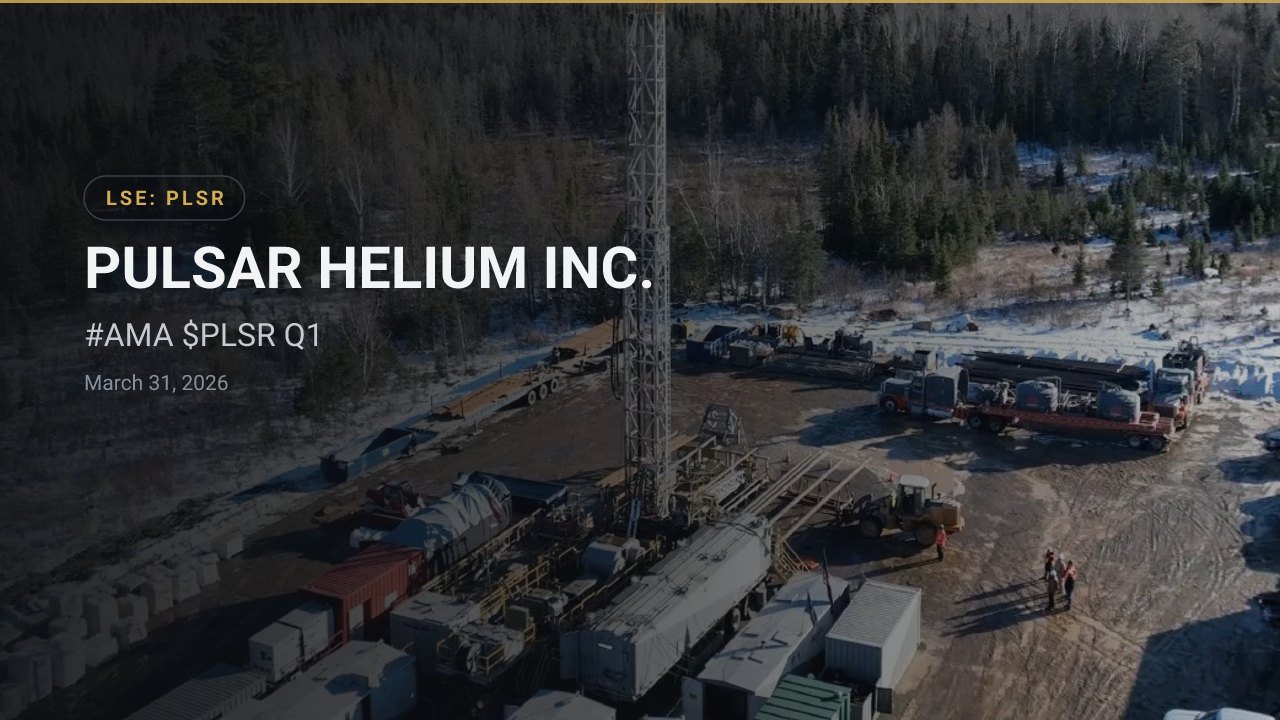
On 6ix: 6ix.com/event/pulsar-helium-inc-plsr-ama-dollarplsr-q1
Automated transcript · Written by software from the replay's audio. It can mishear names and figures; the replay is the record.
0:01 Good afternoon, and welcome to PULSAR HELIUM INC's first Ask Me Anything session. This is the first of what the company intends to make a regular quarterly open forum for investors. Throughout this recorded meeting, investors will be in listen only mode. Questions can be submitted at any time by using the q and a tab just situated on the right hand corner of your screen. Just simply type in your question and press send. We've had some strong demand and some strong engagement already with a number of questions submitted by investors, so please do continue to submit those throughout today's session. Any question not covered during the session will be reviewed with responses provided where appropriate to do so. Before we begin, we'd like to submit the following poll. For the for today's session, Tom Abraham James, CEO, beginning by addressing company specific questions. Then we'd be joined by Cliff Cain, commercial external affairs manager, who'll discuss broader market dynamics, including the situation in Iran, the emerging helium supply disruption, and the potential implications for the global market.
0:56 So let's get this underway. Tom, thank you so much for joining us today. Let's perhaps start with the first question. Quite a broad one here, but think one that you can probably answer very succinctly. Looking ahead, where do you see both yourself and PULSAR over the next twelve, twenty four, and thirty six months? What does success look like across those milestones, and are you confident you'll achieve these milestones? Well, hello, everyone. Thank you very much for attending. And, yes, quite a broad question to start with, and I must admit the the headline ask me anything was quite terrifying, but I'll do my best to endeavor to answer all questions, including this one. So, really, it's myself personally and the company in that time frame. I can see us being very busy, to be honest, and as we have been indeed, but continuing that. So we've just completed the the drilling program there, drilling up to Jet Stream Number 7.
1:50 The well testing is underway. Flow testing soon to commence. And then after that, we're then looking at a resource update. And then we'll then be looking at project economics. So, certainly, my plan for the company and certainly with the results that we've seen to date is to realize the full potential of our Topaz project in Minnesota in The United States and and realize its production potential. And, certainly, there is, if there was ever a time for a new source of helium supply, now is the time. And, certainly, the demand is very strong with the reduced output from Qatar, which has a, indeed, a global impact. So I think that certainly with the the company's business model of bringing on a new helium source in a jurisdiction that is the world's number one user of helium, which is The United States, and also with helium not being a byproduct, is something we've been advocating for, well, a decade now, if not longer.
2:52 So, so, yeah, I I long way of answering the question, but busy and and ultimately realizing the production potential at Topaz. Thanks, Tom. Next we've got here, a bit more of a personal one. Are you a sports fan? If so, which sports or teams do you follow? And could we see PULSAR explore further sponsorships similar to its previous involvement with Formula E? That's a nice one. Yeah. Well, look. Sports. When I grew up, I played cricket, rugby, and, did downhill downhill, mountain biking. So, those ones have always been my favorites. But, look. It was a great partnership that we had, with the Formula E team, and, it's really good because they aligned with PULSAR's values, where, you know, helium is, used in, semiconductors, of which there's many in an electric car, then also in the battery testing.
3:43 So if we could find something that's, you know, aligns with, you know, helium being, the primary source as it is in our projects without that hydrocarbon component, then we'll certainly explore it. But at the moment, it's, really good because helium is getting out there. It's gone from, is it just party balloons to something which is now becoming somewhat mainstream because of all the news headlines. And, unfortunately, for the wrong reason, but at least now there's a broader understanding of why helium is important to this, you know, modern world of ours. And so perhaps that level of future sponsorship and education may not be required so much. Thank you. Okay. A bit more on Minnesota. Reflecting on the Minnesota campaign, what surprised you and press you pressed you most about the exploration results for Topaz so far? What's been your favorite trip to site and why? And do you see lots of wildlife up there?
4:39 I mean, it's guess the most satisfying thing has definitely been the the continued success that we've had on-site. I think it would be very naive to say that we're gonna go out there, we're drill, and it's gonna be a 100% successful. It's gonna be perfect. Mother Earth doesn't behave that way. You could do your best derisking, which I believe that our team did in terms of our seismic collection, our previous drilling, to come up with these drill targets that we think has got the best chance of success. But, actually, to to realize that and to hit gas in in each of the wells that we've drilled and indeed under high pressure, the the bottom hole pressures that we've measured to date, I mean, that is incredibly satisfying, particularly when you think that, you know I've worked in other projects in my life, and I've never received a a 100% success rate in hitting the target. So that's very pleasing.
5:32 But also that this is a new project. It's something that I always try to emphasize is that we're not reworking something that's been looked at a dozen times before. We are the first mover there. So every drill hole that we do has a material impact on our knowledge of the project. So that really is very satisfying. So I guess my favorite site visit out there is probably every single one. I really do enjoy it. Where we are in Northern Minnesota is quite a stunning location. Probably going there in the the autumn, I think, is probably the most beautiful when you see all the different colored leaves. It really is like a postcard out there. It's quite beautiful. So I think that answered most of the question. I can't remember. It's quite a long question. I think you did. Thank you, Tom. A bit more of a closer to home question really about Europe. With Europe facing increasing helium supply pressures, how should investors think about the long term potential of PULSAR's Greenland project as part of that solution?
6:32 I think one thing that we've seen in recent years is that national security for for resources. And resources have been something that have not really been talked about in the public domain for for quite a long time, But now it is being highlighted as being strategically important that that nations, indeed regions, need to be have a safe supply of what they deem to be critical materials. Now in Europe and the European Union, helium is on the critical list. And at present, the the helium production out of Europe is minimal. There is small production from Poland, and that's all that I'm aware of. And so otherwise, it's a net importer, and that's mostly coming from Algeria or Qatar.
7:19 And so really for security of supply, yeah, Europe is obviously deemed as necessary to to source helium. And our project in Greenland, which falls under the European Union mandate for critical raw materials, you know, is one of very few helium occurrences occurrences in Europe. So we have made a helium discovery there. It is a primary helium discovery. It's at an earlier stage than our topaz project in green in Minnesota, but nevertheless, it it certainly has all the qualities and just the work has to be done. So now look, I I think that the, the the demand for something like we have in Greenland is is very much there. Super. Thank you very much indeed.
8:04 Can we expect upcoming flow test results to further address the commercial potential of the HELIUM 3 discovery? Is this still the world's highest grade terrestrial discovery? Yeah. Look, with the flow tests, so they're coming up shortly. And so, look, with those, we we've completed the drilling just the other week, and we were going to start doing some of the flow testing on the wells earlier. We're gonna do it in stages. But instead, what we've done is, you know, quite frankly, we had a 100% success rate with the drilling where we've intersected gas in every well, and then we need to do the downhole testing. So that's wireline logging. And so with that, that was the next phase. So we decided to do that on old wells. And so that's now being just wrapped up. And to do that, you know, you you insert these different tools down the wells. And then once that complete, then you can get on to the flow testing. So now that the wireline testing is more or less complete, we can then get on to the flow testing, and and that will be happening very soon. So in the last news release we communicated, it'll be happening late March up until, you know, early mid May mid April. Apologies. April.
9:08 So, yes, we're we're going to meet that guidance as far as we can see from our activities in the field. So and then that will be the the last of the field activities, and then the rest will be crunching the data and coming out with that resource update. A bit more about where you are at the moment. Are there any legal or state obstacles which might prevent drilling for helium? No. So there's no legal obstacles for drilling helium. We certainly have been drilling quite consistently over the past few months. So we've got a very good working relationship with the the state of Minnesota. So 2024, they came up with the helium and other gases regulation legislation, I should say. And for us, when we drill, that is regulated by the Minnesota Department of Health. We've got a very good working relationship with them.
10:00 There are a number of permits that are required to be able to drill, and we've obtained all of those and, following all the rules of play, and, we've had no issue. So, yes, we can continue to drill. And a couple of more just short extensions of that, Tom, if I may. Are more wells planned for fur to to further delineate the reservoir? And if so, how many are planned during that phase? Okay. Look. We can always keep drilling because at the moment, it it is open in more or less all directions, this resource. So we stopped drilling at well number seven. We deem that to be sufficient for this phase of drilling to be able to then have you know? Let let's just say if if the wells perform, then, you know, that perhaps is enough for this first phase to be able to then say, okay. That may be sufficient number to then do the economic analysis.
10:52 And then at the, I guess, at the end of that, say, okay. With what we've drilled, is that sufficient? Or do we need to drill more wells? So, really, it was when we made that call to to stop the drilling, that was before we did we'd seen this movement in the helium commodity, indeed price as well, with the conflict in The Middle East and Persia. So, really, I think that, hopefully, what we've drilled is sufficient, to perhaps go into initial production. We'll know that later after this economic study. And then if it's not, then we'll need to drill more wells in order to get to that point. But, ultimately, we would like to drill more because it is open in all directions. So we'd like to know indeed just how large is this reservoir.
11:39 So how many to be drilled? It's very hard to say, but we now know with the drilling that done, we've stepped out with quite significant spacing between wells. We've gone over a mile between wells. And so with that broader spacing, we could then cover a much larger footprint with less wells than if we had to indeed do tighter spacing. So, yeah, once again, answer to a question, but more drilling, yes. But is that required for production? Maybe, maybe not. We'll know soon, and there we are. Great. So just following that trend, really. Given the success of appraisal wells based on seismic data, will future wells be drilled to production specifications, and will new seismic data interpretation be made public?
12:26 Yeah. Well, in terms of future wells, I would say most likely that they would be drilled to production spec. I see no reason why not. So we've we've certainly done that with some of our previous drilling. And then in terms of making the the seismic data public, I'm sure that quite a few people would like to see that. But also at the same time, it is a competitive environment out there. So, yeah, we certainly, you know, very happy to show the the geological model and what we're working on. But in terms of specific datasets and so on, that would probably be limited in its release, and that's surely to, you know, protect our intellectual property. One more of a bit of a forward planning question for you. Are there any long term plans linked directly to the Lake Superior Port via pipeline?
13:18 Oh, wow. No pipeline. No. So we would not be looking at a pipeline that's not necessary for this project. So what we'd be looking at is that any potential production of helium at site would then be put into trucks, and then it would be trucked out on existing roads. So so the volume is still relatively small, so it would not necessitate the need for pipelines. So yeah. And then for any other production and, you know, we're looking also into options for the Helium three as well, so the volume of that would be even smaller. So no no pipeline infrastructure necessary. It would go onto a truck, potentially then onto a vessel in the lake after that, but no pipeline. Of a clarification point here just with this question. What does the noncommunication between wells in the Topaz project mean? Is it good or bad for the project?
14:12 Well, noncommunication between wells. So that's not something that, we've talked about because we haven't done the flow testing yet. So after the flow testing and the pressure buildup program, then we'll know. So with that, so what we do is, with the wells, you put gauges on them, and the gauges, measure the pressure at the wellhead. And then one of the wells would be open, and then you can see if the pressure changes, at the those gauges from the other wells, then you can tell if it's connected or not. And considering we haven't done that work, it's not possible to say. Thank you. Is there any reason why one of the five new wells was not drilled continuously to depths of locating the GWC gas to water contact so as to understand the nature of that reservoir? So there is no water. So, our reservoir is dry. We've not encountered water, so there is no gas to water contact.
15:05 So that one's quite straightforward. We also, I'm not sure which well you're referring to, but, perhaps it could be I think, number six that we'd we've stopped a bit shallower than we were saying, but it was within the range that we'd mentioned. And that's purely because we hit multiple gas zones already, and it was deemed unnecessary to go any deeper than that. So that's why. Great stuff. A bit more of an infrastructure question here. How long will it take to build and install the production plant or plants for the Helium four and the carbon dioxide products? Yeah. So the two come hand in hand. So let's say if we were looking at something like a a small plant where you're producing, you know, a pure helium gaseous product, you'd probably be looking at something around about six months to get that online.
15:54 And then for a larger plant that you could potentially be doing a a liquid helium product, you're probably looking at twelve to eighteen months. Okay. Thanks, Robert, for this one. There was chatter on, on the discussion boards at Well 3 and onwards around the hydrostatic pressure gradient. So the likelihood of the wells will mostly flow water. Can you comment? Haven't hit any water. Perfect. That was a short comment. Thank you, Tom. I think you previously asked that. Have you found a process for separating H E 3? Well, actually, funnily enough, we have been digging around and talking to the experts. So we've got a Helium three specialist in the team, doctor Peter Barry from the Woods Hole Oceanographic Institute.
16:46 I first started working with him when he was at Oxford University, what, that's about ten years ago now. And so he's got one of the few labs on the planet that can actually analyze for helium three. And and with it in discussion, we've actually found that there's published and peer reviewed scientific literature out there about how helium three can be separated from helium four, and there are six known techniques for it at this moment in time. And they've all been, though, conducted at, let's call it, lab scale because there's never been a need to do it at commercial scale because the opportunity has never presented itself. It's just never existed. And this is why people are looking to potentially mine the moon, which, you know, still baffles me. But our reservoir in Minnesota, it has got that high helium three. It's been verified by two federal government laboratories.
17:39 And now that we know there's these six techniques out there, some r and d is required to then find out which one of those or indeed which combination thereof, would be appropriate, for potentially separating the helium three. What I do know is that, a conventional helium plant that produces, like, a pure helium product at the end of it, would be a a mixture of helium three and four. So, if we were to go into, you know, realize the value of the helium three, it's not something that would delay the production potentially of just the standard helium four product. It's something that could be bolted on afterwards. Great. Question really about financing. I appreciate, obviously, you're listed, so there are only certain things you can say around this. But can you share your financing plan for the next twelve months and twenty four months? And in what way are you planning to raise capital?
18:31 Yeah. Look. Actually, I can elaborate on that one. So it wasn't that long ago, just the other week, that we raised $10,000,000, so we're in a good place financially. And then with the the work that we've got coming up, we're really getting to that point where it's like, okay. What do the economics like look like? Can we get into production? You know, as as one of the top three shareholders in the company, myself, I really do want to move away from equity financing. So for any potential development, we would be looking at majority debt financing for that. I've got a very good feel for it because one of our great supporters, who's now joined us on the board of the company, and that's University Bancorp out of Michigan, and their representative, Steven Ranzini.
19:19 They have offered us a $4,000,000 project finance line of credit, which we have not utilized, and then an additional nonbinding at this stage. But should we get to a production scenario, an additional 12,500,000 debt facility as well. And so it's it's really pleasing to get that as as at an early stage so that, you know, we can say that switching to a debt model is very much, and then revenues from HELIUM would be used to repay that so that we can avoid future dilution in our stock. Thank you. A bit more, I guess, about the helium market and operators. There are multiple other helium exploration companies in The US. How do you think this plays out over the next several years?
20:06 Are there enough economics for everyone? Do you think there'll be M and A of smaller players in the market? And kind of what are those trends, or what's your thought process there, sir? I think that there is a place for all of us, to be honest. And I think that we're seeing that right now with the, you know, with the the the lack of output from Qatar. And, you know, my colleague, Cliff, will be talking about that in more detail. But what we're seeing is that it's very centralized. There's only a few really big helium producers out there, and so there's a lack of diversity of supply. And so I I think that there's room for all of us, quite frankly, to join this. But particularly this this new breed of which, you know, PULSAR certainly fits very much in, which is, primary helium, so where it is the primary economic driver and not a byproduct of natural gas.
20:53 And that's in itself gives greater flexibility as well. So instead of being told, okay, you've got these rigid contracts, take or pay, and you're gonna be given the helium at the same rates we produce natural gas, then perhaps we could look something a bit different, which is speaking to the end user and saying, well, what do you want and when do you need it? We could provide flexibility that currently doesn't exist. So I I think that there's very much a place for all of us, and I'm very supportive of the the other helium companies. And, I think it's high time, that, the, helium production or the helium suppliers was, given a bit of a shakeup, to be honest. I don't know. We're we're waiting for some of this information. What's your low to high estimate for BCF of helium at Topaz? I'm afraid that something is too forward looking that I can't comment on.
21:42 That's great. Thank you very much. Yeah. You yeah. Toby, you touched on this a minute ago talking about financing. We got a question here from Sean. Is the plan for financing or the processing processing plant to be from private finance for a new share issuance? Again, I know you've kind of touched on that. It's That is the plan. Yeah. Great. Thank you. Is it true that helium is so valuable and vital that China has considered going to the moon to acquire helium? Yeah. Well, look, this is it. And it's not just China either. We're it's The United States as well. And that's for helium three, which is the the rare isotope of helium. And so for for those who are not aware with helium three, it's, how do I put it? The the helium that we hear about all the time, the common one is helium four, and helium three is this rare isotope. And its its primary applications are in neutron detection, which is a fancy way of saying picking up radioactivity.
22:34 So using it to detect, you know, what might be nuclear installations or weapons, whatever it might be. It's also used in quantum computing, and it's used in, potentially, in fusion energy, fusion reactors, of which I believe they're building the first one, first commercial one in Washington state for a data center. But, yeah, look, on Helium three, it's it's fairly rare. We found it, as I say, at at our project in Minnesota. But, prior to that, the biggest known, I guess, resource of Helium three is actually on the moon and, that China and The United States had been actively looking at it and seeing if it could be, you know, mined, processed, and returned to Earth.
23:21 We're also aware that companies private companies have been given funding for this as well or indeed offtake agreements for for, product from the moon. And so, just to show how healthy the appetite is for that product. And so we were certainly very pleased when we had our gas analysis verified by two of these federal government laboratories, stating that indeed, our helium concentration is on par, if not slightly higher, than, the the moon. And the other nice difference apart from being on on Earth, which is a big plus, is that ours is in the gas, not stuck in a rock. So that that would, simplify the processing somewhat. That's super. One thing I was gonna say, we've got a question from Daniel here. You need to add a store on your website. Someone get some merch on there. Would PULSAR consider selling promotional merchandise such as hats? Dan, hold on, and and we'll see if we can get something Just send us an email, Dan, and we'll put something in the post too. Fantastic.
24:22 Steve, thank you. Can you clarify how many of the wells have HELIUM three hit so far? With HELIUM three, so we've only just analyzed the one. So that's from jet stream number one. And when we analyze all the others, they will be analyzed for HELIUM 3 as well. Super. Okay. PULSAR correctly. Sorry. I beg your pardon. Not that one. The initial estimate of volume was 4,000,000,000 cubic feet on Well 1. What's the new estimate following all seven wells? That's work in progress. So we'll know that, once the the resource, or the the third party resource estimator has completed their work, and we provide the resource update to the market. So it's not in hand at the moment. Super. Randy, thank you. With a 100% success rate in relatively narrow areas, is it possible that resource could be extended well beyond the land package and the PULSAR's own the own PULSAR owns? And if so, how can the ranges of this find accuracy be determined?
25:19 Really, it's it's continuously stepping out with seismic and drilling. And, so as I was alluding to earlier, it's it's appears to be open to the Northeast, south, and west. And so, additional drilling to to really determine the the the the overall size of this reservoir is ultimately gonna be required at some point. Perhaps not necessary for initial production, but at least to know, okay, what is the extent of the reservoir. We've also been quite aware that guess how to put it, with the work that we're doing, we're continually learning. And so intellectual property has, you know, certainly increased in terms of our knowledge of what environments are appropriate for these helium accumulations.
26:05 And so recently, we conducted two acquisitions where we took out two companies so we had access to their land because we deemed those locations to be prospective for additional helium discoveries, and we continue to keep an eye on that. And any other areas that we identify as having the the Goldilocks zone, let's call it, for for helium, we would certainly look to to gather those up as well and and just further consolidate on our first mover advantage. Great. Grace, thank you. Has PLSR begun the process of procuring long lead processing equipment as mentioned in the press release on the 02/19/2026? If so, what are the lead time for that equipment? Yeah. Look. The the main one is for long lead items is a compressor, actually. So that's the the main one. And so with that particular one, once we get a little bit more work done, so once we have the the next lot of testing complete, the flow testing, we'll have a better idea about the the scale that may be able to be produced, and then that will determine which size compressor we're going to need. And so every helium plant has a compressor, but they are different sizes. And so what we need to determine is what size would we indeed need, and then we put that order in.
27:25 Great. Just skipping back to Greenland here. Thank you. What's the road map look like for Greenland project in the next twelve, twenty four months? What are the major milestones that you've got to achieve or you expect to see achieved over that period? Yeah. So what we've got there is, we need to further up. So so the intention for this year is that we're going to be doing some, geophysical work, and that's really just to look at the subsurface and to be able to, sharpen up targets for drilling. And so those then could be potentially drilled next year. And so then based on the the drill results, we'll then really determine the next steps. But in the short term, geophysics this year, quite limited. You know, that'll be conducted over a period of about two weeks, and then, potentially drilling next year.
28:16 It's worth mentioning that, really, our focus is on advancing Topaz, in Minnesota. And so when we get to the drilling stage in Greenland, we will then see I mean, if, you know, hypothetically, if we're in production in in Minnesota, fantastic. We can use revenues to to advance Greenland as well. But otherwise, yeah, we'll see what the situation is. And, in Greenland, we certainly, you know, I guess, potentially looking at partners for that one as well, because, as I say, you know, we've got, gonna have so much focused on Minnesota, but the road map remains the same. We'll do the geophysics next this year, and then one way or another, coordinate drilling the next. Super. I guess just a transition question here from James. What changes have you made internally to ensure the team can transition from a discovery mindset to a capital intensive execution mindset without losing that discipline that you've had so far through the project?
29:15 Yeah. I look very proud of the team that we've built. And so one of our most recent addition, you'll be hearing from in just a few minutes time. So Cliff Cain, he's fantastic. He's got a very commercial background. So he's been in the industrial gas space for some time. And then we've got operations on the ground. So Steve Campbell as well. So he brings decades of experience and has executed our work program beautifully, and so has also been exposed to production as well himself. Reservoir engineer, Brad Cage. So he's been looking at assets for through, you know, from the expirations phase all the way through to production as well. So, look, you know, we're building up a very capable team. We've got a dedicated land manager as well who's always out there looking at our opportunities and further consolidation. John Evans, you know, got a fantastic geologist, professor Nick Scofield.
30:12 And, you know, look, the team's great, and, you know, certainly, we are aware of other talented individuals that would be complementary to the team, you know, should we get to that next stage and really start development in earnest. So, yeah, a very good and majority US based team. Tom, look, thanks very much indeed. I think at this stage, let's as as you said, let's perhaps bring our friend Cliff to the table. Cliff, there we go. Perfect. That's great. Look. Fantastic. Thank you very much indeed. Tom, if you don't mind, I'm gonna just pop your camera off for now. And, Cliff, look, thanks very much indeed for joining us. And we'll we'll have a look at some of those questions now. They're really focusing a little bit more around your area of expertise.
30:58 And let's perhaps start with this this question that we've got here. Given helium's critical role across advanced manufacturing, in your experience, what's been the most reliable indicator of helium pricing trends? And do you expect greater transparency to emerge? Specifically, could PULSAR play a role in that evolution? Well, thanks for having me, guys. Appreciate everybody being here. You know, good question. Unfortunately, the the biggest indicator has always been, disruptions. Right? Disruptions have always been the indicator, on pricing. And this is due to the concentration risk that, this entire environment has been built around. There's very few places in the world, that, you know, can produce liquid helium. You know, you've got, you know, L'Barge there, in Wyoming, Algeria, Qatar, now Russia.
31:49 And that's it. So anytime, we have whether it's anything from maintenance to, what we're seeing today with this black swan event, that we've warned about over the years, you know, this is where we're at. Right? And, you know, PULSAR's role into helping with that transparency just comes down to derisking. Right? Derisking that concentration, effect. You know, this this is gonna affect, it's gonna affect positively to the markets to bring on new supply. And so, yeah, we just need to educate. What it comes down to is just education in the marketplace, especially for the downstream end users and buyers.
32:35 A lot of the times, they feel like they they've diversified their risk, and what they've truly diversified was maybe their suppliers. But when you kinda go further upstream in that, it's not really diversified because both or multiple suppliers are pulling from the the same source. That's great. Thank you. Something you just touched on, obviously, from a market perspective. How do you see the the situation in Iran influence healing of supply dynamics? I know something that you know very well, the pricing, especially over the longer term. Is a helium price hike guaranteed almost by those dynamics? It's already happened. Right? You you already have force majeure letters that have been sent out.
33:20 We have allocations across the globe. I've seen pricing jump from 32¢ per standard cubic foot up to a dollar 15 right now. And, you know, those buyers are are were pretty quick, you know, to to to jump on those spot molecules as quickly as possible, to to to secure their stability for their growth, right, or at least just to keep operations going. When I look at some of these allocation letters, you know, a lot of a lot of companies out there right now are only gonna get 50%, and that's now. Right? We're not even forty days into this thing. And maybe some of the callers might remember or maybe not, you know, when the Saudis blockaded Qatar back in 2017, you know, that that was a very, severe and acute shortage there.
34:08 And we saw pricing jump up to $2 a foot. And then this last shortage that we just had, you know, you're looking at $2.50 a foot for for those molecules, and that's if you're able to even get it. So, you know, this is I I just put an article out, I think it was early last week. You know, black swan events are not fairy tales. It's happened. Cutter Energy has clearly stated that there's been damage to the facility. It's gonna take three to five years to to get fixed. It is an active conflict, so I would actually be really curious to see actually how extensive the damage actually is. I don't think they really maybe wanna tell folks how bad it is. But until we see an end to the hostilities and the cessation of hostilities, and I'm sure everybody's watching the news on this thing.
35:00 It doesn't look like it's gonna be over anytime soon. And, you know, there could be the possibility of further damage to more facilities out there. They're already targeting desalination plants and AI data centers. So, you know, three to five years, Cutter Energy said it themselves. You know, they're not gonna be there just to fix the liquefier. Right? You know, helium is just a flea on the tail of the dog at the end of day. They're in the business of doing LNG. So, as it stands right now, we have around 33% of the world's supply of helium off the market for the next three to five years. Now that's barring if we have another shutdown. These other facilities that we have out there, they're still gonna have to go through maintenance.
35:48 I would I would always encourage additional security around these things. There's also you know, with the state of affairs, say, you know, we don't need nefarious actors running around doing things to other liquefiers. You know, we would have a catastrophic systems event then in the industry. So, what I would tell the end users and buyers that are out there right now is to, look closely at the inventory that you have, carefully go over your agreements with your current suppliers, learn and understand how the market actually works, how it's produced, how the molecules actually flow, the logistics behind it. And, you know, we're in for a long ride here, unfortunately.
36:33 And this is gonna have again, it's already impacting the globe as we speak, and we're not even forty days in. Thanks very much. That that that comprehensive update there. A bit more, I guess, about Minnesota. PLSR's TEPAS HELIUM project in Minnesota. They're increasing signals of both commercial and government entities that came to get their hands on your helium. When could we expect an offtake announcement? Well, those are things that we're actively working on right now, both federal and private, institutions. And, you know, I can't speak to specifically on the private ones, but I can tell you that, I just briefed the Pentagon, last week. They're taking this shortage very seriously. You know, when we talk about helium used in, the processes, you know, you you know, munitions, productions, aerospace, you know, space launches, This is one they can't ignore.
37:30 And then we've got the Department of Energy that is extremely interested in the the helium three component of this. So, yes, it's we're getting there. Yeah. I believe this system's very prolific, and it it can definitely be built into a rare gas hub for the nation. That's great. Quick one here for you, though, Cliff, before we get into it. How'd you switch off? What are your hobbies? And then we'll ask you a few more things about government grants and a bit more HELIUM. Sure. Sure. Okay. Let's let's roll into that one. Robert, thank you. My PULSAR HELIUM INCULIFY for a US government grant, to investigate HE three production technologies?
38:17 So the interesting thing about Helium three is it's never been commercially produced before on this planet. Right? It's it there's never been an opportunity where you had potentially commercial, viable volumes to actually do that. You know, currently, where we get our helium three from is, you know, in layman's terms, it's just basically nuclear weapons maintenance program. Right? You know, we siphon off the helium three from from decaying tritium from the warheads and, you know, off into the market it goes. But as you're seeing, you know, throughout the advanced economies of the world, China, Russia, The United States, you've seen this chase for the moon. Right? Chase for helium three on the moon.
39:05 And and I think that push is because of quantum AI. Right? We can talk about fusion energy. We can talk about neutron detectors. A neutron detection is you you know, you need helium three for neutron detection to look for nuclear weapons moving across borders. If you've ever been to a port of entry, I'm sure you have. Right? Airports, shipyards. There's a neutron detector sitting there, and they're they're not very obvious either, but they can detect nuclear fissile materials moving across. They put them on drones, right, to go, look for stuff moving around. Do I think that market's growing? Yeah. I think that market's growing, but I don't think it's really triggering what the US government and China specifically is, you know, aiming for is a a secure stable supply of helium three.
39:53 And, you know, they're looking at the moon, right, in that 10 to to 12 p p b lunar regolith concentrations. There's serious money behind it. You know? And what I'll say and what I'll say about the quantum AI, it's the Manhattan project of our era. You know, he who gets to quantum AI, efficiency is is going to win. And I think that's what's really driving it. And with this discovery, with the the source here in Minnesota, it's definitely, you know, piqued the interest of of government entities, that see a terrestrial source as an option instead of having to go to the moon. Because going to the moon is gonna require, just for one gram of helium three, you're gonna have to, you're gonna have to mine a 100,000 tons of lunar regolith.
40:43 And I guess what they say is they're gonna bring it back to Earth, and they're gonna process it here. So, you know, that seems like it's got a trillion dollar number behind it, not a a an m or a b. But if they continue to pursue this, you know, this, I believe, is it's because of the quantum AI movement and what's happening. And, that answers your question. Thanks, Cliff. There's some big numbers. Are you able to give an update on the potential joint efforts with the US government? I know you just touched on it in in one of the earlier questions, but, if you can add any more color, that'd be great. Not at this time, but there will be there will be news coming on that once once we have more clarification on how this is gonna look. Because it will be, it will require, you know, in theory, right, we'll we'll have to go from a r and d to production type of facility. Again, one that hasn't been built before. It's been done in labs, but it's never been done to where you're processing commercial volumes.
41:43 That's about as much as I can say right now. Thank you. And, again, around that kind of frame, do you receive inquiries about partnerships and or investments from some of the large gas companies like Air Products, Linde, etcetera? I'm sure, obviously, with with the resource you have potentially coming on stream, that is is a question that's on everybody's list. I can't speak to specific, entities. Right? But what I will tell you is that you do have a lot of independent distributors, that really see the value in, this project up here. One, you know, they understand how the markets work. They deal with the customers on a day to day basis.
42:32 They don't like receiving force majeure letters and allocation letters themselves. You know, a lot of the independent helium distributors and, industrial gas companies, independent ones, yeah, especially here in The United States, they do a really good job, servicing the customers. And, you know, they don't like delivering those letters to those customers as well. Right? So what I would say is a lot of independent distributors are are looking at this pretty heavily. So a bit more of a practical question really really from Anthony. Thank you for that. You know, can you describe the uses of Helium in semiconductor manufacturing, especially in data centers, kind of how that all fits into play? I'll touch on the the data centers because I there's a lot of misconceptions out there about, you know, how does this affect AI? How does this affect data centers? Right?
43:22 You know, the actual specific operations of the data centers, right, it's more or less the the, you know, the HDD drives, which are which are filled with helium. Right? And if you look at the current state of the market, with data centers, I'm sure you open up the newspapers, see it on the news every day, or you hear a new data centers wanna move to town. I think the last I checked, there was, like, 15,000 data centers that were in the process of being permitted for 2026. So it's a lot. Right? And when you have a, a shortage of helium, it it affects it from the upstream side of things, and there's serious growth risk around that. The semiconductors themselves, right, the process for, for making electronics, they they have to have it.
44:12 If if they can't make chips, right, and you're not making laptops, you're not making cell phones, you're not making, boards for automobiles, it it affects the entire electronics industry. And this kind of bleeds over into aerospace and defense, you know, the the munitions, productions. When we think about the THAAD missile systems, Patriot missiles, mortar systems, All these require electronics, you know, the eyeballs in these things. It it it requires helium to be produced. And so you you when you have a disruption like this, you're putting a a growth cap. And, you know, you've got Israel and The US right now heavily involved in this conflict.
45:01 Ukraine has been involved in a conflict. I believe it was 2022. All need helium to produce those electronics and for the munitions production. Welding applications across the board, whether it's from shipbuilding, to pipeline repairs, to you name it. Right? If it's if it's a welding application that requires high purity, there really is no other options. You can try to blend down and use an argon c o two mix, but a lot of the requirements for aerospace, you have to have helium, right, for the high purity welds. And for those who don't know, when a weld is being made, there's a gas atmosphere that is it's called shielding gas. It's a shield, right, to prevent atmospheric impurities from getting into the welds. And helium is the perfect gas for that to to to create that atmosphere, that's inert, and it keeps the, the impurities in into going into the welds.
46:04 Lifting gases and balloons, I really won't talk too much about just regular party balloons. They're you know, I think they're around less than 1% of global demand. But what we can talk about is aerostats. Right? When we talk about the the National Weather Service and the balloons that they fly every day, they you know, there's about, I believe, 400 launched every single day for the weather service. Those use helium. When you look at the Ukraine, right, or any conflict zones, they're using aerostats to to put communications devices on them or video and audio equipment on them. You know, The Ukraine in the past year has been heavily investing in aerostats on their front, with Russia, and that's not going anywhere anytime soon.
46:55 And then the other one, this is one I'll I'll talk about at a at a at a on another date, but, drone manufacturing. Drone manufacturing is a massive growing market, for many, many reasons, whether it's agriculture or it's for defense or for security, you know, the batteries that go into them. You know, battery manufacturing, you need the helium for the batteries. And so, yeah, it it's in so many different avenues, and, I I don't think a lot of folks realize. Maybe they do. You know? You wake up in the morning. You grab your cell phone. It it took helium to make that. You get in your car or your truck. It took helium to to to to make that automobile.
47:40 You get on a plane. Right? Helium is touching everything in our everyday lives. So and with this current shortage, all of these right now, are, at high risk for growth. Sorry for the long winded No problem. Response. Thank you very much for a, comprehensive response. William, look. Thanks for your question. Really good one, actually. Many cryogenic trailers are currently bottled up on the Persian Gulf due to the Strait Of Hormuz as is being closed. Does this have any effect on the ability of PULSAR to procure such transport equipment? No. Not really. I mean, I did see some of the news and some of the data around that, you know, around 200 ISOs, that are trapped in there. Listen. Those things will be shipped out overland.
48:28 They'll be out in the markets before too long. Right? I would say forty five days from the onset of this whole thing. They'll be they'll they'll be they'll be moved out of there. Now moving through the Strait Of Hormuz is a different story. They're not gonna move through that, but they will move overland to ports and then kinda get filtered back into the logistics supply chain, where they may be used. But it's not gonna affect PULSAR anyway. I think we do have a Chart staff member on this call. I wanna give a shout out to Chart. Wes, hey. How you doing, buddy? Chart is a manufacturer of the cryogenic tanks. Those guys are are they're awesome. Right? The top top top of the class when it comes to manufacturing these things.
49:17 It wouldn't take long for something like that to be produced. Great. Thank you. One from Alex. Clarification on the Minnesota regulatory regime. What is the latest progress on the regs to enable PLSR to produce helium, not just explore for it? Comments recently indicate that no meaningful progress was being made, which is a different story to what was initially said last year that we would expect it to be sorted around summer twenty six. Yeah. Well, I mean, the dynamics of Minnesota, if you're in The United States, you you you may have heard, you know, Minnesota is, you know, kind of equally divided, from a from a political standpoint. But, you know, you know, since I've I've been onboard and been up here, we've got a a bipartisan group working on this thing, right, and getting the regulatory moratoriums lifted.
50:12 You know, my anticipation is we'll be there here really soon. You know, I think everybody at the highest level at the state of Minnesota with the government here understands now the importance of helium, not just to Minnesota, but to national security, and the markets. So very good, very involved bipartisan support in getting this done. So that makes me feel really good. I was, you know, extremely concerned coming up that, it would be a big fight, but it hasn't, it hasn't turned out to be that. I I I don't think I've really run across anybody that, doesn't want the project to happen. You know, when you look at Northern Minnesota and kind of the decline of, the steel industry, the folks up here are hard working working, looking for opportunities, and, they definitely wanna participate in helping get this done. So pretty confident in that.
51:14 And just one more if I may, Cliff, just before we turn back to Tom. One to end on. Thanks, Greg. When do you expect to start selling helium? As soon as we get to the end of this, kind of the regulatory cycle here by the, end of April, as soon as we can get a plant up here to start moving molecules. Cliff, that is absolutely fantastic. Thank you so much. Tom, if I may just bring you back up. I'm just gonna unmute you there. Thank you very much indeed. Tom, just if I may, probably got time for a couple more questions and just some closing comments if that's okay. Wesley, thank you. What's your favorite thing about Chart Industries? Hi, Wes. Probably your beautiful smile, Wes. There we go. That's my favorite thing. But now look, you're a great company to work with. And look. I mean, the reason that we signed an agreement moving forward with Chart is that, really, it's the the gold standard when it comes to making these industrial gas facilities. So there we are. So we've seen that some other companies trying to get into production, and they haven't been successful.
52:27 And we don't want to replicate that. So going with the tried and tested industrial gas, you know, facility provider, and it's also American as well. So and one of their largest fabrication facilities is also in Minnesota. So the shoe fits. Fantastic. I think that's what I always wanted to hear, Tom. One one from Robert. What have you learned, from the data retained from the Ocelot PLC deal for the area to the west of Jetstream Wells? Okay. So with that one, what we've learned there is that well, it's kind of what we already, knew that geologically, we think it's got the right hallmarks for the helium accumulations. So the, the the the ingredients that you need for helium so here we are, everyone. I'm about to make you a a helium exploration expert.
53:15 There's there's really four key ingredients that you need, and we believe this location has them. And so the first one that you need is a a source rock. Where does the helium come from? And that is an old granite. The older the granite, the better. And so that source rock exists over there. It also exists over at Topaz. Then you need a a liberation mechanism, like, how do you get the helium out of the rock? And so you basically have to fracture it, break it up. And so for this location, you've got the Midcontinent Rift of North America. So that's there. You then need, trap and seal. And in that particular location to the west of us, there's a sedimentary basin there, and, that can act as a conventional trap. And then the last ingredient that you need is a heat source to to drive out the helium from the source rock and drive it into the reservoir.
54:07 And, so that was, ancient volcanism that used to exist in that location just a mere billion years ago. So, so, you look, it it, it ticks all the boxes for, the the right geological zone. And, what we'll be doing is following it up with, ground truthing and then seeing if we can identify areas that have got, you know, the the best chance of success for for drilling. Super one just about where are we? Here we go. Yeah. So if if all does go to plan, how much money will you need before self funding and free cash flow positive? Well, look, for the for the smaller plant, you know, we're looking at sort of sub $10,000,000 for that. So somewhere in the range of 5 to 10,000,000 for a small plant. If you want one of the largest helium plants on, you know, on the planet type thing, then you're looking at about 60,000,000 US thereabouts.
54:59 So when you compare it to mining or indeed natural gas or oil, it's a very small capital outlay, and that's really to just to reflect the inert nature of the of the material, nonhazardous, but then also small volume. So helium is very important for all the industries that Cliff has highlighted just now, but the actual volumes are significantly less than, say, natural gas or oil. So that's reflected in the capital cost, and we would certainly be looking at, as I say, debt financing for that. Sure. No problem at all. I know we're just coming up to to that hour time. Look. Thank you to everyone for for all their questions then. The team will review those. And I know, Tom, Cliff, you you've got through a heck of a lot of questions. But I think we've the penultimate one. Here we go.
55:46 Jason, thank you. Does PULSAR intend to publish a third party resource study in q two? What firm's been hired to produce this? Yeah. Look. So we've already published one previously. So we've got a current resource estimate, and that was done by Spruell as was their Denver office in The United States. So so that one's actually on our website. And then the update will be most likely with sprule as well, and we're looking at yeah. So mid mid year ish, that will be when it's coming out. So once we've collected all the data from the wells, and then once that third party estimator has then been able to review it all, synthesize it, and then publish it, and, yes, that will be going into the public domain. Super. And one final question, just to to come to Tom perhaps before I ask you just for a few closing comments after that, if I may.
56:33 Josh, thanks. Will you be pursuing a listing on the New York Stock Exchange or Nasdaq as soon as possible? Look. As soon as possible. Perhaps not as soon as possible, but it's it's something that we are, know, you interested in. There's no doubt. At the moment, we're on London AIM, Canada, TSXV, and in The United States, we're on the OTCQB, and we're seeing very good volumes there, so across all three exchanges. But I think that, you know, ultimately, this is a US project, and it's going to be going to US customers. So I think that at the right moment in time, that it is probably quite likely that it will be going into, you know, potentially a major US stock exchange.
57:19 But right now, probably not at this moment in time. Fantastic. I think that's just, as I say, coming up to to that hour mark. And look, Tom, Cliff, thanks both of you for answering so many questions from investors, and and thank you to everyone for submitting those. Tom, perhaps just a few closing comments, if I may, and then I'll redirect the attendees to give some feedback. Certainly. Well, look, the closing remarks are that, you know, PULSAR, it's it's an incredible time for the company and albeit under unfortunate circumstances globally, what's happening. But it really what's it's happening is it's putting the highlights on helium. And, you know, I use this analogy. And, when I was younger, when I heard of lithium, all I thought about was lithium grease that I would use on my bicycle chain, whereas now the first thing you hear you think about when you hear lithium is batteries.
58:09 Helium is going through that moment right now, where the penny is dropping, that it's helium is not party balloons. Helium is, modern technology. It's semiconductors. It's space launch. It's MRI scanners. And, it it's really good to see that that message getting out there because it is important. It is something that shouldn't be wasted, and it's been somewhat neglected, with it being a byproduct, and we're seeing lots of industries suffering now from a shortage coming out of Qatar. So, really, it's an exciting time for PULSAR to, you know, potentially do our bit to disrupt the supply of an element, which is something that is quite a rare opportunity to do. And, you know, we we think that we've got the best helium projects that are out there.
58:55 We're the first mover in each, and they've got all the potential in the world, and they've got off to a tremendous start. So I think it's, you know, this is the most exciting company I've ever worked on, and it, will continue to be so. Fantastic. On that note, Tom Cliff, look. Thank you very much indeed for hosting the the first of which I'm sure will be many, PULSAR HELIUM INC AMA sessions. I please ask investors not to close the session? You should now be automatically redirected to provide your feedback, which I know some of the team will be greatly thankful for. This will only take a few months to complete, and is very valued by the company. On behalf of the team at PULSAR HELIUM, we'd like to thank you for attending today's presentation. That concludes today's session, and good afternoon to you all.
Follow Pulsar Helium, Inc. into a list and get an email when it puts out news.
CEO at PULSAR HELIUM INC.
Commercial & External Affairs Manager at PULSAR HELIUM INC.