Thomas Abraham-James
CEO at PULSAR HELIUM INC.
Replay available
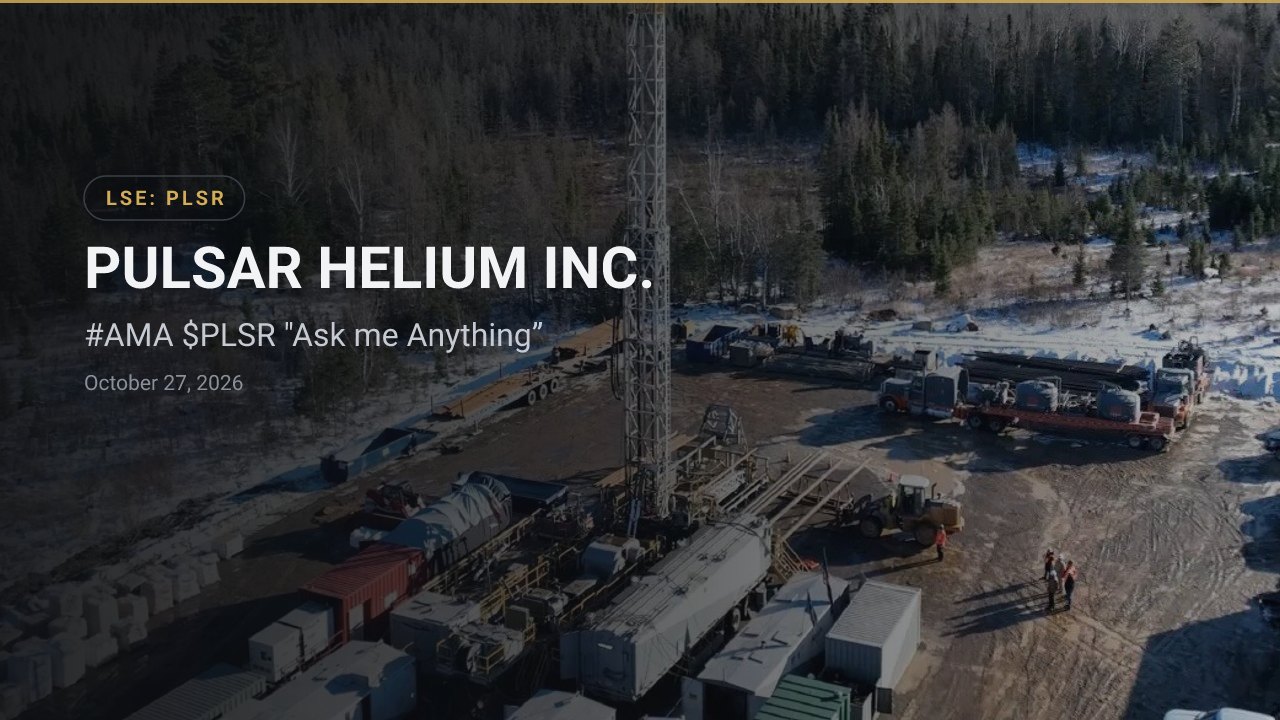
#AMA $PLSR "Ask me Anything” hosted by Pulsar Helium (TSXV:PLSR) on Investor Meet Company. Replay available.
On 6ix: 6ix.com/event/pulsar-helium-inc-plsr-ama-dollarplsr-ask-me-anything
Automated transcript · Written by software from the replay's audio. It can mishear names and figures; the replay is the record.
0:00 Good afternoon, ladies and gentlemen. Welcome to the PULSAR HELIUM INCASTER Sessions. Throughout today's recorded meeting, attendees will be in listen only mode. Questions are encouraged and can be submitted at any time using the Q and A tab situated on the right hand corner of the screen. Just given the significant attendance on today's call, I suspect we won't be able to get through every question. We've had a number pre submitted, but we will do our best to cover as many as we can throughout today's session. Before we begin, we'd like to submit the following poll, and I'm sure the company would be most grateful for your participation. Okay. Thank you very much indeed. Well, look, that's the intros over with. Tom, Cliff, thank you very much indeed for joining us this afternoon. Let's not waste any time. I think we've got a lot of questions to get through. So maybe, Tom, the first one is for you. The company's share price is up by more than 20% in a week. Are we likely to hit an all time high in your opinion? And and what news and milestones could investors look forward to in the near term?
0:57 Well, thank you, and good afternoon, and good morning to everybody listening. Thanks very much for your attendance. Well, look. Thanks for asking because it's... Whilst we don't comment on the share price per se, what I can say is that it's been a incredibly busy week for the company. We've had a lot of news flow, actually, over the past couple of weeks, I should say. And so what we've had is we've had the the signed charts in Baker Hughes equipment proposal, and so that's for the rare gas hub. So the the actual equipment for the production of liquid helium and c o two. We've also had a separate announcement with city of Two Harbors in Minnesota, which is the proposed rare gas hub site.
1:43 We've then had the the Helium three evaluation agreement with LH three m. My colleague, Cliff, here has been on sixty minutes, which really garnered incredible coverage around The United States and indeed globally. Department of Energy has just put Helium onto its critical list in The USA. And prior to that, earlier this year, we managed to raise quite a lot of capital. So we're in a very healthy financial position. So I would think that it's one or all of those combined that's resulted in this resurgence in our share price. And I I guess I could say, you know, long may it continue, and we're certainly doing everything to continue the news flow and deliver on everything that we've stated in all those respective news releases.
2:31 Great. Thank you. And I and I think you just touched on the US Department of Energy's putting helium on the critical list. Do you think this will expedite PLSAR's pathway to production? How do you anticipate that this will help the company's growth? And could PLSAR qualify for DOE, EXIM or other federal financing loans, guarantees or trusts? Will this designation accelerate ongoing nondilutive capital discussions perhaps, Cliff, want one for you? Yeah. It it it absolutely would. I mean, this is this is wonderful news that, the DOE moved to to put this on the critical minerals list. Again, this is my own opinion. I I would suspect that probably the Department of Interior is is right behind that.
3:16 We're we're obviously in... There's two different, major conflicts going on, globally. You saw the Pentagon's announcement, just a couple of days ago on Fortress, you know, building resilience throughout the supply chain and specifically for, for the Department of War and and US bases. So, yes, this definitely opens up a lot of avenues, for for PULSAR, not just on the helium forefront, but also the helium three. That's great. Thank you. Regarding the helium three potential at Topaz and your recent collaboration with LH three m, what timeline are you working towards regarding development of helium three for separation technologies?
3:58 Maybe Tom. Yeah. So this one, we signed the agreement on the October 14, and we're actually at that very moment in time. We were in... Together in California at the NASA research facility, Ames. So it was it was quite the the location to announce this agreement that we've signed. And so it starts off with a a deep dive into desktop review of the topaz gas gas and isotope data. And then phase two will then go into a laboratory testing plan, and the starting target is at least 95% helium three purity. And then a pilot could follow, but that will be under a separate agreement. So we haven't set public dates on when these set milestones will be achieved. Mean, really, we don't want to rush the science.
4:49 We are looking to do something here which has never been done at a commercial scale before, really because there's never been a requirement for it. There's never been, or should I say, an opportunity for it. So with it, it's something that's... You know, we've already got the federal labs who've looked at it. We've got the Woods Hole Oceanographic Institute. We've also confirmed the helium content in our topaz gas, and this is really the next iteration to see if we can, via a staged approach, which is really coming at minimal to no cost to PULSAR, to see if this technology can be utilized at our facility and then add that helium three value to it. And so, yeah, we will announce to the market as and when those stages have been reached and what the decision point is at the end of those.
5:41 Great. Thank you. And, Cliff, I mean, just returning to the US government's interest around the the critical middle... Minerals importance of helium to The US economy. Do you think it's likely that the US government might consider buying someone like PULSAR? I mean, there's always the the the chance. Right? You look at the current administration's making, industry moves where if you look at MP materials out there, you know, this this this move to bring processing and rare earth mineral processing to The United States. Again, I would say, like, maybe an outright acquisition, no. But, if some kind of equity investment, yes, probably. There's there's always the potential for that. And, honestly, that's more for the helium three side of things, just because it is kind of like the Manhattan project of our time.
6:32 Terrestrial helium three has never been done, on commercial scale. I've said it before, Minnesota or the moon. But, you know, I don't wanna I don't wanna attack the, the lunar mining folks. Right?
6:43 Listen. We've gotta get back to the moon. So what a better place to, you know, Minnesota's a bridge to the moon is what I briefed Pentagon officials on. Right? Here... Here's our opportunity. So Thanks for that, Cliff. Tom, production, question here on on production. Given the previous target at q four twenty seven has shifted, what is the board's confidence level in meeting the new h one twenty twenty nine target for first helium production? And maybe could you walk us through some of the primary drivers behind the delay? Yeah. We'll look at that particular production guidance that actually didn't come from the company itself. It came from an analyst out there, so an analyst estimate. What we put out in the public domain was that we put out that we were targeting q four two thousand and twenty seven.
7:33 And so, look, now that... Since we've made that guidance, we've actually gone and signed the the Baker Hughes agreement. So that's in place. And shortly thereafter, then the the Two Harbors site was announced as well. So before we could really comment on an absolute time of when production may be possible. We're going through this phase now of site due diligence, EPC selection, and then, you know, ultimately, financing as well, but also in discussions with, you know, potential off takers. So there's there's many things in there that contribute to it. But, as mentioned in the the Baker Hughes, announcement, we did say that a portion of this equipment had already been fabricated, and so that, therefore, creates an opportunity as well. So, whilst I can't answer the the the question absolutely, the reason for the change, as I say, it came from an analyst.
8:33 But we do have... Now that HELIUM is on the the DOE critical list, we know that the the conflicts are ongoing and the shortage is ongoing. We have a fair wind behind us in order to to realize this potential as soon as we can. That's what we intend to do, and we will keep the the market announced when those key milestones, as far as I say, the the site, EPC, and the financing are all ticked, then we'll be looking to move forward as quickly as possible. Let let me stay with you, Tom, for a moment. Out of the projected 85,500,000 facility cost, is this capital allocated to both helium and c o two plants or strictly to the helium infrastructure? If they are separate, what's the estimate cost for the c o two plant, and will both facilities come online concurrently?
9:23 They're not separate. So that's an all inclusive cost for the plant itself. So this is for the production of liquid helium and for liquid c o two. So that is the plant itself. The the only costs that would be in addition to that is the EPC works. So what we like about particularly the the Two Harbors site is that it's already in a... Effectively in a logistical hub, so that accelerates things. So there's rail there. There's power there. There's water there. There's all the utilities that you would anticipate. And then also the the city putting its support behind and and also, you know, making a level of commitment to contribute and participate in getting this production facility online as well.
10:10 So so look, it's the the cost is for for the plant. It will do both commodities. The additional costs are effectively the connection of it to the site.
10:22 There are a few questions around, you know, contracts. And mean, one of them, are we still on track to secure low cost drilling contracts for the next phase of the world? Or has the rising industry wide profile of helium inflated drilling and supply chain costs? And if that's for you, Cliff, maybe. No. It hasn't inflated. I mean, you know, drilling contracts are... It's regional. Right? If I'm trying to, find somebody down in the Permian Basin right now, they're pretty busy, up here in North Dakota, Montana. I mean, fairly available. So I think we're in a good position where it's, you know, those costs are not really gonna impact us at all. So, yeah, I think we're in a good position. Tom, maybe a couple of questions around financing here. Funding for plant construction, six new production wells and corporate g and a through production, what is the target financing structure?
11:14 Specifically, how are they split percentage wise between equity debt, government grants and loans, and potential offtake agreements? Okay. Well, I'll split this question up into a couple of different components. So the first one is is that earlier this year, we raised $25,500,000. So with that, 5,000,000 of that is going to chart Baker Hughes as the initial payment for the production facility. But we have budgeted for... Within the money that we already have in in our account for the up to six additional wells to be drilled. We also have the g and a costs in there as well. So, look, what it... The the question mark then remains the second component, which is the financing of the plant itself and the EPC costs for its installation.
12:02 So with that one, we put out a news release the other week, you know, clarifying what the company's position is on this. And very much so, it is targeting majority debt finance for this. So that is... We we... We've already started speaking to, you know, traditional or conventional banking institutions of which there's interest. In in addition to that, there are a number of government agencies at a federal and state level as well. So the United States Department of Agriculture, they they can provide facilities as well for for qual... Qualifying companies or locations. And so for those, it would be a a rural environment with job creation for which we fall into.
12:50 You've then got deed, which is a a Minnesota agency for financing. You've then got the iron range, which is a local one for the... What's called the taconite assistance area, which is what we're within, and taconite is iron ore. And so so there's a number of iron ore mines around us, some of which have closed. And so the I triple r is there looking at what's the next generation of potential extraction industry that could be receiving support from them. So there's there's a number of avenues there. Of course, now the DOE will be speaking to them as well after last week's announcement. So, we are very much of the opinion that, we want to go through and do, yep, majority debt for this. We think there are some very good low interest options out there that we're looking to pursue.
13:39 And what we would be looking at is not so much of a a piecemeal approach to it, but, having it so that, for the... We could say that with each of the milestone payments for this plant, that, with the financing that, you know, we are looking to put into place, we'd be able to effectively cover all of those and with any luck, be able to, you know, accelerate the the time frame. Because with the the plant itself, you know, we've got a milestone payment, The second milestone to be paid next year, the sooner we get that one paid, the sooner the the time frame reduces. And that's our intention. That's great. Thank you. Given the Topaz project requires intensive capital expenditure to reach production, What's your strategic rationale behind concurrently funding both the Falcon project in Michigan and the Chunu project in Greenland? Is there a risk risk potentially of overextending our financial and operational bandwidth?
14:36 Look. For for minimal capital outlay, we can keep those projects moving along, and they are very good projects. They are just simply at an earlier stage than Topaz. And so we know that TUNU in Greenland, that we have identified the helium there, it exists. With Michigan, it's at an earlier stage, but certainly from regional work and previous work that's being conducted there by explorers not looking for gas, The gas has been encountered, so it's effectively being derisked to a degree as well. So, look, we've we've got an opportunity here for very low cost. So in Greenland this year, we spent something like less than $100,000 for for Michigan. We're doing an airborne survey. And whilst it may seem, you know, from a market point of view, not the most exciting of programs, technically, they will advance these projects a lot and, you know, get them to the stage where, you know, the next stage would most logically be drilling.
15:36 So... And then a decision would be made at that point in time how that would be financed. But for low for low cost, we could get these very exciting projects moving forward. And what's the... Yeah. Really, the strategy is is that we've got Topaz, which we are looking to get online. And then in addition to that, neighboring Michigan to see if we can increase the resource base there because we are firmly of the belief that we are looking at a regional helium system there. And then Greenland, which is its own project in Europe where there is absolutely minimum helium available. So each project's exciting. Great. Thank you. There were a couple of questions around chart processing facility and what caused the final price really to raise from 78 to 85.
16:25 At what point did you know they needed two full years for construction? And are there any discussions with Baker Hughes stroke chart about them financing any proportion of those... That facility?
16:40 Yeah. With that one. So when we signed the the firm final proposal, that one came through. And prior to that, it was, you know, dependent on some unknowns. So that was why it was sort of a price change. And so those unknowns were, you know, purely that, okay, at the time, material costs, what specific requirements are required for for, you know, our purposes, Things like that is what ended up resulting in the final number. You know, as to whether Baker Hughes would, you know, participate in financing, I mean, that... Yeah. It's it's it's their call, but it's not something that we're relying upon. I mean, this is... You know, we're seeing it as strictly a a a vendor purchaser arrangement.
17:28 So as I said earlier, there's there's many other options for financing. That's great. I see Cliff is busy multitasking, addressing all as every question I ask you, there's another two or three that are coming in. I'm I'm... I need to to speed up here. But Tom, just just one another one for you maybe. With seven wells now demonstrating the presence of the reservoir system across Topaz, when do you expect to publish an updated independent resource estimate? Will it incorporate data from all seven wells? And should investors expect it to materially expand upon the existing estimate largely based on Jet Stream one? Yeah. Well, look, to clarify, the the the the existing resource that we have strictly utilizes data from Jetstream one. So since then, we've drilled an additional six wells.
18:14 But the the recent campaigns holds three through to seven. They're purely exploratory wells. So those are not ones that would be used for production. So they were not set up for that. They were not designed for it. They were designed to be effectively a cheaper form of drilling that would derisk future, you know, targets where we'd be looking to get to production ready wells. And that's the next phase that we're looking to embark upon. And so, logically, the the resource update would come after that next campaign of drilling. So the the one that we've mentioned that we've budgeted for, which is up to six additional wells. Great. Some investors noted that Canaccord recently initiated coverage that assumes more than one Bcf of recoverable helium at at Topaz.
19:01 I guess, commenting on their valuation or price targets, does management believe
19:05 the geological and drilling data collected to date reasonably supports evaluating Topaz at that scale, pending obviously an updated independent resource estimate? We're not here to find some tiny pocket of helium. We're here to find something that would make a material difference to US supply. So I I have to say that, you know, our company's strategy is that, to have something that would be meaningful and go some ways is our target to, you know, to reduce this supply crunch, which is not just related to this current, you know, round of conflict. But prior to that, even when, you know, things were calmer on a global stage, you still had these significant supply shortages, and, it's being treated as a byproduct as well. And, you know, no commodity likes to be the byproduct.
19:57 Just imagine if you're an end user of helium and you're at the whim of another commodity. So you get these, you know, quite unfavorable contracts with zero flexibility built into them. And so, really, we are looking to change that. And so you will not change it by finding some small resource. You would change it by having something that's significant. And with the work that we've conducted to date, the drilling success, the high grade nature of it, a second commodity as well, which is the c o two, and then potentially a third commodity, which is the helium three, that creates a lot of options for us. So, look, you know, for an analyst to say that they've used a a BCF, you know, that's their prerogative. But for us, I can safely say that we are looking to get something which is certainly larger.
20:45 If we look at our existing resource as well, you know, best estimate perspective resource, you're looking at a mean of 1.3 BCF and a high case of 2.8 BCF. And once again, you know, this is predicated on on that one well. So, you know, long way of answering your question, but, yeah, we're we're aiming for the stars here. That's great. Well, look, Cliff, let let me save your fingers for a second. Management have described the pressure results and reservoir continuity as encouraging. What additional information can you provide regarding reservoir pressure, connectivity between the wells, and what the seven wells have revealed about the potential size and continuity of the Topaz Reservoir. Here's what I'll say about that, and Tom could probably add a little bit to this.
21:31 You know, we've drilled seven wells. Right? All of it helium. We have two production ready wells ready to go once we get to this permitting here, which we should be done with by the end of the year. You know, everything's pointing to a very large system. Right? It's kinda like that show land man where he hits six out of six on the oil wells. He's doing pretty good. And when you look at success rates, any type of drilling, whether it's for natural gas or even helium, a 15 hit rate is is considered good. So I think, you I know, think the geology is there. We got a lot of smart folks on this looking at it. We definitely have activity north of the border. You know, I'm pretty I'm pretty I'm pretty excited about what we actually have here in Minnesota and potentially as this thing loops around in...
22:20 Into Michigan. So, I think it looks pretty good. And to add on that, so so what we've seen from the wells that we've drilled is certainly where we've been seeing that we're getting increased bottom hole pressure. We know that we hit the gas because of the pressure and then also seeing the gas coming up to surface even through the the mud system that we have. So, you know, counterbalance the gas with the weight of the fluid on top of it. And so, you know, should you hit something at a higher pressure there, then you start to see bubbles coming up through that mud system. And so we then had to change the weight of the mud on top in order to keep the gas from, you know, coming coming up to surface. So so we have that. We also know what intervals that we're we're hitting the the gas as well, what depth, and we're able to correlate those as well between wells.
23:11 On top of that, we're operating in a brand new system. So it's it's worth reiterating that this is not something that's been drilled a thousand times before like many US gas plays have. This is... Every well that we drill is making a meaningful contribution to our understanding of it. So when it comes to the next iteration of the resource, we're going to be in a much better position on reservoir quality. So the reason that we did coring for this instead of... You know, we didn't use a trichone bit where you get drill fines. We were doing coring where you get sticks of rock, and that's so we could visually see the reservoir itself. We can look at macro and micro fractures and all these things so that we can put real numbers into the the resource update and that we're able to then map out across. You know, we've got distances of, what, two roughly... Well, just short of two and a half miles between wells.
24:08 And, you know, we're now able to see, okay, is it continuous? Is it not? What depths do we anticipate? We've also, you know, mentioned that we don't need to drill most likely in excess of three and a half thousand feet, whilst gas most likely goes beyond that because we're seeing seeing stacked reservoirs that, you know, going down to that three and a half thousand feet. Probably going beyond that is probably not necessary at this moment in time. There seems to be sufficient systems above that depth. So our understanding is is increased remarkably. And so when it comes to this next round of drilling, whilst you never say that it's, know, it comes with zero risk, we can say that we we are able to go in with a much better image of the subsurface, which is saying something when prior to that, we still had a 100% success rate of hitting gas. So so, yes, our feeling of the subsurface is...
25:08 You know, we've got a very high degree of data and a very technically led team. Well, let... Let's move on from there, Tom. You guys previously decided not to conduct additional flow testing and instead you moved towards development. What technical evidence gave management sufficient confidence to make that decision? And what should investors infer from from it regarding expected commercial deliverability? Okay. So with this, as I met... Just mentioned, we hit the gas in each well. So, yeah, you can see it. You can feel it. It's there. So there's that. So that gave, you know, the significant level of confidence in itself. And then when it comes to then the next phase of, you know, potential flow testing, I mean, really, the the money is better spent.
25:55 You know, we've derisked it. We know that the gas is there. We could have done flow testing potentially on all those wells, but at the same time, okay, would it be better, use of our time, to put that money towards drilling the production ready wells so that the larger bore, the ones which could actually be utilized for production, and do all the testing on those and then use those towards the resource. So that was the the the the mindset there. But I just have to reiterate that we drilled. We we hit the target depths in each well, and each well hit gas. Great. Thank you. Cliff, over to you, sir. Are discussions currently underway with potential helium or c o two customers regarding binding offtake agreements?
26:40 And could an offtake agreement form part of the financing package for the rare gas hub? Cliff, we just lost you for one sec. There we go. You're back with us. Are you there, Cliff? Can you hear us?
26:54 Oops. Yeah. I turned my camera off. I'm having a little Internet issue here. So my apologies. No problem at all. Do you want me just to to just repeat that? Our discussion is currently underway with potential helium or c o two customers customers regarding binding offtake agreements? And could an offtake agreement form part of the financing package for the rare gas hub? Yes. To all those. Right? Obviously, we... You know, helium is highly sought after. You know, this plant that we're... That we we will be building will be a QAQC semiconductor plant. There's only two known in the whole world. So having that semiconductor grade helium is, is critical for the semiconductor industry. So those offtake discussions are happening. Also not just with Minnesota end users, which is a big focus, but also some global end users as well.
27:46 And that goes for the c o two. C o two also suffers from shortages, and, we're in discussions with that as well. That's great. I might just stick with you, for the time being, Cliff, if that's alright. Now that 2 Harbors has been selected for the rare gas hub, what are the major remaining milestones between today and construction, commissioning, and first commercial helium production? And if I May, is there a pathway to production earlier than 2029 if financing and permitting progress favorably?
28:17 I think we're on a good pace here, to get to production by that time. You know, you know, when we look at milestones, you know, one, we've we've selected the site, which was important. Right? We we look at this in a in a very broad category here where when we talk about Michigan, I see that as feedstock for the future of the rare gas hub there in Two Harbors, and the port that's there. I'm looking at the the feedstocks from, Canada, from the Western United States to come in, for that as well. Yeah. I mean, 2029, probably doable, for sure.
28:58 And I'm seeing the the the biggest things that kinda fakes us right now from a, from a rule making perspective, I would say, is our biggest risk. But I think we've we've done a very good job with a a very strong bipartisan effort at state of Minnesota. We're down to MDH right now, which is the Minnesota Department of Health, you know, to do their part in the rule making process before the session starts. And, you know, they've hired the consultants, that they were funded to do, And we've been working hand in hand with everybody in the g tech committee to get this thing going forward. So from the Minnesota perspective, they are very excited up here to get this thing done. We haven't had any really roadblocks as far as, anybody opposing this project. Now I do feel bad for, the hard mineral folks up here for the the copper nickel. They they definitely have a much, more difficult path than we do, but, I think we're in a good spot here.
29:56 I guess, Cliff, given the the national attention on on helium supply security and, I guess, your discussions with with policymakers, has PULSAR had substantive discussions with the Department of Defense or any other, federal agencies regarding Topaz. Could federal loan guarantees grant strategic off date or other government support accelerate your development? Yes. They could. And, yeah, I'll answer the first question here. Have we been... We we have been briefing the Department of and the Department of War, Department of Interior, USGS, throughout this process. One, obviously, there's big interest in this site. You know, one, as you know, again, like I talked about earlier in the, webinar here, there's conflicts in I... In Iran and and and Ukraine, right, where, helium assets have been targeted.
30:49 So from the US Department of War's perspective, they wanna make sure that they have reliability of supply. Right? They wanna derisk the supply chain. And, like, to Tom's point earlier, there are other gas fields out here in The United States, but they've been picked over many, many, many times over. This is a new system. This is a new opportunity. But, you know, kind of the cherry on the top of that is the helium three as well. And so with this new, race to quantum supremacy, and current conflicts that are ongoing and, you know, it's just been it's been a very pleasant journey with the the folks on the hill. Thank you very much indeed. There are probably two more questions. I'm gonna stick with you, Cliff, if that's okay. Following Minnesota's work on the environmental review and gas resource regulatory framework, what specific state approvals remain on Topaz's critical path?
31:43 And does management see any remaining regulatory issues or obstacles that could materially delay the current development schedule? No. I I I don't see any, potential delays here in the future. I think we've done a very good job again, like I said earlier, working with all stakeholders, you know, bipartisan effort, there in the cities and up here and, also with the the tribal communities. Right? You know, we are in the eighteen fifty four ceded territories. We wanna honor their right to hunt, fish, and gather, and and then allowing them to participate in this project potentially. So Great. And I think just to wrap up, for you just for the time being, on sixty minutes, mister Cain said it would take years to get into production.
32:30 What specifically would need to happen to get into production as soon as possible?
32:34 Well, technically, I'm kinda right. If you think about it, this project started back in 2019. You know? And if you look at helium projects around the globe, it's not easy. It's complex. Even the biggest players have difficulties getting these projects done on time. I think, you know you know, my experience in the industry and doing this for a very long time, I think we're well on our way to getting this done under two years, this final this final push for a touchdown, as I would say. And... Yeah. So I think that's it. Great. Thank you. Right. Tom, over to you, sir. Are you considering helium extraction and sales of extracted gas prior to any of the Two Harbour Two Harbour's facilities being built? And will you allow Pentagon participation in the Topaz project with terms shareholders can vote on?
33:28 We don't want to rush what we're doing unnecessarily. We know there's a shortage. We know that the the price is lucrative. But at the same time, we've seen other companies trip over when it comes to getting the actual gas out in a saleable form. So we don't want to replicate that. So we want to do it methodically. We want to do it correctly. What could accelerate things is, you know, end user support, let's say. So, you know, we've talked a lot about US government agencies, but, what we haven't talked about is private industry. And, so, you know, they too are feeling the pinch. And so that's semiconductors, MRIs, fiber optic cables, these other things. So we...
34:17 I think that, you know, whilst carrying it through and conducting it methodically and getting it done correctly, the the the single thing that could make it all go quicker would be, you know, securing the the finance. Now we've only literally just a matter of a couple of weeks ago mentioned that we have the the 2 harbors site. And and prior to that, we only just mentioned the the bind... Or the the, you know, the final contract with Baker Hughes. So it's all very fresh.
34:50 And we've been... You know, I've just returned from The United States. I was there for the past two weeks, certainly talking to all the the relevant people there as my colleagues being. And so we've got, you know, according to the contract, to make that additional... The next phase payment, which was $8,500,000 to get to phase two, is that we've got... Was it... We've got nine months to be able to do that. Now I think that time frame is, yeah, very doable, but it simply comes down to, okay. If we secure the finance sooner, than that nine months, if we can get that to a smaller number, that means that the plan could get online sooner. So that's that's probably the the most straightforward way of doing it without unnecessary haste.
35:38 But, otherwise, you know, if there is support from others out there who've, you know, have a vested interest in getting this product out the ground, then I guess anything's possible. But for us, yeah, I have to emphasize that we would not be doing, anything unnecessarily hasty, which increases the risk of things going wrong. Got it. Super clear. Since the processing facility will now be in two harbors, could you please explain how the raw gas from the seven drill sites will travel to the Two Harbors processing facility? What will be needed to accomplish this, and what will it cost?
36:14 Yeah. Sure. That's all part of the EPC component. So we've mentioned earlier that, you know, the plant itself, Baker Hughes, $8,085,500,000 dollars. And then in addition to that is the EPC cost, effectively the connectivity of it and, you know, the installation. So there there are a number of different options there, but what we like about Two Harbors is that's the the logistical center that's there. So with liquid c o two to put that onto rail carts, that's important to to have the the c o two going out on rail, to then have access to to the the Great Lakes and, you know, which are effectively also connected to the ocean, and then the power and all the infrastructure that comes with it. Now how do we get it from, you know, our various different locations to the rail gas hub? There are many different options there, and those ones will be... You know, they're all in the process of being assessed, and we'll inform the market when a decision's been made. But it's it's, of course, possible. We wouldn't put the production facility in a location where you couldn't get the gas to it.
37:19 Great. Thank you. Couple of questions around maybe some upcoming publications. When will the company, a, produce the independent resource estimate be? When will it be published? And when will the economic study be published? Please also identify any outstanding requirements that could prevent publication on this timetable. So the the resource update, as mentioned earlier, would be after the next phase of drilling. That would be a a logical time to do. So with that one... And then the the economics is... You know, it's really would be then... We... We've just finalized the the plant itself.
38:02 We'll soon be getting some of the parameters in the next few months around the the consumable costs and so on, so absolute numbers for that, and then feeding in the resource as well and potential feed in production. So I I think that we would be looking at in terms of, you know, order. It'd be resource first after the drilling and then an economic study thereafter. And sorry. What was the third component of the question? The third component would be please identify any require... Any outstanding requirements that could prevent publication on that time frame. Drilling. Got it. So we just have to wait for that to occur. Excellent. Thank you. Cliff, I'm coming over to you, sir. I'm just gonna unmute you. There we go. What's management's current estimated total capital requirements in US dollars to bring the rare gas hub into commercial operation, including the 85,500,000 chart equipment package, construction, infrastructure, commissioning, contingency, and working capital.
39:07 I I think... Excuse me. Apologize. Total cost probably around a $120,000,000, but we are working closely with deed here in Minnesota, also the I triple r b, tech and I assistance, and also the federal government on this. So they have a clear understanding of what this potentially is gonna cost at the end of the day. But, you know, it's well under the 300,000,000, that some people have pointed a finger at, but I think we're we're in a good position here. Okay. And let's stick with the rare gas hub. The proposed rare gas hub has a nameplate capacity of approximately 7,500,000 liters of liquid helium annually. How many production wells does management estimate will be needed to supply the plant at 80% utilization?
39:54 That will be disclosed after we drill the next round of wells and we have the resource update. So until then, yeah, we can make inference from the jet stream number one well, but nothing conclusive until that next phase is completed. Great. And does management still expect to make the next 8,500,000 chart milestone payment by 01/31/2027? Of course. Okay. It says ask me anything on the title, so here I am. But it is worth mentioning too. Look. I know you you did a great job, Mark. But it is worth mentioning with that milestone payment, so the the end of January, it it was also mentioned in the news release that there is the option to extend that by an additional hundred and eighty days as well. And so, you know, we've got plenty of time to make that payment.
40:43 I'm probably gonna stick with you with this one, Tom. Given the success PULSAR has had identifying the presence of HELIUM three and the unique geology at Topaz, did the company ever analyze its gas composition for other rare and potentially other valuable noble gases such as Neon, Krypton, Zenon? We have analyzed for everything. Yes. And so that's for economic reasons, but but then also so we have a broad understanding of our gas. We've even gone down to the isotope level, hence, the helium three. At this moment in time, the the economics appear to be, you know, reliant on the the the the helium and the c o two. You know, there's there's trace quantities of the gases that you mentioned, but I I don't think that, you know, that would make a a meaningful contribution, which is why we haven't talked about them. But, you know, nevertheless, if if the demand is sincerely there, the plants that, you know, we're looking to get is, know, it's geared up for it. So the opportunity exists.
41:44 That's great. And there's a question here, Tom. We we we discussed Christmas before we went live about your plans, which may give me a nightmare tonight, but we'll we'll we'll turn on that another day. But, the question reads as as we approach, Christmas, besides you and your team enjoying some well deserved r and r, what are PULSAR staff as excited about looking ahead into '27 and beyond?
42:06 Well, it's very kind to to to to say that this is an r and r. Must admit, has been quite busy. But, look, helium never sleeps. So for us, what I'm looking forward to under my colleagues as well is that we've we've really been talking about getting to this stage where we can then start to discuss, okay, what does production look like, get to the next phase of PULSAR and realize the the strategy. So for me, it's all about, you know, with the... Getting the financing sorted, you know, showing to the world that there's that support for what we're doing here, the the regional gas hub for for the updated resource numbers post drilling at Topaz, and and, you know, being able to talk about economic numbers. I think that's what excites all of us. And then and then to be able to say that, you know, it's it's it's not a one trick pony that, you know, our work in Michigan and indeed in Greenland also shows great promise as well. So, you know, going another step towards being, you know, fulfilling our strategy of becoming a major player for gas that's in demand and is not associated with the production of hydrocarbons. I just can't emphasize enough that primary helium could really offer something that the the world is sorely lacking at the moment.
43:30 Great. Thank you. Cliff Satter, again, typing to to these questions that are coming in. Question here from Ashwin. Thank you, Ashwin. When will we hear about the helium reservoir capacities in Michigan and in Greenland? Oh, Tom, you wanna take that one? I'll take that one. So look. We need to drill those ones first. So what we've done is that we've we've... In Greenland, if we focus on Tunu, so there, the the helium has been recorded, has been measured. We have mapped the subsurface as best we can using geophysics, and then the next stage is drilling. So we would not get any numbers until that drill program is complete, and we're looking to see how that can be conducted in, you know, the future.
44:17 For Michigan, with that one, we've got a very large regional play of about half a million acres. The the work that's going to be conducted this quarter is a geophysical survey. It's called a... It's a bit annoying, bit but it's called a Falcon survey and our Falcon project. And that one gives a a very good sort of regional overview of the areas of interest to zero in on for further work. So neither of those will get get us to the resource phase, but they will certainly get us to the the point that will help us with targeting drilling. And we know that with Michigan as well that they've got a well established framework for for drilling and for gas operations. So, you know, it could be relatively rapid in in Michigan should the geology substantiate that.
45:06 Great. And just a quick shout out to all those submitting questions, Josh, Sue, Michael, Steve, Harry, Tim, Troy, they keep coming. I don't think you're going have a Christmas holiday if I carry on with these questions there, Tom. But question here that relates to drilling, I guess. When will the next stage of drilling on Topaz commence? Can you give us maybe some color on that? Yes. We're looking at we're targeting Q1 of next year. Okay. Great. And look, as I say, lots of questions. I think we've covered a lot of the themes. I'm mindful that we set out for forty five minutes a tad over. But but maybe an interesting question from Sukman to to end with. Have you tweeted Elon Musk regarding helium supply for any of their projects?
45:54 But, Cliff, do you want that one? Yeah. I mean, I don't think we've tweeted him outright, but I I I will say for for SpaceX and even Tesla, they need helium. Right? One for launches and the other for, you know, producing the vehicles that they got and for the leak detection in their batteries. I would say that he is very aware of of of the importance of helium in his supply chain. But, physically tweeting about... I I personally haven't. I don't know if anybody on the team has. No. We haven't. But, you know, you know, when you look at any space launch company's, launch schedules, right, you can kinda work back the formula on how much you're need. So I think, this year, they're on pace to do a 165.
46:42 That's up for, like, a 130 last year. My numbers may be a little. But, and then you've got competing agencies. Right? European Space Union or the European Space Agency, the India space. I mean, they're all all really trying to get their launch schedules up. So, it was long winded, the answer to that. Well, look, there is a... There is an open text feedback for investors post this call. So if anyone does have Elon's mobile number, please drop it in there, and we'll we'll be sure to to follow-up with that question. Well, look, Tom, Cliff, thank you ever so much for giving us your time. Ask me anything. Literally, we we tried our best to do so. If we haven't asked your question directly, apologies, but we we will have a little review post today to see if there's anything that was missed. Tom, before I I send everybody off to give you their feedback and hopefully collect Elon's number, perhaps I could just ask you for a couple of closing comments. And then as I say, I'll send investors to give you their feedback.
47:35 Certainly. Well, look, it's been an incredible year. An awful lot has happened. It's all been quite rapid towards the the end of the year. But, I'm I'm really pleased and grateful, and a big shout out to, you know, the entire team and all of our support base because, you know, what we're trying to achieve is something that is, you know, quite unique and quite different. And and, you know, we're now getting the support and the interest out there and and the... Certainly, the demand for what it is that this company exists for. And I I, on personal note, am just extremely excited about this opportunity that we've got and that we've started to, you know, firmly execute. And with the likes of, you know, the bipartisan approach at a state and federal level in The United States, the city of Two harbors, you know you know, basically extending and asking, you know, for us to have the the rare gas hub in their city.
48:33 All these things just give me, you know, so much, you know, pleasure and, you know, sincere, you know, belief in what it is that we're we're trying to achieve here. So, you know, we're we're dedicated to to gain this moving forward and realizing the entire portfolio's potential. So, it is incredibly exciting and in a time when, you know, there is a a genuine, shortage of this commodity. So thank you, everyone, for listening. Well, that's that's great. Tom, Cliff, and and Mark behind the scenes, thank you very much indeed for your time this afternoon. If I could please ask investors not to close this session as we'll now automatically redirect you in order that you can provide your feedback and Elon's number in order the company can better understand your views and expectations. It'll only take a couple of moments, I'm sure, to complete, but I'd...
49:19 The company would be very grateful for your participation. On behalf of the management team of PULSAR HELIUM, thank you for your time. Good afternoon to you all, and
Follow Pulsar Helium, Inc. into a list and get an email when it puts out news.
CEO at PULSAR HELIUM INC.