Thomas Abraham-James
CEO at PULSAR HELIUM INC.
Replay available
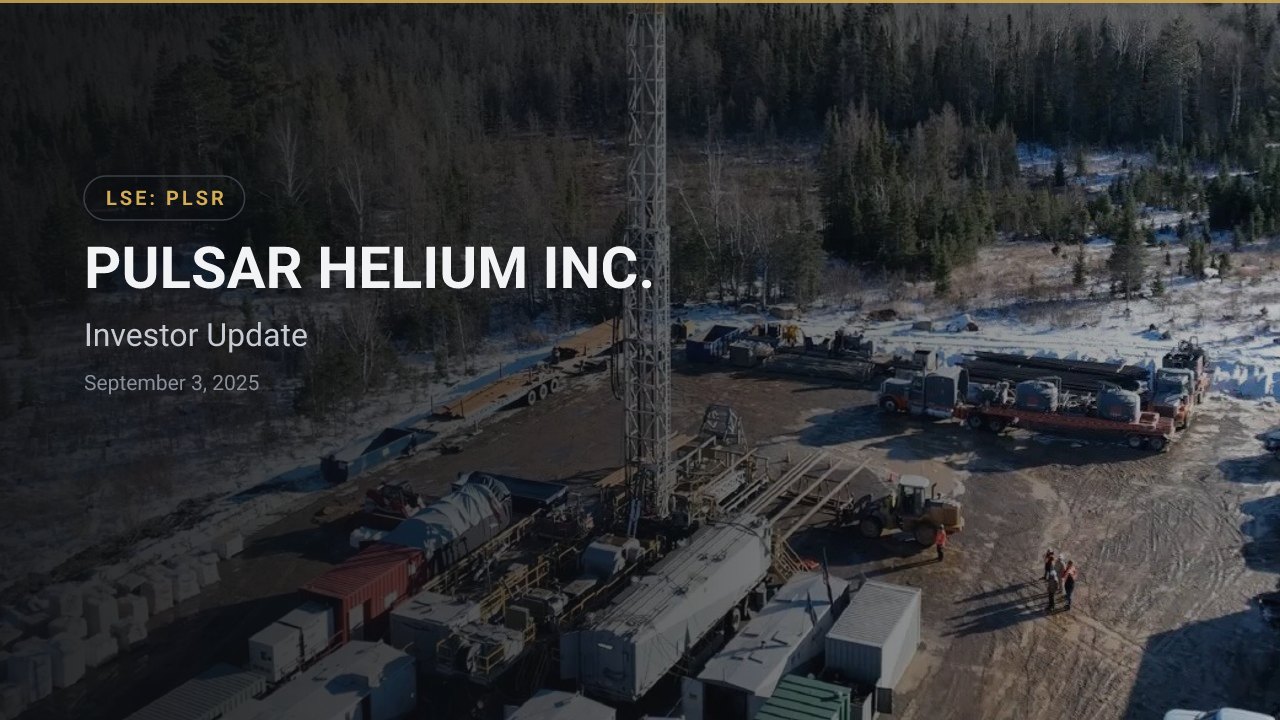
Investor Update hosted by Pulsar Helium (TSXV:PLSR) on Investor Meet Company, held 2025-09-03.
On 6ix: 6ix.com/event/pulsar-helium-inc-plsr-investor-update
Automated transcript · Written by software from the replay's audio. It can mishear names and figures; the replay is the record.
0:02 Good afternoon, ladies and gentlemen, and welcome to the PULSAR HELIUM PLC Investor Presentation. Throughout today's recorded presentation, investors will be in listen only mode. Questions are encouraged. They can be submitted at any time just using the Q and A tab situated on the right hand corner of your screen. Simply type in your questions at any time and press send. The company may not be in a position to answer every question it receives during the meeting itself. However, the company can review your questions submitted today, and we'll publish those responses where it's appropriate to do so. Before we begin, we'd like to submit the following poll, and I'm sure the company would be most grateful for your participation. I'd now like to hand over to the management team from PULSAR HELIUM. Tom, Brad, good afternoon. Good afternoon. Hello, everybody. Thank you very much for joining us today. And yes, with me, I've got Brad Cage, VP of engineering as well, who'll be joining and assisting with the q and a component.
0:50 So we'll start off today with going through our corporate presentation. Look, this one is about a a month out of date. We've had a a lot of news flow recently, so I can assure you that a new one's on its its way. But it's been it's all happened very quickly recently. So
1:04 but I will be talking about some of the the new progress the company has made. So the all important legals. And then, really, I'd like to start with why does PULSAR HELIUM exist, what is our objective. And really, that is it is all helium and we have a key project in The USA and then we have a second project in Greenland in Europe. But really, broader picture is that helium increased demand for its applications very much tech heavy, so we don't talk about party balloons, that's a frivolous waste of a valuable product. But it's very much driven by the tech industry. And the current situation is thus that helium is produced as a byproduct of natural gas.
1:52 So geological reservoirs in the ground extract the natural gas And some of these have a helium component that is then stripped out and processed. And so for the end user, what we see there is that they go into long term take or pay contracts, which is the industry norm. There is no spot market for helium. And for that, there is a distinct lack of flexibility. Should somebody need more product, they can't get it. Should one of the major suppliers, of which there's not that many, that go down, then all end users are impacted. There is no flexibility. So what we do is we specialize in primary helium occurrences. And these are geological reservoirs in the ground where helium is the primary economic driver, not hydrocarbons.
2:39 And so these do exist and we've got our flagship project, Topaz in Minnesota and then Tunu in Greenland. And so the overall ambition is to become a producer and to provide that flexibility to the market that doesn't currently exist. So why invest? So what we have is, as I mentioned, primary helium occurrences. I'm going to focus today on Topaz in Minnesota in The USA. That one there is a new discovery and it's extremely high concentration. So helium content up to 14.5%. You could think of helium a bit like, say, precious metals where you never get a pure occurrence in the ground. It's always diluted with something else.
3:25 So for helium, that's the case. And with it having over 10% helium is quite astronomical, to be honest, when you consider that current producers or the sort of industry expectation to go into production is anything above 0.3% and then up to around 1% helium in the gas stream. So to get to double digits, we're off to a tremendous start. Looking at both continents, Europe and The USA, but as I say, focusing on The U. S. Today. We're looking towards production. So we have an agreement in place with a company called Chart Industries and they are looking at the plant design and different sensitivity analysis around that. And ultimately, the objective is to have Chart construct a helium and CO2 co production plant for us.
4:15 Board and management, so myself, I'm a co founder of the company, been here obviously since the beginning. And my colleagues have been here for a long time as well. We hold roughly about 32% of the company's issued capital. So we certainly have a vested interest in the company's success. And why HELIUM? It's a very valuable product and it's small volume. So it's something which you don't need to build a small city for it to be able to go into production. It's actually quite a modest footprint and very high value. So as I say, it's not about party balloons. The big one is semiconductors, so to make computer chips effectively in the fabrication process, liquid helium is used. Another big one is MRI scanners for the magnet to superconduct in the helium.
5:03 And then for spacecraft as well, for acting as a pressure agent in fuel tanks. And then the list goes on. And in fact, really, what you want to keep really cold without it solidifying, that's one of the best ways to think about helium and its applications. And also it being completely inert, therefore, combustible, non hazardous material. So a lot of new upcoming tech applications for it. Here's a good example from Reuters. Helium demand doubled by 2,035 tracking chip production boom. And this is a problem, quite frankly, because really for the past roughly twelve years, you're seeing that helium supply globally has been very unstable. You go through prolonged periods of shortages, moments where you've got oversupply, imbalance, which is really undesirable for the end user. It's not a big component of the fabrication manufacturing process, but it is an essential one and so very hard for them to do forward planning with the commodity that is so unstable.
6:08 So the time we're talking here sorry, now is the time. We're talking here about pricing and what we are using as a unit of measurement is per metric ton. The reason for that is because we're talking about liquid helium. We're not talking about gas, we're talking about liquid. So you're looking at roughly $100,000 per tonne. And to put that into perspective, natural gas is about $184 per metric tonne. So as I said earlier, very valuable and small volume commodity. The major producers are The USA, Qatar, Algeria and Russia. So for international transportation of helium, it's in liquid form in containers. So you do not see helium in pipelines. It is shipped in 40 foot customized containers. They go on to ships, they go on to trucks and they travel around the world.
7:01 One of the issues with that is that helium, a bit like the party balloon analogy, after a few days the party balloon is deflated, it's on the floor. On a macro scale, you see the same thing. Helium is a very small atomic size and it does like to leak. So this makes it very important to have a helium source that is close to its market. You can imagine if it's being shipped long distances that a customer may not receive 100% of the product by the time it's arrived even though they paid for it. So very happy to have our main project in The US because The US is the number one consumer of helium. Roadmap to success, I won't dwell on this one, but really, it's like any other resource project, identify it, find it, drill it, get up to reserves, offtake and then produce. And so for our project in Greenland, we're at the data acquisition phase where we've identified that there is helium there, we've been able to measure it. Whereas in Minnesota, at Topaz, it's more advanced. We have a resource. We have drilled it. It has flowed to surface.
8:05 And so now the objective is to determine the size of it, the volume of the occurrence, and then to start converting that into reserves. In order to get to the reserve stage, you need to show that it's commercially viable. So you need to have that development plan and also offtakes in place. Okay, zooming in on the Topaz project. We are in Northern USA, Northern Minnesota, not too far from the Canadian border. And this is a new occurrence for helium. This is not a piece of ground that's been looked at 100 times. We are the first mover there. And so to date, there have been two wells drilled for helium. And what you need for production of helium, which is why this area we're so happy to be working here, is that two key pieces that you need for infrastructure: one is roads, because the helium goes out in the back of a truck and there's a very good road network here with highways nearby.
9:02 And then the other one is electricity and that's also present in nearby grid power and the majority of that comes from a hydroelectric source. So, those are the two things that you need. The other thing that you need, of course, is a supportive legislation. Last year, Minnesota put in place new legislation for helium, hydrogen and CO2. And so that certainly helps to give us certainty moving forward as we look towards production. And where we are, we are on private mineral rights that we hold exclusively. So what we've done here is we've drilled and we have a resource estimation here. And I have to emphasize, this resource is based on one hole in the ground one hole.
9:47 So one well drilled and then with some of the supporting geophysical data. And we have a P50 gross recoverable helium perspective resource of 400,000,000 cubic feet, which granted is rather, you know, big ugly number. What does that mean? The world uses 6,000,000,000 cubic feet per annum, to put it into perspective. So with we used a group called SPRAWL, an independent third party resource estimator, The USA office in Denver. They came up with the resource figure. They also gave a 65% chance of commerciality, once again, based on one well. So I'm very excited to see what happens when there's two, three, four wells included in the resource. Jetstream number one is the name of the well used for the resource.
10:35 That one, we got helium concentrations up to 14.5%, ranking that as the highest helium concentration discovered in North America. So building on the success, so what we've conducted is we've deepened jet stream number one, and that was to go through the entirety of the interpreted helium bearing zone, so going deeper through that entire zone, and then drilling a step out well, jet stream number two. And then with all the data that's being received from them, that is going off to Chart Industries for them to put into their modeling for production plant design. And really, the objective is to move Topaz to a development ready stage by mid next year, and that's what we're working very hard to achieve.
11:22 So here is a seismic cross section of where we've drilled. And so the colors here, green basically means that is the area of interest where we're seeing the helium bearing zone, and red is not so much of interest. So what we see is the seismic velocity decreases in the area where it's green, and that becomes coincident with where we're seeing the helium gas. The two well traces that we see here, these are Jetstream one, Jetstream two. Jetstream number one, where the resource was conducted, is on the blue component. So just the blue, the top of that well string, that is what the resource was conducted on. And then the red beneath that is the deepening that we conducted earlier this year.
12:09 And we then recently just completed flow testing on that one. Very pleased to see that, I must admit. So we more than tripled the natural flow rate that we received from last year to this year. So the improvement of going deeper is evident. And then we did some compression testing on that as well. And we got up to a flow rate of 1,300,000 cubic feet per day. So this is, for us, a result that we are incredibly happy with, a stellar result, to be honest, when you couple that with the high concentration helium that's there. Jetstream two, we went to go into the cleanup job on that one. And what we're finding is that the pressure was building up on the well, so we measured that at the wellhead, but the flow is being restricted.
12:54 So that is currently being reviewed. We need to find out exactly why we're not having that lack of performance. Is it because the wellbore is obstructed somehow? Is the reservoir itself? The work needs to be conducted. So we should have an update for the market in due course for that one. And then with the jet stream number one,
13:14 with the gas samples that were taken, we announced this, that a number of samples have been sent to the laboratory. These have not yet been received. As soon as they've been received, then of course, we'll update the market with that. We've also just announced, so with the recent capital raise and the majority of the funds for that are being allocated to drilling additional wells at Topaz this year, drilling up to an additional 10. Now the reason for this is increasing the size of
13:46 the resource is the primary reason. So you can appreciate with two wells drilled close to each other that the area of influence is quite restricted. So what we need to do is we need to increase the resource size so that we then have all the key data to be able to say, okay, we can fit that into modeling for any production scenario building. So we will be starting the drill program at the end of this month. And then we'll be going on and, yes, as I say, drilling up to 10 wells. And it's going to be quite an exciting time. So every few weeks, we'll be having another well completed. Chart Industries. So a little bit of background on Chart. Chart is effectively the gold standard for industrial gas equipment.
14:35 So we're very happy to be aligned with them. So we signed an agreement with them back in December of last year. We've been working together since. We've been giving them the data.
14:47 And now that we're waiting on the last pieces of information from the Jetstream one and two program, we'll be giving it to them as well as the updated information from the new wells as it comes in. And then they'll be working on, yes, production scenarios based on their equipment and tailoring it exactly for the Topaz project.
15:06 We have seen in the past that with other companies that have gone into production for helium that it hasn't been terribly successful. We're very much aware of that. So what we're looking to do is, obviously, we want to get to the stage of getting to revenue. But as I said, we've drilled two wells. We know that we need to drill a little bit more. So the objective is by middle of next year to get to that point where we could say, all right, can we now potentially pull the trigger to go to production? And what we want to do is we want to make meaningful production and do it properly so that we meet our production guidance. So aligning ourselves with Chart, I would be able to say with confidence that should they say the plant will be able to produce X, that it definitely will be able to produce X.
15:55 They've got a very strong history. And also, one of their major fabrication facilities is in Minnesota, just down the road from our project. So it's a tremendous fit. But no, we're certainly looking at when we reach our objective, getting to production to be able to get into meaningful production, not just something that, you know, is just a blip, but something which I think this resource deserves with the high grade nature of it. Okay. So now just touching very briefly on Greenland. So we have a project on the East Coast, so European facing.
16:30 It is we're the only company that's identified helium in Greenland, so first mover. So once again, with the legislation in Greenland, they were very supportive of this. And Helium is very much in the license documentation, giving us the ability to move forward with this project. I have to say that, of course, because Topaz in Minnesota is more advanced, that's where we're deploying most of our capital and efforts. However, we have identified helium in Greenland. And we've also identified that coincidentally at the same location, there is a very high heat gradient.
17:07 So we've contracted SPOOL ERCE to conduct a pre feasibility study on both helium and the geothermal energy potential, and that report is due actually very soon. So once that's received and being reviewed, we will then be updating the market with that too.
17:26 I've got a very capable team, that's for sure. So it's and I'm very pleased to have Brad joining me today. So you'll hear from him shortly. But, yeah, look, with our Chairman, Neil Herbert, he's been very successful in the, I guess, could call the boutique commodity space, which helium probably falls into.
17:46 And he's had quite a lot of success in the London markets. Dan O'Brien is our Financial Director. He's based out of Vancouver. We've got Michael Sturdy, our General Manager of Operations, who's been overseeing the drilling today. We've got Nick Schofield, sorry, Professor of Nick Schofield. So he's a specialist in igneous gas and petroleum systems. And then we've got Mark Farrington, who's Head of our PR and Partnerships. And really, think we'll leave it there, but that's the formal part of the presentation. And I'm now happy to allocate as much time as necessary for Brad and I to answer your questions. That's great. Thank you very much indeed. Well, thank you to everybody for your engagement this afternoon. Tom, I might have to hold you to that. So get comfortable. You have lots of questions to go through.
18:37 Let's start off with some that we had sent in ahead of the event. At what stage can we expect an update on gas composition at the reservoir and the reservoir size and scale at the Topaz project. Do you have an idea on the project's production longevity yet?
18:53 Do you want that one, Brad, or do want me? Sure. No. I can take it. I can tell you that we should have an update on the gas composition here in the next couple weeks. So we should know that information with the additional reservoir that we encountered, how that changed the the composition from what we tested last year. Along with that, as Tom had mentioned, we had done testing, and we are in the midst of concluding, the pressure testing as well. So we should have an update on what the updated size of the reservoir might be
19:27 as far as, you know, project longevity. You know, we're we're still a ways from that, you know, as we're still learning more about the reservoir. But very soon, we should have additional updated information. Thanks, Brad. Can you can the upcoming multi world drill program be across the new acreage that was announced yesterday? It's not our intention. Oh, I guess the answer to the question is, can it be? Yes, it can be, but that's not the intention. So really, the focus is on getting Topaz up to get to that investment decision point by mid next year. But what's this this new acquisition or this new potential acquisitions yet to be finalized, but what that gives us is additional portfolio of highly prospective ground. So we've been operating now for a number of years in in this part of the world, Northern Minnesota.
20:17 And what we've been able to do is we've been able to say, okay, we now
20:20 understand what is the helium system, how does it work, and this opportunity came up to acquire this potential ground and it really fits in with the modeling that we've conducted. We deem it to be highly prospective and I guess the best way to look at it is that could be the growth potential for the company. But at the moment, the drilling and efforts are all going to realizing Topaz's potential. Thanks, Tom. For publicly listed junior E and P companies in North America, what does it terms to be the only company with access to the world's highest grade helium supply?
20:55 And how does this translate into production advantage or maybe other tangible benefits? Well, look, I mean, on a single well basis, we came out as the highest helium concentration found in North America, so it's extremely pleasing. But, you know, look, we're not yet producing. But what I can say is that, like any commodity, grade is king. And so the benefits are that we can see is that the amount of gas that needs to be processed in order to make x tons of helium would need to be less than if the grade were less. So that could have a positive knock on effect for operational costs. The other thing is, is that when it comes to how much gas, what the volume of gas is that needs to be found in order to substantiate going into production could be less. So the overall gas in place would be less than, say, if the helium concentration was 0.5% or 1%. So therefore, your exploration expenditure could be less or the duration could be less.
21:58 Thank you. Turning, I guess, to Jetstream one. There's lots of lots of talk about huge flow rates. But what about the concentration of the helium? Is it as good as as it was before?
22:12 Do want that one, Brad? Oh, there we go. We'll know shortly. Like I said, we're about to get the composition results back, and so we'll have an idea here in the next few weeks. Thanks, Brad. Is the production plant agreement with Chart Industries still valid with the acquisition of Chart by Baker Hughes? Yeah. Look, is, well and truly. So obviously, when I found out about the news, I quickly got in contact with them to see what does it mean. But no, it's all systems go. And good luck with this one. Lobbied Have the Trump administration directly for a consideration in The US Critical Minerals Program? What I can say is that with both sides of the political spectrum in The United States, we've invited everybody to site. So it's been seen from local legislators, senators, congressmen, all walks of the political spectrum. And what I'm pleased to say is that, you know, the it's effectively unanimous that this can only be a good thing to have a new helium discovery for The United States.
23:19 So I would call it politically agnostic. And as far as, you know, with the critical list, we'll see what happens there. I mean, it's still got potential to go onto the list, but we'll wait and see what happens. Thank you. How many wells are to be drilled with the funds raised? Up to 10. Great. Thank you very much indeed. How will rock dust be avoided in the drilling of the wells or the next wells? Right. So after evaluating what had happened in the original Jetstream one and the deepening in the Jetstream two, we've talked with some other experts in the industry as far as the technique that we're using, and we feel that we have a couple of avenues available to us as far as mitigating and minimizing the drilling fines in the future. So we have some new techniques that we'll be deploying when we drill the wells going forward. And also, given some of the success that we saw with the remediation, we have some end of well techniques that we will be deploying as well that will take care of the drilling fines moving forward.
24:34 Thanks, Brad. Have the issues with the MN Department of Natural Resources as well as the health department been resolved for now and for future drilling and exploration? I wouldn't say that they're issues. It's we've got a very good working relationship with them. And, yeah, we've had the ability to do everything that we've wanted to do. So it's you know, with some of this, you have to appreciate that this style of drilling and this style of resource is new to the state. The state doesn't have a history of oil and gas, but we've obviously seen their support with the legislation that's being passed, the new regulations that they're working on as well. But But otherwise, at the moment, we work under the existing regulations that are already in effect. And look, Brad, do wanna elaborate on it? Because yeah. It's Yeah. I mean, like like Tom said, they're they're they're moving forward.
25:27 For any of you that weren't paying attention, there was a lot of turmoil this year in the legislative session in the state of Minnesota. So, unfortunately, a lot of the things that we were hoping would be remedied and taken care of this past session were not. And so they kinda got pushed into '26, but they they are like Tom said, they're still working forward and moving forward with it. It's just some other things from the legislative standpoint got got in our way. But at least we've got good relationships with the departments, they are they're working with us and they're trying to get this done as quickly as possible. Thanks, guys. Question from Peter. The acreage you are looking to acquire was deemed as hydrogen acreage. What are your thoughts on that comment? Yes. Look, I think there is potential for bit of hydrogen. To be honest, this whole part of Northern Minnesota, this hydrogen potential there, you've got the right geology.
26:22 However, area that we've got under option now, I actually think that it's it's it's really good for helium. So the reason I say that is that, you know, as I said, look, we've lots of experience from the area. But underneath, there you've got a sedimentary basin setting, and I'll try not to turn to geologists on here, but you got a sedimentary basin. Then underneath that, you've got this incredibly old granitic rock there, which we know is the source rock for helium. And so you have potentially helium accumulations then going up into the sedimentary basin and then getting trapped in a conventional conventional sandstone reservoir and that we know that that particular basin doesn't have hydrocarbon potential, which is a big tick for us.
27:08 And we also know that it's got some good ceiling units as well and it's tectonically stable. So all of those things together, we think that it's a good hunting ground for helium. Great. Thank you very much indeed. Jetstream one has helium concentration up to 14.5%. But what is the average concentration level that one could expect for commercial production? Up to date, right now, we've seen an average of around 10%. But that all is going to be, you know, changing potentially here with the new composition testing since we've got more reservoir that we know is contributing. But we don't expect it to degrade massively.
27:55 Okey dokey. Got a question here around the potential purchase of Quantum Land claim. How far exactly is the location from Topaz? And follow on from that, also Quantum has previously reported that it had done shallow soil gas sampling and possibly some gas chromography. Did they detect any helium in their testing? And are there any plans to test the well during the one hundred and twenty day due diligence period? Yes. So the ground is it starts 30 foot 35 kilometers to the west of Topaz and then extends for a further 150 kilometers to the west. With the work that they have been conducting, they've been effectively probing the the surface. So they haven't gone deep into it.
28:41 So and they've been focused on hydrogen, so they haven't had helium readings. So that style of exploration has not been applicable to what we'd like to achieve. Great. Thank you. A question from Nicholas, Northern Minnesota investor. Northern Minnesota is an area that's been left barren since the death of The U. S. Mining industry. Do you plan to continue collaborating with Minnesota based companies for engineering work and general labor? Brett? Yeah. I mean, we we have a good relationship with Mining Minnesota and with Twin Metals Resources and a a number of other companies that are up there and working with them on and, you know, leveraging their experience and helping us out. So we would obviously be willing to help, you know, work with the labor force that's up there that's existing, and, you know, where draw from whatever experience that we can.
29:36 Obviously, some of the engineering side is gonna have to come from the oil and gas sector, like someone like myself, because it's it's there's a lot of things we do that is different from what the the mines have been used to operating under. But there's definitely some some cross discipline, and cross industry expertise and information that we can we can work with them and work together. I'd also elaborate on that too by saying that with this this recent drill contract that we just announced. So that contract is coming out of Northern Minnesota. So they're actually coming from the town of Virginia. So not the state, but the town of Virginia. And so it's quite neat because at the end of every twelve hour shift, they'll be able to drive back home and sleep in their own beds instead of staying in in the, you know, in the the camp. So we do really try as much as possible to utilize the local workforce apart from, as Brad says, when it doesn't exist because it's just that lack of oil and gas history there.
30:35 Thank you. Did PULSAR ever measure helium three concentration at Topaz? Yeah. Look, we've obviously, it's something which is quite topical out there. One thing I will say is that helium three is actually quite a difficult one to get a true analysis for. It's not just, hey, give it to a lab and, you know, what have you got type thing. It is quite a difficult one. So it's it's something that is it's it's a curiosity for us. I mean, at the the end of the day too, like, the processing technology to get it out, you either strip mine the moon or you process an ocean of gas to try and get the helium three. So I think there's still some engineering feats that are there required.
31:20 But, you know, maybe with a bit of r and d, it could be there. But what I can say is that we do intend to do an isotope analysis on the gas samples that Brad's been talking about. So the first step is a commercial laboratory for the helium four, which is readily assayable, so that's easy. But the helium three, there's a layer of complexity. So samples will then go off to a most likely to a university that's got the the high end equipment to then be able to give us those helium three readings. So watch this space. If there's something interesting there, we will let you know. Thank you. Question from Ron. Ron asks, has air drilling been the issue with j two? If yes, will you move away from air drilling? Yeah. We we do think that the way we did air drill, deepening the the jet stream one and the jets and drilling the entire jet stream two did cause some of the problems. However, given our bottom hole pressures, we cannot completely move away from air drilling.
32:18 We don't have that option just with the hydrostatics involved. And so, like I said, we were going we'll we'll be modifying our drilling techniques. We'll probably go into more of a misting system and then some other changes we'll make as far as the drilling assembly as well. During a traditional drilling operation, the the drilling we've got coming up is gonna be a different setup as far as how we're doing it and why we're doing it. But moving forward, yeah, we we do have plans in place to modify that will mitigate things, but we can't completely move away from an air system. We can just we can make some changes that will will help, things in the future. Thank you, Brad. Okay. There's currently a moratorium on gas production in Minnesota under new legislation. Any estimates on when that regulatory process might be finalized and that moratorium lifted?
33:12 Yeah. So what what that had was a a two year process to come up with the regulations. And so that's why we Brad mentioned the next legislative session legislative. Sorry. And so so that one next year. And look, considering that we're not looking to start producing next year, I think that would be highly unlikely. I mean, really, it takes twelve to eighteen months to fabricate and commission the helium plant. And in the middle of next year, we're looking to be aiming to be at that point where we could then say, okay, we can start the process. So really, look, I don't see that having a material impact on us because any production would be after that moratorium is lifted. So and we have the full ability to do all the exploration work, seismic, gravity, drilling, well testing, everything. So no concerns there.
34:03 That's great. Thank you very much indeed. A couple of questions from William and Sugeman. I think they've kind of been covered in some of the other questions. So I don't want to duplicate things. But of course, we can add responses should there be any other questions that we need to address. So that's everything from the investors on today's call. Thank you to everybody for your engagement this afternoon. Tom, I know feedback is particularly important to you, and I will shortly redirect those on the call to give you their feedback. But before doing so, if I may, just ask you for a couple of closing comments. Yeah. Certainly. Look. Thanks everyone for attending because this is really an exciting time. So, yeah, look, earlier this year, we drilled Jetstream one and Jetstream two. We then had a very unfortunate delay while waiting for the well cleanup as well. Four months or so. But what I sincerely wanna say is to everyone is that I think you've seen that now, the well cleanups there. We've got fantastic results from Jetstream one.
34:57 And really, we've been using that time very wisely to plan the next phase, which is now commenced with the drilling, the additional land acquisition, the work with Chart Industries, the gas samples to come. I think that I would be surprised if PULSAR HELIUM wasn't the helium company with the most news flow out of all. And I'm just really so pleased because of that high helium concentration and now seeing an increased flow rate and to see what that deeper reservoir zone in terms of composition. I mean, know I'm biased, but hey, I'm the third largest shareholder in the company and I couldn't be more excited. Well, on that positive note, Tom, thank you very much indeed. And Brad, thank you for joining us this afternoon. If I could please ask investors not to close this session as we'll now automatically redirect investors on the call to provide their thoughts and their expectations.
35:50 It only take a few moments to complete, but I'm sure it'll be greatly valued by the company. On behalf of the management team at PULSAR HELIUM INC, we'd like to thank you for attending today's presentation, and good afternoon to you all.
Follow Pulsar Helium, Inc. into a list and get an email when it puts out news.
CEO at PULSAR HELIUM INC.
Vice-President Engineering at PULSAR HELIUM INC.