Simon Deacon
CEO at LIGHT SCIENCE TECHNOLOGIES HOLDINGS PLC
Replay available
Results and Company Update hosted by Light Science Technologies Holdings (LSE:LST) on Investor Meet Company, held 2024-08-05.
On 6ix: 6ix.com/event/light-science-technologies-holdings-plc-lst-results-and-company-update-3
Automated transcript · Written by software from the replay's audio. It can mishear names and figures; the replay is the record.
0:01 Good afternoon, and welcome to the LIGHT SCIENCE TECHNOLOGIES HOLDINGS PLC Investor Presentation. Throughout this recorded presentation, investors will be in listen only mode. Questions are encouraged, and they can be submitted at any time using the Q and A tab situated on the right hand corner of your screen. Simply type in your questions and press send. The company may not be in a position to answer every question received during the meeting itself. However, the company can review all questions submitted today and publish responses, which is appropriate to do so. Before we begin, I would like to submit the following poll. And I would
0:32 now like to hand you over to CEO, Simon Deacon. Good afternoon to you. Thank you very much, and good afternoon, everybody. Welcome to LIGHT SCIENCE TECHNOLOGIES interim results and company update, August 2024. Contents, controlled environment of agriculture, CEA, contract electronics manufacturing, CEM, and the passive fire protection, PFP. We'll be going through these key three divisions in in four companies. Jim will be talking about the consolidated financial results, and I'll finish off with the group strategy and outlook. There's two slides of disclaimers. Please read these, when you have time.
1:20 So introducing the team today presenting, is Jim Snooks, CFO and company secretary, Andrew Hemsall, COO of the company, and myself, Simon Deacon, CEO of the company. I'm gonna play you a short video just to introduce you to the company and the three key divisions that we work have people interested people who in world. World.
2:08 We have have a over thirty years experience in two businesses, LIGHT SCIENCE TECHNOLOGIES and TOMTECH. We provide turnkey technology solutions that use real time data to create the perfect recipe in any growing environment. From our award winning hardware solutions like SensorGrow and NurtureGrow to our proprietary control systems and performance monitoring platform, we combine cutting edge software with our in house UK manufactured hardware to improve productivity, increase plant yield, cut costs, reduce wastage, and extend the growing season. Whatever the plant, whatever the environment.
2:48 Within contract electronics manufacturing, we own UK circuits, a twenty five year old business and world leading player in the field. UK circuits supports clients at every stage of the procurement lifecycle right through to expert technical support. From printed circuit board manufacturing to finished products, we work with a broad range of partners both within The UK and globally and service blue chip customers across multiple sectors including robotics, lighting, fire safety, sensors, pest control, and audio systems.
3:23 Within our passive fire protection division, we own Injecta Fire Barrier, The UK's first independent approved installer of the patented InjectorClad system. InjectorClad is an acrylic based graphite sealant that can be swiftly injected into building cavities, blocking fire and smoke spreading throughout a building structure. It is suitable for installation across all types of building cavities. Using InjectorClad, we can work towards ensuring the existing structures are safe, protected, and meet the latest fire safety regulations, giving peace of mind to owners and occupiers. Following the Grenfell Tower fire, fire safety act of 2021, and the building safety act of 2022, there are over 11,000 buildings in The UK which are labeled as high risk.
4:09 Passive fire protection is more critical than ever. At LIGHT SCIENCE TECHNOLOGIES HOLDINGS, we combine British manufacturing, innovation, cutting edge technology, software, and expert knowledge to solve some of the most important global issues that we face today. Right. Just to to move on to the key financial and operating highlights. We grew 19.3% between twenty three and twenty four half years up to £5,200,000, a really good growth rate for this half year. We've got £51,000,000 worth of quoted pipeline and sales opportunities, and we've got a committed group forward order book of £5,200,000 and some of this going into 2025.
5:07 The key here was and one of our key management focuses and strategy has been increasing our margin, and our gross margin has grown from 20.9% to 26.6 in this period, which we're really pleased with progress. We've also seen cash and cash runway of just over £1,500,000 with an undrawn debt facility of 500,000, and we've also enhanced our group debt facility with Close Brothers of 850,000. So it's put us in good shape for for this year and next with a good cash runway. We've reshaped the group with revenues and profits following the two acquisitions late last year with Tontech and Injecta Fire Barrier.
5:58 And we've also brought on two new board members, doctor Graham Cooley as the nonexecutive chairman and Richard Mills as nonexecutive director, both bringing an awful lot to the party with doctor Graham Cooley having huge experience of the city, and Richard Mills, managing director of Haygrove, got huge experience in the control environment of agriculture and supporting those with helping us create partnership and distribution agreements globally for the CEA market. Moving on, we've got three growth sectors, so three key divisions with four companies. We've got Tom Tech and LIGHT SCIENCE TECHNOLOGIES the controlled environment of agriculture, both award winning. But the key here is that Tom Tech's got thirty years of experience.
6:51 So now we've got over thirty five years experience in the controlled environment of agriculture, providing technology from sensors, lighting, control systems, irrigation, and installation, and we've got award winning smart technology that we've won also.
7:09 At UK Circuits, in the contract electronics manufacturing side, up in Olden, we continue to grow this business, and it's our key manufacturing and quality. And we provide products to the finished state, so not just SMT boards, but also finished products. And then Injecta Fire Barrier, our our new business acquired at the end of last year in Passive Fire Protection, the first independent installer of the Paterson injector clad cavity fire barrier remedy system. The group's overview revenue was 5,200,000. Customers, 250 plus clients and 75 employees.
7:57 So what's driving the opportunity in the market? We talk about a large volume of market opportunity of 100,000,000,000, and I'll break that down so that you can see our focus on what we're working on. In contract electronics, the focus is 2,300,000,000 up to 2020, and this has been growing due to the reassuring of manufacturing back to The UK and Europe. And we've seen this since the pandemic, and this continues today. We've also, in the passive fire protection with injector fire barrier, got a a market opportunity of £50,000,000,000. There is over 11,000 buildings which are over 18 meters tall, which are high risk, and 33,000 buildings, which are between eleven and eighteen meters, which need remedial work doing on them and correcting for to make fire safe.
8:52 And in the controlled environment of agriculture with Tom Tech and LIGHT SCIENCE, the opportunity is global at 47,000,000,000 and growing at 11.3%
9:05 AGR. So it's really important to see that up until 2033. It's really growing, and there's global opportunities which we're taking to our strategy through distribution and partnerships. Moving on, what's gaining those trends is government policy worldwide. In the CEA market, it's very much about extreme weather, advancing in technology and dietary shifts. You know, we all worry about food security. Where's our food coming from? And with extreme weather, we're seeing this harder globally. We're either seeing fires, droughts, awful lot of rain in one area at one time, and it's becoming harder to grow in open agriculture. So providing the technology that we provide in the turnkey solution in the agri tech side is really important to help this. We're also seeing a growing population and dietary shifts, and this is all driven by government policy.
10:02 If we look at passive fire, this is driven by the building and fire safety acts, which is driven by government policy. And if in the CEM side, we're seeing shipping being more difficult because of the conflicts around the world, and so we're seeing a return to manufacturing here in The UK. So let's talk about the controlled environment of agriculture in the CA market with Tom Tech and LIGHT SCIENCE TECHNOLOGIES. Global smart opportunity in agriculture is 47,000,000,000 and CAGR of 11.3% up in 2033. The grow light sector is growing at 1,700,000,000, and we manufacture a range, a suite of products in lighting to create a recipe of light, and this is growing at 21.1% up until 2025.
10:56 So it's a key market for us with our grow light sector. In the agricultural sense sensor side with our sensor grow product, it's 2,000,000,000 pounds up to 2026 and a CAGR of 11.4%. So it's a really key growth for us, and we see agricultural centers being sensors being more important globally to actually control and bring in the data so that they'll be able to control what happens with our control systems, which I'll come on to.
11:26 Current quoted pipeline is 43,600,000 globally for the CA division, and we've got a turnkey smart technology solution providing integrated systems for lighting, sensors, and environmental controls. Our global focus is due distributions and partnerships, and our focus is America, America's East, Middle East, and South Africa and Australia, really key growing countries where we're focusing on creating partnerships. And you would have heard more recently, we signed a South African partnership with AgriLogic over in South Africa and quoted over £500,000 worth of work for them, and we see this as a key part of our strategy.
12:14 Our clients that we're working with, some of them you would have heard of, Tiptree, Berry Gardens, who turn over £300,000,000 worth of fruits here in The UK, Bridge Farm, Zenith, Dyson Farming, we're currently doing a grant opportunity with Tripp, opening open agriculture, and Haygrove where Richard Mills is the managing director of Haygrove and he's supporting us with partnerships globally. So what does this look like? We talk about SensiGrow and its features, and why is it so important? It's really important to see what functions it does. It creates air zones, so light, temperature, c o two, humidity, and pressure.
13:00 But also with the key factor, it has pucks within it, and it's battery operated. And this battery can last up to two years in operation. And then we take it out, refurbish it, and install it back into the marketplace. Lara Wan provides the communication, and that's possible up to 10 kilometers away. And that's really important if you're working in indoor environment or outdoor environment because there's no cabling required. We're actually got a UKRI grant for sensor development as part of the Dyson trip project to monitor greenhouse gases and nitro oxide's n two o, and also to monitor root zones, which are soil temperature, soil moisture, soil electro conductivity, and soil pH.
13:50 And the future development here is methane and ammonia. Ammonia has uses up 44% of the power and energy required to create it globally for agriculture. So these are really two key things, methane and ammonia and nitro oxides that we're creating in this sensor, which takes it further afield, just in enclosed environment, but as you see
14:17 in the picture on the right hand side, into open agriculture, water courses, and eventually towns and cities as we open that up, and it's monitoring the environment that we live in. So bringing this together, we also created our own software. In the right hand side of the picture, you will see a dashboard where we've created our own software so that this is live data coming from the sensors. And then from that software, it goes to our control system. This is all done on cloud storage, and we can then analyze this data to create the right growing environment in an enclosed space. From an outdoor opportunity, we can stop the wastage from how much fertilizer might be putting on the ground or nutrients.
15:05 So we're actually saving energy, time, labor, and the cost of actually going over fields for whatever crops that you might be planting. So this is big data. It follows through with AI technology for the future, so you're starting to learn what's happening in your environment. And the future will see more automated growing facilities with less people within them as robots pick fruit or or pick the produce, and measurements are done by data and controlled by a control system. So it's got the perfect environment that it's growing in. So this is real time and creates historic data as well with an interactive dashboard. Thank you, Andrew. So moving forward, what does this provide in the CEA? What are we providing in products?
15:55 Well, I've mentioned about the sensor, which you see here on the left hand side, and our software creating AI in the future with our our screenshot of a mobile phone there in the middle. And our acquisition of Tom Tech brought in the actual control system. So if you're reading the data, the software is then telling you the parameters that you need to to create within your your glasshouse. The control systems then react and open and close the valve, so it will control heating. It will control misting. It will
16:27 control the light. It will control how much dosing of pH and nutrients need to go into the soil. So it's that automated process that we're providing, which is the recipe for not only just the light of the for the crops that you require, but the environment that you're growing in. On the right hand side, you'll see a lab, and that lab we work in conjunction with universities so that we can recreate your growing environment and set those parameters for you so that
16:57 you can grow tomatoes, strawberries, salad crop, whatever crops that you're growing, we can give you a recipe for your environment to control what's happening, and you've got real time data to save you money to increase the yields, but also to extend the growing season. Thank you. At UK Circuits, based up in Manchester, contract electronics manufacturing division, the CEM side, this company goes from strength to strength. Next slide, please, Andrew. And in that that market, we we see in the market of opportunity of £2,300,000,000. And and the reason is that since the pandemic, we've seen a lot of more manufacturing return back to The UK and Europe, and this is due to the uncertainty in the world and shipping lanes being blocked,
17:50 but also the carriage and shipping increasing and the cost. So we're seeing a lot of return to UK manufacturing. A lot of our clients who might split their orders with the Far East and The UK have now switched that over, so more product is being produced in The UK. As I mentioned, we don't actually just make an electronics board here. We actually make finished product for customers.
18:12 So we continue the investment in new equipment. We've got two automated lines now on our surface mount technology, and we're looking to implement a third. And we've also seen a real strong performance in our pest control sector and audio sector as well. So the sectors that we we work in are pest control, sensors for fire and gas, audio, lighting, robotics, and more recently, sports entertainment, which is a new sector for us where we're actually putting circuitry into golf balls. Some of the customers that we work with next, Andrew. Our Sandsonix, Cloud, Rent A Kill, very blue chip client, where we've been working with them for well over twelve years, FlameFast, who do sensors for gas and safety, switched to CalX,
19:10 and more recently, Put Shack, who are these and where the the golf balls and electronics are going into these golf balls. And we recently received an order a couple of months ago, which we fulfilled, which was our first order, and now we've risked the second order, which in total we've done 10,000 units for Butch Shack. So it's really important to see that we're getting clients now from a new market building up to being a solid client, and potentially could there could be a million pounds. So this business has been going for twenty five years. We've got a fast turnaround for our clients so we can turn around products quickly, got turnkey solution from designing a product to actually boxing up and making it and shipping it to a distribution center. It's got high quality volume manufacturing facility here.
20:00 We're you proud to be a UK manufacturer, and we're accredited provider. Moving on to passive fire protection division or PFP.
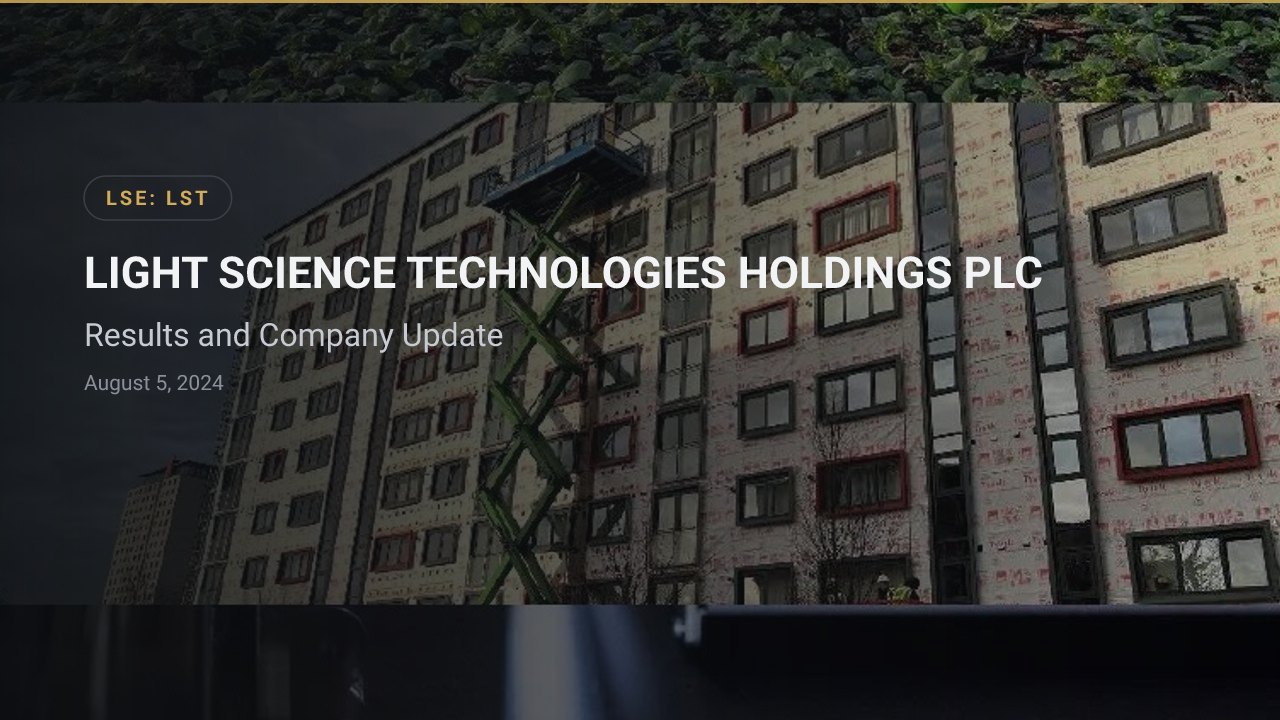
20:14 This was an acquisition we did towards the end of last year. On the right hand side, you see a typical building that we're doing in Manchester Salford area. It's 25, 26 stories high, and this is a very typical building that we're doing. It's in apartments, and this is really driven by the fire safety act of 2021
20:37 and the building safety act of 2022. As I mentioned earlier, it's a 50,000,000,000 potential market opportunity, and that's because there is 11,000 buildings over 18 meters which are high risk, but also 33,000 buildings which all need so many remedial work doing on which are between eleven and eighteen meters.
21:01 This work is is is carried out without having to disturb the occupancy of any building, so it's minimal disruption. It's cost effective, less waste, more environmentally friendly, and also is very much a much lower cost to do the work than it would be to do traditional fire stopping where you might have to take down the facade and put traditional fire stopping in and then brick it up or whatever the cladding is on the outside of a building, which takes three times longer and cost at least six times more. This is near term cash generative with strong margins for the group. And what we're looking to do here with InjectaFire Barrier is also adding our technology side where we put sensors into the cavity.
21:53 So it protects and is censoring
21:56 actual fire and smoke within a cavity rather than it being right in the center of the building. So it's an early warning system that we can provide on apps for phones, and it also can be connected to the main fire control system in the building. The contracts and quotes and pipeline, current quote pipeline for this division alone is 6,900,000 and growing. Our conversion, we've done £600,000 worth of contracts, which are in progress. And more recently, we won an order for £750,000, and that work started in June. So you can see these buildings are from hospitals, universities, student accommodation, flats, offices, hotels. They really do range, and the occupancy within them. So it's really important to see that coming through, and the margins are very strong on this division.
22:53 We're working with people like Ferguson's, Key Square, c c c CGC as partners, just to name a few that we're working with, and we're working across the country. So we're working from London to Nottingham to Manchester, all the way across the country. Installing the patent injector clad system, and we can really retrofit it into cavity barriers. We're not filling the whole cavity. We're actually putting a a sock in and backfilling this sock to each level of a floor horizontally and vertically, and this what gives you your two hour rating so that you can get out of the building safely. So that's the real key to it. It's also IFC accredited, and this is where we make sure that all the product is photographed, measured, and also GPS marked on the building of where it's gone into the building to a drawing so everybody's clear about how it's gone in and how it's installed so the quality is there throughout before it's closed up before the building is closed up.
23:59 This is all about stopping the the spread of smoke and fire within the cavity. The government set aside £5,000,000,000 to help building owners get this remedial work done. It might be a £50,000,000,000 problem, and it's going to take over twenty years to do all this remedial work, but there is money put aside to support the tenants of some of these buildings who are owner occupiers of of these buildings. We're compliant with statute regulation, enable safe evacuation of a building. Thank you. I'm gonna show you a very short video of how the Injecta Cloud system works. So as you'll see, there was a brick facade building going to come up as we move through the the building, and it could be any facade of a building, but this one's showing a brick facade. First of all, we drill holes within the mortar, and this is at floor level, and you'll see the windows above. This is very typical.
25:04 We insert steel pins throughout the mortar. We then take out the block work, the brick work every two meters, and install a sock on top of the the steel pins which hold the sock while we backfill it with the injector clad material. The block work goes back in and put in place. It's sort of photographed and recorded. And if there was a fire, the yellow there is insulation, and it filled any void which might come across. So as the fire takes hold and the flames get get go through the building, the injector clad material expands into that void, stopping the flames and the smoke spreading throughout the building. I'm now gonna hand you over to Jim Snooks to go over the half year results.
25:49 Thank you. Thank you, Simon. So I'm going to cover the, consolidated financial results, for the half year to the end of, May, and, then Simon will take us through the group strategy and outlook. Thank you, Andrew. So looking at the profit and loss, we saw a revenue growth of 19.3% from the same period of the prior year of 4,400,000 increasing to 5,200,000 of this half year. And, you know, that was partly to do with a growth in the contract electronics manufacturing division. We had organic growth there, but also the effect of those two acquisitions at the end of the last year. The one in the Passive Fire Protection division and the other, TECHNOLOGIES in the controlled environment agriculture.
26:39 We saw contributions coming through from those two divisions which started to change the balance of how our group revenue is made up. Historically, UK circuits, the platform business has been the backbone of the group, but we're starting to see that profile change and we expect to see that continue through the second half of the year and onwards into financial year '25. In terms of gross profit margins, the group margin was 26.6% in the period, up from 20.9%, for the prior period. And that really is reflective of an increase in the contract electronics manufacturing gross margin, but also reflecting those stronger margins from the passive fire protection division and the control environment agriculture division starting to come through with their revenues rebalancing as part of the group.
27:46 We managed to keep overheads in line with the prior year despite those additional costs that came with the acquired businesses. And for the first time in the group's history, we showed a positive group EBITDA for the first six months. So real sort of move towards one of the key strategies to become profitable and following on from that, cash generative. The loss before tax, we managed to reduce from 58.4% to 300,000 for the period against the prior six month period of, 800,000. So very much moving in the right direct direction right down to the bottom line. Thank you, Andrew.
28:32 Looking at the balance sheet, we had just over 1,000,000 in cash at the end of the period with undrawn debt facilities of approximately 500,000. So 1,500,000 in cash and availability on debt facilities to draw. During the period, we renegotiated with close brothers and enhanced a set of debt facilities for the group. Historically, the debt was all on UK circuits in the contract electronics manufacturing division, but we now have a group wide set of debt facilities so we can move funds freely throughout the group to underlay opportunities as and when they arise.
29:19 And as part of that, we agreed that 850,000 additional facility to underlay. So gives us really good resilience from a financial perspective, but also to allow us to facilitate opportunities through any any companies in the divisions. Looking at the program of investment through the period, in the controlled environment agriculture sector, we we invested a £140,000 in product development. That was pretty much all on the sense of growth of it. Simon took us through the functions and features of that product and how we're working hand in hand with Dyson farming under a grant to develop that to be able to pick up greenhouse gases, etcetera.
30:07 So really key points in our in our product development cycle and, you know, as part of that turnkey solution within the controlled environment agriculture with extensions into open agriculture and beyond water treatment, etcetera. In the control sorry. In the contract electronics manufacturing division, we invested 60,000 in parts and equipment to further automate our processes. Part of the margin increase in that division has come about, through investment prior investment in automation and better quality, online quality, systems and and management, and we plan to continue that through.
30:54 Looking at the passive fire division, we've just invested in a third injector pump. We had two already, and we've invested this third one post period. They cost about £30,000 each, and that will support the new contract for £750,000 that we started in June. It will also support future pipeline conversion. That 6,900,000 pipeline we've got there as we continue to convert, it will underlay that. Each of these pumps, we estimate will equates to about 1,500,000 turnover capacity. So the three pumps enable us to run capacity at 4,500,000.
31:41 Each of those pumps has a team of four five to six people around it. So you can see that we can scale, as we convert the pipeline, we can scale readily, without too much capital investment there. So all in all, real good period of progress, proper EBITDA profitable, in the right direction to become group profitable bottom line, and we you know, that's a sense part of our strategy as we move through the second half of this year and as we go into financial year '25 to ultimately become operationally cash generative. So if we can hand back to Simon to do a group overview strategy wrap up.
32:30 Thanks, Jim. So the group strategy and outlook is we're really focusing on a 100,000,000,000 and how we can convert into the into the marketplace. And TOLDTEC and LIGHT SCIENCE are really growing through, the acquisition of TULLTECH and their customer base with over thirty years of experience, but we will continue to invest in new technology and products. The SENSOR GROW product is really important and has a global market opportunity. It's so important that we are able to measure and detect c o two, n two o, c h four, and n h three alongside temperatures and humidity is really important breakthrough for the business. So we will continue to develop these products for enclosed environment, but also broad acres and also water courses and environmental programs, if it be in city centers or in towns.
33:27 We continue building a strong customer base and also partnerships and distribution globally, if that be in Australia, Middle East, Americas, or South Africa. In UK circuits, we continue to look for acquisition opportunities to complement our organic growth, invest in equipment and skills, and expanding into new markets as we've demonstrated with Pupjack and putting electronics into into golf balls. This is a strong profitable platform business been going over twenty five years and continues to grow organically year on year, and we're very pleased with with the progress now. With Injecta five Barrier, we're gonna continue organic growth, as Jim mentioned, adding extra pumps when required at 30,000 pounds per pump and the teams which are required between five and six people per pump and investing in that skills of training, but also in accreditations as we grow.
34:27 Building partnerships with blue chip companies. As I mentioned earlier, you know, the value the average value of of an order is between $203,100,000 pounds. And some of our clientele have got buildings which in their portfolio are 20 or 30 buildings, but also over 300 buildings within that portfolio which need remedial work. So being a partnership with these blue chip construction company is really important. The other added benefit is we mentioned earlier, it's strong gross profit margins and near term cash generative. So what we're looking here as a business, as a group, is to level up the revenues of where they come from. So it's not just the CEM side, but CA and passive fire protection.
35:13 And with these new key divisions in CA and passive fire protections, we will see the margins rise as well as the group revenue grow, which filters down to that key area of cash generative by the end of the year moving into 2025. We've got a strong cash runway, and we're really pleased with progress so far this year and continuing in for the rest of the year. I'm going to open the floor for for any questions, but I want to just say thank you very much for for listening. That's great. Simon, Jim, Andrew, thank you very much indeed for your presentation. Ladies and gentlemen, please do continue to submit your questions using the q and a tab situated in the top right corner of your screen. While the company take a few moments to review those questions submitted today, I would like to remind you that a recording of this presentation along with a copy of the slides and the published Q and A can be accessed via our investor dashboard.
36:08 I'm Simon, Jim, Andrew, as you can see, we have received a number of questions throughout today's presentation. And Andrew, if I may now hand back to you to chair the Q and A. Read out the questions where appropriate to do so, and I'll pick up from you at the end. Thank you. Thank you very much. So the first question relates into the Centimeters side. We'll pass this one over to Jim. So Centimeters has had a strong period now that the global electronics component shortages seem to be subsiding. What is this likely to mean for the company in the short to medium terms? Yes. We've certainly seen that that supply chain issue correcting over the last year, in particular, in six months. And with it comes certainly more stability over pricing and visibility and control over our pricing.
36:58 You know, we haven't seen the the wild sort of increases against against short supply. So, you know, beneficial effect in the the stabilizing of pricing within the market. With that, we've seen a drawing in of of forward orders from customers because, you know, they don't have to order quite as as far as period out. But, you you know, it it it it's really there's opportunities that are presenting now with some of the geopolitical issues that are going on worldwide, you know, the shipping issues in the the Red Sea, the the the some risk of China and Taiwan. So we're seeing that reassuring trend for for the for the CEM market.
37:46 And, you know, we definitely see future growth. We've been growing that company year on year for the last four or five years, and we we don't see that changing. We see organic growth. We're also considering acquisition opportunities within that within that sector. And alongside that, we're automating and training people in the division, and we're seeing that come through in stronger margins. So, you know, we see it as a as a key part of our group. It has been the backbone historically, and we don't see, you know, we don't see the importance of that getting any less, but we do see the other divisions rebalancing revenue and and profitability.
38:34 Thank you, Jim. Going for Simon here. So are you happy with the group structure, or are there any further changes to be made? With the group structure, there's always as you grow as as a group, each individual division scope to to to make changes and improve so that we become more efficient. We're certainly with the TECH acquisition at the end of last year, looking to move some of the manufacturing into our manufacturing facility at UK Circuits. This makes us more profitable moving forward and more efficient. And also, you know, when we do global expansion with partnerships as well, we'll see that come through as well.
39:19 And as we expand, we'll bring more members of the team as and when required. Okay. Thank you. We've got one on the passive fire side now. I can take this one. So it was what is forcing building owners to have their buildings remediated, and why would they spend the money? Well, we heard in the presentation how, you know, following Grenfell, you got the Building Safety Act 2022. You got the Fire Safety Act 2021, where they're really talking about sort of buildings over 18 well, between eleven and eighteen meters, banned on combustible materials, the sort of creation of golden threads. So it's almost like an an online manual of every building of that sort of size. So and and then also the requirement for a responsible person to be created who's through the building owner creates a fire risk assessment of the external walls.
40:11 And this is really our first interaction with either a building owner or a construction company where the building owner has gone to them because they built it, and they want them to do the remediation work free of charge. And then we'll get the call that says, help. We're gonna take the whole front of the building down. Is your solution a bit or an alternative to that? And then we've got a number of different warrants and fire tests that we can then go back to to see if that's that cavity has been tested, and our solution is a is a fit for that. And then we kinda go from there. Actually, there's another one about the passive fire side. So following the acquisition of Injectify Barrier, how is the integration to the group going? It's going very well, really. I think our initial focus was on getting the sort of accreditations in place. So they might be industry accreditations, health and safety, quality.
41:05 You know, bear in mind our customers are, you know, great big blue chip construction companies. You know, they need to see scale. So, you know, having those in place is really important. The PLC thing for us helps us enormously because a lot of our competitors are even smaller than us on the installation side. So it just that governance that you've got with the PLC bits is a real benefit when you're trying to sell to sort of the big blue chip builders. So that's good. Recent you might have seen more recently, we've sort of appointed an MD for that division, Sean Tasca. He's been with us a couple of months now. He's you know, we've all got day jobs in a company of this size. You know? His main one will be the sort of generation of new business as well. That's obviously driving that business forward. But at the moment, we've got sort of 14 guys on-site on two different sites.
41:55 And, you know, we've built that team and, you know, that that we can recruit quite well. As Jim was talking about the pumps, they they they're sort of three or four weeks lead time. So we can scale up pretty quickly, really, as time goes on, and we hope to have some more news on that in the near future. Okay. Let's go how are you going to capture overseas business in CA? We'll put this one through to Simon. We're capturing globally, we're capturing it through our strategies, through partnerships, distribution centers. So the the key thing for us is making sure that we've got solid partners. Opening those doors around the world is extremely difficult without going to lots of exhibitions and sharing your product. Having Richard Mills on board as a net is really supporting that because he's been doing it for years.
42:47 And so he's already brought to as many partners that we we started talking to in in America, in South Africa, obviously, since we signed up our first partnership, but also The Middle East and Australia. And we'll continue to work to open those up to enter the market market much quicker, but also at a less cost to the group. And that strategy seems to be working well. Okay. Are there any other potential acquisitions on the horizon, Simon? Yeah. We're we're always got our eyes and ears open for any possible acquisitions. I think our focus is really in the contract electronics manufacturing side. We've got capacity. We're looking to to move into new markets and and looking for an acquisition which has already got accreditations required and is involved in those markets would be a really good fit for us. So we continue looking for acquisitions in that sector.
43:46 In the CEA, we we will also continue to look as we did with TECH, bringing that company within the group into CAs, created good strong revenue and profit margins for us in the CA with with over a thirty year old business. And it speeds up the process of not just organically growing, but also by acquisition. It really supports the group in in our direction we want to go. Okay. Thanks, Simon. We've got one here on, are there risks or dependencies on the supply chain that need to be addressed? Really, on The UK circuit side, those risks in the supply chain are what gave us a massive market opportunity, you know, post COVID. I think our ability to, you know, go to the different brokers, dive under the legs of the big boys that are going for the massive volumes, the automotive people, you know, we won a lot of business there because we were giving people dual alternatives in lead time and price.
44:43 So I think that, you know, that gave us really an opportunity. It was a very painful experience, but it was a very, very good opportunity. That's on the Centimeters side. On the CA side, really, that's all been dealt with or a lot of it's been we're dealing with against people like Philips and OSRAM, people like that, great big companies. What we did is we patented the sort of PCB board that goes inside our LIGHT that allows us to very quickly remodel the sort of circuitry to take any type of LED chip. So, you know, LED chips get more efficient with time, or you might want a different type for a different color. This this system allows us to swap and change. So, you know, we use Philips chips. We use Osrun chips and as well as other peoples, but we're not beholden to them.
45:29 But anytime, we can just change that to another one. That would be the CA side. On the passive fire side of things, the risk there would be that, you know, we are focused solely on the Injecta Cloud solution. But, you know, we have quite a good rep robust contract in place that was part of the acquisition. And, you know, at the end of the day, we're at the moment, we would be the biggest installer that they use that that is buying material from them at the moment. So, you know, keep that would actually keep that relationship going. What steps can be taken to sustain and enhance EBITDA going forward? Probably one for Jim. Yeah. I talked and Simon's talked a little bit about the rebalancing of revenue within the business, and that's absolutely key because, you know, historically, the contract electronics manufacturing division generates 23 22, 23% gross margin, whereas passive fire protection, you know, could be circa 50% contract sorry, controlled environment agriculture, it's 30 to 40%.
46:38 So you can see as pipeline converts from those two sectors, it's going to not only rebalance the revenue contribution within the group, but it's also going to push the group gross margin upwards. And we do anticipate that to increase from the 26.6% it was for the first half. We see that rising as we go through the second half and beyond. One here on how quickly and easily can you go inject a fire barrier. Are there enough trained operators, or is it easy enough to train them? What we found is when we're sort of placing adverts, we're getting sort of seventy, eighty applicants within two or three days. It's been quite phenomenal.
47:25 And so what we've been able to do is book the answer a little bit in terms of the qualifications that are required. So we're going for more passive fire protected qualified people to to work on work on our site. So we've been able to build really high caliber teams in a quite short space of time and then just, you know, put them together in our training matrices to make sure that we've got all the right qualifications and training in place for the go on-site. So it's been, yeah, it's been really good, a really good market for that respect. And we've managed to, you know, get a good retention rate as well, keeping all of the teams on-site. Our aim is really to keep them going all the time. So another one here. You're a tiny company operating in three different markets, which are large. So can you effectively compete in all three with the resources you have? And what is our competitive advantage in each market?
48:15 I think that can we compete in all three? The the Centimeters side, whereas, you know, we're probably an average player in The UK, so I don't see a problem in that. I think on the CA, if we're starting today, then, yes, we would probably struggle to compete. I think the good news is is that, you know, we spent £5,000,000 developing the products over the last two and a half, three years. So that works already sunk. It's already been done. We're just going to the final sort of stages of it of it now, really, you know, with the adult products to the sensor and things like that, but but the core products are already there. And, really, the way we've designed them is a way that we don't have to line up against people like Philips and OSRAM because they'll sell you a brown box automatic catalog. We'll sell you that, but we'll also sort out, you know, the fact that five lights go into one driver, for example, saves on cabling and things like that. So whilst we might not be able to compete with them on a like for like light, we can compete with them when you add together the whole infrastructure into it as well.
49:12 And then bringing Tom Tech in from the installation side as well, which they don't tend to do. So so I think that that helps us kind of compete as well. And then on the Pacifi side, I think, like I've already alluded to, you know, particularly finding that with the big sub with the big main contractors, you know, the fact that we're a PLC and there's a lot of governance in there, we can't run away with the deposit is a is a massive sell. It really is. And, you know, we are getting some of the bigger projects put our way from a quality perspective than some of our competitors. And, you know, in terms of size, we are bigger than most of our competitors in there as well. So, yeah, we're we're kinda confident and and, thankfully, that the the hard work's a lot of the hard work's been done already on the CA side. Simon, how does the Centimeters identify sectors for which it wishes to work, and how does it market itself to selected sectors?
50:06 That's an interesting question and a good one. So from our point of we look at sectors which are growing and how we can add value. So we're always looking at various sectors in the marketplace and then see if they're growing sectors, if it'd be audio, if it'd be gas, fire, and sensor technology. Most of the time, we're we're manufacturing product for other companies and manufacturing that from start to finish to a finished product. We don't make our own product in the CEM side because we manufacture our CEA product for of Tom Tech and LIGHT SCIENCE in that sector. So it's where our customers are driving and the inquiries coming through, But majority is is looking for that that those key sectors. And we see health care as being strong, but also the military applications also as we see more conflicts around the world.
51:06 That's great. Simon, Jim, Andrew, if I may just jump back in there, and thank you for addressing all those questions for investors today. And, of course, the company can review all questions submitted today. I will polish those responses on the investor meet company platform. But before we direct investors to provide you with their feedback, which I know is particularly important to the company, Simon, could I please ask you for a few closing comments? Yeah. Absolutely. We feel that the half year has gone really well and probably better than than what we proposed. Our strategy is taking place and is fulfilling nicely. And with the three divisions now, that really evens up our revenue. But as you can see, our gross margins are increasing, which then delivers this the key thing, which is profitability, which Jim mentioned earlier. Having that profitability to the end of the year and going into 2025 is really important.
52:00 We've got the cash runway to take us there and into 2025. And, also, we've got the products in the CEA market, which connects Span globally and tailor making those for our distribution and our strategy lead there, setting up with partnerships globally. So we feel that we're in a strong position going in the right direction and and and continue that growth organically as well as through acquisition. I'd just like to say thank you to all our investors for investing in us and for joining today. Perfect. Simon, Jim, Andrew, thank you once again for updating investors today. Could I please ask investors not to close this session as you will now be automatically redirected to provide your feedback in order that the board can better understand your views and expectations?
52:47 This will only take a few moments to complete, and I'm sure will be greatly valued by the company. On behalf of the management team of LIGHT SCIENCE TECHNOLOGIES HOLDINGS PLC, we'd like to thank you for attending today's presentation, and good afternoon to you all.
Follow Light Science Technologies Holdings PLC into a list and get an email when it puts out news.
CEO at LIGHT SCIENCE TECHNOLOGIES HOLDINGS PLC
CFO at LIGHT SCIENCE TECHNOLOGIES HOLDINGS PLC
COO at LIGHT SCIENCE TECHNOLOGIES HOLDINGS PLC