Simon Deacon
CEO at LIGHT SCIENCE TECHNOLOGIES HOLDINGS PLC
Replay available
Results and Company Update hosted by Light Science Technologies Holdings (LSE:LST) on Investor Meet Company, held 2025-03-18.
On 6ix: 6ix.com/event/light-science-technologies-holdings-plc-lst-results-and-company-update-2
Automated transcript · Written by software from the replay's audio. It can mishear names and figures; the replay is the record.
0:00 Good afternoon, and welcome to the LIGHT SCIENCE TECHNOLOGIES HOLDINGS PLC investor presentation. Throughout this recorded presentation, investors will be in listen only mode. Questions are encouraged and can be submitted at any time by the q and a tab situated on the right hand corner of your screen. Simply type in your questions and press send. The company may not be in a position to answer every question it receives during the meeting itself. However, the company can review all questions submitted today and publish responses where it's appropriate to do so. Before we begin, I'd like to submit the following poll. And then I'd like to hand you over to Simon Deacon, CEO. Good afternoon,
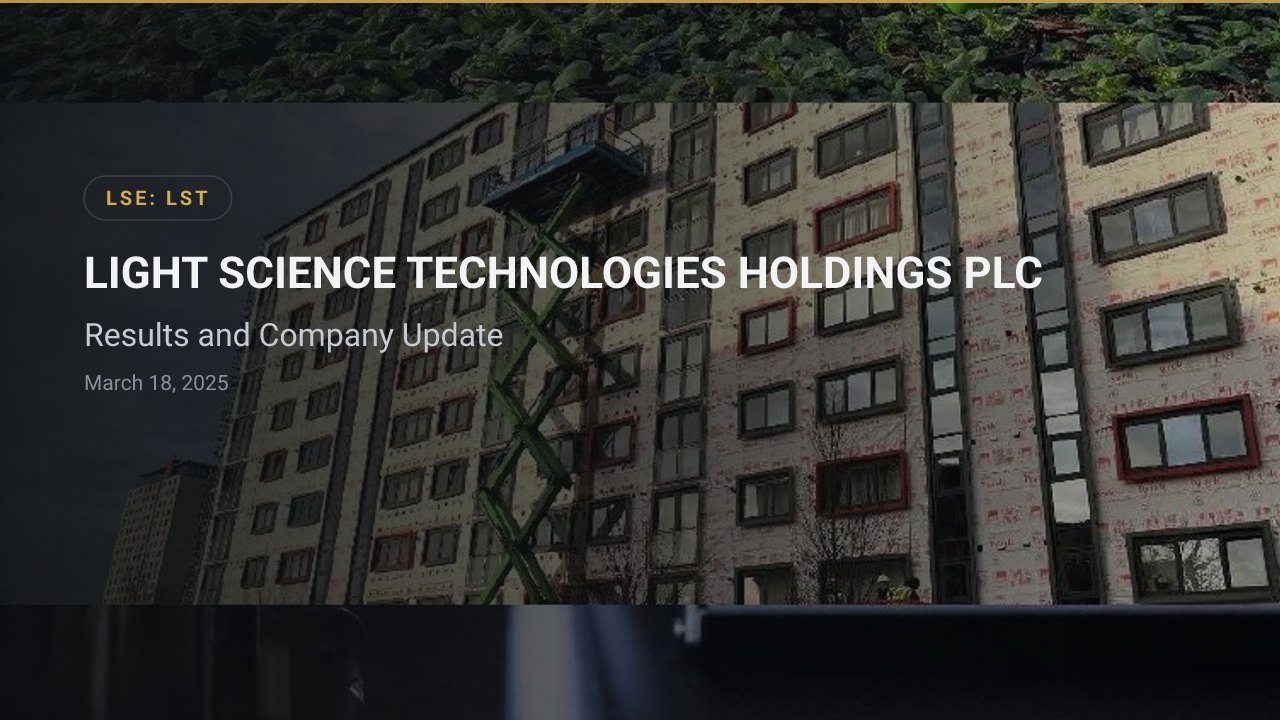
0:32 sir. Thank you very much, and good afternoon, everybody, and welcome to LIGHT SCIENCE TECHNOLOGIES HOLDINGS final results for year end 11/30/2024. Just to go over, we have three divisions within our group. We have our ag tech division, which you'll see top right of of the presentation there. We have our passive fire protection, which you see in the middle there of the building going up on on the right hand side. And we have our CEM contract electronics manufacturing business also, and we provide technology in all three divisions. We've got a a slide of disclaimers, which is obviously good reading when you've got time to to read through it in your own time.
1:22 Just to introduce who's presenting today, we've got Andrew Hansel, chief operating officer, highly experienced in in his industry. I've worked with Andrew for for over thirty years, and we have a really good partnership to to expand the business. There's Jim Snook, CFO and company secretary, experienced FD, through multimillion pound companies and a broad range of industry sectors. And there's myself, Simon Deacon, chief executive officer, Been an entrepreneur for over thirty years heading up acquisitions and growing businesses, over those thirty years. I'm just gonna play you a short video just so you can get an understanding of how all three divisions come together.
2:18 At LIGHT SCIENCE TECHNOLOGIES HOLDINGS, our mission is clear. We offer solutions to some of the most significant current global issues. We have four businesses across three sectors. In the controlled environment agriculture division, we have over thirty years experience in two businesses, LIGHT SCIENCE TECHNOLOGIES and TOMTECH. We provide turnkey technology solutions that use real time data to create the perfect recipe in any growing environment. From our award winning hardware solutions like SensorGrow and NurtureGrow to our proprietary control systems and performance monitoring platform, we combine cutting edge software with our in house UK manufactured hardware to improve productivity, increase plant yield, cut costs, reduce wastage, and extend the growing season whatever the plant, whatever the environment.
3:13 Within contract electronics manufacturing, we own UK circuits, a twenty five year old business and world leading player in the field. UK circuits supports clients at every stage of the procurement lifecycle right through to expert technical support. From printed circuit board manufacturing to finished products, we work with a broad range of partners both within The UK and globally and service blue chip customers across multiple sectors including robotics, lighting, fire safety, sensors, pest control, and audio systems. Finally, within our passive fire protection division, we own Injecta Fire Barrier, The UK's first independent approved installer of the patented InjectaClad system. InjectaClad is an acrylic based graphite sealant that can be swiftly injected into building cavities, blocking fire and smoke spreading throughout a building structure.
4:07 It is suitable for installation across all types of building cavities. Using InjectorClad, we can work towards ensuring the existing structures are safe, protected, and meet the latest fire safety regulations, giving peace of mind to owners and occupiers. Following the Grenfell Tower fire, fire safety act of 2021, and the building safety act of 2022, there are over 11,000 buildings in The UK which are labeled as high risk. Passive fire protection is more critical than ever. At LIGHT SCIENCE TECHNOLOGIES HOLDINGS, we combine British manufacturing, innovation, cutting edge technology, software, and expert knowledge to solve some of the most important global issues that we face today. Hopefully, that gave you a a really good understanding of how the different divisions come together and what they're about.
5:09 Just to take you through group highlights. For this financial year of 2024, revenue was up to £12,000,000 just over at 29.5% on the previous year. So really good growth for for the group. More importantly, one of our key strategies was gross profit margin, and we've seen that move up from 23.4% to 30.3%. So that's really good gross margin improvement for the group. And we'll talk about that a bit further because that's really helped us become cash generative in h two of last year. We did 36 r and s's published last year also. And so we're really, you know, publishing the results of what we're doing, if it be orders coming through, but really getting the the information out there to investors to see the activity that we're doing. We've got a strong forward order book of over £3,000,000, and that continues to grow off the back of our £50,000,000 quoted group pipeline.
6:17 The AgTech division grew by 250%, so it's really pleasing to see that division now starting to create good revenue and especially bringing in the the new acquisition from the other year, Tom Tech. We've got cash and undrawn funds availability, a circa of £1,900,000. So we're improving the cash position. And we virtually broke even just a 30 k loss, net loss for the year. But as I mentioned, we were profitable in h two of last year, and we're nearly at breakeven point for the year of last year. So really good improving results for that whole year. Looking at the global trends and driving our markets, we're we're in three key divisions of markets, and that being passive fire protection, contract electronics manufacturing, and the ag tech market. And what's driving those markets is in the contract electronics, it's British manufacturing.
7:22 It's about returning and onshoring back to The UK. There's an awful lot of uncertainty in the world, and more recently, there's more budget in military and hardware, and we see an awful lot more work and activity happening for the contract electronics side due to this. In the ag tech sector, it's all about food security globally, and the reason for this is extreme weather patterns. Some points we've got droughts. Other parts we've got flash floods. So we're seeing extreme weather patterns globally, and so we see more growing actually indoors in a controlled environment. But, also, we've got a growing population, and how are we gonna feed that population as it grows up to twenty fifty?
8:10 So this is really important. More recently in the news, there's been about water shortages and building our reservoirs up in The UK, but this is global problem. It's not just a UK problem. So for us in selling our product, that's very much a global opportunity. In passive fire protection, it's really driven by the government. Since the awful tragedy of Grenfell, what we're finding is the Fire Safety Act and the Building Safety Act, that legislation coming through to make these buildings good. I'll talk about the numbers in a bit, but there's there's thousands and thousands of buildings across The UK which need remedial work doing to them, and this is really creating our market sector for us. All three divisions, all three market sectors are growing in a really strong position.
9:02 So let's have a look at that combined market opportunity. It's a 120,000,000,000, and that's for The UK, but also globally in the ag tech sector and through in The UK electronics and and the CEM sector that is through Europe. So let's break that down. We've got 47,000,000,000 in the ag tech division that we're looking at, and that's got a compound growth rate of just over 11.3% up to 2033. As you can see, there's really good opportunity to sell our products, which I'll come on to throughout the presentation in this sector. We've broken it down into LED grow lights, which is at 9,600,000,000 and growing at 28.2%, and that's creating a recipe of light and an artificial light in these environments.
9:54 And also the agricultural sensors, which is our our product that we've been developing over the last few years, and that's worth 3,740,000,000 and growing at 11.3% up to 2032. So really strong market in the ag tech sector as we move forward. In the passive fire protection market, it's 50,000,000,000, and this is in The UK alone. We're only looking currently at UK market. There's a big enough market, and you'll see there's around twenty years worth of work to remedy all this health health and safety issues, fire safety issues within the property sector. And at UK circuits, the electronics side is 22,000,000,000. It's growing at 8.8% up to 2030.
10:41 So as you can see, it's a really strong market. It's growing at a good rate, and we're in the right sector moving forward. So let's start with the ag tech division. First of all, we we had a name change with in the ag tech division. We were originally called Controlled Environment of Agriculture, the CEA, and you would have seen in a recent announcement on our Capital Markets Day in London, we announced that we were changing the name to AGTEC. And the reason for this is that our products now are broadening. The technology products that we have are not just now used in the controlled environment of agriculture indoors for horticulture, but also in broad acres and open agriculture. So we've changed the name to it being more suitable for AgTech AGT.
11:28 The year on year revenue is up approximately 250%, just under £1,000,000 worth of revenue, and that continues to grow. We've got a strong quoted pipeline in this sector of just over circa £42,000,000, and that is being converted. And what we saw, we delivered more recently was, for the Rochelle Group, one of our lighting products, and this was for a glasshouse. This is a French company, Rochelle, but for a glasshouse which was being built in Germany. And this is key, really, for our ag tech sector is partnering with companies like Rochelle who provide 12,000 hectares of growing space in the controlled environment of agricultural every year. They've completed 500 projects per year in across 95 countries.
12:22 We don't just see our ag tech sector being in The UK. It's very much global, and we're doing that through partnerships. Our sensor growth now is in broad acres. We've been trialing the sensor, which you see here with Dyson Farming over the last couple of months and last year. And this has really taken off, you know, Dyson Farming and sir James Dyson has invested heavily in technology and in agriculture, and we're part of that development moving forward with grants and developing the product. Nitro oxide sensor enter emissions to help farmers reduce waste and cost. One of our products being that sensor you see on the right hand side is all about, you know, managing carbon monoxide, what's going into the soil, the nutrients, and also is managing the waste.
13:18 It you know, it's not just about telling you what you need to put on, but, you know, everything becomes expensive. So it's about making the grower, the farmer more profitable while reducing the waste and putting the right amount of inputs that it requires to increase the yields and get better crops. At the moment, you will see that 60% of the land in open agriculture we work on is unhealthy, and yields are reducing. And that's because it's been used and rotated far too often, and we're losing that nutrients in the ground. And that makes our food less tasty and less healthier as well. The Toltec acquisition is now successfully integrated into the division, and this is really pushing up our our margins in the ag tech, which is over 50% gross margin, I'm pleased to say.
14:11 Moving on, and you'll see all the way through the presentation, partnerships are a big part of of what we do, if it be in passive fire protection or if it be in the ag tech or in the contract electronic side of our business. It's really important that we partner with the right people so we can expand and increase our revenue and margins. So we signed AgriLogic in South Africa. It's about choosing the right partner who's already within the industry. We're providing products to substitute some of their own products and so that they can expand in their own market. They're local. They're on the ground. They've got a customer base. And this is where we see in the ag tech sector where we can really expand by selling our lighting, platform, our irrigation, and our control systems.
15:01 We really do have a turnkey solution for our products in this space. AgriLux was a more recent partnership. They are part, you know, of a huge organization of Miracle Gro who are listed on the New York exchange, a value of around £3,000,000,000. And AgriLux are one of the leading horticultural providers of lighting. We've done around £10,000,000 worth of quoted business for them here in The UK and Europe, so split between UK and Europe. And this is a really strong partnership where we see that we can expand and sell our our products into. They provide lighting and and so do we, but it doesn't mean that we we can't also sell our sensors and our control system irrigation systems off the back of it. So this is a really strong partnership, and we're really pleased that we've managed to achieve that more recently.
16:00 So having a look at the the AgTech division, intelligence software provides live data, and this is the key for a successful growing environment. You know, we need to provide a product to the growers which is really useful for them to spend the money in this technology. And this is giving them live data so they can put the right inputs if it be in controlled environment, enclosed vertical farm, polytunnel, or glasshouse, or if it's in open agriculture. We're seeing a lot more technology. As you know, tractors now can operate twenty four hours without any any driver within them and plowing the fields, setting the seeds. So technology is out there, but we're part of that movement moving forward to make all the growers more profitable.
16:49 Monitoring in real time allows decisions to be made for ultimate growth, predicting the weather and when crops will be at the ultimate for harvest is really important. So we believe technology is really the key for to driving the future in open agriculture as well as enclosed. As I mentioned, we're working with Dyson Farming on the nitrous oxide project as part of a grant process developing the sensor. And this is really taking us to the to the next level in our sensor technology and control systems so that we're looking at carbon dioxide and the inputs and how much different plants can capture carbon and put it back into the ground. And this will have a real effect on carbon credits as an example. If you get the right plant, which is growing to capture carbon and put it back into the ground, and carbon credits can have different grades of carbon credits, and this is real time information.
17:48 As normally with carbon credits, it's all about historic data. This is live data. Methane is the other direction that we're going is looking at methane and capturing that data also. So as you can see, we're starting to become not just in ag tech, it will also evolve into more environmental sensor as well, which is really important. And it'll be managed to manage water pollution as well as many other things as we move forward. I would say that, you know, some of the sensors that were were required in carbon carbon dioxide, and n two o, you know, these are are stronger than ozone depleting substances. So over a 100 years, that is more than 300 times more powerful. So it's really important that, you know, we've got the right product at the right time. It's a subscription based model taking shape of our monitoring software solution, so it'll be sold on a subscription basis with three to five year contracts, so giving that really recurring revenue stream.
18:52 We've got a good, quoted pipeline in the ag tech sector of 42,000,000. Moving on to contract electronics manufacturing division. Market size of 22,000,000,000. Revenue circa 5% up to 9,500,000. So really strong results. And there, again, a real management team focus on that gross margin. It's up from 22.6 to 24.3%. So really strong margins. We continue to get those efficiencies within the factory so that we can increase those margins. We've entered into new markets within this sector. As you appreciate, we don't just do ag tech and manufacture our own products, but we do pest control, sports entertainment, lighting, audio, gas, fire in the industries as well. And we're looking at seeing what industries and markets we need to be in to get that better margin, and we've taken on 10 new clients in that time as well. So so really growing industry, more efficient, and we're in control of our own design and manufacture for the group, which is really important.
20:02 The market opportunity and the return to UK manufacturing we've seen from the Far East, lot of uncertainty in the world. A lot of now, you know, even in Europe, paper, which has to change hands and red tape. And we're really seeing, you know, people who are English companies wanting to return back to The UK because of those costs if it be transport or administration of goods. We're also seeing more recently tariffs being imposed to certain countries from America, and this is also seeing reassuring back to The UK, which is is great to see. I'm really pleased to see that in the summary analyst report for January 2025, we were positioned ninth overall out of 24 for the best Centimeters trading partner in The UK, and we've also achieved the top 50 in the Centimeters UK market share. So it just shows that management is driving this business in the right direction, and we're starting to get our name heard more and more. This is a business that she's been going over twenty five years, so it really is well established and continues to grow.
21:11 The facility increases profitability and the products manufactured within the divisions for the group. We really took when we bought Tom Tech to see how we could integrate. And they were manufacturing their own control systems and how could we actually, you know, make that product more efficient. So we moved it to our contract electronics side, assembly plant, manufacturing site up in Manchester, and that's really brought the efficiencies for the ag tech side making more margin, but also for the contract electronics. We continue with the group and grow further in different sectors, and this really gives us the flexibility to design and manufacture things a lot quicker with our own in house manufacturing. Clients and partnerships. I mentioned partnerships. Having visibility in partnerships really is key.
22:02 And so we're looking at, you know, having contracts with clients over a number of years so we have better visibility. One of the key things for us is making sure that we look at potential new markets. And more recently, military contracts, IT, and traffic communications are what we believe have got higher margins but also can provide us good revenue and growth. So we're looking at what accreditations we require. We've been in some of these sectors before where our customers have got the accreditations for military applications, as an example, but we're supplying to our customers then supplying to the military. So we'll continue that. The accreditations we're looking for are different two different types of ISO, one three four eight five and ISO four five zero zero one.
22:52 You know, really important to get the right accreditations moving forward so that we can enter these markets.
22:59 We continue with further increase in automation investing in equipment in our facility. This increases the margin and lowers the concentration level and derisks our customer base going forward.
23:16 Moving on to passive fire protection division. The UK market size is £50,000,000,000, as I mentioned at the beginning, and this is really being driven by the amount of buildings which need need doing. There's over 18 meters size height buildings. There's over 11,000 buildings. So there's a lot of buildings which are high risk, which need completing. And buildings between eleven and eighteen meters, there's 33,000 buildings. So there's quite a large amount of remedial work which needs doing throughout The UK. The revenue in this sector is circa 1.8, of which 1.5 was done in h two of twenty twenty four. So they had a really strong second half.
24:04 It's cash generative and have strong margins, so these margins are above 50%. And this is what we were talking about earlier about leveling up the revenue of the group to push up those strong margins overall, which is really important for us. We did five projects in the last twelve months of different sizes and different parts of the country. We won our Manchester contract in October worth nearly £1,200,000, and our quoted business, our quoted pipeline is 14,000,000. And I'd like to see that continuing to increase as we get new inquiries on a on a daily basis. As I mentioned, this is driven by Fire Safety Act of 2021 and the Building Safety Act of 2022.
24:52 The government really is pushing for these buildings to get the remedial work done. Now this isn't gonna happen overnight. We believe there's probably around twenty years' worth of work. I think the government wants it going much faster than that, but the realistically, there's a lot of work to be done over a long period of time. They've pledged 6,000,000,000, the government but what I'm really pleased to see is that not only has it been pledged, but 1,100,000,000 of it has already been spent to support owners, occupiers of buildings who haven't got the money to repair these buildings and live in apartments which are over 18 meters tall. So really good to see that. Our product is really cost effective, less waste, more environmentally friendly too as we we move forward. And that's really you know, you see the speed of the the projects coming through, but, also, it's less mess for any occupiers who might be in it. We're IFC accredited, which is really important to make sure that we're downloading the information without live information that we record and putting in into the building so it's all recorded and regulated.
26:04 We enable safe evacuation of a building. You know, our barriers we put into cavities last up to two hours so that you can get safe evacuation of these buildings, which is really important.
26:19 As I mentioned, you know, there there's a lot of buildings. There's over 33,000 buildings. There's twenty years worth of work, you know, all over the country. This division is really scalable. It, you know, it only costs a a small amount of money between 30 to £40,000 to buy an extra pump and put five or six people around that pump which are trained, which create around £1,500,000 worth of revenue. So it's really scalable. Mention again partnership. It's really important for us to be partnered with the the customers that we, you know, have a portfolio of of buildings which need doing. Some of our customers have 10 or 15 buildings in their portfolio which need doing. Some have 300 buildings which need doing. So the key factors is being partnered to blue chip companies, but also specified.
27:16 So we're being specified with the fire officers, the architects across The UK as these jobs come through
27:24 to to return into orders. So it's really important the quota pipeline is converted, but also grows as we move forward. So really exciting division and a rapid growth potential.
27:39 So our focus is also on new technology. As a group, we sell technology. How can we improve not just putting a barrier into the passive fire and into these buildings, but it's providing technology. And we want to put an early warning system sensor technology into cavities. Why do we think this is important? Well, a lot of fires can be caught inside a cavity, but not actually within the building. So it doesn't mean that certain alarms go off at that stage because the fire hasn't reached internally. So for us to put an early warning system if you're the 23rd Floor up on the West side of the building in an apartment and the fire is going off on the East side on the 11th Floor, it would be really good to have an early warning system which might come up on your phone or actually being connected to the main system and alert everybody all at the same time. So we're developing that as an early warning system, and this will create recurring revenue like the ag tech sector in a subscription based model.
28:41 And we also want to get this specified by insurance companies because, you know, if it's in buildings, it's better for those insurance companies to endorse the product and technology we're putting in. So we're very excited about developing that as we move forward.
28:57 Some of the activity we've done for the group, we've tried certainly in the last half of last year to be more active in putting out news. We did 36 r and s published last year. New communication methods have been very much about video content, audio, so people can visually see and hear short videos that we're doing. In proactive, we had a total of 15,000 views. We had seven hundred and forty two hours of total watch time of the interviews. Articles that was over a 175,000 views and impressions. So you really get a a feel just for one platform, how much work we're doing. And these are going on all sorts, not just from our website, LIGHT SCIENCE TECHNOLOGIES HOLDINGS, but also on X and other platforms
29:55 going forward, being in in mail or the Times or in newspaper articles. And more recently, we had a Capital Markets Day at the London Stock Exchange on the twenty sixth, which was really good, and we had a guest speaker in Dyson Farming. So we're really pushing to have more activity, and you'll hear a lot more about us as we go forward and continue this momentum.
30:21 I'm gonna hand you over now to Jim to talk about the financial overview. Thank you, Simon. So looking at the revenue and gross profit, for financial '24, a very strong continued growth, trajectory there. Growth of 29.5% taking us from 9,300,000 to 12,000,000 for the group as a whole. And importantly, what we're seeing is a reshaping, a reweighing of the divisional contributions with the newly acquired passive fire protection division at the end of financial '23 and with, Tom Tech having been acquired into the ag tech section.
31:07 So, you know, really, f y twenty four was the first year of a reshaping. And what we're seeing is that platform business within the CEM contract electronics manufacturing division that's always been our platform. We're now leveling up with these two new divisions. Revenue growth is organic and acquisitive. The contract electronics manufacturing division is growing in its own right at a rate of 5% last year. But the much bigger, pieces here really are from the pacifier,
31:41 and the ag tech divisions. Pacifier grew, to 1,800,000 through the course of the year. New division, it's achieved 300,000 in the first half and 1,500,000 in the second half. And AGTEC saw its 250% growth from around the 200,000 prior to near on 800,000, for FY '24. A couple of, substantial contracts, to highlight. In the passive fire, we, we won £2,700,000 worth of contracts through last year, with 1.8 delivered upon leaving, 1,000,000 approximately to take into financial year '25.
32:28 And in the AgTech division, we had a a key order from Richel, as Simon mentioned earlier, for 120,000, and that was delivered successfully in February of this year.
32:41 Alongside those scaling revenues, really importantly, is the gross profit contribution. As you can see from the table down in the bottom right, the AGTEC division delivers, gross margins of near on 50% and the Pacifier Protection division in excess of 50%. So we're seeing alongside those scaling revenues a a driving up of our group margins and and that we've achieved from a margin of 23.4% for FY '23 to 30.3% for FY '24. And as those divisions continue to scale, we see that margin moving further upwards.
33:28 Looking at EBITDA and net loss, net profit loss, well, we maintain very tight overhead control through the whole business, not just within the sort of holdings company, but also within the divisions. And, you know, to give an example of that, our administrative expenses for last year only increased by 10.3% despite that growth of 29.5% and in integrating those two acquisitions into the group. So, you know, it's important to us not just to drive revenue and increase margin, but also to control our overheads. And for the first time, we had a a near on a million pound positive EBITDA last year.
34:21 So how does that drop down to the bottom line? Well, the second half, we generated a net profit for the first time of near on £300,000. And for the full year, a near breakeven, it was only a 30,000 loss. That was a reduction of 97.3%, from the prior year. Alongside of that that, improvement in that second, year second half of the year profit generation was, operational cash, generation, and that's improved from a prior year of a 180,000 to just over 1,500,000, for last year. So driving towards profitability, sustained profitability, and with it operational cash generation.
35:13 Looking at our balance sheet, a key part of our balance sheet is our development assets, and that really reflects the developments in the, ag tech division. Simon's talked through, the SENSIGRO products and what we're doing with that and the potential opportunities that that's going to bring. And we we've invested a further £300,000 in that product during the course of the year. It's really a key a key product solution of ours for the future, bringing with it recurring revenues. So, you know, we will continue to develop that product, but also to commercialize and start to harness, the opportunities from that. In terms of fixed assets, investment in CEM, the contract electronics manufacturing division continued, near on a 100,000, investment in plants and and equipment to continue automating and bringing with further efficiencies and improving our margins within that division.
36:16 And in the pacifier division, we now have three injector pumps. Each of those costs around £30,000 to £40,000 and they support revenues of about 1,500,000. So, you know, we'll continue to keep a close eye on that and invest in further pumps as the business continues to scale upwards. And looking at group cash and banking facilities, at the year end we had cash and undrawn facilities of £1,900,000 £1,200,000 being cash and the balance being, the undrawn facilities, an improvement from the previous year and also from the half year point where we had 1,100,000 in cash and 500,000 in undrawn facilities.
37:05 So alongside the profitability comes cash generation and that improvement in our cash position. Close Brothers is a key partner for ours. You know, we do see them as a key partner into the future in supporting our growth opportunities, and acquisitive, and they supported us in the first half of the year with a new facility that was for use throughout the whole of the group. Our net cash and debt, or net debt position decreased from 1,400,000 from f y twenty three to a much lower 700,000 at the end of f y twenty four. So, you know, Simon's mentioned, throughout his presentation, you know, it's all about, the three growth, divisions that we're operating within, scaling, revenues within those divisions, improving our margins, our gross margins as the PFP, Pacifier, and the AgTech division start to level up against the contract electronic manufacturing division, keeping a control on overheads, generating and becoming sustainably, profitable, and generating operational cash out the other end.
38:25 So I will hand back to Simon to do a summary.
38:31 Thank you, Jim. You know, the the next five years and the vision, the the the group's currently turning over, you know, the circa 12,000,000 for 2024 in a really strong, growth rate. We want to drive this business for revenue of 50,000,000 over the next five years, and this is in the AgTech division CEM and the passive fire, selling our hardware and software solutions which provide recurring revenue. I'd like to see at least 20% of the revenue in ag tech being recurring and a small proportion also in the passive fire protection business as we grow the revenue in these divisions. It's really important that we continue to build the operational cash generation within the group, and that means, as Jim mentioned, that leveling up of of revenue, what we're seeing is the leveling up with the CEM side of the business in pacifier and the ag tech, which has got those real stronger margins moving those margin up for the group, which now are over 30% and that key cash generation.
39:42 Creating partnerships is a really strong point and being specified for jobs. You know, this is how we are. Our strategy is how we're going to be a global player with people in the market within their own countries and supplying our product. So it really is a key part of us being a global company and supplying our global products, especially in the ag tech division. Using our current technology model to expand a digital monitoring system for greenhouse gases. You know, we've branched out into broad acres, and I see that, you know, with our sensor product, we can broaden that further and monitoring greenhouse gases and under environmental censoring products that we require for water courses and so forth, which are really important to to be measured, especially, you know, with the current climate change that we're in. So we really see a drive in different market sectors within the division and then that growing strongly globally.
40:48 So looking forward for the next twelve months and beyond, you really, you know, building a brighter, better technology group, having that global presence, having a real sensible approach to to a clear strategy and a solid team to deliver our ambitions and to lead to a prosperous group. Sustainable, you know, we we are an undervalued group. We're pushing hard to be noticeable. We've got a market cap of 10,000,000, but we've really got a, you know, three divisions in, you know, a £120,000,000,000 market, and we're growing. We're growing at a at a good rate and generating now that that cash which is required. So we've got a 10,000,000 market cap with one division being worth that. So you can see there's really good potential to to get behind us and support us in our in our growth.
41:43 I'd just like to say, you know, thank you to to everybody who has invested in us and come along for the journey, and we continue to to expand and grow as a group and and thank the staff as well. And I really open the floor to to any questions that you might have. Simon, Jim, thank you very much for your presentation this afternoon. Ladies and gentlemen, please do continue to submit your questions just by using the Q and A tab situated on the top right hand corner of your screen. Just while the company take a few moments to review those questions submitted today, I'd like to remind you that recording of this presentation, along with a copy of the slides and the published q and a can be accessed via investor dashboard. As you can see, we have received a number of questions throughout today's presentation. And, Andrew, if I could just hand over to you to chair the q and a with the team, and I'll pick up from you at the end. Yeah. Thanks very much.
42:30 So, yeah, the first one we'll take is one I mean, you've answered very well about the disconnect between the share price and the underlying value, but how do you plan to increase your share price? We we plan to to increase our our share price. You know, it's important that we make sure that we we get new investors. We've seen more this year that we've got more publicity out there. I talked about the 36 RNSs that we did last year. We very much continue to do the the same development going forward of pushing the the information out there doing short videos. And then what this has done and having the Capital Markets Day and doing retail events, it's pushed new investors who are are coming on board and taking quite large stakes in the business, if it be institutions or if it be private investors.
43:21 And we continue to do this as we broaden and open more doors across the scope. And so we continue to do that as we go forward to to hopefully that which will push the share price up as we go forward. Okay. Thanks, Simon. Another one that's share price related. At what point do you anticipate declaring the dividend? I think that one, we can say that we are definitely a growth share. You know, any profits that the company makes will be sort of reinvested in the company to make the company grow and therefore grow the share price. That's kind of our strategy there. Let's get into it's we'll go back to SAL. Again, it's been a year of progress for life science. Can you talk us through the change the company has seen? The company is constantly evolving, but we, you know, successfully integrated TUM TECH and Injecta Fire Barrier in the last twelve months, and that's really pushed those profit margins up.
44:18 You know, it's really important that we, you know I mentioned those three growth divisions. We continue to invest in them so that we can continue that growth. But really the Tom Tech and Injectify barrier integrating that into the group was really key to our progress and the margin and the cash generation of last year. I think one for Jim here on margin growth. Margin growth has been impressive. Where do you think, yeah, margins could reach? Yeah. So, you know, in my section, I talked about the different divisions, gross margin contribution. CEM contract electronics manufacture, are typically 23, 24%, whereas AgTech pacifier around the 50% mark.
45:04 We do see within contract electronics manufacturing that there's avenues to, push that margin further. We are investing in, plants and equipment to automate and make more sophisticated. So we have already achieved efficiencies and margin improvements through that route. But also, as we move into new sectors that we're currently targeting, like health care, defense, then inherently those sections those sectors rather bring with them higher margins. So, you know, we think the contract electronics manufacturing division has opportunities. In terms of ag tech, really, the census growth product is unique there.
45:51 And when we get to the point of the subscription model embedding in those recurring revenue starting to flow significantly from that, you know, that will be at a higher higher margin, against, say, the lighting products that tend to be, you know, slightly lower than SensiGrow, maybe in the thirties. And then finally, passive fire protection. You know, we see, you know, maintaining those margins, but we're also, as Simon said, trying to get partnerships with with, businesses that we've done jobs, you know, their portfolio of properties. So, you know, with it, there might be obviously some benefit to to the client there. But, you know, as a whole, we we we see those though the ag tech and the passive fire as those revenues start pushing through, bringing that margin up as the CEM division becomes kind of less concentrated as a mix towards the group. And definitely that 30.3% margin we anticipate pushing up higher.
46:58 Thank you, Jim. Another one here, more on products with the backdrop of worst in global drivers, population growth, water supply, employment, weather patterns, etcetera. What could this mean for The UK and how your products evolve into these challenges? Well, I think, you know, it's obviously publicizing national internationally about sort of of the issues with the weather. We've got sort of extreme heat followed by a loss of rain. You know, some of the roads that we're tell us that they're losing about 60% of their gear to our side. And I think, you know, the control environment is the is the right to counter that put more of it on the glass and polytons. But, you you know, Simon talked about with the sensor, we've come and also looking at moving that to that little pond as well. So, you know, pond water, quality, you know, this sort of blue, regenerative pond that we've called in sequestration, things like that we're looking at as well.
47:48 And then also, you know, coming on with the m two o measurements, you know, moving into greenhouse gases as well. So kind of expanding our product portfolio to sort of match what's happening in the environment as well. We could look into the one on PSP. PSP completed roughly 5,000,000,000 last year. How many would you hope to do this year? We've kind of worked on 5,000,000,000 already this year and and we're to our our plan, we're aiming to work on about 10 buildings. That's not to say that the whole thing for our budget, as some said, they're all different sort of shapes and sizes, if you like, but we've got decent What was on are you seeing third parties with interesting technologies for which LST could be an attractive chance to market and which would be suitable for CEM?
48:50 In the contract electronics side, there's always partnerships. I'd like to see partnerships throughout all divisions. You know, we we currently partner with companies in in pest control as an example and have had done for for over ten years. So there's certainly scope to partner and also to partner with companies on a more global side on on the contract electronic side. So we continue to look. We continue to grow, as you see, and to move into different markets. You know, I mentioned traffic communications is one of them and also military applications, which we've done in the past for for customers who have got the right accreditations, and we see that as a big growth and higher margin sector for us as well.
49:39 Thank you. On. Well, for Jim, are you happy with your corporate structure? Have you got the personal seats that are through the next phases of our growth? So, yeah, I mean, last year, we we we reshaped the the board. Graham Cooley, doctor Graham Cooley came on to be non executive chairman. He's got very extensive in the market, having been CEO for ITM Power for ten years. Very valuable input to the board. We've got Richard Mills who is a who is a expert in the ag tech market, being managing director of the largest independent polytunnels provider.
50:29 So, you know, that was a really good sort of reshaping of the board. And, you know, we continue to monitor board composition as we grow bigger and scale and, you know, we will obviously bring the right expertise in to assist there. And then in terms of, you know, how that flows down, the divisions in their own right have their own divisional MDs, and we support from the group level into those divisions. And when they need to recruit, you know, we do that. So I think the structure works well. We keep it under review, and, you know, we will take any actions as and when that that the right time comes. You can have this one as well, Jim. One more salesman that there are no research currently.
51:16 Is it time to get research? We do have research, broker led research. We haven't got expectations in the market currently. You know, we we will we're reviewing that. What we wanted to do, particularly last year, was actually follow through, you know, what we set out, which was to become profitable. And, you know, we need to sustain that. That's a a key strategy of the group. And, you know, when the time comes as appropriate, we will put expectations out in the marketplace. But, you know, we went through post IPO. We we went through times where the energy prices, Ukraine war, and, you know, we we I guess we're quite prudent on that, but it we have every intent to put those expectations out when the board feels that the the full visibility is there to stand behind them.
52:15 Simon, the company constantly talks about 40,000,000 pipeline. When will this pipeline get connected? I'm pleased to say that it's it's no longer 40,000,000 for for the group. It's it's over 50,000,000 for the group. And as as you could expect, having three divisions that are continuing to grow, it's important that we have a strong quoted pipeline for us to convert to to keep that growth of nearly 30%, which we've achieved last year. So it is being converted. I think you will see more being converted in the ag tech space this year and the passive fire protection space this year, as Jim mentioned, that leveling up with the contract electronic. So there's a big push to to level that up because it brings larger margins to the group. So, yeah, I I expect to see it being converted, but also built upon on that quoted like pipeline of 50,000,000 now.
53:13 Do you have any exposure to defense or you've seen them inquiries or growing demand? I mean, yes, Simon talked about in his presentation. You know, we are definitely targeting defense in the market. We do do some work as well at the moment, you know, sometimes with third parties because we've done some of those presentations. And for us, it's really about getting those presentations and creating a platform to sort of enter that market and then want to use as well. Simon, can you outline the group strategy and let us know what investors might expect from the coming years? Well, as I mentioned towards the end, you know, we want to drive the revenue to 50,000,000. We sit just above 12 now, so continue that growth in the three divisions that we've got. It's got good market value, and it's growing at the the right growth rate in those market sectors.
54:05 So to do that, we'll do that organically, but also through acquisitions as and when we see that they come up within the divisions. And we can see, as I mentioned, you know, we want to make sure that the platform that we have in software and the subscription model that we have for the the sensor, we get that recurring revenue in the ag tech division for broad acres and control environment where we're getting around 20% of recurring revenue within that division. And as we bring in the early warning system into the passive fire protection, I can see that being also having a recurring revenue model also. So I I think there's great potential as we expand within those divisions with the product range.
54:54 And and we've really got a, you know, a turnkey solution in what we sell and also can, you know, ask for, you know, higher margins because it's unique, which I think is really important. So over the next five years, there'll there'll be a continuous push for for growth, but also that that margin to to increase overall, which will help us develop products as we move forward. And then lastly, how do we deal with thought leadership within each of AgTech and PLC? I mean, I think with PLC, we're involved in both. There's some sort of putting out a lot of different media channels there that sort of gets us out there actually using our PLC status, for the PLC is really good because it's very much about governance in the construction industry, so that really helps us. I don't think we're trying to be thought leaders on PLC, to be honest. I think there's lots of fire engineers and people like that that are way more qualified than we are. It's about engaging with them, understanding.
55:52 We really wanna understand what their problems are and sort of where we come in, if you like. And we have to be very careful who don't step into the line, become designers and things like that. So very much sticking to our knitting in that respect. And I think on AdTech, the way we when we first started that we felt that we were doing it was by creating the laboratory. So we had the science lab with two scientists in it, doing trials and things like that, and it allows you to talk with authority, because you've got that. Unfortunately, I think what was clear is that, yeah, everybody wants free research, but nobody wants to really pay for it. So, you know, really, at the end of the day, we're we're not adopting that approach either. It's it's about doing lots of the the media, lots of different channels, and getting the name out there if you like.
56:37 But but, you know, not necessarily being the thought leaders. I think that covers all the questions that the the Guys, thank you for answering all those questions that you can from investors. And, of course, the company can review all questions submitted today, and we'll publish those responses on the Investor Meet company platform. Just before redirecting investors to provide you with their feedback, which I know is particularly important to the company, Simon, could I please just ask you for a few closing comments? Thank you. Yes. We see the business is really going in the right direction. We're really pleased with with the growth that we've had in the margin increase and the the cash generation that it's starting to provide. That's really been one of the key strategies of the management. The teams in the different companies and divisions are working hard. There's great opportunity out there across the board, and we're very excited about the future moving forward to continue that growth and expansion plan.
57:33 So I'd just like to say thank you very much for the current investors, and I hope that the people who are looking at us will come on board soon. Simon, Jim, Andrew, thank you for updating investors today. Can I please ask investors not to close this session as you'll now be automatically redirected to provide your feedback in order that the management team can better understand your views and expectations? This may only take a few moments to complete, and I'm sure be greatly valued by the company. On behalf of the management team of LIGHT SCIENCE TECHNOLOGIES HOLDINGS PLC, we'd like to thank you for attending today's presentation, and good afternoon to you all. Thank you. Thank you very much.
Follow Light Science Technologies Holdings PLC into a list and get an email when it puts out news.
CEO at LIGHT SCIENCE TECHNOLOGIES HOLDINGS PLC
CFO at LIGHT SCIENCE TECHNOLOGIES HOLDINGS PLC
COO at LIGHT SCIENCE TECHNOLOGIES HOLDINGS PLC