Simon Deacon
CEO at LIGHT SCIENCE TECHNOLOGIES HOLDINGS PLC
Replay available
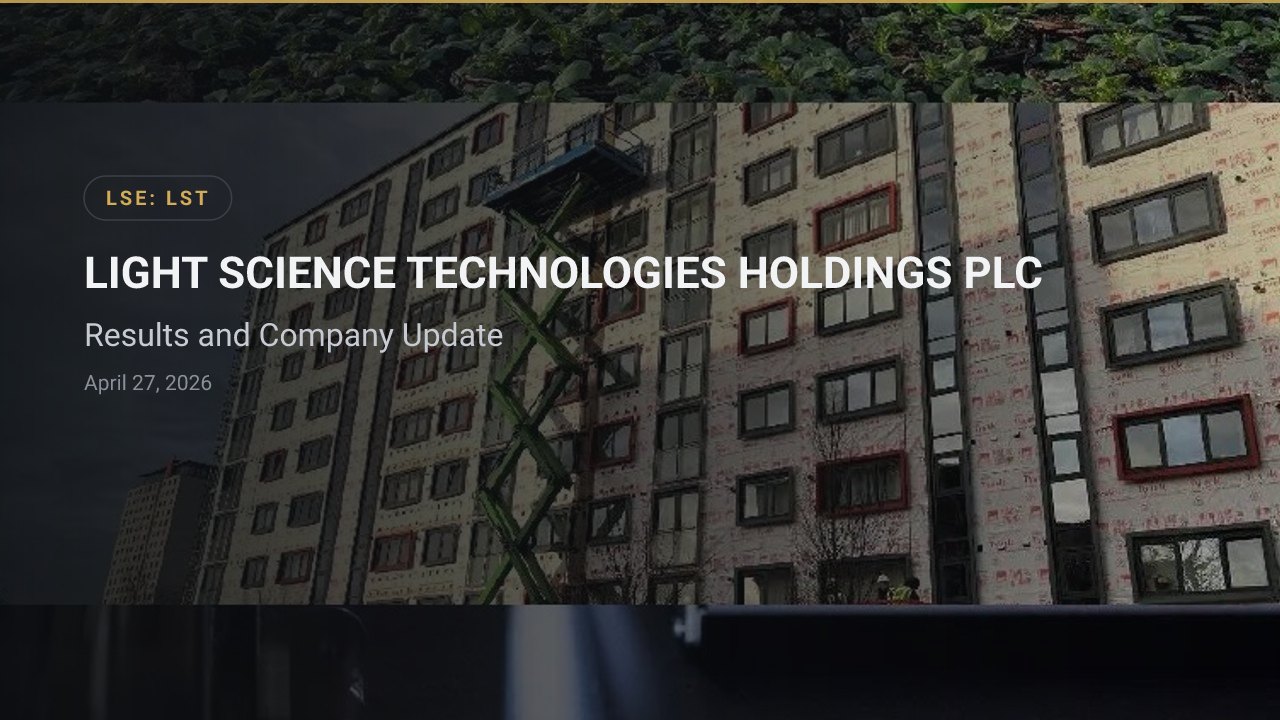
Results and Company Update hosted by Light Science Technologies Holdings (LSE:LST) on Investor Meet Company, held 2026-04-27.
On 6ix: 6ix.com/event/light-science-technologies-holdings-plc-lst-results-and-company-update-1
Automated transcript · Written by software from the replay's audio. It can mishear names and figures; the replay is the record.
0:00 Good morning and welcome to the LIGHT SCIENCE TECHNOLOGIES HOLDINGS PLC Investor Presentation. Before we begin, I'd like to submit the following poll. I'd now like to hand you over to Simon Deacon, CEO. Good morning, sir. Good morning, everybody, and and thank you very much for for attending the financial results for 2025. Do you want to go through who's presenting? Andrew? Thank you. So presenting today is Andrew Hemsall, chief operating officer. Andrew, do you want to give a little bit of background about yourself? Yeah. I've got over thirty years experience in sort of senior operations role, mostly within sort of private equity and PLC environments and kind of experience in integrating new acquisitions.
0:53 Also with me today is Jim Snooks, CFO and company secretary. Over to you, Jim. Thanks, Simon. So, yeah, over thirty years in senior finance roles, great deal of experience in acquisitions and disposals, and I'm a qualified management accountant. And myself, Simon Deacon, chief executive officer, over thirty years of experience to founder of the business and a track record of founding and acquiring growth businesses. So looking at twenty twenty five's highlights, it was very much a transitional period for us in 2025. So the highlights were in ag tech. We were awarded an NTU contract, that's Nottingham Trent University contract worth £460,000 in AgTech.
1:43 This increased post period to £600,000. And what this showed was our strength of bringing all of our divisions together in fire protection, in contract electronics, manufacturing the parts, and obviously in ag tech, bringing all of this to create this fantastic facility, is being created as we speak today. We've also strengthened the SensorGrow IP position through our patent grants moving forward. We've worked very closely with Dyson Farming other customers and partnerships to really strengthen Sense2Grow and its positioning, and we'll come on to that in a bit more detail in the AgTech division slides. In the contract electronics manufacturing and CEM, we focused on derisking a high customer concentration level. As you all know, we have a very high concentrated level in pest control, and we really started to focus on gearing you know, for an entry into higher margins, including defense, medical, and health care.
2:48 And to that, we've added 14 new clients in 2025 really through management developmenting of those customers moving through. So that's a really good progress of creating some new clients into some new markets. In passive fire protection, PFP, we've increased the number of building safety regulator applications. We've seen that in the BSR, building safety regulators. So it's really good to see that, you know, that we're starting to see our Injecta Cloud being specified into the BSR and starting to get approved also coming through that backlog and which has been happening over the last, really, nine to to eighteen months we've seen that backlog. And we'll we'll come on to a few slides explaining that.
3:41 So over a 150 buildings have had remedial work done to date using Injecta Cloud system. And recent regulation and progress underpins expectations and significantly improves for h two of twenty twenty six. You know, we've seen this backlog, and we expect for us, really, our half half year in h two really improve as these from the acquisition, but also from the BSR application starting to come through. Post period end highlights, we raised 6,600,000 to fund three acquisitions, and that were very much in the acquisition of InjectaClad, the acquisition of the 10% minority at the CEM division and the property there to house the Injecta Cloud acquisition.
4:33 We've also got 4,000,000 in current forward orders and 55,000,000 circa of in quoted pipeline. So really good highlights as you can see. I'm gonna hand you over to Jim to talk about the financial overview for the year. Thank you, Simon. So this is for the financial year ended 11/30/2025, our audited results. No doubt that FY '25 was a challenging year. It it was a year of transition. We knew within the contract electronics manufacturing division that our large customer in the pest control sector was bringing one of its products to end of life. So whilst we didn't know exact timing or or quantification on that, we knew that through '25, that would take effect, which it absolutely did. And the drop off in in group revenue was really reflective of the drop off in that pest control servicing within the contract electronics manufacturing division.
5:40 What we expected was that the Pacifier division would sort of come through following the previous year's strong growth. Unfortunately, the building safety regulator, came in and the backlog that, Simon will cover, in his presentation a little bit longer. What's now happening to relieve that backlog, he he will cover a little later. But, '25, became a a challenging year because of it. The good news is building safety regulator was moved from HSE to the Ministry of Housing at the end of January, and that really is the platform for a change of culture and a change of practical, handling of the app the volumes of applications that are going through that regulator.
6:26 So group revenue was 8.6, million, from the prior year of of 12,000,000 for FY '24. That's a reduction of 28% just over. And on the flip side of it and the real positive from last year was that group margin improved to 33.8%, up from 30.3% in the prior year. And that really is a result of the rebalancing of the portfolio businesses towards the group. There's three divisions, in particular, passive fire and ag tech at much stronger margins starting to change the group group contribution and a very strong increase group at level resulting.
7:14 To give you an idea, passive fire typically around 50% gross margins, ag tech 40 to 50%, and CEM division, typically mid twenties. But even CEM has seen an improvement from 24.3% to 20 over 28% during the course of the year. So we're focusing very, very hard on improving gross margins throughout the whole group, going for sort of higher value markets for for the businesses and resulting in in in the group, giving that much better group margin performance. Thank you, Andrew. So looking at group EBITDA, we continue to control our overhead costs in question David, question comes 3,340,000 to 3,600,000 in 2025.
8:19 And we have a clear strategy to continue, controlling those costs, but also, as I've just mentioned, strengthening our group portfolio margins. And when the revenue start to scale as the ASR starts to unblock and indeed we move into high value markets in the contract electronics manufacturing division, being defense, health care and medical, then we expect to see that return to over and above the levels of '24 where we were solidly EBITDA positive at just over £1,000,000. In terms of group net profit loss, FY '25 net loss increased to 890,000 from the prior year of $0.00 3,000,000, and that's representative really of that drop off in revenue as I covered a little earlier offset to a to a point by the improved gross margins.
9:18 We were net profitable in the second half of of twenty twenty four, first time. And as we start to scale, the, Pacifi division and and bring back the revenues in the CEM division, we see that that is very much, doable, particularly as we move through the second half of FY twenty six. Thank you, Andrew. Looking at the balance sheet, we continue to invest in development assets, specifically, SensiGrow. We invested around £100,000, during the course of last year in that. But most importantly was the work that we did on the acquisitions, three acquisitions that Simon flagged earlier on, the the the most significant being that of RL UK, the owner of InjectaClad.
10:11 And really, that is an absolute transformational acquisition for us because it allows us to secure the the value chain in that division, take much better control over the the market, and in turn, further improve the strong already strong margins in that division. In terms of noncurrent assets, post period end acquisition of the remaining two units of the Manchester property, that's at the contract electronics site. And we've got plans for further investment, to bring us, up to the levels to hit the accreditations for those three high high value sectors that we're we're looking to enter into medical, health care, and, defense.
10:57 It also allows us to integrate InjectaClad. We've got a distribution center at that site for InjectaClad and a a training, center that we're setting up there too. Looking at group cash and banking facilities, our cash position at the end of last year was around the 700,000 mark compared to prior year at 1,200,000, and our net debt increased by 200,000 from 700,000 to 900,000. This post period end acquisition was is absolutely transformational for the group because it's gonna it not only does it provide us with a a strengthened balance sheet, and that allows us to get bigger contracts in pacifier, in ag tech.
11:45 But also, it gives us that control over the market and over the CEM business, having acquired the the minority holding there to really springboard our strong 20,000,000 group pacifier pipeline as we move through the second half of twenty twenty six. So if I can hand back to Simon to cover the markets. Thank you, Jim. So let's have a look at the market opportunity and the drivers in our three divisions. In ag tech, we have a market opportunity of $12,700,000,000 and that's really a global opportunity and is split really between lighting and sensor and control systems. So we've got really good market opportunity here as we all know that food security is one of the key drivers.
12:37 As part of that, we've got a circa 34,000,000 current quoted pipeline, and I'm really pleased to see that that's starting to be converted. And more recently, we've seen an order come through for a Welsh university and the MTU project. So circa of of 450 to £600,000 starting to get come through on that pipeline. The gross margin, as Jim touched on, is a circa of 43% in 2025. So, really, what are the drivers? A delay in transport, you know, since all the different regulations, getting fresh produce through and across our borders is being delayed. It's taking longer, and so you see a lot of wastage going through.
13:24 Food security, as I've mentioned, is gonna become even more important as we move through the year. With the conflict out in The Middle East, we're going to see a lot of problems with food security, empty shelves, you know, it's a major base for fertilizers to come through The Straits, and we're going to see that having a big impact later on in the year. The cost of materials are rising, if that be energy costs, fertilizer costs, nutrients costs, they're all going up. So that's going to create inflation. So the big drivers here really for ag tech and what we can do in that division, and I'll come on to that in the ag tech slide a bit further on. So our route to market really for our lighting and especially our sensor grow product through agronomists, growers, and resellers.
14:19 Here in The UK, we very much go directly to growers. But internationally, where we're seeing traction is through resellers. In contract electronics manufacturing, the market opportunities you'd expect in electronics is quite big. It's $21,000,000,000 We really focus here in The UK as much of our product goes out indirectly through our customers and our partners that we have. And our quoted pipeline there is is 1,000,000. Now you might say that's quite low with quite a high turnover in revenue in that division. And in the past, we've seen revenues there at £9,000,000. And the reason it's low is because the actual quotes turned around quite efficiently and quickly in that market. So if we get a quote through today, it'll be quoted within twenty four hours.
15:14 And generally, the orders are accepted within sort of four to six weeks, and we start going into manufacturing. Gross margins here in this division are lower, and this is, you know, what we've really been focusing on. In 2025, the margin was 28.4%, and that's a really good result. You know, we've seen margin in in the CEM division go up, you know, up 18% overall compared to last year in 2024. So it's really pleasing to see that margin increasing to 28.4, and we continue to focus on it. What are the drivers? Onshoring, you know, the risks and the conflicts though and uncertainty we have in the world. Onshoring, see a lot more returning manufactured to The UK because of it. Import tariffs, you know, certain tariffs have been put on countries to manufacture certain goods and ship them into certain countries.
16:11 And and The UK, at the moment, their tariffs are quite low into the American market, which is really pleasing to see. And the cost of logistics, you know, increasing of moving around if it be moving product through the air and air freight or if it be through shipping containers, you know, all of these costs have gone up. Route to market is primary contractors and supply chain, building long term relationships. All our our customers in the contract electronics side have been with us for ten or twelve years, and and we're bringing new clients on as well. So we expect that to continue and to build those long term relationships as we move forward. And offering that turnkey solution is really important. So we're not just providing an electrical board, we're also providing the finished article, the finished product for customers, which can be shipped directly to the warehouses.
17:06 In passive fire protection, the market opportunity is 50,000,000,000 here in The UK. It's a big market and lots of opportunity for us, especially with acquiring InjectaClad. So what we're looking at here, the 20,000,000 current quoted pipeline is just the installation part of our passive fire protection and not now the new acquisition, which we will add in at a later date once we've embedded the Injecta Cloud company into the group. But we've got 20,000,000 current quoted pipeline with a gross margin in 2025 of 51.7%. So margins are really strong there. And you can see from the margins going across 43 in AgTech, 28.4 in contract electronics, and 20 51.7%.
17:57 But once we start leveling up the revenue as we did in 2024 financial year, you can see and see the cash generation and the EBITDA turning into profitability, And that's what we want to do, obviously, in 2026. What's driving pacifier legislation? The government has brought in certain legislation into the market, and those are the real key drivers to get these buildings and make them safe. Government timescale. Government just put a timescale to get these high risk buildings done. And and as you can see, there's 40,000 buildings in The UK alone, which require remedial work doing to them over 11 meters in height.
18:43 Routes to market for us is really educating fire engineers, architects, contractors, and building owners, So real key stakeholders within these buildings to get these buildings complete and done, and those are our our routes to market. Thank you, Andrew. So looking at the AgTech division, an overview of what's happened in 2025. On the right hand side there, you get to see a picture generated, which is now being built of the Smart Agricultural Research Center for Nottingham Trent University. And this really, as I mentioned earlier, is bringing together all of our product suites within AgTech, but also bringing together the divisions and the synergy that we have. If that's through manufacturing and contract electronics or our passive fire protection side to make sure that this building, is going up, creating this research center, is going to be to the right standard.
19:39 So it brings all of our talent together as a group, which is really good to see. AgTech division is really our core products that we're focusing on is lighting, environment computers, and the SensiGrow product. And those three are really our core moving forward. We're really seeing that, you know, circa 450,000 of new orders won more recently, one of which was the Welsh University contract here in in The UK. So you can start to see that we're starting to convert the AgTech division and those strong margins and that that strong quote quoted pipeline. We've engaged with a new sales executive to support scaling up the SENSIGRO.
20:27 You know, we've talked about the development of SENSIGRO. We've talked about the trials for SENSIGRO internationally, and we've worked alongside people like Dyson Farming. But now we're actually going international with SensiGrow. It's our easiest product to go international with and get global resellers. So we've recently sent out in that 2025, you know, UK, Mexico, Chile, Poland, Australia, just to name a few, where these sensor grows are going out into the market, if it be broad acres or an enclosed environment. And you can see some of the pictures there of the environments there on the right hand side they go into, if it be glass houses, and also they go into broad acres as well. Future developments here really are eco lighting.
21:16 Lighting continues at a fast pace to be developed in LEDs and energy efficiencies. It's really important that those efficiencies are brought through. Developing new environment computer, making sure that, you know, we're up to date with the digital platform and apps. And this really goes alongside our sensors and our lighting to control anything within an enclosed environment. We've been doing it for thirty years, over thirty years in control systems. And so upgrading it to the most technology out there, making it more digital, more easy to use, really controls what's going on in the environment. And what that does, it makes sure that you can lower those inputs, and that's where you become profitable. As we all know, inputs costs are going up with fertilizers, nutrients, lighting, energy are all going up. So if you can reduce those inputs and control those and give the plants and the crops what they yield, you'll increase the yields, but also lower the cost for growing those crops.
22:23 At the same time, we're identifying key stakeholders, including agronomists and resellers. You know, agronomists are out there already providing farmers with data, and it's important that we can support them providing that data. And that's what our our sensor does, collating that data and providing it into really important information. In agriculture now, technology is out there. It's not about necessarily educating farmers in in data. They really want the data and to be use user friendly, so we're doing that. And we continue with the sensor grade development of nitrous oxide's n two o sensor, and we really do see a big market, not just in agriculture, but as an environment sensor overall, if it's in water courses or measuring how much c o two has been going into the ground or being released.
23:12 And that's a really important stage. So just the highlights of AgTech, revenue up circa 24%. We refurbished over 30 glass houses here in The UK in 2025, and lighting orders were shipped to Poland and Germany within that time. Thank you, Andrew. Moving on to Contract Electronics division. You know, we've really seen a very impressive margin increase there, and it's one area we're really focusing on, you know, transitioning into more profitable markets, which is defense, medical, and health care. And so we're progressing with that, if that be with accreditations, procedures that we have to put in. In some of these markets we've been in before at lower level tiers for our customer bases, and we want to move up that food chain to improve the margins as we have been doing.
24:09 You know, I mentioned that they've increased in the Centimeters over 18%, and we want to continue to do that. So investment in new equipment and technology further improves our efficiencies. It's important we've got the right test equipment and making sure that our customers are really satisfied with the process. As components get smaller and smaller to handle, some of the components that we handle now are actually virtually invisible to the to the naked eye. So, you know, as electronics get smaller and more compact, it's quite incredible the the equipment that we need to to trace them and where they're placed. We've created the new factory tool. It's really important to make sure we're engaging customers in what we're doing. So we've got a three d tour as well as a a fly through with a drone in in our factory, and this really showcases our facility. And you can see on the right hand side the pictures of our facility, if it'd be our SMT lines or if it'd be pushing through on through HOLD with certain electronic boards going through. So really important to see, you know, that we continue those efficiencies coming through. The remaining of the 10% minority interest has also been purchased in UK circuits as well as the profit enabling us to reshape for accreditations that were required to go into the the defense, medical, and health care markets, and so we can target those. And, also, what it's created is a facility
25:41 for InjectaClad within the building, which is really important for InjectaClad to have its own home, to have a distribution center. So we move forward with business development. We've gained 14 new clients ranging from different markets. And and as Jim mentioned, the concentration level within the division, you know, is making sure that we lower that concentration and derisk. And of that, derisking the pest control customer concentration from 49.2% to 30.4% in 2025. So you can see the actions that we carry out, the strategy we have, and we've actually implemented it. And we we continue to focus on growth in this division. You know, it's taken a a setback from the end of life of product, but we really do see some really good opportunities, especially in defense and medical and health care sectors as the government's going to be spending a lot more money on these arenas in this area, in these markets in defense were due to the conflicts around the world. Thank you, Andrew.
26:45 Moving on to passive fire protection division and the overview there. Really, the highlight, as as everybody knows, that, you know, we've done an acquisition and actually now own the patent protected material, which provides InjectaClad to 11 installers. And us being one of those, our passive fire protection business has been about installing InjectaClad over the years. And you can see pictures on the right hand side there of the size of the buildings that we're doing, and if that be residential or social housing, student accommodation, schools and universities, hotels, public buildings, and commercial. They're all of all sizes. Some require scaffolding.
27:31 Some require just using mutes and lifts from the outside of the building. So all our work is done from the outside of the building, so we don't have to you know, the owners or the occupants of the building don't need to leave the building. So we can get the fire safety put into the building from the outside. We don't need to remove the facade of the building. So it's a lot lower cost entry compared to removing the facade, and obviously, it's much quicker. The injector clamp material, if you didn't know, goes 20 times its size within the cavity as the material burns away and gives it the protection to get out of the building in a safe and evacuate the building. I've mentioned there's 40,000 buildings for remedial work, so we see, you know, fifteen years plus of work here in The UK.
28:25 And, also, there's an opportunity to do this internationally, but at the moment, we're very much focusing on The UK because there's so much work to done. There's a new northern base. I was up there only last week to see the new racking going up to create that distribution center and create that training facility that we need to educate those key stakeholders, but also for those installation teams. We've got an increasing number of projects going through the building safety regulator, the BSR, so a lot more applications with InjectaClad on them, which is now being specified. So that's really good to see. We believe InjectaClad acquisition opens up a potential opportunity of circa 130,000,000 of quoted pipeline.
29:14 As you can appreciate, in our installation type business, we've got 20,000,000 of quoted pipeline. So if we've got another 10 who are doing 10,000,000 each of quoted pipeline, you can see quite easily how that can be a 130,000,000 already to be released into turning into actual projects once they've got through the BSR. So it's really exciting to see one division, which could be easily, you know, $3,050,000,000 in its own right once the market starts getting that traction. And I think acquiring the business at the time we've done, we've got really good value to get this acquisition now rather than later as we will get the benefit as the floodgates open.
30:02 Thank you, Andrew. So looking forward, what are the drivers to the market, really, you know, driven by the Government Fire Safety Act of 2021, the Building Safety Act of 2022, government ledge pledge of 6,000,000,000. It's really good that the government is pledging, but not also pledging actually see the money coming through to owner occupiers. And of that, it's 1,100,000,000 has already been pledged and spent to make these buildings safe. Conversion is it's been slow. We predicted in 2025, it would be a lot higher, but, you know, we've seen that the BSR has really shifted. You know, there's been an awful backlog of jobs and projects waiting for approval, and the regulator actually moved in 2026 from the safety executive where, really, jobs were very being very slow, and I don't think they had the right teams of people.
31:04 Now it's become a stand alone body within the the Ministry of Housing and community and local government, and we've really seen a shift of, you know, educating those key stakeholders within the BSR. And that shift happened at the end of January twenty twenty six. So now we see that the jobs and the progress of the project, which, you know, we've been anticipating in '25 coming through in h two of this year for us and moving into 2027. So we really do see, you know, the passive fire protection being the largest division moving forward as these projects actually start taking hold. We've mentioned the market value of 50,000,000,000, and we've got addressable market right now of over 4,000,000,000 from our quoted pipeline and what we can see. So huge opportunity here.
32:00 We're very much focusing on becoming the market leader in cavity fire barrier removal work, and we believe we're the only one who's got an injected solution here. So it's a really good division with really strong growth potential with strong margins with over 50%. A 150 buildings have already across the country had injector clad put into them, IFC accredited and compliant with statutory regulations, and an increased number of BSR applications being approved by a BSR and being specified, which is really important. Thank you very much, Andrew. So moving on to to group communications.
32:47 It's really important to keep investors updated with what's going on. We take our pride in making sure that we, you know, get as much video content, audio content, as well as the usual RNSs and information and reaches. So we did over 19 RNSs stroke reaches. We did over 12 short published videos, over 24 interviews with ProActive. We also brought in a marketing manager in house to help with individual marketing within the divisions, but also to investors. And that's really making a big impact to increasing our sales, but also for investors to get more information.
33:33 We're attended at seven trade shows, and these continue throughout our divisions as part of our our drivers to increase our workload. So it's really important. The picture on the right hand side there shows a small media room that we've created to do those short videos, to create those podcasts, to keep you informed as we move forward. Thank you, Andrew. So just to summarize, we did a fundraise post year of 6,600,000. We're really pleased to, you know, to get this across the line. You know, we went out to market to to raise the money, £6,000,000 to do the acquisitions, And we had a really tremendous first week of raising the the money and and getting where we were and where we needed to.
34:23 But, unfortunately, in the second week, when we came back to do our second week in the roadshow, you know, the the war happened with Iran and The Middle East, and the market changed significantly. So we were really pleased to get this across and make sure that we're in really good shape moving forward with the right amount of funds to do the strategy that we've got in place and actually to to grow the markets that we're in. This is transformational acquisition for the group that significantly enhances our ability to generate revenue at scale with AgTech and in passive fire protection, as I mentioned before. And we saw in 2024 when we move those revenues up, the margins speak for themselves. The higher margins generate the profit and the cash generation.
35:16 So once that bottleneck's released in that h two, we really do see that we're going to start making some really good progress. 55,000,000 current group quoted pipeline, so it's a strong it's being converted, as I mentioned in ag tech, as I mentioned in contract electronics, and we will see in h two coming up for for the second part of the year. Forward orders, strong good visibility of £4,000,000, and we've got a clear strategy for route to market, expanding those growth sectors and those market opportunities. You know, we've got a, you know, an vision here that targeting 50,000,000 in revenue in the medium term. And as I mentioned, one division can do that. So having three divisions derisks where we are in the markets and where we need to be as we've seen in in Pacifi and the bottleneck, which is just about to be released.
36:16 And it gives us a really good forward step for the future, making sure this year and going on into the years to come that we've got a really strong growth company with high margins. Thank you, Andrew. Disclaimer as usual, but I open the floor to any questions. Thank you for updating investors today. Could I please remind investors to submit your questions just by using the Q and A tab situated on the right hand corner of your screen. And for your reference, a recording of today's presentation will be available in the Investor Meet company platform shortly after the meeting has ended. Guys, as you can see, we received a number of questions during today's presentation. Andrew, if I could just hand back to you to read out the questions and give responses where appropriate to do so, and I'll pick up from you at the end. Thank you. Thanks very much. Yes, we've got one here.
37:04 In your results, you mentioned the speed of the building safety regulate speed of the building safety regulator. How much of your state of pipeline is coded off with BSR? That's around 40%. What it does is it also has an effect on the rest of the pipeline because what it's doing is it's reducing the capacity of all the decision makers, so your fire engineers, your architects, your legal people, as well at the end of the chain. They're all full with these, going backwards and forwards with these inquiries. So it really what we've seen has an effect on the whole pipeline. You know, you've got kind of contractors that are having to pay for these works, may then decide to use this as an excuse not to move forward, but because, because, obviously, they're spending their own money. So but you we do really get a feel that it's kind of starting to release now. You know, there's been a couple approved in the wider injects cloud chain in a couple of weeks to BSR, and we've got a a number at the moment that gone through just going into the legal side as well. So the feeling is it's starting to release. It's not quite there, but it's starting to release, which is good. And I think this one for Simon. You described this as a transitional year. What are the key foundations that have been put in place for future growth?
38:13 Few future growth really, you know, in each division is slightly different. So in CEM, you know, we saw a decrease in revenue. So to make sure that we can get growth in the future is making sure that we've got the right equipment, the right assets, which we we continue to update, as I mentioned, but also making sure we've got the right accreditations and procedures in place for the markets that we've identified, which are growth, e g, defense, health care, and and medical in the CRM. In ag tech, we see growth internationally. You know, UK, we're very strong in ag tech and have been for over thirty years with environment computers and installations. But we really do see our SensorGrow product.
39:00 And once we've developed further the new version of our environment computer system that we can sell the sensor growing now internationally and start seeing that recurring revenue through resellers. And that will really gain us traction in AgTech and that recurring revenue model. In Pacifier, I think we all know that, you know, there's lots of opportunity there. And once this backlog starts coming through, you know, it's about educating the key stakeholders, and that's where we will see the growth because the demand's certainly there. It's just got to get through the the regulation requirements. We've got one here. How does our tech impact on growers need to use fertilizers? The actual the project, we've been doing a three year project with Dyson, and we're coming to the end of that now. That is exactly actually what that's about. It's we measure in nitrous oxide, and that leaches from fertilizers.
39:54 And so what DARZALIES have been doing is using our sensors to map out coverage, and they're gonna use foliar nutrients, which effectively electrostatically applied to the crop. So rather than dousing entire areas that are not covered by plants, they kind of electrostatically attach the fertilizer to the even the underside of the leaves and things like that. So it can, you know, dramatically reduce the amount of fertilizer that's used. So it's actually a really good example of that. Are there any issues manufacturing sourcing injectable material? No. There's kind of there's a supplier that's based actually about 15 miles from our offices, so I'll meet them this week. But, no, there's no no real issues in sourcing those materials. Let's have a look at this is probably one for Jim. Why did you have a place in such a massive discount?
40:50 Well, I think Simon's alluded to that, Andrew. We went in week one of the the road show and, you know, had a we had a very good feeling that we we'd get a good price. We've got very good demand there. The demand, you know, we got over the line in the end, 6,600,000 raise. Sadly, the second week that that we were going through that process, mister Trump created the situation in The Middle East that that that's ensued ever since. So it's a very sort of volatile market. And, you know, we made the decision. We we've got the acquisitions all lined up, good to go with with all the opportunities that result from that. And, of course, it was at a price. So, you know, we feel that over the course of time, the the opportunities and the benefit back to shareholders from these acquisitions will come through strongly.
41:46 But it was, yeah, it was unfortunate timing. Thank you, Jim. Regarding the Centimeters, for the purpose of moving into new verticals, what core capabilities promoted to open doors to potential customers? I think we feel that in the, in the global component shortages, we did a really good job of being agile. So and we've actually won a lot of work from other other competitors. So what we were doing is we were able to negotiate sort of procurement, give customers opportunity, you know, alternative sources. So instead of just saying, well, your lead time is one and a half years now from out from six weeks, we're able to say, however, you could do it like this, you could do it like that, and this will be an effect on the price and the lead time. And that really worked well with customers, very integrated with the customers.
42:33 And what we've done is to move into these other markets is we've had a gap analysis carried out, and we've literally come up with a five stage plan of implementation. And we're on towards the latter stages of phase two. But what we're doing is is we are targeting revenue during that phase. We're not just getting to the end of five phases and then entering the market. We're kind of entering the market more likely at a lower tier. And then as we get through the stages, we'll go in the high tiers. What we've got to be careful is that we don't lose that agility, you know, and become like the civil service, if you like. You know, we've got to keep that agility. Let's go to another one. This one for Jim. Not too many results result regarding risk to going concerns, get investors how far off from management forecast will trigger that given you missed the numbers in 2025 versus earlier expectations.
43:23 Yeah. Obviously, gone through all the reasons for FY '25. The the BSR situation, I think, you know, it's commonly known. It's affected all of construction. And as we say, it it really blocked has blocked conversion for what essentially is the last twelve months. And when we look at sort of moving forward, we've got a a 20,000,000 pacified pipeline there that's grown from sort of $6.07, 8,000,000 at start of the year. And, you know, from a from a risk point of view, it's very hard not to sort of put a material uncertainty stamp on it when the previous twelve months has been have been caused such an issue.
44:12 However, that is the point of the acquisition of Injecta Cloud to control the market much more, to control the margins and the supply chain. We've grown significantly the pipeline, so it's good to go. BSR has moved department in January and then launched its strategic plan literally a couple of weeks ago to say that its its key key center plan is to bring application process times down to twelve weeks. So we're building our confidence around all those things that are that are moving in our our favor. The potential is all there. Strong margin, 50% margin, big contracts.
45:00 Alongside of that, CEM and AgTech so far for the first half of this year are working to to expectation. So, you know, that is the the the reason for why the the material uncertainty came into our accounts. We feel confident that those things will will alleviate in the second half and conversion will take place. As to how much would would trigger that issue, well, it really is circled around the pacifier, and it would take sort of sub 50% of our expectations, to to to trigger that sort of issue to to become, you know, something that happens, a material uncertainty that actually comes into life. So, you know, yes, it it was a disappointment last year with that blockage, but we've got a lot of confidence with all those things moving in the right direction that, the second half will will bring, you know, really, really strong, strong improvement to that situation.
46:08 Thank you, Jim. What sort of reasons do customers give for not using Injecta Cloud? I think it's primarily it's it's the fire engineers having the time to get their head around the system. And that's one thing that we're really majoring on upon acquisition was is really that education piece. You know, I'll be there. We're at an exhibition for three days this week to do a fire safety. We've got a a speaker there that's doing a key speaker slot there to educate. You know, we've got a little mini display sign that we'll take around. We'll do CPD events. We're potentially doing something with the institution of fire engineering as well later this year. So, yes, our education piece trying to trying to get the message across this specifies the architects, the fire engineers, and people like that, all the decision makers.
46:54 How many individual Inject Cloud applications across the wider chain in total currently stuck in BSR? We don't have that information at the moment. We've obviously only just taken on Inject Cloud as of the April 14. We're now trying to get to the bottom with all the 11 contractors exactly where they're at with their pipeline. But, you know, you've got to bear in mind that their pipeline, sometimes it's their pipeline. So some inquiries will have originated within Inject Cloud, some will have originated within their own sort of customer base, if you like. So you've seen how much of that information we can get to put together. So we're aware of a of a decent number, but not the full picture. How much is your shareholder base changed following the recent place in June, I think?
47:41 Well, it's changed quite significantly. We've got, more institutional involvement. We've got they want our family office in at 15%, continued strong support from long sorts of onward opportunities around the same sort of amount. We've got premium item coming in around the 7% and Puma at lower levels around the 3%. So good institutional involvement. Simon continues to be a strong shareholder at just sub 10% and Graham, our chairman, around the support percent mark. So, you know, we have really good support during during the road show, and it's great to see some new names on the register.
48:32 And, you know, we much appreciate the support out there. We have a strong retail offer as well as 600,000 as part of the overall 6,600,000 raise. And, you know, it's very much appreciated that support from shareholders, and, we have every intention to deliver, the shareholder value that, that that all those parties deserve. I feel like I'm leaving Simon out. So what kind of news flow can we expect during the remainder of the year? News flow, I think you will see, obviously, projects being completed, which are creating revenue now, more orders coming through contract wins, partnerships internationally through resellers for for AgTech.
49:21 You know, AgTech is is is doing extremely well currently, and so is Contract Electronics, and we do expect Passive Fire Protection really to be strong in H2. So I think you'll see a lot more announcements going through as we move forward. And we also embrace the acquisition into the group, you know, as Jim touched on. We we've only just actually got our hands on it and to embed it into the group is really important. So I think you will see from the 11 installers that we have that there will be announcements of wins for material sales as well. So there's a lot more to come. It's very exciting opportunity that we we've got ourselves and created through our strategy.
50:07 And now it's time for us to deliver for for shareholders. Thank you. Please define what you mean by quota partner of 20,000,000. That's on the pacifier side of it, of these successful tenders tenders or simply bids that you've submitted. So what we do, we've got a pipeline that's it's in a funnel shape, five different sections in the funnel. And the ones at the neck of the funnel are the ones that have been through BSR and then are going through kind of contracting and the legals. And then at the very top of it of it, you then got the ones where they're very initial inquiries. So we don't tend to have values in those ones. Quite often, it's just the feasibility of the solution. We don't got drawings at that stage. So these are ones that have been very definitely priced to specific drawings, and we've identified that the solution is possible.
50:54 We also do know more information now that we own Inject Cloud of what other parties involved in in those those are. So have a lot of projects that come onto the part and go off very quickly. But then these are the ones that have been kind of with regular talking to the customers. We know that they're awaiting approval either at legal stage or, you know, requirement from customer or BSR and things like that. So they are all live projects, but, yeah, they're not 100% hours, and that does that's not reflected in, you know, our forecast going forward either. You seem to be very small for Jim, I think. We seem to be very h two weighted in the current year. Should we be concerned? Yeah. I I think I covered that a little bit in the material uncertainty question, Andrew.
51:41 You know, we we've got a 20,000,000 pipeline for pacifier. Good to go. That's growing from sort of $67,000,000 for the start of the year. We've got Centimeters and AgTech that are on song for expectation thus far in the first half. And we've got the changes with the BSR and the Injecta Cloud acquisition bringing all those things together. We we believe strongly that the second half will will deliver those expecting expectations that that we've laid out. Okay. Thank you. I think two last ones for Simon. Where do you see the AgTech growth coming from? Ag tech growth, very much, you know, The UK, we're getting stronger, I would say, of market share within The UK with being in the market for thirty years, and that continues certainly with refurbishments of glasshouse commercial glasshouses.
52:42 Internationally, it's really through resellers, as I mentioned earlier. And, you know, we've delivered lighting projects into Poland and Germany, and we've delivered sensors into, you know, Brazil, Mexico, Australia, and into Europe. So we really do see, you know, AgTech gaining ground now that the trials have been completed, and we're embedding it in with resellers. So that's really where we see AgTech growing. And I think you'll see this year, it will grow again quite considerably. So we're we're we're quite excited about about that division. And finally, what are the main steps in achieving your 50,000,000 revenue target? Main steps, as we mentioned, you know, early, we we want to level up the revenue. We we saw that in 2024.
53:31 It worked really well where we got to sort of a breakeven point and start to become cash generative. And to do that, to get to that 50,000,000 in the medium term, you know, we saw in CEM, we quite easily got to 9,000,000 in revenue. So I could easily see the the CEM, you know, being, you know, anywhere between 15 and 20,000,000, as the defense contracts, and we move up the tiers in those divisions in health care and medical. So I can definitely see, you know, dollars 15,000,000 to $20,000,000 in revenue in that division. In AgTech, as I mentioned, it's about resellers. The UK, we're gaining market share. And internationally, we're really focusing on where our competitors are not good at. And ag tech, you know, food securities, we're going to become even more important with the conflicts going around and where food is grown and making sure that we can keep supplying and and filling our our shelves. So our technology is helping for farmers and growers to do that if it be enclosed or or out. So I can easily see, you know, 15 to 20,000,000 there as well.
54:37 Within passive fire, it's a huge market a very short period, really, you know, the next ten or fifteen years. And, you know, we mentioned earlier that there's a possibility of a 130,000,000 quoted pipeline out there now with a £50,000,000,000 market. So it's easily that that division easily could do 50,000,000 on its own. But we're we're sensitive. We're cautious, and we're building these divisions. We've now got the the right amount of funding. We've got the right acquisitions and the right strategy, and we now build a team internally to deliver on that strategy and to give shareholders the value that they expect. Okay. Thank you. There's just one final one just coming. Does ACTECH undertake marketing collaborations with third party complementary product suppliers? I mean, that would be kind of what we're doing with Dyson farming there And then, obviously, being an distributor as well. So we we do joint we do quite a few joint exhibitions with both of those parties, actually.
55:43 So and and, obviously, the Injects Cloud acquisition will give us the opportunity to do that with, obviously, the other 11 installers as well. So okay. Thank you. Thank you all for answering questions from investors today. Before we ask investors to share their feedback, which I know is particularly important to the company, Simon, could I please just ask you for a few closing comments? Yeah. Absolutely. You know, we are in a really good position. We've got good market opportunity in the markets that we're in all three divisions. It derisks what we do as a group. The margins are strong, and we've got the the right setup to deliver. So we're very excited to see how h two goes and moving into 2027.
56:28 And I would really like to thank all of the continued support from current investors and the new investors which have joined us and supporting us to raise that £6,600,000. It means a lot. I I know it's quite a hard hit for some who are existing, like myself, but we do really feel that we're going to return investor value moving forward, and we're excited about the opportunity. So thank you very much. Thank you. Thank you all for your presentation this morning. Could I please ask investors not to close this session as you'll now be automatically redirected to provide your feedback, which will help the company better understand your views and expectations? On behalf of the management team of LIGHT SCIENCE TECHNOLOGIES HOLDINGS PLC, we would like to thank you for attending today's presentation, and good morning to you.
Follow Light Science Technologies Holdings PLC into a list and get an email when it puts out news.
CEO at LIGHT SCIENCE TECHNOLOGIES HOLDINGS PLC
CFO at LIGHT SCIENCE TECHNOLOGIES HOLDINGS PLC
COO at LIGHT SCIENCE TECHNOLOGIES HOLDINGS PLC