Steven Noble
Chief Investment Officer at SUPERMARKET INCOME REIT PLC
Replay available
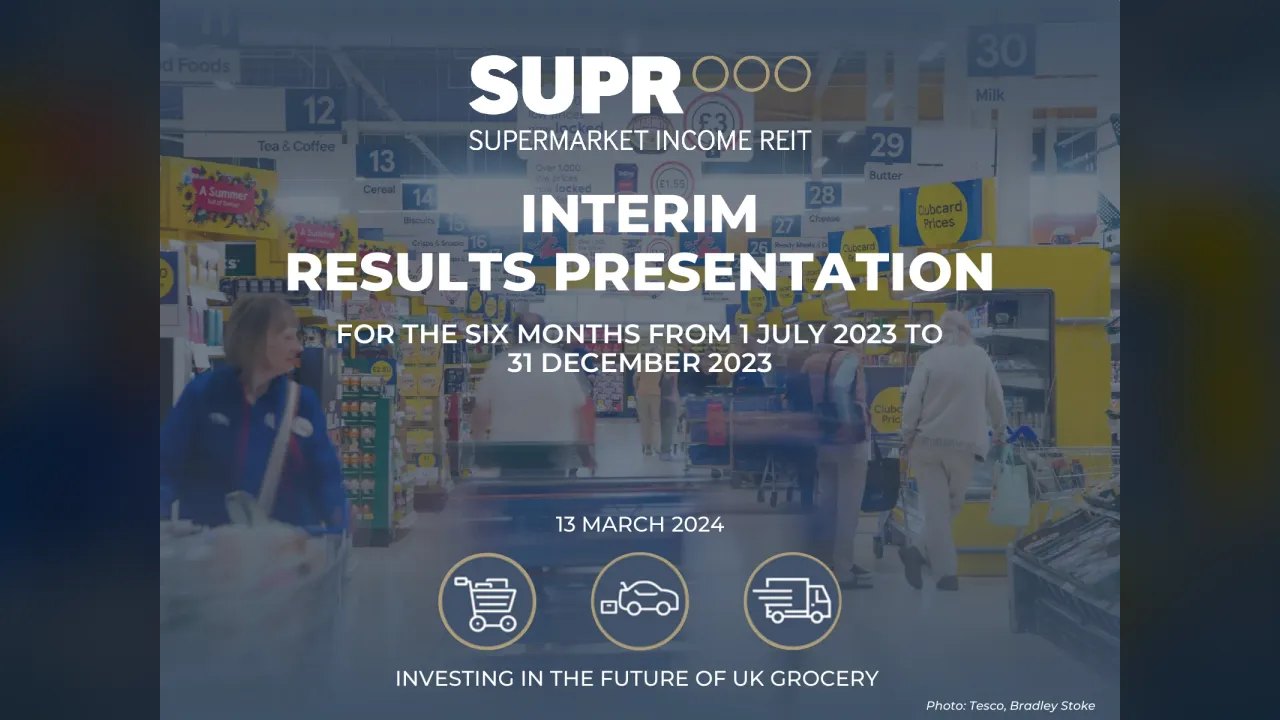
Interim Results hosted by Supermarket Income REIT (LSE:SUPR) on Investor Meet Company, held 2024-03-15.
On 6ix: 6ix.com/event/supermarket-income-reit-plc-supr-interim-results-1
Automated transcript · Written by software from the replay's audio. It can mishear names and figures; the replay is the record.
0:02 Good morning, ladies and gentlemen, and welcome to the SUPERMARKET INCOME REIT PLC Interim Results Investor Presentation. Throughout this recorded meeting, investors will be in listen only mode. Questions are encouraged and can be submitted at any time using Q and A tab situated on the right hand corner of your screen. Please simply type in your questions at any time and press send. Company may not be in a position to answer every question received during the meeting itself. However, the company can review all questions submitted today, and we'll publish those responses where it's appropriate to do so. Before we begin, we'd like to submit the following poll, and I'm sure the company will be most grateful for your participation.
0:33 And I'd now like to hand over to chief investment officer, Steven Noble. Good morning. Good morning. Thank you, and good morning for everybody joining us online. You're joined today by myself, Steven Noble. I'm CIO for ATRATO, which is the investment adviser to SUPERMARKET INCOME REIT, and also Robert Abraham, who's the managing director for SUPERMARKET INCOME REIT. I wanted to start this morning just by highlighting some of the key messages in our six months results presentation, which we will be taking you through in more detail shortly. But, firstly, we are in a really strong position for the next phase of our growth. Our omnichannel stores continue to grow at the fastest rate in UK grocery, and I'll be taking you through that in more detail shortly.
1:23 In addition, we have very low leverage on our balance sheet with capacity to grow, and we've got a really strong pipeline of opportunities for us to explore. And Rob will take you through this in more detail shortly. But we thought to start this morning by just taking you through a quick summary of our financial results. So our key financial highlights is that during the period, we generated rental income of 52,600,000, which in turn provided an adjusted EPS of 2.9p, and we are on target to achieve our full year dividend target of 6.06 p. Our independent our portfolio was independently valued at 1,700,000,000, and that generates an 88p per share, and our loan to value at our period end was 33%.
2:24 Just taking you through those numbers in a bit more detail. Firstly, on our rental income. During the period, we generated £52,600,000, and that was up 15% driven by two new acquisitions and rental uplifts during the period. And I'll take you through that in a bit more detail. On this graph, we show a bridge of our annualized passing rent since June 2023, and you can see that our annualized passing rent is now at a 104,700,000, which increased 2,500,000 as a result of two new acquisitions carried out during the period, which was done at an average 6.5% net initial yield.
3:13 In addition, a further 1,600,000 was generated through rent reviews, which was achieved at an annualized 3.6% rental uplift. And we're pleased to report another period in which we've collected a 100% of our rents. Just turning to expenses, you can see that our expenses during the period reduced by 4%, which continued to decline as we scale and grow our platform. And on an EPRA cost ratio basis, that reduced to 15.1%, which is one of the lowest in the real estate investment sector. Finance expenses, Rob will take you through our debt in more detail shortly. But as a result of us lowering our LTV to 33%, our finance expenses has declined during the period.
4:11 Now putting all of this together, we've actively maintained our earnings during the period whilst lowering our overall leverage, which you can see here at the very bottom from 40% LTV to 33% LTV.
4:30 On the bridge graph, you can see that the divestment of our joint venture interest in the Sainsbury's reversion portfolio resulted in a reduction of earnings of 7,400,000, which was replaced via new acquisitions generating 6,700,000 in earnings. Together with the lower finance costs through lower leverage, a further 0.6 millions of earnings was generated. As such, our total earnings for the period was 36,300,000, consistent with the previous period, but a much lower leverage. During the year, we paid a half year dividend of 3p.
5:17 And as I said earlier, we're on track to achieve our full year target of 6.06 for the full year. I'll now hand over to Rob to take you through the balance sheet in a bit more detail. Good morning, everyone. So it's Steven Smith touched on some of these points already, but you can see there the first line portfolio valuation down 1.1 on the previous on the previous period. That is net of acquisitions, of course, as well. So on a like for like basis, we saw the valuation down 3.2% and that led to a decline in EPRA NTA of 5.4%, which took NTA per share to 88p. But the key point here as well leaving an LTV of 33%, so lowly levered even off those revised valuations.
6:14 And then you can see how the breakdown of that valuation move in a bit more detail. But you can see acquisitions at $36,000,000 You also then had the valuation move which was impacted. Well, firstly, the valuation change was is positively impacted through rental uplifts, but then the yield expansion moves in the opposite direction, but giving you that net move to portfolio value of 1,675,000,000 overall. And then just again how that breakdown has impacted NTA. So during the period, we had earnings of 2.9p per share. The dividends paid was equivalent to 3p per share. And then the property revaluation and some of the other items reducing the NTA to give us the 888p per share.
7:11 But then turning to our balance sheet in terms of the debt perspective. So you can see here the low leverage and significant covenant headroom. So firstly, we proactively decided to reduce leverage in the last year and reducing from 40% at December 22 to 33% as at December 2023. And that actually then means there's really significant covenant headroom. So current LTV of of 33% against the covenant of 60%, you would have to see valuation decline by 40 plus to be to be under any strain there. And similarly, similarly, significant cover on interest cover as well. And on the right hand side of the page there, you can see that six times net debt to EBITDA ratio, the average cost of debt at 3.1, and also Fitch confirmed reaffirmed SUPER's rating as BBB plus, so defensively positioned.
8:14 And then just looking to our banking facilities, you can see in the pie chart there now 60% of facilities are unsecured. You can also see it's well diversified across a range of lenders and a range of maturities. And this includes facility extension options with $177,000,000 of undrawn debt capacity. The average term of those facilities is four point one years. And we also have 100% of that debt. The cost of debt is fixed. And as I mentioned on the previous page, that's at 3.1% on average.
8:55 Just to turn briefly to sustainability. So, we recently published a new sustainability strategy of which there are three pillars. The first being climate and environment, and the work there involves achieving a net zero carbon portfolio. We also have the tenant and community engagement, so ensuring our assets are enhancing the communities in which they are located. And part of the tenant engagement includes getting information from them on on energy consumption. And then finally, responsible business, such as strength ESG performance and upholding responsible business business practices. And then at the bottom of the page, can see that these pillars have been aligned to the UN Sustainable Development Goals that we were able to have the most impact on.
9:46 And then just looking at asset level initiatives sorry, our ESG initiatives firstly at the portfolio level, and it's that sustainability reporting. Our annual report was TCFD compliant for the first time in September, and we're continuing to build out our reporting. We're also looking at new projects, any any potential development, and the impact that might have through a nature related strategy. And, again, just that proactive tenant engagement. And then at the asset level, you've got the two items at the bottom here, EV charging and solar installation. So EV charging now present at 30% of the portfolio, solar present at 20% of the portfolio, and importantly, that has been delivered at zero CapEx cost to SUPERMARKET So this is something that we see tenant sort of third parties funding the works of, but ultimately is a net benefit to SUPERMARKET INCOME REIT PLC scores where particularly where solar installations are rolled out.
10:49 Thank you, Rob. Back to me. I'm gonna take you through the grocery market now because we're seeing some really interesting numbers coming out both on the overall UK grocery market, but more particularly for our tenants. We'll start by just reiterating that The UK grocery market is experiencing strong growth. Since 2017, the grocery market has grown by an impressive 35%, and it stands at 250,000,000,000 today. Now in other words, our market has grown 65,000,000,000 since we launched the fund in 2017. And, of course, given store rents are a factor of turnover in our space, this growth is highly positive to the reversion value in our portfolio.
11:36 And we can illustrate that by looking at how that growth has been distributed by the various formats or channels in UK grocery. Now this chart shows the breakdown of the growth by the different channels, and highlighted in green is the omnichannel segment. That's the area that we specialize, the integration of online fulfillment with physical, store sales. It is the largest growth segment in UK grocery at 18,000,000,000. And, of course, this growth has been achieved through existing stores with one net new supermarket opening since 2017. And that was the thesis when we set up the fund that future growth would compound on existing stores given the grocers network throughout The UK, and that's what's being achieved.
12:28 Now to make that clear, that means that this growth is achieved on like for like store sales. And, again, it's further evidence around the future value of the reversion portfolio. Now if we contrast that then to the second fastest growth segment in UK grocery, which is the discounter segment, which I've highlighted here in light blue, you can see that's substantially driven by new store openings in the period, 568. And we can have a look at that in a bit more detail.
13:06 So here, we're illustrating the historical store openings from the discounters. And as you can see, there's been a slowdown in the rate of new stores from both Audi and Liddell, and that's predominantly driven by higher development costs for new stores and lack of sites. And in turn, that generates lower returns from the new stores. So it's providing a bit of evidence that actually the discounters market share may be now reaching a maturity level. But turning back to our tenants, Tesco's and Sainsbury's. In these two graphs, we're showing the total revenue growth versus larger format stores for both Sainsbury's and Tesco's. Now whilst The UK total growth has been very strong, what's more impressive is that larger format stores have outpaced that growth, up 10.89.3% respectively.
14:04 And, again, that's just further evidence on how omnichannel strategy is driving increased volumes for our tenants. And, of course, this is delivering a significant shift in our tenants' market share as we're showing you here on this graph, with Tesco's and Sainsbury's capturing ground on all other grocers over the last six months. And just to remind, 80% of our portfolio is let to Tesco's and Sainsbury's, and Rob will take you through, more details on the portfolio shortly. Now in contrast, the market share for Audi has actually decreased over the last, six months. That may be evidence of the, the decline in the growth of new store openings.
14:50 But putting all of this together, this is highly positive to market rents and, of course, the reversion value of our portfolio.
15:01 So to break it down at a store level, I mean, this image is our Sainsbury's store in Ashford. It's a top performing omnichannel store for Sainsbury's, which generates annual sales in excess of a 100,000,000. And we wanted to explore in a bit more detail how that revenue is generated just so we can illustrate the versatility and resourcefulness of these assets.
15:28 Typically, 60% of the revenue of an omnichannel store is generated through in store sales, Their size supporting the full range, serving around 10,000 customers a week, and we're seeing now growing momentum behind the big weekly larger shops. Around 10% of the revenue is generated from essentials, school supplies, pharmacies, fuel, and we're seeing the food to go market in EV charging offering significant growth potential for the grocers on-site. And, of course, 30% of the revenue on average is now coming from online. These stores are just optimal locations for last mile delivery with the full range in store enabling profitable online fulfillment through both home delivery and click and collect.
16:25 And we can explore that online element in a little bit more detail. Right now, 90 of The UK population is less than thirty five minutes from an omnichannel store. And, of course, omnichannel stores fulfill 80% of The UK's online grocery market. But the grocers are now increasingly leveraging the power of that last mile proximity in their omnichannel store estate. For example, 70% of Argos' annual sales are now collected at a Sainsbury's store. With Sainsbury's becoming the largest click and collect platform in The UK. In fact, the majority of the Argos range can now be ordered and collected same day through a Sainsbury's store. That's becoming an alternative to Amazon.
17:17 And in the same vein, Tesco's has been leveraging its proximity. It's now expanded its Whoosh delivery service from more stores across The UK. In fact, their coverage on their Whoosh platform is now 60% of the population. And, again, it just demonstrates how our stores are so vital to our tenant strategy and how the future growth will be positive to the future reversion value of our portfolio. I'll now hand you back to Rob, who's gonna take you through the investment market and
17:49 our portfolio in a bit more detail, and then we'll come back to q and a. Rob?
17:56 Thanks, Steven. So as you can see on the page here, you've got the yield series from the MSCI index. And in the gold line, have supermarkets. And you can see in Q4 of last year, we saw yields soften out to 6.4%. And SUPERMARKET portfolio was not immune to that. And I've mentioned already the yield shift there and the impact that's had on the portfolio valuation. But you will note that 5.8% SUPERMARKET valuation is inside that reported by MSCI. And the reason for that is the very strong assets that SUPER owns, but also its assets are weighted towards Tesco's and Sainsbury's 80% of the portfolio. So those covenants, which are the strongest in the space, whereas the MSCI index is very much an average and particularly will include both weaker covenant operators such as Morrisons and NASDAQ who've been doing their selling and leasebacks, but also will just generally include weak performing stores and also discounters.
19:01 So there's there's a real mix in there. So that's why it's not comparable to SUPER's valuation, and SUPER's valuation is informed of transactions, which I will come on to in a moment. But really and but really, we just think it looks really strong relative value at the moment, supermarkets compared to where you can see all property, the blue line, 5.1%, and logistics at 4.7%.
19:25 So then it's that strong relative value that just means we've seen investment volumes achieve a record last year, pounds 2,100,000,000 transacted. A large portion of that around £1,000,000,000 was selling leaseback activity, the largest being as the 650,000,000. But, again, just showing that of that SUPER's portfolio valuations are based on transactional evidence because there has been a large volume of transactions, and you can see that it is a very liquid market averaging that $1.81900000000 pounds a year. And Rob Tesco's is still doing further buybacks as part of this investment activity? Yeah. Absolutely. So we've seen Tesco throughout throughout this period buying generally kind of $2,300,000,000 of stores a year, and that's been the case more recently. We've seen them them buy back in a a couple of stores. And also Sainsbury's have been buying. They bought back our our interest in a joint venture. So those are two biggest tenants, are two of the biggest buyers in our space.
20:28 And for those of you who know as well, we've always said that's what differentiates us from the rest of the market is that our tenants are one of the biggest buyers
20:36 of their own real estate, which underlines the long term value that we're also seeing. So then when when I talked to that 2,100,000,000 of volumes, there there are four distinct investor strategies across across that volume. So the first being the long lease strategy, which is targeting your investment grade covenants, Tesco, Sainsbury's, but also the discounters, M and S in that bucket as well. And, really, these are being targeted by unlevered institutions who are just looking to the long term returns of this asset class and still buying at yields of five and a quarter percent. And on the next page, we've got a a short case study,
21:17 which is Sainsbury's and Chadwell Heath. So this was acquired by Aberdeen recently at five and a quarter percent. So, again, just highlighting those strong yields you can that that investors are willing to pay for long leases, fifteen years, inflation linked, and it had been recently regeared by Sainsbury's. So the store was rack rented. The second strategy is regear opportunities. So this is where you've got the same strong covenants of Tesco's and Sainsbury's. This will typically have been the original sale and leasebacks of those operators around twenty or so years ago now. And this is being targeted by the operators themselves, as we've mentioned, but also sector specialists like ourselves. And you're seeing pricing here at 7% plus.
22:03 And with the example being a Tesco, a strong trading Tesco store in Edinburgh. It's omnichannel.
22:11 This was purchased for a yield of 7.6%, but importantly, you'll note only seven years left on the lease, and it is over rented. And this was acquired by ICG who took advantage of some some pressure on the vendor last year. And, actually, if this came back to market today, we think this would achieve both stronger stronger interest and stronger pricing. Then the then the next strategies move on to the weaker covenants. As I've mentioned, we've seen as the Morrison's, but also Waitrose undertaking new sale and leasebacks. And this has generated really strong interest from institutions and the pricing there around six and a half percent. And again, the example of this one was the as the sale and leaseback.
22:58 On the next slide, please, Stephen. The as the sale and leaseback $650,000,000 at a 6.5% net initial yield. So that was with a twenty year lease term, annual inflation linked uplifts, and that was acquired by Realty Income. But we fought saw four credible bidders on the portfolio here, which included sovereign wealth type names. So, yeah, really strong demand for for some of these assets, but the yield the yield being wider there at six and a half percent.
23:26 And then finally, the last strategy we're seeing is in the secondary market where you've got the the weaker covenants, but also generally kind of weaker forming stores, maybe over rented. And these are being targeted by opportunistic investors who are just buying into record wide yields with pricing of 8% plus. And the example in this case was a was a Morrisons in Gloucester. Next one, please, Steven. Morrisons in Gloucester, which priced at a yield of 8.8%. So for a fifteen year lease term with inflation linked uplifts. And as I say, that was acquired by a private investor.
24:05 So of these four strategies, where we see the the biggest opportunity and the most value for SUPER is in that regear bucket. So we're seeing Tesco's and Sainsbury's opportunities, as I say, would have been the original sale and leaseback. So maybe ten, twelve to maybe up to twelve years left on the lease, pricing at 7% yield. And you can see on this page, that means it would be both accretive to earnings, but also maintains the tenant covenant strength. And that earnings accretion just just then supports the ability to grow SUPR's dividend.
24:36 The other opportunity sets either because of the the earnings dilution or or because of the covenant dilution are therefore not considered kind of priorities at the moment. But but, yeah, the focus for us will be on those re year opportunities. So then we turn to SUPR's existing portfolio. So we we are looking to grow this portfolio, but as it currently stands, 55 supermarkets. You can see on the left there weighted to Tesco's and Sainsbury's. So 80% of our exposure with those, but generally diversified across across geographies and tenant. 93% of our stores are on the channel. And then last point on this page on the bottom right, 3.8 average rent to turnover. So highly affordable relative to store performance.
25:21 And just turning over the page,
25:24 this is where we're now seeing regear evidence in terms of rents, demonstrating 4% rent to turnover being the affordable benchmark for operators. So three Tesco's here at £26, £27 per square foot rents, but importantly at that 4%. And then in the case of the Sainsbury's in North London, actually, £35 per square foot starting rent for a twenty year lease term. That's over 5% rent to turnover. So just highlighting for strong performing stores that the operators are willing to pay higher rents and commit on on long lease terms. And then turning the page again, that really then just highlights the affordability of SUPER's rents in that context, £23 per square foot on average and 3.8 of of store turnovers.
26:15 And Rob is correct to say that these regears tend not to get populated into the mainstream market rental index because, well, they're behind a kind of confidentiality firewall. They're technically not new rentals. Right? Exactly that. So so this these transactions do not count as open market evidence. So valuers, the MSCI index will not reference these rents because they're private transactions. They're not viewed as arm's length open market transactions. But, actually, yeah, the really important point is it is demonstrating that rental growth coming through. You just might not see it when when you see a, yeah, a valuers supermarket ERV number. Which underlines our importance of being a specialist in this space is that some of the mainstream rental indices just don't really reflect the full value of larger omnichannel stores such as these ones.
27:10 So then and then we come just back to the point around strong relative value that I've I've already mentioned. So at current pricing and and you can see here compared to on the left hand side, UK ten year gilts at 4%, Tesco bonds at 6.6%. But owning supermarket property at current yields can generate an IRR of 12% on a levered basis. And we just think that looks incredibly good value in the context of 78% of SUPER's portfolio has index linked rent reviews. 80% of the portfolio has led to the strongest covenants of Tesco's and Sainsbury's. And then really important there, a 100% occupancy and rent collection since IPO.
28:03 You still there, Rob? Yep. If if you turn over, Steven, I think it it's on to the next one. Fantastic. So for me to sum up and I guess just turning back to that 12%, Most of our tenants are Tesco's and Sainsbury's, but you could earn 6.6% with their bonds, or you can earn a 12% IRR from us. So for our current share price, we yield on a cash basis around 8%. And, of course, that pricing differential shouldn't exist, but it does. And that's the kind of arbitrage, that we've currently got within our portfolio relative to, say, the bond market. And, of course, they're different markets with different investors and different levels of liquidity, but that seems incredibly strong, to us.
28:53 So we promised Mark we'd be done within 30. I think we're pretty much there. Just to summarize up, Mark, if I can before turning to q and a. Yes. Of course. So overall summary, our investment strategy, which is predominantly focused on omnichannel stores, is a growth sector within UK grocery. In addition, we've got a really strong balance sheet with our leverage at 33% LTV, gives us capacity to grow. And we've got accretive acquisitions within our pipeline, and that will be accretive to our earnings growth. And to put it all together, our strategy is to generate secure income with long term attractive total returns focused on UK grocery property.
29:39 And at that point, I'll probably pause, Mark, and start with questions. That's great. Steve and Robert, thank you once again for updating investors this morning. Ladies and gentlemen, please do continue to submit your questions using the q and a tab. Just situated on the right hand corner of your screen, just while the guys take a few minutes to review those questions submitted already, I'd just like to remind you that recording of this presentation along with a copy of the slides and the published Q and A can be accessed via your Investor Meet company dashboard. Firstly, thank you to everybody for your engagement this morning, Robert, Stephen. Hopefully, you can see in the Q and A tab you've received quite a few questions from investors today. If I may just hand back to you just to read out those questions where it's appropriate to do so, and I'll pick up from you at the end. Yep. Thank you, everyone. Lots of lots of questions, which is great to see. I'll probably compare.
30:28 So we'll start with the first one, which is a question coming from Matthew b, which I'll ask Rob. On the two acquisitions we did during the year, can we disclose who the sellers were or what industry and why they're selling? Yep. So those those two acquisitions were actually two of these stores from the Sainsbury's reversion portfolio. So these were bought from out of that joint venture structure. So they're Sainsbury's. They let Sainsbury's on new fifteen year leases. The rents were materially rebased on those, and they came at an attractive yield. As part of that unwind, we were able to negotiate. So attractive pricings, they came at an average of six and a half percent yield. So that's accretive to the cost of debt for omnichannel stores and, as I say, with materially rebased rents.
31:15 And on a similar vein, a question that's come in from Katie or a few have raised to this. Can we continue to grow, if we're not gonna increase our exposure to Asda or Morrisons? Is there enough pipeline of Tesco's and Sainsbury's out there? Yeah. Look, I I think we've we've mentioned Tesco's and Sainsbury's buying back stores. So, of course, it is competitive, and we've seen increased competition since the start of the year. I guess what I'd say to that is we are sector specialists, so we get 100% visibility of the market. So we do still have a pipeline, and we have some opportunities that we're working on at the moment. We've got around 150,000,000,170,000,000 of debt capacity. And and where we've seen kind of market sentiment shift feels like valuations have or close to finding a floor. So now it feels like a good time to be buying. But, yeah, I think that we expect it to be quite competitive for assets this year, and that is a is a challenge we will have to face. But we have we have managed to grow the portfolio over over the last six years or so by by competing against those same names. So so we're hopeful of that ability to continue to grow, but it it will get harder the more the more stores that we see Tesco's and Sainsbury's buyback.
32:28 And that leads in nicely to another question which I can take, also coming from KT around, can we continue to grow the business without raising capital? Well, as Rob mentioned, we have a 170,000,000 of undrawn debt capacity available to us. And if we were to draw on that debt and deploy into some of the pipeline, we'd be doing that at a level which is accretive to earnings. So that would flow straight through and down into the bottom line. So in the short term, that's that's our focus. There also remains the opportunity to grow through active management where we can consider maybe selling a store at a yield and then re redeploy that into an equally high quality store, but at a higher yield to generate more earnings growth. And there's probably a related question around, well, how does that feed into dividend growth. Of course, the other component of our investment strategy is progressive rent reviews.
33:22 Around 80% of our portfolio is is linked to inflation or, I think, around 75 to 80%. Most of that is annualized. And you'll have seen during the half year, our average rent review was 3.6%. Was it, Rob, or 3.8 3.6? So that's predominantly how our our rents will grow over the second half as well. We do have a rental cap, for those of you who know as well. That's around 4%, and current long term inflation is pricing just below that. Probably turn to ESG. A question coming in from Mark b. Do you find tenant engagement on ESG matters easier with our tenants than, say, privately owned or other sectors?
34:09 Yeah. Look. Good question. And and, actually, I think we're just really fortunate to operate in a sector where our tenants have really strong and serious commitments to sustainability. So of our tenants have ambitious net zero targets. They are the ones who invest in sustainability initiatives. There's also a significant incentive for them to do do that given they are such large consumers of energy. Tesco is, I believe, the the biggest private consumer of energy in The UK. So that just means they're they're very much incentivized to get their energy consumption down. And the the net benefit to us is we see sustainability metrics in our stores improving at zero cost to SUPER, and we get good it's an evolving space, but we get that really good engagement where the tenants are sharing information with us at the store level. A granular we get very granular data, and we're improving that the quality of that data and and the and the breadth of it.
35:11 But that will be something we continue to work on. The flip side for us is is that actually evidencing our own sustainability credentials is is more difficult because all of our tenants are doing that work, and and our assets are let on long leases. But where we can, we're supporting with EV charging rollout, solar rollout, and ensuring we're we're we're assisting with that reporting where we can. And another good question coming in from, I think I'm pronouncing this right, Venue, is around the warts and a kind of linked question around the investment strategy. So with our wart being thirteen years now, fourteen years last year, how do we see the wart evolving, especially if we're looking at short dated regear opportunities?
35:59 If you want to comment on that one, Rob. Yes. So as you've mentioned, portfolio awards is now thirteen years. So naturally, with the passage of time, that declines. But of course, those maturities are are staggered. Our shortest supermarket lease remaining lease term is six years. Our longest is thirty four years. So the the maturities are are staggered, and therefore, as as they approach maturity, we will, of course, regear those leases. The the likes of Tesco's and Sainsbury's now will not not extend beyond fifteen years typically. So that does does put a bit of a cap on where we will be able to get the walk to over time, but I think we will we will just see through that kind of portfolio churn and and through extending leases.
36:47 I'd expect us to kind of still be beyond ten years and and in that long income bucket and and probably on average around around twelve years going forward. And it is a good question, of course, because one of the one of the things we have seen is the growth in UK grocery and the acceleration of sales at the store level is exceeding rent reviews predominantly because of the higher inflation environment as well as the growth that we saw during COVID in in store sales and online. So, actually, the reversion value of the portfolio is growing. So, actually, by looking at acquisitions with shorter dated warts is actually a way in which we can capture that reversion quicker, into the funds. But as Rob mentioned, we still remain core to being long income with an average wart in excess of around ten years.
37:36 There's quite a few questions coming in on debt, which I'll try and group together, but just running through some of the last ones on the portfolio. Rob, just a question on the Sainsbury's joint venture and the one store we didn't buy in that property. That's a question coming in from Mark b. Yes. So that store was vacated by Sainsbury's. For those of you, again, that would have heard the story before. You'll be aware that that was the store that was the weakest one in the portfolio. So when we entered into the transaction 26 stores in that portfolio, we identified the one weakest store. It was in Coventry. It was kind of materially underperforming in terms of revenues.
38:24 So we always identified that as a as a risk and had underwritten the value of that store at a very low value. It is now being sold subject to vacant possession. There are kind of various interested parties of developers who will look to convert it into an alternative use, but it isn't it isn't kind of a material number for for SUPER, given it was underwritten at a very low value. But what I would say is it just does highlight why you need to be a specialist in the space and being able to understand store trading and the risks of owning that property. But as I say, we always identified that as the weak one and and it underwritten at a very low value. Good. I'll stick with the property ones before we come on to deck because there's still, quite a few questions on the property strategy.
39:12 All good questions. One coming in from Johnny, around geographical distribution. We only have two two stores in Scotland. Do we see any more opportunities up there? How do we think about geography? Yeah. No. I think for us, actually, we're we're pretty agnostic on on geographies. For us, it's about buying the best quality and the best performing supermarkets. And and yet, in in doing that, we we are open. Grocery is a very is a highly localized market. Shoppers will not travel more than ten or fifteen minutes to their supermarket. So for us, it's about understanding the local demographics, the local competition, and making sure that we're buying the dominant store in that area. Other than that, we're we're broadly agnostic.
39:59 And and, actually, for us, in some of the locations that are maybe less less obvious to the to your typical UK institutional investor who's based in London, well, actually, we can get better value elsewhere. So Sainsbury's in Islington in North London was acquired by a pension fund mandate on a twenty year lease at 4.1% net initial yield. And that's the difference when you're buying property in London. We own Sainsbury's best performing store in the North Of England in Newcastle, and that would be kind of more like 5%. So you get that 100 basis point additional yield for owning a store which is outside of London, but it's equally important to Sainsbury's operation because it's still turning over $1.31400000 a week of revenue.
40:46 So from the operator's perspective, they're also agnostic as to whether it's in London or Newcastle. It's all about the revenue generation. So, yeah, there's no no particular bias geographical bias. We we have bought stores in Scotland, as you mentioned. More it's more for us where kind of the pipeline falls, and and we will we will buy depending on where the best value is. And a couple of questions on our exposure to as to our Morrisons. Any sign of any underlying stress at the store level against those assets that we own? No. And again, this is this is our point of targeting the best performing supermarkets. So we're we're confident that the stores we own that are let to those operators are both strong performers, but also in your kind of ultimate downside case, there would be demand from alternative occupiers to take them. But I don't think it's any secret that those operators have certainly felt more of the pressure from the discounters, and they they have they have lost market share. I think if you look at more recent performance, they kind of refocused the strategies. There's been a change of leadership at Morrison's and actually over the last I think it's the last eight or ten consecutive weeks, they've they've been net net gain of market share. So we're seeing that refocused strategy. I think the the distraction came from the the leverage takeovers from the private equity groups, and they had to deal with their financing.
42:11 We saw those same leaseback programs that assisted with that. But, actually, now, you have to remember these are just at their core very strong underlying businesses. They're grocers that have stood the test of time, and they still have significant market share in The UK, and their store networks and their supply chains are still incredibly valuable. So no real signs of of kind of distress. Certainly not yet anyway. Great. I'll take, just a couple of questions on strategy, and then we'll turn to the debt. So a few more. Question around, do we ever consider convenience stores? I think the short answer to that is no. One of the things we like about omnichannel is their size and importance. With convenience stores, they tend to have a much smaller trading footprint, and they tend to be more liquid in grocers moving in and out of those assets.
43:00 So you tend to get exposed to more tenant risk with smaller convenience stores. So hence, we don't really play in that sector. Another question around have we considered international opportunities? So, look, we're always looking at The UK grocery market globally because it's quite important to understand what's going on in other jurisdictions. We have good relationships, for example, with tenants in Europe. Right now, core of our focus is in The UK, but we do consider value, overall when considering investment, decisions. And then, I'll probably turn to the debt questions coming in at the moment. One question which I can take is, being an ex accountant, very detailed one, can we explain the movement in the changes in fair value of our interest rate derivatives?
43:51 Yes. Of course, when we lock in our our interest rates hedging arrangements, as interest rates increase, those derivatives or those fixed rate hedges just become more valuable. And now we're in an interest rate environment where the future looks like a much lower interest rate than where we are currently, and hence, that feeds into the fair value of the interest rate derivative, so hence, the movement there. It also does neatly lead into how do we think about future interest rates. I mean, when we look long term into the interest rate curve over the next three, four, five, and seven years, that is starting to come down predominantly in expectations that the inflation rate is gonna fall, and there'll be a likewise reduction in the Bank of England's base rate.
44:39 So in that respects, looking forward, the interest rate cost curve does look like it's coming down, and we did note, Land Security has recently done a new bond issuance into the market, which was seven year debt priced at 4.75%. So we are in an environment where interest rates are coming down, but equally, we're in an environment where we're seeing some really attractive property yields. So, hence, the strategy around considering additional leverage to take advantage of that. One of the questions is how high we would take leverage. I mean, for those of us knows knows us well, we've never really taken leverage above that 40% LTV level. So I think that's a a safe assumption going forward. And I'll just take one other question, which has been a a couple of questions coming in around how we think about share buybacks, and the reinvestment of the SRP into assets as opposed to to buying back shares.
45:37 I mean, it is something we, of course, continually look at with the board. If we choose to do share buybacks, where does the source of funding come from? Well, it would be through through bank debt. So increasing leverage in order to buy back our own stock would be the outcome of doing a a share buyback program. But, look, how we're thinking about it and how we think about it with the board is really around value. And right now, we see more longer term value in this asset class. So in that respects, the acquisition opportunities here look more accretive than, say, buying back our own shares in the market, but it is something we keep continuously under review. I think that's broadly That's good. That that's perfect, Steven. Robert, thank you very much indeed, and thank you to everybody for your engagement this afternoon. And, Steve and Robert, if any further questions do become available, I'll make those, available on your platform, this afternoon.
46:34 Robert, Stephen, I know, investor feedback will be particularly important to you both. I'll shortly redirect everybody on the call to give you their thoughts and expectations. If But I may just come back to you, Steve, just for a couple of closing comments, and then I'll send investors to give you their feedback. Yes. Thank you, and thank you for everyone taking the time. Again, just to reiterate, we're in a market which is growing. And at the same time, we've got a very flexible balance sheet and a really active pipeline that we can look to deploy into to grow our earnings on top of the compounded earnings growth we will get through our contractual rent reviews. And we're invested in a sector which is incredibly strong with strong tenant covenants of Tesco's and Sains That's great. Steven, Robert, thank you once again for your time this morning. Later on, could I please ask you not to close the session as we now automatically redirect you for the opportunity for you to provide your feedback in order the management team can better understand your views and expectations.
47:25 This may take a few minutes to complete, but I'm sure you'll be greatly valued by the company. On behalf of the team from SUPERMARKET INCOME REIT PLC, we'd like to thank you for attending today's presentation, and good afternoon to you all. Thank you.
Follow Supermarket Income REIT PLC into a list and get an email when it puts out news.
Chief Investment Officer at SUPERMARKET INCOME REIT PLC
Fund Manager at SUPERMARKET INCOME REIT PLC