Automated transcript · Written by software from the replay's audio. It can mishear names and figures; the replay is the record.
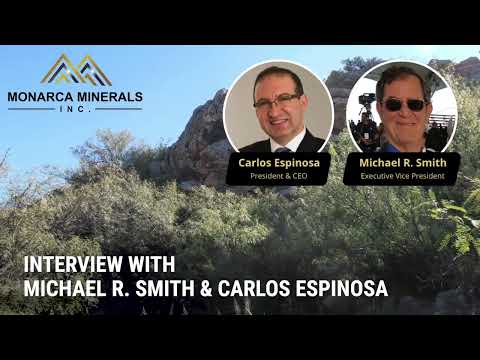
0:11 Absolutely, Dasha. Thank you very much for the opportunity to speak today. Monarca Minerals is an exploration company listed on TSX Venture. We are focused on gold and silver, mainly silver. And we have 3 assets in Mexico, 2 in the state of Durango, 1 in the state of Chihuahua. The 2 jurisdictions, the 2 states are really, really friendly jurisdiction for mining. And we have been there for years. So we know very well the location. We know the people, the laws. We have a very strong technical team down there. And we have an amazing VP of Exploration and qualified person who is Mike Smith with us today.
0:57 And I think I'm going to ask him to tell you more details about the company or the price of the company. I just want to highlight those 3 products are San Jose, San Lucas, and Tejamen. San Jose's the one in Chihuahua, San Lucas, and Tejamen in Durango. I'm going to ask you, Mike, to please take a little bit more about the technical aspects of the project. Sure. Yeah, as Carlos mentioned, the property that we're the most active with right now and getting ready to drill is the San Jose project, which is west of Juarez, Mexico, which is right across the river from El Paso, Texas. So it's great access. It's easy to get to the project. It's about a two-hour drive west of El Paso.
1:46 The project is very close to the border with New Mexico. It's only about 20 miles south of the border with New Mexico. And so it's easy access. The project is not very steep mountainous country. It's easy to work in. And it's located about 15 kilometers west of a small village called Guadalupe de Victoria where we have 2 houses rented that we use to house the personnel that are working on the project. And so we have a great relationship with the community there and we recently signed an agreement with the Colonia which owns some of the surface where we're going to be drilling. We went through the process of getting that agreement with the colonia completely legally documented with the federal authorities in Mexico. And so that was a process that took a lot longer than we thought it was going to take for various reasons that we can get into later.
2:45 So it's a great project. It's a SCARN system with high-grade gold and silver mineralization, as well as base metal mineralization at the surface. Based on sampling that we did, where we had grades of gold up to 10 grams per ton and silver to about 250 grams per ton. It was pretty obvious that it was a leakage from something much bigger at depth. So we did a geophysical survey, magnetics and IP, and discovered a very large IP anomaly associated with the magnetic anomalies. And so we have designed a 10-hole drilling program, about 5,000 meters. It looks like we'll be able to start that now, but recent news from the authorities in Mexico – Hopefully we can start building roads in mid-July and then drilling hopefully towards the end of July and early August.
3:39 So that project is advancing quite rapidly. And we also have the other 2 projects to the south about – almost about a one-day drive outside of Guadalajara, Mexico. The projects are easy to get to in both cases. There's paved road access to within 10 kilometers of the Tomin Project and goes right through the San Lucas project. The San Lucas project is exciting. It's very close to Argonaut Gold's San Agustin project, which is an open pit gold mine. You can see the mining activity about 4 kilometers away from the ridge line where we recently did sampling a couple of years ago and got very high grade gold and silver and some base metal assays off the surface.
4:24 So we're moving towards advancing that project by expanding the land package in that immediate area. And then the Tahaman Project has a 43-101 compliant resource with about 28 million ounces of silver. It's very, the mineralization is right at the surface. We recently realized that there are very high-grade feeder veins that we want to follow up on with the drilling program. And that drilling program would confirm the existing surficial mineralization down to about 200 meters deep, but continue down and look at the high-grade feeder veins, of which there are 3 or 4 or 5 of them, depending on how you look at the mineralization. And what we're excited about there is those high-grade feeder veins, with grades up to well over 500 grams per ton silver, are associated with lead and zinc mineralization.
5:25 And where those high-grade feeder veins come into the base of the volcanic section, which hosts the shallower mineralization, we think there's great potential for Montos and very large scale mineralization where we would have ponding of those fluids at the base of the volcanic section. So we're excited about the projects that we have. They have great value and we're very excited to be able to get started drilling the geophysical anomalies of the San Jose project in the next month or 2. That's great. Thanks so much. Mike, maybe you can tell us why there's been so much delay in starting the San Jose drilling program? Yeah, a lot of that's basically due to COVID. The federal authorities that we have to do permitting through were completely shut down in terms of access to be able to get the permits to do drilling all the way into the early part of this year. And part of that process of getting the agreement with the Colonia, which owns the major portion of the surface in the area in the San Jose project, was that they had neglected to maintain their legal compliance with their appropriate legal formation and we had
6:37 to walk them through that entire process and get them registered with the federal authorities. So that took several months And then the permit application process is going in next week. And then we expect that to take about a month to get the permit to be able to start doing work on the surface. So there was big delays. We certainly didn't expect that, but we've got that remedied now and expect to be able to be drilling in a month or 2. Great, all right, well thank you. What areas offer the best opportunity for more exploration at San Jose? Well actually I'm going to the San Jose project this Sunday on the 6th, and I'll be taking a bus to New Mexico.
7:23 The daughter of the original owner is gonna give me transportation to Palomas, the border crossing. I'm gonna walk across the border and get picked up by Carlos Pacheco, our country manager, and go down to the project for 5 days. It's very close to the border with New Mexico, as I mentioned. And what I'm going to be doing is walking the ground on the southerly extensions of the mineralization. The geophysical anomalies extend beyond the area of the survey. So we're going to be following those on their south extension and looking to see if we can find any old mines, look at mineralization, alteration at the surface. So it's obvious based on the geophysics that the mineralization extends further south. We just don't know how far, so we're going to start doing the work on the ground to follow that up.
8:09 Wow, that's very exciting. What kind of mineralization do you expect to see in the drilling? The drilling is focused on the IP anomalies. And what we see at the surface is we see areas of mineralization with scarn veins up to 10 grams per ton gold and 250 gram per ton silver at the surface. And so the focus of the drilling is following up on the IP anomalies and chargeability anomalies which indicate buried sulfide mineralization. And there are almost 3 kilometers of IP anomalies. So we've got a drilling program planned to focus on drilling the IP anomalies and targetability anomalies where we expect to see sulfide minerals. And with the mineralization we see at the surface of the silver, gold and base metal grades, we expect to see sulfide minerals that are going to be containing gold, silver, lead, zinc, and copper.
9:05 All right, perfect. Well, so with some sampling having resulted in high gold and silver values, is there opportunity to focus on just that? Well, there is. I've just mentioned that there's 1 spot at the south end, one of the mines at the south end of the geophysical anomaly is called Guadalupanla. And that's where we got the 10 gram per tonne gold and the 250 gram per tonne silver in surface sampling, channel sampling across the vein. It's a scarn vein. It's about 2 meters thick. And so one of our drill holes is going to be cutting that mineralization. It's a sub-vertical vein at a depth of 50 to 100 meters. So just stand-alone, That's a pretty significant grade and significant mineable thickness. If we can show down dip and lateral extension of that with drilling, we could have standalone precious metal mineralization that's economically viable.
10:00 Great. Absolutely. Well, so in addition to the San Jose project, what are the plans for Tehamin and San Lucas projects?
10:12 The San Lucas project is very well located. I mentioned it's very close, about 4 kilometers away from the San Agustin mine. Right now, the focus is to expand the land package. We've been in touch with the owners of the surface of the mineralization, the mining concessions that are in the area, And they seem amenable to be able to basically bend about 700 hectares of mining concessions that they have there. And so adding that to our land package would get us up to almost 800 hectares of land position. And that's really where we want to focus is to expand the land position. And with Tahaman, we're continuing to work with the community to, and through Monica Ospina, to develop a good relationship, repair the relationship for the Tahaman property.
11:04 The historic management prior to our arrival in about 2009, messed up the relationship with the community. So we're putting together a program to repair that so we can get in and do drilling. Got it. Okay. Thank you. And Carlos, are you planning to raise more money soon? That's an excellent question that people are asking quite often. And it's a difficult answer. Currently we have enough money in our treasury to continue to complete the drilling program. We had a private placement last year, and currently we have around $4.4 4.4 million dollars in warrants. Those warrants expire on August 22.
11:56 So my view or what we're expecting based on the conversation we have with current investors is most of them wants to convert the warrants after the drilling program. We are very confident on the drilling program for San Jose. So if that really happens, probably we don't need to raise more money for the following phase. If we don't see this warrants conversion as positive as I believe, probably we'll go back to the market. But let me tell you, we have those warrants at 7.5 cents. The trading today for the shares are 10 cents, but we have in between 10 and 20 for the last 12 months. So I expect the share will be performing really, really well after the drilling program. So I don't see a reason why the investor doesn't want to convert the warrants.
12:50 So the question is still there. We are open to analyze all the options and we are trying to keep informed the investors because actually quite a number of investors tell us on a regular basis if we are going for another private placement, they want to be part of that. Oh wow. Well, that's great. Well, could you tell us a bit about who the institutional investors were that participated in your last private placement? Yeah, we have a very good response from the institutional investors. We have like PoliSight, Crescat, we have Aru Capital, we have Red Cloud was part of the student investors, XIB Financial, KJ Harrison, among others. So that's also something that is keeping us very, very happy and excited about the future of the company because we have probably first time in several years a pool of institutional investors willing to participate and back up the company.
13:58 And as I mentioned, we continue talking with them on a regular basis, Mike and myself, just providing updated information on the plans and the progress, and they express their interest to continue supporting the company, which is great. Just on the last part of the panel, just a small comment, We have probably around 70% institutional investors and the other 30% was retail and insiders, so it's also a good number to have a new group of retail. We have some people from Mexico, Canada, US, Europe. So it's a good balance. All right, thank you. And Carlos, how much has COVID-19 impacted your plans? It has been a big headache.
14:47 As Mike mentioned, it's creating a lot of delays in our plans. Fortunately for our company, for people, for the communities where we are involved, COVID doesn't affect that much as an illness problem. However, in terms of working, has been creating a lot of issues. As Mike mentioned before, the community in San Jose doesn't have the registered authorities before the Mexican government, So we need to help them to go through a new meeting and elect new authorities and so on. But you need to have the Mexican government as a witness for all this process. And because of COVID, an office is closed for the Mexican governments.
15:33 We have a big delay on that. And now we are in the process for getting the environmental permits that also have been very slow process for because of the COVID. So We, in the meantime, we have been working as much as we can, planning, advancing, talking with our contractors now that we are coming for the drilling program. And be sure not only our employees, but also the community and the contractors' employees are safe in terms of COVID. So we don't want to have any issues or any bad surprises in our team or our community. So we are trying to spend the time that is needed to be sure the impact is minimized, at least in terms of health for the people. In timing, it's having a big, big headache, as I said, but it's what it is.
16:29 Yeah, it is what it is. All right, Well, in closing, why invest in Monarcha Minerals? I know we know we are competing with many, many mining companies that are also in Mexico or any other parts of the world. So when we said, why Monarch versus any other, and there are several factors that are important for investors to consider. One of those is we are in Mexico, which is a great jurisdiction to work close to Canada. It's a jurisdiction with a tremendous mining experience and tradition. So Canada and Mexico knows very well each other. And we are in a very friendly States in Mexico, which is even a plus for us or for an investor who is exploring the opportunities where to invest.
17:25 And we are a very strong local team. Carlos Pacheco, our country manager, has over 25 years experience in geology just in Mexico. He knows very well the country, he knows the projects, he knows the people, so he had been very very helpful for the company to advance and develop the projects. He was the one who found a San Jose, for example. I think mentioned a Mike didn't mention, but we pay $150,000 for San Jose project, which is almost 6,000 hectares. And, and the reason we got a great deal is because it's a product that we acquired from a local position owner, not from another mining company. So we took this extra risk because we are very, very confident in the information and experience of our local team. And also Mike, even though he's based in Arizona, he's fluent English and Spanish with a lot of experience and he had been also working in Mexico for the last 10 years so it's a very very as I said very strong local team so that's one of the reasons but some of the reasons are the products we have. Tejamen with almost 29 million ounces of silver in further sources.
18:42 San Jose with a great potential and San Lucas with an excellent location, the potential to expand the land package that also offers a good opportunity to grow a nice project. I mentioned we have enough cash to complete the drilling program, which is very important for us. And I think something that is also very important for investors is the performance of the share and liquidity. In the last 12 months, the lower price for our share was $0.04, and the higher price $0.225. Today, we are around $0.10. And I think this is great news for the investors, because the company is still undervalued with a huge potential. So we're still cheap and this is a good moment for investors to participate.
19:40 And on top of the share and its performance, it's liquidity. For the last 12 months, we traded over 67 million shares. So for a junior company, this is a really, really good performance. Our highest day volume was 2.1 million shares in January. And actually on October 13 last year, we trade over 1 million, 1.4 million shares. And that day I got a call from the Securities Commission asking me if there is any information I haven't opened to the market because it was like a tremendous jump from 300,000,400,000 trading to 1.4 million in a single day.
20:34 So we've been asked to actually preface saying we are unaware of any material change. So we didn't hide any special information. We didn't wait to disclose anything. But it was just the response of the people and the investors that are supporting the company that are creating this volume. So today we have the average trading volume for the last 12 months of close to 300,000 shares a day. So when a company is, or an investor is investing in the company, also it's interesting, you know, well, is there any liquidity? Because if I want to walk out at any moment, I don't know if I can sell my shares, right? So we are offering a good opportunity to grow with us, but also it's a great liquidity to sell the shares at the moment they want to do it or they need to do it, right? So it's, I think this is a very important point for investors when they are analyzing investing in 1 company or the other.
21:39 And another key point is social management. Monarca is implementing a social management system, customized on managed social risk and build the relationship of trust with every community we're working. As Mike mentioned before, in Tehamin, we heritage a very bad reputation as a mining industry. So we have a risk management program in Tehamin rebuilding the relationship and restoring the relationship and the trust on the industry and in the company, while in San Jose or San Lucas we have a great relationship with the communities and we have a different problem to maintain this relationship, to keep informed and just to inform the people about the plants and the next step so there's no surprises for them, there's no big interruptions and so on. So I believe Monarca is a great opportunity for an investor who is willing to take some risk in the junior exploration companies and because of location, commodity, team, projects and so on.
22:59 All right, well thank you so much Carlos and Michael. It was great to learn more about Menarche Minerals. Thank you very much, Lisa.