Transcript
Automated transcript · Written by software from the replay's audio. It can mishear names and figures; the replay is the record.
0:08 Well, hello everyone and welcome to Monarcha Minerals live summit today hosted by 6. We are joined today by Carlos Espinoza, President, CEO and Director, and Michael Smith, Executive Vice President of Exploration and QP. Carlos and Michael will walk us through a company presentation and then afterwards we will be accepting questions live. So as a reminder, you can submit your questions at any time on the Q&A panel on the right-hand side of the screen and we will get to that in the presentation. And as always, this summit is being recorded
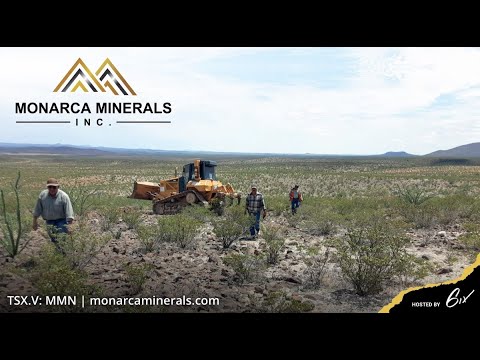
0:39 and will be available to watch afterwards on SIX.com. But without any further ado, I'll hand it over to you, Carlos, to kick things off. Thank you very much, Dasha, and good afternoon, everyone. Thank you for joining us today on this presentation. It's a very interesting and important presentation for us. For those of you who are familiar with Monarca, we have been working in preparation for a drilling program in one of our properties. We have been drilling now for a few weeks and we have a very important results that we are seeing on the ground. So we want to share where we are at this point. So I'm going to show quickly these looking forward statements. And just for those of you who are not well familiar with Monarca, we have 3 assets in Mexico. 2 located in the state of Durango, San Lucas and Tejamen project.
1:37 And the main project we are working on at this point is San Jose. San Jose is almost 6,000 hectares located in northern Chihuahua, close to the border of the US, like 120,150 kilometers west of Ciudad Juarez, but like 30 or 40 kilometers south of the border. So we're basically very, very, very close to the border. I don't want to talk in much detail about the project because Michael Smith, our Executive VP of Exploration, is joining us today and he's going to walk us through all this progress that we have been doing in the last few months. But I want to mention Michael, he's a world-experienced geologist.
2:26 We are lucky to have him on the team. He has over 40 years of experience from exploration to production, companies like Barrick Gold or Continental Gold, and he's been with us for around 10 years. So we are very, very happy and lucky to have him. I want to mention just quickly about our capital structure. Our share is around 10 cents trading. We have an average volume close to 300,000 shares a day for the last 12 months. So we are happy with that because we have liquidity for our investors. We have 120 outstanding shares and we have currently close to $1 million in the bank, so we still have enough money to complete all this drilling program with no problem at all. Some of the main institutional investors that are with us, it's Crescat Capital.
3:25 They own currently over 10% of the company and they have been supporting us since the beginning when they joined us last year during our prior placement. We are in constant communication with some of the institutional investors and we are also talking to retail investors on a regular basis, trying to promote, trying to create awareness about this opportunity and the progress we have in the company. This slide is about the board and the management. We are very happy with the team we have. I don't want to spend much time here because I think it's better to use the time to talk about the project, but you can download the handout so you can read and learn more about the team here in Canada and in Mexico.
4:14 I'm going to stop here. I'm going to pass the microphone to Mike so he can start telling us more about our 2 projects that we have in Mexico. Thank you Mike. Yeah, thank you Carlos. Yeah, so we have 3 projects in Mexico. Carlos alluded to 1 in particular. We're drilling now the San Jose Project, which is very close to the border with New Mexico and the US in the northern part of the state of Chihuahua. We also have 2 other projects, the San Lucas Project and the Tahaman Project, which are very close to the capital city of the state of Durango in Mexico. And both of those projects are easily accessible by paved road, as is the San Jose project.
5:00 The Tehamin project is the only project where we have a 43-101 resource, where we have almost 29 million ounces of silver at an average grade of 45 grams per ton. I'll get into a bit more detail on that further in the presentation, but we've realized recently the very high-grade feeder veins have not been drilled below a depth of about 200 meters. The San Lucas project is also very close to the capital city of Durango, Durango City. Very importantly, it's only 4 kilometers away from Argonaut Gold's San Agustin project, which is a gold mine that's now in production. You can see it from the ridge line where we have outcrops of gold and silver mineralization at surface. Next slide, please, Carlos.
5:51 The San Jose project, as Carlos alluded to, is about 5,850 hectares of land. It's a large land position. The area is easy to work in. It's not steep mountainous country like in the Sierra Madre. It's more rolling hill country and it's very close to about 15 kilometers west of an agricultural settlement called Guadalupe de Victoria, where we have a couple of houses rented where we live in the community with the people that live in the area. We have a great relationship with everybody in the area. Importantly, the San Jose project is about 50 kilometers northwest of the Bismarck mine, which is on standby right now. They went into production in the 90s and went on standby earlier this year. So they have about 25 years of continuous mining production at a significant rate. And importantly for us, it's also a SCARN system like we have at the San Jose Project. So it's sort of an exploration model for us. We entered into an agreement to acquire the San Jose project in 2019 for a 100% interest for total cash payments of $150,000.
6:57 The previous owners retain a 2% NSR of which we can buy half of it for $100,000 single payment down the road once we get into production. The potential in the mineralization we see there is dominated by scarn mineralization with various intrusive rocks and scarn hosted in limestone, as well as lots of endoscarn in the intrusives themselves. There was very small production historically reported from the area in the early 1970s. The deepest mine working on the property is only about 10 meters deep, And so the production was very, very limited. It was more exploration and nature. We saw that there was a significant potential in the area there where the old mining prospect pits are and so forth and so on. And we decided to do a geophysical program, which I'll get into a bit more a little bit later on in the next few slides.
7:54 But if we can go to the next slide, that would be page 8, where we're looking at a cross section through the Bismarck mine. Again, it's our exploration model. We see the mineralization very analogous to what Bismarck had. The cross-section on the right is a cross-section through the Bismarck mine, where you can see the intrusive on the right in purple and the limestones on the left in blue and green. And at the surface, there was very minimal surface expression at the Bismarck mine. And Peñoles, who are the owners, they did a geophysical program and discovered IP anomalies. And so their success demonstrates then with the drilling that they ended up with an initial starting inferred resource of 13 million tons at 52 gram per ton silver and 11% gold with some other base metals. And so it's our exploration model. We see very narrow veins and mineralization at the surface but over a broad area.
8:56 And so we have a star system that's very similar. What we're thinking and what we're seeing now that we're starting to do the drilling is that the mineralization we see at the surface is indeed leakage of larger mineral systems at depth, dominantly demonstrated by star mineralization. And so we have the intrusive rocks located at the property dominantly. We have early monsonites and intermediate age granodiorites and recently we discovered in the drilling mineralization that explains the large magnetic anomalies we see in the property where we have magnetite bearing biotite porphyry. The kind of alteration that we see ranges from broad areas of very strong specification as well as endoscarn in the intrusives and then with disseminated sulfide minerals including molybdenite and also we see significant magnetite in much of the endoscarn.
9:54 The exoscarn mineralization is dominated by bronstedurite, but there's some dioxide associated with it too. And Importantly, we see that the higher grade gold values are associated with late hydrous retrograde silica plus clay mineralization overprinting earlier mineralization. Next slide, please. This slide gives you an idea of the work that led us to do the drilling. The right-hand side is the size of the claim block. We did an IP survey over the area where the oval is indicated because that's where the dominance of mineralization expresses the surface outcrops. And to help guide us with that, we also did a chip channel sampling program early on before the geophysics was done where we took 167 chip channel samples across mineralized structures with grades up to almost 10 grams per ton gold and 257 ppm silver.
10:55 So we covered the area of the magnetic and an IP survey and the lower right hand colored image is the IP survey, I'm sorry, is the magnetics results, and we can see 2 anomalous areas of mineralization, which are buried intrusive rocks. We have a larger one to the southwest, which I think is the biotite porphyry that we've drilled in now and a few drill holes in the area that contains magnetite, and then a smaller more subtle anomaly to the north, which again we think is probably a buried intrusive rock. And if you look at that and compare it to the IP survey, the IP survey shows the bright red and pink colors which are very strong IP responses and they're associated directly with the areas around the probable buried intrusive rocks we see based on the magnetic. So we have the classic picture here of mineralizing intrusives indicated by the Magnetic Geophysical Survey, and then the IP Survey shows locations where we are now drilling and seeing significant sulfide minerals associated with the IP anomaly.
11:58 And so we're continuing through that drill program right now. We've drilled up through the last press release 2,889 meters of drilling. Since then we've completed about another thousand meters. In that first batch of drilling that we did out of the roughly 2,000 meters of drilling, we drilled 407 meters of exascarn and 1,275 meters of endoscarn. We are certainly seeing larger mineralized systems at depth, which are expressed at the surface via leakage from these larger areas of mineralization that are at depth and indicated by the IP survey. And so all of the information combines that We have larger areas of mineralization based on the drilling that's now underway, and we see leakage in the form of smaller, thinner veins at the surface in the area of those IP anomalies.
12:57 Next slide, please, Carlos. This slide gives you a quick summary of the drilling compared to the IP survey of what we've done so far. We've drilled about 8 holes now, and the mineralization that we're seeing by targeting the drilling at the IP anomalies is we're certainly seeing significant amounts of alteration and sulfide minerals at depth. We have individual intercepts that are up to about about 50 to 60 percent of pyrite dominantly. We do see other sulfide minerals, including molybdenite, galena, stalerite, and chalcopyrite. So we're certainly seeing mineralization at depth that we anticipated that we would see based on the geophysical surveys.
13:46 Next slide, please. This is a quick summary of the drilling up through October 3rd. I've tabulated the general generalities of the mineralization that we're seeing at various depths in the drilling. In drill hole number SGO1, we drilled 9.1 meters of exoskarn with silicification and also 43 meters of endoskarn. In SGO3, we drilled into limestones with exoscarn mineralization into more granodiorite endoscarn mineralization at 29 meters of thickness there, then below that another 91 meters of exoscarn, below that another 27 meters of endoscarn, below that another 33 meters of exoscarn, and then back into endoscarn. So we're seeing multiple intercepts of mineralizing intrusives associated with endoscarn and exoscarn mineralization.
14:49 In SJ07 we did not hit any scarn mineralization. It was a hole that was targeted on a mineralized shear zone with a very strong IP anomaly based on the quantitative sections that were provided by Matrix, the geophysical company that did the work for us. SJ08
15:08 drilled all intrusive rocks again, in an area where there was a strong IP anomaly. And we did encounter there 180 meters of endoscarn associated with strong silicification. In SJ-10 we drilled entirely within endoscarn and the entire length of the hole with significant sulfide intervals up to several percent pyrite with other sulfides. In SJ11 we drilled 128 meters of exoscarm. In SJ12 we drilled 76 meters of exoscarm. And then in SJ15 we drilled 48 meters of exoscarm. So we're seeing significant large volumes of skarn mineralization at depth, much larger volumes than we see at the surface.
15:55 All of these areas where the drilling has been done, it's associated with old mines that have significant grades at the surface based on initial work that we did, which is leakage from these larger scarring systems at depth. Next slide, please. We have an agreement with the local surface rights owners. The colonia has been certified and it's a document that we're operating under in terms of land disturbance, surface disturbance, building of drill roads and drill pads. The environmental assessment was completed months ago and has been approved. We've got Lane drilling out of Edmonds Sea, we're doing our RC drilling and they're doing an excellent job. And we're still planning on drilling up to 5,000 meters. We're at about 3,000 meters right now.
16:47 The work, The geophysical work that was done was done by Matrix. They did a great job for us. One of the things that we recently discovered by simply looking at float in arroyos to the south of the area where the geophysics is done is to see a large extension of the mineralization to about 3 kilometers south of the area of the geophysics survey where mineralization is hosted in limestones. Here's a few images just of the drilling going on. I mentioned we're doing RC drilling with Lane. We see in the upper right-hand image, the cyclone splitter being used in areas where we have significant water that we've encountered. And we have that water up to 50 or 60 gallons per minute in some of the drilling. So we have to go from dry drilling to wet drilling when we get significantly below the phreatic surface.
17:39 And then the samples, when they're very wet, like the upper right-hand image you see there, is the cyclone splitter. We've covered half of the sample port so that we're getting about 8 kilos of sample to be sent to the laboratory. And we're also collecting a duplicate sample from each one of the intervals and holding those until we get assays back to decide if we're going to dispose of them or retain them for potential future work regarding metallurgical characterization or waste rock characterization. And then you can see the sample bags lined up. This is the first hole, SJ1, where the samples have all been put into bags, all been organized. Every 20th sample, we put in either a waste standard, rock, a sterile standard of barren basalt rock to run through as part of the QAQC program. And then the other sample we use is a QAQC mineralized standard that we've used for years, about 10 years. It was a, that was developed and on another project.
18:42 Next slide, please. So this slide just gives you an overall summary of where we're drilling and the roads that have been built. The roads that are indicated in blue are new roads that were permitted by the environmental permit and so those roads have all been constructed and so what we're doing is drilling on the colonial lands and up to the area of the Yejido, which is to the west. And so the work that's been accomplished on the ground has been really very extensive. And with the drilling underway now, we're very excited to see the mineralization as we had anticipated that we would likely see. And the next slide, page 15 Carlos, shows the location of one of the drill holes and it gives you an example about what we're doing in terms of targeting the IP anomalies.
19:32 We have located the SJ09 in a position to drill that very strong IP anomaly you see in profile. The 2 bottom cross-sections, the upper one is the IP work, and you can see that we're targeting with that drill hole to target that IP anomaly, which based on the drilling we've done so far is going to be have significant sulfide mineralization. Next slide, please. This is the Tehamin project. It's a project that has a 43-101 resource of almost 20 million tons at 45 grams per ton silver, which is contained almost 29 million ounces of silver. It's a fairly large land position, 1,685 hectares, and it's located about 10 kilometers south of a town called the Huevo-Huillial, which is accessed from Durango City by a paved highway.
20:28 The access into the area is good. There's lots of local talent and resources in terms of power. The small town of Ndwebuwi, the Eyal is there. And so the mineralization that we see there has been drilled for the intent of looking at just shallow mineralization. And based on the historic drilling, we see grades in some of the feeder veins that I alluded to before of up to 6 meters grading 1,400 gram per tonne silver with about 5% combined lead zinc. So what we see at the surface
21:02 is mineralization that was drilled historically to come up with the current resource, but all that drilling was limited to about 200 meters of depth. These high-grade feeder veins, which now are fairly obvious based on recent geological reinterpretation, extend below the base of the deepest depths of the drilling on the property. So one of the things we're really focused on doing is working and continuing to work with the community to be able to get in there and do additional drilling. The next slide, which is page 17, Carlos, shows the area of the drilling that was historically done. The upper right-hand image shows the drill holes, which are indicated as blue and red points where the Los Montos deposit was drilled, as well as to the northwest of that, the Cerro Prieto deposit.
21:52 In both cases, what we see is a mixture of vein-style mineralization combined with Montos-style mineralization hosted in volcanic rocks. So that's an area we'd like to get into and do additional drilling. You can see in the table in the lower left hand side some of the significant intercepts. Some of those higher grade intercepts are these high grade feeder veins and we have intercepts like the MMT097 which is the second hole indicated in Los Montos where we drilled 138 meters of 105 gram per tonne silver. Below that, about 90 meters of 620 gram per tonne silver. So there's significant mineralization. As I mentioned, the drilling was originally done very shallow to a maximum depth of 200 meters. That's because at the time it was looked at as an open pit, mineable deposit.
22:43 And so metallurgical testing indicated recoveries that might be achieved
22:48 in a heap leach environment. And the ore here is a bit unique in that it does respond well to cyanide leaching because all of the silver is tied up in argon, acanthite and native silver which are both soluble in cyanide solution. So test work indicates that we would have decent, good recoveries there in the future. Next slide please, Carlos.
23:15 The San Lucas project is a very important property for us. We have done recently sampling, about 2 years ago sampling, along the part of the main share zone where we had an area called the doctor zone, where out of the 89 samples that we took, the average grade was 3.2 gram per ton gold off the surface. And that's not counting the very high grade, 110 gram per ton gold sample that we saw. So there's significant mineralization at the surface. Our next endeavor is to basically consolidate the land position there more. So it's a property with significant mineralization. It's in elephant country on the ridgeline where the sampling was done in the old doctor zone.
24:03 You can see 4 kilometers to the north of the San Agustin mine, which is now in production. So we're in an area with a very notable mineralization in the area. And so we hope to be able to advance that project in the coming months. And the next slide is for Carlos to deal with the comparable company analysis. Thank you very much, Mike. We like to share this slide because it still shows that Monarca Minerals is undervalued compared to its peers. So we are trading about 49 cents per ounce of silver compared, which is almost 60% discount to the average of the peers that are exploration silver companies in the Americas.
24:52 So in other words, it's still a really, really good opportunity to join Monarca, to invest in Monarca and grow together with us. And we also want to talk a little bit about the social management. We have been working, building the relationship with the communities. One of our board members, Monica Spina, is also an expert in ESG and social corporate responsibility. So she has been helping us with her team to start building the foundation for a good relationship and prevent issues that might happen in the future. So we are very happy with that. And as Mike mentioned, in San Jose Prairie, we have an excellent relationship with the community. We became part of
25:46 the community. We rented a couple of houses for us. Mike, myself, and the rest of the team were down there. 10 days ago, I stayed in the same house as the rest of the geologists and the rest of the team. Local people is helping us cooking, cleaning. We hire some local people to assist the drilling company. So we are trying to get involved with the community and to bring something to the community. And they're responding really, really well. So we are happy with that. And we will continue working together with them. We just met with the new local authorities because in Mexico, there's been change of local authorities at the municipality level.
26:36 Great welcome from the new mayor. Happy to have Monarca there working, investing, spending money in the community. So we are excited with that. The Hameln and San Lucas, we are working with them as well on different levels because really at this point, most of the airports are focused on San Jose, and I think it's gonna be the same focus in the next few months. Just usually when the people ask why Monarca could be a good opportunity to invest, it's really we have a great project in San Jose, which is the main focus at this point. We are in the middle of this drilling program that we talked in the past and now it's happening and we're getting good results there.
27:24 We have 3 assets that are very, very well seen with a lot of potential and still undervaluated. So we're expecting the share to perform better as soon as we start getting results and sharing with the market the plans for the future. So this is the right time to participate. And I'm gonna stop here. And I think it's the time to open the floor for Q&A. And so I pass the mic to Dasha, and she can handle the questions. Great, thank you so much. So now we're going to open the floor to Q&A. So if you do have a question, feel free to submit it now. But Mike, what kind of mineralization are you encountering in the drilling at the moment? We're seeing mineralization both precious metals as well as base metal mineralization.
28:16 Again we've drilled lots of scar mineralization. Assays will tell us exactly what kind of assay grades we get in there. But we're basically looking for gold, silver, as well as lead, zinc, and copper are the dominant minerals associated with this style of mineralization and scarves. Great, thank you. We have a question here from Warren. He says, good day with the October 3rd mineralized intercepts. What data or understanding is being gathered to finding or locating or the possibility of silver mineralization? Well, we're at this point primarily looking at the mineralogy of what it is that we're drilling. Of course, you need assays to help back that up, but what we are seeing is dominantly sulfide pyrite mineralization, but we do see in the chips coming from the RC drilling galena as well as sphalerite and chalcopyrite, depending on the area.
29:16 We are seeing molybdenite too in areas up in the northwest in the mineralization. And so dominantly we're looking at base metals and precious metals, but along with molybdenum could be something important to us. And in fact, we did find on site several months ago, some in a waste dump, some wolfenite, which is lead molybdate. So it's additional confirmation of molybdenum being associated with the mineralization. That's not our primary target, But if it's there, we're happy to have it. Great, thank you. We have a question. When can shareholders expect new information with regards to the actual drill results? Of course, delays possible given the issues with labs. I think we're looking at about 2 weeks out to get assays.
30:06 The turnaround time has been pretty comparable with what we see in other projects in the U.S. And so we do expect to be able to get a press release out regarding assay results and the drilling that we're doing in the next couple of weeks. Great. And when you complete your drilling program, what is next for Menarca? Basically, it's analyze what we found. We just started, I bought a microscope and we just started logging in more detail than we had. The logs that I have in hand right now are on the rig, and so they come very fast to sample. Sometimes it's 5 minutes between intervals, so it's a quick log. But it does give us basic information about mineralogy, like the scarn minerals that we're seeing as well as sulfide minerals. We've also just completed detailed surface mapping in a radius of about 100 meters around the drill pad so that we can combine the detailed geological mapping, which includes alteration, along with the drill hole intercepts, interpret the geology, that puts us in the position then where we can understand where we need to look at the next pass of drilling.
31:14 All right, thank you. Tyler is asking if you could please reiterate what target metals should be associated with the different mineral types. I've kind of already addressed that to a certain degree. Primarily we're looking at gold and silver mineralization. We do have gold assays up to almost 10 grams per ton gold and some significant silver assays off the surface sampling that we did up to 250 approximately grams per ton. But we also have a broad distribution of copper, lead, and zinc mineralization at the surface. So Those 5 metals are predominantly what we're focused on. The style of mineralization we have, where we have this scarn mineralization associated with multi-phase intrusive rocks, which have been altered to endoscarn because of the calcium coming in from the limestones as alteration occurs.
32:04 The combination of everything is very prospective right now. We're hitting large volumes of scarn mineralization, which is what we hypothesized would exist at depth. We are seeing sulfide minerals associated with the IP anomalies in the scarn mineralization that we've observed in the drilling that's been done so far. And we're up to about 3,000 meters of drilling right now. We've only got, let me think, 1234 more holes planned right now. If we have some extra meterage left over, we may put in some additional holes from existing pads, depending on budget and what we're seeing in terms of getting the assays back. All right, thank you. And I know you're both in Mexico recently. How is the current COVID situation there, especially in the communities around San Jose project?
32:52 Now, Mexico is getting much better in terms of COVID. The government is having more vaccinations program moving well. And we are lucky that we are located in a very small community. So as I mentioned the city of Ciudad Juarez is like 120-150 kilometers far from from our community. So Guadalupe Victoria is the closest community where we are working. There's probably 800 people living there and it's very independent, isolated, agricultural community. So in a way it has been very good to have a community like this because they don't need to go to other places. So we don't have any cases of COVID. We are taking all the precautions, of course, but we've been lucky that we haven't had any issues in terms of sick people.
33:53 The only problem we had with COVID, which now is getting much better, was when the government offices were closed because we had delays trying to get all the permits because we couldn't have the authorities processing. And they were closed for weeks or months sometimes. Now they're open again and moving well. So we are very excited that from now on we can continue working with no problem. Great, thank you. And will you expand your drilling program or will you concentrate in the current area of interest? I'm sorry, could you say that again? Will you expand your drilling program or will you concentrate in the current area of interest?
34:39 Right now we would probably be focusing on the current area where the IP survey, the geophysical work was done, because we're putting 15 holes or so in an area that measures 3 kilometers by 2 kilometers. We just can't cover everything with those 15 holes. The intent of the current drilling program is to test IP anomalies, to test geological interpretations, all of which associated with metal mineralization at the surface based on the sampling that we did. I would imagine that the next drilling program would be following up on what we're hitting now, because we are hitting large areas. We have a great technical success. We've hit large areas of scarn mineralization and so now we need to interpret what all that means, put together the geometry of what the mineralization looks like and that will give us additional targets in the area.
35:29 Right now our holes on average are you know hundreds and hundreds of meters apart So we need to have a lot of additional drilling to do once we get all the assay results in and an interpretation done. Yeah, just I want to add up. Keep in mind, the whole property is almost 6,000 hectares. And we are currently working in like a 700. So it's a little bit more than 10% of the property, but it's still a large area. Mike has been walking around south of the current area of interest and looks interesting as well. But the most important part is to really understand what we have there. And in the future, of course, we will continue exploring other areas.
36:15 Great, thank you. And will you be raising money soon? More money soon? We are planning to raise more money soon, yes. The short answer is yes. We have enough money to complete the trading program. We want to show the market the results of the assays before we try to raise more money. So we are expecting to raise money probably late November, early December more or less. That's the timing. And also we have 4.5 million dollars in warrants that expires in the summer of next year. So, I'm expecting that some of the investors, or most of the investors, will convert those warrants before they expire.
37:06 But we don't want to just wait until see if somebody start converting or not. Probably they're going to do it after the first results, SA results come out to the market. But just in case when the raise some money by the end of the year. All right, thank you. We have an attendee here asking, is it possible to visit San Jose Drilling Project next month when they are in San Jose? I think the answer, it could be yes. However, if everything goes well, next month we won't be drilling. We are planning to finish the drilling program at the end of this month. And Mike, you can correct me, but I think we are finishing with the drilling program by the 30th of October.
37:54 And probably from there, we're gonna be analyzing the samples from the Durango office So definitely we can arrange if some people want to visit the site, but they won't see the machine drilling because it should be done by then. All right. Well, that is all the time we have for today. Thank you so much for taking us through your presentation and the Q&A. And of course, thank you to everyone who attended and asked questions. If you do think of another question, Carlos's email is here on the slide. There's also more information on moroccominerals.com. And for those asking, a copy of this presentation is available for download under the handouts tab. So be sure to do so before we end, which will be soon.
38:41 And of course, this has been recorded, so you could rewatch this on SIX.com afterwards. And I'll pass it back to Carlos for the final word. Thank you Dasha. I just want to thank you the people for attending today and happy to have more or continue this conversation. They have my email there, my phone number. So happy to share my information and will be exciting to have some of the investors visiting the site of course.