Transcript
Automated transcript · Written by software from the replay's audio. It can mishear names and figures; the replay is the record.
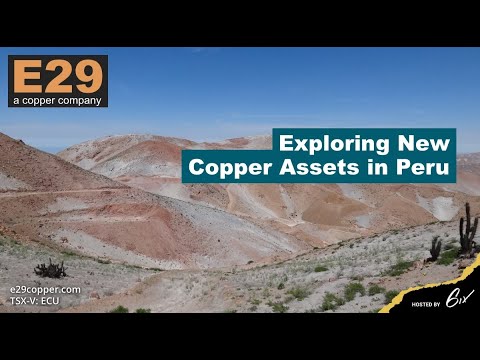
0:11 Hi everyone, thank you for joining Element 29 Resources live Investment Summit today hosted by 6. Element 29 President and CEO Brian Booth will walk you through a company presentation highlighting its 2 advanced copper exploration projects in Peru.
0:29 You will be accepting questions. As a reminder, you can submit your questions on the Q&A panel on the right-hand side of your screen at any point during the presentation. We also have a copy of today's presentation available to you in the handouts tab for you to download. And as a reminder, The webinar is being recorded and it will be available for playback on six.com. So without further ado, I'll hand it over to you, Brian. Thank you very much, Dash, and good morning, everyone. Very excited to have the opportunity here to discuss E29 and our 2 projects located in Peru.
1:07 I'll move now to slide 3. So we have 2 very exciting opportunities in Peru. These are very new projects to the market. We're excited about these 2 projects. They're not new projects in the sense that they have had exploration on them in the past. They're 2 key projects. They're well located in the country of Peru. They're close to the coast with great infrastructure, low elevation, already has a historic resource on 1, and the other one has 18 initial drill holes in it with wide intersections of copper, molybdenum and silver. So we're very excited about these 2 projects and bringing them to the open market. We have a very experienced team.
1:53 I've been working in Peru for over 10 years. So understand how to do business there. And also we have a very tight share structure as we completed our IPO. And we're gonna have some very significant catalysts that drive our work program and milestones for the value of the company going forward into 2021.
2:17 Our management team, myself, I was with Inco Limited for 23 years in exploration management. I was also CEO of Lakeshore Gold and former chairman of Clone Resources, which was sold to SSR Mining, and I'm currently a director of SSR today. Richard Osmond is the founder of Globetrotter Resources where these 2 projects that they come from. He has extensive exploration experience in Peru as well as I, so that brings a lot of experience to the projects to move them forward. Rounding out the rest of the management team, Duane Lowe also has worked in Peru with 1st Quantum, currently also the CFO for Entrez Resources, so obviously in the copper space as well. And the other directors, Michael Doggett, Patrick Elliott and Peter Espig.
3:13 Dr. Doggett was a former professor of mineral economics at Queen's University. Patrick Elliott is also an experienced explorer in Peru and Peter Espig is also a CEO of Nicola Mining in the copper space in Canada.
3:32 Our share structure is very tight, 80 million shares fully diluted. We just finished our IPO and raised $6.7 million. So we're well financed to go forward on these 2 projects. And you can see from our share position Globetrotter by virtue of spinning out the 2 projects 2E29 holds 23% of the company at this time and then management and board own 6% of the
4:00 company. This slide shows the 2 locations and photos of the 2 projects. Florida Cobre located in the southern Copper Belt, low elevation, fairly hummocky hills, so very good for potential mining prospect going forward. The Alita project you see on the right, big copper anomaly that was discovered by Globe Trotter in 2013. So very new. So first I'll talk to you about our Florida Cobre property. You can see the center part of the diagram here. You can see here that's the location of the historic area where there's a historic resource. Just for scale you can see that there's a truck located here.
4:52 So we own 100% of this project or are earning 100% in 1 small part of the project. It contains a historic resource which was drilled by Phelps Dodge in the 1990s. At that time, Copper was at a very low price and so the project was not pursued and has been in the private hands of a family for 30 years since that time. So we were able to make an agreement with that family to acquire that historic resource, which is wide open for further exploration, but starts us off with a good high-grade enrichment zone and oxide opportunity to move forward fairly rapidly. So again, as the other project, this is excellently located, great infrastructure with power lines close by roads and close to the coast where most of the product from copper mines in the general belt take our ship to markets.
5:50 So the promising exploration here, you can see some of the initial results, you know, 272 meters of 0.9% copper in the central part of this historic resource. Of that, the top part, the top 200 meters or so is enrichment and oxide grading 1.3% copper, very good grade, very high grade. And then below that only a few holes into the sulfide primary ore grading 0.54% over 148 meters. So a lot of great opportunity for sulfide expansion as well as oxide on the project. You can see here the location. The location here is between the Cerro Verde mine, which is the third largest copper mine in the world, and 8 kilometers north of the Chapi deposit owned by Nexa Resources.
6:44 And These are both located in the significant Paleocene copper belt which extends down into Chile and is a significant producer of copper in the world today. You can see it's located very close to the second largest city in Peru called Arequipa and very close to the coast.
7:06 This shot satellite image shows you the 2 target areas on our Florida Cobra property. The primary 1 is our Candelaria deposit. This historic resource is 57 million tons of 0.67, wide open at depth and a non-strike to the northeast. That will be the focus of our preliminary drill program when we get there. A second target that we worked on last year in 2019 called the Atrafasado target is a very large 1 by 1.2 kilometer system. Good mineralization at surface, obviously leach capping as well as very similar to Candelaria. We've completed all the geophysics and surface sampling and mapping and are be working on finalizing our ability to drill that through a permit later this year.
7:57 This slide shows you a cross section through the Candelaria Historic Resource and you can see here from the resource, it's perfectly pit shaped and it's all above, the enrichment zone is all above 200 metres from surface, So very amenable to an open pit situation, good grade, very clustered opportunity. And below that, there's still a lot of open area down here for the sulfide as well as on strike to the Northeast. So a lot of upside here to add to that resource.
8:39 This just shows you the small workings that occur on the property. These are all above that resource, so never impacted it. So this is they were just mining surface oxide and enrichment material that was very close to surface goes down about 20 meters that's all. So again, they were selling this material close by to various facilities.
9:03 So now I'll take you through Alida. Alida is a very large porphyry. It's a 2 by 2 kilometer system, was discovered by Globe Trotter, and then was drilled in 2015 with initial 18 holes that were very successful in intersecting significant mineralization. This one as well, we own 100% of this project and very promising exploration results And you can see one of the holes highlighted here, 500 meters of 0.42% copper, including 193 meters of 0.46 copper in that deposit. So starting off with a really great result, wide open at depth and on strike in all directions. So there are a lot of opportunity to grow this and build on a resource in the future.
9:57 In addition to that one area that was tested, which is the central target, There are 4 other untested central porphyry targets on the property that are very promising. We can see the mineralization sitting at surface. And so a lot of opportunity to grow this into a significant resource. You can see from this slide the location. It's in the belt that also contains the Antamina deposit, which is very significant. And you can see in green the pipeline that takes the Antamina material to the coast here, and we're only about an hour, an hour and a half's drive from the town of Barranca, which is 4 hours drive north of Lima.
10:50 Geologically, the project again sits right on that main belt and is Eocene and age, which is consistent with a lot of the big deposits in Chile. And again, this is a brand new opportunity that the market hasn't been aware of and is being taken for the first time to market for us. And we hope to be focusing on our maiden resource here throughout 2021. This slide shows you some of the holes from the central target area. You can see the very, very high grades and wide widths. Many of the widths are 300 meters to 500 to 600 meters in width, and copper equivalent grades reach as high as 0.579, over 500 meters with the molybdenum and silver credits. Molybdenum is very high compared to average copper moly porphyry, it's 2 to 3 times higher than the average grade in most porphyry, so very good.
11:49 And a good silver credit as well on the deposit. So we're excited about working in this area towards a maiden resource for the year. And we hope to get going very soon. This slide here shows you the location of the central target, which is right in this area here. This will be the focus of our first phase drilling. And then there's a target here, as well as in this area under here, and then in here these 4 other targets can add significantly to the size of the system if drilling successful in those areas. So a lot of brownfields upside here, So we're excited about getting going on this spectacular project.
12:37 This slide shows you the geophysics and on top of the geophysics we've draped the mineralization. Green is copper and blue is molybdenum. So You can see they're very consistent grades in this area here. This will be the area where we focus and we will be infilling some holes in here to be able to tighten up the drilling to create our first maiden resource here, as well as planning to expand in areas here where there's no drilling, so that we can grow the resource the best we can. The previous drilling, as you can see, the end of holes here, Ended in mineralization in almost all cases, so there's certainly a depth that's wide open and it's wide open on strike and of course we have the other 4 targets here. So this is a world-class, serious, large deposit opportunity, so we're going to be excited to get going on that option.
13:34 The catalyst for the company on these 2 very advanced projects from an exploration standpoint, we hope to get drilling here in the early part of 2021 and We'll focus on probably Aleda first and then go to Florida Cobre with our preliminary drill programs. We'll focus in on the historic resource at Florida Cobre first and make that a modern 43-101 resource, as well as starting from the products of the drilling, we'll be able to initiate some metallurgical studies, and then that will flow into engineering studies into 2022 as we start to take the project through economic assessments.
14:23 In addition, we have that Atravisato target. We will be working on permitting that one so that we can get drilling on that in the very early part of 2022, so that we can look for brownfields growth in addition to the known deposit that's there with the historic resource. At Aleda, we plan to grow the resource very quickly and start to do some metallurgical testing as well. Again, that's another reason why these are more advanced projects. We're not grassroots. We're moving these very quickly through to more advanced studies as we move them through 21 and 22. And so we'll be, the catalyst here will be drill results in 2021, followed by technical reports with new resource and 43-101 compliant resources towards the end of the year.
15:18 And so those will be the milestones that will be circulated to the market as we start to bring out those results. So again, why E29? Again, we have great projects that are less advanced, less risk because of their location. They're greatly located, low elevation, which is very positive for Copper deposits today. They're in that 2000 to 2500m elevation range. They're close to the coast, as I said. There's lots of power infrastructure in both areas, as well as these are open pit projects. So again, mining is cheaper that way. And they're close to the ports where a lot of existing mines are already sending their products. So again, road networks are good. There's available water for the projects. So Those are the main issues that all companies look for, which help to reduce the capital costs of eventual production decisions.
16:24 So again, the economic opportunity here is better because of the location. We have the right team with the right people that understand how to take these projects through the various advanced stages of exploration and studies. We've all done that in our careers. And again, we're at a very good infrastructure compared to our peer groups with a market cap of around $40 million. So a lot of upside growth with the milestones that we plan to achieve in 2021, we should see a rise in our valuations in accordance with those deliverables. We have a very clear work plan for 2021 into 2022, so that we'll be focused on drilling these known mineralized deposits and areas, and then expand on those at depth and on strike, and also onto the additional targets that we have on the project. So there's a lot of growth opportunities here.
17:25 So we're excited about getting started and getting going on exploration on these 2 projects. So that concludes the presentation and thank you very much for your attention. Great, thank you so much, Brian. So we're gonna move on to the live question and answer section. We got some questions sent in so we're going to start with those. Brian, you mentioned both your projects are well located in Peru. Can you tell us in more detail about how this impacts development of Florida Cobra and then Alida?
18:02 Well again, because both projects are close to the coast and there's already existing infrastructure in both cases, this reduces the need for building those power lines or building the roads to access the deposit and et cetera. So all of that infrastructure already being there lowers the cost of us having to do all that work to build the projects eventually when we get to that stage. So again, that reduces the capital investment when we get there. So again, that makes it that much more economic when you don't have to put up as much money initially. Great. Well, Andres is asking if he can ask you to comment about social acceptance surrounding both properties described.
18:52 Oh, thank you very much. That's a great question. Both projects are we've had at Alita, for instance, we've had an agreement with the community there. There's only one community, the ACO community, and we've had an agreement there for 5 years. We've extended that for another 5 years. So we have a great working relationship with them. They've always been involved in the project. We provide employment and assistance to them, and we keep them informed on all of our activities and keep a great relationship with them. At Florida Cobra, we have 1 community at the Atravisato target, which we've already had an agreement with, and we will be renewing that agreement as we get ready to drill that project and go through the permitting of that throughout the year. But at the historic resource area, the surface rights there are owned by the government and by NXA Resources, and We're working with both of them to go forward. So again, no issues there from a social issue standpoint. And again, wherever those are, we always focus on making sure that we have a good relationship with our stakeholders.
20:01 Great. So how did you come to acquire Floatacobra and then also Alita? As I mentioned, both projects were spun out of a project generator company called Globetrotter Resources. Those projects became more advanced, so the decision was made to populate them into E29. Again, Globetrotter discovered the Alita deposit, so it's their discovery that we're taking forward. And they also acquired from a private family who were just creating the small surface mining of the Candelaria deposit at Flor de Cobre. And so that's how they were able to acquire it when the family got to a point where they wanted to divest of it. So it was a target of opportunity that was a great acquisition.
20:53 So we look forward to taking both of these projects and compared to our to other companies we have 2 great opportunities and not just 1. And one that we plan to take forward at Florida Cobra and hopefully build Candelaria in the future. Wonderful. So Louis is asking, when is the mineral rights situation around the Candelaria resource? The mineral rights? What is the mineral rights situation around the Candelaria resource? Around the Candelaria resource itself, we own the mineral rights. So the surface rights are owned by the government or by NEXA, but we've got working on with them on all of those.
21:39 And around us is, you know, around the property, our NEXA resources and Sumitomo and some other companies around our main block. Wonderful. Well, so Harry is also asking if you could discuss exploration permits and do they expire and what are the costs? Well, exploration permits, we explored the properties with community involvement over the years. The only permits that we do require initially are the drilling permits. All of the drilling permits have been submitted to the government and we're in the final stages of getting those approved. So we hope that those will be approved in the early part of 2021. We're working with our consultants and the government to get those finalized as quickly as possible.
22:27 Again, we've already had community engagement. Those are the key issues and deliverables that the government always looks at is whether we have a community agreement and a relationship with them. And in both cases, we've satisfied that. So, you know, we're excited to be able to get those permits underway and get going on the drilling as soon as they come. Very exciting. John is wondering, what is the current availability of drill rigs and have you signed contracts for the 2021 work? I've already contacted some drilling companies and there are drills available. We haven't entered into any contracts yet, but we plan to do that now that we've completed the IPO and we're in the new year and we'll start looking at that as we get closer to the permit approvals process. Okay.
23:12 And so following up, Maibi is wondering if there will be any delay given the permits from the government? We don't anticipate any because we, you know, we've satisfied a lot of the issues that the government always looks at. In my experience in 10 years in Peru, if you have good community engagement and have an agreement with them, there are usually no impediments to getting the permit. So we don't see any reason why we won't get our permits on time because The permits that are delayed are usually related to companies that are having problems with finalizing agreements with communities. And so we don't have that issue in this case. So we don't see any impediments.
24:00 Great. And are there royalties on each project and can they be reduced? There are royalties on the projects. They're owed to Globetrotter Resources. There's a 2% NSR on the Florida Cobra and also a 2% NSR on Alita. OK. And they can't, there's no buyback opportunity at this time. Oh, I see. Because Harry is wondering, does Globe Trotter have a lockup on their stake? And can you discuss who took up the most recent capital raise? And were existing shares sold in the IPO? Yes, so there are lockups on the Globetrotter block and on management, of course. So there's escrows there. The Globetrotter block will be escrowed for a while under the terms, you know, at the IPO.
24:54 And what was the other question that was? Well, it was about Globetrotter has a lockup on their stake and- Took up the financing. So- Capital raise, yeah. Yeah, the financing was taken up mostly by retail with a few institutions added in. And, you know, management and board and founders also took up big stakes and those are escrowed as well. Great. So for the drilling plans, how much slack is built into this to take into consideration the impact of COVID? We're monitoring the situation with COVID and we are developing our COVID mitigation plans. As we start to move closer to the drilling, we will be doing that.
25:44 And so we are liaising with other people as well who have been going through it so that we can learn from what worked and what doesn't work and what's most effective. And so we'll be trying to put in the most effective plan to mitigate the spread of COVID-19 to our projects. Right, of course. Harry's wondering if you could discuss permitting royalty structure in Peru. Are there Indigenous rights to take into account? There locally can be, And we've done that liaising with those people, like the ACO community, and we've hired Lavellin to do an analysis there to mitigate that. That's part of our permitting process.
26:31 So again, those rights are always taken into consideration for the drilling permit process. So that's been done. So we're in good shape from that standpoint. So being that the Florida Cobra project is near existing mining operations. Is the plan to de-risk and sell or eventually build standalone operation? We're driving forward with a plan to move the Candelaria deposit towards more and more advanced studies through PEA and eventual hopefully pre-feasibility and feasibility to construction. It's a project that we can do as a phase 1. The oxide and enrichment material is above 200 meters. It should be low capex to develop and something that a junior company can do. So we're moving that one forward.
27:30 At the same time, we're doing a lot of brownfields exploration around that deposit and on the Alita project to grow the resources to as much as we can during the same time that we're doing these types of studies to move those towards a development decision. And of course, you know, we're a business like anyone else, so if something comes along, we'll react to all those situations. Of course. Could you tell us more about how you will fill out your management team? Because Richard and I have been working in Peru for over 10 years, as well as Patrick, we have a network of people that we've used on all of our projects that we've been working on in the past. And so we have a network of people that we're already contacting to build out our team and with the skill sets that we need to move things forward at the pace we need to do them.
28:23 So, yeah, we're already in the process of building that team out. Great. And can you give us a bit of background in your working in Peru? I worked in Peru for 10 years with Pembroke Mining, which was a private company, and we discovered a porphyry called the Pocoy Porphyry, located just north, actually, of Cerro Verde. And, you know, it's close to 1 billion tons of resource. We discovered that in 2013 and we took that through PEA and an optimization engineering study. So again I've done that in Peru and used contractors such as Osanko, etc. To do the work on those advanced studies.
29:08 So I'm well aware of how to do that going forward for these projects. Great. And how much cash do you have and how far do you think that will take you through your plans? We have a little over 6 million dollars and because of the infrastructure and location of these projects, they're easily moved forward with that money on both projects. We have the money to drill both of those and do metallurgical studies in that plan that I outlined in the presentation. And that should take us into 2022 with the money that we have. Great. Do you have water on site for future development? Victor, you're welcome. We do have water on site at Alita. There's plenty of water there for something if there is something there to be built in the future.
29:58 At Florida Cobra, there's water nearby and we would have to get access to that to be able to build anything there. But there's lots of opportunities there to provide water to the project. As you saw, there's all kinds of other mines in the area, so that's not deemed to be a problem going forward. Great. Richard is asking, when are you filing 15C11 for OTC US listing? We're investigating that now, and we'll be looking at that as we go forward into 2021. Very exciting. So Harry's asking who owns the surrounding areas and are you planning on acquiring additional plots? At Alita, we're very pleased with the and happy with the land position that we have.
30:45 We have plenty of ground for infrastructure needs should we get to that stage. Around the deposit, the deposit sits right in the center of our project. It's quite a large project, so we're good and comfortable with our position there. At Florida Cobra, we have a large position as well, So there's plenty of area there for us to do what we need. As I mentioned, the people around us there are Nexa Resources and there's some Sumitomo blocks and other companies as well, most of them majors. So we're surrounded by a lot of major mining companies and hardly any juniors at all. Great. Are you looking at open pit or underground mining? Both of these projects are considered porphyry deposits, which would be amenable to open pit mining. So then low mining costs to move the tons. So you're looking for big deposits with surface mining activities.
31:45 Great. So how about the infrastructure to build plants to exploit these deposits? Again, as I mentioned earlier, there's plenty of space here for us to put in the infrastructure required. That was one of the considerations that we took in acquiring the ground around it, or as Globe Trotter did, is that you need to have enough ground around your deposits to be able to put in your plant, put in your tailings if needed, your leach plants, et cetera. And we have the surface area under our control to be able to do that. So we're very comfortable with our current land positions in both places that we can move these projects forward unimpeded. Amazing. So Nick is asking, how are you planning to power the mining operation?
32:34 The mining operation would be off of the grid. So there's a lot of opportunities with substations and so on, and those are things we would be investigating, you know, the electrical grid to move those forward. And we'll be doing that as we get to more advanced studies and looking for the most optimal location to access the various power grids that are available to us on both projects. There's multiple opportunities there to pick from So it's just selecting the most opportune one that an economic one for the project. Great. Well, so in closing, remind us again, what are the near term catalysts that we should be watching for in the first half of 2021? Well, once we get started drilling, of course the first catalyst will be initial drill results, you know, on the projects. And so that should be very favorable.
33:27 And as we move through the drilling, there'll be more and more drill results as we move through the year. And then, that'll culminate with hopefully a modernization of the historic resource at Florida Cobre at Candelaria, as well as a maiden resource for Aleda as we get going on that drilling and start to infill where there's already significant drill intersections. So we've already assessed that and feel that, you know, we'll get to those milestones fairly quickly towards the end of the year and then into 2020, early part of 2022. Wonderful. Well, I think that's all the time we have today for questions. Thank you so much, Brian, for taking us through your presentation and the Q&A session. I want to remind everyone who submitted questions, if you didn't get a chance to get your questions answered or if you thought of new ones, please stick around after we close the webinar. We have a short survey where you get the opportunity to leave your contact details and your questions directly to the Element 29 team.
34:31 They'll be happy to follow up with you directly. And you can also find more information on their website at www.e29copper.com. So now I'll hand it back to you, Brian, for the final word. All right, thank you very much, Dasha. And I'd like to thank everyone who participated in the webinar today. I'm excited with this new opportunity in my latest company that we're taking public and you know it's going to be an exciting year for 2021 so please stay tuned for news flow and good results and we look forward to answering any of your questions that you may have after the webinar and please don't hesitate to contact me. Thank you. Thank you