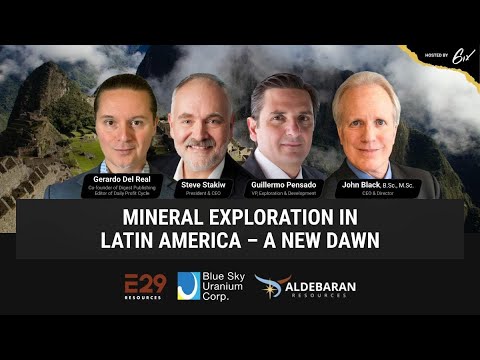
Automated transcript · Written by software from the replay's audio. It can mishear names and figures; the replay is the record.
12:30 So we are still teenagers in the mining sector also. And that creates some challenges, as Sean indicated. But we could see in the last 30 years the opening of significant deposits, some of them in the top 10, like Bajo la Nombrera, a huge porphyry copper deposit. Veladero, Pascualama, Pascualama finally never opened but it's still waiting there. Now is Jose Maria, the discovery of Navidad. So we could see we challenge it not only with Argentina, also in the international market, but Argentina is growing. And in the last few years, you can see, as Sean mentioned, finally the society and the politician are understanding what represent that potential, what geology means, because it's different. It's different to agriculture, it's different to oil and gas also. Now, the unconventional oil and gas is more similar to mining, and that's forced them to start to understand the long view, the long term of investment, and that is changing the mind of the local politicians or also the communities.
13:45 I mean, I think that Argentina is a, the legal framework with all the challenges is still very well supported. And also, For example, in the case of uranium in particular, there are not much countries with a legal framework for uranium as Argentina has, because we have a mining experience in uranium since the 1950s. So we have 9 uranium mines producing in the past. Now anyone producing, but we hope we could be the first in the next period. But that indicates that you have an entire legal framework, for example, to produce uranium on the international market and local conditions.
14:40 So that is very significant. I mean, Also, which is important in Argentina is the preparation of the communities, the universities and everything. I mean, it's people that in general take time to understand what mining represents, but once they understand, I mean, we have very good capacity to develop this industry very well with the good standards of the century for everyone giving benefits for the society, for the country, and for the world. I think so. And spectacular bottles of wine as well. Yes, we have. And I'm in Mendoza. Steve, John and Guillermo both referenced the tremendous geologic potential in Argentina.
15:34 Nobody's going to argue with Peru in regards to geologic endowment, right? We all know how blessed that country is geologically. The political landscape has been a tad bit challenging, and I'm being a bit sarcastic here, the past several years and months. And it seems to be going in a direction that's not less volatile. You're extremely experienced in South America. You've monetized assets in the past. You've worked through many different administrations and in many different scenarios that have similar volatility. How does this compare to those and how are you approaching exploration in Peru as it stands right now? Good, very good questions. We view Peru as really it is a top tier mining and mineral exploration jurisdiction.
16:26 As you intimated, it's the world's second largest copper producer and that's growing. So certainly they see the opportunity to grow that portion of their economy. And as you stated, while there are challenges, as there are everywhere, we're encouraged that we do, we see numerous mining projects are getting permitted and getting built. On our projects, We've been successful in permitting our exploration drill programs at Elida and at the Candelaria on Florida Cobrae on both our projects and we look to continue to advance these projects. I'm encouraged when you look at some of the big developments that are happening in Peru. Recently there's 3 big copper projects moving into production or in development or expansion. You're seeing more than $70 billion of investment by Anglo American at Keoveco, Minsur at Mina Justa Marcobre and Chinalco at their Toromocho mine expansion.
17:23 And these initiatives are going to add over the next year and a bit another 400,000 tons of copper per year to the market. So I think Peru gets it. Mining is the backbone of their economy. It's 60% of their exports are mining related, 10% of their GDP. And as an operating jurisdiction, we like it as well. If you look at operating costs for copper miners, it's one of the lowest costs, I think, just behind, as of some of the recent stats, just behind Chile. So, a good position for a country to be in. In terms of challenges, no, you're correct. We don't see them at our stage, where the regions that we're operating in, and I think it is a jurisdictional or regional, you know, a metric that you have to look at. Some areas are more open, understand the benefit from mining, and some areas are much more challenging. I think you've seen certain projects in Peru, Case in Point, Las Bombas, which tend to be lightning rods.
18:23 These projects have been controversial and will be so probably till they mine the last pound of copper out of those deposits. I don't see it changing on that front. But overall, I think as a company, we strive, as all of us should and hopefully do, is to be good corporate citizens and engage with the communities. And I think that's an important component, and with the government agencies as well. So we continue to see Peru as a top tier jurisdiction. In terms of the other countries in South America, we're wholly focused on Peru. A lot of advantages in terms of a very strong economy. There's a free trade agreement in place with Canada as well. So if at any point down the road, anything goes astray, there's mechanisms to solve that under the free trade agreement. So lots of strengths that we see operating in Peru and and obviously we're focused there and will continue to be focused there.
19:23 So no hiccups? Noteworthy hiccups?
23:24 last year and now we're settling into it. Honest, I like it. We'll talk about what comes next year in a little bit. Guillermo, how's things with Blue Sky? John mentioned you know finding good drillers, the lack of supply. You have a massive district-scale uranium district that you're exploring. How's it going out there? Well he pointed out the main points that we deal with in Argentina. I mean, the inflation, we are very familiar with inflation, so we understand that. It doesn't mean that we don't suffer that. We also suffer that, more than with higher inflation. So, but we have a practice to do it.
24:12 The good thing for the price is going up is that John mentioned before is that we have different exchange rates. So, that allows you to bring cash into the country at different exchange rate that finally maintain your cost. So, that's I mean if you always see I've been in this position for many years in this company and others before, I always see the same value in dollar. In US dollar, you're almost plus minus the same volume. Now with the inflation in North America, you can see some subtle changes in geochemistry in the labs or things like that, but not significant. I mean, it's still controlled.
25:06 Drillers and drilling, that is the big challenge, certainly, for many reasons. He mentioned something which is very important to find good drillers. The downturn period in the sector, exploration sector, the last few years made that we lost a lot of drillers. Some of them moving to Chile or to Peru or some of them changed to other jobs. And when all the sectors start to heat up again, we could see that we have not enough and now significant drill programs. We don't have enough drillers to maintain all the crews around Argentina.
25:53 But as I mentioned before, this is a country with good preparation in the education point of view. So there are many now, many provinces or commercial chambers trying to deal with that issue, training people, preparing people for technician, for driller, for this and the other. So, that's will, I guess that in the next few years, we may probably overpass that shortage that we certainly have today. After that, I mean, the overall cost, as I mentioned, in general is always the same. We try to maintain the salary as maintaining their value along the time. So we are – what it changed now with very high inflation that we have, instead of reviewing salaries every 6 months, sometimes you change to every 3 months, or certainly not once a year, at least 2 times along the year. So those are the things that you need to adapt.
27:05 But because we understand that, we can manage that. And all your accounting people and everyone understand that. I think they may do it rapidly with no big issues. Excellent. Guillermo mentioned that Peru is getting a lot of the Argentine drillers. Are you benefiting from that? Is that the case? Yeah. Are you getting Guillermo's drillers? No, no. Nothing personal, Guillermo. But yeah, no, we certainly, one of the benefits in Peru is obviously there's a strong mining culture and mining community. So in terms of infrastructure, services, equipment, obviously we're in pretty good shape on that front. We're currently in the process of queuing up our phase 2 drill program at Elida. So it's interesting you mentioned inflation. So yeah, even there we're starting to see a little bit of cost creep, kind of several percent of increase in cost to offset some of the inflationary pressures that the drillers are seeing there.
28:06 But overall, it's not unexpected. I think we're seeing that globally, and in some areas, obviously a bit higher than others. And from a supply chain perspective, I think we, you know, there again, you know, sometimes, you know, equipment availability can be challenging. But once again, you know, for us in Peru, you know, we haven't run into any major impediments on that front. So, you know, fortunately, and, you know, happily for us, I know where, you know, things are moving forward quite well on that front. So no, no hiccups on our path to date. All right. Sounds like a well-managed situation over there. Well, Gentlemen, all 3 of you seem like nice enough guys, but let's be completely transparent and honest. Nobody's really watching this to make Facebook friends with John Guillermo or Steve, right? They want to know why they should trust you with their hard earned capital. And so I mentioned early that I wanted to provide each of you some space to go over the catalyst here coming up for the company and frankly your track record of success you've all had success in the past which is something that I always look for when I'm writing a check for a company. And so, John, I'll let you kind of take the floor on why people should be writing checks or buying shares in your company.
29:25 Great, thanks. And that's an excellent question. It gets right to the grain of what we should all be looking for. When we have kind of a challenging time like we have right now in the markets, it's easy for people to look at their portfolios and kind of get worried. We all do when we have that, but it's a great opportunity. And particularly in the copper space, the fundamentals for copper are just so strong. I would argue uranium as well in this really, is we come out into a different world where we look differently at how we source energy and how we move forward on this. And so the the current downturn in the market, the slight downturn in copper price might have people a little bit worried. But I've never seen better fundamentals than we have right now for an increase. And I look back to 2008, 2009 when we had a sharp drop off in the market, and then we rocketed right out of that as we came out. There's even more reason to believe that we will. I can't tell you when this market will turn, but I can tell you it will turn and copper is likely to shoot really quickly.
30:24 So now is a great time for people to be looking for opportunities in the copper space, looking for companies and projects that will be able to take off. And when you're doing that, you look for a team that has experience. Our group has made discoveries before, sold those to major mining companies, and you learn so much in that process when you do that. You know what they're looking for, you know what it takes to move forward on it. We're on a great project with our Altar project right now. It's one that has the scale already to be of interest to major mining companies and with plenty of room for it to continue to grow. And then once you identify a company with good people, experienced people, a good project, a good country, what you really need to do is take a look at the valuations on the company. There are some outstanding projects out there that are already well-recognized in the market and are fully valued. And I think one of the reasons to take a close look at Altar right now and Aldebaran is that we are, we have a market cap of about 100 million dollars but when you look at that on evaluation per pound of copper we have in the ground we're still valued at much much less than a penny a pound in the ground. And these type projects typically sell for more than 4 or 5 cents a pound under the old metrics. With the new copper prices, we'll probably likely see it could be even more. So there's a lot of leverage to increase the valuation in the company. And at the same time, we're going to be growing. It's not just simply getting a better valuation for what we have as we move closer.
31:50 And then fundamentally what we're looking for are projects that major mining companies will want to acquire. It's not good enough just to have it out there. You have to have one that has indications that a major company might look. And that's why we're really pleased with the endorsement we just received from South32 and the fairly sizable investment they made into us at close last week. Where they're indicating that they're seeing things that they like to see in this project that it has potential to go forward. So we have that endorsement, we have eyes on us. We are, even though we're in a bottom of a market right now, I think that will change quite soon and quite sharply when it does. And so what you look for are opportunities just exactly like we have, where you've got great asset, great team, great partners, and you're undervalued compared to peers. So those are the ones you want to jump on. I mentioned the assay spending earlier in this conversation. When are those coming out, John? We're waiting. How's that coming along? Well, we can clear the decks now. We were in the middle of doing the financing with SAL32, and I want to emphasize that the SAL32 and Route 1 who had rights to maintain their interest or dilute less as they came into the, They weren't exposed to those assays. So those assays, they made their decision to come in on the project on the merits of the project.
33:06 But it meant while we were closing that transaction, we couldn't put those results out. So now with that out, we're in a position to put those results out. They'll be very, very soon for the first batch of those results. They'll come out in 2 batches. There'll be an initial batch of results. And what everybody's watching for on that one is hole 221. In the process of putting all the district data together this year, we completed a deep-looking 3D IP resistivity survey. It's a new technology that we're seeing work very well in major porphyry copper deposits. And in my experience, geophysics is a good tool for us to have, but there's rarely a direct correlation between anomalies and mineralization. However, the results that we received on this project have one of the closest correlations I've ever seen in my life. And we'd already started a drill hole through an area that had never been tested in this large anomaly when we received the results. And that's the one that people watching to see if that drill hole confirms that the large anomaly that's mostly untested that we have is indicative of a much larger deposit than we've been able to report to date. So We'll be happy to talk about those very soon. All right, I'll be happy to talk about those results with you. Guillermo, again, I mentioned you have a district, you have a massive land package.
34:26 The fundamentals for uranium, as Mr. Rick Rule mentioned, are as bullish as he's ever seen them. And I concur for whatever that's worth to people. How are you gonna add value? Why should people look at blue sky? Well, first of all, as you mentioned, the fundamentals of uranium. Uranium is finally understood as a key part of the climate change thing that we need to introduce in this century to produce energy with low CO2 emissions. I mean, copper will transport that energy. Lithium will accumulate energy. Someone needs to produce energy in huge volume, reliable energy, 24 hours, 7 days per day, as uranium can do it.
35:20 So uranium, if you see the war, and now if you see the gas issues in Europe, okay, the people have started to understand that, okay, that the Energy strategy in every country is very important. So that is forcing a little bit more the fundamentals of uranium, not only for production, which is shortage. I mean, we are in deficit around the world, but also because Iranian is becoming a more important energy for this century. Secondly, blue-skied Iranian control this huge district in the Rio Negro province. This is, as I mentioned before, Argentina is a nuclear country.
36:15 The actual main manager of the Atomic Energy Association is an Argentinian. That is because we are a big player in that game. Rio Negro province, where the project is located, is probably the more nuclear province in Argentina is a problem with a lot of experience because we have the main College or research center in Bariloche with a nuclear research reactor there. We have the province control, one of the most important nuclear engineering companies, which is in VAP. And we also have a pilot uranium enrichment plant in this project.
37:07 So, I mean, becoming with mining is like the most easiest part in this nuclear sector. So that is very important, because nuclear, you understand, you need to talk about the people that understand what you are talking. Finally, this project shows the huge potential of the country from the geological point of view. I mean, this district was discovered back in 2006. And what we finally understood was that it's an entire district, as I mentioned before, more than 100 kilometers long, with 30 to 50 kilometers wide.
37:53 So, a huge area. We control more than 300,000 hectares. So that is a lot of work to do. And the geology of that region, this is in the central part of Rio Negro. It's a big depression out of all in the middle of the desert. Not much people living there, but still accessible year round. So very good infrastructure to work. And this has many geological similarities to the more important uranium-producing districts around the world, like Colorado, Pato in the 50s, and actually Kyrgyzstan. I mean, the geology is very similar. We are talking about uranium-sandstone deposits in a significant fluvial basin depression that catch a lot of uranium and we did this first discovery back in 2017.
38:55 The deposit, as you cannot believe, is from surface down to 25 or 30 meters in depth. That is a good example of the geological potential. The mineralization was outgroping. That deposit, which is the first discovery in this district, is Ivana deposit. We rapidly went into resource estimation and trying to show to the market that we could have Iranian deposit with a good volume and potentially competitive for a market that 5 years ago was a very challenging market due to the price. Our goal was to show to investors or potential investors that we had the chance to produce Uranium, potentially at very low operating costs as those be coming from in-situ recovery deposits.
40:00 We did it rapidly, we discovered in 2017. February 2019, we present the preliminary economic assessment, the first preliminary economic assessment, showing that as the prognosis was indicating that the operating cost was competitive, could be competitive, very low cash cost, about $16 per pound, all included 18 plus. So that is competitive in the market. It was competitive in those days, more now when the Uranium price is close to the $50 per pound. Also important to show that the CAPEX to open those kind of, because the metallurgy of those kind of deposit is very straightforward, and it's really very low CAPEX.
41:00 And because we are thinking about a cluster of deposits surrounding Ivana deposit, we understand that if we discover another deposit that we are trying to do with many target that we defined in the last 15 years. We may be extending the mine life of that first deposit at very low cost of exploration, as we actually have. A capex and production. So that we understand that we may have a significant district to produce a good volume of uranium for the market which is requiring more uranium today.
41:47 You just raised some money Guillermo, how do you plan on allocating that? Is the bulk of that going in the ground to try to make more discoveries or grow that resource? All the money that we are trying to put, all the money in the ground. I mean we, Ivana deposit in the first year and a half, we drilled almost 500 holes. Now we added up to almost 850 holes. This was in Ivana. We are trying to go into a new resource estimation for the Ivana deposit. The goal of that is to convert the inferred resources into indicated for a potential pre-feasibility study later by the end of the year or beginning 2023.
42:37 The other portion of that money is going to exploration. As I mentioned, we have 4 targets in a 30-kilometre radius surrounding Ivana deposit that we are testing. We have been drilling since, well we have many challenges due to the pandemic times and those kind of things but we are continuing drilling and we hopefully may find another Ivana type deposit in that area that could be showing what we understand is the potential of the district, that this district may contain more deposits than Ivana, as it happened in other countries. I mean, Ivana deposit itself is almost 23 million pounds uranium, which is medium-sized deposit good for starting. It's on surface.
43:34 The good thing is that as competitive the deposit could be. But if you compare with Kazakhstan, for example, you can see multiple deposit there and deposit as huge as almost 230 million pounds so 10 times even a deposit So you're drilling to grow that resource that's what you're telling. We are drilling we are actually focused in order to maintain our exploration cost low because we understand that we have enough potential not only on surface we can go deeper in the system and trying to find a staking deposit, but at this point trying to maintain our exploration cost low, we are focusing the first 50-60 meters from surface trying to define another Ivana type deposit which is on surface. So this is how it works. Perfect. Steve, Robert Friedland says I'm going to need a telescope to see the copper price because it's going so high.
44:30 Whether or not that materializes and I think it actually will, we're seeing the majors step in with multi-billion dollar offers for companies that are able to prove up significant resources and discoveries and upside potential. E29, and I got a couple of questions here from the crowd, has 2 advanced stage projects, multiple advanced stage projects, a historic resource. You mentioned having good access to drillers and infrastructure. You mentioned your community ties and your social license being solid. How are we going to unlock value in E29 shares? Really good question. And yeah, how could you not like an endorsement like that from Mr. Friedland on copper? Certainly I think we all buy into the copper thesis.
45:18 Copper is the metal that brings energy to market. And in a green economy with EVs, transmission infrastructure, etc., copper is going to be required. And we're near all-time lows again. So in terms of all the macros are certainly aligning. We've seen copper come off over the last several months. But nevertheless, you know, still copper at 350,360, you know, when we model, you know, a lot of the modeling long-term consensus copper is in the, you know, is in the 330 to 350 range. So it's not as if we're out of line right now. You know, the copper miners are making pretty good, pretty good money at current copper prices. Obviously, you know, 450 would be even better. In terms of where we're focused, certainly we see that opportunity for E29. We're an early stage company, we've only been public for just over a year and a half now and really only drilling over the last year on our 2 projects but we see that opportunity to unlock that value. So really evolving the company from an exploration drilling stage company to delivering resources on both projects.
46:23 So I think in terms of what we're looking at at Elida, our 1st resource estimate is currently underway. I anticipate that coming out over the next 1 to 2 months. So certainly that's a very near term catalyst to watch for. And there again, we're going to be looking at just 1 of 5 porphyry centers at Ellada. So this is just going to be on on zone 1. And there again, just on a portion of Zone 1. Our exploration target at Zone 1 was in the range of 250 to 500 million tonnes, just in that one porphyry centre, looking at grades in the range of 0.3 to 0.45, with significant moly grades and silver by-product grades as well. Initial metallurgy looks really good. The assay analysis shows low arsenic within this as well.
47:12 So I see real opportunity to unlock value. So getting that initial resource estimate out, I think for us is going to be a very significant milestone for E29. But we're not just sitting still with that. We're also, you know, we're, you know, in the background, we're also doing a resource estimate on the Candelaria zone at Florida Cobre, where we just wrapped up a drill program in May of this year as well. So we put 12 holes, about 4500 meters on that. And that was really to reconfirm that historic resource that exists at Candelaria. And that was drilled in the mid-1990s by Phelps Dodge which is now Freeport and Rio Amarillo mining. So we twinned a lot of those holes because the historic material was not available and that gave us very, very strong comfort.
47:59 The correlation in terms of assays was almost spot on. So that allows us to use, not only the results from our drill program, but the historic resources, or historic drill results in our resource estimates. So we'll be putting out our initial resource on Candelaria this year as well. So I think going from an early-stage driller to delivering 2 resources and there again we're also going to be launching a phase 2 drill program at Elida to start testing some of the other porphyry centers there that I think look really encouraging. And obviously any drill success we meet there will certainly there again, should daylight, further upside potential in terms of growing that resource at Ellada. So that's for me, that's really, that gets me excited in terms of moving the company to the resource stage, delivering those pounds in the ground.
48:51 And I see that as an opportunity to really to start to unlock value. We've underperformed, but so has the rest of the market. The stock's off probably in the range of about 50% but so is most of our peers over the last 4 or 5 months. But I certainly see the opportunity to regain some of that ground with the deliverables that we have in our pipeline at this stage. Everybody wants to be a contrarian until they have to buy low. Yeah, exactly. Let's open it up to some Q&A. Brittany has an excellent question. She asks, is nationalization a risk in Argentina or Peru? John, I'm going to let Steve breathe for a bit and let you answer the Argentina question and kind of give us your take being that you are as active as you are in Argentina right now.
49:39 Good question and it's certainly in South America overall and perhaps even in the world we're seeing a movement towards more social unrest, more concerns about how things work in the economies in the world on that. And so that does bring up questions, and it puts us in a period of risk. But when you look more closely to individual countries, a country like Argentina right now, they fully recognize that they would like to have a mining industry. They very much like to have the investment that comes with that, the jobs that come with that. And I don't worry that much about Argentina because they don't have an established mining industry. They don't have really the know-how and the capability to do that. So they need, in addition to the foreign investment to come in, they need the know-how.
50:24 And they need that ability to come in and the endorsement of those foreign investments. So I think, particularly for traditional metals, it's very likely that we'll see major money coming in. And a good judge of that is when you see companies like BHP just announced a $100 million investment into FILO, you know, Timo just bought an asset for lithium for some $800 million in Salta. Companies like that are not putting their money into a country if they're concerned about that, or they certainly are evaluating that and deciding it's worth their risk. So I think we're pretty safe on that. I can throw in a word or 2 on Peru as well on that, because we have a sister company that operates in Peru. And Peru, even though there has been a shift in the government a little bit more to the left, it is a mining country, just as Steve mentioned. It's a mining country, and everybody recognizes that mining is really the driver for the economy on that. I was quite proud that our mining industry really stepped up to help out in the COVID pandemic on that, providing PPE, providing help for communities on that. And it's really kind of a leading industry in the country. So there may be discussions about taxes or other things, increases, but I really doubt that we'll see nationalization of projects.
51:42 The one country in South America that I watch a little more closely right now is Chile. There, the discussion is a little bit more leaning towards potential, maybe not nationalization, but partial nationalization or increased taxes on that. And the sentiment there is a little bit more, Mining's mature, it's an important part of the economy, but there are other parts of the economy there and a lot of particularly young people feel that perhaps mining should be contributing more. I'm fully in favor of mining contributing more, absolutely, and we can, but it has to be done in a way that still encourages us to work. You don't want to kill the goose that lays the golden eggs. Well said. Steve, your thoughts on Peru and the potential for nationalization. Is it like real estate? Is it local? Is it region by region? Is it town by town? Is it project by project? Or do you feel as confident as John?
52:32 I would say John framed it really well. Obviously, we're confident and certainly very, very comfortable with the environment that's in front of us in Peru. Pretty much every major, every super major globally is active in Peru. And that's for a reason. Projects get built and companies can operate in that country and that's operated and that's continued really unfettered for many decades. I'm looking even a decade ago, I was involved with a base metals company that had an operation in Peru and Humala, who is a leftist leaning president, came into power and we were quite nervous over nationalization. But at the end of the day, I think regardless of the government, they recognize the significance and what mining is, how significant of a component it is to their economy.
53:21 So I think given that, the continuity and there is stability there. So we monitor things and I think There may be small changes in terms of potentially taxation, etc. Going forward, but nothing that we see as disruptive or nothing that would dissuade us from continuing to operate there. We like the jurisdiction and as I touched on earlier, just given the amount of investment, several billions of dollars have been invested in the country. The Ministry of Energy and Mines just recently came out with the mining investment in the country for the first half of this year was up almost 10 percent to about $2.5 billion, and that was evenly spread between new mine projects, exploration and infrastructure. So it just shows you, I see that as an endorsement, almost regardless of the government, mining is such a vital component of the Peru blood that it's gonna continue to operate. And I think mining companies are, hopefully, we strive to, and I think hopefully we all do, strive to be good corporate citizens and be responsible. And I think that'll go a long way in terms of encouraging that to continue, to have that social license to operate you know that's that's the way you should be doing business.
54:36 Gentlemen this has been an absolute blast there's a few questions lingering that I encourage everyone to pass along and I will make sure they get passed along so that they are addressed individually as some of those are are pretty specific as it relates to companies deposits and grades but I want to thank everybody for their time. John, Guillermo, Steve I want to thank you for an insightful conversation. I encourage anybody to reach out to myself, to Guillermo, to Steve and to John if you