Transcript
Automated transcript · Written by software from the replay's audio. It can mishear names and figures; the replay is the record.
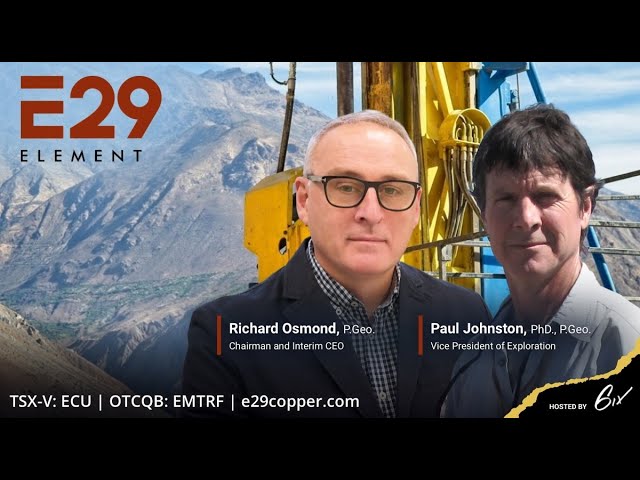
0:08 Hello everyone, welcome to Element 29's live summit today, hosted by 6. We're joined today by Richard Osman, Element 29's Chairman and interim CEO, and Paul Johnston, the company's vice president of exploration. Team's gonna take us through their presentation and after they'll be accepting questions during the live Q&A session. You can submit your questions using the Q&A panel found on the right hand side of your screen at any time. As always, the summit is being recorded and will be available to watch afterwards on Six.com. Without further ado, Richard, I'm going to kick things over to you to start us off. Okay, thank you, Cam.
0:41 Today's news release is related to the ELEA drill program and we're just going to give an overview of the drilling results to date. The first slide provides a disclaimer which I'm not going to read through but I just wanted to put it on the screen and you can read when you have an opportunity if interested.
1:09 The Element 29 was founded through the spin out of 4 copper projects from Globe Trotter's resource group back in 2019. Globe Trotter is essentially a private junior explorer focused on copper and precious metal exploration in mostly in Peru. Included in the spin out were the the Elida and Florida Cobra projects, which are both very high quality projects with excellent exploration potential. They also are fairly strategically well located, very proximal to infrastructure and relatively low elevations. For today's discussion, we'll primarily be focusing on Elida and the drill results from a 4,000-meter drill program that started back in late July. And we'll be giving results on the first 2 holes.
2:06 So, Elina was discovered by Globetrotters through a regional exploration program, following up on in-house remote sensing targets back in 2013. Follow-up exploration work outlined a large 2K by 2K porphyry copper system with multiple centers. Globetrotters was then optioned to delegate a project to Lundin Mining back in 2014, and Lundin drilled 18 holes for nearly 10,000 meters before returning the project to Globe Trotters back in 2016. Several holes into the Target 1 area outlined good copper moly grades from bedrock surface down to depths of over 400 meters, including hole 12, which intersected 503 meters of 0.42% copper, including 265 meters of 0.53% copper.
2:56 Most of the drilling centered on target 1 area, outlined in the red and orange in the image. El Ida is located in central Peru, roughly 200 kilometers north of Lima and just 85 kilometers from the coast. The project is at a relatively low elevation at just 1600 meters and strategically located near a main transportation routes. As you can see, Highway 1, the Pan-American going all the way from Lima to the Maranca and above. It also has an electric grid, including a 400 megawatt hydro station within 15 kilometers of the project. It is also close to the port facilities, including the Antimuniport, which is roughly 85 kilometers to the west of the project. Also, the region has a skilled workforce, which will be important, I guess, as we move towards development and operations.
3:44 The main objectives of the 4,000-meter drill program were to initially investigate the vertical continuity and zonation within the target 1 mineralization. And that was primarily planned through hole 19, which is in here, which essentially was drilled vertically to test this green halo of mineralization, which was outlined primarily by Lundin. We also wanted to improve the confidence in the interpreted mineralized boundary, which is the boundary that's outlined in green here.
4:22 And at the same time, achieve a drill spacing, including the Lumbee drilling that would be appropriate for estimating a potential mineral resource down to depths of over 400 meters. Some of the highlights from the initial drilling, we've got the results back for our first 2 holes and in the case of the LED-19, we're pretty excited to report that we intersected about 384 meters of 0.54% copper, 0.35% moly and 4.2 grams per tonne silver for about 0.71 copper equivalent grade with just 47 ppm arsenic. This also included a 314.9 meter interval of 0.6% copper, 0.03% moly, 4.7 grams per tonne silver, which equates to about 0.76% copper equivalent, again with just 32 ppm arsenic.
5:19 This is exciting because it does show that there is some higher grade mineralization within that mineralized shell in the target 1 area, which was the main reason for the drilling of this hole to follow up some of the higher rate mineralization and some of the Lundin drilling. LA-20 was designed to sort of test the outer mineralized shell and also to get a sense of the grades as part of, you know, building infill drilling to be able to build that mineral resource. It was also quite exciting. We managed to outline about 308m of mineralization at 0.43% copper, 0.28% moly and 3.9g per tonne silver for a total copper equivalent of about 0.56 with extremely low arsenic at just 15 ppm but this also included a 104 meter interval of 0.54 percent copper 0.031 moly and 4.6 grams per tonne silver.
6:23 So we're quite pleased the 2 holes met the objectives that they're designed to do. So we were able to outline a higher grade copper moly intersect, which is critical, I think, if you're looking to put a porphyry copper project into production to be able to get to return of capital as quickly as possible. It also shows a vertical continuity. These holes basically collared in mineralization at the bedrock interface.
6:55 We're still in the process of drilling some of the holes and do some of the infield drilling, but I think the mineralized shell is proving up to be fairly continuous. What's also attractive about the intercepts that we've had so far as well is that we're getting really good moly credits. We're seeing moly grades that are essentially about twice what you'd expect for most large porphyry copper systems, which is important, I think, because in most cases you have to put in a separate MOLLE circuit. So if you can double the amount of material coming out of that, the amount of moly coming out of that concentrate. If you can double the amount of mineralization or grays that you're putting through the plant, that will significantly improve the ability to pay off that capital as quickly as possible. We're also very excited to see the low arsenic graze where a lot of porphyry systems have much higher arsenic related to epithermal overprints and the introduction of energite. So we're not seeing that here and that can be detrimental if you have too much arsenic in the in the ability to generate a copper concentrate that you can actually sell to a smelter or that's become a very important thing from an environmental perspective in the last few years.
8:22 At this point, I think we'll play a quick video to show where some of the drilling is being done and I'll hand it over to Paul and he can go from there. Well thank you Richard. Yeah what we'll see is a video that's more or less panning from the northwest to the northeast. As it progresses I'll try to stop it in certain places and explain what you're seeing. So let's give it a try. Before it starts, you can see on the left is the driller's camp. The white tents are used to house the offices and accommodate the drillers. So as the video starts you can see the drill access road going up in elevation.
9:09 This red tone that you're seeing is target 4 up in the rugged areas there and we're going to pan across eastward and from here you can see the drill roads that that we've used to access these 6 holes. Right now in this view you're looking roughly straight at the at the target 1 area. Now we're panning down and moving over to the target 3 area which is again on the east side of the main target You can see that alteration in the brown and yellow colors. And now we're moving up to show you straight on target 2.
9:56 Now you can see in the middle upper part of the screen a diamond-shaped light patch. That represents the leach capping of target 2. Okay, we can switch back to the slides. Can I do that? Well, thank you, Richard, for introducing that. I'm pleased to review in more detail the results from our first 2 holes. The diagram you see on the right summarizes in plan the progress to date. As Richard mentioned, phase 1 involved 4,000 meters in 6 holes. We've completed 4 of the 6 plant holes and 2 rigs are currently drilling the last 2 holes. We have assays pending for holes 21 and 22. Just to cover what the first 2 holes that we're presenting here were designed to do, Ellida 19 was designed to test the vertical continuity of some good mineralization that was intersected by Lundin's program in 2015.
10:56 Hole 20 was designed to test the the volume of mineralized material between hole 15 which was drilled by Lundin. You can see that was an angled hole, so it didn't completely cut the mineralized zone.
11:14 So hole 20 was designed to pick up where that left off and drill south to where we would intersect the lower grade porphyry stock at the center of the mineralized zone. Holes 21 and 22 were positioned to give information On the east side of the system where we needed more data to understand what the mineralization was doing there. Hole 23 is a hole that's designed to test the southern arm of mineralization where we really don't have very much information. And then finally hole 24 is to define the eastern limit of target 1. You can see there's no drill holes out in that area to constrain that that limit of mineralization and it's also designed to test the continuity of mineralization picked up in holes 14, 19 and 20 to the west.
12:15 So getting into the results themselves, I'll start with hole 19. As Richard mentioned, that intersected 384 meters of 0.71 copper equivalent. And that also included a slightly higher grade zone coming in at 0.76% copper equivalent across 315 meters. The significance of this is that strong mineralization extends down from bedrock to where it was intersected in the earlier hole and continues all the way to the the lower grade porphyry stock which is shown there on the section in orange. These good grades as you can you can see by the colors they they were maintained pretty much uninterrupted over a 300 metre plus interval.
13:06 That means there wasn't a lot of lower grade material diluting the higher grade samples and The section here shows the results from individual samples, colored according to the scale on the right of the section. We also found, as the other holes have shown, that moly grades are consistently high. A lot of porphyry systems usually come in around .015% moly, and we're seeing double those grades in most of the drill holes in the mineralized zone at target 1. Also arsenic is quite low. We don't see a good correlation between copper grades and arsenic.
13:52 And as Richard pointed out, that will be beneficial for the production of any concentrate being within smelter limits. The other thing I'd like to just point out is that the mineralized system is still open at depth. You can see the extension where I've drawn it down. That outer limit is based on the earlier drill holes, so we still have more work to do to trace that mineralization down. I put a couple of pictures in on the right side just to show you what the mineralization looks like. The top 1 is a very good zone of chalcopyrite and pyrite mineralization associated with a larger than usual or wider than usual A-vein, which is a quartz vein.
14:38 We see most of the copper introduced during that event. The middle picture just gives you an indication
14:43 of how much fracture and rock damage there is, how much veining is superimposed on the original sediment host rocks and a variant on that on the bottom picture just to show you the different styles of veining and the sulfides that are introduced. For hole 20, this hole was angled at 65 degrees to the south, as I mentioned, to pick up the volume of mineralized material between hole 15 and the lower grade porphyry stock, which is a quartz monsonite porphyry. The hole encountered mineralized potassium altered sedimentary rock at the bedrock surface and that was continuous up to the up to the porphyry contact that's indicated in orange.
15:34 This intersection was 308 meters of 0.43% copper and 0.28 moly, giving us a copper equivalent of 0.56. Also you can see the mineralization is open at depth, there isn't any real indications that the mineralization is stopping from the drilling that we have. I also want to highlight just the lower interval where you see the brighter colors towards the porphyry itself. That returned an interval of 0.62% copper and 0.041% moly for 0.81 copper equivalent. This is important because it tells us that the porphyry system is capable of generating higher grades within the larger zone of mineralization.
16:24 And as I pointed out before, the moly grades are high, similar to hole 19 and the other holes that we've had through the mineralization. And it is elevated relative to many other porphyry systems, especially the ones that we're seeing in Peru and Chile. Arsenic in this hole was about half of what hole 19 encountered. It was all less than 25 parts per million. Also, too, this was geologically interesting because it was the first unequivocal
17:02 interval of an early mineral hydrothermal breadshoot. We were expecting to see evidence of this but it wasn't, it wasn't intersected in some of the earlier holes. This is encouraging because it can represent an attractive higher grade target of mineralized systems. So we'll be looking for more of this in future programs. The other photograph is quite an excellent shot, just showing the timing of the 2 main vein types we see. There's an earlier A vein which is a quartz vein containing disseminated chalcopyrite and pyrite and then that's cut by a B type vein which has a more distinct look to it and that just shows us the multiple inputs of copper into the system.
17:54 For our next steps, our plan is to complete drilling by mid Q4 and we're currently on track to do this. We'll evaluate if additional drilling will be beneficial before we end this current phase of drilling. We've initiated preliminary metallurgical testing and hope to have this work completed in the first half of 2022. However, laboratory analysis is slow at present and it's difficult to predict how long it'll take to get results back. We'll also use the drilling to estimate a potential mineral resource for the part of the mineralized zone where we have drill hole spaces. You can see the mineralized zone is not fully covered with the drilling that we're doing now and the past drilling so we'll only be able to do an estimate over a portion of that zone.
18:41 Just to close out to provide a synthesis of what this drilling means to us as reported the first 2 drill holes intersected attractive copper and moly mineralization over significant drilled widths. The mineralization remains open at depth and we are now confident that sulfide mineralization extends up to the bedrock surface located about 30 to 100 meters beneath unconsolidated cover. We've confirmed that low arsenic is associated with copper mineralization and the levels of arsenic suggest that this will produce a concentrate that will be within acceptable smelter limits. We've also found, as we've stated, that the moly grades
19:27 are higher than many porphyry copper systems in the Andes, which will give us a good credit on an eventual concentrate produced. And I'll hand that back over to Richard to close out with what our plans are for the coming year. Yeah, thank you, Paul. So, The catalyst for the company moving forward will be primarily for the rest of this year. We'll finish off our phase 1 drill program at Elida, which we should expect to finish up by the middle of November at the latest I think. Then of course it will be releasing drill information as it becomes available. We're on the last 2 holes so the next 2 holes should be should be available fairly shortly.
20:18 From there what we really wanted this drill program to be able to do was to be able to prove up an economic resource. So, It is something that we'll be working on for all through December and hopefully have it done for early January. We also plan to start some metallurgical work on the LA project in the first quarter of 2022. Hopefully by the second half of the year, we'll be ready to get back into into LA and start drilling some more of the mineralization with target 1 as well as maybe test target 2 and target 3
21:05 within the system. We're also planning to get going on our Florida Cobre project. We've already received the environmental permits. We received those about a week and A02 weeks ago. And now we're just waiting for the authorization to begin exploration activities, which essentially means that we're just waiting for a few permits, which are pretty much already approved to get the drill permit in place. So we're hoping to have that done and ready by mid-November as well. And then we'll start the resource drilling to try and prove up the
21:51 existing resource at Candelaria, which is part of the Florida Cobre project, where we already have a historical resource of about 57.4 million tonnes of 0.67 leachable copper. As part of that, we'll use that drilling as well as to start our engineering studies and metallurgical studies as part of putting together a PEA, hopefully by the end of the second quarter of 2022. I think that's it. Hopefully That provides a bit of a summary of what we're really excited about moving forward with the ELEDENC and Florida Cobre projects. If there are any questions, we'll be happy to answer them.
22:45 Great. Well, thanks a lot, guys. I'd like to remind the audience at this time that you can ask those questions using the Q&A chat found on the right-hand side of your screen. However, Richard, Paul, we've had some questions come in in advance. To begin with, in a previous news release you stated that there are 3 objectives to the Ellida drilling program. 1, appropriate drill spacing. 2, investigate vertical continuity of the mineralization. And 3, improve the confidence of the mineralization boundaries. Have these been achieved?
23:14 Yeah, thanks, Cam. Well, we have achieved some of these objectives, of course, but we're still in the process of completing the six-hole drill program. So we're still working to answer some of these questions. We feel that the first 2 holes clearly show the vertical continuity of the strong copper moly mineralization, extended from bedrock down to surfaces, from surface down to depths of more than 400 meters. Plus we have also outlined a program that should provide hole spacings needed to confidently build a potential resource model. But we still are testing the overall extent of mineralization within the target 1 area. Okay, great. What's the significance of only having 30 to 100 meters of gravel before the mineralization starts?
24:03 Yeah, that's a good question. This is still in early days, but what this suggests is that the good mineralization really starts directly below the colluvium cover, which pretty much can be removed without blasting. And this will become more important as an impact with respect to the operations where you pretty much have good moly grades and copper moly grades starting pretty much at surface. Right, OK. Geologically speaking, why does Elida have such low arsenic levels? Paul, maybe this might be a good question for you. Yeah, sure. One thing Elida doesn't have is an epithermal overprint, which is responsible for introducing arsenic in many porphyry systems that have higher levels of arsenic.
24:57 So not seeing that in our area, our deposit, is really, I think, the primary reason why we don't see high levels. All right, thanks. Next question. What did you see in Elida that Lundin did not? Yeah, that's another good question. We felt that the Lundin exploration team at least were pretty excited about some of the results they were getting back when they were doing their drilling in 2015. But we can't really speak for Lundin at this time, but we certainly were pleased to get the project back with 10,000 meters of drilling and some excellent drill intercepts, such as hole 12, which was mineralized with good copper molygrades, pretty much from bedrock surface down to 500 meters. It was actually it ended in mineralization.
25:52 There were several holes like this which which were following up with this drill program so that was pretty exciting and they left a lot on the table for sure. Okay, nice. If the higher grade portions of the mineralization is open at depth, why didn't you drill deeper? Paul, did you want to take on that one? Yeah, sure. We had, as Richard outlined, some objectives of defining the mineral zone that we interpreted from the first pass drilling. It's quite a wide zone and requires a lot of meters to get across the zone. We just felt it was a cost-benefit kind of situation where we would get better value out of looking at the upper 400 meters in part and coming back later with more expensive drilling to follow up on the better areas of the mineralization that we're outlining from the program underway right now.
26:52 Right. In a perfect world, what would you want to achieve in a Phase II drill program then? Yeah, We would like to continue to build on the mineral resources in target 1, but we'd also like to get out and test some of the other targets, particularly targets 2 and 3, which have, you know, we've already mapped out 2 separate porphyry centres there. We're seeing pretty similar stock working and veining in those areas. It's been leached, so it's really hard to get a sense of what we expect for copper grades, but we're pretty excited about getting in and testing those areas. Okay, great. Why is the priority to get a resource estimate on Target 1 and not wait to do more exploration work to get a bigger resource estimate?
27:40 Yeah, that's a good question. Paul, do you want to try and answer that? Yeah, for sure. At Dell, at a Target 1 and the project as a whole, it's really a process of resource expansion and we feel that it would be useful to know what we're dealing with at Target 1. This will help us start to understand the economics, but also it will help us to target further drilling with a block model, with a geological model based on or generated to support the resource estimation that should help fill in the gaps, if you will, in the next programs. Right. When can investors expect the resource estimate?
28:27 Yeah, we're sort of targeting for having that available in Q1 of 2022. We'll be starting this process directly after we finish the drill program. Okay, and can you tell us about your relationships with the local stakeholders at ELIDA? Yeah, we have a really good relationship with the local community, communities actually in the Yelida area within the catchment zone, I guess. Lundin did a really good job of building that relationship and we've continued to build on that. They're pretty excited to have us there. They really want the work and they see the value in what we're doing. We're pretty happy to be back to drilling after 5 years. David Elliot in the chat has asked, are you going to extend any of Candelaria holes into the Hypogeny?
29:24 That's a good question. Certainly we will be. Most of the drilling at Candelaria primarily focused on the enrichment blanket, which is basically a secondary copper resource that was put together by, I guess it was Phelps Dodge at the time and also another junior called Rio Amarillo. They drilled 1 hole into the into the Hypogene mineralization below the enrichment. They got some pretty good grades. I think they had like you know 150 meters of over half a percent copper and You know directly below the enrichment So we'll definitely be continuing to expand on that and looking to try and build a hypogean resource below the enrichment blanket.
30:13 Okay, great. In closing, wrapping up these questions, could you remind us again in the next 6 months or so, what should investors be watching for from Elida and Florida Cobre? Yeah, thanks, Cam. Certainly we will be putting together more, well, sorry, we'll be putting out more results on Elida over the next few weeks, so stay tuned for that for sure. We should be getting our drill permits for Florida Cobra for the Candelaria project very soon. We have pretty much everything in place it just has to get the final stamp of approval and we're starting to plan that drill campaign as we speak. We'll also begin building the potential economic resource at LA that are around the tier 1 target. So those will be pretty exciting things that will be happening over the next couple of months.
31:05 Great. Well, thanks, Richard. Thanks, Paul. I believe that's all the time we have for questions today. I'd like to thank everyone who did submit a question, as well as Richard and Paul, for the updates. If you didn't get a chance to get your questions answered, or if you think of 1 after the summit, we'll be sending out a short survey where you can leave your contact information, and the Elmwood 2019 can reach out to you directly. You can also find more information, of course, at www.e29copper.com. And with that, Richard, I'm going to hand things over to you to wrap up. Yeah, thanks, Ken. Well, certainly, you know, I'd just like to ask people to please stay tuned. We'll definitely be having more results coming out at Elida. And certainly with the Candelaria work, you know, getting those permits and moving that forward will be exciting. So, if you have any more questions, certainly feel free to reach out. We'll be happy to answer those.
31:56 And yeah, have a great day and thanks for attending the webinar. Great. Thanks guys. Have a good day.