Replay available
Tenneco Clean Air India (NSE:TENNIND) Q2 2026 Earnings Call
Tenneco Clean Air India (NSE:TENNIND) Q2 2026 earnings call, held 2026-11-05. Watch the replay and read the transcript on 6ix.
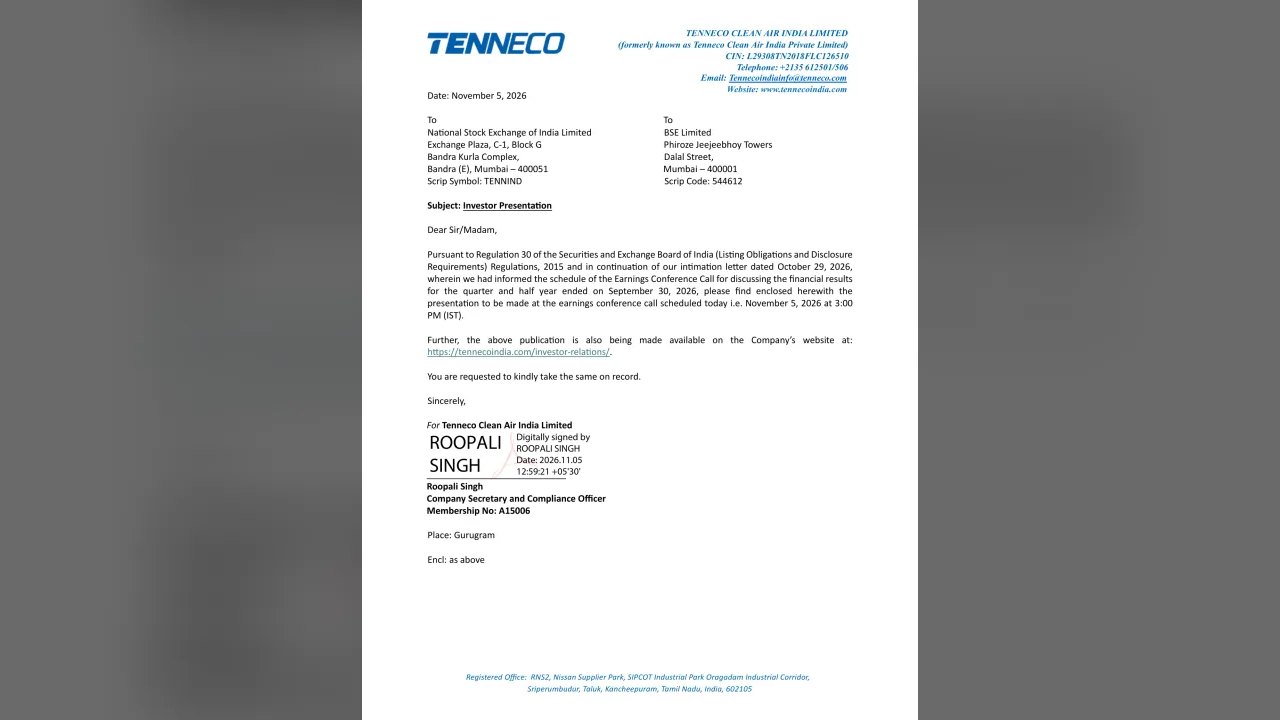
- Company
- Tenneco Clean Air India Limited (NSE:TENNIND)
- Period
- Q2 2026 earnings call
- Date
- Thu, Nov 5, 2026, 7:32 AM ET
- Replay
- Watch the replay on this page · 59 min
On 6ix: 6ix.com/event/tenneco-clean-air-india-limited-tennind-q2-2026-earnings-call
Replay
Transcript
Automated transcript · Written by software from the replay's audio. It can mishear names and figures; the replay is the record.
0:00 Ladies and gentlemen, good day, and welcome to the Q2 and H1 FY 'twenty seven Earnings Conference Call of Tenneco Clean Air India Limited. As a reminder, all participant lines will be in the listen only mode, and there will be an opportunity for you to ask questions after the business update concludes. Please note that this conference is being recorded. I now hand the conference over to Ms. Rupali Singh, General Counsel and Company Secretary of Tenneco Clean Air India Limited. Thank you, and over to you, Ms. Rupali. Thank you, Vikram. Good evening, ladies and gentlemen, and a warm welcome.
0:47 Today from management side, we have with us Mr. Arvind Chandra, full time director and CEO Mr. Mahendra Chandra, the Chief Financial Officer. A detailed presentation on the financial performance is available on the company's website and on the website of the stock exchanges as well. We will begin with Mr. Chandra providing a business update followed by Mr. Chandra covering the financial results. We expect the updates to take around fifteen minutes, after which we would open the floor for the Q and A session of about forty five minutes. Before we proceed further, I would like to draw your attention to the cautionary statement, which is already included in the presentation. With that, I hand over the call to Arvind. Thank you, Rupali.
1:33 Good afternoon, everyone. Thank you for joining us for Tenneco Clean Air India's Q2 and H1 FY 'twenty seven earnings call. Before I begin, with Diwali around the corner, I would like to take this opportunity to wish all of you and your families a very happy and prosperous Diwali. May the festive season bring happiness, good health and prosperity to everyone. I am pleased to report another strong quarter Q2 and H1 FY twenty twenty seven for the company, building on the encouraging start we made to the year. The first half of FY 'twenty seven has been marked by healthy growth across our businesses, continued market share gains and several important customer and technology wins. This performance reflects the strength of our portfolio, our strong customer relationships and consistent execution across both advanced light technologies and Clean Air and Powertrain.
2:27 During the second quarter, our value added revenue grew 32.2% year on year, supported by volume growth of 25.4%. For the first half, value added revenue grew 25.3% compared to volume growth of 20.7%. This growth has been supported by our continuous demand by continued demand across our served markets, new program launches and increasing content per vehicle. Beyond the financial performance, I'm particularly pleased with the progress we continue to make in strengthening our competitive position. According to the Crystal Research report, our market share in Clean Air Solutions for the Commercial Truck segment increased further to 59% in H1 FY 'twenty seven compared to 58% in FY 'twenty six and 57% in FY 'twenty five.
3:14 In passenger vehicle shock absorbers and struts, also known as the ART business, we continue to maintain a strong leadership position with market share of approximately 55%. You would recall that just one years point ago, that share was only 48. Let me now talk about some of the developments across our businesses during the quarter. In Advanced Rise Technologies, we continue to see strong momentum across both existing and new customers. We secured content on three new vehicle platforms with a leading Indo Chinese joint venture. We also made an important entry into the fast growing three wheeler segment, where our where we won suspension business with a leading Indo Korean joint venture.
4:00 This opens up another addressable market for our suspension portfolio and further broadens our customer base. We continue to build on the momentum behind our unique Da Vinci technology as well. During the quarter, we started production for three door THAR suspension program. We also secured two generation next generation models with an existing leading Japanese passenger vehicle OEM and are further expanding our engagement with a Vietnamese OEM with the introduction of three new platforms. Another important highlight is the commercialization of advanced suspension technology in India. We supplied India's first locally produced semi active CBSAE, marking a very important step in our localization journey and demonstrating the strength of our local engineering and technology capabilities.
4:49 Turning to our Clean Air and Powertrain business. We made progress across commercial vehicle, alternative fuel and ignition applications. During the quarter, we introduced a new hot end commercial vehicle exhaust program with a leading Indian commercial vehicle OEM for bus applications. We also made a strategic entry into the CNG market through a cold end assembly program for a European passenger vehicle application. In powertrain, we further expanded our share of the business with an existing customer through a new Sparkler award from a European passenger vehicle manufacturer. Taken together, these wins demonstrate that our growth opportunity is not dependent on any single product, customer or end market. We are expanding across platforms, applications and geographies while continuing to build on our existing customer relationships.
5:42 Let me now spend some time on our order book, which provides us with very good visibility into our future growth. At the end of the first half, our lifetime order book stood at approximately INR 165,000 million. This represents more than 100% coverage of our FY two thousand thirty revenue target, giving us good visibility towards our longer term growth ambitions. Exports accounted for INR 8,750 million of the total order book. Exports continue to form an important part of this opportunity. Our export order book now provides 50% coverage of our target FY two thousand thirty export revenue. The strength of this order pipeline is also driving our investment priorities. We continue to invest in capacity expansion, localization and technology to support future customer requirements.
6:33 This includes another new Clean Air manufacturing facility in West India with an investment of approximately INR $450,000,000. Innovation and localization remain equally important to our long term strategy. We continue to invest in local engineering capabilities to develop in house solutions for our OEM customers. Now beyond financial performance, we remain committed to sustainable and responsible growth. We were honored to receive the Best Manufacturing Brand Award from EDH and the National Green Future Leadership Award from the National CSR Leadership Congress. These recognitions reflect the dedication of our teams and our unwavering focus on operational excellence, innovation and sustainability. As we look to the second half of the year, we remain encouraged by the underlying momentum across our businesses.
7:20 The combination of a robust order book, continued customer wins and technology led growth, increasing export opportunities and investments behind our future capacity gives us confidence in our longer term growth trajectory. At the same time, the external environment continues to present challenges, particularly from inflationary pressures, including commodity related cost increases. We remain focused on addressing these through productivity, commercial discipline and rigorous execution across our operations as part of our P3 people, performance, pride, culture and operations framework. Overall, I believe that the first half demonstrates the resilience of our business model and the progress we continue to make in strengthening our competitive position. With that said, I will hand it over to our Chief Financial Officer, Mahindra Chabra, to take you through our financial performance in greater detail.
8:14 Thanks, Arvind. Good afternoon, everyone. As we enter the festive season, I would like to extend my best wishes to everyone for a happy Diwali. May the orgasm bring joy and happiness to you and your families. Now let me take you through the financial performance for the second quarter and first half of FY twenty twenty seven. As always, we use value added revenue or VDR as our primary operating performance metric as it excludes pass through substrate costs and provides a more meaningful view of the underlying operating performance and profitability of our business. This is consistent with how we have reported our financial performance in the past. We delivered another strong quarter, building on the momentum from the start of the year. Revenue from operations increased 34.2% year on year to INR17183 million, while value added revenue grew 32.2% to INR 15,229 million.
9:09 For the first half of twenty twenty seven, revenue from operations stood at INR 32,631 million, growing 27.2% year on year, while value added revenue reached INR 29,044 million, an increase of 25.3% year on year. Looking at our performance across our businesses, our growth remained quite broad based. Clean Air and Power TENNED Solutions delivered value added revenue of INR 7,218 million in Q2 FY 'twenty seven, growing 26.6% year on year. For H1 twenty seven, value added revenues stood at INR 13,843 million, representing growth of 17.8% year on year. This growth was supported by healthy underlying volumes and the continued ramp up of the programs across our Clean Air and Powertrain portfolio.
9:59 On the other side, Advanced Side Technologies continued to deliver strong growth with value added revenue of $810,000,000 in Q2 FY 'twenty seven, an increase of 37.8% year on year. For H1 twenty seven, value added revenue reached 15,201 million, growing 32.9% year on year. The performance was supported by strong production volumes, ramp up of new programs and the increasing content across customer platforms. This performance reflects the continued scale up of our business and execution against our existing export programs. From a profitability perspective, EBITDA for Q2 increased 20.7% year on year to INR2616 million, translating into EBITDA margin of 17.2% on value added revenue.
10:48 For H1 twenty twenty seven, EBITDA increased 14.1% year on year to INR 5,085 million with an EBITDA margin of 17.5% on value added revenue. Moving further, profit after tax for the second quarter stood at $1,734,000,000, representing growth of 15% year on year. And for H1 FY 'twenty seven, profit after tax stood at 3,386 million, growing 6.2% year on year. PAT compared with EBITDA during the first half should be reviewed in the context of a onetime interest income benefit of INR $254,000,000 net of tax related to the sale of Moto Care entity, which was recognized in H1 of previous year and, therefore, created a higher base for comparison.
11:36 Excluding this one off item, the PAT would have been in line with EBITDA growth. Our profitability during the period was impacted by inflationary headwinds, including commodity costs arising from geopolitical environment, increase in the minimum basis in couple of states, weakening currency and the premium fleet, plus the cost associated with operating as a public listed company. Despite these pressures, the impact was partially offset through commercial recoveries, productivity improvements and disciplined cost management, enabling us to maintain healthy profitability. Our operating performance continues to benefit from the majority of Tenneco's P3 operating model, which is people, pride and performance. This framework remains deeply embedded across our operations and continues to drive improvements across safety, quality, delivery, inventory management and cost competitiveness.
12:26 Our balance sheet remains strong, supported by capital efficient operating model. We remain debt free and continue to maintain a net cash position. Our cash conversion cycle stood at negative twenty two days, reflecting disciplined working capital management and strong cash generation efficiency. This enables us to fund our capital expenditure and growth requirements through internal accruals while maintaining financial selectivity for future investments. Our book business already covering more than 100% of FY 'thirty revenue plan. We have strong visibility on the medium term growth trajectory supported by domestic as well as export programs. We continue to invest ahead of these commitments through planned capacity expansion across our country, including a new plant for Clean Air in West India. This new Clean Air plant will generate additional capacity of 12% to 14% for hot end. To summarize, Q2 FY 'twenty seven saw strong growth and continued momentum across both our business segments, resilient profitability despite inflationary headwinds and a strong balance sheet.
13:31 We remain focused on disciplined execution, commercial rigor, operational excellence and proactively manage proactive management of external risk as we continue to pursue sustainable and profitable growth. With this, we'll now open the floor for questions. Thank you. Thank you, Mender. We will now be moving to the Q and A session. I would now hand over the meeting to the moderator to commence the Q and A session. You very much. You, ma'am. We will now begin the question and answer session. Anyone who wishes to ask a question, may press star and 1 on their touch tone telephone.
14:21 If you wish to remove yourself from the question queue, you may press star and 2. Participants are requested to use handsets while asking a question. Ladies and gentlemen, we will wait for a moment while the question queue is. The first question is from the line of Radha from. Please go ahead. Yeah. Hi, team. Thank you for the opportunity, and congratulations on good performance. So my question was regarding the margin compression in this quarter that has happened in the subsidy, which majorly contains the suspension and the businesses from 14% level to 11.6% in this quarter. So wanted to understand how much of this is due to commodity pass through lab and by when do you think it can be recovered back to previous levels?
15:14 Yes. Thanks for the question. So as we know, this quarter was impacted by the inflationary headwinds, which is mainly on account of the Middle East situation where the prices of commodities had gone up, which included steel and non steel items like lube oil, plastic rubber and all. Now for some of these commodities like steel, we do have an arrangement with our OEMs where we recover this money from the OEMs. There could be a time lag of the quarter or so. But for the other items like blue ball plastic and rubber, these are the non debt items, and we kind of keep on discussing and negotiating with our OEMs to recover as much as we can. We have been able we have been successful in recovering a part of that and the discussions with the customers are ongoing.
16:01 And as and when we are able to recover that amount, it will be part of the P and Okay. So by when can we expect it to reach back to previous levels because considering the product mix is also improving for the company with expansion, so that should help cushion the margin. Yes. So like I said, these are non indexed items, and this is all subject to discussions and outcome of those discussions. So the discussions are in progress. Our difficult to committed time line for that, but yes, I mean, we will keep on having these discussions with our customers. Okay. Second question, sir, what will be the dividend payout policy? Is there a plan to start paying out dividends from this year?
16:50 We do have a dividend policy and it's still on the website. We would be taking it this season at the right time. So we do have good amount of cash and we are generating good amount of cash. And even for this half, we generated good amount of cash. Now yes, we need to invest that cash. So we have been exploring the various opportunities where do we invest this cash. So this could be in terms of the investment. One is the investment within the business. Like we already announced two plants earlier, and we have announced one more plant. So one is to invest behind the growth. That's one of our top priorities. Then we are also looking for any other growth opportunities, the way we can invest this money. And of course, dividends will also be one of the consideration as we move on. So difficult to say at this point of time how much dividend and when we will be declaring it. But there is a dividend policy, and we do have a capital allocation policy, and dividend is one of the consideration in that.
17:42 Okay, sir. Thank you, and all the best for the team. Thank you. Thank you. Before we take the next question, we will take the next question from Sandeep Pandey from Axos Capital. Please go ahead. Yes. Hello, sir. Thank you for taking my question. My question was on exports. So if I recall correctly, in, say, at the end of FY '26, the order book stood at about INR 12,400 crore. And you indicated that the export order book would have stood at about 14% to 20% of the total order book. But in this quarter, the number seems to be in the ballpark range of five to 6% because it is about INR 800 crore on a base of 15,000 crore.
18:35 So just like to understand what has changed in six months? And is it something that I'm leaning wrong? And then another question on Quidel and Jeeva, a little ticket later maybe. Pradeep, thanks for your question. Yes. So last you're right, FY 'twenty six with INR 12,400 crores order book, exports came in somewhere between 1420%. This quarter has been a bit less for a variety of reasons. I think one is the again, when we export, we export the third party OEMs as well as the internal Tenneco to Tenneco, right? Tenneco India to Tenneco U. S. And Europe. So the end market OEMs, the market has been a bit soft in Western markets.
19:25 They have slowed down specific to Western Europe and Americas. They have GDP contraction. And some of the vehicle deliveries themselves have stopped. And that's also made worse because of the China OEM successes that they've had with Chinese vehicle exports into those regions, slowing down the Western OEM production, right? This is Especially acutely felt in Germany, France, U. K. And even in The U. S. The second one is The U. S. Tariffs. There's a lot of uncertainty around The U. S. Tariffs having a negative or spooking effect on many OEMs, including as recently as mid September when Trump threatened to have 100% tariff on India for buying Russian oil.
20:13 All that spooked the market. So I think some of it just slowed down because of uncertain tariffs and also things like the oil prices going up, freight costs going up. So the business cases that we had before, everything got a little bit uncertain because of that. The EV adoption rates have also increased in some of the Western markets. And specifically to our order book, right? Some SOP launches or start up production launches got delayed or even canceled due to the war, the uncertainty, tariffs, etcetera, as well as freight cost increases. So making some of the business cases worse. The other reason from a ratio standpoint is our domestic order book has been very, very strong, right? So we our order book has been way more way in excess of what we could have ever anticipated, right? That's the other reason, right? So having said that, I wouldn't worry about exports so much simply because, look, it's a cycle. And now with this yesterday's news about the midterm elections in The U. S. Completely swaying away from the Trump administration, we're hoping that some of the things around like Iran war, just stopping the war, bringing oil prices back to what they were, bringing the freight costs back, also getting rid of all the tariffs, at least what the Democrats have promised, should kind of ease up on some of these export concerns that they have. So I look, overall, yes, it's low.
21:32 Optically, it looks low. But I think if you look at the grand scheme of things over time, knowing that India Tenneco India has such a strong labor cost advantage and also because of technology equalization, right? Whatever we are selling to, for example, Mahindra, Tata and Clean Air, Powertrain and even, let's say, suspension systems like da Vinci and semi active suspension, the same product also sells in Europe and The U. S. And so on. So when you have technology equalization, when you have India that has a strong labor arbitrage, we believe that the long term conditions for export will remain strong. And many OEMs themselves are pushing more and more. As many OEMs are struggling with their own profit margins in Western countries, they are demanding that a lot of that business be moved to India over time. So it's a little bit of a long term journey here. So I'm not super concerned about this particular quarter export as a percent of total order book, yes? Yes, yes. So as the base case, 800 crores to INR 900 crores would be the lifetime export orders, sir, as of now?
22:41 Yes. I think it's 8,750, I believe. I didn't look at the number, but yes, that's sort of the lifetime revenues. And yes, correct. So just another question on the three wheeler suspension. Congratulations on entering the segment. And what would the suspension be? Would it be passive in nature? And what shall be the content per vehicle in three wheelers? Because the passive in PEs are generally at the ballpark range of 5,000 to 6,000 per vehicle, how material is different or similar? And when do you expect to when does that go into production? Right. Great question. So first of all, we are very happy to see that after the success of the four wheeler suspension, especially and the semi active, there's one is there's been a FOMO, like a fear of missing out with other OEMs beyond Mahindra. So everybody is coming to us asking for this, right?
23:39 So there's a this big disruption expected to happen in Davinci and CBSA are helping us get there. And you can see just by the sheer number of programs we're winning. Remember, one years point ago, our market share was only 48%. Now we're at 55%, which for the automotive industry is very, very strong disruption, if you will, of that market itself. Now hearing the news of four wheelers, even the three wheeler OEMs and the two wheeler OEMs are coming to us, asking us, hey, can you do something? Can you da Vinci this? Can you do that? So right now, we are winning a combination. I won't specify what exactly is the technology. We haven't announced it yet. But with both with Indo Chinese OEMs, JVs and also Indo Korean, Indo Japanese, all of these other combinations of OEMs that also want to set up shop in India, they realize that Tenneco has a much better technical product and performance product, right? So the three wheeler is a good example of getting into that business. At the right time, we will announce the obviously, the customer name. We have to get the permission of the customers for that. But it will be a combination of conventional, slowly moving into da Vinci and then that slowly moving into semi active solution. Now because it's a three wheeler kind of EV, it probably means that it will start off as conventional but move into da Vinci over time. Because da Vinci, remember, I said even the last time, the delta cost is not so much.
25:02 But the advantage in terms of comfort is it takes you 80% of the way there, right? So just bear with us quarter over quarter, you will notice that our foray into three wheelers, two wheelers, also with all these JVs coming, especially with Chinese OEMs, I would like to win more and more with Chinese OEMs. I think that would be a huge advantage for us. Okay. Thank you so much, sir, and congratulations on a good set of numbers this quarter. Thank you so much, Pradeep. You. Next question is from the line of Viraj Santhi from Ambet Capital. Please go ahead. Hi. Thank you for taking my question, sir. My question is on the Clean Air and Powertrain business where growth has kind of recovered this quarter almost after three quarters of underperformance.
25:52 It has been tracking the segmental auto production growth this quarter. So I just wanted to understand what is the outlook over here in terms of growth? Do you think you'll kind of going forward grow in line with the auto production volumes at least? And the capacity expansion over here also, is that for the large PV OEM with whom we are not present earlier? That's my first question. Great question. So look, like we always believe that, see, Clean Air and Powertrain business, you have to look at the whole world as our market, right? And because of a very strong order book, a lot of those order books are being converted to production, right? So Clean Air see, right now, what is our Clean Air issue, right?
26:43 So we are serving all the markets, right? The passenger vehicles, commercial truck, off highway, and we have very high market shares. Now the only thing is we are not present in Maruti right now. But in the future, we will be there in 2029, as we said in the earlier quarter press releases. And because of the advent of EV, right? But despite that, for example, now if you were to take out EV, we'll take out Maruti, we're actually doing much better in terms of volume to volume comparison. The industry production volume without EV, without Maruti grew by, let's say, about 13.3% and our Tenneco sales volume for Clean Air, Clean Air grew by 18 plus percent. So we are growing market share through Tata, through Volvo I share, through a showblade and etcetera, right? But having said that, now let's talk about exports. So exports also now we recently had a very successful seven POC, proof of concept at the leading Western truck OEM in Europe.
27:43 And that means that we are BS seven sorry, we are Euro seven ready even before BS seven was announced. And BS seven recently got announced, right? You know that the passenger vehicles will be twenty twenty nine, the light commercial vehicles will be 2,030 and then heavy commercial vehicles will be 2,031. So we are ready, and we believe that we have a superior product. So we think that the growth rate for Clean Air and powertrain will continue to grow, not just in domestic markets, but also in export markets. Because here's the other thing, right? As the market is moving to electrification, many of the OEMs that are still selling ICE vehicles and by the way, ICE is going to continue for a very long time, both petrol and diesel and in all forms, right? CNG, biodiesel, all kinds of combinations, ethanol.
28:30 What's happening is, as many of the OEMs want to source exhaust systems of the future from India. And this is where we are ready because we are technology ready. OEMs have the desire to source more out of India, and I think that's where we will come in. So overall, I think that growth will be maintained. Of course, I cannot forecast what that's going to be, but it will be a good growth when you take the full global market into consideration. Got it, sir. Secondly, sir, the order inflow both the order inflow and the revenue growth in your suspension business has been very good almost upwards of 30% in first half as well. But sir, EBITDA growth in ex of Clean Air Solutions business is almost only 10% Y o Y in the first half. I understand there will be some bit of commodity pressure and conversion cost pressure over here. But does the scale benefit to operating leverage doesn't seem to be coming in over there in the suspension business? So how should we look at the margins going forward over there?
29:35 Okay. I'll start and then maybe, Mender, you can add more detail. So look, suspension is a technology game, right? Over time, as our as we are disrupting the markets, as da Vinci and semi active suspension start creating their own niche, the profit margins will increase because that's the way new technology works, right? And we are clearly the market leader. So as these technologies proliferate and penetrate the market in bigger numbers, the mix of higher margin da Vinci and semi active suspension should increase as a percentage of the total, right? Right now, 90% of the Indian market is still running on conventional suspension, but that is drastically changing. Look at Mahindra, for example. Mahindra has decided that they don't want to have conventional suspension anymore.
30:25 That's it. Once the consumer has tasted da Vinci, the anything else sounds very, very tepid. And that too, da Vinci can even now go on an A segment vehicle. You know the last time we announced last quarter that we have now come up with a smaller diameter damper to also meet the needs of an A segment vehicle. So we can go down as much as 5 lakhs, 6 lakhs, even if you have if we had to, in terms of the vehicle cost, the MSRP of the vehicle. So with carbon sheets having that kind of a market impact, as it starts disrupting, the margin will improve. I cannot tell you what that exchange of margin will be over time, but definitely, it's moving to a higher margin plateau as the conventionals are getting replaced.
31:11 And the battle is only internally just for us to be able to keep adding capacities. We've already announced a new suspension plant in West Of India. And guess what? That plant is also going to run out of capacity very soon. So we will keep on adding plants just to meet the sheer crazy growth of the suspension business. And that too, the growth is all happening in technology, right? So I think that's how it will be. Maybe Mahindra, you can address the commodity impact for now, at least for the Q2. Yes. So I mean, we look at the current quarter and likewise the previous quarter, we know there was an impact of commodity prices increase. Like I mentioned, mainly oil, like oil, we have about three thirty ml that goes into one listing. So over 1.2 liter oil goes into all the four suspension systems in a vehicle. And there has been a huge increase in prices of the Now since it is as of now a non indexed commodity, we are discussing with the OEMs to recover that.
32:10 And as and when we are able to recover that, as of now since it is not it's not a non indexed item and not a contractual commitment, we can't take that into the P and L, still that we have a confirmation from the OEMs. So as and when we have our discussions kind of move in the positive direction, and then we have some positive kind of response from the OEMs. So we'll see the benefit of that coming to the PMS. Sure, sir. And Mahindra sir, lastly, if you could just help us with the export revenue in first half and the CapEx target for the full year? That would be my questions. Thank you so much. Yes. So as far as CapEx is concerned, we had given a guidance of about INR $3.50 crores to INR $4.50 crores INR for this fiscal year, FY 2027.
32:59 We as of September end, I think we have invested close to INR120 crores, and we should be on track to kind of meet the number that we had indicated earlier. In terms of export, like it's about 7% of our revenue for the current quarter. Next question is from the line of Himanshu Singh from Baroda BNP Paribas. So my question is on the order book. We have seen the export order book actually falling by almost 50% on a Y o Y basis. So can you just highlight what is the reason have we lost any customer or what has happened?
33:53 Thank you, Manju, for the question. Yes, I think I already answered it a little bit earlier. Just to kind of reiterate, right? This I don't worry about it so much simply because this is a just a one quarterly number. What has actually happened is the end markets have slowed down in Western markets, GDP contraction, declining vehicle production and also made worse because of the Chinese and plus Chinese OEMs have been entering those markets. Of course, U. S. Is trying to put bans and tariffs and so is Europe on Chinese OEMs. But that has had a damper on order book. I think the main effect is more to do with threatening of U. S. Tariffs. The Trump administration threatening 100% tariffs on India for buying Russian oil.
34:42 Trade costs going up due to the Middle East crisis, oil prices going up. So all the business case, everybody sort of puts a few things on hold just to see wait and see wait for the midterm elections to see if there will be any change. I strongly suspect that after the news of the last two days, things will loosen up. One is the war hopefully will come to an end. The tariffs will come down to something that's reasonable. And the those GDP contractions will stop. You're already seeing some sort of rally across the world. For us, some of the SOPs got delayed and also canceled, again, all related to the war uncertainty and also because of tariffs and so on. So I think this is a temporary thing. I think over time, we will catch up.
35:29 We do have very strong labor cost arbitrage. We have excellent technology, which means we are on par with technology that is being sold in The U. S. And Europe, for example. So it's not like we are lagging behind when it comes to technology or equalization. So we are able to do that. Plus, with our labor cost arbitrage, we're able to export across the world. I strongly suspect in areas like Clean Air and Powertrain, that will actually accelerate mainly because many of the OEMs over there, Western OEMs themselves, who are not making very good profit, are really pushing for India to be an export hub for them. So I think over time, you'll notice that it will come back. The other thing is from a ratio perspective, our domestic order book was very, very strong, right? Way stronger than what we thought it would be. So exports as a percentage of the total order book looks on a percentage basis small, mainly because your denominators have increased on the domestic side. Hope that answers the question.
36:27 Yes, sure. Was the cancellations from our own group entities or direct to order customers? What's the question? No. Actually, India and intercompany also finally, sell to a third party, right? We are Tier one supplier. So yes, India is a third party OEM. Many off highway customers, for example, said that, wait, we're going to delay the production of this particular model or going to cancel it and wait for it to come up next year. So that's the other reason. So I think, look, all of this is a temporary lull. There's been a lot of political uncertainty, especially around The Americas, and a little bit of that is affecting Europe as well. So I think once those things are they settle down, I think our exports will come back. Because our basic formula for exports hasn't changed, right? We have the technology at the Western OEM level, right? We have the quality. We have the ability to deliver. We are already doing that across over 14, 15 countries today.
37:31 And we have a very strong labor cost advantage that nobody can beat us on, right? I think that still remains. Sure. And just last question on the new CapEx, which we have announced, the hot end CapEx, which is operating at 99% utilization. So will we see a mix kind of deteriorating towards cold end in the meantime until the new CapEx comes online? Look, hot end is way more profitable than cold end. So I'm very happy to have more and more CapEx and new plant additions where we're focusing on hot end because the profit delta is significantly better for hot end. Why? Because hot end obviously has the three way catalyst or it has the particulate filter, SCR and so on. So because we have mixers and so the fluid flow in the hot end and the technology and the science that goes in the hot end is way more than that of a cold end, which is basically a pipe and a muffling device, right? So I think look at it from a profit mix standpoint. So as our content business grows from a mix standpoint, that also helps us vis a vis the cold end.
38:44 Right. Right. So my question was like we have we are already utilizing 99% of our capacity and the new capacity will take some time to come online, right? So will we see the mix deteriorating towards cold end? Or No. No. So will we do a de bottlenecking and will increase the capacity? How do you see... We are not going to be bottlenecked by it. So what we're doing is we're adding a new plant in the West Of India for Clean Air with the 45 pro investment just to deal with this additional volume. So somewhere around, let's say, 300,000 or 10 systems will get added on top of the existing base that we have, somewhere around 2,000,000, right?
39:33 So we're just basically adding more capacity with our new plant to support our customers in West Of India. So these are obviously the Tata Mahindra's of the world. So it's good. It's all good. We're just adding a plant. And again, that plant was going to also get filled up very quickly. So we're doing it in a way where we have maximum utilization. You know that in the one of the earlier calls, mentioned that we have a very unique standardized and modular way of working, which means we are able to run very high volumes of basic Lego parts that can come together. And that explains why our we are sort of asset, right? Our fixed asset turnover is very high. Our return on capital employed is very high. So for Clean Air, that's a very huge advantage for us. So with a very the depreciated assets with a very standardized module on the same line, the tanning line, we can run multiple parts. So the same tanning line can run a generator exhaust system. It can run a short layland big heavy duty exhaust system. It can also run a Mahindra vehicle, like a diesel engine exhaust system, right? So it can run all of that in the same line. So all that has an advantage. So that gives us the ability to have a very good ratio of revenue to the CapEx intensity.
41:00 Thank you. Next question is from the line of Rajat Agarwal from Delhi Giri Advisors. Please go ahead. Hi. Thank you for taking the question. Just staying with the capacity, could you advise the status of the two capacity additional announcements, which were made in February and May? And the reason I'm asking is the announcement that was made in May, it said that capacity of hot end products is 1.97 and you were adding around 250,000 of hot end product systems. And the current announcement says the capacity is two to 2.2. So has that been commercialized? Yes. So we have both plans for Clean Air, which we mentioned which we have mentioned clearances.
41:49 The plant that we announced earlier, which is coming in the northern part of the country that would be should be up for SOP starting March 27. Now in terms of installed capacity, to some extent, it varies on the product mix as well, whether we're doing hot end production for commercial vehicles or for PV. So the capacity is close to 2,000,000, but it could slightly go up and down depending on the product mix. Okay. So the cold end product expansion and the hot end product expansion announced in February, SOP will begin in March 2027, right? Yes, that's right. Roughly, yes. And so the North India plant will have both hot end and cold end capacity increases. Again, I'm eyeballing it, but 10% increase. And this plant in the West Of India, that adds another 12% to 14%, something like that capacity increase. And that's more focused on the hot end. And like I said, mix wise, we are delighted because that gives us a much better margin mix, right? As we add plants that are more hot end focused, then the margin mix is better for us.
42:51 Right. And the capacity addition announced in May for 2,100,000, both front strut and rear shock absorbers, it said it will come up in two phases, one in FY 2027 and another in FY 2028. Does that still as in the status, stay at the same? Or is there any change? Yes. So we're basically doing it half and half, right? So we'll probably add million dollars by July. And again, it's more about getting the full annualized value of that, right? Because we will be starting to add capacity So only like 1,000,000 this year, next 1,000,000 next year, another 1,000,000. So it will give you another 2,000,000 shocks of capacity on top of the 19,000,000 we have, which is the basic base capacity across the many plants we have.
43:45 Got it. Okay. So the next question is on related to the FY 'thirty revenue target that you have referred to in your presentation. So is there a number to it? What the number that you're looking at? I mean, I can't find the number in U. S, so I might have missed it. Yes. So we don't disclose, obviously, future revenues. But I think what we're trying to do is just provide comfort that our order book is so healthy that it gives us very strong conviction that we will have a nice, healthy double digit growth that thesis all the way through FY 'thirty. So FY 'thirty revenues are fully covered. So whatever we have planned pre IPO, that's comfortably covered by for the FY 'twenty. You'll recall that in earlier quarters, we said, okay, FY 'twenty eight, we are probably 80%, 90% and then finally 100% covered. But now we have enough confidence to say that by FY 'thirty also, the FY 'thirty revenue number will be 100% covered.
44:48 But if you just stack all the order book lifetime revenues year after year in terms of the start of production, the ramp up peak and then ramp down, that gives us a lot of confidence and comfort that it's going to be a good growth for us in the future. Right. Just a small clarification, Rohit. You're saying the order book covers the revenue or total revenue, cumulative revenue up to FY 'thirty, not just the FY 'thirty revenue? No, no, FY 'thirty, right? So if you take the just the bar FY 'thirty revenues, right, whatever that is, let's say that's X that was planned. We are very happy to report that all of that X is we are able to cover now So through the that is for one year and not just cumulative for four to five years? No, yes, just for that one year, which means next year, we'll be able to probably say that, hey, we can even probably do FY 'thirty one. So now obviously, FY 'thirty one probably will be at a lesser percentage coverage because there's a lead time because we have a long sales cycle, there's a lead time to it.
45:46 But by next year, with the continued success of our business, we will be able to provide more comfort on the coverage of a particular year, if that makes sense. Right. Got it. Can I have a quick question? Yes, sure. Do you share the total number of customers as on September 30? Is it possible? And the same number for FY 2026 end? We've not announced. I think we just did that during the RHP. After that, we haven't said that. But I think all I'll give you comfort is that once we have a customer, we never lose them. We've got thirty, forty years with some of these customers, and all we're doing is growing with them. And in fact, like you saw in today's the announcement, we are picking up customers that we never had before, which is fantastic. I'm delighted to have Indo Chinese, Indo Korean, Hindu Japanese, all possible coverages we are okay with, especially for the white space that we still don't have. So that's the reason why we keep picking up market share across the board, and we're quite happy with that.
46:57 Right. It's very hard to and hear about the customer additions. And that's precisely why I was asking because you've been adding so many customers and so many know, increasing the volume share as well. Anyway, thanks a lot for your time. Thank you. Yes. Thanks, Rajiv. Thank you. Next question is from the line of S. A. Narayan from Caprican Research. Please go ahead. I understand you are putting up three new facilities. Where are these to be located? Yes, sure. So the Clean Air facility that we announced first, that's located in the North Of India. Obviously, supplying to supply Mahindra Mahindra and some of the others in the North.
47:48 Then we announced the suspension plant for ART, Advanced Ride Technologies, at some in West Of India. That was the second announcement we made in our prior quarter. And this quarter, we are saying we are adding one more Clean Air plant also in Western India. Obviously, when you say West India, that's Mahindra and Tata, that's sort of the center of gravity there. So look, this is all because of our order book, right? And as you can see, our order book is stronger and stronger. And because of the health of our order book, you can be sure that we'll be adding many more plants in the future. So these are in nearness to the OEMs, right? You are taking care of logistics there.
48:37 Sorry, if you're asking is, are these for Indian OEMs? Yes, Indian OEMs, but also a portion of exports will also figure in there. Fair. I understand. When will these facilities go live, all three of them? When will they go So the first plant that we said seen in the northern part of the country, that would be the SOP should start sometime in March 27, close to that. Then for Advanced Light Technologies, which would be in Western India, that should kind of begin SOP sometime in July 27. And the plant that we announced like yesterday, today, the Clean Air plant in West India, There, we are expecting the SOB to start around September 27. All in calendar year 2027?
49:24 That's right. As of now, yes. These will start Give in... It a plus or minus a couple of months here and there, right? It all depends on the customer volume, etcetera. So it will be again, it's approximate a month, yes. Great. And finally, what is the payback period for these facilities units? So I mean, can tell you the fixed rate turnover that we have. So whatever we have been investing, we generate revenue of, let's say, 3x to 4x on a gross block. To start with, it can be three. And as we keep on utilizing it more and more, we need the optimum capacity utilization, it can go up to four. So from investment, you can figure out how much... Yes. I think this is without giving you the answer, we can say with a smile on our faces that this is a great story for us, right? We are our asset utilization and efficiency is among the best in all of India.
50:19 And that explains why last as of March 31 last year, last financial year, our ROCE was 94%. Think about that. And in fixed asset turnover is upwards of eight:one, right? So I think or nine:one. So I think as we deploy our capital see, we have the advantage of using depreciated assets. We also buy assets at fair market value from our sister divisions in Europe and U. S. So as their volumes are declining, there's a lot of CapEx that's sitting around that we want to buy, right, at a much lower cost. And then we bring it in, and that also gives us an advantage of a lower CapEx base. And of course, because of our standardized modular nature of how we manufacture stuff, the efficiency is very high. So multiple plants can make the same product, the same line can make multiple segments at the same time, which is very, very efficient from that standpoint, Fair enough. Nice of you. Thanks for responding.
51:25 All the very best to you and great Diwali to you and your team. Thank you so much, Mr. Narayan. Thank you. Next question is from the line of Shivam Agarwal from FIL. Please go ahead. Hi. Hi, Arun. Thanks for the opportunity. First question is on you've mentioned that there have been two next generation model wins in Japanese OEMs for the ART business. Can you give some more color on this? Is this for TENNIS or the passive suspensions or FDD? It's a combination of both. Because like for the existing customer base, most of them want the balance sheet, right? They want to upgrade.
52:12 But for new customers where we have not had business historically, they want a mix of both, right? They're like, okay, on the maybe AB segment, we want this, the basic conventional suspension. And on the new ones, we want Davenci. So there's like a pecking order and a sequence to these things. They also want to feel comfort that, okay, here's a new supplier. Even though we are quite well known, 55% of market share means more than one out of two cars in SUVs in India are have a Tenneco shortcuts over. But having said that, there's still that remaining white space that we are trying to go after. And so these business wins are a combination of conventional and Da Vinci. And Da Vinci also is like we have to set up the capacity, right?
52:58 We also have to kind of bring the piston line in house, localize it, automate it and things like that. So there's going to be some gestation period to that. But the demand is huge. The demand is way more on balance sheet than we can supply today. So that's the reason why we are scrambling to create space in Hosur in our plant to allow for that balance sheet growth to happen. And a lot of that is legacy commodity, let's say, shock absorber lines from Hosur in Bangalore. Some of that will move to West India in this new plant. So that's it. We're just kind of playing a little we're juggling chairs around to allow for this new technology CapEx to be created in Hosur. Hosur is our pillar plant because Hosur is where Hosur engineering center is located for the ART business.
53:49 Okay. So to summarize, what I understand is that these two next generation model wins for the Japanese TV, they are a mix of both passive as well as DaVinci in short, right? Right. And as the comfort grows, there'll be more and more DaVinci replacements because the Delta cost is so small, they will see that there's value, right? A few thousand rupees where a Delta cost for a 11 lakh car, right? There's no it's a no brainer. Right. Yes. That is the story across. That is the story for the whole DaVinci to move forward anyway. Just specifically for the Japanese TV OEMs, this is a mix at this point of time. So you have some DaVinci wins also. So Japanese OEs will be introducing is my understanding. Yes, at some point. But don't forget that at Maruti Toyota, we have very high share of business. So I can't say what's going to be launched when because it's still a discussion we're having, but it will happen at some point.
54:57 Okay. My second one is on the margin pressure in the subsidiary. The margin pressure out in subsidiary is quite high compared to the stand alone business. While we've mentioned commodity being the key headwind and we also see that in gross margin consult, But can you give more color on what's leading to this sharp drop in subsidiary profitability? Because Yes. It's largely on account of commodity prices. There are no other reasons for that. And like I said, commodity prices could be bifurcated into index and non index. Index, we have been able to recover from the customers. Non index is something which is subject to a discussion. So there's no other reason. And when I say the impact of this commodity price, it also includes the ForEx impact, which again, we have been kind of discussing with our customers to kind of compensate us for that. So it's largely on account of the geopolitical impact on the price.
55:55 So fair to say that the proportion of non indexed cost is significantly higher than the subsidiaries? I mean, one of the things, some subsidiaries could be. Yes. And can you give some more in-depth color on what are those commodities? Like is it plastics? Is it more ForEx oriented? It mainly oil? Yeah. It could be oil, plastic rubber, and, yes, the ForEx impact that I mentioned about. Okay. And... Okay. Just to... Sorry, but just to pull this straight forward.
56:40 In the stand alone business, we're not seeing any kind of margin pressure at this point of time. But we're seeing that... So in the stand alone, we don't have... We've already passed on all the commodity increases that have come. Is that fair? Yes. That business has... Most of the kind of components are indexed. That's what is our business. Alright. So it's mainly the steel, so which is an indexed commodity. Okay. But in the... I'm so sorry to interrupt, Shivam. You may please rejoin the queue for follow-up questions. Thank you. Thank you. Yes. Next question is from the line of Adesh Gosalia from Sparce Capital. Please go ahead. Hello? Hello? Are audible. Yeah. You are audible.
57:30 Yeah. So firstly, congratulations on a good set of numbers. Actually, I missed some part in between, and it's... Sorry if I'm repeating the question, but it was mainly on the subsidiaries and that the margins in the ART segments seems to be lower. So just wanted a verification that whether they are related only because of the commodity pass through or is there something else? No, it's mainly on account of the commodity price. Like I mentioned about the oil, low oil. So we have had steep increase. Yes, that's one of the main commodity, which is impacting the profitability of the advanced technology. Okay, okay. Thank you.
58:20 Thank you. Ladies and gentlemen, that was the last question for today. I would now like to hand the conference over to Ms. Rupali Singh, General Counsel and Company Secretary for closing comments. Thanks, Itra. Ladies and gentlemen, thank you so much for your continued interest in our company. We appreciate the time you have taken to participate in the meeting and look forward to meeting you in the next quarter as well. On behalf of the entire Tenneco India team, I wish you and your families a very happy Diwali. Thank you, and a good evening. Thank you very much. On behalf of Tenneco Clean Air India Limited, that concludes this conference. We thank you for joining today's call. You may now disconnect your line.
Follow Tenneco Clean Air India Limited into a list and get an email when it puts out news.
Latest news releases
- NSE:TENNIND — Tenneco Clean Air India Limited has informed the Exchange regarding a press release dated November 04, 2026, titled "Tenneco Clean Air India Limited Announces Q2 and H1 FY 27 Results". · Wed, Nov 4, 2026
- NSE:TENNIND — Press Release Aug 05 2026 22: 39: 08 · Wed, Aug 5, 2026