Replay available
Tenneco Clean Air India (NSE:TENNIND) Q1 2026 Earnings Call
Tenneco Clean Air India (NSE:TENNIND) Q1 2026 earnings call, held 2026-08-06. Watch the replay and read the transcript on 6ix.
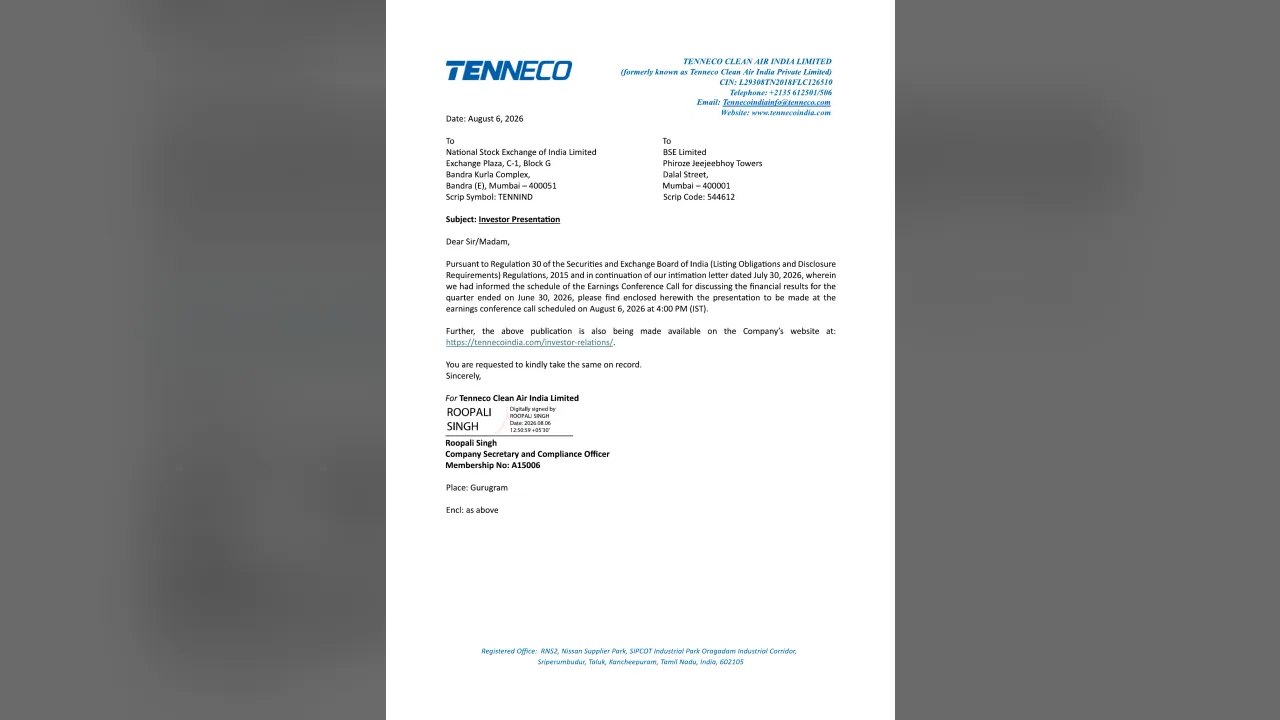
- Company
- Tenneco Clean Air India Limited (NSE:TENNIND)
- Period
- Q1 2026 earnings call
- Date
- Thu, Aug 6, 2026, 11:02 AM ET
- Replay
- Watch the replay on this page · 1 h 5 min
On 6ix: 6ix.com/event/tenneco-clean-air-india-limited-tennind-q1-2026-earnings-call
Replay
Transcript
Automated transcript · Written by software from the replay's audio. It can mishear names and figures; the replay is the record.
0:01 Ladies and gentlemen, good day, and welcome to Q1 FY 'twenty seven Earnings Conference Call of Tenneco Clean Air India Limited. As a reminder, all participant lines will be in the listen only mode, and there will be an opportunity for you to ask questions after the business updates concludes. Please note that this conference is being recorded. I now hand the conference over to Mr. Himanshu Sharma, Head Investor Relations of Tenneco Clean Air India Limited. Thank you, and over to you, Mr. Himanshu. Thank you, Sanya. Good evening, ladies and gentlemen, and a warm welcome.
0:47 Today, we have with us Mr. Arvind Chandra, Coating Director and CEO and Mr. Mahindra Chandra, Chief Financial Officer. A detailed presentation on the business and financial performance is available on company's website and on the websites of the stock exchanges. We will begin with Mr. Chandra providing a business update, followed by Ms. Chandra covering the financial results. We expect the update to take around fifteen minutes. After this, we will open the floor for a Q and A session of about forty five minutes. Before we proceed, I would like to draw your attention to the disclaimers included in our presentation. With that, I now hand over to Arvind. Thank you, Himanshu, and good evening, everyone, and thank you for joining us for Tenneco Clean Air India's Q1 FY twenty twenty seven earnings call.
1:41 We started FY twenty twenty seven on a strong footing, driven by disciplined execution, continued market share gains and increasing adoption of our technology led solutions across both our advanced ride technologies and Clean Air and Powertrain businesses. Despite a quarter marked by significant commodity inflation, geopolitical disruptions and the additional costs associated with operating as a newly listed public company, we delivered healthy growth while sustaining strong profitability. For the quarter, value added revenue grew 18.4% year on year to INR 13,816 million, outperforming the growth of our served addressable market. Revenue from operations increased 20.2% year over year to INR 15,448 million.
2:30 EBITDA grew 7.9% year on year to INR 2,469 million, and we delivered an EBITDA margin of 17.9% on value added revenue. Profit after tax stood at INR $1,652,000,000. Now PAT grew similar to EBITDA growth. If you exclude a onetime benefit recorded in the corresponding quarter last year, where we sold our Motor Care business and other one off incomes. But if you exclude Motor Care, our pad growth is similar to EBITDA growth. I want to be very clear on that. Beyond financial performance, I am particularly pleased with the continuous progress we're making in gaining market share across our core businesses.
3:16 Our commercial vehicle Clean Air Solutions business increased value market share from 57% to 58% in FY twenty twenty six, while our passenger vehicle shock absorbers and struts business expanded market share from 52% to 55% of the Indian market. In off highway clean air solutions, we maintained our strong leadership position with a market share of 68%. These gains reflect our technology leadership, customer relationships and relentless focus on execution. In advanced right technologies, the momentum behind our proprietary DCX da Vinci platform continues to strengthen like never before. During the quarter, we secured multiple new application wins across existing customers while also adding four new customers to the conventional and DCX platforms.
4:07 Since its introduction, DCX has continued to redefine ride performance expectations in the Indian market while maintaining the affordability and robustness required for local operating conditions. Building on this momentum, we introduced DCX32, the latest addition to the DCX family, specifically targeting smaller A and B segment vehicles and significantly expanding our addressable market opportunity. We also successfully completed fitment and performance benchmarking of our Mechanical Adaptive Road Damping or MART technology with a leading domestic OEM. Importantly, this innovation was developed and validated entirely in India, further reinforcing our local engineering capabilities and commitment to technology leadership.
4:58 And this type of local engineering and innovation will continue in the future. Within our Clean Air and Powertrain business, we continue to strengthen customer partnerships through multiple strategic program nominations, spanning ignition systems, hot end and cold end after treatment solutions and other powertrain applications. One of the notable achievements during the quarter was securing a spark plug order from one of India's largest passenger vehicle OEMs. This win represents a strong entry into a new white space opportunity and demonstrates our ability to leverage long standing customer relationships to expand our footprint. Additional wins included a new passenger vehicle exhaust program with a leading domestic OEM, a cold end assembly program for a global OEM CNG platform and an upcoming emissions after treatment program for a leading domestic commercial vehicle manufacturer.
5:57 These program awards continue to broaden our growth pipeline and reinforce our position as a trusted technology partner for our customers. We're also making encouraging progress in export markets. During the quarter, our Advanced Ride Technologies business secured its maiden order from a leading European all terrain vehicle manufacturer, opening a new customer segment and geography for us. Additionally, our powertrain business won a heat shield order from Tenneco America, demonstrating the global competitiveness of our Indian operations. These export wins support our long term ambition of expanding exports and deepening our participation in global supply chains. Another highlight of the quarter was the recognition we received from our customers and industry peers.
6:50 We were honored with the Innovation and Performance Award from Mahindra, the Technology and Innovation Award from Daimler India Commercial Vehicles and the Ride Performance 2026 Award from The Economic Times. These recognitions validate the strength of our engineering capabilities, operational excellence and customer centric culture. As we look ahead, the underlying drivers of our growth remain intact. We continue to benefit from increasing content per vehicle, strong program execution, technology differentiation, market share expansion and a growing customer base. Our investments in advanced ride technologies, alternative fuel enabling solutions and next generation mobility applications position us well for future opportunities while maintaining relevance across evolving powertrain technologies.
7:43 While external market conditions remain dynamic, including commodity volatility and geopolitical uncertainty, we remain confident in our ability to navigate these challenges through the disciplined application of our P3 operating model, commercial excellence and operational rigor. Most importantly, we remain focused on creating sustainable long term value for all our stakeholders through profitable growth, technology leadership and strong governance. With that said, I will now hand you over to our Chief Financial Officer, Mahindra Chabra, who will take you through the financial performance in greater detail. Thank you very much. Thank you, Arvind, and good evening, everyone, once again. Let me take you through our financial performance for the first quarter of FY twenty twenty seven.
8:35 As always, we use value added revenue or BAR as our primary performance metric as it excludes pass through substrate cost and provides the most meaningful view of the underlying operating performance and profitability of the business. We started the year with a strong growth performance despite a challenging external environment. Revenue from operations increased 20.2% year on year to INR 15,448 million, while VAR grew 18.4% to INR 13,816 million. This growth was driven by higher production volumes, new program launches, increasing content per vehicle and continued market share gains across our core businesses.
9:21 Importantly, our value growth continued to outpace the growth of our served addressable market, demonstrating both the strength of our customer relationships and the benefits of our diversified portfolio. Looking our business segments, Clean Air and Power Strain Solutions delivered BAR of INR 6,626 million, representing growth of 9.6% year on year. Advanced Ride Technologies continued strong momentum and delivered VAR of INR 7,190 million, growing 27.9% year on year. The ART business remains a key growth driver supported by increasing adoption of advanced suspension technologies, new customer additions and expanding application of the DCX platform.
10:10 From a profitability perspective, EBITDA increased 7.9 year on year to INR2469 million. EBITDA margin stood at 17.9% of BAR. While margins were impacted by significant commodity inflation, rupee depreciation, geopolitical supply chain disruptions and incremental costs associated with operating as a listed public company, we were able to sustain strong profitability through disciplined execution, productivity initiatives, rigorous cost management and commercial actions. Our customer recoveries and effective productivity amounted to 60 bps, reflecting reflected already reflected in the EBITDA margin. Our operating performance continues to be supported by Tenneco's global P3 framework, which remains deeply embedded across our operations.
11:03 Through this operating system, we continue to drive continuous improvement across safety, quality, delivery, inventory management and cost competitiveness. The ability of our teams to execute with consistency and discipline has enabled us to navigate a period of elevated external headwinds while maintaining healthy margins and operational stability. Profit after tax for the year stood at INR $1,652,000,000 with a FAT margin of 12% on BAR. It is important to note that FAT grew similar to EBITDA growth, excluding a onetime benefit recorded in the corresponding quarter last year, which was from selling our motor care business and other one off incomes. From a return perspective, our annualized ROC continues to remain very strong, demonstrating our continued focus on capital efficiency and disciplined allocation of resources.
11:57 At the same time, we remain committed to investing in future growth opportunities, including previously announced capacity expansion projects that will support our growing order book and customer requirements over the coming year. Another important area of focus has been strengthening the governance and compliance framework expected of a publicly listed company. We continue to enhance processes, internal controls, risk management practices, strategic compliance systems and internal control mechanisms. These initiatives are intended to build a robust governance platform that supports sustainable long term growth while meeting the expectations of all the stakeholders. To summarize, we have delivered a strong start by 2027 with double digit revenue growth, continued market outperformance, resilient profitability and disciplined financial execution despite significant external cost pressures.
12:51 Our diversified business model, strong balance sheet, high capital efficiency and focus on operational excellence position us well as we move to the remaining part of the year. With that, we will now open the floor for questions. Thank you. Thank you, Mahindra. We request participants to kindly limit questions to two at a time. If you have additional questions, please rejoin the queue. I now request Sanja to commence the Q and A session. Thank you very much. We will now begin the question and answer session. The first question is from the line of Ravi Gupta from Incred Capital.
13:54 Congrats on strong Y o Y top line growth. So my first question is on the value added EBITDA margin decline, which is around 170 bps Y o Y and 43 bps Q o Q. So which segment of your Clean Air or Suspension witnessed the higher decline, right? I believe in Clean Air, the input cost is more of a pass through. And so this was because of only Suspension business or how the data is between both of these segments? Ravi. Thanks for that question. But as a practice that we've agreed, we generally do not disclose the margins at the BU level. We look at the overall margins. And as far as the costs are concerned for components, the index components like steel and all, we have back to back arrangement with the customers.
14:47 There could be a time lag by quarter or so. And for non index, we have been kind of following up with the customers. We have been able to recover certain amounts and for the remaining part, the discussions are in progress. Can just add to that. I think, see, so year over year, we were not a public company last year. So now we're a public company. And obviously, the cost of running with a public company, entire setting up a full leadership team and all the things that are needed for good governance, right, that adds cost. So from Q1 of last year to Q1 of this year, obviously, you'll see additional cost. The other one is just the geopolitics of the Mideast war that has, to some extent, impacted everybody in the supplier community from because of crude oil, LPG, CNG, plastics, rubber and so on. And some of these are not indexed, right? Like steel is indexed back to back with our OEMs, but some of these are not indexed. So and again, we've been able to partially recover some of these. I must say that team has done a fantastic job. So the EBITDA percentages have been maintained. But that year over year delta that you see mainly comes to these two. It's moving from a private to a public company, and secondly, the commodity escalation that happened in the last quarter because of the MIDI score.
16:10 Got it. Secondly, on the order book. So since you have added four customers in suspension business and multiple wins in Clean Air, so what is the growth in terms of your order book? Like last time, it was around INR 12,400 crores. So what is the growth? I just want to understand. I know you don't share it on quarterly basis, but just to look at the directionally. So last time you had said for two years, it will be like mid teen kind of growth to achieve the order book. So is that improved like late teen or something? So how to look at it? Yes. Thanks, Ravi. So obviously, we cannot share because we have not that would be a forward looking statement. But I think let's put it simply, right? What we said the last time from to where we are today, there's no change, right? Obviously, we are very excited about the fact that this da Vinci technology is completely disrupting the market, right? And we are in fact, for us, it's more about how do you execute when you win so many programs. One, the pilot program at our lead Indian OEM customer, but winning more programs, winning more applications within the same customer as well as picking up four new completely different customers and all of them very prestigious and growing. So we're very excited about this the rate at which we are acquiring new business with new technology, right? And obviously, with new technology, hopefully, our margin situation will also go in the
17:41 right direction, right? So I'll give you a number. Order book, we decided that because the thing with order book is that there's no steady order book, right? Some quarters it goes really high, other quarters it's little bit low. So to kind of even out the peaks and the troughs, we decided that we would report order book every half year, right? So H1 at the end of the second quarter, we'll report order book. And then again, at the end of the full year, we'll report second order book. So if you can just be patient for a few more months, we'll have the H1 number as well. But it's good. That's the best way I can say it without sounding too positive or too negative. The next question is from the line of Himanshu Singh from Baroda BNP Paribas Mutual Fund.
18:36 So I just wanted to understand why is the growth in the Clean Air business at, let's say, 10% when the industry is growing at like mid to high teens for the quarter? My first question. Yes, sure. I think a very good question. Obviously, we knew that this question would come up. So first of all, remember that our Clean Air and Powertrain solutions, they address the whole market, right? So we are in passenger vehicles, we're in commercial vehicles off highway and so on. But we're not in EV, right? So an electric vehicle does not get an exhaust system, obviously, right? So from the served addressable market, you have to subtract the EV part of it, right? So from a 16% market served addressable market, you have to remove the EV part.
19:36 And then also don't forget that we are not present in the passenger vehicle, one of the leading Japanese OEMs, we're not present at all. So that kind of removes us from participating in the growth that they were having. And in the recent quarter, quarter over quarter, because of GST, this particular customer, a leading Japanese OEM player, we because we didn't participate and they grew by a very, very strong double digit, we couldn't get the benefit of that, right? So minus so total served market minus EV minus this particular customer is where we end up. So if you subtract that and compare us our growth to these, let's call it, apples to apples served market, then we're actually growing because we've had some gains with one of our German truck customers as well as a leading passenger vehicle OEM. So that's best way I can describe it. Now having said that, the good news is, and I've said that in prior quarters as well, we have with one entry into this passenger vehicle OEM that we did not have business for the longest of time.
20:43 And we're entering through Cafe three, and we're waiting for them to announce when their engine will be launched. We are expecting that to be maybe twenty eight, twenty nine ish. And based on that, you will start seeing our entry into that white space. And then once that happens, our market share in the passenger vehicle side will also grow. You know that on the truck commercial vehicle side, we have very high market share, like 58%. And also on off highway, we have like sixty sixty plus percent, right? So we're very strong players in commercial vehicles and off highway. And with this entry in the FY twenty twenty eight, twenty twenty nine period, we will start also making an entry in the passenger vehicle side. Hope that answers your question.
21:30 Yes. So could you just give us the growth for the industry after doing all the deductions which you suggested? I think we have I think our served addressable market at about a 16% level roughly. And from there, I think the EV part is about again, I'm just high level numbers, don't quote me on that, but I'm just doing a basic math of 16% minus about 3%, 3.5% leading up to about 13%. And then when you take out the growth of the passenger vehicle OEM, the large OEM where we don't have business, we end up with somewhere between like 8% to 10%.
22:18 And so relative to that, our 9.6% growth for Clean Air and Powertrain is better, right? So it's a value growth that is better than the apples to apples comparison of the market, if that makes sense, So market minus EV minus this particular leading OEM equals apples to apples with our growth. And our growth is slightly better, like I said, because we've had some gains with a few of our customers locally on the commercial vehicle side. Right. Okay. And sir, on the spark plug order, what is the size of that order? Can you give that? Sorry, which one is it, Himanshu? Wait, what's your question? The spark plug order. Yes. So we haven't released the value for that yet.
23:07 We will do that at the right time. But I think the more significant thing is that getting entry into such a large vehicle volume base is very strategic for us, right? It's very hard to get in with what might be perceived as a commodity product, but we actually secured this through technology and also from a time to market perspective. So we were able to leverage our relationship with other products to be able to get it. So leveraging relationships with new technology, something that's a product that's more durable, that's how we were able to get it. So that's exciting because now we can grow within this OEM in a very big way over time. But to answer your question, we will come up with that number at a future date when have solidified the revenue value.
23:54 Sure, sure. Thank you. And just one last question on the can you give breakup of domestic and export? That's it from my side. This is for order book, Himanshu? No, the revenues. So in terms of the current quarter, our exports are slightly over 7% of the overall revenue. Thank you so much. Thank you, Himanshu. Thank you. The next question is from the line of Nishik Jalan from Axis Capital. Please go ahead. Yes. Hi. Thank you for the opportunity and congrats on a lot of numbers. Two questions from my side. One, on the suspension business, PV suspension business. Just wanted to understand where are the process of shift towards more advanced suspension technology?
24:47 What is the penetration of passive plus and similar premium technology in TVs? And where are we in the localization process of the same? Because if I remember correctly, we have our localization content was on the lower side in this part of the business compared to other subscription segments. And secondly, one more question on export side. We had obviously plans to ramp up exports meaningfully as a percent of revenues. Where are we in that journey? Will it be more back end then? Or will we see good growth in exports in this year also? And if yes, what are the CapEx plans for the 05/27? Thanks, Nishit. You were breaking up a little bit, but I think I got the gist of what you were asking. So going back to your question one, there were a couple of like sub questions as part of that question. So I think one is, yes, we are shaping the market for suspension.
25:48 We introduced electronic suspension for the first time for an Indian OEM. And that we saw in the some of the electric vehicles that got launched by this OEM very successfully. We were still in the process of fine tuning the technology. And they want to actually keep improving it until it offers a very, very high level of comfort, right? And so and localization is a chicken and egg situation, right? So once we have the required amount of volume, we're able to kind of localize here with the critical mass and then rather than importing from overseas, right? In the case of Da Vinci as well, Da Vinci, the difference is, one is semi active suspension is more with electronics and software.
26:39 And it samples the road every 10, 11 milliseconds. Davinci, on the other hand, is more like frequency dependent damping, right? So it's more like a FDD plus, which is more about nonlinear damping purely through mechanical means. See, that technology itself is so good that it has the ability to disrupt over half the entire market. And you're seeing evidence of that, the rate at which we're booking business on the DaVinci is very spectacular, right? So again, same thing on the localization side there. I think the localization will happen much faster because the volume uptake of Da Vinci is going to be much faster. It's going to be applicable across definitely the entry level, the mid, the BC segments of SUVs and also with this new DCX32 piston launch, we are also able to go down all the way up to the AA segment. So to answer your question, localization is just a matter of time. It will happen. We're waiting for the right critical mass and volumes to come in, and then we will localize. So but we are the ones that are disrupting the market.
27:48 That's very, very clear. To answer your second question on exports, like I said, the there's no change in our story from last time. We're still booking export. As you saw in this press release, we have talked about winning ATV order. We are also winning business within our own Tenneco Group competitively, obviously. That shows that our cost structure and the fact that we are technology equalized allows us to have exports growth that is a little bit faster than the overall market, right? With exports, again, it is not a linear thing. Depending on the quarter, it can go up or it can go down. So we will as part of our order book, at the end of Q2, we will report both the domestic and the export order book. So if you can just wait a few months, we will report that as well. But the good news is we're we've got exports coming in across our major product lines across Clean Air, powertrain and suspension.
28:49 Yes, tariff is a problem. The Trump administration levied additional tariffs on Section two thirty two, which is the some of the exhaust parts that get the bit to in more going So we're of in the It's more to do with what's happening in those regions that could pose a challenge for exports. But having said that, our basic export story and our focus has not changed. Thanks, Nishit. Hopefully, I answered your question. Just one left CapEx count for FY 'twenty seven. CapEx for?
29:37 For the current fiscal year, CapEx, what are you planning for FY 'twenty seven? Okay. So we are targeting to spend across $3.50 to INR $4.50 crore for FY 'twenty seven, which will support our double digit top line growth. Having said that, please be mindful that we are closely monitoring the economic environment across our key markets and may pulling or push out CapEx based on the actual demand requirement. Please note these numbers are kind of indicative and not really precise guidance for the current fiscal year. The next question is from the line of Arvind Sharma from Citigroup.
30:26 Thank you, sir, for taking my question. My first question would be that, again, if we... That you get exports a little more and you've kind of alluded to it, how would you say the difference would be between what we are selling to direct OEMs outside and to Tenneco's global entities like you highlighted the Tenneco America heat shield order in? So broadly, what would be the contours of these two segments? Yes, sure. Yes, so look, again, you have to remember that our strategy to really focus on exports only happened like recently, right, like three, four quarters ago. So we're only like about a year into this post just a bit before the IPO and post IPO. So right now, our export order book is coming in like seventy-thirty.
31:16 70% is more like Tenneco to Tenneco, right? Tenneco India exporting to other Tenneco entities. And 30% is coming through third party OEMs. So now will this ratio of seventy-thirty continue over time? I can't tell simply because there's a lot of opportunities also with third party OEMs that our sister divisions in Europe and Americas don't want to participate in for whatever reason. It is not profitable enough for them, etcetera. But some of those that are not profitable for them are profitable for us, right? So we can go after those businesses. So those are things that we're still exploring across major regions. And also internally, right, Tenneco to Tenneco, we're also looking at where there's technology equalization, where there's opportunity for cost arbitrage, where we can provide the partnership in terms of either child parts or subassemblies or even finished goods for that matter. So a lot of these are opportunistic.
32:15 Some of them be strategic depending on new products that have been set up or new technologies that have been pursued by our other divisions. So it's a little bit of a mixed bag. I think as we go through another year, the strategy will become a little bit more solid in terms of where the exports are going to come from. So for now, you can at least for now, say, assume that it's a seventy-thirty split between internal versus third party OEMs, but that ratio can easily change. And if it changes with more third party sales, that's also good. We welcome that. For us, it doesn't matter, right? We are happy to export to anybody who will give us a decent margin, which is obviously accretive to what we have. And plus, from a labor cost arbitrage, we are competitive and we have the technology. So having the ability to be able to ship the latest technology from India anywhere else at the right cost structure gives us an advantage. Hope I answered your question, Arvind.
33:15 Yes. Thank you so much. Just two more data points. What was the royalty payment in the first quarter? And if you could share the capacity utilization in both the ART and the CAPT segment? Yes. So as far as royalty is concerned, royalty is 2.5% of the overall revenue reduced by intercompany sales. So that stays consistent in line with the previous year. Royalty. That's the royalty. Okay, capacity utilization. Yes. So as far as capacity utilization is concerned, for CFP, it is upward of 80%. However, the advanced technologies, are really working more than 90% of the capacity currently. And that's one of the reasons we already announced one new plant for advanced rate technologies that should be either Western part of the country with an investment of INR 70 crores approximately.
34:11 A lot of the run up to the increase in capacity utilization is directly as a result of GST as well, right? GST has really benefited some of the smaller vehicles, AB segment vehicles. Not just for us, I think many auto suppliers are also hand to mouth on trying to deliver parts. But this is a good problem to have, right? It's a good news that our volumes are going up because of that. So it has really spurred demand, and all the suppliers are trying to all maximize from our capacity utilization perspective. And that's the reason why we're adding capacity in a frenzy to be able to catch up. Got it. That's all from my side. Thank you so much for taking my question. Thank you. Thank you, Arvind.
34:57 Thank you. The next question is from the line of Vipul Agarwal from HSBC. Please go ahead. Congratulations on a good set of numbers. So my first question is on the margin, like margin since the RM cost increases are passed through for you. And what we are seeing that OEMs are now kind of taking the actual price hike to pass through the R and M cost inflation to the customers. And we would assume that there must have been some pressure for auto ends also. So does your margin in first quarter reflect all the cost margin pressure or the pass through? Or there's still something pending at your end, which has to which is yet to be received from the OEMs? Yes. First of Lipul, hopefully, you're doing well.
35:43 Good to hear from you. It's a good question because this is we have commodities that are escalatable like steel, right, that they're back to back covers. So we don't have an issue there. But it's the non indexed commodities, right, like rubber, plastics and crude oil, LPG and CNG and so on. We use that for various processes for our furnaces, for example, for welding, we use argon gas and so on. So three things you have to bundle and then try to recover these from the customers. So what we are showing this quarter's performance, margin performance, indicate a partial recovery of that.
36:31 I must congratulate our purchasing team to have tried very hard to recover this. But having said that, it is a very difficult challenge to recover some of these from our customers. We're constantly hoping that we can recover all of it. But with the mathematical formula, if your commodity costs go up by 10 and if you are able to recover INR 10 from the customer, your margin percentage drops purely because of the numerator denominator effect, right? So but having said that, yes, look, we're trying our commercial sales teams are trying. It is a tough market out there, but and we're not one is the recovery, the other one is focusing on productivity, right? Because of our P3 operating model, we're constantly focusing on factory level productivity, making sure that we are doing everything we can to manage costs, including SG and A and so on. And again, Mahindra can talk in more detail about it. But this is a it's an ongoing battle. We don't know how long this Middle East war is going to continue. We're hoping that for whatever the cost increases are, we are able to offset that. It will be tough, but we are trying our best.
37:41 I mean, just to highlight, we really remain focused on the current cost environment, and we are very closely monitoring the current situation. And to mitigate the impact, we already spent on the oversight to various reviews and interventions that we have done within the organization. So I mean, some of the examples are, for example, energy optimization through peak of usage, production consolidation, then we are having regular kind of sync over the SG and discipline. We have a very higher kind of increased focus on the customer recoveries and all. So at an overall level, I mean, we have been taking all the actions to ensure that our cost, whatever there is an increment, we can kind of if we can set it off to the extent possible. Understood, sir. So maybe if you can explain us the seasonality of your margins in the stand alone business, which is mostly your Clean Air business only, stand alone. So I would assume that like in what happens in from fourth quarter to first quarter, every year, we'll see a lower sales share of heavy commercial vehicles as compared to medium commercial vehicles, while it will kind of decline in first quarter.
38:44 So the sorry, that share of heavy commercial vehicle will decline in first quarter. And so is there a seasonality which we will see every year in Tenneco margins in stand alone business? Or was it like kind of one off this year? How we should read through the stand alone business margins? Yes. So seasonality is typical, right, for the auto sector. So this covers passenger vehicles, commercial trucks, off highway also. So you do see a little bit of a decline. And then certain quarters like leading up into the festive season, we do see an increase. So we're not any different from any other auto supplier that is in the Indian economy, right? So I don't think we can give you any flavor on how our margins will behave over time.
39:35 All we'll say is that it will be consistent with how prior years have gone. If you looked at prior quarters, looking at sort of the pattern of how the margins have been in terms of down again, tied to the revenues, right? So, so far, the demand has been good. If you start with the demand in the last six months. So even this quarter, even next quarter, at least the good news is where other regions in the world are struggling. India is still Indian OEMs are still predicting very good demand. Now if the Middle East war continues on and on, there will be some impact, I think. I don't think the demand will keep continuing. But right now, it looks like through Q2, at least, the demand seems to be good.
40:22 So you will go into the next quarter, hopefully, with an uptick, assuming that the Mideast war doesn't deteriorate any further, and that will have an effect on our margins. But I think the pattern of margins will continue like prior quarters. So my next question is on smaller the new DaVinci for the smaller cars you have introduced. So what is so for example, if what is the incremental cost for an OEM to shift from traditional or passive suspension to the new suspension? Maybe, for example, if you can quote some example from, say, Baleno like vehicle or Baleno or Fronks like vehicle, what can be the incremental cost for an OEM to shift from a traditional to the new Da Vinci, the smaller Da Vinci? So we haven't because we cannot specify price in a public forum simply because it's one is it's forward information because it hasn't been sorted yet. At the same time, it would be proprietary information. But let's talk in general, right? As the customers convert from conventional to da Vinci or, let's say, semi active, they will reduce hope to see an uptick in margins, right? And the margins will uptick at the max level when we have the volume, we are able to localize. And we're, of course, hopefully, able to charge a premium for the superior technology. Because these technologies, especially, comes with a much better comfort level. And those of you who have driven the Mahindra 7XO can see that it's highly publicized. It's all over YouTube and Instagram. So
41:53 all I'm saying is these technologies over time will come at a better margin. I can't give you a price delta because proprietary. I was think... Actually, I was thinking from other perspective perspective. Like, for example, if OEM wants to introduce, not from your margin perspective, like, how fast the absorb... Acceptance of this model can happen from OEM levels. For example, if OEM have to take a Pfizer who have just, let's say, 3,000 rupees, So the adaptation can be much faster. And if the Pfizer, maybe, say, 10,000, then the adaptation can be much slower. So I'm trying to understand the delta from OEM perspective, like what can be the answer? Good question. Good question. So yes, it's a very good question. So I'll look, all I'll say is the price delta is makes it very affordable for the OEMs, at least on Dow and Chief, for them to be able to scale up quickly.
42:40 Now it's a little bit different for the semi active suspension because there's electronics and software and routing cables and wiring harnesses and but and so on. But for the DaVinci, it's very simple. It's remove and you plug the new one in, right? It's plug and play. And of course, Delta is makes it very affordable. In fact, that was the purpose that Da Vinci was designed as a way to kind of get you 9085%, 90% of the way there on comfort, but with a cost delta of a few percentage points, right? So I think that's what makes it so compelling and this is why you're seeing us win a lot of programs on DaVinci, as I mentioned earlier. Understood. Just one last question on the CapEx, you highlighted that it can be $3.50 crores to INR $4.50 crores.
43:29 So can you give me some direction like where it will be? It will be towards ART or TENNIND new capacity you are bringing in. So if you can give some direction around it. That's my last question. Yes. So this CapEx will be towards both the business segments, Clean Air Powertrain as well as ART. And just to clarify, this includes the investment towards the two plants that we've already announced, which is amounting to INR140 crores. So yes, this will be towards both our business units, both the business segments. Thank you so much. That's all from my side. Thank you, Ripul. Thank you. The next question is from the line of Radha from Motival Oswal. Sir, when DS6 norms happened, that then the content per vehicle for both PV and CV are almost doubled for our Clean Air business.
44:27 However, when b s seven is more about diagnostics and monitoring, so if we combine the upcoming norms like CASPO three and BA seven, does this mean that the content per vehicle increase will be limited to maybe 20% only? Is that the right way to think about it? It's hard to say because BS seven is not out yet. Whether it is a BS six plus or a watered down version of BS seven, we don't know where that's going to be. But certainly, what we're doing is we're looking at the market as the whole world, right? We in the last quarter, if you remember, I mentioned that we had done a very successful proof of concept for Euro seven with a leading European truck manufacturer.
45:21 And that success means that we are not just technology ready in India, but we are for BS7 in India. We're also technology ready for Euro seven and The U. S. Version of that for 2030, right? So we look at the world as our oyster, so to speak. Yes, BS IV to BS VI was a much bigger jump, went from X going to 2X and in some cases of commercial vehicle, X going to like 4X. That won't be the case. I agree with you. BS7 and Cafe three, it will be more like X going to 1.3x to 1.5x, something like that, I think, if you take the combination.
46:06 But don't quote me on that because it's still not sure how the BS7 legislation will land. As you know, because of higher NOx and particulate requirements, they will need to have some sort of dual dosing for the SCR and larger particulate filter. It's very likely. They can use some injection technologies to do some optimization. So each OEM will figure out some way of how to achieve the legislation on NOx and PM through injection, through better fluid flow, fluid mixing, dual dosing and maybe more precious metals loading to achieve that legislation.
46:55 Now on the Cafe three, the CaPi three norms are more about the penetration of gas direct injection because it really offers a huge CO2 benefit, right? It improves CO2 significantly. But the byproduct of that is it produces more particulate. So that will need a gasoline particulate filter, right? So that also will take you from x to like 1.2x to 1.5x, depending on what application that is. But yes, you're right. It will not be like a BS IV to BS VI jump. It will be BS incremental, and that's how we see it. Understood. Secondly, except for 7% of your revenue, as of now, like you mentioned to the previous participant, As the can we expect the business to grow at double of the domestic business going forward considering the global partnerships that we have and how localization and considering India's export have considering these factors there?
48:03 So Rata, can you repeat your question? The voice is not very clear. Yes. Are you on a headphone? Can you remove your headphone? Because we cannot it's very muffled, what you're saying. Can you say it better? So I was saying that exports are currently 7% of your revenue. And given the multiple factors of localization, considering India as the exporter when your global partnership with Tenneco, do you expect this business to grow at double of what India business can grow? Okay. Good question. Yes, look, we're starting from a low base, right? So pre IPO exports was only like 5% of total sales. Now it's about 7%.
48:52 And I said that in my in prior quarters that exports are coming in at a higher percentage of order book, right? So if you look at the total order book of, let's say, 100, then exports are coming in somewhere between 14% to 20% of that 100, right? So we do think that exports will be a higher percentage of the total. However, there's one important thing that has changed. Our domestic business has really taken off. We are booking business left, right and center, and you've seen with ART, with Da Vinci and also with local Clean Air and powertrain customers. The rate at which we're booking local business is great. And this is music to our ears, right? So exports will continue as a strategy for both third party and also intercompany. But don't forget that the denominator is also growing, right? So that ratio is not is less important for us because domestic is growing.
49:50 Exports will continue. As long as we have the same technology, as long as we are cost competitive, we will continue to seek opportunities for exports on both sides, by the way. This is for right technologies as well as for Clean Air and Powertrain. Understood. Generally, what is the delta of margins in exports versus domestic across your business verticals? Amit, we do not disclose the margins for export and domestic separately. Having said that, our export margins are either in line or better than the domestic margins. Okay. And as there has been multiple order wins across both business divisions, especially catering to new customers, I wanted to understand whether the margins of these orders are better than the current margins of the company?
50:46 So we cannot disclose that customer level or program level margins. But like I said, our exports business, the margins are better than the domestic business. Understood, sir. Thanks and all the best of the team. Thank you. Thank you. Next question is from the line of Biraj Sanghvi from Ambit Capital. Please go ahead. Thank you for the opportunity, sir. I just wanted to understand the Darvin Sheet DCX suspension business a bit better. So there, what I want to understand is that when you win a model for Darvin Sheet DCX suspension, does it mean that all the trims of that particular model would have Darvinshi DCX?
51:31 Or would it be the case that it could be possible that lower trims still have passive suspension and it's the top trims which have Darvinshi? And secondly, over here, the four customers that we are mentioning with one, are those four new customers for Davinci DCX Suspension specifically? Okay. So I'll answer your first question. Thank you, Viraj. On your first question, look, our objective is very clear. Our aspiration is to ensure that all of India improves its suspension. Over the last seventy odd years, India is still 90% of vehicles on Indian roads, passenger vehicles, sedans, SUVs, they're still operating with conventional suspension, right? We've had all sorts of improvements in our engine, on interiors, better seats, now glass mat screens, Bluetooth, ADAS, sunroof.
52:29 But somehow suspension was always orphaned, right? But that has changed. That has changed forever. Why? Because of da Vinci and because of semi active suspension. We have proven that it doesn't take a massive it's not a big thing on your wallet to be able to aspire for higher suspension. So that's what Da has proven that you can make it affordable and you can give better comfort. So our aim is to with this new announcement that DCX32 that we are also going to be targeting the very, very low end of the A segment markets. We think that Da Vinci has the potential to disrupt all the way from the lowest what is the cheapest car, about INR 3 lakh rupees maybe?
53:16 All the way up to 35 lakhs, 3 to 35 lakhs will be Da Vinci, maybe above 35 lakhs will start getting into semi access suspension. So it's our aspiration to do that. And look, we are doing that. We are proving to you that we can book business very rapidly at not just one customer and multiple programs within the same customer, but also multiple new customers. And these are new customers that are new, not just for da Vinci, but also for conventional, right? So very often, it happens that the customer says, okay, you can have these programs will have conventional, but these higher premium ones might have da Vinci, right, within the same customer. But these are the good news is these are customers where we've never had any business even with conventionals.
54:01 And with a 55 market share, that's today, right? The fact that I'm telling you that we want four new customers beyond that, that should give you an idea of how strong we are in the market. Got it, sir. And just to get some sense for an OEM, how much cheaper would a DaVinci D6 suspension be compared to a semi active or a similar model than they would be trying? So we cannot, again, discuss price, delta, etcetera. All we're saying is Davenci is affordable enough where it can become standard, just like a window regulator, right? It's become standard in every car's automatic window regulator. We think that Davenci of of market. At who some kind of an electronic software based suspension the market. Simply because it integrates better with braking, steering, engine performance, right? Because you can have a common ECU, you can have a master ECU to have functionality split by various axle functional safety aspects. So it's easier to integrate electronic suspension and EVs.
55:24 But having said that, we still have interest from EV OEMs saying that, hey, we want to put Da Vinci on our vehicles. So because it's a lot cheaper, right? So I think Da Vinci has the ability to kind of satisfy a long range of A, B, C, even D segment vehicles if value and affordability become an issue. Got it, sir. My second question is on CapEx. So out of this $3.50 crores to INR 400 crores of CapEx, which is planned for FY '27, how much would have we incurred in Q1 FY 'twenty seven? And secondly, there was some export oriented CapEx also, which was going to be planned. So would this INR $3.50 crores to INR 400 crores CapEx include some export oriented specific CapEx as well?
56:14 Thank you. Yes. So yes, the overall CapEx, the guidance that we're giving includes the CapEx towards the investment for export. And regarding the first question, since we would be publishing our balance sheet in September, so we would be disclosing the amount that we would have spent during the first half when we do the Q2 discussions. Sure, sir. Thank you. Thank you for answering my questions. Thank you. Thank you so much. You. The next question is from the line of Nagraj, an individual investor. Please go ahead. Sir, good evening. Congratulations on a very good set of numbers. My first question is, do we have any plans to enter passenger EV segment with any new products other than ART?
57:04 My second question is, when are we expected to start commercial production of driving g suspensions for smaller passenger vehicles? And my last question is, since we are already a debt free company, if negative working capital, how are we planning to deploy cash flow from operations in future? Thank you. Okay. Thanks very much, Nagarash. I think the see, we are already a big player in EV, right? So our suspension in fact, electric vehicles need almost necessitate that you have a much better suspension because the EV drives on a battery with a very low center of gravity. And if you don't have a more robust shock absorber or suspension, it will feel like you're riding a go kart, right? So by default, all the EV players are leaning towards more of either a da Vinci or electronic type suspension. So that automatically gives us more content per vehicle, right? Now if you're saying other than ART, that's a good question. That's something that we are debating internally. We're not ready to disclose what we want to do, but that's something that we're discussing in the background in terms of how we can be more not just easy, but more like agnostic, right, which means pick a product, whether it's an ICE engine or a, let's say, electric vehicle, the product should not it should be agnostic, right? It should work on both the type
58:34 of segments of vehicles. On your second question on DaVinci, the smaller bore announcement we have made. The announcement we've just developed that. So now we are looking for customers. The good news is that this already came in as a result of some customers asking for it. So it's just a matter of time before we start merging the demand from the AB segment customers with the readiness and the comprehensiveness of that of this new technology, right? So it's the chicken and egg. OEMs want the same thing on the low segment, but we didn't have the technology ready, but now we do. So now we can start discussing with them how we would like to apply this. But like I said, my aspiration is that I want if I had a wish, I would put the entire all of India's A and B segments on Babinji as a minimum, right? So that's my aspiration.
59:33 Your third question was something around cash. Yes, how to use the cash, right? Look, yes, we do generate a lot of cash, 50% to 60% of our EBITDA converts into cash. Our traditional business lines are big cash cows for us. So we will use that for funding our CapEx, that INR $3.50 crores to INR $4.50 crores is fully generated the CapEx is fully generated through internal accruals. So we are not even after spending that kind of cash, we are still be debt free. So the obvious question is what else are you going to do with the free cash, right? So there are a lot of options, including M and A and organic options that we are pursuing. So it's in line with your first question. So wait for the right time, and we when we are ready to announce something, we will come out and do that.
1:00:32 Did I answer your question, Adarash? Thank you, Adarash. Thank Adarash. Thank you. The next follow-up question is from the line of Himanshu Singh from Baroda BNP Paribas Mutual Fund. Please go ahead. Sir. Thank you for the opportunity again. So just wanted to understand, like, did we face any impact from Hyundai supply disruptions, which we saw in 1Q? So did we have any impact from there on the Clean Air segment? No, we didn't because our we don't have a strong position in that passenger vehicle company. So we face that. So, that's the simple answer.
1:01:27 Okay. And just on the progress of new product launches, which you had highlighted earlier, like suspension business into different segments, How is it coming? And when should we start seeing some movement in those segments? Yes. You're seeing that in the continued growth of our business, right? So if the market grew by 16%, we've grown through content per vehicle and through new launches. In fact, this coming year, sitting here today, going into next year, let's say, through 03/31/2027, we do plan to have a lot of new launches, especially from the Da Vinci win, semi active. There's also on the Clean Air and Powertrain side, a lot of the business wins will start bearing fruit. So somewhere between like early calendar year 'twenty seven through 'twenty eight and through 'twenty nine. So the next couple of years are going to be very heavy for new product launches across the board. So we're quite excited about that, and that will automatically give us a pretty nice growth to look forward to.
1:02:44 Sure. Sir, and just last question, what is the like difference between the DCX32 and the DCX? Yes. So the normal DCX that we invented earlier was for the, let's call it, the mid to premium SUV types, right? So the 3.2 refers to 32 millimeters and the 3.5 refers to 35 millimeters. So the standard one was more like 35 millimeters for the luxury mid to luxury vehicles. The 32 is basically the size of the piston, which works for the A and B segment vehicles. So you're just going to think of it like you have a product and you're just shrinking it to form fit a vehicle that is much smaller.
1:03:37 So the things that are is the rod diameter. So for something like a 32, you would need like a 25 millimeter rod, and it will be encased in an outer tube of maybe 58 millimeters. I'm just giving you an example, right? So these are all ratios between the rod, the piston diameter and the inner part of the outer tube. And by shrinking it, you are now able to compete on the lower end for AAG segments. Sure. Thank you so much, sir. That's it from my side. Thank you, Himanshu. Thank you so much. Thank you. Ladies and gentlemen, we take that as the last question. I now hand the conference over to Mr.
1:04:23 Himanshu Sharma, Head Investor Relations for closing comments. Thank you, Sanneo. Ladies and gentlemen, thank you all for your continued interest in our company. We appreciate your time and participation and look forward to speaking with you again next quarter. Thank you, and have a good evening. On behalf of Tenneco Clean Air India Limited, we thank you for joining today's call. This concludes this conference, and you may now disconnect your lines.
Follow Tenneco Clean Air India Limited into a list and get an email when it puts out news.
Latest news releases
- NSE:TENNIND — Tenneco Clean Air India Limited has informed the Exchange regarding a press release dated November 04, 2026, titled "Tenneco Clean Air India Limited Announces Q2 and H1 FY 27 Results". · Wed, Nov 4, 2026
- NSE:TENNIND — Press Release Aug 05 2026 22: 39: 08 · Wed, Aug 5, 2026