Replay available
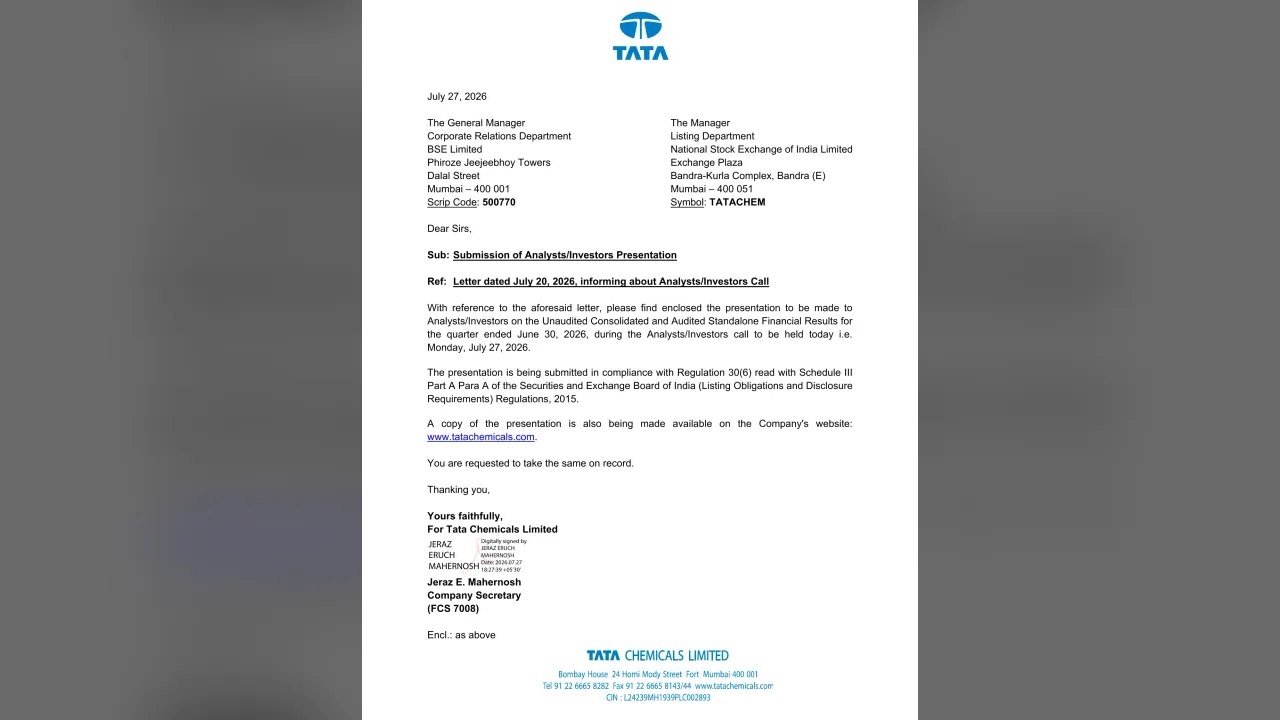
Tata Chemicals (NSE:TATACHEM) Q1 2027 Earnings Call
Tata Chemicals (NSE:TATACHEM) Q1 2027 earnings call, held 2026-07-27. Watch the replay and read the transcript on 6ix.
- Company
- Tata Chemicals Limited (NSE:TATACHEM)
- Period
- Q1 2027 earnings call
- Date
- Mon, Jul 27, 2026, 11:45 AM ET
- Replay
- Watch the replay on this page · 47 min
On 6ix: 6ix.com/event/tata-chemicals-limited-tatachem-q1-2027-earnings-call
Replay
Transcript
Automated transcript · Written by software from the replay's audio. It can mishear names and figures; the replay is the record.
0:00 Good evening, ladies and gentlemen, and welcome to the Q1 FY 'twenty seven Earnings Conference Call of Tata Chemicals Limited. Please note that this conference is being recorded. As a reminder, all participant lines will be in the listen only mode, and there will be an opportunity for you to ask questions after the presentation concludes. Should you need assistance during the conference call, please signal an operator We have with us today are Mukunden, Managing Director and CEO and Nanda Kumar Thirumalaei, Chief Financial Officer of Tata Chemicals Limited. Before we begin, I would like to mention that some of the statements made in today's discussion may be forward looking in nature and may involve risks and uncertainties.
0:49 I now invite R. Mukundan to begin the proceedings of the call. Over to you, sir. Thank you. Thank you, Sagar. Good evening, and welcome, everyone, to our Q1 earnings call. I'll start the discussion with brief overview of industry, then move on to our operational highlights across businesses and geographies. Before I begin, I just wanted to say that this quarter, we made a significant accounting change, which Nandu will explain at the end of my overall presentation in terms of the segment change to align that with the way we are running the business. The... Instead of two segments, which is basic and... Basic chemistry and specialty products, we have now renamed them as living industry and farm essentials. The farm essential business is is particularly comprising of Rallis and also Morocco, which is reported as a JV income below the line. In terms of Living Essential, it is mainly comprising of products which are salt, bicarbonate, prebiotics and everything which goes into feed, food and pharma.
1:55 The industry product especially is around soda ash, silica and industrial chemicals, which includes things like bromine, chlorine and caustic in addition to soda ash and silica. So let me start now highlighting the demand scenario across geographies for each of these three segments. In Living Essentials, mainly the food feed pharma, the core products which are sold by carbonate and eforest, they continue to have a stable demand, continuing to grow with supported by premiumization in this segment. Also, prebiotics is expected to grow faster due to rising health and wellness consumption. Industrial essentials, which is mainly soda ash, the near term outlook, unlike the previous one, is challenging due to global oversupply, especially coming out of China and also elevated raw material and trade costs, which are caused by the geopolitical tensions in Middle East.
2:54 Despite these cost pressures, the market was adequately surprised... Supplied in addition to which, I think there were no major market demand disruptions except in Arabian Gulf. So while global soda ash growth, while it is subdued, it has not gone down despite all the other macroeconomic challenges. The long term fundamentals remain positive, mainly on view of the focus on renewable as well as electrification. And India continues to demonstrate stronger demand momentum across in terms of the global market. China and U. S. Remained flat, mostly flat. Demand in LatAm has strengthened, especially supported by rising lithium carbonate production.
3:41 Exports to Argentina and Chile increased by 5332%, respectively. And Southeast Asian market mainly declined marginally. However, this is also a place where there is a maximum pricing pressure coming out of Chinese exports. In terms of farm essential, Indian farm sector outlook remains moderately positive, supported by improved irrigation technology supplies. There is, of course, a focus by the team on monsoon variability, potential as you know conditions and higher input costs, But we do remain positive in terms of the outcome during the year despite certain pressures coming on the overall system, especially driven by a higher commodity prices which farmers will have, which will ensure that they will save all the crop and hence use the crop protection products to get to... Or those products to market.
4:33 In terms of supply scenario, the bicarbonate... So additional supply coming in from competition, but overall, the supply scenario remains balanced. The... In terms of soda ash, the market are more than adequately supplied. The Chinese inventories reached the all time high of 1.73, and Chinese producers continue to operate at high utilization rate. The export volumes from China remain elevated and with no significant supply curtailments which are announced, the market rebalancing will be mainly driven off supply rationalization, which we are closely watching. In terms of pricing environment, as I said, this demand supply environment, especially in soda ash in the industrial segment, continues to compress the margin.
5:27 Chinese soda ash export prices are in the range of 160 to 180 FOB, translating to $1.70 to $1.90 CIF in Southeast Asia, which is where the most... Which is... Which remains the most challenging markets for us. So in our view, global pricing is expected to remain subdued given elevated inventory levels. However, the several domestic markets will continue to have steady pricing and move in a steady on the back of steady demand. Now I'll move to operational highlights. Despite the challenging environment in one segment of our business, which is the industrial essential, the company delivered resilient performance due to higher sales and production volume across segments, more especially in the living essential and in farm segment and strong operating efficiencies and disciplined cost management.
6:22 The revenue from operation on consolidated basis was up 14%. EBITDA was down by about INR 100 odd crores compared to previous year despite the lower realization, sharply lower realization. And net debt was INR 5,692 crores lower than previous quarter on account of monetization of assets. Stand alone was a very strong performance. The revenue was up 10%, EBITDA was up 35% and profit after tax from continuing operations was up 12% compared to Q1 of last year. In terms of unit wise performance, as I mentioned, the tender own has done well, both on higher volumes and stronger realizations with higher fixed cost control. We also capitalized some of the projects, which has led to higher depreciation.
7:09 And domestic demand has remained steady right across all products. However, the input costs have increased due to Middle East conflict. US has a higher revenue previous year due to higher volumes, partially offset by slightly lower pricing during the quarter. EBITDA was impacted due to lower realization and higher fixed cost, which was mainly not fixed cost were fixed in U. S. Dollar. However, because of the exchange rate impact in rupee terms, they were higher. Demand remains stable. Markets were well supplied, especially in most of the export market, especially in the Southeast Asian market. UK had higher revenue than the previous year due to higher volumes. There was a lower pricing in some of the product market segments.
8:01 EBITDA was impacted due to higher variable cost on account of Middle East crisis, which was mainly due to higher gas prices they had to buy. Kenya, higher volumes were partially offset by lower prices, especially in the Southeast Asian market. Fixed costs were under control. Singapore, the integration plan is going well, and Radix saw an overall revenue growth due to higher volumes and higher pricing, EBITDA growth, primarily driven by better volume in cost protection and optimization of fixed cost. With this, I hand out... Hand back to you for q and a session. Thank you very much. So we will now begin with the question and answer session. Anyone who wishes to ask a question may press star and then one on your touch tone.
8:48 If you wish to remove yourself from the question queue, you may press star and 2. Participants are requested to use handsets while asking a question. Participants are also requested to limit their questions to two per participant and can rejoin the queue in case of further questions. Ladies and gentlemen, we will wait for a moment while the question queue assembles. Our first question comes from the line of Saurabh Jain with HSBC. Please go ahead. Hi. Thank you for the opportunity.
9:36 My first question is relating to the reclassification. Can you please give us more details? What are the objectives that you wish to meet by, you changing this classification? And are there any measured targets or outcomes that we can expect because of this reclassification, which may reflect on the p and l? Yeah. I think mainly, sort of, I think the whole objective here is to make sure that we can continue to focus on reshaping the portfolio towards what we would call as non cyclical products. And these also are the products which are sustainability led. There's a lot of application focus in these products. And customer saliency and customer stickiness is very, very high and less volatility in pricing. So we are fundamentally focused on making sure that our portfolio moves in that direction.
10:33 Our capital allocation will be done on that basis. We are also building deeper deeper customer engagement here because the sales, marketing, the operational teams are all geared around following similar processes. If you look at food, feed, and pharma, the regulatory environment under which that operates, especially the food regulatory environment, the pharma regulatory environment is very different from industrial segment, which is why we have carved it out. As you know, the farm sector anyway is running a separate subsidiary. So this effectively brings focus into each business to build its own capability. Over a period of time, this will also see... Show itself in terms of capital allocation. We're already seeing part of it, but this would be more sharply seen in going in going forward, especially with the investments being focused on the living essential and farm essentials.
11:25 You can add to mister Mukundan on that segment here. See, earlier we had one basic industry segment having everything in that in terms of solar, solar, bicarbonate. On what is the revenue towards nonsecretive and technical part. Because earlier, was one big segment where you are unable to make out within that what is driving the growth. Now we can look at the the components of each of segment and see what is driving growth for Tata Chemicals. So this attempt towards that and the best of all investors' feedback given so far. So is there an added cost also involved here when you try to restructure your sales marketing team or other processes? And possible, can you quantify it? And also, you quantify any realizable benefits because of this restructuring, any synergies if some of those calculations have done on the back of the envelope?
12:26 In fact, sort of the... This was the way we were running the company. So the operations, the segmentation reflect our the way our company is structured. And the benefits are greater administrative control and also greater ownership of the outcomes, especially from the customer side. And in terms of financial and operational benefits, it is effectively, we will have one view of bicarbonate, one view of higher grades of salt. It then becomes very easy to sort of look at a global view in terms of the overall specific products rather than geography view.
13:14 This is just to drive one solution for every customer. Many of our customers are present in multiple geographies. If you take customers in the food area, customers in the pharma area, customers also in industry area, they are present in multi geographies. So they also want a single point of accountability, which is the way we have been structured. So now the financial reporting also is structured on that basis. But we would still be showing... We'll be still be relaying to all the analysts the specific geography wise PML so that you also get a view of what each geography is doing. Sure. Okay. And and the the base, it has it has happened by... Because of restructuring, which has happened over a period of time, while the split is happening in India, where there is a split of stand alone revenue into living and industrial, U... US and Kenya fall fully in industrial, and UK falls fully in living. So it it already has happened because in U U...
14:17 In UK, we have shut down the industrial businesses 100% because they were unsustainable. And the the reflection is also coming in the way that we are looking at the marketing. Singapore is folding into the living essential, more or less. UK would be in the living. Right? You have a salt and biomass business. Yes. Yes. Okay. Understood. So when I look at your CapEx plan, it shows a skew towards your living essential segment. Now going forward from a way to long term point of view also, once you're done with this this CapEx, are you focusing more on the living essentials, trying to deploy more capital on that side and less capital on industrial essentials? Or is it like only for the next two to three years and then you might need incremental CapEx on industrial side also? Yes. So very clearly, objective is to move away from cyclical business. If you look at the cyclicality of the business, the highest in soda ash, not that we want to sort of reduce our soda ash operational strength today. It will continue to remain because it is when it comes back, it is going to be one of the biggest profit drivers.
15:22 But it's industrial segment. Our focus would be on focusing on silica, which is also slightly more noncyclical than soda ash itself. So we will be sort of focusing our CapEx more towards what we explained that we drive growth in food, food, and pharma, and also specific segments within the industrial essentials. And try to decommoditize our portfolio as much as we can because that's a strategic direction we have been undertaking for the last few years. Any time lines on your silicon plant expansion of 50 Kt? I think Any time lines for all the projects because I think that the timeline is missing in the presentation? Yes. I think if you look at the the plant...
16:13 Salt plant in India, ABSD, 82.5, that should get operational by this year end. So you should start it supplying to market by first quarter of next financial year. The two ten kiloton plant in South India, which is mainly there, is the has a twenty four month execution time. Similar to the execution timeline for our 50 k to PSE. They would become operational early twenty eight, some... Sometime during '28. Okay. Understood. If I may ask one more question, more insights Sorry to interrupt. Okay. Sure. I'll get back into queue. Thank you. We request participants to limit themselves to two questions each and rejoin the queue for further follow ups, please.
17:03 Your next question comes from the line of Sumant Kumar with Modi Lalloswal. Yes. My question is for India business. We have seen a significant improvement in operating level. So apart from whatever the reason you talked on the initial commentary, is there because of West Asia award, the freight cost has increased. The overall because of that, the realization is higher. Salt business, I think volume is higher. So any other reason apart from that? Am I understanding, Derek? Yeah. I think the main driver of this India growth has been the volume increase. That's fundamentally right across all products. And the the...
17:49 Also, there there is a higher realization in soda ash because of the foreign exchange shift which has happened. We had taken a pricing adjustment because the products are linked to... Especially, soda ash is linked to import parity price. And freight cost also play... Played a role? The freight and forwarding cost did increase during the quarter, but they were more or less passed down to the customer. Okay. Okay. And so also we've been... We've been talking about the pricing for India business. How is the revision for contract and how is the mix contract in a spot market for us? I think India has taken a price increase of about INR 2,000 per ton, which I think is spot price, but the contracts are quarterly, as you know, and quarterly data review with the customers.
18:44 You have significant deterioration. How is the scenario in export because of tariff war? Overall, the export market is unrivaled and domestic is also subdued. So any outlook for The US business, how about the 48 rupees dollar USD per kg IV. So it's going to be reached at that level or it will take time? In terms of The U. S, I think one of the key approaches we have is that the biggest impact in the shift which has happened in terms of margin is on the export front, especially the export volumes which we were sending to Southeast Asia. They are just at breakeven level or $100,000,000 and that is likely to remain for at least through the year. And unless some capacity rationalization happens in China, it is unlikely to see uplift.
19:41 Next one year, I'll put the order to interrupt you. Mr. Kumar, we request you to return the Q4. Thank you. Thank you so much. Thank you. Your next question comes from the line of Ankur Periwal with Access Capital. Please go ahead. Yeah. Hi, sir. Thanks for the opportunity. Continuing with the the geographic performance there, especially in U. S, last quarter, we did rationalize some bit of volumes, saying that Southeast Asia was not as profitable, so we had taken a strict call there. We are seeing good volume growth here, but your comment on Southeast Asia pricing being lower. So we are still supplying at lower margin or was it a a tactical call? You know, if you can put some... Throw some light there. And same question on Kenya, good volume growth, but margin is not there.
20:29 So what are your thoughts, please? No. In Kenya, the Kenya fundamentally has been because of the pricing as well as their HFO prices have increased. I think if you really see that it's been not so much the market price pressure, Kenya had a very high impact of the war, and that's directly related to oil prices. So when oil price goes from $70 to $100 that clearly reflects in their HFO pricing, which leads to compression in margin. And we will try to pass that increase to customers as we can as much as contracts allow. But clearly, that's a tough spot they are in. As the spot prices come down, I think any of those are just.
21:15 There's a... They they have... Since bought hedge HFO, which covers them up to October, but we'd rather see what happens beyond October, the war drags on beyond that. In terms of U. S, while the input cost prices are more or less under their control, they have done well, mainly on back of higher exports to mostly the LatAm and Northeast Asian market. There were some exports Southeast Asian market, but we have more or less vacated like most of The US players, the Southeast Asian markets are Chinese. Sure. And given the Chinese inventory being higher, probably that pain may continue as you rightly mentioned. So the domestic part of U. S.
22:00 Is doing good? Domestic part of U. S. Is stable. And while there is no volume increased growth as such, the pricing levels are more or less stable, maybe $3.04 dollars shifts here and there. The the main pricing... The cost pressure we are facing in US is on logistics and transportation, and we are engaged constantly with customers to pass it on to them. But that remains an open item in terms of customer by customer to ask them to change the logistic cost. Sure, sir. And just last bit, the same question on the UK business as well, on the profitability side. Your thoughts given the ramp up in the Salt business there as well, but still the margins don't suggest so.
22:49 Yes. So I think UK had basically fundamentally two big events which were one offs of adding up to about GBP 2,400,000, which is one was on the loss on sale of UETL. This is likely to come back by October quarter because we go through a cycle. And second, there has also been one off issue related to some of the prior period adjustments. So that has led to a fall. But overall, I think our expectation is U. K. Should be EBITDA positive as well as tending towards PBT breakeven. Breakeven for the full year that is? Just that clarification. Yeah. Yeah. So the bigger full year, but also during next from next quarter onwards because these one offs, we don't expect it to repeat.
23:41 Great. Thanks for the answers. I'll get back into the queue. Thank you. You. The next question comes from the line of Abhijit Akhila with Kotak Securities. Please go ahead. Yes. Good evening. Thank you so much. My question is on the India business. So we are seeing soda ash sales volumes down about 12% sequentially and bicarb sales volumes down about 19% sequentially. So first of all, what were the reasons for that? And number two, despite this volume decline, we've seen really sharp margin expansion. EBITDA margins are 28%, more than 10 percentage points higher quarter on quarter sequentially. Is this some sort of maybe temporary benefit because of some low cost coal inventories that you were sitting on during the quarter? And in your view, is this margin sustainable next quarter? Or should we expect margins to revert back to, say, the 18%, 20% kind of range in India EBITDA?
24:40 So in terms of the inventory benefit, which are there, I think there are two elements here. One is in terms of the overall plant itself, there's been a bit of an optimization done to deliver higher volumes of salt to the market, which has led to certain throttling of soda ash production at the production level, nothing to do with market demand. And in terms of bicarbonate, it's fundamentally some of the contracts getting realigned, especially some of the tender contracts we had to forgo during the quarter because of certain pricing issues, which we hope to get back during the year. Certainly, in terms of inventory gains, we do believe that there'll be certain inventory gains which will happen in coal, which would come back to impact the cost in the next quarter because as the fast inventory of the coal goes out, the fresh inventory of coal is coming at pricing, which is elevated, not because of the basic price, but more due to the higher freight cost.
25:49 But we let this play out in the marketplace in terms of whether we can get a better pricing from all the customers because the price increases also have not been transferred to everyone, which means the only spot price increases has happened. So we let it play out, but certainly your point of view that while volumes may remain more or less steady, there could be a marginal pressure on the driven mainly by the cost side. Sorry, yes. So just to clarify, I mean, would a sustainable margin range be for the India business, if it's possible to spell that out? And just the other one that I had was you made a comment about a reduction in debt because of monetization of assets.
26:36 If you could please just help us understand what assets were monetized exactly and what the value is. Thank you so much. Ravi, what address the monetization? Yeah. So we have sold some land in q one, and we sold some of the shares we are holding, and that contributed to the debt coming down in q one. That stands up for that. Yeah. In terms of sustainable margin, it would be somewhere around 18%, which you referred to. I think that would be broadly the number I would pick. Approximately about 35%... So sorry, 32% to 33% GC margin. Got it. Okay. Thank you so much. I'll come back in the queue for any more. Thank you.
27:21 Your next question comes from the line of Rohit Nagraj with three sixty one Capital. Please go ahead. Thanks for the opportunity. Sir, the question is on the annual report research and development. So a couple of things that we have stated here is on the battery recycling process. And we've also developed indigenous sodium ion battery technology. So can you just throw some give you more color on the same, how things are likely to shape up? Where are we in terms of the commercialization process? And any time lines around that? So on on the battery side, I think we have certainly made the first battery pack, and it's undergoing testing.
28:06 And at the same time, I think we are reviewing the entire business strategy for the sodium ion battery, especially for the storage application. It it will not be appropriate solution for mobility. It will remain as energy storage mainly for renewable power as well as data centers. That's the main focus of that. But we'll come back to you with the specifics of the plan. Right now, we are going through the phase of proving the product and also piloting it. That itself should take better part of this year. After that, once we get through that, we'll come back with specific plans to enter the market and launch the market. Certainly, we can see that several strides have been made by the competition in China and the sodium battery.
28:54 We remain very positive about it, especially since it uses soda ash as one of the cathode active material, which is what we make as a product. So it has been patented, and we will be looking to commercialize that at... Basically take it through a pilot phase as soon as our testing protocols are over. In terms of the cathode active recycling business, we are working internally to set up this entire unit, and no major CapEx is needed. It's more or less being tried... We are trying to set this up in Metapur. Initial lot is very small because the volume of vehicles, which are more than seven eight years old is very small at this point of time. But this will be a business which will be built on OEM tires, especially with the auto manufacturers.
29:51 Thanks. Just one clarification on the sodium ion battery. In terms of soda ash requirement, any ballpark numbers in terms of one gigawatt or one megawatt battery, how much soda ash is required? We'll come back to you with a specific number. What we what we do indicate to market is for the lithium battery, for lithium carbonate production, you need two two parts of soda ash for every part of lithium carbonate. But on sodium, we'll come back with specifics as soon as the piloting phase is over. Okay, sir. Thanks a lot and all the best. Thank you. The next question comes from the line of Abhinav Mandopra with Equitas Investments. My first question was regarding the pricing impact, which has happened quarter on quarter. We are seeing a lot of rationalization in EU and even India.
30:50 So how has the quarter on quarter prices of should have have changed? And do we still see... Do we see China dumping since China have additional capacity of 10,000,000 tons? So any idea on that? So I I think this threat from China is for all markets in the world. It is not just Indian market or US market or Southeast Asian market. So we will work actively with, especially since there is manufacturing facilities in India, we will work with regulatory authorities in making sure the domestic industry is kept healthy as far as we are concerned. In terms of the pricing, as I mentioned, big impact in pricing has been due to foreign exchange rate movement. And broadly, I think Indian market has seen about INR 2,000 price increase. Some contracts have got it, some contracts still on the old prices, but we see as it rolls out. We don't see pricing in China dropping below anywhere around 160 to 170 odd at a FOB level. It has been holding steady for quite some time.
31:57 Moving in tandem with what the yuan... USD rate is. So the fall in yuan has... Yuan sale price of soda ash in China has been commensurate with the depreciation of dollar, which effectively meant the pricing has remained more or less flat. We don't see any big shift in this. We are probably at I don't want to say this, but maybe we could say that 170 was the bottom. It is close to 160 to 170. It's pretty much at the bottom. Most Chinese manufacturers are, in effect, losing money on cash basis. So this is the reality of the market. Okay. And on the raw material, how was the raw demand? How are you selling?
32:47 Can't hear you clearly. Sorry, Tatiana. Abhinav, sir, there is a lot of background noise from your side. Sorry. I'll jump back in with you. Thank you. The next question comes from the line of with unlistedindia.com. Please go ahead. Sorry to interrupt, sir. We are not able to hear you clearly,, sir. If you are using any other mode, may be requested to use handset, please. Can you hear me now? This is much better, sir. Please go ahead. Oh, yes. I had one question. So we have seen the price of soda ash coming down because of the excess capacity in China. So similar trends is expected in YCAP also? See, I think every market will have a very different reaction to this. If you look at our units in UK and in Singapore, we sell to premium markets, which are pretty much...
33:46 Which needs customer approval and the the plan to be cleared by the customer before the supply starts. These are not technical products, so we don't see a big shift impact on those two units. Certainly, within India, the competitive intensity has increased in the short term, not so much because of China, but because one competitor has brought in some capacity in, which will get absorbed due to growth in the market. So we do expect during the course of the year that that capacity will get absorbed and intensity will drop. We haven't seen big shift in the bicarb as such as of now. And China does have surplus in bicarb, but that that can impact mainly the technical grade. Okay. And what is the reduction in that amount?
34:34 $303,100 crores compared to March. Okay. Thank you. Thank you. The next follow-up question comes from with Equitas Investments. Please go ahead. Hello,. Yes, sir. This is Peter. Yeah. Yeah. My question is regarding the cost of raw materials. How has that been said? Have you seen any increase in raw materials, the current impact margin going forward? So I think your question is on raw material side. Yes. Yes. Yes. Clearly, I think it is depending on unit and unit, let me just telegraph that properly. In U. S, there is no impact on the input raw material, input cost side, except for the logistics, which is outsourced. So there'll be impact and we are working with customers to make sure that it's passed on to the customers.
35:32 The UK, there will be an impact from time to time. We do believe that UK, we will be hedging going forward. But fundamentally, there's an open item we keep in US because we do believe UK because we do believe the cash prices will revert back to mean at some point. In in in Kenya, as I said, our contracts are clear up October. Right now, if the prices remain high, they will certainly get impacted with the high price beyond October. India, of course, we are mostly on coal and which the biggest impact in coal is in terms of the logistic cost of getting it imported from Indonesia.
36:18 We do see that if the conflict continues beyond certain point of time, which is beyond October, November, we will have an impact coming in in terms of the limestone because the limestone stocks and the domestic production can only cope with production there. And we're going bring in fresh consignments from Middle East, which today, today's rates are extremely high and mainly because of the transportation they have to incur to get the product to Fujairah. So, really, the inputs for India, the biggest impact is to see whether the war does drag on beyond October. And right now, we are planning that we would be able to find solutions on that.
37:04 So clearly, out for Kenya HFO, India Limestone beyond October. And energy cost increases in India are mainly driven by logistic costs and the cost increase in The US driven by, again, logistic cost. Thanks a lot. Thank you. Your next question comes from the line of Arjun Khanna with Kotak Mutual Funds. Please go ahead. Thank you for taking my question. So the first question is back to the sodium ion. So in our annual report, we have talked of using it for drone flight test. Drones are likely to be the least amongst the transportation segment to adopt sodium ions.
37:52 Just curious, why would you use it for a drone flight test? And if you could talk a little bit about the output our product is getting in kilowatt hour density, etcetera. Thank you. We will come back to you with the details going forward. This was just to prove the product in extreme application, but, clearly, in terms of customer specifications, this is more suitable for static application. We will not be selling it for mobility including drone going forward. This was just to... It's a proving flight. So we have gone through several tests both on static proving flight. Mobility has been done in some of the lab tests also, but we do believe that the competitive positioning is absolutely right for static applications, stationary applications.
38:39 Sure. Any metric that you could share in terms of energy density or number of cycles, etcetera, that we have been able to produce back? We come with a very specific number on this because, as I said, it's undergoing testing, and we don't wanna give a number which the testing doesn't prove. We we will come back with number which what our pilot units can do. But as of now, our view is that the product does meet the minimum requirement for stationary application. Sure. Secondly, just in terms of CapEx, if you could talk about how much do we envisage on spending in FY 'twenty seven?
39:25 Are we looking at further sales of investments? You mentioned we have liquidated crores of investment partly stock, partly land. What's the plan for the remaining part of the year? And what's that outlook on? Yes, I'll come to that. See, our annualized CapEx will be around the depreciation number. We will try not to exceed it. In fact, it'd be below that. So I think that's our plan through the year going forward, including all the CapExes which we have lined up. In terms of the sorry, what is the second question? In terms of spending I mean, in terms of liquidating investments, so we have sold 300 or I'll answer.
40:10 I'll let Nathu answer. See, we we have some noncore land available in the country there. So we're looking at monetizing some part of that in the second half or after q two onwards. And we will also look at what we can do in terms of any other non core we can look at monetizing. We can't comment on that now in this call, but we can look at as in when required. Sure. So we spent roughly 1,200 crores of console was our console depreciation for FY 'twenty six. Should we take that as the CapEx and maintenance CapEx number for FY 'twenty six? Yes, sir. You can take the number. Perfect. Thank you, and wishing you all the best. Thank you. Thank you. Your next follow-up question comes from the line of with HSBC.
41:04 Please go ahead. Yeah. Thank you for the opportunity again. Again, trying to understand more on the sodium ion battery side. So when you say indigenous developed technology, is it like a part of the whole battery that you have developed indigenously? Or it's like a complete battery solution that you have then developed indigenously? And going forward, which part of the battery would you look to scale if you want to go ahead with your plan for the battery space? We have we have produced a full unit, including BMS, full assembly, including BMS to be tested by power companies and data center for their application. And in terms of which parts we do, we will certainly be doing the chemicals and cathode active material. But whether we get into the full prismatic cell or the cylindrical cell, I think we will come back to you specifically as our plans unfold.
42:00 But at this point of time, we are extremely focused on getting the piloting done with as many customers as possible. Okay. Sure. Well, I understand that you would not be able to share more details on this side, but can this also be scaled up for export purposes or it's going to be more focused on the domestic needs? As we see it, the demand in India itself is going to be very, very strong with a number of data centers coming and a number of the focus on renewable power. But we are not ruling that out how we deal with exports. We've we've not put it in the strategy, but it remains something which we will be open to in case the plans develop even better than what we've anticipated.
42:45 So when can you be in a position to go and update? So maybe request to return to the queue for further follow-up questions, please. I was just completing it. Any insight into when can we expect more details to be shared on this side? See, we expect the piloting to finish in about six to nine months so that we we at least get a clear understanding of what is the customer responsiveness. After that, we'll come back to you. So end of the year, we should have some element of... From lab to at least initial customer, let's say, offers and units. But the the full scale plant, as I said, will come after that two years after that. Okay.
43:30 Understood. Thank you so much and all the best. Thank you. Your next question comes from the line of Abhijit Akhla with Kotak Securities. Please go ahead. Just two, three quick data related questions. One is the staff cost this quarter includes some INR45 odd crores reversal, is it? So the staff cost would actually have been higher by INR45 crores. Is that correct? That is point number one. Number two, would it possible to just share a breakdown of U. S. Volumes between domestic sales and exports? And the last one was on Masvid. It seems like the income from associates has gone into negative zone this quarter. Is that because of the higher sulfur prices? And so any outlook for the massive business? Thanks a lot. So all good questions. So I think firstly, let me start with the massive. The massive did not produce during the quarter because of high sulfur prices.
44:25 I think they have just begun operations during this quarter. So we'll see how it progresses. But certainly, I think that part of the business is under pressure in terms of margin. But I think they will make they'll be profitable for the year, but I think the first quarter they took a call to not run the unit. The second piece in terms of the Employee cost, you're right, about INR 43 crores. I think it is that normal run rate should be 43 crores more than that. And that's a one off during the quarter. And there was a third question. You must export almost a split. Split, I think we'll give next next quarter, if you want, obviously. Okay. Fair enough. So just to clarify, this employee cost would have been closer to $5.90 crores, which is up from about $51.07 last year, $52.04 in 4Q. Is that largely a rupee depreciation impact that's flowing through or something It's largely rupee depreciation also. I think many of the quarter one usually is a high number during the quarter, especially we're doing the rupee number. It is also the year where it's a period when we also pay out all the people's variable fees and all that. So take the large impact is on from the overseas business.
45:42 Thank you so much. All the best. Thank you. Ladies and gentlemen, we will take that as the last question for today. I now hand the conference call over to Mr. Arun Pindal for closing comments. Thank you. Thank you all for joining today for your for the conference call. I'll discuss the operating environment remains dynamic with ongoing uncertainties and disruptions. There is a price challenge as well as the cost challenge. In one of our biggest businesses, almost 50% of the revenue in soda ash. Despite these headwinds, our business continued to demonstrate resilience supported by this different execution in terms of the volume of products sold and our customer engagement. We do have a diversified portfolio and the revised segment results also will highlight which parts of the business are stable and continue to be non cyclical.
46:35 And this is backed with the stronger customer relationship right across portfolio. On behalf of the entire management, have to thank our customers and our partners for their continued trust and confidence, and look forward to your ongoing support. Thank you all for joining this call, and we look forward to speaking to you again in quarter two FY 'twenty seven. Thank you. On behalf of Tata Chemicals Limited, that concludes this conference. Thank you, everyone, for joining us, and you may now disconnect your lines. Thank you. Thank you.
Follow Tata Chemicals Limited into a list and get an email when it puts out news.
Latest news releases
- NSE:TATACHEM — Tata Chemicals Limited Press Release Sep 01 2026 · Tue, Sep 1, 2026
- NSE:TATACHEM — Tata Chemicals Limited Press Release Aug 29 2026 · Sat, Aug 29, 2026