Peter Kenyon
CEO at RAMSDENS HOLDINGS PLC
Replay available
Audited Results for the year ended 30 September 2023 hosted by Ramsdens Holdings (LSE:RFX) on Investor Meet Company, held 2024-01-16.
On 6ix: 6ix.com/event/ramsdens-holdings-plc-rfx-audited-results-for-the-year-ended-30-september-2023
Automated transcript · Written by software from the replay's audio. It can mishear names and figures; the replay is the record.
0:01 Good afternoon, ladies and gentlemen, welcome to the RAMSDENS HOLDINGS PLC Results Investor Presentation. Throughout this recorded meeting, investors will be in listen only mode. Questions are encouraged and can be submitted at any time using the Q and A tab situated on the right hand corner of your screen. Just simply type in your questions at any time and press send. The company may not be in a position to answer every question received during the meeting itself. However, given the company can review your questions post today's meeting, we'll publish any additional responses where it's appropriate to do so. Before we begin, we'd like to submit the following poll. And if you give that your, kind attention, I'm
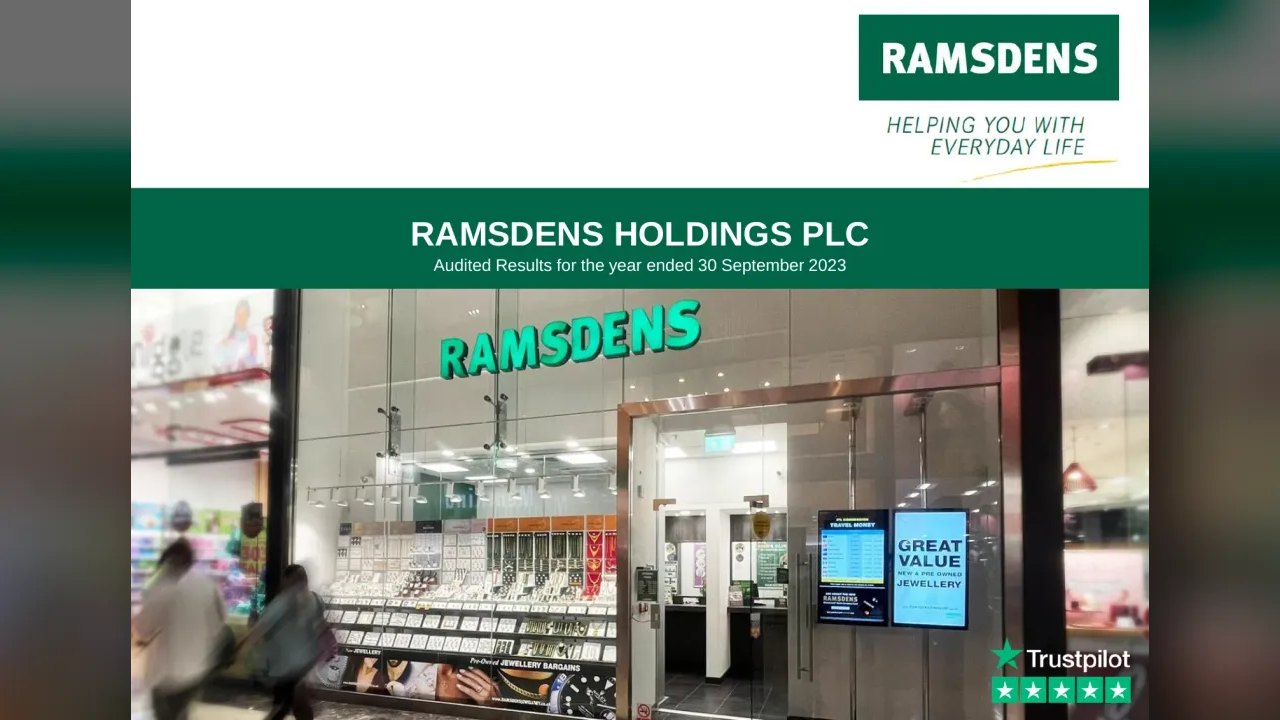
0:31 sure the company would be most grateful. And I'd now like to hand over to Peter Kenyon, CEO. Good afternoon. Afternoon. Thanks, Mark. So we're gonna go through our presentation. It's obviously on screen now. That's a picture of our Broadway Bradford store. You can see in the background two TILs. That's where we would service, like, the financial services from. Inside the store to the left is the jewelry serving area. You can see a big jewelry window there. We're advertising great value jewelry on our TV, and you've got a rate on the TV. And we're quite proud of the five star trust pilot rating that we've enjoyed forever that we've been on actually trust pilot. Alright. That's the disclaimer. If anyone wants to have a read that, please enjoy.
1:24 That picture there is inside our new York store in Stormgate. It's a retail street, a lot of jewelers on it, and that's got off to a very good start. Started opening in in September.
1:41 I'll click on to a summary. So in summary, we've had a good year. F y twenty three saw profit up 22%, record milestone of achievement 10.1. We got over the $1,010,000,000. And that's you know, there's been a great performance across the four key income streams. So retail, 23%. The
2:06 the, online jewelry, up 70%. Pawnbroking, up 90% in the loan book, and and, obviously, with pawnbroking, the interest income follows that. Currency, up 8%. A bit of a transition, some story going on there that we can come back to. We'll talk you through it. Purchase precious metals, gold buying from customers who want to get rid of their unwanted jewelry, very strong. Great balance sheet, liquid assets. Martin will shop through that later as well as, obviously, basic EPS increased 17%. And subject to approval at the AGM, the dividend will increase for the year 16% to 10.4 p with a final dividend of 7.1 p. I think that's payable on the March 22.
2:55 If you followed us, we've got quite a a simple growth strategy. One is improve our core estate, relocated two stores, invested jewelry, and results just ran through there. They are getting better. Expand the store estate. We've opened eight stores during the year. Got a strong pipeline for for this year. We've opened three already in Cardiff, Pool, and Blackburn. We are extending store estate in the Southeast. Romford is in shop fit as of yesterday, and a new store in Burnley went into shop fit last week. Online, that 70% growth means that our online department contributes over a million pounds worth of profit, which is a great achievement.
3:44 New currency website has launched in July. We're very happy how that has, like, transitioned from old to new. We have home delivery coming along, later this quarter, and we have new websites for home broken gold buying coming in in the early months of 2024. We bought a business in Bexley Heath. The loan book that we acquired in April is now 50% bigger than it was, and that store has made a good start. So all in all, if you like, our strategy has continued, and some of that is working quite nicely, and we've had a good set of results. What I'll do now is I'll go through the key income streams one by one, and it'll lead us into, if I overall, how the accounts have added up together.
4:32 So you can see in the bottom left hand corner, the bar chart of foreign currency gross profit since we listed in 2017. And you can see that, you know, the 2023, the volume of foreign currency is 408,000,000 exchanged, and the income that we made from foreign currency is now higher than it was pre COVID. For those of you that's looking into the the historic numbers, the currency exchange values are still 20% below where we were. So we've increased our margins, still very, very competitive on the high street. Still attractive new customers to us. New customer rates are up 20%, and foreign currency is in a good place.
5:19 Now our quarter one update said that our foreign currency performance was flat year on year, but there's obviously a few things happening within that. The first thing is the sales of foreign currency. So we sell foreign currency to people going on holiday. Whether that's Dubai or Benidong. We're happy to, supply you with your notes that you will spend on holiday. And, the rate that we the margin, if you like, we sell that at is very low and competitive, and that is going quite well. What's fallen off a little bit in the quarter is our purchases, and that's been the same for most of the summer as well. The purchases back of foreign currency have been lower than, if you like, historic levels, both in customer numbers and in the amount that they're bringing back.
6:10 Now the reasons for that are the amount that they're taking in '23 is slightly lower than '22. And I suspect wherever you travel in the world, inflation has had an impact, and the chances are you're gonna spend most of the currency that you take on holiday with you, meaning you're gonna bring back less. Therefore, we have the opportunity to buy less from you. On a like for like basis, we think we'll get through that comparison by April, but we're very encouraged for the rest of this year because of the growth in our sales for foreign currency. So as holiday makers return to travel in their numbers, we should see an increase in our foreign currency. So that's the foreign currency segment, if you like. We have launched the currency cards that launched in September.
7:01 I used it myself as the guinea pig test person when I went on holiday to New York for the first week in September. I could use the app. It was very easy to use. The product was seamless. The card looks great, and that's had a very good start. We're happy with it. Mastercard are happy with it. We've just gotta continue to sell that as we serve our foreign currency customers throughout 2024. The website talked about, and the launch of home delivery coming this quarter too. So foreign currency, we think it's in a good place, and that's a quite a bit of history on that income. Into pole broking. So bottom left hand chart again, if you have a look at that, you can see that the loan book's as high as it's ever been.
7:50 We've got the gross profit coming through again, 10,000,000. It's in a good place. It continues to grow. It grows because of, you know, people needing to borrow, whether that's a bill, or a little overspent, whatever it might be, but also that there is a number of alternative providers who want to borrow £200 no longer lending. So if you want that sort of small sum amount for a short term, the pawnbroking store is where you would go. I think there's, you know, an outgrowth in customer numbers. Customer numbers are up 11%, and that's in the detailed report. Average transaction value is £325, about 8% up. So the growth at 19% is a mix of new customers, returning customers, and a slightly higher average loan value.
8:44 Pawnbroken, therefore, a good place as we lend the money, obviously, the year end higher than it was at the start of the year, so the interest is gonna run faster at the start of this year than it did last. So we would expect our interest income to also grow. The media has been kind about the awareness of the service over the last twelve months, and that's helping bring new customers to our door. Just pausing on this service for a short while, the expansion into the Southeast that we have seen, we did that for pawnbroking reasons. We knew that the flat loan books of some of our competitors were a lot higher in the Southeast, and we're very pleased where the pawnbroking is at for our new stores in the Southeast. So all that is, if, like, good news. Underpinning pawnbroking, obviously, you've got the high gold price.
9:40 You know, the reality of our high of the high gold price is our our loans look a little bit more conservative. We are not going to max out our loan to values because of a higher gold price. We'll take a cautious approach, long term approach to our lending.
9:57 You know, we like the solidity of our loan book and the fact that, you know, most customers repay. And if they don't, there's a chance we can get them a surplus once we've sold their goods. So happy where palm broking is at currently, and we think that will continue to grow as we move further into 2024. During retail, know, given the headwinds of the economic climate, it has to be seen as a success story. We used to sell about 2.3 items per day per store. That's now increased to 2.9 items per store per day. Still very low volumes if you compare us to a high street retailer that just sells jewelry. But for us, that's a good improvement. And, you know, the revenue up 23% year on year and the gross profit up 17%.
10:50 The difference is really just the the impact of watches. It's lower margin, higher ticket, and that's the reason why revenues run a little bit faster than gross profit and also the impact into the the margin. Two graphs on the page, bottom left, you can see where we came from for when we listed in 2017 when we had about a 124 stores. And where we are now in 2023,160 stores at year end. And you can see the significant progress that we have made both in store, the green element of the chart, and the gold element, the online part. So good success story. And in the bottom right hand side of the screen, you can see that premium watches is 38% of our revenue and pre owned jewelry and new jewelry, 31% each, and that's the last well, it's the FY '23 percentage mix.
11:49 Quarter one, we have said that our revenue is flat, but our profit is up. The reason the profit is is up, but revenue flat is we've sold less watches. Main reason for that is online third party finance approval rate has declined. But we've seen good growth in new jewelry, good growth in pre owned jewelry, and that's more than compensated us, and we've still got profit growth. I think we've got a pretty neutral competitor landscape. We've got a a growing online, which I've touched on before, 70% growth online. You know, it's got momentum, and, hopefully, we should see that continue throughout 2024.
12:37 And the last core income stream is that purchase of precious metals, 38% up year on year in gross profit. You can see that the average gold price has gone up as well 8%. We always talk in nine carat terms because that's the the the gold that we buy mainly.
12:58 And you can see that the profit in the in that bottom left hand graph, how that has grown, and you can see bottom right where the gold price has been over the years. So it's a a service where about a third of those customers come where we have cross sold the service. So it's not coming from people walking off the street. It's people we've had a conversation with. Then we have those that have come from recommendations, and then we have the people who may be selling their goods because the gold price is high at the moment. So we have leads for new customers coming in, and I don't see the gold price falling backwards anytime soon. So we should see continued momentum in this service too. So our income streams are all performing well. And what I'll do is I'll get Martin to run through some of the financials.
13:48 Thanks, Peter. You know, so a very, very strong year in f y twenty three. As Peter mentioned, gross revenue up 27% to 83,800,000. It's an increase from 66,000,000 last year. You can see across all the segments, we've got growth in each of the four key income streams, all at various different levels. I think the the biggest growth by by revenue would be the precious metals. Gold buying because of the the higher price, not all of that drops through to gross profit. So you can see precious metals 38% up in gross profit, whereas the other service is very much the margins within those stay very consistent. So most of that drops through at the same rate to gross profit.
14:33 Other services includes check cashing. So we did explain in April time that we'd stopped doing that service. It's a service in decline, but that is the reduction there in the other service columns. Gross profit up 20% in the year, 45.7, 45,800,000. And and foreign currency remains the highest contributor. So you can see in the bottom left the pie chart of our income, our gross profit level. So you can see the four segments are relatively evenly balanced. Currency is 30%. You can see retail has grown to 26%. You've got pawnbroking at 22%, and gold buying or precious metals buying at 20%. So you can see that diversification right across those four segments.
15:20 And we serve those those services through our store and through our online business. And you can see admin expenses in the year, again, quite heavy increase to 20, and we've seen various moving parts there. So if you look at our biggest cost as a business, that's our people, our staff cost, and about 3,500,000 of the increase in admin costs is actually an increase in people cost. So coming out of COVID, we explained last year, I think, that we'd had a, you know, a struggle in some respects to fill the gaps full of vacancies that we created through the the period of reduction through COVID. We've actually filled those gaps in the years. It's around 50 extra people that we've employed into the the core estate of the core network. We've obviously got the new stores as well coming through.
16:10 And at the bottom end, the the real living wage that we pay to entry level staff, that's been going up consistently over the last couple of years, and it's about 10% last year, and we we expect to see that in May coming as well, a further increase of around 10%. So that's by far the biggest cost pressure that we've had in the business. The other income sorry. The other expenses in there that are under a little bit of pressure are our energy costs. So we have a a good electrical contract fix, which actually runs out into February this year. And we'll see that increase by around about 400,000 in f y twenty four, and that probably annualize out closer to 600,000 in f y twenty five. Apart from that, our rents and rates are very, very benign. You know, the increases in rents, we're seeing anything in that in that shape or form. Actually, we had some savings on renewals.
17:05 So we've got an increase in profit, operating profit of 24% because of that growth in the income layering in over and above those pressures in costs. Profit before tax is a record profit for the business at 10,100,000, and the increase in tax rate has happened over sort of half of the way through that period. So you can see the tax rate has moved from 19 to 25% from April, and we'll see a slightly higher tax charge next year as that full year effect of that increase in corporation tax comes through. But earnings per share, 24.5 p, and we've continued our dividend payout ratio around about 42% of that, 10.4 p as a dividend payable to shareholders this year.
17:56 Let's just jump forward onto the cash flow. It's been a year of real investment. As Peter said, the growth across the income streams needs to be supported with working capital investment. We've seen significant growth in retail over the last two or three years, and we've put a lot of time and effort into, you know, the appearance of the stock. We've put a lot more stock into the existing stores, and we've put stock into the new stores as well. So there's 4,700,000 there of of of investment into into new inventories in the year. We do think that, you know, that investment we've had now is more of a what we'd expect to see going forward is probably a much lower investment, more more so in the the new stores rather than the the step change investment we've seen across the existing estate over the last two years.
18:42 We've also got the loan book growth. So this is about £2,000,000 of pawnbroken loan book improvement in the year. And, again, you know, that investment then yields the the interest growth that we'll see and continue to see into the current year as well as some, you know, future growth which we've seen in q one for the the pawnbroken income stream. We we've got the philosophy of a long term view of around 50% of our profit payable as dividends, and 50% will buy as our new stores and working capital for for growth of the business. And and there's no change to that strategy. You know, we we've probably had an increase in cost for opening a store partly because the CapEx of a store is now around about 200,000 on average. I mean, we've opened a larger store, and we've had some larger stores in the in the current year that we've opened, including, as Peter showed earlier, the the Bradford store on the front of the deck. Then, actually, the CapEx is a bit higher than that, and, actually, the stock investment is higher as well. But it's around about £500,000 to open the store now. It's around 200,000 CapEx, probably 200 to 250,000 of of stock depending on the size of the window, and then the investment in in the loan book as that grows through the the first few years of the store as well.
20:01 So we're expecting to see probably around about eight stores in average going forward as a as an investment in terms of that half cash we invest in the business and the other half available for dividends and other opportunities that that we might see. So very cash generative, but, obviously, through a period of of real investment as well as we've recovered the the business post COVID and seeing good strong growth across the income streams.
20:30 Into the balance sheet. The balance sheet continues to strengthen. As we, you know, invest in those working capital assets, they are very, very strong asset classes and very liquid. In in fact, we can, you know, reduce our stock number very quickly if we wanted to and turn that back to cash. Similarly, the the pawnbroken loan book is a trade in receivables, which is obviously asset backed. And the cash and short term deposits is is our cash and our currency that we carry in the balance sheet. One of the questions, I think, that was pre submitted was the mix of inventory. So with our inventories, there's actually a couple of million of of scrap stock within there from our precious metals purchases. But if you take that away, the the retail stock that sits in the balance sheet, it's around 36% of that is pre owned jewelry, 34% of that is watches, and around 30% is is new jewelry.
21:25 So we do carry the pre owned stock at the purchase cost, which is below intrinsic value. So there is a very, very strong, you know, liquidity of those assets. We have a 10,000,000 RCF facility. We have we are very close to to renewing that into a 15,000,000 facility, but that's not quite yet complete. But we have significant opportunity to grow the business. We've got adequate capital funding. You know, we believe we can do that growth through through the existing facilities. So a very strong balance sheet, well positioned to grow, you know, and opportunities across all four key income streams. Okay. So what's our strategy to move forward? Well, let's say if you saw this last year, you'll have seen that picture or that page before with just some updated images. So we wanna drive growth from the core estate, expand the store estate, grow our online presence.
22:26 And if something crops up, then maybe we can buy it and have a consolidation opportunity. Underpinning all of that is we have a fantastic, IT system and processes. We've got a strong brand in our heartland and a growing brand online. And what sits underneath all of that, if you like, is that is that culture, the way that we do things, the way that we try and do things right, whether that is, you know, through ESG, good old corporate social responsibility with the old name for it, but how our people act day in, day out, and how they live that mission statement. So that's, if, like, what underpins how we're gonna try and move this business forward and grow it. Taking each in turn, what we have is the growth estate or growth from the core estate.
23:19 So foreign currency, we talked about the card been launched. We talked about increasing volumes this summer. We're looking to maintain or even increase sales margins where we can across the state. Pawnbroking, services in demand, loan book will grow. It's grown in that first quarter as well. Retail jewelry, while we do have that economic climate, still opportunity for us to get better that I mentioned. And purchased precious metals, you know, again, positive momentum. The gold price is expected to stay high. Another picture of our staff and how we invest in them, and then, obviously, they've been awarded a certificate for something that I can't recall, but I do know that's the Bridges in Sunderland. On the right hand side of the page, two stores relocated.
24:07 What you can see in the bottom right hand corner is a picture of our Dundee store. So we're in Dundee about twelve years now. We were slightly off pitch. We are now definitely not off pitch on Murraygate, next door to the Tesco store. A lot of footfall going past. As you can see, that's quite an impressive jewelry window. The store relocated in September and is doing quite nicely. And the reason for that relocation, high footfall, greater presence, you know, large jewelry window, which is obvious with that store there if you've seen other pictures of our stores. We have two stores planned for a major refurbishment in 2024. That probably is most of the estate done, and we have a little bit of refinement.
24:56 You know, obviously, we like to keep them clean with carpets and lighting and paint the walls now and again. So we've always got an ongoing maintenance program. And in the back in the appendix, so I'll rattle through it at the end, but we have a flexible lease portfolio, And, you know, we're not tied into long leases. And where I have a lease that's over five years, you can bet that that's one of my good stores because there's only one. Expansion of the store estate, you can see the map. You know, actually, Scotland is pretty well covered. The Northeast where there's a lot of yellow dots or yellow pins, you know, that is the heartland. That's where the head office is. So Teeside, Tyneside, Weirside, a lot of stores.
25:44 Northwest and across the Midlands there is pretty sparse when you get to anywhere near Birmingham, plus we're not. You know, we have Darwin on that map. And then there's a bit of a gap going south. You've got the odd pin in that Southeast corner. You have Boston there on its own. It now has pool next door to it. Across to Chippenham and Bristol and then South Wales, we have a good representation with Haverford West and Carmarthen stuck out on the left there. In terms of what's the capacity, there are 350 towns or cities in The UK with 30,000 people or more, and London constitutes one town.
26:31 I know there's a town within that cluster in Scotland where the profitability is over a £100,000, and there's only 9,000 people living in that town. So we can more or less go anywhere as long as we get the the balance of the diversified services working. And we seem to have done that almost everywhere we've been to, so we're you know, we we'll have every conference in our model. Bottom table just explains really that the cap of x for a new store has gone up. It's about £200,000 now for a new store. So you think of Dundee and and that impressive appearance of that store, that does cost a bit more money. So £200,000 because the jewelry that's gone into those type of stores, the working capital is a little bit higher.
27:21 And working capital ekes out a little bit as pawnbroken loan books grow. But as you can see there, we, you know, we make a first year loss. That's usually preopening costs because I've gotta pay the rent while we shop fit. I've gotta pay the staff while they're getting trained elsewhere. And then, obviously, we open the doors, we quickly, you know, on a on a monthly basis, might break even. And then we make profit in years two, three, four, and, obviously, it keeps going. Now that's the model. And as my chair keeps challenging me, it needs to be better than that. But that's our base model. If we can't get to that, we will open the stall. We're quite discerning because we have quite a lot of opportunity. On track, as Matt said earlier, eight to 12. It'll be eight to nine this year, eight to nine last year, and that's probably more of the number going forward.
28:10 Just a reiteration that Cardiff, Pool, and Blackburn all opened in December.
28:18 Online, I think I've touched on this, 70% growth in in the retail website, half the sales of premium watches for the year. It's had a great foundation. I'd say that business unit now makes a million pounds for us in the contribution. And, hopefully, we can see the same as we develop the and grow the currency one, the pawnbroken one to follow, and the purchase of precious metal ones in due course. You know, part of that is about, you know, providing the service online at a distance, but it's also about driving customers into our stores. When we talk about our online service and our online retail sales, this is direct to the customer. So it's a proper ecommerce website. So if you go online, those sales that are are there, that revenue is where we have posted the product direct to you at home.
29:10 So we think that's still in its infancy and has a good way to continue to grow. You can see the picture there, Broadway Jewelers in Bexley Heath is now RAMSDENS PALM brokers incorporating Broadway Jewelers. I talked about the loan book increasing by 50% in the time that we have had it, and it has been, you know, well received in the town. It's right in the middle of the high street. Very pleased with it with how that has gone so far. There's about 870 palm rubbing outlets in The UK, both ourselves and H and T have have bought, you know, the odd ones that have been available for sale. And I'm sure that will be the continued case as we move forward.
29:56 Talk about the expansion in the Southeast. If I've got nuclear stores down here where there is a lot of competition, I'm more likely to buy Bexley Heath and put it into our portfolio as opposed to having no stores and then, you know, try to chip away with ones that need a little bit of conversion because they used to do things their way, and we obviously want it done in the RAMSDENS way. So opportunities, I'm sure, will persist. People will not wish to do everything that the FCA wants and leave the industry and may have other challenges, no succession structure, etcetera, that allows opportunity for us to buy pawnbrokers into the future. Pawnbrokers isn't the only thing. We would look at a currency store. We'd look at a a jeweler's store because we have converted many jewelers over the years.
30:47 So those are our big, if you like, four planks of how we grow the business, and this is how, again, how we underpin it. So environmental is, like, some statistics there, how we're reducing our emissions, and we have signed a new electricity supply contract that will be all green energy come March, and that'll reduce our emissions even further. And to, like, the social side of things, we want to be a really good employer of choice. 91% of staff, you know, we have an annual survey said that we're happy. That has been consistently over 90% for the last three or four years. We wanna pay the staff at least the reliving wage. We want to reward them because we wanna invest in them. I wanna trade them. I wanna be here for the the next five years as they develop experience and skills to serve our customers better.
31:40 We wanna be good people in our community. You know, we're part of it, and we've donated, you know, funds to to help charities throughout the year, and that will continue. And we've had recognition, by the National Pawn Conversation as the employer of the year in 2023. Another couple of staff images there, and and they're at the frontline of our governance, how they do things right. They they outfall the policies for the processes means that our internal audit can, come along and and make sure that everything is operating compliantly, etcetera. And we take our responsibilities here very seriously. We are a member of the QCA code. As well as if I've been listed, we have that FCA regulatory spotlight on our industry and on ourselves, and we want to do everything correct with the senior managers regime and the conduct rules.
32:35 So governance, we think, is in a, if we're at a good place. Into summary, it's been a good year. We've got some costs, we've said, you know, energy costs coming along, staff costs coming along. But we think that we will, move the business forward. Liberum have written a note that's available on Research Tree where they think our business will still move forward in the coming twelve months. We're rewarding shareholders with a improved dividend up 16%, strong balance sheet, cash generation. The the growth strategy, is working. New stores opened, and, you know, the board have have optimism.
33:20 And, hopefully, we have been, if you like, quite transparent with the information that we share in this presentation. There are, like, seven pages of appendix that follow. Don't really propose to to go through those, but, obviously, if you've got the presentation, have a look because it might generate a question or two with some of the detail. But, Mark, from a presentation perspective, that's us. That's great. Thank you very much, Peter and Martin, for updating investors this afternoon, ladies and gentlemen. Please do continue to submit your questions using the q and a tab just situated on the right hand corner of your screen. That's why Peter and Martin take a few moments to review those questions submitted already. I'd just like to remind you that a recording of this presentation along with a copy of the slides and the published Q and A can be accessed via your Investor Meet company dashboard.
34:06 Peter, Martin, as you can see, you've had a number of questions both presubmitted and also live through your presentation this afternoon. So thank you for all your engagement this afternoon. But if I may just hand back to you, Peter, I could ask you to read out the questions and give a response where it's appropriate to do so. I'll pick up from you at the end. Okay. So, obviously, the first I think it's eighteen, nineteen questions, have been presubmitted, so they've been sort like, jumbled into an order. So I'll take pawnbroking and FX questions and leave retail and, precious metals to Martin, and then we can get on to the outlook. So first question, what is the mix of loan book buying gold, watches, and diamonds? So 40% of our loan book is lent against watches. 11% of our loan book is probably gold and diamonds, and 75%, therefore, is lent against, like, gold jewelry and maybe lesser quality diamond rings.
35:03 So that's the mix. Paul Broking. According to your major competitors' financial statements, they are lending a 100% on gold value. RAMSDENS is lending 66% on gold value. As RAMSDENS' retail capability is improving, one, do you plan to grow your pledge book by increasing the amount you lend on gold value? And can this be done without unacceptable credit risk? Well, firstly, I don't think any of our major competitors are lending a 100% of the gold price. I don't know where that has been taken from. It might have been one of the accounting notes. I don't know. Certainly, operationally, if, like, in the high streets when we mystery shop our competitors and see what's happening, we don't see them lending at a 100% the gold price. 66% is conservative.
35:57 We would have opportunity to increase that, but what we do is we put our our customers into a matrix. We've got a new customer, customer maybe with a poor history with us, a customer with a good history with us, and and customers with excellent histories with us. As you can gather, if we've a customer with a poor history, we will lend a little bit less, and customers with an excellent history will lend a little bit more. And the product is a factor as well as the the gold price in terms of how how retailable it is. So I think I think the other thing is probably to mention there is the customer sometimes obviously has that choice of lending less as well. So a lot of customers don't lend the full amount they could lend. So that customer choice plays a factor in that as well. Yeah. Absolutely. And we don't want to you know, it's a it's a loan. We want we want it paid back, not not paid back.
36:47 Okay. Next question. According to the 2017 annual report oh, no. No. There's a problem broken. Some UK banks have difficulties with their anti money laundering controls and have consequently stopped providing services to all money service businesses, which cause companies such as RAMSDENS. However, subsequent annual reports did not mention this
37:08 risk anymore. One, is this because the banks have become willing to provide banking services to bond brokers after 2017? And two, if not, could you please confirm that RAMSDENS has accounts with multiple banks right now and consider including such confirmations in future annual reports?
37:26 Three, how strong is this factor as a barrier to entry against new competitors? So we currently have accounts with three high street banks. We are in a good position. Behind the scenes, you're probably not aware of, but UK Finance working with the pawnbroken industry, the treasury and the FCA issued what's called, if that, a protocol on banks should assess customers on their own merits. So if you like us with our banks, we go through a a due diligence process. We prove our worth, if you like, and the systems and controls that we have, and that's why we enjoy banking facilities with three banks. We've had the fraud incident with Coots, and derisking, you know, raised its head again. It's not necessarily something that we see as a threat anymore.
38:21 I think banks are not necessarily closing bank accounts, but it probably still is a a factor for new competitors wanting to enter the market. But we have three high street banks. Next one. In the long run, it appears that gross profit from Forex will decline as the use of cash declines, albeit slowly. One, do you expect the multicurrency card to be able to replace this important source of profits? And two, what are the mitigating actions will you be implementing? Well, okay. You know, what sort of long term view do you have for the use of cash?
39:07 You know, cash usage in The UK has actually increased in the last two years. It's now about 20% of transactions. If you actually went on holiday to Portugal, Italy, Greece, or Spain, that number is near 60% and has not been declining. So, you know, we're serving customers going on holiday to Portugal, Italy, Greece, and Spain, and they should be taking cash with them because that's what the the shops and retailers and bartenders, etcetera, in those locations wants. They want your cash. They want their euros. So I don't necessarily share that view. I mean, in the long run, you know, what sort of time frame are we looking here fifteen, twenty years out? Then, yeah, you're probably right. But I think in the short term, medium term, I'm not seeing the threat to cash. Cash is used as a budgeting tool, and lots of people do that when they go on holiday.
40:00 Moving into the card, we expect the card to be profitable. We also see it as incremental and additive. So if you come into our stores, we will sell you your euros to go to, and then we'll also see if you're gonna use your main bank account abroad and tell you, hit the use our currency card because, one, you can use it wherever you're gonna travel to. We swapped it to 18 different currencies. Very easy to use. And you segregate your spending in a strange country from your main bank account. So it's a very good method of spending securely abroad. The if you take a a bleak outlook, you know, the first thing that you would say is COVID was really the test, and our average transaction value for for, you know, our change behaviors in The UK. But if you take our average transaction value, that's higher now than it was pre COVID.
40:55 So pre COVID, it's about £403. It's now £430. So not really seeing that that risk to cash that people talk about. But if it happened, you know, we're multiservice. We, you know, share share our income streams or our costs across four core income streams. So you know what? We could be last month standing, and we can take market share as others leave the market. So, you know, we're not we don't have a bleak outlook on this key income stream for ourselves. I I think the other point just to make there as well is if you look at the volume of currency, you know, we're we're about 80% of currency exchange against pre COVID, so we are down 20% transactionally. But our commission is is now higher than pre COVID, so we still have quite a lot of pricing power in this segment. So we are the cheap you know, we are one of the cheapest on the high street. And, therefore, if, you know, cash usage declined, we would have the opportunity to move our margin out to compensate against that fall.
41:59 And others would do that much quicker than than we do because, obviously, we have this diversification as well. So I think that, you know, you've got some level of of margin offset, which we've already seen since COVID of the of the reduced travel. So I think that would continue if cash usage reduced as well. You want to take retail? Yeah. I can take retail. So we've got various questions here on retail. One of them is what is the breakdown of inventory? I think I covered that in the in the slide. So it's 36% secondhand, 34% pre owned watches, and about 30% new jewelry. That starts out September 23. We've got another question, which is inventory days have increased since 2014.
42:44 After 2019, it's stabilized. Does this mean investment in jewelry inventory is complete? I think, as I mentioned earlier, I think we've invested very heavily into retail. Retail has been growing very, very strongly since, you know, since we listed in 2017. You can see that growth on on the item in the deck from five, six million right up to, you know, where we are today. So I think we're not necessarily done. I think we're done in if if revenue doesn't continue to grow, I think you'll see that we have an opportunity to, you know, to invest in the new stores, but the the core estate will only see further investment if we see that that continued growth in the revenue coming through. So we, you know, we have a a very keen eye in our return on capital. We've got a very strong return on capital as a business, and we're always making sure that we have efficiency without cash. So, yes, you wouldn't expect to see that further investment unless you'd see that further growth in the p and l and the return that we get from that.
43:49 Question. According to 2022 annual report, jury stock levels have increased significantly. Could you please share what lessons have been learned, improvements were made? Okay. So we, you know, we've we've invested for a long time now in retail, and I think clearly coming from a a low base and going through that, then you have to learn lessons in which products to buy and which ones sell better than others, how you sell through the ones that don't sell as well. And I think every retailer would agree, you know, you're always gonna learn those lessons and and try and improve the the science of sort of stock replenishment and and improvements to to stock efficiency. So I think we're learning that as we go, and I think there's still an opportunity for us to to use the data we have through this journey to to to improve not just, you know, the the purchasing of jewelry, but also the cash efficiency of the stock.
44:44 But that will continue, and and the momentum has certainly been there for the last five years in terms of retail growth. In the first half of the year h one three presentation, you mentioned you had reduced competition in retail. Could you explain why competition has reduced? Has this trend continued? I think certainly post COVID or during COVID coming out of that, you saw a lot of some of the the large chains reduced store counts. So I think h Samuel, are a good example of that. They've closed a number of stores in towns across The UK, so I think there's a level of of less competition on the high strength. You also see a lot of these retailers move away from probably standard gold product to go more into sort of plated product given the cost of gold has gone up so much over the years. And I think that, therefore, means that people who want, you know, that high value, stronger sort of intrinsic value products have have much fewer places to buy that. So we've seen an uptick because of that certainly in terms of the quality of our products for sale against some of the competition on the high street. I think the outlook for competition is probably relatively neutral given, you know, you're not seeing huge closures in the in in in probably in in the second half of the year.
46:08 Moving on to precious metals. RAMSDENS gross margin is a circa 40%. H and T is a circa 20%. Could you help us understand why? I think, obviously, H and T is a is a different business, and it's it's quite hard to to to comment on their accounting and and what they do, but we can certainly explain what we do. And we buy we've always been very clear in our conversations with customers when we buy gold that you are actually selling the gold, you're not lending against it. So I think we are very efficient in making sure that our purchases we you know, more of our purchases we can deal with straight away as cash. It also makes a difference whether you retail how much retail of the of the you know, if you buy a 100 items, how many of those items you retail versus how many you scrap.
46:55 And, obviously, you pay more for the items you retail and you pay less for the items you scrap. I think, you know, there there could be differences in terms of how much of that stock is retail. And I think we generally take a lot of our pre owned retail stock from our goal buying, or is it if you look at H and T, they will take a lot of their retail stock from x pledge items because they have a much, much larger loan book than we have. There's a chance that we are scrapping, if you like, less of the gold that we buy, and therefore, on average, the margin will be higher. But we are paying very similar amounts if you were to mystery shoppers both on the high streets. In recent years, RAMSDENS have benefited from increases in gold price. The last time this happened in two thousand seven to twelve, there's a subsequent collapse in 2013, which wiped out profits from precious metals.
47:48 I think, you know, if you go back to 2007, 2012, I think this is referring to probably the a and b demise, which happened shortly after that. I think the amount of gold that is purchased generally by Pawnbroker is much lower than it was back in in that time. We, for instance, probably buy a quarter of the the value of gold that was that we purchased as a business back then. So I think the the risk of reduction in gold profits would be much lower because we're starting from a much lower base, for instance. Also, we've got much better, certainly, over the last five or ten years, retailing gold. So we only obviously scrap a proportion of what we buy in. And, obviously, if the better we are retailing, if there's less profit in scrapping that goal, we can retail more of it and still make higher profits.
48:38 So, you know, the the segmental mix that we have means that it would, you know, it would have a a small a small impact into profits. And you're probably looking at our 9,000,000 profit there from gold buying in the year and say, well, actually, 2,000,000 of that might be at risk if the gold price falls, but certainly, it's not gonna affect the profitability or, you know, the it's something not gonna lead to any demise of the business. It would just change the the mix of services. Yeah. And in that terms, that fall in that gold price, that would have to be significant for it, you know, to cause a £2,000,000 income fall in that service. You know, I I was the chief exec of RAMSDENS in that time in in '13 '14. So, you know, we've we've lived through those scars. That's why we have a very conservative loan book we had at the time.
49:30 And, alright, OTC was very transactional income, but the business is a lot lot broader now. It has more diversification. If you like, those four key income streams are very much in balance. And if you like if you think of it as a table, our table is is a lot more rock solid than maybe it was in '13 as a business because we've done so well from goal buying. But, you know, our business, great platform for us to grow, I would suggest. If I take Outlook for the Forex jewelry retail and Paul Brooking segment, what is your outlook on competition? Didn't know whether this is competition in terms of numbers, which I think is probably pretty pretty flat and stable, or whether it is whether the competitors are going to do anything different.
50:16 You know, we see a little bit of price competition on Forex in some locations, but not every location. Jewelry retailing, competitors offer different products in different areas, and and then pawnbroking. You know, some of our towns that we're in don't have a pawnbrokers. We're the only pawnbrokers, and some it's highly competitive, you know, ourselves, H and T and other independents. So I'm not really seeing a a lot of change to competition levels as it moves forward. Over the next year, what is the most important challenge, and how is RAMSDENS preparing to face it? I think, you know, we we've been very clear that we have increased operating costs coming through, but we have four core diversified services that each of them has momentum and opportunity to grow.
51:07 And we think that those in terms of taking market share and growing the business in FX, growing the business in retail, growing the business in in Palm Broking, growing the customer numbers will overcome those increasing costs. You know, we're certainly keeping our our pawnbroking interest rates as they are now because we think that's what we should be doing for our customers. We wanna grow our our customer base, but we do have elasticity of demand with pawnbroking interest rates, but we're not following some of our competition in increasing interest rates. So, you know, we have levers to to overcome those costs, but, you know, increasing customer activity and transactions is where we're focused.
51:52 How about over the next five years? We need to make sure that our new store growth continues. It continues profitably. We choose our locations well. We stay very flexible to the high streets. We concentrate on online. You know, everything that we've done over the last six, seven years coming to market, we continue to do well over the next five years. I think that's the what we're going to challenge ourselves to do. Okay. Next question. Could you provide a thorough revenues and profits forecast for the following two years and the one just ended? Well, obviously, the numbers are out for last year, and, no, we're not going to give out forecasts. Liberum or pamular Liberum as it's going to be, I believe, or if it gets FCA approval.
52:41 They put out their paper on what they're forecasting our numbers will be on the next two years. And for those that's on Research Tree, you can find it there, I believe. Next one, according to, half one twenty three presentation, the group's expansion strategy into the Southeast is aimed at creating a nucleus of RAMSDENS stores that builds brand recognition and as opportunities arise acquiring pawnbroking outlets. The Southeast has the highest concentration of pawnbroking outlets in The UK and presents a compelling expansion opportunity for the group. Could you please help us understand the reason for expanding into a highly saturated region versus expanding into untapped markets? One, I don't think the Southeast is saturated.
53:30 I explained earlier as well that if I've got a nucleus of stores, then I'll take on acquisitions as we did with Bexley Heath. If we didn't have any stores down here and I was just off of Bexley Heath, I wouldn't take it on. That had been our strategy for probably ten or fifteen years since I was offered the first store in the Southeast. So we need our own core stores operating well, using our systems, training our staff that can then help us buy businesses, integrate our systems, and take the business forward. New stores are going very nicely in the Southeast. Got the confidence to open another one in Romford and continue to take the business forward in this in this region. There's a lot of population. I know there's a lot of competitors too, but we think RAMSDENS offer to the customer is strong enough that we will survive and prosper down here too.
54:26 Right. Some macro headwind questions. Do you foresee serious negative impact from the increase in the national minimum wage in 2024? Okay. Two parts. We pay the real living wage, which is also higher than national minimum wage, but that has gone up 10% also. So as we've said and explained, yes, we expect our costs to be up. But you know what? There's a lot of people there with a lot more money come April or May, depending if they pay the reliving wage, and they might be able to spend a bit more. So more people might be grooming a holiday and might buy more jewelry. So it can have a positive and a negative impact. But as a business ourselves, we think we can overcome these costs. But then if you think wider and you think into, if you like, solo provider services, you know, maybe some of the jewelers, maybe some of the foreign currency providers, you know, they they've got only that one service to increase their income. So I think it's gonna be a lot harder for a currency provider to absorb attempts at increasing their wage line, maybe have an increase in rates, have an increase in energy, and still keep their rates competitive.
55:39 So we think we can, like I said, it provides an opportunity for us to grow our market share. Next one. According to the 2022 annual report, RAMSDENS has fixed energy pricing across the majority of its estate till February 24. What's the negative impact going to be? I think Martin talked about this. Annualized cost, £600,000. So it's just shy of £400,000 in in 2024 and six hundred thousand in f y twenty five. A couple of other queries here. Has the company been able to arrange that shareholders with shares held in a nominee account can receive dividend payments electronically rather than having to hope that the post office will deliver the payments on time.
56:26 I asked this question as my interim dividend was delivered ten days after the expected payment date. I think, you know, Royal Mail have a few problems at the moment, other post office do. We have asked equity Equity, who are our registrar, to move this forward. And, hopefully, it will all be in place for the March 22 dividend payment. I haven't had absolute confirmation, but I've not been told of any problems that that won't be implemented. Many investors and the company broker consider that the current share price undervalues the company. If you consider that statement to be accurate, would the company consider in the future a buyback of shares? You know, we're cash generative. We have options.
57:12 You know, our our options is to pay a dividend, and we'll pay the good dividend out, 42% of the EPS, as Martin commented about, up 16%, just to reiterate that. And we're investing our cash for growing the business. One option could be reinvesting it for for buying shares, but, at the moment, that's not in our immediate horizon. Question on the screen now. Sorry. Alright. Okay. So RAMSDENS Pawnbroken no longer fully reflects the breadth of the company's services. However, Pawnbroken carries a stigma in the minds of some investors and analysts. Is it therefore time to rebrand the company to something like RAMSDENS FINANCIAL? I know. I and we you know, the the listed name is RAMSDENS HOLDINGS PLC. The trading name is RAMSDENS FINANCIAL LIMITED.
58:05 A lot of our high streets are known as RAMSDENS. If you go back to to slide one on the deck, it's RAMSDENS. We have an experiment with some stores to call ourselves RAMSDENS pawnbrokers on the fair share to see whether that impacts the the pawnbroking, you know, the pawnbroking growth. And the jury's out on that. In some stores, it's actually worked quite nicely. In some stores, it's made no difference whatsoever when we changed the name. I think there's a lot of media. You know, pawnbroken isn't our biggest service. Foreign currency is, but we get labeled the pawnbrokers. Next one. During '23, what is the average launch ratio of the loan book in terms of gold value and in terms of retail value?
58:53 Well, I'll let somebody else do the math, but, you know, playing gold, new customer will get about £12.50 per gram. Gold price today is about £19.50, and the retailing of it, if it's if it's, you know, very plain gold signet rig, let's say, something like that, the retail price of that will be £32 per gram. So, you know, it is conservatively a length I would consider it at. Congratulations on the great progress in your presentation. You mentioned as one of the risks, the increased regulation in the pawnbroker segment. Can you elaborate on this? Hey. Look. We're FCA authorized. They've introduced the consumer duty. They you know, the FCA have looked at pawnbroking a couple of times.
59:42 You know, I'm the president of the National Pawnbrokers Association, so I'm actually quite close to the edge of where the pawnbroking sector is with the FCA. You know, regulation could come down the track as it did in other industries, but I think it's it's quite well understood. The regulator knows that the customer understands the product. Complaints that go into a are very low. So I think, you know, look, as as as long as as a company, we do our AML controls correctly, as long as we ensure we're driving towards good customer outcomes, I think that the regulator will be happy with us as a business and and and us as an industry. Forex. One, we believe that going forward, margins will be at least at f y twenty three levels.
1:00:29 Could you please help us understand the reasons? So pre COVID, very simply, you know, we were selling euro with a 2% margin. Post COVID, we were selling that euro with about a 2.85% margin. In f y twenty three, we sold it with about a 2.7% margin. We've started this year off with slightly north of 2.7% margin, and we think that as a company, as a whole, we will at least keep our margins to 2.7% when we are selling euros. That's what that means. I I think what, you know, where where that confidence in the margin comes from is the increased cost pressure. You know, a lot of people who sell currency if there's in the the same cost inflation into people cost and into, you know, energy costs. So therefore, we don't see competitively people expecting to cut that rate unless, you know, volume massively increases.
1:01:26 So we're quite comfortable that where you certainly where we pitched, you know, our our forecast that that it we can we can definitely expect to see the the the margin sticking on on those volumes. Okay. Thank you. The next one is, are we gonna consider buying back some shares? I think I've answered that one. What is the typical APR for pawnbroking customers, and is this under any pressure from the FCA? It's definitely not under any pressure from the FCA. Our APR is about a 153, 54%, and the APR of what's the largest palm broker in The UK is about a 165%. So, you know, we're below the largest pawnbroker and no pressure from the FCA. Next one, do all your jewelry stores also offer pawnbroking?
1:02:16 Yes. Might this deter any potential jewelry customers? I suppose it does, but Paul Brooking you know, our jewelry retailing is going quite nicely. Again, go back to the front of the deck. You can see the offer that we have in Broadway, Bradford. That store's not quite a year old. Its retail is very good. Its palm rubbing is quite good too. How do you deal with the volatility in the gold price and its potential impact on your metals business? You know, the gold price moves around every day. Well, it moves up around during the day, but every day, we reset our rates. We have a matrix that we offer to customer depending on the what they're selling, whether that's retail or scrap and what the rate is that they're selling. So the like, the staff are well aware of of of how they offer good prices to customers and how that moves across the days.
1:03:07 Obviously, if we do give a customer a price and a go away to think about it and come back and the gold price has fallen, we will have nigh unlikely honor the price that we've given the customer as long as it's within a few days. When do you expect foreign currency customers to shift from cash to card for holiday expenditure? In the EU, I already find it easy to put 99 percent of my holiday spend on a card at only naught point 5% cost. Yeah. Okay. Depends where you're going. As I said before, if you go to Portugal, it's Italy, Greece, and Spain, you will probably get a 10% in the rest 10% discount in the restaurants that you're spending if you pay them in cash. So, you know, I would take cash and card with you if you go into those countries.
1:03:53 Obviously, if you're gonna go to Scandinavia, they're using a lot less cash, but you might might need a little bit cash in your pocket for tax season tips. How do you compare the return on investment on new stores to compare with existing stores? Well, we have a hurdle. You know, we have a hurdle that we have to achieve over 20% return on investment. Otherwise, that new store doesn't get the light of day. Our return on capital actually, know what it is now, but it's north of 20%. Probably 24 in my head. You know, we have a good return on capital. We wanna continue to ensure that we do do that. You know, it's part of the assessment. Well done, really good year. Thank you. Can you explain why if a customer has chosen to use a digital currency card, they will still choose to go to RAMSDENS as it is cheaper to use the likes of Chase, Monzo, and Revolut?
1:04:49 Hey. Look. Let's let me take Revolut for for an example. The question that I would ask you if you're a Revolut user is do you know what the fees are today and what the fees are tomorrow? Because I understand they chase them change them depending on the day of the week. I also believe that the exchange rate that you get changes depending on the day of the week. If you use a RAMSDENS, multicurrency card, you will get a great rate that you preload in advance. You know what rate you're getting. It's quite transparent. There are no fees when you use that card in a retail shop. A Chase or a Monzo Monzo or Revolut might be a harder sell for us to that customer, but that customer probably isn't using Chase Monzo or Revolut as their main bank account. They understand the principle of having that secondary card. So you never know. There might be an open door for a product that will have Google and Apple Pay later this year, has 18 currencies, has great exchange rates.
1:05:52 So, yeah, they might come to a RAMSDENS I think for their card. The other key thing to remember is, you know, we've got a 165 stores in the high street. You know, if you if you take a Revalu card and you have any sort of problem, it's it's gonna be very difficult to speak to somebody, especially face to face. Whereas you can walk into one of our stores. So I think that's a real benefit, that trusted provider on the high street, which will certainly help, you know, get people to take the product. I know we've slightly run over, Mark, but there's a few more questions. So, you know, we've always had the habit of answering them all, so let's keep going. Could you elaborate on the typical brands and price points of the secondhand watch business? Is this not deflating at the present time after a boom in 2122?
1:06:39 Thanks. Rolex is the main brand that we sell. It's probably 50% of the secondhand watches we sell. Our average tick ticket price is about 4,200. Watches that are under £10,000 in value have held their value quite well, but there's been some devaluation for watches that have been in that $3,040,000 pound bracket. We had a couple. We've worked our way through that. You know, watches, we have over 2,002 thousand 200, I think, in stock and online. Should anybody want a watch? Do you incentivize your store managers and staff to grow revenues and profits? If so, how? Yeah. We have bonus schemes. We have transactional bonus schemes on the cross sell activity that we do. We have, bonus schemes on the behaviors and giving great custom service that gets recognized with a reward.
1:07:35 And we have schemes, six monthly schemes where, you know, the the the headline is, like, beat last year of increasing the income of your store. That's, like, the gross profit income of your store, not the sales revenue, and they get a percentage of that increase. How do you go about selecting store locations? Carefully, due consideration. We look at foot flow. We look at competition levels. We look at pricing, what customers wear, what the competition levels are at. I have sat and drank many a cup of coffee and watched people walk by. How do you explain the serious fall in the share price since the middle of last year?
1:08:24 No idea. You know, if if I said that our share price was £2.10 last January and our profit was 8,300,000, and I said, look. We're gonna deliver 10,100,000. What will our share price be twelve months later? And I don't know what we've closed up today, But I would have thought it would have been north of £2.10, but, you know, you guys buy and sell shares a lot more than I do. All I can focus on is how we grow the profitability on that balance sheet of RAMSDENS. What is the basis of how you compete with H and T? After a very good year, congratulations, why are you confident will you complete successfully against them? And we work hard exceptionally well at customer service. We're good at evaluating goods. We empower our staff to make decisions at the counter.
1:09:17 We have lowering lower interest rates than them in their pawnbroking, so we think we're able to to compete. I think our stores look a lot newer and fresher as well, certainly in the Southeast where, obviously, our new our stores are relatively new. You mentioned when talking about geographic coverage, the gap in the Birmingham conurbation. What is the reason for that? I went to the Southeast before Birmingham, basically. I assume it is unlikely to be because of the strength of H and T there. Nope. Nothing to do with that. In previous presentations, you have said there is room for both companies in the same area. There is. You know, they've opened into South Wales against some of our stores.
1:10:03 Our South Wales stores are still doing very nicely, and I'm sure that h and talk H and T stores have have started well. If I think about my stores in the Southeast, my stores have started well, and I'm sure that the H and T stores are still continuing to perform well, no doubt. Obviously, I would like to know their numbers, but I don't have them, only mine. And, you know, I think we can go about it. You know, the more pawnbrokers you see, might be a bit like shoe shops. And if you if you wanna buy a pair of shoes, you go where the shoe shops are. If you want to borrow or buy a second hand jewelry, go where the pawnbrokers are. Do you expect to see the overall number of pawnbrokers grow nationally? Or in order for growth, do you and H and T need to continue displace or acquires others?
1:10:50 Look. We are opening stores. H and T are opening stores. I know there's another chain that is opening stores. There are some people that are closing stores, leaving the market. I don't think that there's gonna be a mass increase in pawnbroking outlets. You know, we're about eight seventy now. You know, you might see it at 900 in a year or two. You're not gonna see the 3,000 or so stores that we used to have when check centers, money shop, and A and B were in the industry. I think that's it. I think that's them all, Mark. I think you've been very generous with your time, and I better jump in at this point. Otherwise, we could be here with more questions coming. But, thank you to everybody for engagement. And, guys, thank you so much for for the time you've taken to go through those questions. Look, know investor feedback is particularly important to you, and I'll shortly redirect those on the call to give you their thoughts and expectations.
1:11:48 But perhaps if I may, Peter, just a couple of closing comments before I ask investors for their feedback. Hey. Look. We've had a good year. We have moved the dial above 10,000,000. We wanna continue to move that dial upwards in profit and in balance sheet. You know, I think the the message is we believe we're IHT qualifying for those inherent tax investors. Hey. Look. It it's a good, solid, diversified business, cash generative. I'm very happy with the investment that I've got in the business, and, hopefully, I can grow its value as we move forward over the weeks, months, and years. That's great, Marty. Peter, thank you very much indeed for updating investors this afternoon. Ladies and please, could I ask you not to close this session as we're now automatically redirect you in order to provide your feedback so that management could better understand your views and expectations.
1:12:38 This will only take a few moments to complete, but I'm sure it'll be greatly valued by the company. On behalf of the management team of RAMSDENS HOLDINGS PLC, we'd like to thank you for attending today's presentation, and good afternoon to you all.
Follow Ramsdens Holdings PLC into a list and get an email when it puts out news.
CEO at RAMSDENS HOLDINGS PLC
CFO at RAMSDENS HOLDINGS PLC