Paul Griffiths
CEO at PREDATOR OIL & GAS HOLDINGS PLC
Replay available
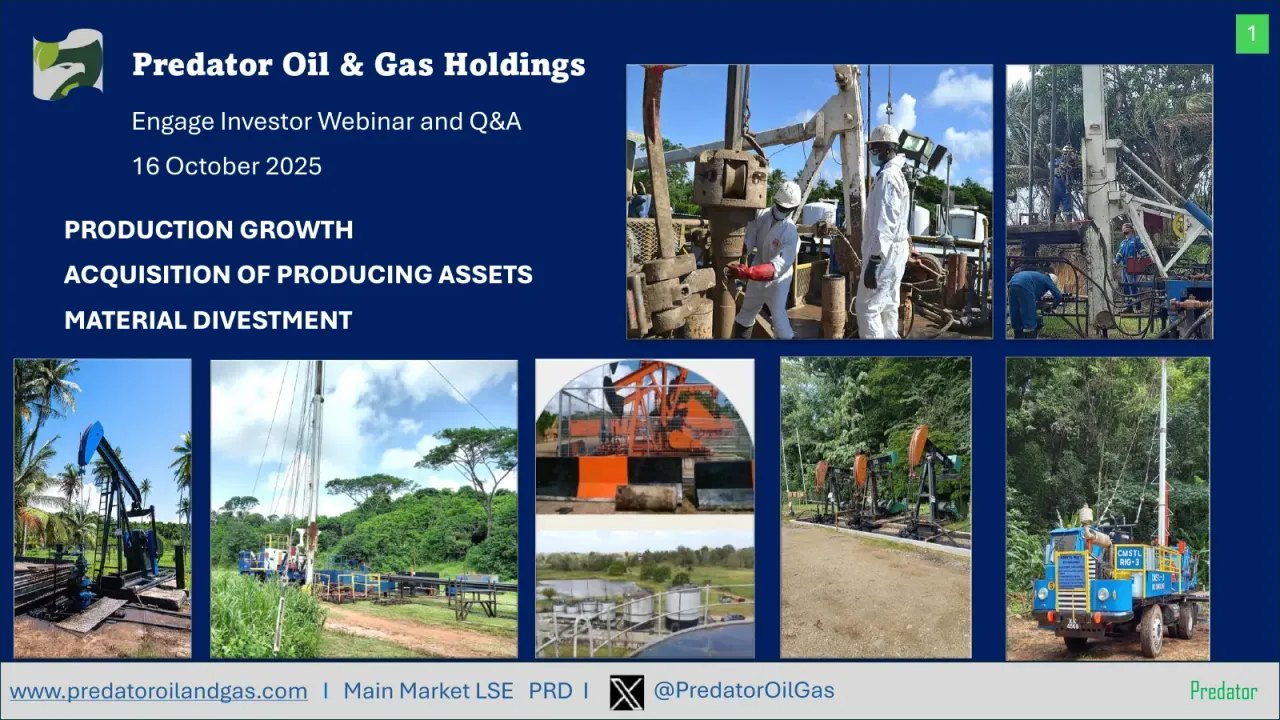
Investor Q&A session hosted by Predator Oil & Gas Holdings (LSE:PRD) on Investor Meet Company, held 2025-10-16.
On 6ix: 6ix.com/event/predator-oil-and-gas-holdings-plc-prd-investor-qanda-session
Automated transcript · Written by software from the replay's audio. It can mishear names and figures; the replay is the record.
0:01 Good afternoon, ladies and gentlemen, and welcome to the PREDATOR OIL and GAS HOLDINGS PLC investor presentation. Throughout this recorded presentation, investors will be in listen only mode. Questions are encouraged. They can be submitted at any time via the Q and A tab that's just situated on the right hand corner of your screen. Please just simply type in your questions and press send. Due to the significant attendance on today's call, the company may not be in a position to answer every question it receives during the meeting itself. However, the company can review all questions submitted today and we'll publish our responses where it's appropriate to do so. Before we
0:32 begin, we would like to submit the following poll. If you could give that your kind attention, I'm sure the company would be most grateful. And I'd now like to hand you over to CEO, Paul Griffiths. Paul, good afternoon, sir. Good afternoon, everyone. So, let's get straight to the point. Apparently, we are going, we are giving up on Morocco. So that rumor was spread on the morning of our AGM and, when our presentation was released. So what I'm gonna tell you now is a story of why we are not giving up on Morocco and never ever had any intention of giving up on Morocco. So anybody who spread that rumor could only have done so, you know, on the basis of trying to undermine our position in in Morocco and also the way we want to develop the company.
1:24 So another point to make is I was hugely, appreciative of the shareholders who actually turned up to our AGM in Jersey. They are long term shareholders. Yes. They are supportive, but they also ask difficult questions. I hope they got, the answers that they were looking for. Many people have said, well, why do we why don't we hold an AGM in London? There's one problem with that. We are a Jersey domiciled company. Always have been and always will be. You don't hold if you're a Jersey domiciled company, you can't hold a AGM formal AGM in London because then your domicile and and focus of control changes geographic jurisdictions, and that would have huge implications to our ability to attract foreign entities into, you know, eventually a divestment process for Morocco, for example.
2:18 So we are in Jersey for a very good reason. Also, the financial services sector here is very efficient. The Jersey regulatory regime is very efficient because they have to protect their position as an offshore entity to attract investment, which they very successfully do. In London, we can't attract the same level of investment because the way the the London Stock Exchange at present is under evaluating not just our assets, but assets in many different areas of the sector. So appreciative for those shareholders. In actual fact, they were the only ones who turned up to an AGM in Jersey. And I know it's difficult to come to Jersey. You know, I I live and work here for eight years, as PREDATOR.
3:03 It is a difficult place to come and go sometimes, particularly when they reschedule the ferries, so there's no fast ferry in the winter for six months. But it was very informative for me, and this is where I first learned of, effectively the the rumor that we were, giving up on Morocco. They, these shareholders, probably between them and their colleagues, own maybe more than 10% of the company. So I regard them as perfectly aligned with me. It's sometimes forgotten that when there's, dilution events and when there's, events that are not necessarily beneficial for the company, I am still, you know, the largest individual shareholder. So I don't, you know, willingly dilute myself just for the sake of, raising a bit of money. Whatever I do is for the benefit of the whole as the company and the growth potential of the company. What happens on a day to day basis is important, but what happens long term is the most important thing that, can affect the fortunes of the company.
4:08 They these shareholders actually provided some really excellent insights, to balance, what I call the armchair keyboard warriors who have the easy job of sitting in their armchairs, and someone accused me once of sitting in an armchair. I've never in an armchair giving a presentation. But it's very easy to sit in your armchair and just press a button. Not easy for me at present because I have to look at three different screens to remind myself about different things, but, you know, I'm sincere in what I believe, and I've always followed my ambition to create, a significant company out of PREDATOR, which we all believe in PREDATOR. We are doing. So in '90 I'm not gonna digress to Ireland because this is why you have to understand PREDATOR business model. In 1999, I founded a private company on the same business plan of PREDATOR's.
5:00 This was our, if you like, our AI training set, which we've been using to develop the the PREDATOR business model. We did not need armchair keyboard warriors to tell us how to create that business or run that business. We did it through fifty years' experience in the oil and gas industry. We don't need anybody to dictate to us how to monetize assets based on fifty years in the oil and gas business or over one hundred and fifty years collectively on the board. Thank you very much, but we don't need your help and assistance at this time even though you're unpaid. We established a portfolio of assets, and we became an operator, which was respected and rivaling any other operator offshore Ireland at that time, including ExxonMobil, ConocoPhillips, many other companies.
5:49 And they were all around our table, For example, the Institute of Petroleum Dinner when we were hosting a table three tables at that time. So majors in terms of, Ireland, Ireland was at that time in 2008, 2009 an environment for some of the super majors. So at that time, we acquired the equivalent of two zero eight barrels of oil a day production, which we acquired it and seven heads and the seven heads gas. And we made money out of that, by the way. That supported our overheads necessary for business expansion. Without that, we wouldn't have been able to demonstrate a production income that would give us more credibility and leverage in some of the deals we did. We proved up to approximately 100 Bcf of gas by drilling or two c two c contingent gas resources by drilling four wells back to back over two years.
6:45 Never before in Ireland achieved four successful wells, and we proved up modestly about 100 Bcf of gas back in 2009, priced at 40p a third. We developed two gas storage projects to potentially support Ireland's security of energy supply way back in 2008. We generated a multi GCF gas prospect off the Atlantic margin, Kilara, which was next to well, very close to Corrib gas field that had yet to come on stream. We negotiated an agreement to utilize the gas infrastructure 40 kilometers from our gas discoveries. These are proven, but not yet developed, not dissimilar to what we've been gonna tell you about Morocco. We negotiated also other infrastructure agreements that allowed us eventually, potentially, to sell gas because we're already selling gas through the infrastructure from our seven heads production.
7:39 We ruffled some feathers, fair to say, from one of the most influential people in Ireland at the time. Many wanted us not to succeed. That would be quite obvious at the time if you read the newspapers. In fact, we would do at one stage just before that, we're gonna do a reverse takeover of one of the entities that subsequently became very strong offshore Ireland. So what these ruffled feathers meant was there were people not wanting us to succeed. It was almost embarrassing if if we succeeded and they didn't. We then made a $220,000,000 bid for Kinseil Marathon's Kinseil assets, the Kinseil gas field and infrastructure. And we were supported by numerous high high worth corporates, if you like to call them, recognized household names and banks.
8:36 We were unsuccessful. Petrobras bought the asset for a $180,000,000, $40,000,000 less. An entity had a 40% back in right, which they never exercised it. On the back of this bid in 2009, and putting that all together, we had secured a potential $7,000,000,000 purchase and investment strategy on all this business that we had put together by, fair to say, a massive world renowned entity, who and they were gonna come in and take 49% of our subsidiary in return because they wanted continuity of management. And they wanted continuity, didn't want a change of control of the assets and the title to the assets. We didn't win the bid, so it didn't happen. But their investment would have provided an LNG FSRU for Ireland.
9:29 This is way back in 2009. Would have drilled the Kualaala prospect and would have developed the gas storage projects and also, obviously, developed our gas, old head and skull gas prospects and storage. So the only reason why we could achieve that, position was bundling assets together to form a complete business strategy because Ireland at the time had an infrastructure link to The UK, which had a 100% capacity, and that made it attractive to people interested in strategic gas investment. Also, we used the the same agent that we we're now using for the Moroccan process that we used at that time back in 2009.
10:17 And the value of that agency relationship, let's say, is that it means we can get to the very highest levels in any organization in the oil and gas sector anywhere in the world. And that's how we managed to get that position in Ireland, in that bid process. So, when when people, sort of tell us about, you know, how how we should run our company, I always think it may be a bit like a BAQ, when you're in the groups. So, like, we're in group zero, and then you gradually drop down the order. And I've rumored, of course, you know, if you can't beat them, join them. Rumored that there's gonna be a group amoeba shortly.
11:03 Thank you, BA, for preserving the feudal system, by the way. So next step, the icing on the cake. The same, let's say, political entity, blocked as was present in the last government for five years, blocked our applications to progress and develop our gas discoveries and undermined effectively undermined Ireland's security of energy supply way back in 2009 by not allowing, the, storage projects to go ahead, etcetera. Apparently, just a rumor, the individual or some individual was on the road to Cork looking up at the fossil gray sky, fossil fuel gray sky, when suddenly there was a blinding green light and the evangelist was born.
11:59 So, great. Maybe that's why we should all be converted to green. You know, that's a good basis. Fast forward to 2025, present day reality. Well, the bird of envy, as I call it, was frustrated. And in 2009, all the feathers were plucked. The entity is no more. The value for the shareholders, absolutely zero, the original shareholders. Ireland oil and gas was a subject of a hostile bid, went into another entity, bed of superior management. What happened? Blown away. Value for shareholders, zero. The green evangelical star went to Green Pastures New. Ireland now has the third third highest cost of living in Western Europe and some of the worst electricity prices in Western Europe.
12:57 The green revolution targets middle class, working class, and welfare recipients. It is not discriminatory right across the board in those sectors. It doesn't matter about their living standards. It doesn't matter about their future aspirations. It doesn't matter about their gifts to children, indeed, they have any after, the dreaded toxic inheritance tax. On a pro they're given the promise of Valhalla, paradise, net zero by 2050. Well, good luck. That's really comforting when you're trying to trying to buy a loaf of bread at inflated prices. Well, when that happens, because it's gonna be so long in the future, the bad news is that the Earth's natural science of natural climate change process that has been active over hundreds of millions of years will probably eliminate civilization, in the same way the dinosaurs were eliminated.
13:53 But that was from a different not wasn't from climate change. But, of course, our T Rex will survive. At the end of the day, you know, green revolution has its consequences. And one of those consequences is that Ireland currently now imports 45% of its gas from The UK with a higher c o two emissions in footprint than developing its own indigenous gas. And that's compared to developing and and producing its its gas versus importing gas from, various sources. So, you could say that Ireland and UK are now going truly green, banning fracking. Yeah. What absolute hypocrisy.
14:40 So almost a lot of the gas coming into The UK comes from LNG, fracked gas, through the Milford Haven terminal. Many of that much of that can come into the system into Ireland. You know, there's no way for a consumer to tell whether his gas or her gas is fracked gas or natural gas produced from other sources other than fracked gas. And, also, it's almost like we've gone back a 100 years to colonialism. It's alright for other countries to produce fracked gas and for us to import it so long as we can say, you know, we're banning fracking. It just smacks us so much hypocrisy. Now even Ardent is looking at LNG. Amazing. I mean, there's, again, another rumor, know, it's only a rumor that a person was on the way back from Cork along that same pilgrim pilgrim route from Cork to Dublin when the skies opened and an LNG concept fell into their hands.
15:43 Yeah. That was, I think oh, yes. It was this year, earlier this year. That LNG concept, five years too late, we already presented to them in 2020, 2022. Rest of Europe invested heavily in, LNG all over Europe. Ireland didn't, and now suddenly they want a concept of f r s IFRSU LNG, and they go out to the dreaded e tender process to ask for ideas of how to put it together even though one existed and was presented to them five years ago. Good luck, guys. So at the end of the day, we built this model in Ireland based on developing a business that was an integrated business, had strategic importance.
16:34 So the other thing to look at, you know, because the political climate has changed, as we all know, is that is it no wonder that president Trump is asking Europe to pay and do more to defend themselves and to develop their own indigenous oil and gas resources? For too long, Europe has treated America like a soup kitchen, a charity soup kitchen, going there with their begging bowls, expecting to be given special preference because they're Europe, because they're Ireland, and everything will be fine. Oh, bad luck. That's not gonna happen now. Yeah. Tariffs have come into play. Yeah. So at this time now, the leverage is all elsewhere, and the special relationships are no longer special.
17:24 I have instructed our PR team to ensure that, this interview goes to president Trump's Twitter account sorry, x account. Apologies. I'm still old fashioned. And that's because president Trump is an oil and gas man. He understands oil and gas, and he understands the importance of oil gas. Many people don't like that. That there are many, many people who are suffering because of the green revolution, which is a great evangelical concept that put is putting into practice. But the fundamental problem is that too many people are suffering from price rises, insecurity because the security of their energy supply has been completely changed over five years. It used to be there and freely available.
18:13 Now it's only available at certain times. And when the wind doesn't blow, it's been often said this, when the wind doesn't blow and there's no source of renewable energy, it comes back to gas, and then gas is overpriced and a drain on energy bills. So this is the model that, you know, we've been involved in previously. So why is Morocco any different? Why, you know, did we push Morocco? Well, in 2018, we listed listed in London. Seemed to be the perfect venue at that time. The focus on was on Ireland and Trinidad. But then we saw the geological similarities in Northern Morocco and compared them to the giant biogenic gas discoveries in the Mediterranean region.
19:06 This was our vision at that time, our geological vision, unproven. But the difference here between Morocco and Ireland was this was onshore, much more easily accessible than offshore. But Morocco had the same strategic issues, if you like, as Ireland. It had an interconnector to Europe, currently with huge amounts of spare capacity present day. It had a captive gas market with a very, very poor supply of indigenous gas, a tiny fraction of what was required. Its progress to eliminating coal fired power stations was hampered by the lack of available gas. It also, difference between Morocco and Ireland, it has Morocco had a very, very favorable tax regime.
20:01 Basically, no corporation tax for ten years, one of the best tax regimes in the world. So we saw a huge opportunity in Morocco, both geologically and infrastructurally, that matched our business model progress in Ireland. So we identified a big, biogenic gas basin, 150 square kilometers. We proved that up with our drilling, with our four wells. We proved up 2C resources of 441 BCF, over four times what we proved up in Ireland already. We proved up a unique hydro hydrocarbon fairway for this part of, let's say, Central East Morocco. We didn't have any partners. We do everything a 100%.
20:50 And, again, I hear the comments about dilution and rinsing of shareholders. Do you seriously think I would rinse my own shareholding and worry about dilution if I wasn't having, a thought about what the end process is in all this. It's a question is, do you wanna buy peanuts, or do you wanna buy the world's most expensive diamond ring? Not that I buy any of those items. It's about scaling valuation. If you just want to sell the company for peanuts, well, you can do that tomorrow. But the opportunity to build a business, develop a business, and then at the right time, the materiality necessary to offload that business to the right entity for strategic as well as the gas resources purposes.
21:47 Well, that's important, and those opportunities for a small company like us don't come along too long too too many times. And you have a choice. It's very simple. You either dilute a bit in the share capital, develop and grow the assets to that material level, or you dilute in the assets. What I can tell you now, selling 10% in Morocco versus a 100% in Morocco will make a huge difference to the net entities that you can attract. I prefer to sell a 100% with control, with the right corporate structure of subsidiaries that is very tax efficient, very efficient for change of control rather than selling an asset. That's my goal, not increasing gas by a couple of BCF or talking about what the netback is today, what the netback is tomorrow when the price of oil, just like share prices, related to spread share price spread, change literally every day. What you say today as a netback will not be what you say tomorrow, and, frankly, the netback's not important because what you're trying to do here is sell a much, much bigger integrated strategic industry business. And I should also point out that since we acquired GAS HIEF right on the top of the, Margaret Gas Pipeline, M E 5 is three kilometers from a tie in point.
23:15 The, Moroccan government has announced that it wishes to create a strategic gas reserve this year. Well, not this year, but has announced that it wishes to create one. And it it's going to build wishes to build an FSIL LNG import facility at the port at Nadore, which just happens to be north of, Gassif. And the tie in point for gas coming from Nadore is about three kilometers from MOU 5, hence the interest in gas storage. So everything we do is planned for a strategic objective. Some may not may not like that. Some may not understand that. Some may be envious of that just as people were envious of us in Ireland. Well, sorry. We have a business strategy that is not going to be deflated, and in those famous words of the past, I can't remember it was, in the eighties, I think, this company is not for turning.
24:10 So don't even attempt to think that you can infer us to turn from our vision or our ambition to create value. And we succeed, everybody succeeds. I think our loyal shareholders understand that and perhaps wish they'd, been given a stronger voice at times. Well, I can assure you that we and them, me in particular as a a large shareholder, are aligned as one in terms of how we want to get value out of Morocco in the bigger picture. So we started that sales process. Yes. We've talked about farmhouse. Yes. We talked about this. But we moved on in 2025 because we found salt in m a v five, which allowed us to create the concept of a gas storage. The gas reserve concept in Morocco was developed this year, relatively recently, a few months ago. So you'd you use the the tools that you have in your license effectively to adapt to the bigger picture, the strategic picture, and we're in a great position. We have proven gas resources.
25:23 We have FSRU potential infrastructure necessary for gas storage. M a e five have created the opportunity for gas storage in salt cabins, ultimately. And we've also discovered some helium, very early stages of helium. But it just makes me laugh, frankly, that we were the first ones to come along with the helium concept, which I presented to O'Nim last year. And suddenly, everybody else wants to think that they've reinvented the wheel. Well, we're first. We found it, to start with, and we have a 68 square kilometer structure that is ideal for helium. And we have a 100, square kilometer structure beneath a titanosaurus m e v five prospect, which is potentially, a Triassic target similar to Algeria, Ahasi, Armel Armel Field, Tendrara, and Miscallo GAS HOLDINGS in in Morocco. We would never have found, even contemplated that play. Nobody had ever thought of that play. Even I hadn't thought of that play until we drilled MOU 5. So you gotta kind of refocus on the bigger picture. MOU 5 is our Irish Kil Island, if you like.
26:45 And what we offer then is when an entity, a larger entity wants to come in just like we negotiated and and moved along in Ireland with a business plan, they want material size. They're not interested in, oh, yeah. Have you have you ascertained this? Have you done that? Because they understand the the reasons, the technical reasons why it would be premature to do things like that. And I'm not even gonna explain those technical reasons. It'd be easy enough to do it. But you have to look again at what you're trying to do here. You're trying to execute to a strategic partner, incoming suitor, if you like, that wants to have a pivotal position in the Moroccan infrastructure and in what's going around on a GASIF license, just as what we established in in Ireland and with exploration upside potential for big prospects.
27:45 And the helium is a bit of icing on the cake, but, you know, it's still at such an early stage. It would be premature to to determine how that will ultimately work out. But it's a nice gift, if you like, to have on the table to negotiate with. I think I heard, another comment. I was told that I didn't, or not I was told, but I was told by the, very, very supportive and constructive, shareholders who actually turned up in Jersey. I'm not in it for Trinidad. Well, yes. I mean, I'm not in it for Trinidad. I'm in it for Trinidad and Morocco. But Trinidad provides us with the production to underpin our, you know, business growth strategy just as what we did in Ireland. In Ireland, we had 208 barrels a day oil equivalent production. In Trinidad, we already got 280 barrels a day. In Trinidad, we've managed to derisk everything, our costs, because we've signed, if you like, a master services agreement with a very competent, very efficient in country operator.
28:54 And despite, all the sneering about in country operators that sometimes you hear and, particularly, you know, that they can't deliver, etcetera, well, you know, this operator increased production sevenfold in one of the fields in in Trinidad in probably a year. This operator drills wells cost effectively. Yeah. May might not be a Rolls Royce industry driller. But the frightening thing is he actually gets the work done, and he actually gets results. Whereas sometimes you hear blah blah blah. We can do this. We can do that. Who are you using? Why you should've used this? Yeah. Proof of the pudding is actually getting results.
29:39 He gets results. He gives us opportunity. He creates us opportunity in the greater South American region, and we like to work with people like that. Also, we share the risk in the sense he's taking all the risk on our costs. He took on the 65 or 60 odd staff from Challenger at his cost, and we get anywhere from 15 to 30% cost revenues off the top, before tax. We all have to pay our tax in Trinidad. We got a 100,000,000 tax losses, so not as much tax to pay and and a government royalty. So from us, we get a consistent revenue stream, and we also get the ability to, like, pick and choose.
30:28 He can go in and derisk things for us, and we can say, well, I we might go in and do that if we have the money from production, for example. So it's very good business strategy for us. And in terms of raising money, he's taken on all the obligations, we don't have to cough up anything for the obligations. 30% up to 30% off the top. So barrels of oil per day and our net barrels and this and that, doesn't really matter our operating costs. We have zero operating costs field operating costs under this agreement. Zero. So our netback is, the gross percentage of revenues. And before anybody says, oh, he's gonna control that, we are still the operator.
31:14 We are still the license operator. We have financial control. We distribute the money, so nobody can outmaneuver us in terms of what our share is. We get our share, and then we distribute the shares to the other party or parties. So that supports our business growth strategy. And, again, you know, a lot of criticism about increasing the authorized share ability to issue shares up to 500,000,000 shares. Yeah. We're not we're not an ATM machine, although some think we're some think we're an ATM machine. We are not going to go out and suddenly raise a huge bunch of money for something we don't even know what what we wanna spend it on or or what that could buy us.
32:05 Maybe it could buy us, a dozen companies on AIM at present. But at the end of the day, we have to have flexibility, cosmetic flexibility as well as physical flexibility. If we suddenly see something that we can purchase, which is production and adds adds value, and we have to issue a few shares to do it, we will do it. If we find a distressed asset, if it adds value and adds cash flow. But most importantly, if you're trying to sell a huge strategy, if you like, in Morocco to the sort of party who is going to look, first of all, most of the opportunity, but secondly, make sure that, the entity that it's buying into can survive.
32:54 And surviving means that you have flexibility. You have a bit of cash in the bank, which we do have. You have the ability, an instrument with the 500,000,000 shares to raise cash even though you don't necessarily or you were not going to go down that route. And that all your licenses are good in good standing and that you've structured your companies in a way that they can buy into subsidiaries just like we structured in Ireland. That is far more important, showing that cosmetically as well as practically to a potential buyer. And the other thing is, like, it is no good trying to be at the table and selling assets that we have if you're going through an audit every year and you have to prove that you're going concern.
33:45 And proving that you're going concern means that you have to prove that you have the ability to raise funds for twelve months. Not necessarily that you're going to do it, but you you have to have the ability. It is and and people ask us, oh, why don't we spend all the money and drill m a v six now? Well, yeah. Great. And then we come to the audit, and then we have to determine whether we're going concern or not. And then we have to raise money. And then we have to, you know, prove that we can have another twelve months working capital forecast. Well, that doesn't sell you the company. I'm sorry. It doesn't sell you the company. There are a lot of different things to look at when you're trying to put a strategy together, an exit strategy of this scale. There are good examples in the last twenty four months of companies that have had to be suspended period periodically from AIM or the London market because they couldn't put their audited accounts out on time.
34:41 And when your shares are suspended, you can't trade them. So the value goes down to zero temporarily or, in some cases, forever. So we're not gonna make an apology for putting ourselves into a position where every time, you know, we have an audit, we have a clean audit, we have a twelve month working capital forecast, and we have no debt. So we are in a strong, strong position in that respect when we want to exit, you know, our asset, which is what we put into price. If you're trying to exit something of this scale, we set a timescale of six months, to work this through, and that process has started. We're not gonna tell you who we're talking to. We're not gonna tell you what the terms are because we're in a commercial process.
35:28 We started the beginnings of a commercial process. And we're not gonna give you a daily football report on what we're doing because we have to protect our commercial interests. And by protecting our commercial interests and negotiating leverage, we're protecting our shareholders. We are not protecting our shareholders by saying, oh, we're, you know, we got 10 barrels a day out of trillion today. We got the we're not that doesn't protect us. We will report where we have to report, and we'll report on progress. But the biggest progress we can make in the next six months is to be able to get the scale of transaction that we had negotiated with Ireland using the same tools that we put together for Ireland, the same management skills. You might not appreciate management skills, but the people we are dealing with do, and the same, ability to hit way above our weight at all levels, at government level, at a a big company level. We can do that, and we built that up over many years. It's not something that comes overnight.
36:32 So when you're getting nervous about progress, just remember what the ultimate goal here is. And it took us nine years to put together the Irish position from absolute scratch, zero balance sheet day one, to a situation where we could attract a $7,000,000,000 potential investment. We started I started PREDATOR, myself, zero balance sheet. We're coming to a situation where we're almost where we what we are, where we are in Ireland. We're ahead of where we are in Ireland, and we've done that in six years, not nine years. That's progress for me, our our loyal shareholders, and the people who wanna be associated with this company.
37:18 So I guess I've had my, say on this. I hope, from what I've told you, you understand what the what the strategy is here and why it is so, so annoying that, a rumor can be put around that we're exiting Morocco, misinformation, disinformation, sheer hypocritical ignorance of what the company is doing, because they men people some people don't want to know just as they did in Ireland in two thousand eight and nine. Just don't know what we want to do. The other thing I would add is that we have a very, very, very good working relationship with ONIM.
38:08 I understand that ONIM ONIM is in the process of being privatized. This is the perfect window to look at a flex I call it a flexible investment strategy because what I would like to see is a 49% investment in a subsidiary on the on the same terms as similar terms that we got in Ireland as that is a great way to progress a transit transition gradually, so you the incumbent party can utilize network of contacts that we've made in Morocco. And, as I say, on even very supportive. And this year, in the last twelve months ever since September last year, we have had not one single delay on customs clearance.
38:56 We haven't had not one single issue in terms of use of equipment, timing, etcetera. We drilled MOU five with no overbalanced drilling issues. We drilled it in 12 with a minimum downtime of literally hours, and that was not due to us. We didn't have a a 100 people on the site. I'm not I'm not sure where that came from, but that might have been there was a rumor that another operator had a 100 people on-site. I know where that rumor came from as well. But there certainly wasn't a 100 people on our site, so there might have been a bit of misinterpretation of what was said at the time. There could might have been could there could be up to a 100 people on our site, but there was not 100 people on our site, and there never has been and never will be.
39:48 So I think you've got a pretty good, outline of where we're at today. And, can I add anything to that? Probably not. So let's go to I'm not gonna go through all the slides, so relax. So let's go to this slide. This is just the the overview of the activity in Trinidad. I'm not in for Trinidad. No. Definitely not. But what we're doing in TRINGS is giving ourselves all the instruments, all the agreements in place, like the master services agreement that minimize risk. We've reduced operating costs already by 28%, but all those operating costs are par parked with the operator of the technical operator, if you like, of the master services agreement.
40:40 We still have AFE approval rights. We still have rights to approve where wells or workovers have been done. That has allowed us the acquisition of the Challenger assets have allowed us to put a program together of nearly 15 heavy work 15, yeah, heavy workovers and in four infill wells to be drilled in the next twelve months at no cost to us, satisfying all the work commitments and remembering we bought the Bonas asset for $1. And we've managed to restructure those assets in the last month for six weeks. We've managed to create creating balance sheets, constructive, and will pass muster when we bigger companies looking at acquisition in Morocco because they look at the whole whole picture, not just a whole straight for the company, not just Morocco.
41:38 We have the ability to increase production now from currently from two eighty barrels a day to over 1,000 barrels a day. Snowcat three is definitely on the agenda as is Snowcat four. The two wells will be build will be drilled back to back next year in q one, q two, late q one, I don't know, q two. Everybody, gets nervous about timing, but timing is dictated, particularly in Morocco with m o six. People think that, you know, we're pushing that m o u six deliberately, but we're not. You know, in Morocco, there is no ability in country to get casing. No ability in country to get the right mud system. We everything has to be imported. That's taped to sign. Until you've gone through that process, you don't actually know where it's gonna be. Three weeks, six weeks, eight weeks, but it's all accessible, but it is a time issue.
42:29 And then you also have to have the right drilling program. So we have spent a month for the last, what, five weeks now, looking at, the future drilling program for m o six, looking at the mud system we need, the casing design, which might include an extra string of casing to resolve some of the problems, and in particular, tying what we propose as a drilling program to the geology. And the beautiful thing about m a five and this year and and even the testing program or m a three, which gave us the information that allowed us to effectively start the divestment process, communication.
43:16 So we made changes, last year in terms of our management structure, not just here, but in Trinidad, everywhere. And the the exercise there was to put the board more in direct contact with the people at the coalface. Well, I can't say coalface. I don't know why I say, at the top of the windmill. But we have to put the people there right at the forefront, of our operations because, fundamentally, if we don't know what's going on, if we can't use our collective, hundreds of years of experience, then we can't, put that value to good use. So that's why I'm very happy this year that our programs in Morocco went so well.
44:04 I'm very happy in this year that we have, acquired a tremendous team in Trinidad. And in particular, I'd like to single out Jeffrey Leed, our managing director in Trinidad. Without him, we wouldn't have grown, the position in Trinidad. It's absolute pleasure to work with someone who understands our vision, supportive of our vision, and works tirelessly to deliver our vision. I just wish there's few more people like that, but all the people associated up with us are there to deliver our vision. Next slide. Oh, no. That's me. Sorry. So used to something else. So, again, over Moroccan oh, yeah. Sorry. I I forgot to mention Hunter and Dad in case people think we're so concerned about not, you know, doing a certain work over on 5AM on Friday night or whatever. We had to incorporate eight different new companies into our structure with the acquisition of Challengers. So we've done that.
45:11 We had to go through all the different audited accounts and bring them all up to date. We had to get everything into a format that put the whole Trinidad structure in place. We've done all that effectively in six to eight weeks. And, you know, I would like to thank publicly the assistance Challenger and particularly Itan has given us on making this happen as well. Without his help and and the help of all the people in Trinidad, we would never have got to this position. I think he hopes, you know, we will be successful on this, and and we will be. We are already successful. We've made huge advances. And that's no reflection on the past. It's just a reflection that we perhaps have a different drive, different different philosophy, etcetera.
45:57 So just going back to then focusing on Morocco, because I know I'm not in it for Trinidad. Morocco is at a stage where we've proven up the gas resources at 2C level, the engine level that we wish to. We've basically, the information that we've got from the m a three testing program in terms of what the potential reservoir was in an unconsolidated sense state was gives us information on how to design the test future testing, but also how to plan for the M O V 6 well for unconsolidated sands and for well, there are four different levels of gas in M O V 3 that are target. Some have said, well, we go for the deeper resources because the resources resources are bigger.
46:50 Well, sorry. That's that is actually changing now. The shallow resources, particularly what we call the MA TGP six hands, where we now think that that's a potential stratigraphic play over 81 square kilometers, 16 square kilometers of which have been proven up structurally in the M 03 and M O U 1 wells. So that what the testing program on the ASAN did for us was for the first time, we can prove formation damage instead of saying, oh, the logs gave this or it was overbalanced drilling. We can prove it was formation damage. We can understand the fact that overbalanced drilling and the fact that we didn't have an intermediary casing point was or the second casing stream was detrimental to the fact that when we're drilling through this section, the fine grained sand, unconsolidated sand got washed out into the drilling mud. The drilling mud then reprecipitated the fine clays in the sand, which are not a problem if you don't drill them. They're very porous, very permeable sands capable of doing at least twenty, twenty five million cubic feet a day if they've got connected volume, which is these have connected volume.
48:10 So we know what's there, but it's the, you know, the the challenge is, which we are overcoming, is to get the drilling program right to address the situation. For example, in MOU three, we can prove that a few p s 20 or 25 PSI overbalanced drilling is enough to shut off the gas inflow into the well. And a lot of people seem to forget that whilst we were drilling, we were getting gas inflow into the well. We got gas gas samples in the well. We got a helium sample, which is a very light gas at the bottom of the well, which is quite remarkable given the, you know, the overbalanced stream. So we proved up what we wanted to prove up, and the beauty about it is that the much maligned Newtek logs, which is a technology I believe in because I proved it in Tendrara.
49:05 I proved it offshore Ireland. So it's a technology of log interpretation that I've proven that I know about and approve of. And, again, it's was the, like, early cursor, if you like, to AI use of of a variety of parameters to create logs that will give you a reading beyond formation damage. So when these logs were run, were interpreted, the conventional logs, the usual, time and time again, oh, they're not showing any gaps. They're not showing any of this, or they don't do that. Well, they were all showing the formation damage. Everything in there was underrepresenting what was there. And along came the new tech logs, nobody believed them because we had, in some cases, 80% gas saturations.
49:55 Nobody believed it. Well, now everybody believes it. I mean, everybody who's knowledgeable believes it. So they understand that the importance of identifying the formation damage and how it's transformed our understanding of what m o u three and m o u one recovered. So we now have two separate fan systems that can be targeted m o three, which we believe all are gas bearing. We have not seen any water on the locks in these intervals. And the attractive thing for us is, yes, there's the proving gas, you know, the two c gas, but then there's now an upside way beyond what our initial expectations were that we will address in the divestment process, the flexible divestment process, and we will update all that as part of that divestment process with an updated technical ITR, CPR designed for the incoming suitor that will effectively put together everything we've achieved over the last five years, which is drill four wells, drill a fifth well for salt, find helium, find gas, develop a huge 150 square kilometer biogenic gas basin in an area that had never ever been explored in over fifty years.
51:23 So it's a new basin. So, of course, there are teething difficulties. We didn't come into an existing gas gas discovery. There was nothing to compare. You know, we thought it was gonna be very much like the Raab Basin. It is, but the sand is slightly different in terms of its composition. But that's not, you know, a a that is not that we can't address. So you gotta look at it from the positive. You start with nothing, and you end up with something that you're trying to sell for or attract a huge investment in. And what else? I'm almost finished. Don't worry. Overview of 2025 activity, Ireland. So I've said here Ireland is a non core. The non core Ireland is non core, and so is New Ventures. They're there for a purpose. So in Ireland, people who know me in Ireland know that, oh, I'm difficult. You know, everybody thinks I'm difficult. But somebody even called me rude, I believe, so I can't believe that. But it's for a purpose.
52:31 You don't negotiate hard. You don't gain respect unless you're prepared to be absolutely ruthless. And the reason why you have to be ruthless in Ireland is because after forty one years of investing in Ireland and building up our position in Ireland, It's all been basically torpedoed by the green revolution, and that's not green windmills offshore. Great. You know? But the bottom line is security energy supply in Ireland is now worse than it's ever been. And prices in Ireland for electricity are worse than they've ever been. Inflation not inflation, but cost of living is worse than it's been for living memory.
53:23 And that's because of lack of gas supply. Simple as that. All imported at very high cost. But what sticks in the throat is to spear with people that you've negotiated with, what you've worked with for forty years, spend seven years seven years over an application for a successor authorization CORB South. Seven years. Every six months last December, you get an email saying, yes. We have everything we need. Thank you. Nothing happens for six months, and then you get another email saying, well, this isn't quite right. Can you produce your next set can you give your latest interims?
54:10 And this goes on and on for seven years. So the, problem for them is that under, the conditions for the award of the licensing option in 2016 under those terms, it is a legal right. It's legally binding on the government our ability to apply for a successor authorization, but they haven't progressed it. They are hoping we go away. Every six months, they are hoping we go away. But we're not going away. I'm sorry. It's never gonna happen. So they were given correspondence in August that basically said we gave them three options to resolve the situation because under any structural imagination, negotiating over seven well, not negotiating over seven years is not what you would call normal industry or regulatory practice.
55:12 So they're in a a very they're in what I like to think is a dark hole. But, you know, they used to be in the dark hole for the last ten years. And we set out a second set of circumstances where we demonstrated some irregularities in the procedural processes. So they have till the October 31 to respond. One minute past, midnight, the October 31, it'll be trick or treat time. And if we don't get a responsible answer or satisfactory answer to our request, then we will start the process of engaging a no win, no fee lawyer a no fee, no win lawyer to go after them, basically, just in the same way Barry Rowe did and is doing, but we will do it more on the basis of the frustration they have caused over seven years by failure to award the successful authorization.
56:10 It's unimaginable what the value of that is to us at present, but the value there is, going back to the president Trump ethos, is Europe should be prepared to develop its own indigenous resources, not rely on The UK for imported gas, which is what Ireland does. And therefore, you know, it's incumbent on the Irish government to take a stand here to address this situation because it looks absolutely embarrassing for them that they spent or their their agents, if you like, have spent seven years doing and saying nothing, leading the company, not just our company, but other companies on on the basis of promoting a financial investment opportunity, but then not honoring the commitments that they made in 2015 when they issued the licensing option.
57:13 And that is their problem. They are in the black hole waiting for us to withdraw our application or die. Well, I may die very soon, sooner than they'll ever get around to processing the application, but that's why trick or treat time occurs on one minute past midnight on the October 31. I've dealt with, corporate changes, the corp oops. Sorry. I'm going backwards here. Corporate changes. I just wanna come back to bear with me a second to this. So this is the next twelve months. So, unfortunately well, I say fortunately, but some people say unfortunately.
58:01 We are a an activity driven company. We never sit back and effectively do nothing, which I think some people think, you you know, we get paid to do nothing. Well, we don't get paid to do nothing. Everybody works more productive hours than probably anybody on this call, and that's because they all have a shared vision. I mean, we are evangelical, but we're evangelical to good purpose. We're not trying to convert anybody. We're just trying to get to an end point. So at the top, you see how I'm not in Trinidad. You know? I didn't come here to be in Trinidad. But at the top, you see why production is important to us and the increase in production.
58:53 The figures are the gross figures. We, you know, have 100% of the gross figures, but we recover 30% of the costs sorry, of the the revenue. But that revenue is off the top. We pay no operating costs. We only deduct tax where we have a $100,000,000 worth of tax to offset, and we have no commitments. You know? So we don't never have to raise money to progress Trinidad. We might, you know, bring in another asset where it has production. And in that case, we might have to issue a few shares, but that's not on the horizon, anytime in the next few months or six months. But we also have the ability to any new entity or act action we bring in, will come under our master services agreement.
59:48 In Vanas, our service provider is drilling for infield infield infield development wells, over the next twelve months. He's already in the field, on a workover and has been for some time. He's already reactivated six wells. Those wells were producing zero, and now they're producing. That was just to get the field, back into shape and allow us to do the deal on the sales point. So without a sales point, you can't sell oil. No point in producing huge volumes of oil. It's gonna put it into a tank which then overflows. So all these things have to be put together. We all have put them all together. There's more to do on particularly on Kraig Brugge. We have to find a sales point for that before we can do anything else.
1:00:40 But, program is still the same as we said earlier, q late q one, q two two thousand and twenty six. It's not wise to do it any earlier than later this year because of the rainy season. There's a lot to prepare for it. Someone asked about regulatory hurdles and things like that. Well, Trinidad has well over well, nearly a hundred years now, but fifty years of practical oil and gas experience.
1:01:34 The system is well known, well tried. The oil and gas industry is the most important industry in Trinidad. And if you ever wanted confirmation of that, ExxonMobil came into Trinidad, as you know, this year with a $42,500,000 investment, and potentially, according to Trinidad source of rumors, I don't know. And actually, this actually came from the government, $21,600,000,000 potential investment if they have the same success as they have in Guyana. So it's nice to be in a country where there are people around, companies around Shell and hopefully well, not hopefully, but Shell may well get a license with or with with the blessing maybe of president Trump. I don't know what the situation is there on the gas development on the joint Venezuelan Trinidad border, large gas field there, which is important to Trinidad's gas industry.
1:02:35 Yeah. Well, I like to be talking about big things like that rather than should I be in Trinidad or not. I have to think about that one. And then the last point there is business development strategy. So although we know oh, sorry. I should have mentioned not deliberate. I should mention go see. M A six is still in there in in the progress and in the schedule, and it's a wide window next year simply because people seem to think you can go out and do something immediately. Well, you can't. You know? You have to first of all, you have to make sure the well design fits your geological objectives. And that means geology, like me, I'm a geologist, working closely with the drilling team, the engineers, if you like, and the people with the fantastic experience to drill wells to ensure that everything's aligned, objectives are aligned.
1:03:33 And then, also, you know, you have to import items, which have to be sourced worldwide in supply chain that is very tight because the industry is expanding now. Exploration worldwide is increasing. COVID still did a lot of damage to the industry and stocks. All that is accessible, but sometimes you have to add a few weeks here and there. But the overriding, philosophy is that you don't start drilling until everything is in place. We don't wanna be sitting around for days waiting on a piece of equipment. So the reason why MOU five was successful, the testing program was successful with very little downtime, is nothing started until everything was either on-site or a few hours away from site.
1:04:24 If we have to pay standby time, it's for drilling, it's a $100,000 a day. Simple as that. I'm not paying $100,000 a day because someone forgot to, tell me or, you know, in in my current drilling team that that, something hadn't that it wasn't delivered on-site. And they all know that. They understand that. So it's good to have that strategy because money wasted is shareholder value lost. And we are always open to new ventures, either new acquisitions in Trinidad production or ultimately evaluating the Greater Caribbean, South American region where we can see value in our business strategy in developing onshore oil, for example, which is being overlooked using the connections that we have and that we've developed in Trinidad over the last few years.
1:05:19 So now I'll deal with questions. I'm sorry it went on for so long. Well, I'm not sorry, actually, because if you don't understand the strategy and the way forward, then the questions don't become relative relevant. Should I hand over to you, Mark, for just a second? Yes, Paul. Absolutely. And thank you very much indeed. Ladies and gentlemen, please do continue to submit your questions just by using the q and a tab that's situated on the right hand corner of your screen. But just while the company take a few moments to review those questions that have been submitted already, just like to remind you that a recording of this presentation, along with a copy of the slides and the published Q and A can all be accessed via your investor dashboard. Paul, as you can see, we have received a number of questions. So if I may just hand back to you just to read out those questions and give your responses where it's appropriate to do so. And if I pick up from you at the end, that'd be great. Thank you. Okay. So what I've done is group, like, families of questions that relate to perhaps the same subject.
1:06:18 So you're not repeat repeating the same answer. So I've got I'm not doing it in any particular order. Right? I'm just going as we, you know, I recent received them questions one to 72 or 80 or a 100 or whatever. But as you can appreciate, it's not possible to answer every question, not necessarily always because of time, but because of commercial sensitivity. I'm not gonna answer a question that is aimed at undermining or not undermining our commercial negotiating power or or trying to request a technical very technical question, which is not really gonna be understood by most of our our shareholders. So question one, what happened well, what happened about the possible farm out? There was no mention in the annual report.
1:07:09 The annual report kinda reflects what happens in 2024. As we moved on, from the testing in the summer, to where we stand today, which is, last three months, we've got into a position where the farm out becomes irrelevant because we're now focused on, effectively the, flexible divestment. I'm not saying it's totally irrelevant, but I'm saying a farm out, based on what we know now from the data we've gathered in the testing, for example, is that, we don't wanna farm out and give away 30% of the license on just farm out terms for three d or farm out terms for one well.
1:07:56 It's almost impossible to divvy the license up into parcels because that creates all kinds of issues with a not not obstructive issues. It's just always difficult to plan for those sort of events. Sometimes you have to be very flexible in the regulations, but it's not possible, to do that when those regulations are are, set out in the hydrocarbon code, for example. So farm out, process, is on bigger values through, flexible divestment. That will take look. We started it would be a six month process. I'm not gonna tell you that we're gonna have a result in one month, two months, three months, six months. It'll take how long it does. You don't try to get a deal like this.
1:08:46 And I'm not saying that any deal is achievable, but you don't try to pitch for a deal like this if you want everything to be done and dusted in three days, seven days, one month. Okay. Stop saying fully funded. This is, like, your biggest achievement when all you do is keep rinsing the shareholders. I I mean, I'm including this. Like, it's it's just typical, really, of of the position of a listed company in the London markets. I'm a shareholder. Am I gonna rinse myself? I don't even know what rinsing means. I mean, I I didn't get into the washing machine this morning, But if I if I did, I would be rinsing myself, would I? I wouldn't be rinsing my through dilution or, you know, lowering the value of the company.
1:09:39 That happens through the public market. There's nothing, you know, we or or many, many other companies can do to influence the public market in in the current situation in in certainly in London. And there's no point in in in saying that we can. I mean, the bottom line is and, you know, there may be people in the regulatory authorities and the LSE that weren't like this said. I don't care. You know? It was announced by, I think it was Bloomberg, just recently, last few days ago, that, London Stock Exchange had now slipped below Oman and, Mexico as a venue for IPOs. And that's no, disrespect to those countries. They're fantastic countries to work in. I don't know Mexico, but I do know Oman. I love Oman.
1:10:31 But isn't it a sad state of affairs that that has happened? And instead of bleating on about, you know, trying to get investment into, London Stock Market, they can start by organizing the London stock market to, regulating it to a situation where, you know, so many companies are not undervalued and forced to delist. We're not gonna delist. I can I can say that now, but neither are we happy about the position? We're not happy that 25% of our value can be wiped off in one day on AGM day by 8,000,000 shares out of 681,000,000 shares. How is that, you know, a regulated, sophisticated market to attract investors? It's sick. It's depressing.
1:11:18 But it's not gonna depress us because we we don't see it as something we can influence. And there's no point, as we found out in the past, in asking for any guidance from the FCA. I mean, we can't wait two years. Even if we waited two years, they don't have the resources on small fry like us. And it wouldn't be in the public interest supposedly for us, you know, to pursue something like that. Just a waste of time. The only way we can get attention is actually by embarrassing people. You know? Embarrass isn't it embarrassing that, you know, not just us, but so many companies has to have to have to desert, we're not deserting, but have to desert the London Stock Exchange as so much so many people are unhappy, particularly in the oil and gas sector and and other but there are other sectors too.
1:12:08 And you've seen that from all the announcements over the last twelve months. Why don't they get off their chairs, and why doesn't Rachel Reeves do something about it? These are the things that have to be done. Investment in the London markets and in the finance markets are critical. Energy stocks are critical. Get off your chairs and do something. Don't let us why should we have to do it? Why should we have to make complaints? You know, it's your job. You get paid for it. Do it. Okay. Third point here. What is the timeline and key milestones for bringing the Snowcap discovery to full production? And what are the biggest risks, technical, regulatory, logistical, do you foresee achieving that? Excellent question. And I'm not being pedantic or facetious.
1:12:54 These are the questions that are really important to shareholders, and these are the questions that we can give reasonable, sensible answers on. So and it's not a planted question before you ask, not like things that are planted on on the blogs. So the Snowcap Snowcap one was a discovery. Yes. And it's often forgotten that Rochard one on the license was a discovery in, I think, was 1955, but never followed up. And it's in the same structure. So we actually have two wells in the same structure, but there is no possibly possibly on earth and go and to go back into Rochard 1 because it's such an old well. So what we looked at in SNOKAT one was a workover, and we can still do that.
1:13:42 But what we also can do now under our master services agreement is effectively take that Snowcap one well and re repeat it, redrill it, which will be more cost effective and will allow us to drill it more effectively because the current work over one well, when we looked and inspected it, are gonna take a lot of work to to work it over and get it, back in production because of the damage that had been done, previously downhole. So redrilling that as part of the Snowcap, three, Snowcap four program is the best way to go. We will drew we we will probably and don't, you know, hold a gun to my head on this because flex we have flexibility, and flexibility is there for a reason. Not to annoy shareholders, not to annoy news flow, but every day, every week, new information has to be integrated that maybe causes you to adjust things. So right now, I'm looking at drilling the shallow well, if you like, the Herrera numb producing Herrera number eight sand first.
1:14:55 And that's because we're gonna we're reactivating a rig. That will take time. Hopefully and, again, don't put me a gun to head on this. Hopefully, if all goes well, the rig will be ready to operate towards the end of q one, and we'll drill a snow cap shallow, if we we got a snow cap shallow. And the reason for that is I suspect I can get an MSA agreement, master service agreement, with the rig owner who is also involved in our current master service agreement and let him take the risk of taking the rig out the stack, shaking it down, drilling it, and sharing, you know, the revenues with us in in as a result of that. We're not giving a lot away because we're only targeting the Herrera number eight sand in that well. And that will be technically less risky than going back in and doing heavy work over on the original well. We can maybe still do that in the future, even next year, but we don't wanna take the risk and the cost to do that if we can drill another well cheaply.
1:16:00 As the rig is then shaken down and we get Snowcat three completed and ready to produce, then we drill Snowcat four. Now Snowcat four, we will do a 100%. There will be ways to fund that through production, but I'm hoping also that, we always have the ability of a divestment, whether it be Trinidad or, certainly, hopefully, Morocco before then, or around that same time. I'm hoping that we can manage a situation whereby, we don't have to raise funds for SNOCAP three. We have got some cash in the bank, but, you know, I I need to have twelve months working capital forecast. I can't blow everything and then not have twelve months working capital forecast. That just doesn't work for us.
1:16:47 I'm not saying we're raising money before we start screaming or diluting. But that is a high high reward whale. We're targeting three horizons producing in the nearby or have have been and are still producing in the nearby Maruca Westfield, and we're targeting possibly about 800 barrels a day minimum initial test results. The issue then is, well, you're gonna sell the oil. So we're looking at some of the risks. The technical risks are limited because we have so much information now on the SOCAP area. So it's NOKAP for high high reward well. We've found a location where we can drink drill a straight hole, and that carries less risk in drilling a deviated well from an existing pad to get We simply can't drill that far at that deviated well. We also have managed to secure, the three d seismic depth migrated, data from a very, helpful local operator, and that allows us to better plan, where we actually position the snow cap for well. But we also have, a very good location that is just 100 meters off the road, which means we can get the rig rigged very easily. So there's very little environmental stroke, civil risk, if you like, in in making sure everybody's happy that our location suits them.
1:18:15 The regulate regulatory risk is never say zero, but is very limited because there's a tried and tested process. The industry is very important to to to Trinidad. There's a set number of procedures you have to go through, but Jeffrey Lead, our managing director in Trinidad, has done this many times. We process always runs very smoothly. Whenever there's any kind of hiccup, it can be resolved in a matter of a couple of days rather than months, weeks, years. So we're very happy that that process will proceed. In terms of production, we have storage tanks through our acquisition of Challenger assets of Vanas and Curry Maruga.
1:19:06 And we have a a plan for the sales point, which I can't tell you about now, but will be certainly allow us to sell oil, from Snowcap in 2026, through with all this put together. Right. Okay. For any possible future raise, do you think the company would be better off going for a loan rather than drilling rather than diluting the shares with the red output rather than diluting the shares with with the revenue of Trinidad will cover the loan. No. I I don't think that's it's not it's not something that we would ignore. We take all suggestions with common sense.
1:20:04 But the issue really is we we've made it clear we don't really want to get into a loan situation. You know, effectively, the way we could be doing this is through our master services agreement, which isn't a learn a loan. It it allows us to take revenue off the top. And and, effectively, if we want to change that, you know, we can contribute a 100% to something. Diluting the shares comes back to my comment about you either have some dilution as we had in the past up until now in the shares, or you dilute the, project equity, and that's the balance. We're not diluting the project equity in real terms in Trinidad because we're actually getting more by taking the cash off the top than if we were, you know, having to pay for all the high operating costs, etcetera, which, as I say, we've reduced by 28%.
1:21:01 And you may say, well, why have you reduced it by 28% if you're not paying for them? Well, the bottom line is we don't want our service provider to go bust because of high operating costs. We're totally he and I at and the company are tote and the shareholders on this are totally aligned. More production, control of operating costs, economies of scale, win win for everybody across the board. We're not gonna screw our service provider so that it goes out of business. Well, that's like, you know, smashing the golden egg, you know, the the goose the golden goose is like. Okay. Well, this covers the same point. Are you able to give some details on the proposed well design for m a d six, please? What advice have you taken from whom regarding the modified well with the aim of reducing formation damage and optimizing sand control?
1:21:55 Would you be willing to share the final specification of the work or design with shareholders? Well, number one, why on earth are we gonna share the final well design with shareholders? Firstly, most shareholders are not qualified even to appreciate the final well designs. This this is like a question that comes from someone, you know, with specific knowledge, and I don't mind that, but don't link it to shareholders. Shareholders, you know, are not gonna understand, you know, the final details of well design. That might benefit another operator, but it ain't gonna benefit our shareholders. Having said that, we have put in place, as we did for MAU five and for the testing program, the team that we need to address this issue, and we're very happy with that. And don't forget, we've inherited a staff of 65.
1:22:54 Not that we're paying for any of them. They're all part of our service provider. And they're extremely competent no matter what other people would like to think about the fact that he's an in country operator. It's actually degrading discriminatory to insult in country operators, which I know some people have done, not on this school, but elsewhere. And he has the experience, the expertise of drilling similar wells in a similar section in Trinidad. So we combine all those attributes, and that's coordinated by me. I may be CEO, but I'm a geologist. You know, my my, background is Royal School of Mines London, which meant something back in 1976.
1:23:45 It was second most well, equal with the Colorado School of Mines' most prestigious science college in the world for geology and mining. And I spent four years learning the trade in Libya. I went there to do a Ph. D. And ended up working for the Libyan National Oil Corporation. And in Ireland, I drilled four wells. I coordinated TIVIS seven, and I drilled those four wells. And that coordinating don't mean you sit at a desk or sit somewhere else other than the well site to coordinate. Coordinating means you're involved in the day to day discussions, and you use your geological input to refine the process, to remind drillers that this is not about getting the well down at any cost, That's a great result. It's not a great result if you don't get the world down that delivers the geology or the geological program.
1:24:33 So I'm not gonna waste my time, one month's time producing a highly specific geological program that is approved by ONI only for that geological program to be ignored by our drilling entity. You know? And that's never gonna happen, and it has happened. So we have to keep very strong control of that process. Drillers probably don't like that, you know, because they they like to be independent. That's understandable. But we're working with a very humble guy, very efficient guy, and a guy who learns and basically contributes as much as I do, and there's mutual respect.
1:25:18 And an example of that is I picked up we had very limited amount of perforating gun for ASAN, because there's hardly anything in Morocco left. Well, that was the only amount left. That's three and a half meters that came directly from Schlumberger, no other operator. So they graciously gave us that price, of course. And that meant we could pick, say, four four points in the 11 meters of ASAN that we wanted to perforate. So I picked the points where I wanted to perforate. He comes in to me with a piece of paper and said, oh, do you wanna pick the perforating points? And I said, yeah. He says, look. I've I've I've just and then gave me a piece of paper. And I said, well, where does this come from? Did you just copy my piece of paper? He said, no. No. I thought this was the right place. He said, you you're spot on. I couldn't have done it better myself.
1:26:09 So working like that in conjunction with someone is the way to deliver results. It is not my business to sit. I'm not gonna sit a million miles away and tell anybody what to do. For that kind of program, I was there for five, six days working with them, listening to, you know, listening to the cement, you know, unit guys moaning and whinging and what have you. But the fact that the CEO of the company was present meant that nobody wanted to go rogue, if you like, because they knew they would be watching by the by the seat CEO of the company and a drilling, corporate drilling manager now, who had a window that was like a wide screen that looked at every sync aspect of the of the operation across the site.
1:27:06 So if he saw a guy on top of a crane or something and that wasn't in the program, he'd go out there and say, what are you doing up there? You know? And that's the way everything should be run, and that's our modus operandi. And, okay, we, you know, we have great team in in Trinidad as well that we can rely on. So we're not too concerned about people telling us, you know, how to engineer or how to drill wells. I developed the formation damage issue. No driller. No engineer. I developed, you know, how we could resolve that. But it was geologically based, and then it was we'll do we'll talk to the drillers. We'll talk to the service companies. How do we do this? I want this, this, this. This is the problem. If you don't understand the problem, then you won't find a solution. And, unfortunately, I'm pretty tired of getting, emails and, text saying, oh, you know, how you can do this?
1:28:01 What do do this? So we can do this. We can do that. I don't care. We've been there. We've done it. We've learned, you know, a lot from what was done before. We now have the team and the people in place to deliver what I want and what is good for shareholders, and that ain't change. Ain't changing. This model is not for turning. Okay. Have you had any lowball offers from Morocco that you rejected? Nope. None at all. And neither are we ever gonna entertain any. Not interested in lowball offers. Nobody e nobody has even dared approach us with a low ball offer. Nobody would. And that's not because they don't think we have any gas as some people may have alluded to. Another rumor, misinformed rumor, you know, probably from a geological expert. I don't know.
1:28:49 But we're never gonna, you know, look at a lowball offer. You know? Anybody who even dreamt of doing that, and nobody would, would know what my reaction would be. Right? I wouldn't even get to wouldn't even sit down with them at a table. We're not interested in the lowball offer. We're interested in doing what we did in Ireland, and we're gonna get there if we, you know, go down that route, whatever happens. What sort of figure do you have in your head that you're willing to let Morocco go for? I think, you know, a lot of shareholders would ask that question quite rightly in many respects. But how can you actually say what will you let let it get for go for? The minute you said something in a in a in a a public interview that could go literally worldwide after what what I'm gonna do after this interview is over, then, then your negotiating position is gone. You've already set your goal, and your goal may be an underestimate, may be an overestimate, it may be in the middle.
1:29:58 But what what person on earth would give away their negotiating position, before you even, you know, got to the table or or even in the process of, you know, starting negotiations or something like that? So I'm sorry. You know? That's an answer for you. Have you gone to the FCA to complain about our share value like you said you were going to? Yeah. Well, I've answered that question. There is no point. There is absolutely no point. If by now the FCA and the ASC don't appreciate the issues with under eval under evaluation of not just our assets and our share of value, but many, many companies. If if you look at share trading today, compared to even a couple of years ago, you see massive swings, sometimes, reflected to share price sorry, spread rate. Sometime, a bit of new goes out, and something goes up 25%.
1:30:58 Next day, they've gone down 15%. Well, what, you know, what is anybody watching at the FCA or LSE? They're certainly not watching those screens of the companies that we all know have quite volatile share price movements. That should tell them that there's something fundamentally wrong with the trading system, with the disclosure of information. And the company can disclose information. The company can in in the conventional channels, and we will only ever do it in the conventional channels. And then a false rumor and AI fake news can change that. So it's very it's the problem with social media, and that's why we made it very clear that we're not using social media. We we use our formal x account, predator x account. We use x account. We use RNSs where we do provide a lot of information, believe it or not, and we do provide annual reports and interim reports.
1:31:59 But we're not gonna go down a social media route to be manipulated literally every single day. There will be manipulation after this course. We know that after this court. But if the FCA and the regulatory authorities in the SEC can't see that already, then they're letting everybody down. They're letting shareholders down. They're letting the financial markets down. They're letting investors down. And is it no wonder that the, you know, the market isn't getting the investment in certain sectors than it should? Maybe they don't care about our sectors anymore. Well, someone should tell them. You know? Hopefully, you know, by doing interviews like this and by getting some shareholder feedback, not for either people who benefit from share trading, but from the loyal shareholders, you know, the people I sat around the table with in Jersey recently, two days ago.
1:32:51 We deserve better than what's going on at present. We deserve better regulatory oversight. We deserve a better system. We don't wanna be part of those who join in Moses and the exorcists through the through the seas to foreign lands. We're not gonna do that. But we're gonna make it very clear that we're not satisfied with the current way things are going, and we're not the only ones. That most people are too afraid to say anything about it. I'm not afraid. I don't care what they think of me or what they say of me. They can do what they want, but I know from my experience that in my case, they won't have a legacy sandal. Okay. The RNS in the September 19 confirms that the Jurassic project Stent is still a 187 kilometers square kilometers.
1:33:44 Following m a u five drilling, is the estimated Jurassic gas resources still the same as the previously published estimate of 70 CF, etcetera, etcetera. Next predator. So what we drilled, we drilled the Jurassic. It was down dip. The structure still is there retained. There's other drilling locations, but probably the folk well, definitely, the focus of move to the underlying structure, which is about a 100 square kilometers, plus or minus maybe 10 kilometers square kilometers. And that's directly beneath the Jurassic and was below the base of our MOU five well. And when you know, you can say, oh, well, why didn't you drill it? Well, we didn't know it was there.
1:34:32 You know? Nobody knew that the Triassic existed as a target. We were primarily looking at the Jurassic target, and we're not in the right position of that well to to have tested the crestal ultimate with enclosure of that structure. And we did run a gas chromatograph for helium, and we did find helium, a gas chromatograph show of helium at an interface between the tertiary and the the shallow section and the the Jurassic section, which was a line of weakness, possibly faulted as well, which linked back to where we thought a source of helium might have been under the structure.
1:35:20 We did find a 100 feet of sand at TD that we never knew existed. And to give you some background of that, we'd already reached where we intended to reach at 1,100 meters or so. We pretty much threw the carbonate into evaporite. And I said, well, for the sake of a day or half a day's drilling, we're well under budget. Let's just drill it on. Right? And we drilled on, and we found a 100 foot of porous and permeable sand intervals as well. And in that moment, we created another play that we'd never would have found if we hadn't made that split second decision, drill deeper. Right? So that's what I'm telling you is that sometimes things deliver what you don't expect. Sometimes they deliver, you know, pluses.
1:36:13 So in that 100 foot of sand, we didn't have any indication of gas, but we did have some little helium peaks. So, you know, the struggle with well site geologists is they don't they don't have the same background in the overall play understanding. So, you know, they tend to ignore certain things, whereas when you are drilling for something specific and you get even the hint of success, particularly extraordinary light gas like helium, then you start to get very excited. Because we found helium we sampled helium in MOU 3, which we drilled earlier, a couple of years earlier, a year and a half earlier.
1:37:00 And, frankly, at the time, we said, oh, big deal. You know? We didn't we didn't even think about it. But then helium started to emerge as a target in East Africa. So we thought, well, what does this mean? And then we went back, and we got started to develop a helium model with the right kind of basement structure that we needed to develop it. And now we've got the 68 square kilometer structure, which is very, very attractive for further helium appraisal. It may well be that there is the majority of what we're finding, is helium, and there aren't in these, m a E 5 world is helium, and there is no, at this location, is no natural gas. If we can drill the Triassic, which is about 700 meters deeper from where we drilled M E 5, that deeper at than M O U 5 well, then we would hit the but just slightly on the edge of the structure, but certainly on structure. There's no point at this stage in us deepening M O U 5 because we'd need a different set of we'd need a different well design. We could sidetrack up dip.
1:38:10 But we're not gonna do anything like that yet because we're part of this is the the cherry on the cake to offer incoming partner. You know, sometimes it's better to lead the process or leave value, if you like, on the table at the next stage because there's nothing like bringing in a super big company on the basis of this is the opportunity. And, frankly, most, huge companies go into new areas on opportunity, not proven reserves. You know, Guyana would never have happened with ExxonMobil next door to us in Trinidad without, you know, that first world discovery. And a whole new oil and gas province has been established, in the space of a couple of years.
1:39:02 So you don't always prove up everything. You leave the carrot on the table to attract the investment, for the upside. We already have the rest of the vegetables on the table with what we've discovered already. So MOU five, like everything, when you initially drill it, you you get a little bit despondent because you hadn't found a bit gassy you were looking for initially. But then you have time to assess all the data, to, you know, to put the salt presence into context, to then review and look at the thoracic potential, then the salt mobilization, you can identify. That now comes from gives you the pathway for helium migration along the edges of the salt.
1:39:48 That can happen over a couple of 100,000,000 years. Helium can go on generating for couple of 100,000,000 years unlike conventional gas, etcetera. And then you can create a natural gas plate beneath the salt, which is a fantastic seal. And, you know, obviously, the risk on the shadow carbonate was the top seal because it was very quite thin, and the timing of migration was that risk doesn't exist deep in the section. So m a u five, in hindsight, play opening play, but also fantastic catalyst for, the flexible divestment process. You can see I'm getting tired. I don't know what you I mean, you've probably most of you have gone home.
1:40:36 In in the August 1, RNS, you mentioned we will seek to execute the MAOC drilling program at the LHC opportunity in order to maintain the motor momentum. There has been limited correspondence to this matter. Can since can you give an update, etcetera, etcetera. So I've dealt with that. You know, it's an inventory issue. Not an issue, but we have to plan the well. We have to, you know, decide what inventory we're all that's all recurring. It's all in progress. Everything's on track for planning and drilling the well in q one, q two next year, but we're running a divestment process alongside. And there's nothing more exciting to an incoming party, even a super major or super corporate identity, to have a drilling program coming up. It's the spur that helps the, if you like, the divestment process. So, of course, you know, we'll run the two processes.
1:41:34 But, you know, if you're looking for a huge value I mean, a lot of argument not argument. A lot of constructive discussion at AGM with very supportive shareholders, who I say, again, made the effort at their own personal expense to come to Jersey, was about the merits of drilling MOU 6 1st versus anything else. And my point was is that MOU 6 is gonna be drilled, you know, as part of a process, a twin process. But MOU 6 in itself is not going to be a catalyst to on its own to selling the whole an interest in the whole business strategy. The business strategy is built around already discovered gas, helium, salt cabins and gas storage, infrastructure.
1:42:28 MOU 5 is three kilometers from the time point to migrate guys pipeline. All this builds the value of what you're trying to sell. Drilling one well isn't gonna move the dial whatsoever on that value, and that's what, you have to understand is the value in this is not about producing gas or flowing gas or drilling one well. The value in this is a holistic value of the business put being put together. No large entity is going to buy into a country on the basis of one tested well or two tested wells or one m o six well. It's about what the opportunity is for the next twenty years, what the opportunity strategically is to be a the key player in the rock and gas market.
1:43:20 So these are the things that are important. In your financial reports released on September 19 on a short trade ad, you spoke of planning for two heavy wells and one infill development for execution. As we are now midway through October, can you give an update to where you are approaching? Well, I've given that update. To be fair, and, you know, I understand, you know, all these questions in terms of timing. We were in the process of acquiring Challenger. And as I say, acquiring three new fields, securing a master services agreement to reduce our risk, transferring 65 staff seamlessly from the seller to the acquirer, and then making sure that we weren't exposed to those costs, have it putting together a plan for 15 work heavy workovers and four infield infield development wells, yeah, that kind of moves the dial on.
1:44:18 Right? So, yes, this process now is all progressing, but it's progressing at a far different scale to what we were projecting and anticipating at the beginning of the year. That's not because we're not delivering on our promises. It's because we're delivering the potential to increase what we had hoped to do through these acquisitions and acquiring acquiring the infrastructure, the sales points, and an operating team at no cost to us. And that operating team and substance in Trinidad has allowed us to effectively ensure that we've done these acquisitions in record time with record timing on consents and that we've got everything cleaned up in a situation where we've got a master services agreement, a competent operator with rigs, with expertise, with staff, with skills that can move this all along at a pace that can be sustainable over twelve months, just not just over the last two or three months. So don't make any apologies for that. I know it's annoying and frustrating sometimes. I understand that. But at the end of the day, you have to sometimes change your expectations as a as a management team to ensure that they blend in with what you're trying to do with this enlarged entity that gives us much more opportunity to increase production
1:45:48 orders of magnitude more than we were, you know, hopefully projecting at the beginning of the year, and that process has started. Can you give a status update on plans to redrill to drill Snowcap? Are you on course to start in q end q one, q two two thousand yeah. On course. We've already discussed that. The 2021 this this kind of amused me, but in a good way. The 2021 Challenger Energy annual report states that the newly reprocessed seismic data has indicated possibility of deep structures beneath the Trinidad Southwest Peninsula oil fields now under PRD control. T Rex no. T Rex control. Much better having a T Rex in control.
1:46:36 People respect a T Rex where they don't respect PRD management. And to those in the adjacent East Venezuelan Basin could contain 230,000,000 barrels of oil. How realistic do you consider this number? The the quick answer to that is I don't think it's credible at present with the level of research that we've done. And the reason why I say that is we haven't done the research. This was not a priority for us. When we came into this area, we didn't suddenly start looking for this is an old concept that has been developed even before 2021, to be frank, when we first made an offer to buy one of these assets, and to comprise a private company in 2015.
1:47:25 So the potential is always there, but the thing I would say is 230,000,000 barrels. Why it's not totally credible is that at the sort of depths that were being talked about, it's more likely to be largely gas with some condensate. And we know from the experience very good experience of another operator onshore Trinidad is that and from a couple of wells drilled on Penas Field, that to drill into that section carries immense risk because it's over pressured. There's a lot of shale gas. And for us, those are high pressure wells, bigger drilling rig, very much more costly to drill, and also very isolated area for getting gas to market.
1:48:23 And gas is not priced as attractively as in Braco or Western Europe, and there's reasons for that. You know? But the reason reason for us then is commercially, when you look at all the drilling risks, the cost risks, the amount of personnel that we tied up on something like that, and then your rate of return based on gas prices and the all the infrastructure you have to put in, but it's gotta be a hell of a lot of gas as well as some condensate to make it worthwhile. So the number may be right as potential, but the idea that it's oil exclusively is not right, and it doesn't address risk. So I'm not dismissing it. I'm just saying it's not for us at this point in time.
1:49:11 And if I were to go after it, the first thing I'd hear within nanoseconds, where are getting the money from? Are you gonna do another placing? No. Okay. What is the plan for the reservoir below the nine fifty meter depth of M 86? The bulk of the resources are in these lower reservoirs. How does the company intend to test these lower reservoirs? So M A 6 currently is targeted to maybe nine fifty meters, 900 meters maximum. And the reason for that is because of our results and analysis of m a u three ASAN testing and the identification of formation damage and be able to calibrate and do detect logs, etcetera.
1:49:58 We've now upgraded our MA TGB six gas sands into a single, I think, it's about 80 meter unit, which probably has gas intervals throughout it, but no water. So we'd be able to do that because we understand the formation damage and the new tech logs now have calibrated that. So that means now we've got a 16 square kilometer structure with a single gas unit in it, if you like. But most importantly, that structure could extend further west and north and Southeast as a stratigraphic trap, similar to a lot of the stratigraphic traps in the Mediterranean where big gas is found. So I take I would counter that argument saying, I don't believe the biggest gas is in the deeper sands.
1:50:51 The biggest gas is now gonna be in the sands that we're testing, and we might take those down a little deeper to test the middle sands, which is another stratigraphic trap and and partly structural trap in an area of oh, I can't remember. 68 square kilometers. So as I say, everything evolves with all information you do. So m a u six will be taken down to a level that proves up additional gas resources, but more importantly, obviously, flow. But we won't try and do everything in a single well. The biggest mistake we could make is, you know, go for every single target in the same well because you can't produce every single target in the same well. You'd it'd be very complex production and completion technology to allow you to produce four or five different zones at different pressures.
1:51:47 Over time, you'd have to commingle, etcetera, and that just it's oversimcing it at this early stage. But for sure, there are the volumes we require in the shallow gas down to about 900 meters. Okay. What do we got here? Oh, yeah. Equium have been appointed as company secretary to help PRD adhere to the very best practices of corporate governance and regular compliance. Can you expand on the specific tasks they will undertake and whether this spans all of PRD's regions, Morocco, Trinidad, and Ireland? The point is that the company secretary is there for the corporate entity, the PLC level. So it's not about all the different regions. Every different geographic region has different in country regulations, and all the in country countries we have are regulate are has have well, in Trinidad. We don't have a comp actual company. We have a branch in Morocco.
1:52:49 But in Trinidad, all the, subsidiary companies, we have a company secretary that deals with that and compliant with all the Reggie issues. But in, Jersey, we are very, very pleased to be moving to Equium. They're a bigger company. They are, you know, it's nice to get a company that actually says we want to do business with you, basically. Is everybody still there? There was a bit of flashing going on. Yep. Mark? Hi, Paul. Yes. We can still hear you, sir. Well, I thought there might have been I could hear some snoring. But the the the you know, it's it's about the corporate entity. And in Jersey, there are certain money laundering laws in place to protect Jersey's financial services sector reputation, which means that the company secretary has to effectively operate the bank account, which means you we give the company secretary the orders to move money, but they actually, execute the transaction. And that is something that that I think I believe that we have to do under Jersey law. So the company secretary is a very important function. It's only an an operating function. It's not one that exerts control over your finances.
1:54:08 But it also means that every single payment that has been met that is made has to be checked for money laundering. So you have to basically the initial payment to a new contractor or whatever has to go through a verification process, which is the same now, I think, for most companies. But Jersey, I think, were one of the first to introduce that. And the other function, obviously, is to organize the AGM to make sure it's consistent with Jersey company law. Whatever, you know, the the London market says, the bottom line or or we always, you know, try to well, not not try. We always stay within the rules of the London market, the listed companies. But we are I mean, it it it just begs belief sometimes that some people don't understand that Jersey is a unique jurisdiction. It's not part of The United Kingdom. It's a crown dependency.
1:55:04 So what governs us is the Jersey 1998 financial services act, being a Jersey company. So as company directors, for example, there are sort of little quirks in that. One of those little quirks is under the Jersey financial services nineteen ninety eight act. We, as company directors, have to support have to notify of any suspicion we might have of money laundering or even insider trading. It's a legal requirement. And if we don't do that, legally, we can be held liable. And the way we have to do that is a bit bizarre, actually. We have to file a notice with the local police station. So, you can appreciate that at all times, every single director is supportive of that strategy for personal survival re reasons.
1:56:00 And, therefore, one of the most important functions as well as being making sure we're compliant is the keeping of the company's insider register. So when we moved from Oak to Equium, the insider register moved with us. That's kept by the company's secretary. It's updated. And the first thing we did when it arrived yesterday was updated with those who were made inside on our r and s that we issued on, well, we, issued on the sixteenth of, when was it? Sixteenth of this no. Sorry. Fourteenth for two days is a long time in our life. On the fourteenth ahead of the AGM, and all those who received the RNS the previous evening or at fifteen thirty two PM on that afternoon of that day would update it and make sure they were on the insider register.
1:57:01 So the company secretary has a very important function. Okay. Given PRD's focus on tight financial discipline, are there nonetheless, any circumstances under which the board might consider strengthening its capacity and additional nonexec directors or technical advisers? I that's a a very sensible question, and I understand where it's coming from. But we've just acquired entities in Trinidad that gives us access to another pool of technical resources, which we can control if we have to, parts of it. I don't accept at this point in time that we need additional NEDs. We have three. I'm the only exec. Part of the restructuring last year was to give three NEDs with a lot of experience in financial oil and gas and compliance matters a greater role in oversight.
1:58:01 And you you you might sneer at that and say, well, you know, everybody's the same, etcetera, but it's not. You know, the value of the NEDs is that they can constructively say, well, I think you should do this, or in my experience, you should do this, and you should do that. And they are very supportive and helpful to the company. Now I have seen it said, why don't ENEDs buy niche why don't our chairman buy shares? Well, there's a very good reason for that. What's the point of having NEDs if they're shareholders in the company? Well, they're not they no longer can provide oversight because they're conflicted.
1:58:46 And it just, again, begs belief why anyone would anybody would think that you you go to the effort of appointing nonexec directors to ensure that they're independent and they don't benefit from share price rises or share price falls. And then you expect them to be shareholders of the company. Well, I'm sorry. It doesn't work that way. Our compliance doesn't doesn't work that way. Jersey compliance doesn't work that work that way. Yes. You give them share options. You give them the opportunity to benefit in the reward of the company in a in a situation where the company already benefits, like, you know, where the company's acquired at a much higher price. Pound a share would be nice. You know? Who knows?
1:59:32 Maybe next year. And then, you know, at the end of the day, you have to incentivize people. And I'm sorry to to say this, that nobody's incentivized at present in our industry, in our oil and gas industry, in the public market, by simply salary alone. It's just it's not worth the effort. It's not worth the aggravation. So you always have to provide an incentive that is not necessarily, salary. So, yes, there are share options. Every single share option in the company and the directors is underwater. I mean, do you seriously think we're all jumping up and down waiting to exercise underwater share options with money, you know, with discretionary money we don't have just so that, you know, someone else can then trade the shares the next day and short the shares? Ain't gonna happen. You know? We're not that gullible.
2:00:26 We didn't come out and know his are. But what we are is 110% behind creating shareholder value, but we're not gonna allow shareholder value to be dissipated by irregular market activity. It's not gonna happen in terms of where where is the company going. Right. Oh, there's I'm sorry. There's okay. Yeah. Are there any upcoming regulatory or or or fiscal changes in Morocco, Trinidad, or Ireland that could materially impact PRD's economics? How is the company addressing ESG requirements, particularly in Ireland? So the first part of the question is no. There's nothing coming up of immediate that we know about in the next six months. We can never say that won't be something in a in a month's time, three months' time, but there's absolutely nothing that we're aware of, and that most all companies are aware of, that would change the regulatory or fiscal situation in in in Morocco or or Trinidad, etcetera.
2:01:36 You can never say that something won't change, and then and nobody I'm never gonna have someone hold the gun and say, but you said you would never change. You can never say that. But right now, there's no reason to believe, no information, nothing to suggest that anything is going to change. ESG requirements, particularly in Ireland. We do, you know, pursue ESG very carefully, but we target it. So right and we have a group in GASIF in Morocco, which is our landowners, and the guy who owns our warehouse where we store everything is olive olive tree producer, etcetera. So it allows us to feel on the ground what the implications of our activities are in terms of water supply, which is an issue in GASIF in terms of what the local community is looking for for from us.
2:02:35 In Trinidad, we're a bit more direct because we wanna support things that are creative. So we support a local soccer team. They they get T Rex shirts. They complained last year because the T Rex logo was printed on the wrong side of the shirt for them. They wanted to be playing with T Rex Predator Dinosaur, you know, so everybody knew who they were. So I I'm not sure they had I have to ask Jeffrey again, but I'm not sure they had a a very good year this year, but we're hoping next year will be they headed last year, but we're hoping next year will be stellar. We might bring them over to Morocco for a charity match ahead of the World Cup. You don't know. The World Cup is will be cohosted by Morocco in port I think Portugal, but I don't know, in, 2030.
2:03:33 ESG requirements in Ireland. Well, that's brilliant. That's a lovely one. You know? I it's very hard to address ESG in Ireland when they won't give you title to a license. And they won't give you title to a license because they need eight years seven or eight years to work out how they are not gonna give you the license, but they can't say you that you're not going to give you a license because of the green politics. Don't wanna give you the license, but they can't find a way of not giving you the not taking the license away from you. So you sit around for eight years. You can't even both meet them face to face. They call you a stakeholder at the beginning of the year. Well, what's a stakeholder when, you know, you're negotiating for eight years on a license that they haven't successful organization that they can't award you.
2:04:23 And you think, yeah, what ESG policy could I follow? A sauna maybe at the DC Government buildings, paddock, maybe, in the in the back in the back of them or something. I can't think of anything that we can contribute to Ireland right now after eight years of being, pardon the expression, frigged around. Or may maybe I should say fracked around. So okay. So that deals with that. Funds were previously raised for flow testing MOU one and MOU four. What are the plans? Yes. We we we still would be intending to float to flow test all the wells.
2:05:13 But right now, the priority is MOU six, and we've, had the problems with the formation damage. So when we, go about testing, we have to make sure that we can, overcome that. And although it sounds glib, the problem is and it was only resolved when we drill when we tested the ASIN m h three. You have to know what it is you're perforating or, trying to stimulate flow from. And when you don't you can't drill wells with cores, you know, to take take core samples to see the actual rock because of the nature of trying to get the well down. You could get the core barrel stuck and end up costing you a couple of million dollars in lost equipment tools, Flambertier tools downhole. So you can't take that risk.
2:06:00 And, similarly, that's why we ran all the logs in in M O U 5, but we didn't run one particular log that we didn't need because there was risk that it could have got hung up in the salt or reacted to salt or hung up in it or something. So we weren't gonna take that risk. We didn't need that log anyway. So, yes, it's always very exciting to go testing, and and we will. But we'll do it at the right time with the right plan based on all the information we're collecting and in the context of a sales process or a divestment process. Okay. And then what are the plans for MOU two? Will it be completed in flow test? It has the optimal drilling must be determined to assure that the earlier challenges are not repeated.
2:06:54 Well, focus is on the MOU six drilling program. Yes. That one is still in our inventory. The positive about that well was probably the negative was it was probably the worst well in terms of performance for all kinds of different reasons and overall performance. But at the end and the fact we couldn't get the logs down below a thousand meters. At the initially, because it it was a drilling problem, it it looked as though it was a geological problem, and we'd hit some kind of debris slide and because we were getting, like, masses and massages of light colored muddy stuff that looked like clay, that looked like it was an unconsolidated slide. And, of course, now all we know, it was induced induced not only by the overbalanced drilling, but by the mud system that wasn't applicable to that particular section that we were drilling through.
2:07:54 And then when we reached TD, we deep we drilled on for as long as we could at a very slow rate in the system. We reached d d TD at 1,260 meters. And then we had a gamma log, which we had whilst drilling, which allowed us to see what was sand and what was perceived as potentially volcanics and what was thick sand. And that was the thickest section of the Meluia fan we'd ever seen. It proved our our predrill strategy to find the axis of this channel system at that depth. And it was up dip from M O U 3 where we had the helium show, but we couldn't test it. We couldn't log it. We couldn't get information out of that other than the fact the well site geologists told us it was the sand was plugged with kaolinite.
2:08:52 Yeah. Well, now we know that that was induced by the drilling, by the overbalanced drilling, by churning up the fine clays that always exist in this kind of sand interval, and therefore, you know, you you you you well, geologist thinks it's plugged, no porosity. Then you drill the next well up, m a u four. You find 30% porosity, porous volcanic 40% porosity in volcanics calculated new tech calculated 80% gas saturation, but you can't see it on the chromatograph. Because, again, it's still drilled over balance. So your conventional logs are not, you know, getting far enough into the formation to say what truly is there.
2:09:39 So we're still retaining the option to do something with MOU 2. We did have some shallow gas samples in in the shallow section. But, again, what the priority would be for the MOU 2 area is the helium Because where we drilled the the fan, we've got maybe four or five times at least the thickness of the helium reservoir bearing section in MOU 3. And we've got an area of about 56 no. Don't quote me on this. I can't remember now. 60 square kilometers where the where there could be a closed structural closure around the M O U 2 well. So if we are going to focus on the helium, we've gotta think about how we would engineer a well to test for helium. And I can tell you now, I have no idea how that will be because it's kind of new territory for us. But we will find that solution. We will have the right people, and we already have, you know, thinking about how we would do this. But, again, you know, we can't make that a priority at present when we're trying to sell the overall strategy, the overall business proposition, the overall resources that we are wanting to divest in the strategy. Helium is a beautiful thing, and m o u two is a beautiful thing to have on the table. And an incoming ink
2:11:09 we might have not the technology for helium at present, but an incoming party who does have or may have the resources, huge resources to look at this will be very attracted by that as an add on. So we stick with what we have. Would it be cheaper or more efficient to return to m o u two rather than drilling m o six? And how would you weigh the cost of risk reward of each? Well, I think I've dealt with that. I mean, it it it's not about the choice of MOU two or MOU six. It's about, again, the overall package. All these things will be done in sequence. Unfortunately, we're not a BP. We're not a shell. We don't have a a bottomless bottomless pit of production income, and, you know, we are where we are. I know part of the reason why we are is because we're on a market that is not attractive for investment in developing, you know, this kind of resource potential and business proposition that we have. It was very much different in the oil and gas days, but we were on the AIM market in 2004.
2:12:18 We I've brought the private company onto AIM in 2004. We didn't even raise any money at IPO because we had a a Saudi Arabian investor put 16,000,000 sterling into the company and into the management of that company. Well, those days at present are gone for the London market, and that's the whole point. You know? That's what drives you to the divestment process is to create value. You know, we can't create the value that we could create in 2004 in the London market. Something here about helium composition. The helium gas chromatic got detected fifteen fifty seven PPM of helium. Can you expand on what the balance of the gas composition consist of and what's the result has for p d PRD's future operations.
2:13:07 So, again, an appropriate question and and and a very smart question. To run the helium chromatograph, what you know, when when we were planning for m o u five, I said I wanted to run a dedicated helium chromatograph as well as a gas chromatograph. So the two chromatographs are separate. The helium chromatograph really only measures for helium, so we didn't really see any other gas compositions there. And this the the gas chromatograph was pretty flat through that section. So that suggested that, again, because it's a fracture zone, you have to be careful or a boundary or weak point. What you're actually seeing at that point is something that could be migrated from purely a a helium source at depth without any maybe hydrogen, nitrogen content or something that could have been dissipated elsewhere or whatever.
2:14:08 So, it's not truly representative of composition of what could be in a reservoir. And the little peaks of helium we've got in a reservoir section, that 100 feet of section at TD, again, gave us an indication that, okay, there might be some helium knocking around here because there is certainly no obvious gas at at that place on the gas chromatograph where the sand wasn't in closure anyway. Well, we didn't even expect this to be sand at TD. So I think you have to be very careful in and go back to what we sampled in M 03, which came from a volcanic source up a major fraction zone underneath M E 3, which had helium, some biogenic gas, some hydrogen, and nitrogen.
2:15:07 Nitrogen is tricky because there's always nitrogen knocking around for some reason in the drilling system. So, yeah, you know, where that nitrogen comes from sometimes, air or whatever, who who knows? But you have to be very careful on the nitrogen. But the hydrogen and the helium would be very supportive of a volcanic source, a deep fracture avenue to fan. The So it doesn't answer the question. I mean, it's it's not a get out of jail card. It's the fact that, you know, there are limitations at this early stage, but all the indications are it's quite attractive in terms of going further to explore for healing and hopefully test some healing.
2:15:58 What are the key lessons from m a u one through m a u five, and how will all these be applied to reduce the operational risk and thereby improve the chance of success on m a u six? Well, I I've gone through that. So I think the key risk we had or had around the testing program was the formation damage. So that was almost speculate. For me, it wasn't speculated. I've, you know, I've seen my view of the logs from day one and everything else, the and the mud weight and the nature of the unconsolidated sands, in my view, knew I knew there was formation damage or likely to be formation damage. The depth of the formation damage was impossible to predict. You know, when someone offers you perforating guns and someone as as credible as a Schlumberger worldwide, you know, they're using their best endeavors to estimate the formation damage based on their worldwide database as well.
2:17:04 But, unfortunately, sometimes you come across a situation a bit like AI. You can have an AI training set. If you ever phoned a bank and you've asked a few questions, you ask something, and then eventually AI, because it's all AI, say, I'm sorry. I can't answer that, and then they cut you off. So it's a bit like that. If you don't have a training set, you know, in the portfolio or in the worldwide database for the situation we we encountered encountered in in our wells, then you can't necessarily find what the depth of formation damage should be. So we know now what the process was in causing formation damage, but most importantly, we know kind of the tolerance level for these sands and how far we can go with over slightly overbalanced drilling to reach to be below that tolerance level where we would cut cut off gas supply in into the into well and for testing.
2:18:05 So you design a well around that. You also design a well that, particularly, it's a deeper well, you know, to to the deeper gas sands that allows you to reduce the amount of open hole between the the casing point and t the the last casing point in t d. The more open hole you leave, the greater the operational risk of getting stuck or the hole collapsing in on you because of mobile clay stones, swelling clays, etcetera. So all those lessons have been learned, incorporated, and are being put to good use in the planning of the M O V 6 Well. And and what I would stress was the the stress is the planning of this well integrates geology, engineering, and drilling experience on both sides of the Atlantic, Trinidad and Morocco, using the experience everybody to come together to find the right solutions, including service companies in Trinidad as well who have dealt with these problems for fifty years.
2:19:07 So I don't think, you know, anybody should be under any illusion that we haven't started to derisk what we're trying to do here. And the the really positive thing is nothing has changed on our gas resources. In fact, everything is as it was. But what has changed is the fact that we have now more reliance on our new tech logs, and we can validate them and calibrate them and tell people, which we always said, you don't get gas samples in the well. You don't get drilling gas in a well if there's no gas there. So there's gas. But the problem is when you get to the bottom of that well and you weighted up the mud to control the the borehole, you know, conditions to stop it caving in, and you've increased the mud weight by or the overbalanced pressure by up to five five hundred PSI, and your reservoir pressure is only 1,700 PSI, or the shallow pressure might only be 700,600 PSI right up shallow, well, sure as hell, it's gonna take a lot of effort for gas to push through the formation zone, get it into the wellbore, and get it to surface.
2:20:26 So that's the lesson to learn. Wherever possible, you design a well where you're not drilling that overbalance. And before anybody says, well, why didn't you do this? The from the outset. We didn't know what was there in the basin from day one. It's not like we went to offshore Morocco and and found an, you know, a well that was drilled in 2009 and and used that history to drill the next well. We didn't go into the Rab Basin, use the wells that we drilled for, you know, ten or fifteen years as a guideline. We couldn't go down to Tendrara, used all the work that had been done before to to as a guideline. We had absolutely nothing. So everything from the first well to the fifth well fourth well, say, was a learning curve.
2:21:13 And the learning curve changed with every piece of information, but now we've reached the top of our learning curve and can start planning forward. And the the proof of the pudding is although, you know, the section's slightly different, it had different challenges in m eighty five, but we drilled that well. And and the desktop study support teams or fossil pickers, as they call them, and geochemists is were so happy because they had actually had well cuttings that they could analyze with current cavings and covered in drilling mud. You know? Yeah. The danger is when you wash a well cutter. You wash away a lot of the, you know, things that you're trying to analyze. So all those lessons have been learned. Question 57.
2:22:03 Oh, okay. Now, what is the operating cost per barrel in Trinidad and what net back per barrel is PRD currently achieving? Well, our cost now is zero in terms of operating costs. Our net back is 30% of whatever sales revenue is less tax and with the tax sources we can offset, obviously, and royalties. Literally, every I get oil price every day, and, literally, oil prices change every day. So the only you can't say today your netback is $5 or, you know, tomorrow my netback is $6.
2:22:48 And, also, you know, oil is stored, deliberately stored. It's not sold every day to make it cost of cost effective to track it to the to the sales point. You store it and then sell it in one go, and you might store it for long enough for a bounce in share price. No. That would be nice. A bounce in oil price, and then you sell it. Well, you know, and you you got a better return. But, actually, that most of that is largely irrelevant because what we're getting now is revenue off the top, gross revenue, less tax and royalty. So it's gonna take we only signed this master service agreement on the September 1, and we're now middle of October, it's gonna take two, three months of oil production, which is increasing now all the time, for us to work out the cash flow model, taking account that we effectively carry through operational cost, to work out the cash flow model or what we're actually getting each month. And it won't be necessarily completely related to barrels of oil. It will increase as increasing barrels of oil are produced.
2:24:01 But it's quite a complex model, so I'm not gonna tell you now what the cashback is. All I'm gonna tell you is it's a profitable operation, and it will become more and more profitable over the next twelve months as we increase it up to hopefully a thousand barrels a day. Beyond Okay. Workovers, what is the growth outlook for Trinidad? Specifically, how material could be material could the planned snowcat well scheduled for q one, q two two thousand twenty six be in terms of reserves and production? So in the presentation, you'll see how Snowcap three and and, of course, Snowcap four as well, wouldn't we? The two worlds together can contribute to oil production. So together, it could contribute maybe at least 70% of oil production, but that's hard to say exactly what figure because all the time, our oil production is going to be increasing through the workovers, etcetera.
2:25:12 But, typically, you know, initial flow tests, we would hope to be or or for both wells, around thousand not each well. For both combined wells, around a thousand barrels a day, and we have offset data for Coramborica to demonstrate that. You can't put every reservoir on stream at the same time. So in in a well because you have to wait for pressures to equalize and then commingle them. So Stocat one, we have very good data test data from the original well. Stabilized rate of 200 barrels a day would be predictable and forecastable. You you can produce it, you know, more than that, but you have the issue then of producing too much gas.
2:26:00 And then snow the deeper well with the three objectives, test rates, you know, combined test rates up to 800 barrels a day, but we will start with the lowest sand produced at Herrera Number 1. And from the offset wells in Brugal West, initial production stabilized production of those would be three to 400 barrels a day. So that will make significant differences. And in terms of reserves, Trinidad is quite interesting because all the transactions that have been going on, as you've seen, quite a few fields have been bought and sold for cash, which is a great place to be, Trinidad, because there's lots of people with cash that wanna buy your field. In fact, you know, people have come to us already wishing to acquire something, but too early. You know? Even though we bought something for a dollar, we're not gonna sell it for a million dollars. You know?
2:26:56 We can get more than that. At the end of the day, it's about barrels of oil per day. They value the fields they're buying on barrels of oil per day, not on reserves. And that's just one of the quirks of acquisitions in Trinidad. Others do it on reserves, conventional foreign companies, for example. But the people who are most interested in buying assets are the wealthy local Trinidadians, and they'll pay you a cost per barrel of oil produced. So the more oil you produce, the higher the value you get for the oil. So I'm not gonna talk about reserves. The reserves are, you know, in the CPI. You've seen it. It's in the presentation many times, but the value for the assets is through the production.
2:27:44 And, also, one day, someone will give you an acquisition price for that production. So the higher you can get the production rate, the more value you will get for the asset. Strange way of doing things, I know, but that's unfortunately the way it is if we were to sell to a local entity. Can you oh, I love this question. Can you provide any update on the granting of the successor authorization in in Ireland? Yep. Did it. Done it. Been there. Dusted. Trinidad assets. The anticipated production rates mentioned are gross figures.
2:28:31 Can you please provide the net to predator net to predator figures? And would appreciate the gross net figures provided for future announcement. Well, as I've explained, because the MSA master service agreement are already now reflecting income revenue from gross our share of gross revenues off the top without operating costs, etcetera. So that will always be the same, that percentage. As the production goes up, we will get an increase in that amount because, obviously, the amount of oil is being sold. But as I tried to explain earlier, that's a very complex cash flow model, which we've only just started putting the data together. We only just acquired these assets on the August 29.
2:29:24 On the August 1 September 1, we put our master services agreement in. During September, the service contractor has been down there working on getting all of the sites into on all the all the different fields we have up to his his environmental standards. We've been working on improving electrification of electric pumps and things like that. We've been working on the start of the first work over, for example. So when all that is put together with gross sales and things like that and tax deduction and etcetera, and the tax and the royalties deducted automatically at the sales point by Heritage, Then we're in a position to to to to be able to project and comment on cash flow going forward, but not at this point in time because it's not strictly related to barrels of oil per day produced. The the cash flow model has changed. So I'm not gonna prematurely say, or be we're generating certainly not two or three next couple of months what net production is or anything like that because it's about the cash that we received, and that cash will be periodic, normally, within four or five weeks when enough oil has been stockpiled to move in one entity, if you like, to the sales point
2:30:56 and at a time when we can extract a better oil price. As you know, the market oil price market, just like everything else, is volatile. Why the AG headers held held in not held in London instead I held I held in London instead of Jersey. Well, frankly, yeah, you know, I've dealt with that. And, again, you know, you have to understand that we are a Jersey company, Jersey jurisdiction. For many years, when we were in Ireland and we were in London, people used to say people never used to understand the difference between they called it kept calling it Southern Ireland.
2:31:44 You know? So insulting because it's the Republic Of Ireland. And it just kinda shows sometimes people don't do their research more often. If they did or or more stringently, if they did, they would be polite and refer to the Republic Of Ireland. And if they did, they would understand that an AGM they might think it's a FCA or LSE requirement. Yes. It is. But the requirement actually is a company requirement. First and foremost, it's a company requirement because it's the shareholders of the company. And we are a Jersey company, so it comes under Jersey law. And therefore, by law, and in order to preserve our entity in Jersey, we have to have our AGM in Jersey, and directors have to make decisions in Jersey. We have never taken an asset or we never have an asset in The UK and never will.
2:32:53 And our whole structure is revolves around never having a presence in The UK. We have a listing in UK, but we have no interest whatsoever in doing business in The UK. And that simply from day one, I always wanted to be the company to be a big fish in a small pool, which we can be in Jersey, which it could could was were in Ireland when we had Ireland, oil and gas. But in UK, we'd be a tiny little amoeba sprat in a field of piranha. And that's not this company. Sorry. A PREDATOR would be a ridiculous name in those situation. Right.
2:33:41 Well, that's I I'm done now. I can't do any more questions. I've answered everything. I've answered the balance of about 78 questions so far. I think it's 08:00. So if there's anybody online, good. Absolutely. Paul, if I may just jump back in there. Thank you very much indeed for being so generous of your time then addressing all of those questions. And, of course, we'll give you back all of the questions afterwards for you to review as well. But thank you very much for being so generous of your time. Paul, perhaps before really now just looking to redirect those on the call to provide you with their feedback, which I know is particularly important to yourself and the company, if I could please just ask you for a few closing comments just to wrap up with, that'd be great. I think everybody's heard enough from me if they're not dead already or falling asleep. But the the closing comments are, one, we are not I've even forgotten what the phrase was now.
2:34:37 We are not exiting Morocco. We're not giving up on Morocco, number one. Two, we are in Trinidad because we want to be there for production income to develop the growth of the company. Three, our focus is on the bigger picture of divestment, flexible divestment. Now we've reached our first materiality hurdle, which was the trigger point for what we tried to do in Ireland and were very successful at putting it together. We don't like the public market at present. It's just not working for our shareholders, our loyal shareholders. There's nothing we can do about that. The only way we can address that is increase production, increase revenues, and look for sales process, divestment process, flexible because it may be part flexible process like we did in in Ireland, where the people who really matter in terms of valuation will give value to the assets.
2:35:37 We haven't given up on m a v six. We haven't given up on any other aspect of the company. We have 500,000,000 shares authorization for a purpose, which is not just to not to raise money. It gives us strength and leverage in our negotiations. And I just emphasize yet again, fully 100% lined with those shareholders who came to our AGM, who understand our strategy, who are 100% behind us, I hope, and also we are 100% behind them. And I don't think there's many CEOs who sit on a call like this and be as straight with them. You know, you might not like some of the things I say, but I do it for the benefit of our company shareholders. And I do it to get a message out there that we are a very successful company, and I would like people in the London market, regulators, and certainly the regulators in Ireland to understand that. We will not we're not pushovers. We have a message to give to a wider audience, and it's for the benefit of investment in the London stock market, investment in our sector, and we will do whatever we do have to do to formulate those interests, protect those interests, and push our interests for the benefit of everybody.
2:36:53 Perfect, Paul. That's great. If I may just jump back in there. Thank you once again for updating investors today. Could I please ask investors not to close this session as you'll now be automatically redirected for the opportunity to provide your feedback in order the management team can really better understand your views and expectations. This will only take a few moments to complete, but I'm sure it'll be greatly valued by the company. On behalf of the management team of PREDATOR OIL and GAS HOLDINGS PLC, we would like to thank you for attending today's presentation. That now concludes today's session. So good evening to you all. Thank you very much, everybody. Appreciate it.
Follow Predator Oil & Gas Holdings PLC into a list and get an email when it puts out news.
CEO at PREDATOR OIL & GAS HOLDINGS PLC