Tom Loughran
Head of Investor Relations at HARWORTH GROUP PLC
Replay available
Investor Presentation hosted by Harworth Group (LSE:HWG) on Investor Meet Company, held 2022-10-21.
On 6ix: 6ix.com/event/harworth-group-plc-hwg-investor-presentation-2
Automated transcript · Written by software from the replay's audio. It can mishear names and figures; the replay is the record.
0:00 Good morning and welcome to the HARWORTH GROUP PLC Investor Presentation. Throughout this recorded presentation, investors will be in listen only mode. Questions are encouraged and can be submitted at any time by the Q and A tab situated in the right hand corner of your screen. Just simply type in your questions and press send. The company may not be in a position to answer every question received during the meeting itself. However, the company will review your questions submitted today and publish responses where it's appropriate to please stay. Before we begin, I'd like to submit the following poll. I'd now like to hand you up to Linda Shiloh, CEO. Good morning.
0:31 Good morning, everybody. I'm Linda Shiloh, chief executive of HARWORTH GROUP, and I would like to welcome you all to today's call. I'm delighted to also be joined here by Kitty Patmore, our chief financial officer. As you'll probably be aware, this is our first presentation on the investor meet company platform, and we're delighted to have an opportunity to speak directly to our valued individual shareholders and those who are considering an investment in HARWORTH. So to begin, a very brief background to me and Kitty for those who haven't met us before. I joined HARWORTH in 2020, and I'm just coming up to my second anniversary of being with the business. I've spent over thirty years working in The UK real estate sector, both in London and in the regions. And I've led property teams at BT, the Co op, Lloyd Banking Group, and Manchester Airport Group before joining HARWORTH.
1:17 I also sit on the board of Vivid Housing Association, and I'm a former non executive director of the Crown Estate. Over to Kitty.
1:28 Thanks very much, Linda, and good morning, everyone. I'm Kitty Patmore, HARWORTH chief financial officer, and I joined the business in 2019. I started my career working in the real estate banking sector, and after that, held a senior leadership role at HARWORTH real HARWORTH Real Estate, which managed one of the largest private rented housing investment portfolios in The UK. As well as at HARWORTH, I also sit as a non executive director on the board of London Metric PLC.
1:56 Thank you, Kitty. Now turning to the agenda for this session. As this is our first presentation on the investor meet company platform, we're conscious that some of you may be less familiar with HARWORTH, and we'd therefore like to begin with a brief introduction to the company, our investment case, our markets. We'll then take you through some of the highlights of our half year results, which we announced the market last month, and then we'll close with an outlook and an explanation of why we feel very confident in HARWORTH's positioning and prospects as we enter a more challenging environment. We'll then close with some q and a. And just a reminder, you can submit questions through the browser at any stage during the presentation. So starting with an introduction to HARWORTH. HARWORTH is one of The UK's leading London property regeneration companies. We started life as a division of UK Coal responsible for remediating and restoring former coal mine sites, But we've been an entirely standalone business listed on the London Stock Exchange since 2015.
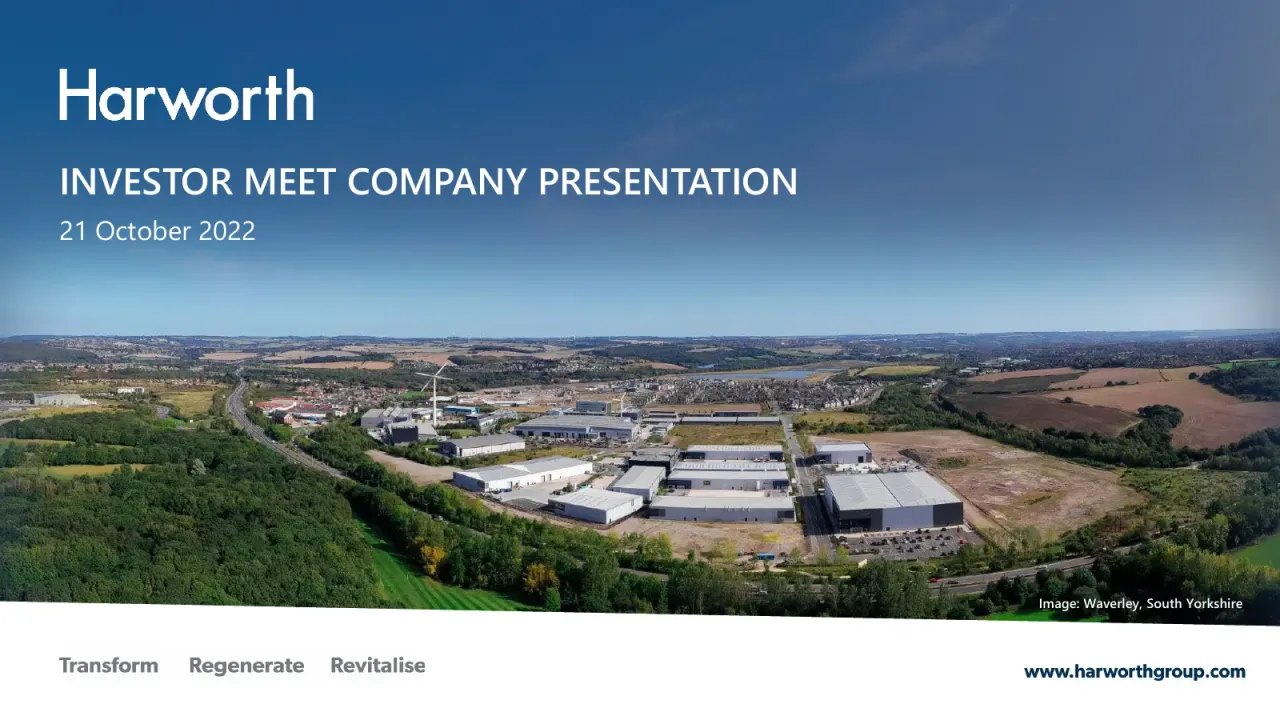
2:51 And since then, we've grown and we've diversified our portfolio significantly. And today, we own around 14,000 acres across a 100 sites in the North Of England and The Midlands. HARWORTH purpose is to invest to transform land and property into sustainable places where people want to live and work. Our developments have the potential to deliver almost 30,000 new homes and 32,000,000 square foot of industrial and logistics employment space, together contributing 4,100,000,000 in gross value add to regional economies. And you can see from the map on the right hand side of this slide our geographic coverage. With regional offices in Birmingham, Leeds, and Manchester, our head office is in Rotherham in South Yorkshire on the site of our largest development, Waverley. Once the site of Allgreave, Corrie, and Coking Works, today, Waverley is a thriving new community, and we're well on the way to delivering 3,000 new homes and over 2,000,000 square foot at the Advanced Park, which is a regionally significant center of excellence where occupiers include Rolls Royce, Boeing, McLaren, Automotive, and the UK Atomic Energy Authority.
3:55 Waverley is a testament to HARWORTH's vision, expertise, and long term approach as well as our commitment to partnerships and place making. So why would you invest in HARWORTH? This slide provides just an overview of what we think differentiates us as a business. First, we're specialists at what we do, and we have a unique set of in house expertise in regenerating large complex sites. We're focused on the industrial and logistics and residential sectors, and both are characterized by significant supply and demand imbalances. Our focus of the North Of England and The Midlands are experiencing the regions are experiencing significant economic growth and investment and are major beneficiaries of government policy. We have a large and high quality pipeline of strategic land and development sites, which we largely own freehold.
4:45 And we have a robust financial position with low leverage and significant liquidity, which allows us to unlock the potential of our sites, deliver development, and pursue new growth opportunities. And last but not least, we are and take great pride in being a responsible business, focused on building thriving communities, providing new homes, jobs, opportunities, and minimizing our environmental impact. All of this over the last five years has translated into a strong track record delivering an average total return of circa 10% per annum. So how we look at our business model? So turning to how we create value as a business. HARWORTH is a specialist regenerator of large, complex, and often formal industrial sites. As the steps on this slide show, we're a master developer that takes the land from an undeveloped and often brownfield state through the remediation and planning process before preparing the land and developing the infrastructure needed for development.
5:42 We then either sell the service land to house builders or increasingly, in the case of our employment space, we directly develop industrial and logistics units ourselves using construction contractors. HARWORTH sites are renowned for their place making, and we always go over and above to provide both residents and workers with well designed public realm, lots of green space, and civic communities to ensure that our developments are a place where people want to live and work. Once our employment sites are complete and let to occupiers, we will often retain them in our investment portfolio. This portfolio plays a key role in our strategy by generating a recurring rental income, which largely covers our overheads and gives us access to a broader range of financing options. It also allows us to continue to generate value from what we have delivered.
6:32 I've touched on this already, but our expertise is one of the key differentiators for us. And to and to and to deliver, this means we really need to invest in our people. Our team has grown significantly over the past couple of years. We were around 90 people at the end of twenty twenty one, and we're well in excess of a 100 now.
6:49 In 2018, we established a regional structure that created a Midlands region managed by a team based in Birmingham and a Northwest region with a team based in Manchester. These two regions joined HARWORTH's existing Yorkshire and Central team, which manages the majority of HARWORTH's legacy sites and is based at our head office in Rotterdam and in Leeds. The regional structure allows for local teams that live and work in the regions they're developing and transacting in. With each region, we have specialists in acquisition, planning, development, and project management, and they're supported by a wide array of expertise in head office, which cover every step of the development cycle. Several of our head office team members have decades of experience, making them foremost experts in areas such as environmental management and land remediation.
7:39 Just over a year ago, we announced a growth strategy aimed at delivering growth from our significant land bank by deploying our existing strengths and scale. This strategy aims to grow the business to an EPRA net disposal value of over 1,000,000,000 by 2027. And for HARWORTH, this plan is evolution, not revolution. It builds on what we already did, but with material shifts in the pace and the scale of delivery. At the core of this strategy are four key drivers of growth outlined in dark blue on this slide. Increasing direct development in industrial and logistics, accelerating sales and broadening the ranges of our residential products, growing our strategic land portfolio, and repositioning our investment portfolio to modern grade a. And I'll outline our progress against these key drivers in a moment.
8:27 Now while market conditions have undoubtedly become more challenging in recent months, we remain confident that our focus markets of industrial and logistics and residential are the right ones to deliver long term value. This is because they're both critical to the growth of The UK economy, and they're both in structural undersupply. The top left chart shows supply of industrial and logistics space in The UK represented by the bars for each of the last thirteen years. And as you can see, supply remains close to historical lows, and this is also driving record low vacancy rates. There has been exacerbate this has been exacerbated more recently by the availability of labor and materials, but also through planning delays and the fact that development isn't always happening in the places that have the highest demand.
9:14 And as a result, we're seeing a mixed pattern of availability across the regions. It is estimated that if we add all industrial and logistics space currently under construction to this supply, it would still only be equivalent to about a year's worth of demand. The chart on the bottom left shows the demand side. The occupied base is becoming more diverse and therefore more resilient with increasing demand from third party logistics companies and manufacturers more than offsetting a decline in demand from online retailers. This is likely driven by the rise of onshoring and nearshoring, which continues to be a driver of demand across the market. So if have a look at the residential market, the chart on the top right shows that the supply of new housing in The UK has been consistently below the long standing UK government target of 300,000 new homes a year.
10:06 Recent reporting from house builders has shown that despite the market cooling, delivery targets remain high, particularly in undersupplied regional markets. And that is particularly relevant to our new single family rental portfolio that we launched in May. The bottom right chart shows the build to rent market remains strong with investment volumes in the first half setting a new record as an increasingly diverse range of investors look to gain exposure to the structural growth sector. As I mentioned already, HARWORTH and its people prides itself on being a responsible business, and we've continued our work embedding the HARWORTH way through our strategy and operations with particular focus on the design and carbon use in operation of the logistics assets that we build.
10:52 Throughout last year, we worked with our board ESG committee to ensure that the ESG targets and metrics that we set and measure ourselves against going forward are right for HARWORTH. This has culminated in us identifying eight focus impact areas against which we will measure our sustainability progress this year. Amongst these areas is a target to become operationally net carbon zero by 2030 and to become fully net carbon zero as a business by 2040. During the year, we appointed our first director of sustainability, Peter Henry, and we also welcomed Marzia Zafar, who joined our board in June as a non executive director and brings with her further sustainability and energy market expertise that we're already beginning to benefit from.
11:39 And I'd like to hand over to Kitty. Sorry, Kitty. That's alright. Thanks very much, Linda. So hi, everyone. Again, I would like to take you through some of the highlights of our half year results for the six months to 06/30/2022, which we announced the market on the September 13. Now by any measure, the first half of twenty twenty two was really strong for HARWORTH. We undertook a record level of direct development in our industrial and logistics portfolio. We continue to accelerate our residential sales. We progressed a number of strategic initiatives, and we made several acquisitions to grow our development pipeline. This slide provides some of our highlights for the period in more detail. Our industrial and logistics pipeline now totals 32,000,000 square feet, and we've really gone through the gears on our direct development strategy with over 430,000 square feet completed after period end.
12:31 This included our Barden Hill site in Leicestershire, which embeds net zero carbon principles and is already predominantly pre let. Our residential pipeline represents just under 29,000 plots. And here, we've had a successful period for land sales, having already completed, exchanged, or entered into heads of terms on over a 100% of our budgeted sales for the year. Staying with residential, we launched our single family build to rent portfolio of up to 1,200 homes on 10 sites. We're we're delighted with the response we received so far from potential investment partners, and we are targeting exchange on this portfolio by the end of the year. Over the first six months, we grew our pipeline way almost 4,000,000 square feet, and we added over 1,100 plots through a number of exciting land assembly acquisitions during the period.
13:24 And our investment portfolio continued to post robust operational metrics with very high rent collection, reduced vacancy, and significant rental uplifts on leasing events. And lastly, as as Linda has just spoken about, we added a number of new roles to our team. Our people have been and always will be critical to our success in this matter. So looking in in a little bit more detail on our scorecard for our strategy for the first half, these are the four core growth drivers of our strategy, which you're going to just set out. And you can see from the middle column highlighted in green just how much we stepped into the delivery of our strategy in the first half. As we progress towards our 2027 ambitions shown in the right hand column. We have over 600,000 square feet either completed so far this year or currently under development more than any previous period. And we're well on our way to reaching our ambition of an average 800,000 square feet per annum.
14:23 We had a very active half for plot sales completing over 1,600 as we took advantage of particularly strong housebuilder demand. And again, this shows significant progress towards our ambition for 2,000 plots per annum to be sold by 2027. Thanks to the acquisitions we made in the first half, we maintained our land supply of twelve to fifteen years. And finally, following the completion of Barden Hill, approximately a fifth of our investment portfolio will be grade a space. And as you can see from the bottom of the slide, we are well on our way to reaching our £1,000,000,000 of EPRA NDV goal. So looking at the the financial performance for HARWORTH in the first half, I will take this you through this in a little bit more detail now.
15:09 And starting with our balance sheet, our main KPI is EPRA NDV. That is an adjusted net asset measure. So what this does is this adjustment to net assets principally puts all of our developments and investment properties at their current market value. EPRA NDV increased to 724,800,000 as at 06/30/2022. She equates to 224.7p per share. This represented a 13.7% increase on our EPRA NDV per share of a 197.6p as at 12/31/2021. This growth was predominantly driven by an increase in portfolio valuation. And you can see us in the property portfolio and the mark to market adjustment on development properties lines of this table.
16:00 These gains were partially offset by an increase in deferred tax liabilities due to unrealized gains on investment properties.
16:08 Within the valuation gains, this is due to management actions on our sites, securing sales, completing direct development, moving our sites through planning, and securing new lettings on our investment portfolio. The gains were fairly evenly split across industrial and logistics and our residential sectors.
16:29 Net debt was 67,800,000, increased from the position as at 12/31/2021. And this is very typical for our development spend profile where we start to spend on sites during the the springs development period, and then see the the development spend offset by sales proceeds at the end of the year. However, I would say the 67,800,000 is lower than at the same point last year. Combined with the dividend, growth in net per NDV led to a total return of 14.1% during the period, just slightly below the prior level prior year, but still high compared to historic levels.
17:09 Turning to the income statement. Sales of service land and property in addition to income from rent, royalties, and fees resulted in group revenue 62,600,000, which compares to 18,900,000 in the prior year period. This increase derived primarily from accelerated service land sales, which was the result of us taking advantage of particularly strong householder demand and saw total property sales increased from 11,500,000 in the first half of twenty twenty one to 39,000,000 in the first half of twenty twenty two. You can see from this slide that we have a robust sales profile for the remainder of the year. Revaluation gains are important components of our performance, and these are seen both in the income statement and the balance sheet.
17:57 In the income statement, we can see the increases in the fair value of assets held for sale and investment properties. These consist predominantly of our investment portfolio, our strategic land, and natural resources portfolio, but this does not include any increases in the fair value of our development properties. Admin expenses increased by 2,200,000 from the first half of twenty twenty one to 10,900,000. This is principally due to higher salary expenses resulting from increased employee numbers reflecting the growth in the group as we pursue our strategy. Admin expenses expressed as a percentage of revenue remained in line with the 2021 financial year at 17%. And all these factors resulted in a profit after tax of 79,100,000 compared to 56,400,000 in the prior year period.
18:50 Finally, we provide an interim dividend of naught 0.404p per share. This reflects an underlying growth of 10 percent on the prior year, which is in line with our progressive dividend policy. Slide 18 shows a breakdown of our £889,000,000 portfolio as at 06/30/2022. Now industrial and logistics land and property shown here in shades of green account for around two thirds of our portfolio by value. And our residential land and property shown here in shades of blue accounts for around one third. This slide shows that the strategic land sites are valued at around half that of the equivalent major development segments. However, the strategic land sites have three to four times the number of plots or commercial square feet that can be delivered on the major development sites.
19:41 This underlies the potential in the portfolio and the value we create as we take sites from planning into the development phase. The investment portfolio shown here in shades of darkest green now totals 295,000,000. This continues to be an important component of our financing strategy. And as development sites reach practical completions such as Barden Hill, they will be transferred to this portfolio. Together with the natural resources portfolio, it creates a recurring income source to service our debt facilities supplemented by sales proceeds.
20:18 HARWORTH's financing strategy remains to be prudently geared, and we have a target net loans portfolio value at year end of below 20% and a maximum of 25% during the year. At period end, our net loans value was just 7.6%, slightly higher than as at 12/31/2021, but below our position at the same point last year and well within our target levels. Earlier this year, we agreed a new senior debt package comprising of a £200,000,000 revolving credit facility together with a £40,000,000 accordion option. This facility replaced our previous revolving credit facility. It added HSBC to our lending club and provides the group with additional firepower and flexibility.
21:05 Alongside this, we continue to enter into site specific developments and infrastructure loans as you can see from the table of our drawn debt on the right hand side of this slide. So in summary, the first half of twenty twenty two saw a strong financial performance for the group, and we move into a more uncertain economic period in a solid position with low gearing and cash and available facilities of a £144,400,000 increased further since period end with the sale of our Kellingley site, and we have no refinancing requirements for a further four years.
21:40 We will continue to monitor closely the external environment, and we will use our skills and flexibility to target our capital, drive long term value for shareholders. And I'll hand you back now to Linda to take you through the operational review.
21:56 Thank you, Kitty. I'd now like to provide a bit more color and some more detail on our operational progress during the first half. So slide 16 provides an overview of our 32,000,000 square foot industrial and logistics portfolio, of which approximately two thirds is held freehold or in joint ventures. Around a quarter of our pipeline is consented, and this comprises of sites such as Barden Hill in Leicestershire, which we completed after period end, as well as larger sites such as our Advanced Manufacturing Park and Gateway 36, both in South Yorkshire, where over 200,000 square foot of development is currently underway as part of the next phases of both sites. Over 6,000,000 square feet of our pipeline is in the planning system awaiting determination, and this includes 3,000,000 square feet across our Gascon Wood, Skelton Grange, and Houghton main sites, where we are targeting a determination in the next six months.
22:51 The remainder of the pipeline is either in land assembly or preplanning phases, and it includes sites such as Rothwell in Northamptonshire, which we bought at the end of last year, and we've acquired a further small parcel of land in the period and are currently engaging with local stakeholders in advance of submitting the planning application. And finally, we continue to make good progress with sales so far, completing, exchanging, or entering into heads of terms on 97% of our budgeted industrial and logistics land sales for the year. And as Kitty has mentioned, we were delighted to complete the sale of our Kellingly development in early September for 54,000,000. Turning to our residential portfolio, this has the potential to deliver almost 29,000 housing plots with around a quarter of these already consented.
23:37 As we've touched on already, it's been a very active period for plot sales. We took advantage of significant house builder demand during the first half. We completed the sale of over 1,600 plots, including our largest service land sale to date to Barrett and David Wilson homes at Waverley. That parcel has the potential to deliver up to 450 new homes and marks one of the final phases of land sales at the site where around 3,000 homes will be built in total. We were also excited to market our first phase of service residential plots at our Ironbridge site during the period, and we saw a highly competitive bidding process amongst the house builders. We significantly advanced place making works across some of our largest residential sites. So Waverley, a new 150 bedroom hotel is under construction, and we have received, excuse me, planning for a new primary health facility at the site.
24:29 Dry throat this morning. Development is also about to begin of Highwall Park, a new one and a half kilometer linear park running through the heart of the site, which will connect the advanced manufacturing park to Waverly Lakes. Meanwhile, at our 2,000 home Southeast Kelville development, planning has been submitted. So just bear with me one minute. Sorry. That is a first, I'm afraid. I'll go again. So our 2,000 home Southeast Kildall development, planning has been submitted for a new 420 place forest school at the site to sit alongside a new local center and extensive green space. If we turn to the residential land portfolio, elsewhere in the residential space, in May, we launched our single family build to rent portfolio to take advantage of this rapidly growing market, which HARWORTH developments are particularly well suited.
25:27 This portfolio represents a unique forward funding and long term investment opportunity for a prospective partner to deliver up to 1,200 homes across 10 sites in Yorkshire, The Midlands, and the Northwest. These sites have benefited already from HARWORTH's investment as well as our master planning and place making expertise, which have delivered green space, recreational facilities, and a well designed public realm. For existing residents, the introduction of the Build to Rent product is expected to add further to the vibrancy and attractiveness of these communities. Launching this portfolio allows us to accelerate the delivery of our residential sites because the BTR product can be built out alongside the residential plots that we sell to house builders rather than having to phase the development to take account of local absorption rates.
26:14 It's also good diversification in the event that we see a softening of the traditional build to sell market. We have received really strong levels of interest from prospective investors since we launched the portfolio to the market. We have a target date of the end of this year to exchange contracts with the build out and phased handovers to take place over the subsequent three years. We're making good progress and look forward to updating you later in the year. So turning to our investment portfolio. Our £294,000,000 investment portfolio is a key part of HARWORTH's funding structure and growth strategy. This portfolio delivers an annualized rent roll of £18,000,000 and continues to post robust financial metrics. So you can see from the charts in the top right of this slide that the occupier is diverse, focused on sectors such as logistics, chemicals, and manufacturing.
27:06 And during the half, we completed close to 50,000 square feet of lettings, adding close to a 100,000 of annualized rent, transacted at significant premiums to previous passing rent and ERVs. This was then followed by significant leasing activity at Barden Hill after period end. Once these leases are completed, they will add £2,200,000 in annualized rent and increase the grade a proportion of our investment portfolio from 11% at period end to 19%. As you can see from the bottom right of this slide, the operational metrics also remain strong on this portfolio with a long weighted average and expired lease term of over eleven years, a low vacancy rate of 3.9%, and continued strong rent collection.
27:53 So before I open up to questions, I just wanted to spend a few moments on our outlook. HARWORTH has made a strong operation and financial progress in the first half. We've seen significant increase in our EPRA NDV, which has brought us even closer to our ambition to reach £1,000,000,000. Over the last couple of years, HARWTH has consistently delivered a strong performance despite an unprecedented macroeconomic backdrop, and the business has shown its ability to sustain its performance in an uncertain environment. This resilience is not by accident. It is as a result of our deliberate management actions to identify a strategy for growth, focus on the right markets and products, build expertise, and maintain strong relationships. We are now seeing signs that both the residential and industrial logistics market markets are coming off their record highs.
28:44 Most recent indicators suggest that the impact of rising interest rates on mortgage affordability, increasing inflation on household budgets, and the withdrawal of government support such as the Help to Buy scheme are likely to begin to impact house prices, albeit the fundamentals of long term undersupply supporting pricing are still there. In the industrial and logistics sectors, yields are forecast to move out as debt markets tighten and interest rates rise. Supply chains and labor markets also still remain constrained, and this is likely to impact the pace of delivery and limit supply, reducing choice for occupiers and supporting rents. These conditions will have an impact on our valuations, and as previously flagged, we expect any 2022 gains to be first half weighted.
29:31 This being said, investors still have a substantial amount of capital to deploy into the right product and into the right sectors. HARWORTH's products are in two of the most resilient real estate asset classes, and fundamentally, both are still undersupplied. The scale of our portfolio and our ownership allows us to drive value from management actions. And by controlling the phasing of our sites, we remain well positioned to deliver through the cycle. Our strength comes from our long term focus and our ability to work through and adapt to changing market conditions. Thank you very much for your time, and I would like to open up to questions. I'm going to hand over to Tom Loughran, who's our head of investor relations, who will be reading these out for us. Thank you. Thanks very much, Linda, and good morning, everybody. Thank you very much for everyone who has submitted questions so far.
30:23 I'm just going to begin to read these out, but, please note that you can still submit questions via the browser if you would like to. So Linda and Kitty, the first question is given the share price, would you look at share buybacks in the current environment? Shall I go on that one, Katie? If you want to. Yeah. Sounds like it. So so, it's a it's a great question. We haven't been asked it much over the years, but, I suspect, you know, when you look at the markets, what you're seeing is whilst our shares are a discount, so is everybody else's, it's it's sector wide. Fundamentally, we're a company that's in growth. We believe that our strategy is the right one for the business, and we believe that actually reinvesting the cash that we throw off, in more acquisitions and in the sites that we hold and developing them and bringing forward will actually create long term value and growth for shareholders.
31:20 Know, sort of it is on our radar as as I imagine any CEO, that you ask that question to will say. But for HARWORTH, as a business in growth, we think actually that we serve shareholders best by reinvesting the cash and driving value going forward. Thank you very much. The next question is, could you expand on the natural resources portfolio? What is it? What is the and what is the opportunity there for the company? I feel like we're doing this a bit out of sync, but, Katie, do you wanna go at that one? Yes. No. I I can do. I I think it's it's a really interesting sort of part of the the portfolio, the natural resources side. So you you'll have seen when I did sort of the the big sort of doughnuts of of the overall sort of shape of the portfolio. It's a relatively small component of it.
32:07 At the moment, it consists of sort of land where we are either generating some renewable energy out of it. So we have some sort of battery storage. We have built solar portfolios in the past. We have some some wins of income as well that that comes through. And then also sites where we're we're generating income through various uses of on that site. So it might be sort of off some of the old coal mines, like coal mine methane extractions, for example. We actually think it's a really interesting area, and and we're hoping to talk a bit more about this in the year end results because we have a really specialist skill set within that natural resources team, which we also deploy across our wider sites, so across all of our our major development sites as well. And as part of our journey to be net zero carbon neutral too is to use that skill set within natural resources to look at how we can maybe drive some of those energy uses across our sites as we deliver our residential and our industrial and logistics communities as well. So really big opportunity there for us.
33:09 Thank you very much. Next question is what are your targets in terms of new land sites, and how generally are you finding the planning process? Or shall I go on that one? So so, you'll see from the lens of the strategy that we talked about earlier that we aim to have a twelve to fifteen year land supply, to enable the company to sustain growth here. We're a long term through the cycle business, and if we just develop what we had and then started buying, that wouldn't be sustainable. So we aim to keep our land supply broadly between those parameters in both the, industrial and logistics space and and residential. So we're always targeting, sort of, twelve to fifteen years of supply. The markets have been, sort of, well, very competitive, I would say, over the last couple of years. I mean, having said that, we've been able to eke out little gems like Rothwell, that I referred to, earlier in the presentation, which was a site we bought at the back end of last year, which will deliver sort of around 1,600,000 square feet.
34:10 And it sort of sits really sort of nicely sort of down down in Northamptonshire. But we've been able to also, buy residential sites such as Stavley Ironworks again completed at the end of last year, which brought 600 new residential plots, into the portfolio. We're always active. We've got acquisitions teams in each of our regions. They're local people, you know, local boys and girls, so they're really well networked. And at any point in time, we're always active on quite a large pipeline of acquisitions. But acquisitions are a little bit like planning, which I'll talk about in a minute, you know, sort of don't perform to financial years. So, some of them will complete sort of next year that we're working on this year. We found we've been competitive. HARWORTH is trusted, actually, so, by landowners. So we actually really successful, at getting into some difficult and complex, you know, sort of opportunities that others may well not be attracted to, and we can unlock land, you know, sort of in that way. So we've got quite high hit rates on refilling our hopper as you'll you can see from the way that the pipeline moves year to year.
35:17 On planning, it's tough. It always has been tough. I think in my sort of thirty odd years now in real estate, I don't think I'd give you a different answer twenty years ago to the one I'm giving you now. It's become more complicated because you have a lot more environmental sort of hurdles to jump over when you're putting an application in. Suits HARWORTH skill set actually is the other side of that, But also local planning teams are under an enormous amount of pressure in terms of resource, and and that hasn't got any better in in the last decade. So we're pretty expert at it. We have in house planning teams in the region and in the center, we've got a really strong track record of success on planning. Thank you very much. The next question is why don't you align your dividend more closely to your EPS?
36:11 Yeah. Kittens. A a really sort of interesting question. Shall I take that one then? Yeah. I was I was just thinking that was one for you. Yeah. Yeah. No. I think I think it's a really interesting question. I think so the consensus the overall sort of strategy of the group isn't similar to sort of Linda's responsible share buybacks is really to around sort of reinvesting sort of the funds in order to deliver growth. So historically, the dividend has always been sort of a relatively small amount because we really reinvest those proceeds back in. Earnings as well as a combination of sort of rental income that we've collected, sort of fees that we've taken, and also an element of sort of revenue from sales. And those sales can naturally sometimes be be lumpy in the same way that sort of planning doesn't neatly fall into a year. Sometimes sales don't always neatly fall sort of into a year. Although as we grow, we hope we can get a little bit more consistency on that.
37:01 And the way that we fund ourselves is really important to be able to take that surplus sort of out of those sort of rents and and sales in order to sort of run the business and reinvest that into the sites as we continue to grow the net assets being sort of the predominant nature. And then I suppose that thinking about sort of supplementing that and supporting sort of the share price, I think we do believe as as Linda says, you know, we are a long term business. And as the market stabilize, we can demonstrate the value and the opportunity within the business as we execute on that strategy to get to sort of a billion pounds of NDV. Thank you very much. The next question is, historically, HARWORTH shares have, been close to, NAV and are now priced at a roughly 50% discount to NAV. What proportion of the fall do you estimate, relates to an increase in value as interest rate assumptions?
37:59 Oh, that's So I think really tough question. Really testing me this morning, but I I think sort of it it might be helpful, Tom, if the slides are still still up just to pull up that portfolio sort of donut slide because I think this is probably sort of the way that that I think about sort of how how the portfolio sits. So we've got sort of different segments and and different types of assets. And and those are sort of more sensitive to some of the changes that are going through sort of the market at the moment to go to your point around valuer and valuer changes as well. So so I suppose if we start with strategic land, both strategic land residential and strategic land industrial and logistics, those are the light colored sort of segments on on this circle here.
38:44 That's our long term land pipeline. So that's land that doesn't have planning permission, doesn't have any hope value in it. It's sort of it's it's really sort of early stages. And so that tends to be relatively lowly values. And if you look at the value of that portfolio relative to the plots and the and the square foot in it, you can see that it's actually valued at a pretty low levels. So that that sort of I don't expect to be as as impacted at the moment. Then you look at sort of the major developments aside, and those are the sites that we've got planning and we're on-site delivering to. And they are, they are slightly, sort of more susceptible to those end markets because they effectively look at what could we sell into those end markets, what's the cost of getting there. And so you would expect a fluctuation there.
39:30 But within those land segments, the other bit you've got to remember is the bit that we add value. So our value gains in the first half were in the main sort of driven by management actions that we took on the sites. And and I think that's a really important thing to sort of take away here. We don't sit on our sites and and do nothing. So to the extent that you might see sort of valuations, sort of move backwards, on on sort of assets where you're not you're not doing anything to them. Here, we are working our sites through planning. We are putting in infrastructure. We are rephasing our sites. We are introducing other products onto them, like build to rent, for example, or affordable housing. So we're we're doing lots of work on those sites, and we very much hope that those management actions help to move those sites forward sort of notwithstanding certain market context.
40:18 So then sort of the the area that is driven, maybe more by sort of changes in in interest rates and then seeing that feed through into market yields where where you are seeing some evidence of that now in the markets too. That investment portfolio is all industrial and logistics assets. It is sort of it's about 96% left. We've got a weighted average lease length of of eleven years. So it's a really stable portfolio. But that that is maybe a little bit more susceptible. But that portfolio sits at an average yield of 6%. So you've seen sort of a lot of movements in the really tight prime yields, but that portfolio is a is a little bit wider in in the yield. And so it might be that element that that might be exposed to a movement. But as you can see, if that portfolio has moved, for example, sort of 15 or or 20%, it's it's only a third of the overall portfolio.
41:11 So when sort of the shares are pricing at sort of 50 percent discount, if you if you think of sort of the elements that are resilient within the portfolio, you'd have to see really very significant valuation moves in order to see that flow across the whole blend of the portfolio. And I I expect you would expect me to say it, but but it does feel like it's a move bigger than certainly I hope that that we will see as we progress over the next twelve to eighteen months. Thank you very much, Kitty. That that concludes the questions that I have on my screen. I don't know if anyone wants to ask any final questions before I hand back to Linda to close. No. I think that that might be everything.
41:59 Back to you, Linda. Thanks, Tom. Thanks, Kitty. Well and thank you all for for joining us and then for giving us your time this morning. Probably just to reinforce a couple of final messages from me, you know, so we had a really strong half one. We are successfully sort of growing this business period on period, and we have been since we stepped into this strategy. And I think to just reinforce that how it is a long term through the cycle business, we're operating in regional markets in sectors that have structural undersupply, and that doesn't change regardless of what's going on, you know, sort of, in the in the markets, in the markets around us. And we're really well capitalized, and we're also very good at what we do with a really experienced management team at driving businesses through the cycles. So thank you for listening. And if you've got any further questions, and you'd like to sort of contact us via Tom, that would be great. Thank you.
42:54 Linda, Kitty, Tom, thank you very much for updating investors today. Could I please ask investors not to close the session as you'll now be automatically redirected to provide your feedback in order that the management team can better understand your views and expectations? This will only take a few moments to complete, and I'm sure be greatly valued by the company. On behalf of the management team of HARWORTH GROUP PLC, we'd like to thank you for attending today's presentation, and good morning to you all. Thank you very much. Thank you.
Follow Harworth Group PLC into a list and get an email when it puts out news.
Head of Investor Relations at HARWORTH GROUP PLC
CEO at HARWORTH GROUP PLC
CFO at HARWORTH GROUP PLC