Kitty Patmore
CFO at HARWORTH GROUP PLC
Replay available
Half Year Results hosted by Harworth Group (LSE:HWG) on Investor Meet Company, held 2023-09-28.
On 6ix: 6ix.com/event/harworth-group-plc-hwg-half-year-results-1
Automated transcript · Written by software from the replay's audio. It can mishear names and figures; the replay is the record.
0:01 Good morning, and welcome to the HARWORTH GROUP PLC Half Year Results Investor Presentation. Throughout this recorded presentation, investors will be in listen only mode. Questions are encouraged, and they can be submitted at any time using the Q and A tab situated on the right hand corner of your screen. Simply type in your questions and press send. The company may not be in a position to answer every question received during the meeting itself. However, company will review all questions submitted today and publish responses where appropriate to do so. Before we begin, I would like to submit the following poll. And I would now like to hand you
0:33 over to CEO, Linda Sheelaw. Good morning to you. Good morning. Thank you, Alex, and good morning, everybody. Welcome to HARWORTH's Investor Meet company presentation. Today's presentation relates to our half year results for the first six months of twenty twenty three, which were announced to the market a couple of weeks ago on the September 12. I'm Linda Shillor, chief executive officer, and I'm delighted to be joined by Katie Patmore, our chief financial officer, and we we are here. We hope we hope you can see us. We're real. We're gonna go off when we do the rest of the presentation, then come back on at the end during q and a so that you've actually got some you've got a full and clear screen. It's great to be back on this platform and to have an opportunity to speak to our valued retail shareholders and those who are considering an investment in HARWORTH.
1:18 So we'd like to start by thanking you all for your support and your interest in HARWORTH and that continued support going forward for the business. Thank you. So on to the agenda slide. So this slide shows the agenda for the morning. I'm going to begin with an overview of our performance during the first half. I'm gonna comment on the market backdrop and report on the progress that we're making in delivering the strategy, and then I'll hand over to Kitty to take you through the financials. We'll then have an operational update and an outlook for the remainder of 2023 and beyond, and we'll close the session with some q and a. And just as a reminder, you can still submit questions as we run through the presentation, and we can see them and we'll aim to answer as many of those as we can at the end. So before I talk about the first half and because I think it's important given the speed at which our markets have changed since the pandemic and through half one of twenty twenty three, I just want to spend a few moments talking about HARWORTH's unique attributes as a business.
2:18 And this should provide context of both our half one twenty twenty three performance and the long term potential of the business. So the attributes that you can see on this slide are central to our strategy, and they underpin our resilient operational and strategic performance through the cycle. First, we have a unique skill set at HARWORTH of regenerating large, often dirty, and complex sites. With decades of unrivaled in house expertise in areas such as acquisitions, planning, remediation, infrastructure development, and building delivery. And as a long term through the cycle business, we have the patience to do this where necessary over a longer period of time, which means we can unlock the potential of challenging sites where others have struggled or avoided them altogether.
3:05 Secondly, we have an extensive land bank, which while we largely own or control the land, we've successfully grown this over the last few years through targeted acquisitions. And our consented residential and industrial logistics pipeline alone has a GDV of 2,400,000,000, and there is significantly more latent value across our long term and consented pipeline. Next, and as I'll come on to shortly, we focus on structurally undersupplied markets. So almost 60% of our portfolio relates to the industrial and logistics sector, where the drivers of demand remain largely intact and supply particularly in the regions remains low. We've got a strong financial position with low gearing, significant available liquidity, and no refinancing requirements until 2027.
3:53 And finally, we're a responsible business and guided by the HARWORTH Way and our net zero carbon commitments. We're leading the way in supporting new homes, jobs, and investments across our regions. Together, these factors are what makes HARWORTH such a successful and sustainable business. They provide us with a platform for growth, and they enable us to deliver long term value to our stakeholders and deliver large scale regeneration in our regions that has a lasting and positive impact. So now if we turn to our results, HARWORTH had a strong first half in which we progressed our strategic objectives. We've delivered a robust operational performance, and this was underpinned by this resilience of our through the cycle model and the sustained demand for our service residential land and industrial logistics assets.
4:39 And I'd like to just pick out three key takeaways here. So firstly, our management actions and the sustained demand for our products has resulted in an uptick in valuations during the first half, while our EPRA NDV remains broadly stable over the period. Secondly, our markets remain in generally good shape with resilient demand for industrial logistics products and the BTR sector continuing to grow, particularly in the single family and regional markets. The headwinds facing the traditional housing sector are well publicized, but we're still seeing a good level of demand for our differentiated and derisked service land product. And finally, as I've already touched on, we've got a strong financial position with low financial gearing and significant available liquidity.
5:26 If you combine with this with the fact that we own most of our sites, we can therefore determine the timing and pace of development. This gives us a huge amount of flexibility and firepower. So if we delve a little deeper into our focus markets, I'm gonna start with industrial and logistics. And as I've mentioned, the structural drivers of demand seen in recent years remain with the and they're there with the terms of the growth of ecommerce, onshoring, nearshoring, and are focused amongst occupiers on securing modern and sustainable spaces. The chart on the left uses data from Savills, and it shows that all the take up of industrial space in the first half of twenty twenty three was lower than the record breaking levels seen in recent years, it was broadly in line with the pre pandemic average.
6:15 And there also continue to be a diverse range of sectors driving demand with manufacturing accounting for a record proportion of take up in the first half. The decline in demand during the first half saw a corresponding rise in supply with Savills estimating that market wide vacancy of 6.3% as of June 2023. Now now this has increased from 3% a year ago, but it is broadly in line with the pre with the long term pre pandemic average. And this is expected to gradually fall as speculative developments in the market is curtailed. So the chart on the right hand side shows this correction is already taking place in the market with levels of spec building in the first half much closer to the historical pre pandemic levels.
7:02 Finally, it's important to consider the regional dynamics in our markets. And across our focus regions of Yorkshire and Central and the Northwest and the Midlands, vacancy remains below the national average with less than a year's supply based on current take up, underpinning particularly favorable supply and demand dynamics in our regional markets. In the residential markets, consumer demand remains subdued, and this is largely as a result of higher mortgage rates, challenging affordability, and low consumer confidence, albeit interest rates appear to be nearing their peak. And reports from house builders suggest that reduced construction volumes over the coming year and a more selective approach to land acquisitions will continue to prevail.
7:49 But despite this, we've seen good levels of demand from a wide range of house builders, both national and regional. And the charts on the left of this slide indicate one of the main reasons why. The UK's challenging and complex planning system is constraining the supply of land for new homes, with planning decisions taking longer than ever before to be decided and the lowest number of decisions for major residential sites and being delivered in over a decade. Against this backdrop, you can see why our consented service land product is attractive to house builders as it's derisked from both the planning and a cost perspective, allowing house builders to quickly start on-site. Return to the build to rent market. This segment has continued to see growth, demonstrating the defensive nature of the product and the acute shortage of rental homes in The UK.
8:38 Savills report that investment volumes in the sector had a record breaking second quarter in twenty twenty three, bringing total investments in the first half to 2,100,000,000. The UK's BTR stock now stands at over 88,000 homes, which represents a growth of 12% in the last year, with the regional markets growing faster than London as you can see from the chart on the right here. And despite this, only 11% of built stock is single family, and transactions remain focused on on multifamily, which have accounted for over 60% of investment over the last year. Our built to rent single family homes and our affordable home portfolios of sites are particularly well positioned to address acute supply imbalance as these markets mature. And just before I hand over Kitty, I want to take a moment to review our strategic scorecard.
9:30 It shows the progress that we've made against all four growth drivers of our strategy to reach 1,000,000,000 of EPRA NDB. So we start with direct development at the top. Earlier this year, we completed a 110,000 square feet at Gateway 36, and we're now on-site with a 166,000 square feet at the Advanced Manufacturing Park, which is already 44% pre let. We're continuing to see good levels of occupied demand for these sites, which were in prime locations, and both have just become part of The UK's first investment zone. In terms of accelerating sales and broadening the range of residential products at the second limb of our strategy, we continue also to see good progress here. With 92% of our budgeted plot sales for the year now either completed, exchanged, or in heads of terms.
10:19 Our single family built to rent portfolio is progressing towards exchange, and we've been securing all important planning consents across a number of sites. And our affordable housing product launched in April has received strong levels of interest, and we're working to select our preferred investors. In terms of scaling up land acquisitions and promotion, which is the first third limb of our strategy, we've acquired land representing 1,100,000 square feet of industrial and logistics space and 700 plots, which is continuing to refill that hopper, maintain our land supply, and support our long term growth strategy. And finally, the transition of the investment portfolio to a 100% grade a is well underway with 70,000,000 of disposals so far this year of old assets where we've maximized value through asset management initiatives.
11:11 Importantly, these were completed in line with December 22 book values, Provo proving the ability of our team to secure sales in a changing market. Combined with the addition of new space through our direct development activity, this means our investment portfolio is now 29% ROA day. So as you can see across the bottom of this slide, over the last two years and despite the challenging macro backdrop, we've made a lot of progress operationally, but we're also making good progress towards our £1,000,000,000 goal. And with that, I'd like to hand you over to Kitty to take you through the financials. Thank you, Linda, and good morning, everybody. I'm pleased to report a resilient financial performance for HARWORTH during the first half. And now I'd like to take you through this in some more detail. So starting with our income statement.
11:59 Sales of Service Land and Property, in addition to income from rent, royalties and fees, resulted in group revenue of GBP 18,200,000 in the first half. This was a decrease from the 62,600,000 reported in the prior year period, where we'd accelerated development land sales into 2022 and which included a large sale at our Waverley site.
12:20 This year was therefore a return to our normal development land sales profile with infrastructure works over Q2 and Q3 preparing for year end sales underway at the moment. Combined with the investment portfolio sales, total property sales, as shown in the table on the bottom right, during the period were 44% higher than the same period last year. Revenue from the income generation portfolio reduced following sales of investment properties, but rents actually increased on a like for like basis. Looking forward, 98% of budgeted sales for the year are either completed, exchanged or in heads of terms, creating a strong revenue pipeline into the second half. Administrative expenses increased by GBP 3,400,000 from the prior year period, and this is principally due to a provision for bad debt and impairment of lease incentives caused by the recent administration of one of our tenants in the investment portfolio and also due to higher salary costs resulting from increased employee numbers last year to support our growth strategy.
13:23 Headcount growth has now slowed materially in 2023. Revaluation movements and important components of our performance and are seen both in the income statement and the balance sheet. And in the income statement, we can see increases in the fair value of assets held for sale and investment properties. These consist predominantly of our investment portfolio, our strategic land and our natural resources portfolio, but do not include any changes to the fair value of our development properties. All these factors combined results in a profit after tax of GBP 2,800,000 compared to 79,100,000 in the prior year, which was heavily influenced by valuation gains. And as I previously flagged, the bringing forward of land sales for the first half of twenty twenty two to take advantage of buoyant market conditions. Finally, the Board has decided on an interim dividend of 0.444p per share.
14:15 This represents a 10% increase on last year's interim dividend, in line with our dividend policy. So turning to the balance sheet. Our EPRA NDV remained broadly stable year on year and was GBP 6 and 31,300,000 as at June 30, equating to GBP 195.7 per share. This was the result of a modest increase in valuations being offset by small increases in net operating costs, interest expenses and tax through an increase in net debt. Net debt was £63,700,000 increased from its position at the end of twenty twenty two, largely due to spend on-site infrastructure and development works and expected to decrease with the completion of land sales and lettings in the second half. In fact, net debt as of the reporting date had already reduced to £53,600,000 with post period sales proceeds.
15:06 Combined with the dividend, our broadly flat EPRA NDV movement led to a positive total return of 0.1% during the period. I'll come on to talk more about our valuations in a second, but I thought it might be good to look at the EPRA NDV per share movement as a bridge from year end twenty twenty two to June 2023. There are three key points to take away. Firstly, EPRA NDV has remained broadly flat at GBP195.7 per share. Secondly, the main component of the growth is from our value gains, which have added 2.3p to EPRA NDV per share in this period. The biggest reduction is 1.3p from our losses excluding value gains, which is essentially our rental service charge and fee income less all of the operating costs of the business.
15:57 These have increased recently due to higher overheads as well as lower one off fees during this period and following sales from the investment portfolio. And although this is negative, I do expect the rental income and fees will offset operating costs again as we execute the strategy, direct development projects complete and become rent producing and as this is supported by an increase in development management and planning fee income. So now looking at our valuation movements in more detail. This slide shows the component parts of our GBP 7,500,000 valuation gain for the first half of the year, which compares to gains of GBP 110,000,000 in the first half of twenty twenty two. Starting with Residential, the land market was stable during the first half. As Linda has covered, supply of service land remained constrained and house prices were maintained in our regions.
16:48 Progress towards residential land sales continue on our major development sites, and these demonstrate demand for our service land products and underpin valuations. However, costs of construction continue to increase over the period, although at a lower level to last year, but this offset the gains from our management actions to result in a modest loss of GBP 2,200,000. In Industrial and Logistics, following significant investment yield increases in the second half of last year, the market remains stabilized over the first half of twenty twenty three with small outwards yield movements and increases in market rents. Management actions progressed sites towards developments and supported valuations, although again, cost of construction increased, albeit at a lower rate as I said compared to last year.
17:37 Combined, this resulted again in a small revaluation loss of GBP 2,300,000 on major developments. Across both portfolios, strategic land valuations increased, and this was due to the progression of planning applications and site strategies.
17:53 And lastly, investment property yields moved in line with the market, and our management actions securing sales, new leases, renewals and rent reviews resulted in a GBP 2,500,000 valuation gain, reflecting a net initial yield moving to 5.9%. Although sales transacted at book value, we incurred some small losses on sale due to transaction costs and some minor adjustments to site wide infrastructure costs allocated to prior period sales. So you can see from this slide that our overall property portfolio now stands at GBP $738,000,000 as of 06/30/2023. Industrial and logistics land and property shown here in shades of green now account for around 60% of our portfolio by value, with residential land and property shown here in shades of blue accounting for most of the remainder.
18:44 The table on the right hand side summarizes for each segment the pound per square foot for industrial and logistics sites and the pound per plot for residential sites. And it shows quite clearly the significant value that we generate by taking sites through the planning system, putting in place infrastructure and services before in the case of industrial and logistics sites, developing and letting them to occupiers. It also shows the huge potential value of our currently unconsented strategic land pipeline, which has increased due to acquisitions in the first half and represents 33,000,000 square feet of industrial and logistics space and around 21,000 residential plots.
19:24 The chart on this slide bridges the increase in our net debt position from GBP 48,400,000 at the end of twenty twenty two to sixty three point seven million as at June 2023. The main driver was an increase in development spend and acquisitions as we continue to progress our growth strategy. This was largely offset by the sales proceeds realized during the period and which have continued over the summer. This chart also shows the headroom afforded by our cash position and the revolving credit facility, which I'll provide some more detail on now. Our financing strategy remains to be prudently geared with a target net loan to portfolio value at year end of below 20% and a maximum of 25 during the year.
20:08 At June, our net loan to value was just 8.6%, slightly higher than at the end of twenty twenty two and the prior year period, but well within our target levels. Post period end sales proceeds have continued to reduce our net debt position, and the loan to value now stands at around 7.5%.
20:26 So in summary, the first half saw a robust financial performance for the group. We remain in a strong financial position with a low loan to value and cash and available facilities of a 163,500,000 and no major refinancing requirements until 2027. And with that, I'd like to hand you back to Linda to take you through the operational review. Thank you, Kitty. Now we'll have a look at the progress that we've been making during the first half. So slide 16 provides an overview of our 37,000,000 square foot industrial logistics portfolio, well over half of which is held in free held or in joint ventures. And over 5,000,000 square feet of this space has a planning consent, and it includes mature sites such as the Advanced Manufacturing Park and Gateway 36.
21:12 Both of these have been hugely successful schemes. And as I said earlier, we've seen good levels of demand at these sites during the first half as we brought forward the next phases of development.
21:23 Our planning contents also include sites such as Chastleigh Valley, where site preparation works began towards the end of twenty twenty two, what will eventually be a 1,200,000 square foot of employment space at the heart of the Ceramic Valley Enterprise zone in Staffordshire. Over 7,000,000 square feet of development is progressing through the planning system, including Gascon Wood in North Yorkshire and Skelton Grange in Leeds, where we continue to make progress. And during the period, we acquired Parkside East, a site with the potential to deliver naught point 8,000,000 square feet of employment space at Junction 22 Of The M 6.
21:59 The site was allocated in the recently adopted Saint Helen's local plan, and it forms part of a wider regeneration area supported by the council. HARWORTH is now developing a master plan, which will be submitted for planning approval shortly. The table on the top right shows the potential gross development value to come from a selection of these sites, which could be as high as £1,700,000,000, demonstrating significant pipeline of development over the medium term and signaling the potential value that we can unlock as we continue to assemble schemes and work them through the planning process. So we now look at our residential portfolio. This has the potential to deliver over 28,000 housing plots, of which over six and a half thousand have a planning consent. Our residential land sales typically heavily weighted towards the second half of the year, and therefore, focus in the first half has been on progressing transactions and carrying out land preparation and infrastructure works across our development sites.
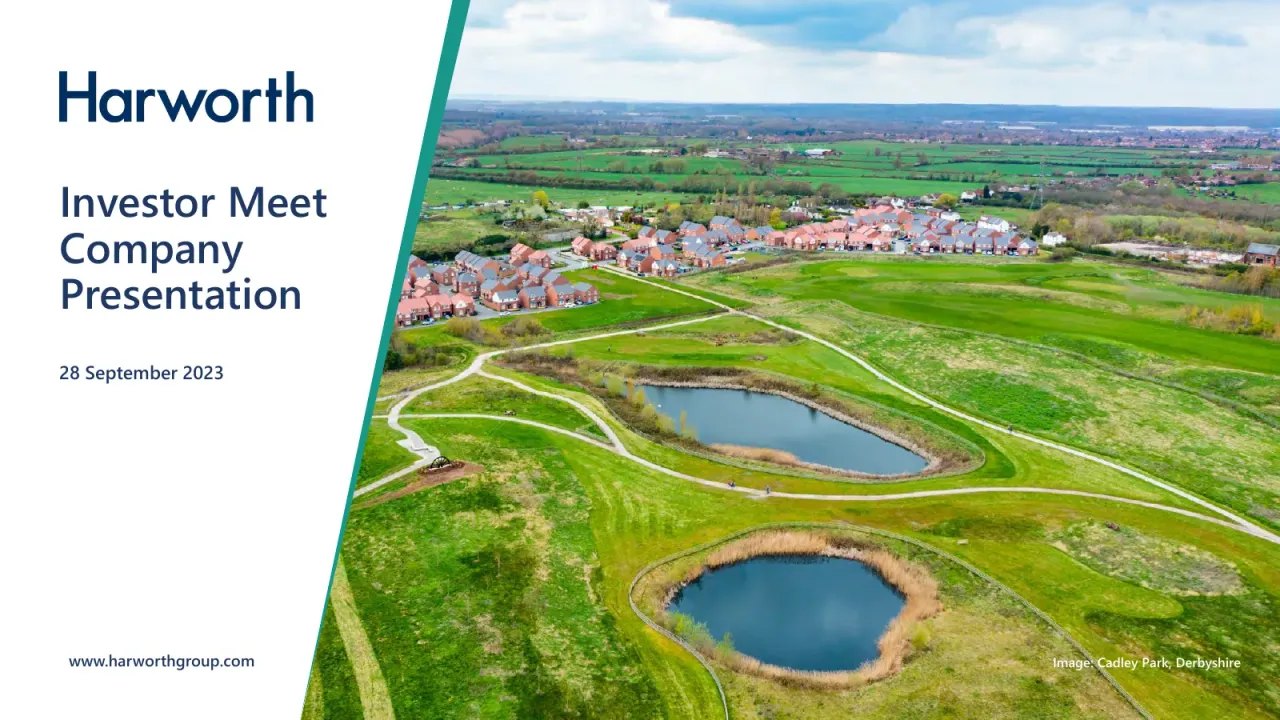
22:56 Shortly after period end, we completed a sale to Barrett and David Wilson Homes of a land parcel at Thorsby Vale for the construction of a 174 homes. And as we mentioned earlier, we continue to see a really good level of bid activity and pricing across several of our sites. Acquisitions added 700 plots to the pipeline, and planning was secured for just under 400 homes at our site in Killamarch, Derbyshire, which is now being marketed for sale. As a massive developer, we pride ourselves in investing in residential sites to provide great infrastructure, amenities, and green spaces for residents. One of the highlights of this during the period has been the opening of a new 50 acre park at our Cuddly Park development in Derbyshire, providing an extensive green space for residents and the local communities to enjoy.
23:43 And finally, as we touched on earlier, our service residential land product is a key differentiator for us, and we've continued to see good levels of demand with an average of seven house builder bids received for each land parcel that's been marketed so far this year. And this is in line with the average number of bids that we typically receive. Importantly, the average bid prices are ahead of book values. So staying with residential, one of our key strategic objectives is to broaden the range of our products. Offering these products alongside our traditional surface hot products has many benefits, which because by but by value, they only account for a small proportion of our portfolio. They provide us with an important diversification, and they allow us to accelerate the delivery of our residential size. And they give us the opportunity to control build quality, innovation, and sustainability.
24:34 And all of this is critical for maintaining a sense of place, preserving land values, and meeting on net zero carbon goals. Some of our budgeted representative sales for the year relate to our single family built to rent portfolio. And here, we're now starting to see our reserve matters planning applications come through for several of the sites, enabling us to progress towards exchanging contracts with our preferred investment and construction partners. As a reminder, this is one of the first portfolios of scale in The UK, and it actually has been a really complex process whereby all of the sites in the portfolio have had their master plans reformulated to change the housing typography to institutional quality built to rent units that don't need to be retrofitted. Owned to the planning environment, timelines for the portfolio become comp become protracted.
25:25 However, this for us has never been about delivering any transaction, but by doing but doing the right transaction and ensuring that we manage the risks as the market has shifted around us.
25:36 It's also been critical throughout for us to identify partners with whom we can develop long term relationships based on shared values and ambitions. Our affordable housing portfolio comprises of approximately 400 homes that meet the national planning policy framework criteria for affordable housing. So this means things like social rents, affordable rents, and and then there's a range of intermediate rents for sale products in between. We've had good levels of interest so far in this portfolio, which allow us further accelerate the delivery and enhance the vibrancy of our residential sites. I've looked a little bit further out. We're now preparing planning applications for our first small scale pilot programs of our net zero carbon products at the Waverley and Prince Of Wales sites. We're also looking at senior living opportunities across a number of sites, and we look forward to updating you further on these plans in due course.
26:29 During the period, we accelerated our plans to reposition the investment portfolio with the proportion of grade a space and it rising from 18% at the beginning of the period to 29%. This was driven by a significant sales program of assets where we had maximized value through asset management or development initiatives. And these sales totaled 52,100,000 in the first half with a further 17,900,000 disposals completed after period end and all at prices broadly in line with the December 2022 valuations.
27:00 Sales were made to a broad range of buyers, including occupiers, highlighting the ability of our team to find investor pools in the challenging market. In addition, over 90% of the floor pay space sold was EPC c rated or below with over 40% grade d rated or below, meaning that these sales have significantly improved the energy ratings of our remaining portfolio. Our investment portfolio is effective sale has effectively concluded now, and we're likely to explore further selected disposals as direct development works complete and grade a space enters our portfolio. So we now have a look at the £240,000,000 investment portfolio in a little bit more detail. So the portfolio delivers an annualized rent of 15,800,000.
27:46 It's reduced over the six months due to the previously mentioned sales, and it continues to deliver robust financial metrics. You can see from the chart in the top right of this slide that the occupier base is diverse. It's focused on those sectors that are currently driving demand such as third party logistics and manufacturing. And as you can see from the bottom right of this slide, the operational metrics remain strong with a long weighted average unexpired lease term of twelve point five years, a low vacancy rate of just over 1% when excluding direct development work that's been completed in the prior twelve months, and 98% rent collection. During the first half, we also completed 277,000 square feet of lettings, adding naught £900,000 per annum of annual of annualized rent, and this transacted also at premiums to passing rents in ERVs.
28:38 One of our occupiers, Ilkka Homes, which was a which represents 7% of the headline rent roll, entered administration during the period, but has remained in occupation to date. The related space is therefore classified as occupied for the purposes of vacancy calculation. The group is currently exploring options for the site, including reletting, refurbishment, or redevelopment of the units. So if we turn to the outlook, how would this a long term through the cycle business? Most of our sites will be in development, planning, or land assembly through the next few years and actually into the next decade. Our land bank is significant, and we have the ability to deliver over 37,000,000 square foot of industrial and logistics space and 28,000 homes.
29:24 And our near return sites that we refer to these as major developments have a combined gross development value of around 2,400,000,000. Crucially, we have the team with a specialist skill set to look through the near term market conditions and deliver these schemes. And where we need to invest to create the future value and returns that we can unlock from our sites. The economic outlook for The UK is likely to remain challenging in the near term. Although there are encouraging signs that inflationary are easing and interest rates are approaching their peak. For the industrial and logistics market, the structural drivers of demand remain largely intact, while supply remains constrained, particularly for grade a energy efficient buildings across all our regions where supply still represents less than Europe demand.
30:11 For residential, while affordability challenges are weighing on house by demand, our sites are located in the more affordable regions, and house builders remain attracted to our service residential land product, which has planning approval and all the necessary infrastructure in place, and it is derisked and ready to build on from day one. At the same time, our new residential products such as BTR and affordable housing will provide resilience and exposure to significant growth markets. So so to conclude, our business is resilient. We continue to make progress against our strategy with our management actions driving and preserving value across our portfolio. And with that, I would like to open up to any questions. I'm gonna hand over to our head of investor relations, Tom Loughran, who will read us out read them out for us and and keep us on track. So thank you very much.
31:03 Thank you. Thanks very much, Linda. And thank you everyone who has submitted a question so far. I'm gonna read them out, but just a reminder, you can continue to submit questions as we go, and we'll try and answer as many of those as we can. So first question we have, which I think is is probably one for you, Kitty. It says my question is apologies. It's a slightly long one. My question is whether HARWORTH has considered publishing a breakdown of its portfolio values along these lines, and then the user lists a few. So incomplete sites of principally agricultural land, completed sites without planning permission, completed sites with planning permission yet to be sold or developed, sites under construction broken down by resi and industrial, and then completed sites held for sale and as investments.
31:59 And the submitter says a breakdown along these lines would guide investors as to the values that carry no definite sale date akin to nil coupon undated bonds at one extreme, and at the other, more akin to dated bonds with a coupon. Because HARWORTH describes itself as a through the cycle developer, I wonder if too many actual and potential investors visualize too greater portion of its assets as falling into the site collecting phase, thus resulting in our 45% discount to NDB? Okay. I mean, it's a it's a it's a really great it's a really great question. And probably, Tom, there's a couple of slides that that I want to sort of dip into within within the pack that might help.
32:45 The first one's probably slide 13. So I touched on this sort of talking about the value that's created, but what I didn't touch on was sort of the breakdown in the portfolio. So we've got this of 60% industrial and logistics and and then sort of the 40% residential. But the key bits takeaway here is that the light green and the light blue colors are the ones that are earlier stage. So they're they're our strategic land sites. So those are the sites that that don't have planning permission where we bought them. They might be agricultural land. They might be brownfield land sites, but they they don't have planning. And what we're doing there is we're master planning those sites. Sometimes we're we're putting the sites together, so sometimes we can we can need to buy land over a number of years to make the right scale of site to deliver our master plan.
33:33 And then we're working it up towards planning, but they don't have planning. And what you can see is that they're they're relatively small in terms of actuals of valuation. So 56,000,000 for the residential and sort of a 105,000,000 on on the industrial logistics, but they've got huge potential in them. So we've got 21 thousands of residential plots, 33,000,000 square feet of industrial and logistics space, and that's what equates us at £5,000 of a freehold plot or £66 a square foot. So they're they're quite low in terms of value of the portfolio. So you're absolutely absolutely right that probably that earlier risk stage is relatively small portion, but but they are there. We then once they've got planning permission and we're in the process of putting infrastructure in place, then we've got sort of two two slightly bigger buckets.
34:20 So there's the major development sites. So those we are again split into residential, industrial, and logistics, which is the dark blue and there's a middle color on on the green side. And those sites are they've got planning. We are putting in sort of this the components of what makes our service land product. So on the residential side, that's the infrastructure works that enable us then to sell the lands to the house builders. Now you sort of raised the question about where we hold it sort of completed for sale. We actually on the residential side, we we don't do a lot of that because what we we work very closely to do, and you'll notice when I talk about sort of net debt positions, I'm often talking about balancing spend with sales. And that's something that we think about very carefully in particular on the residential sites because these are really, really big sites.
35:08 If we put all the infrastructure in and then we don't sell the site and we hold it, that that has quite a big drag on the portfolio. So what we're always looking to do in in any year is where do we think we can achieve sales on the site. So what's the market absorption like in those locations? Where's the house builder demand? How can we how can we sort of tap into that? And then how can we deliver a phase of of a site in order to to achieve that? So we're generally entering into contracts that have a starting on-site into a a March, April time. And then we're spending over the course of some, which is why you tend to see our debt tick up at the half year. And then a lot of the the house builder sales come in at the end of at the end of the year in December. So that's why the the year ends of deposition comes down. So we're not entering into sort of multiyear contracts, which again, very much helps manage our leverage and our cash flow position. But it also means that generally, those sites are sitting within major developments of residential or all sorts of different phases of of infrastructure, but we'll be sort of working them towards that that point of of sale.
36:14 The the sort of built to rent product that we talked about is gonna slightly change that a little bit because we're looking at the portfolios, but it's a relatively small part of of that overall size. On industrial and logistics, the major development sites, there's 76,000,004,200,000 square feet. Those are, again, sort of in the process of sort of readying those sites through to to build on. And then there are a couple of sites where we we are building on those at the moment. So we reach practical completion on the sites Linda talked about, gave with 36 in Barnsley at the beginning of the year, and we're on-site at the Advanced Manufacturing Park. And then once those units are are completed to the extent that we are holding them rather than selling them, then they go into the investment portfolio. And that darker green is is assets that are income producing so or or built for income producing.
37:04 So that's that's also completed stock. So we we have tried to sort of break it down, and and I think the the other bit, Tom, I was gonna touch on is that is really a a sort of an illustration of where the portfolio sits against slide 26, which is the business model. And that's something that we're working on to to probably try and give a little bit more sort of granular granular detail of sort of translating that sort of doughnut through into into sort of the business model side, which which you can find in the appendix of our sort of of our half years of results and presentation. You'll also be able to find site by site information on some of the sites that I've talked about today as well. Thanks very much, Katie. Apologies that the appendices aren't in this in the version of the presentation up on screen.
37:56 Perfect. So the next question is the share price continues to be extremely disappointing. And despite the optimistic statements from the board, the shares trade a huge discount to their NDV. The company has the authority to buy in their shares, and I cannot understand why you are not buying in some shares at these levels. Please, can you explain? There's probably, Tom, are there are few questions around sort of share buybacks? Maybe we try and address We'll try and wrap the book between this. Yeah. Yeah. So I'll I'll start and then and and then sort of Kitty can can can add sort of her thoughts as well. So it's a great question. It's a question that, you know, sort of a lot of investors have have asked us when we were doing the investor roadshow.
38:45 And there's a couple of sort of really key points on this is firstly, we review this really regularly. So like you, you know, so we're acutely aware of the share price. I I must sort of say that this is a UK sort of appeal. It's UK issue, and it's a real estate sector issue. So it's not just a HARWORTH issue. So we do review it, and we review it regularly. And our view is that as a long term through the cycle business, our strategy and the fact that we're continuing to make operational progress against our strategy, that this is the way to deliver, you know, value ultimately to shareholders. Yeah. And actually, we're relatively liquid stock as well. So actually reducing that liquidity at this point in time, you know, sort of actually sort of would just would just potentially make matters worse. The other side of it for us is we also consider, you know, what capital we need to preserve to support that growth, You know, so it's not a bind you know, it's not binary. We've actually we're considering multiple factors around capital allocation as well. But to reassure investors, we do actually review this very regularly, and we'll continue to keep an eye on it, you know, sort of as we go through the coming months.
39:50 Yeah. I I think that I think that's fair. It's it's all about we can understand that when you look at that level of discount thinking, you know, that would generate a really attractive sort of return on the capital and and it absolutely sort would, but that we're always sort of assessing that versus actually what return can can we drive off the capitals that reinvested in so back into the business model. Great. Thank you very much. The next question is how is the regulatory and ESG environmental, social, and governance environment impacting the strategy? That's another really great question. I think apart from what feels like it to be a bit of a sort of moving playing field at the moment in terms of the rowing back on implementation of things in terms of timing, and I'm sure that will all change again at a point that we have a different government.
40:48 From our perspective, we've always baked this into our strategy. So we've we have within our our business, we have something called the HARWORTH Way. We've talked about it sort of quite a lot in in past presentations. That's the way we do things. It's what we deliver, and it's actually how we bring, you know, the ESG sort of side of of of of being a PLC, being a developer to life. So we've always felt that, you know, as a business, we're living and breathing it. We spent a lot of the last two years actually developing a net zero carbon pathway, which for a sort of a regeneration and development business is actually quite a challenging thing to do. It's easier in the vertical builds, but actually when you're clearing or remediating huge sites, we're having to think quite carefully about how we do that. And we were really delighted that we published our net zero carbon pathway documents in April, you know, so people, you know, can can sort of see how you know, the the journey that we're on. So so really, like I say, in a nutshell, it it impacts us because it impacts every sort of PLC sort of a business in the country to some extent.
41:53 We don't see it as being separate from our strategy. We've actually integrated it into our strategy. It's the way the business has always fundamentally operated. And the big sort of challenge for us, like for many businesses, is making sure that we're collecting the data against the targets and the KPIs that we set, and we're able to sort of monitor and actually demonstrate the progress that we're making. I I think it's a really interesting sort of story tied into into the strategy. And if you think of those sort of four limbs that that we talked about, Tom, on on slide seven and and the way it feeds through. And and then also that, yes, there is a cost for meeting all of these requirements, but there is also a there's also a value preservation. Opportunity as well. So the first ones around sort of increasing the proportion of so direct development of industrial logistics space, we we sort of we put together a new spec building last year, didn't we? Yeah.
42:46 So so now everything that that we build is is meeting that spec, which is energy efficient. It's got the ability to put more than a standard provision of of solar on the roof with its insight. We're always looking at how we can sort of improve that. And the commercial reason for that is that actually, that is what occupiers are looking for now. And that part of the market is where there is no supply, where you're seeing shorter term to to let up and where you can attract the highest rents. So there is an additional cost to do with it. It's the it fits in with our net zero carbon pathway, but there's also some value created. On sort of the the residential side, we've been very focused on that alternative set product space. We've made the decision within our set of build to rent schemes within set of new schemes that we're working on not to put fossil fuels into those sites. So we're again already getting ahead of that. We're setting expectations, the house builders and the contractors working on our site that they'll fit in with that too.
43:45 And again, we we think that that sort of fits very, very closely with where the future demand is coming through as well. And then some of the sales that that you've seen coming through in the first half of the year out of the investment portfolio, one of the the reasons for that is that that we've completed the asset management plans on those buildings. But also, we're recycling the capital from all the stock into where we think we can deliver this highest specification stock. So we will upgrade assets where we can do, and we believe in refurbishing and and then sort of bringing on. But actually, we're we're very focused on making sure that we've got an investment portfolio that does meet those energy and set requirements that has got sort of the EPCs in ahead of time. And that, again, is relevant and can support occupiers as as well at meeting their targets too. So it's sort of it's quite I think you you hear a lot of companies talk about it, and we do publish a separate report. But what I think is really exciting about HARWORTH is it's it's totally integrated into what we're doing on the strategy as well. Yeah. And and I think, you know and it's really important because when we put the strategies together, there's a probably a couple of other sort of things to maybe sort of embellish a little further. By increasing the mix of tenure at sites, that plays massively into the s of ESG because it actually makes our sites more accessible for renters as well as homeowners at all different stages of the of, you know, sort of of people's affordability spectrum or need. It drives the place making.
45:05 It drives the place making, which means we can bring schools, parks, the things that we talk about forward earlier. And you can actually create really integrated communities. And it's one of the reasons some of the alternative products such as senior living actually are sort of next on the list because actually bringing that type of product into, you know, the places that we create actually enhances enhances place. And and I think, you know, sort of that that's that's come as quite a natural evolution of work that we probably have done for decades as HARWORTH, but in actually doing the strategy work to identify how we took sites forward, what we put into sites. You know, so this it it's all come together. And on the investment portfolio side, I mean, other considerations that we took into into, you know things we took into consideration were things like making sure that these assets in the longer term were fundable and more liquid because actually banks and investors are focused on, you know, sort of assets that meet, you know, the highest sort of standards from an environmental perspective.
46:08 So the cost of funding or the availability of funding actually sort of as we work forward, you know, sort of is gonna change quite dramatically depending on the sorts of assets that you hold. So so pulling all of that together and wrapping it up sort of and integrating it into the strategy was pretty fundamental to the work that we did back in 2021, actually. That's great. Thank you very much. Then the final question, and just a reminder, this is your kind of final opportunity if you wanted to submit one. The final question, you've touched on already in your answer to the the buybacks question, but I wondered if you had anything further to add. It is why do you think the market is not recognizing the intrinsic value of HARWORTH given the discount to NDV?
47:01 I mean, I think there's a there's a number of things going on, and most of them are outside of the control of management. As I as I sort of said, I think in part of my answer to that earlier question, this is a UK issue, and it's a and it's an issue that's probably, you know, sort of started from about 2016 onwards in terms of, you know, investors into UK markets. At this point in time, it is a particular real estate sector issue. So rising interest rates have a significant impact on, you know, sort of yields in real estate. And then you've got, as we've just been talking about, this this sort of rapid change in terms of, like, regulation, you know, whether it is, like, you know, sort of in the places that we build and try to secure planning for, you know, sort of or actually in in in standing stock.
47:52 All of which are actually sort of having an impact on our markets. And I think, you know, when you look at the last three years, we've probably seen, like, two decades of change in some ways, you know, from consumer behaviors, you know, sort of in terms of shopping, from, you know, sort of worker behaviors in terms of, like, other working in office or the remaining to working from home and actually what does all of that look like. So we've got some really fundamental structural shifts going on in our sector. I think all of those, despite what sector you're in in real estate or what sectors you're in, actually, you know, sort of will be weighing on the sector at the moment. So so a couple of things that will start to change it. I think, you know, sort of the as interest rates start to come in, you will actually sort of start to see yields move, and it won't happen everywhere. There are still some sectors where you might actually, you know, sort of still see sort of an ongoing correction and secondary office, you know, you know, and and some secondary retail, I think, actually sort of fall into that bucket.
48:49 We look at our markets and when we review our strategy every year with our board, you know, the questions we're asking is it is it the right strategy? Are we in the right markets? And, you know, our markets are in structural under supply, and that's not gonna change anytime soon because of availability of land and availability of land that has a consent. But actually sort of more to the point, you know, regardless of which governments in power, these are the sectors that actually drive growth in The UK as well. They're quite key to driving growth, and they're both very significant sectors in their own right. So so the reality of it is when you take all of that into the mix, you know, these macro things that we can't control, the but the fact that actually the sectors are structurally supported, you know, what can we do as management and what do we do?
49:39 We keep executing our plans really, really well through what is a current downturn in the cycle and an investor sentiment to be in a really great place when we actually sort of come out the other side of it into really strong markets. You know, that's the bit we can control as management, and that's the bit that we really are focused on, actually. And then I've got there's another question. Tom, do you wanna sort of read that for everybody? Yes. So the final question is is just come in. Thank you for that response, Linda. Do you talk with your main shareholders, and are they happy with your position on no share buybacks? And So, yes, we yes, we do. Oh, sorry. Go on. Would you was there another one? Sorry. Is that There is another question that's come in, but it's it's unrelated to that. So please go ahead with Sorry.
50:29 So we do talk to our main shareholders as part of and we think this is really important. So every results announced set of results announcements, you know, half year and full year, we actually sort of go on an investor road show and we see our main investors. Lot of this time, we saw we saw most of them in in person actually. We do talk about share buybacks with them, and and they raise it with us. Largely, we're very supportive of the position that we're in as we went sort of as we went through the investor road show road show this time. So an understanding of the long term nature through the cycle nature of the business, an understanding of this macro craziness that we're in that we can't control as management, supportive of the the performance and our ability to continue to execute. Because because this is a business that when you stand back, you know, regardless of all the latent value that's locked up in that land bank that we own and control, which I think is genuinely, you know, one of our superpowers.
51:29 You know, the reality of it is is over the last eighteen months in a market that has been really challenging, we've held our upper end DV broadly flat, and that is a hell of an achievement in terms of preserving, you know, sort of under underlying value. So they are all interested in this. I've got no doubt that when we present our full year results, if if the mark if it hasn't started moving, we'll be having the converse the conversations again. But as a the roadshow we've just been through, I'm very supportive of what we're doing and actually how the business is performing. Thank you very much, Linda. And then the final question that's come in, what are your management incentives slash targets? Yeah. Absolutely. So so a couple of labs. I suppose sort of year on year on year, we have a set of group financial targets, and then we have some personal ones with the group financial targets and so make up the the bulk of it. And those are a combination of key financial measures that the main one being our total accounting return.
52:32 So how much we are growing the overall sort of balance sheet, really, plus plus the dividend. Within them, there are strategic targets too. So it's progressing sort of forwards along some of our strategic initiatives, but very much focused on driving sort of the operational side of the business. We also have some longer term targets and and incentives, and and those are related around total shareholder return as well. So we're very much aligned with the shareholders in wanting to see that share price respond. We both own shares, and and we're also sort of targeted in the sense that there's a target level of shares that that we're building up out of our own funds as well. So we we very much feel the the challenge of of that sort of discounts to to NAV. We we don't believe it's it's right, and and we are very focused on doing everything that we can do both to to execute operationally within the business and show you that long term sort of track record, but also talk to the markets to help them to understand sort of why why that is the case. Yeah. And and actually, we have within the company, we have a restricted share plan which awards shares to about 50% of the business.
53:43 And that again, you know, sort of it existed before the strategy, but we we looked at it when we were doing the strategy work to try to expand share ownership and a focus from everybody in the business on the long term performance of the company. So so that's in place as well. Perfect. Linda, Kitty, Tom, that's great. And thank you for being so generous with your time and for addressing all the questions that came in from investors today. And of course, the company can review your questions submitted today, and we'll publish those responses on the Investor Me company platform. But before redirecting investors to provide you with their feedback, which one is particularly important to the company, Linda, may I please ask you for a few closing comments? Yes. So in closing, look. Thank you ever so much for for listening to us and for and for your questions. It's really important that we feel that you have the opportunity to talk to the management of the company in any way, and and this this way seems to sort of work well for for lots of you. I just like to sort of say, you know, from a company perspective, you know, this company has a really strong balance sheet.
54:46 We own and control our land bank. We are long term through the cycle, and at this point in the cycle, it's not particularly pretty for for lots of businesses actually. But we are continuing to perform and we're continuing to progress, you know, against the in in in executing our strategy. So for me, the underlying markets that we operate in are the right markets and the business is in is in good shape. But once again, thank you for for listening to us, any further questions that that sort of come to us offline, we'll try to respond to as well. Thank you. Perfect. Linda, Kitty, Tom, thank you once again for updating investors today. Could I please ask investors not to close the session as you will now be automatically redirected to provide your feedback in order that the board can better understand your views and expectations? This will only take a few moments to complete, and I'm sure will be greatly valued by the company. On behalf of the management team of HARWORTH GROUP PLC, we'd like to thank you for attending today's presentation, and good morning to you all.
55:44 Thanks very much. Thank you. Thank you. How do I turn
Follow Harworth Group PLC into a list and get an email when it puts out news.
CFO at HARWORTH GROUP PLC
CEO at HARWORTH GROUP PLC