Lynda Shillaw
CEO at HARWORTH GROUP PLC
Replay available
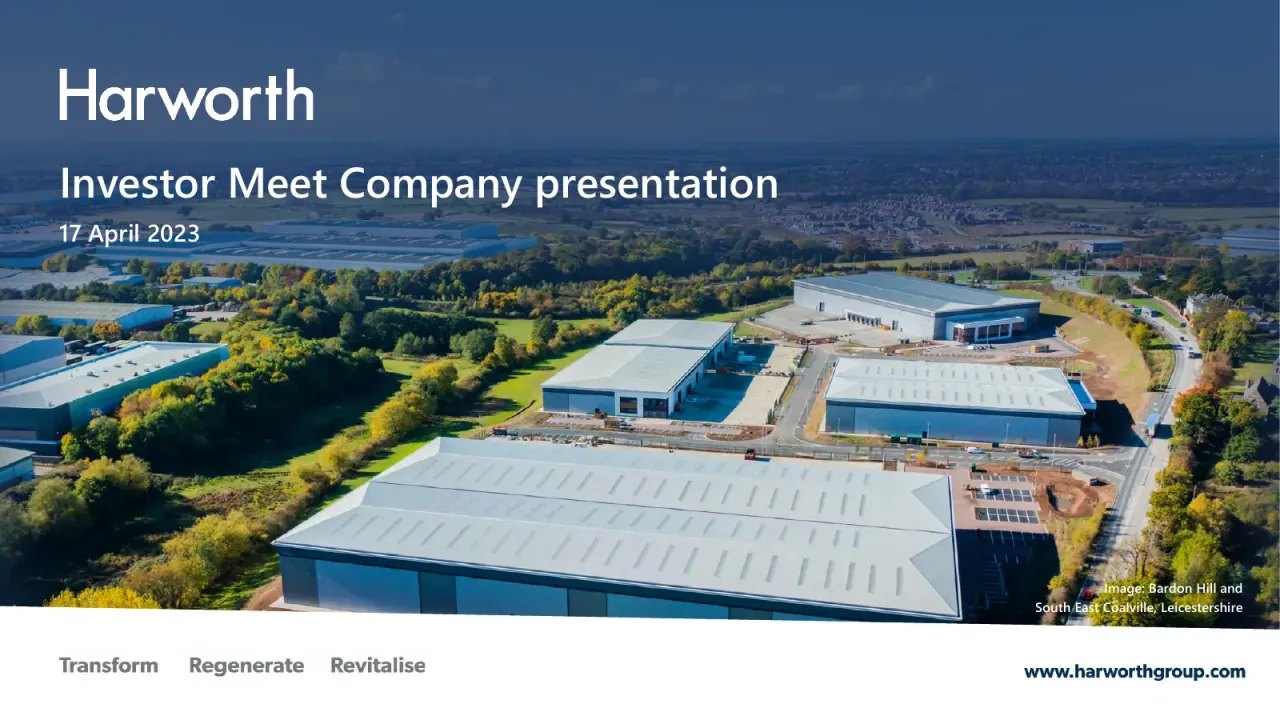
Investor Presentation hosted by Harworth Group (LSE:HWG) on Investor Meet Company, held 2023-04-17.
On 6ix: 6ix.com/event/harworth-group-plc-hwg-investor-presentation-1
Automated transcript · Written by software from the replay's audio. It can mishear names and figures; the replay is the record.
0:00 Good afternoon, and welcome to the HARWORTH GROUP PLC investor presentation. Throughout this recorded presentation, investors will be in listen only mode. Questions are encouraged and could be submitted at any time by the Q and A tab just situated in the right hand corner of your screen. Just simply type in your questions and press send. The company may not be in a position to answer every question it received during the meeting itself. However, the company will review all questions submitted today and publish responses where it is appropriate to do so. Before we begin, I'd like to submit the following poll. I'd now like to hand you over to Linda Shillor, CEO. Good afternoon. Good afternoon, everybody, and welcome to HARWORTH's second presentation on the investor meet company platform. And this is largely focused on our full year results for 2022 that we announced last month, but we'll also talk about our our outlook for 2023. So I'm Linda Shuller, I'm chief executive, and I'm delighted to be joined by Kitty Patmore, our chief financial officer.
0:51 And we're once again very pleased to have an opportunity through this platform to speak directly to our valued individual shareholders and those who are considering an investment in HARWORTH.
1:01 This slide shows the agenda for today. I'll begin with an overview of our performance during 2022. As I said at the start, I'll comment on the market backdrop, but also report on the progress that we're making in delivering our strategy. I'm then gonna hand over to Kitty to take you through the financials, and then I'll provide an operational update and our view on the outlook for the remainder of 2023. We'll then close the session with some q and a. And just as a reminder, you can submit questions at any time during presentation, and we will aim to answer as many of these as we can at the end. So I'd like to begin with three key takeaways from HARWORTH's performance during 2022. It was a year of significant operational and strategic progress, and we delivered on every aspect of our strategy to become a £1,000,000,000 business by 2027.
1:47 We saw record low levels of residential plot sales and direct developments of industrial and logistics space. And we also added a record number of square feet to our pipeline through acquisitions, and we're well underway in transitioning our investment portfolio to modern grade a. From the perspective of the market, it was however very much a year of two halves. And following significant valuation gains in the first half, we saw rapid outward yield shifts in the second half amid a softening of macroeconomic conditions. And over the year as a whole, our management actions to drive value across the portfolio actually managed to largely offset the yield shifts. And we ended the year with a broadly flat EPRA MDV and total return. We consider this to be a very robust performance given the scale of the second half headwinds.
2:33 Finally, and most importantly looking forward, we are really well positioned. Our focus markets remain strong and characterized by resilient demand and under supply. What's more, we have a strong financial position, a large land bank that we own or control, and a highly experienced man experienced management team who are focused on execution. So the last two to three years have seen both tailwinds and headwinds amplified by the global pandemic and the macroeconomic uncertainty that is a consequence of this. And also from the beginning of last year, the war in the Ukraine. Against this backdrop, HARWORTH has delivered consistently strong operational performance, making significant progress in implementing our strategy and growing the business. And I've said before, this is a marathon, not a sprint. You can't just do regeneration.
3:22 HARWORTH is a long term through the cycle business, and that means that we look through these near term market conditions as we execute our plans. HARWORTH is all about its people. And over the last two years, we've built our team to enable us to deliver our strategy successfully. And it is their skill and hard work and efforts that are essential in driving our business forward. And also, believe that we have the right strategy and all the right ingredients to realize the full potential of our portfolio to deliver long term growth to our investors. So looking at highlights of 2022 in more detail. Our industrial and logistics pipeline grew to a new high of 35,000,000 square feet, driven by strong acquisitions performance across our regions. We also completed the developments of 432,000 square feet of space during the year at Barden Hill and the Advanced Manufacturing Park.
4:14 Our residential pipeline remains stable at just under 30,000 plots, a significant achieve achievement in itself considering that we sold over 2,200 plots during the year. And this was again a new record for us. And even in the second half of the year, we were transacting in line with or ahead of our June 2022 valuations. Staying with residential, we launched our single family build to rent portfolio, and we are working on heads of terms with our preferred investors and contracts with construction partners. As we work through the pipeline faster, it's really important for us to keep filling the hopper, and you'll see that we added eight and a half million square feet of industrial and logistics space and over two and a half thousand residential plots to our pipeline through a combination of freehold acquisitions, options, and planning promotion agreements.
5:01 With the transfer of Barden Hill to our investment portfolio, it now stands at 18% grade a, up from 11% in 2021. And across the portfolio, we continue to see strong levels of occupier interest and letting activity, securing deals at premiums to ERV and previous passing rents. Finally, the HARWORTH Way. Our sustainability framework runs through everything that we do as a business, and it has been a transformative year for us as we have created a dedicated sustainability team, developed a detailed net zero carbon pathway while enhancing our metrics, the data collection, and our analytical capability. And our focus in 2022 has been understanding the carbon journey of what we build and setting the program of work from 2023 onwards necessary to deliver and report against our objectives.
5:53 Enhancing our reporting on the social impacts of what we do is a key focus of 2023 Because we believe that what we do in the regions makes a difference to communities and because our portfolio has the potential to deliver 4,600,000,000 of gross value add. So turning to our markets, this slide provides an overview of some of the key trends that we're seeing. The chart in the top left shows that following the record first half, 2022 ended up being the third strongest year ever for industrial logistics take up, surpassed only by 2021 and 2020. Demand softened slightly in the second half, but it still remained well above the long term average. In the bottom left, we pulled out some of the key trends in the drivers of demand for industrial and logistics space, where a significant shift is underway.
6:43 Third party logistics and manufacturing saw their strongest year ever for take up. And this is likely to be driven by trends such as onshoring, nearshoring, and a focus on supply chain stability. These off these offset the reduced demand from onto online retailers who recorded their lowest take up in five years. In addition, 86% of the demand was for grade a space, underscoring occupiers preferences for modern, high quality, and sustainable units, and endorsing our strategy to transition the investment portfolio to a 100% grade a by 2027. Elsewhere in the market, supply remains close to record lows with average vacancy rates below 4%. And in some of our regions such as the West Midlands, it's lower still with the vacancy of around 3% and less than half a year of supply in the market.
7:36 Turning to residential. Following a strong first half, the latter months of 2022 saw weaker demand as higher mortgage rates, challenging affordability, and subdued consumer confidence took hold. This has undoubtedly had an impact on house builders who have been cautious in their recent reporting, which has suggested that whilst pricing and incentive levels are seeing some adjustment, demand has showed signs of recovery, albeit not yet to the levels seen in early twenty twenty two. And the chart on this slide indicates one of the potential drivers of this. Average mortgage average mortgage rates have come in from their post mini budget spikes. And if this continues, it should improve affordability and the consumer outlook. Finally, and particularly relevant to our strategy of broadening our range of residential products, the bottom right chart shows the single family built to rent market has grown rapidly in recent years and is set to increase exponentially over the next decade to over 70,000 dwellings.
8:35 Investors continue to be attracted to the highly defensive and consistent returns offered by these products and the sustainability led rental communities that they can provide. So before I hand over to Kitty, I just want to take a few moments to review our strategic scorecard. And as I sort of mentioned at the beginning, it shows progress against all four growth drivers of our strategy to reach 1,000,000,000 of EPRA MDV by 2027. We significantly stepped up the direct development from previous years and are now making good progress to delivering an average of 800,000 square feet per annum by 2027. To manage risk, we combine small to midsize speculative builds with pre let and build to suit opportunities, and we will flex this to respond to changing market conditions. In residential, we saw a particularly strong year for plot sales. This was driven by buoyant house builder demand. And in response to this, we brought forward land sales to capture these strong market conditions.
9:32 It's also important to remember that our target of selling 2,000 plots per year is an average, and that we will see years above and below this figure depending on market conditions and the phasing of our sites. Our twelve to fifteen year land supply was maintained by the acquisitions as I've already mentioned, and our investment portfolio reached 18% grade a, which is a significant step up from 11% at the end of twenty twenty one and has continued to rise post year end with the completion of additional direct developments and select to sales of more mature investment portfolio assets. So as you can see, we've made a lot of progress operationally, and we remain on track to reach our 1,000,000,000 target by 2027. And with that, I'd like to hand over to Kitty to take you through the financials.
10:18 Thanks, Kitty. Thank you, Linda, and good afternoon, everybody. I'd now like to take you through HARWORTH's financial performance during 2022 in more detail. So starting with our balance sheet. Our EPRA NDV, which is our net assets, assuming all of the properties are held at market value remained broadly flat year on year and was £633,800,000 as at 12/31/2022, equating to 196.5p per share. This was the result of a strong first half performance followed by significant market driven outward yield shift in the valuations of our investment portfolio and more mature industrial and logistics development sites in the second half. Our management actions were able to largely offset this yield shift, but the overall result was a reversal of our first half gains and therefore a broadly flat valuation performance and net for NDV movement during the year. And I'll talk a little bit more about our valuation performance in a moment.
11:17 Net debt was £48,400,000 increased from its position at the end of last year, largely due to higher direct development spend such as at our Bardan Hill site, but it remains relatively low in historical terms. And combined with the dividends, our broadly flat EPRA NDV movement led to a total return of 0.1% during the year. Turning to the income statement, sales of service land and property in addition to income from rent, royalties and fees resulted in group revenue of $166,700,000 during the year, an increase from $109,900,000 in 2021. The growth was due to higher service land and property sales, which totaled £138,500,000 in the year, including the sale of our Kellingley site for £54,000,000 plus growth in rental income due to completed direct development projects and fees from development management and planning promotion agreements.
12:12 Looking forwards, around 72% of our budgeted sales for 2023 are now completed, exchanged or in heads of terms. Administrative expenses increased by GBP 2,900,000 during the year. This is principally due to higher salary costs resulting from increased employee numbers to support our growth strategy. Admin costs expressed as a percentage of revenue decreased during the year from 17% to 13%, and we do expect the pace of growth in employee numbers to reduce going forwards. Revaluation movements are an important component of our performance and are seen both in the income statement and the balance sheet. In the income statement, we can see the decreases in the fair value of assets held for sale and investment properties. These consist predominantly of our investment portfolio, our strategic land and our natural resources portfolio, but it doesn't include any changes in the fair value of our development properties.
13:08 And if you exclude the impact of revaluation loss gains and losses both from 2021 and 2022, operating profit increased year on year. Tax charges decreased due to unrealized gains and losses on investment properties and all these factors combined resulted in a profit after tax of $27,800,000 compared to $94,000,000 in the prior year, which was heavily influenced by the 2021 valuation gains. Finally, the board has decided on a final dividend of 0.99p per share, bringing the total dividend for the year to 1.333p per share. This represents a 10% increase on the prior year, which is in line with our dividend policy. So looking at our valuation movements in some more detail. This slide shows the component parts of our £2,000,000 valuation loss during the year, which compares to valuation gain of a 160,500,000 in 2021.
14:05 This year, we have split our major developments and strategic land sites by market sector to show the different valuation dynamics of each. In industrial and logistics, headline yields over the twelve months moved by out by up to a 150 basis points or 30% to 40% alongside continued rent growth with occupier demand. These market trends are seen across our investment portfolio, industrial and logistics major development sites and near term strategic land sites. The full downwards market movement was largely offset through our management actions on our sites, such as planning progress in strategic land, securing grants and development progress, including development completions and major development sites, a new above market level lettings in the investment portfolio.
14:50 As a result, although headline yields moved 30% to 40%, the industrial and logistics part of our portfolio only reduced in value on a like for like basis by around 12%. Our record residential land sales, which transacted in line with or above book value helped to drive gains across our residential major developments and strategic lands, including at our Iron Bridge development. And our natural resources and agricultural land portfolio made broadly stable year on year. This slide provides a breakdown of our £737,000,000 portfolio as of 12/31/2022. Industrial and logistic lands and property shown here in shades of green count for around 60% of our portfolio by value, with residential land and property shown here in shades of blue accounting for most of the remainder.
15:41 The table on the right hand side summarizes for each segment the pound per square foot for industrial and logistics sites and pound per plot for residential sites. And this shows quite clearly the significant value that we generate by taking sites through the planning system, putting in place infrastructure and services before in the case of industrial and logistics developing and letting them to occupiers. It also shows the huge potential value of our currently unconsented strategic land pipeline, which represents 29,600,000 square feet of industrial and logistics space and 23,200 residential plots. This has increased from 22,400,000 square feet and around 22,000 plots in 2021.
16:25 This slide shows our valuation gains and losses for every six months over the past five years and is very useful for putting our second half performance into perspective. And it demonstrates how despite the valuation movement in the second half, by taking a long term approach, we've been able to deliver over £275,000,000 of cumulative value gains over the past five years and have also delivered an average annual total return of 9.8% over the same period.
16:53 So turning to look at debt. The chart on this slide bridges the increase in our net debt position from 25,700,000 at the end of twenty twenty one to 48,400,000 as at the end of twenty twenty two. The main driver was an increase in development spend and cash and working capital used in operations as we stepped into our growth strategy. And this was largely offset by the significant sales proceeds realized during the year. This chart also shows the headroom afforded by our cash position and revolving credit facility, which I'll provide some more detail on now. Our financing strategy remains to be prudently geared, and we have a target net loan to portfolio value at year end below 20% with a maximum of 25% during the year. At year end, our net loan to value was just 6.6%, slightly higher than at the end of twenty twenty one, but well within our target levels.
17:46 In early twenty twenty two, we agreed a new senior debt package comprising a £200,000,000 revolving credit facility together with a £40,000,000 uncommitted accordion. This facility replaced our previous loan, added HSBC to our lending club and provides the group with additional firepower and flexibility.
18:05 Alongside this, we continue to enter into site specific development and infrastructure loans as you can see from the table of our drawn debt on the right hand side of this slide. So in summary, 2022 saw a robust financial performance for the group and we remain in a strong financial position with low loan to value and cash and available facilities of GBP 175,600,000 and no major refinancing requirements until 2027. We'll continue to monitor closely the external environment. We will use our skills and flexibility to target our capital to drive long term value for shareholders. And with that, I'd like to hand you back to Linda to take you through the operational review. Thanks, Kitty. And now I would like to provide some more detail on our operational progress during 2022.
18:55 Slide 16 provides an overview of our 35,000,000 square foot industrial and logistics portfolio, over half of which is held freehold or in joint ventures. Over 5,000,000 square feet of this space has a planning consent and includes mature sites such as the Advanced Manufacturing Park and Gateway 36. Both of these have been hugely successful schemes, and we still have strong demand during the year as we brought forward the next phases of development.
19:21 Our planning constraints also include sites such as Chatterley Valley, where site preparation works began towards the end of twenty twenty two for what will eventually be 1,200,000 square feet of employment space at the heart of the Ceramic Valley Enterprise zone in Staffordshire. Over five and a half million square feet of development is progressing through the planning system, including Gascon Wood in North Yorkshire and Skelton Grange in Leeds. And during the year, we entered into option agreements for two significant sites, One in North Yorkshire and the other adjacent to Junction 15 of the M 1 in Northamptonshire. Both of these sites are in highly sought after industrial locations and have huge potential. And we look forward to working with local stakeholders to bring forward our plans as we work through '23. The table in the top right shows the potential gross development value to come from a selection of these sites, which could be as high as 1,700,000,000, demonstrating a significant pipeline of developments in our strategic plan window and signaling the potential value that we can unlock from the long term pipeline as we continue to assemble schemes and work them through the planning system.
20:28 Turns to our residential portfolio, which has the potential to deliver around 30,000 housing plans, of which just under a quarter have a planning consent. As I've said, it's been a record year for residential plot sales, which totaled 2,236. And within that figure, saw some significant milestones. We completed our largest sale to date in a 450 plot transaction with Barrett and David Wilson Homes at Waverley. We sold the first phase of our thousand home mixed use regeneration scheme at Ironbridge, also to Baron David Wilson. And we completed the sale of 80 plots to regional house builder KB Homes at Southeast Colville, which brought the total number of house builders that HARWORTH has transacted with to 21.
21:12 As a master developer, we pride ourselves on investing in residential sites to provide great infrastructure, amenities, and green space for residents. And this slide provides just a flavor of what we've been up to during the year, progressing applications for new schools, developing new facilities, and improving connectivity. Staying with residential, one of our key strategic objectives is to broaden the range of our residential products. We made important progress on that front during the year, launching our first single family built to rent portfolio of up to 1,200 homes. Some of you may have heard it referred to as project spur. It has attracted significant levels of interest, and we have now selected our preferred investments and construction partners and are progressing towards exchange. We now have a mixed tenure team in place within HARWORTH. And as you can see from this slide, work is well underway to explore other types of residential products that could be delivered across our sites using strategic partners where appropriate.
22:08 Offering these products alongside our traditional service plot product has many benefits. It provides us with an important diversification, and it allows us to accelerate the delivery of our residential sites and gives us the opportunities to control build quality, innovation, and sustainability, which is critical for maintaining a sense of place, also preserving land values, and meeting our net zero carbon goals. And I look forward to providing you with a further update on the progress of the built to rent portfolio and these other residential products in due course. Our £281,000,000 resident investment portfolio, gosh, residential portfolio would be great, is a key part of HARWORTH's funding structure and growth strategy. This portfolio delivers an annualized rent bill of 19,700,000 and continues to deliver robust financial metrics. And you can see from the chart from the top right of this slide that the occupier base is diverse.
23:04 It's focused on those sectors that are currently driving demand, such as manufacturing and third party logistics. You can see from the bottom right of the slide that the operational metrics also remain strong with a long weighted average and expired lease term of over eleven years and a low vacancy rate of 2.7% when excluding our recently completed Barden Hill development. And also, you'll see we continue to have strong rent collection. During the year, we completed over 600,000 square feet of lettings, adding close to 1,700,000 of annualized rent. And we transacted at significant premiums to previous passing rents in ERVs. After year end, you may have seen press releases that we completed the sale of two sites for a total of 12,600,000.
23:49 In line with or ahead of December 22 valuations as part of our strategy to recycle capital and and and transition the investment portfolio to modern grade a. As many of you will know, the the HARWORTH Way is our framework for embedding sustainability and social value throughout our culture, our operations, and our strategy. And one of the key key pillars of the HARWORTH way is planet, which first means minimizing our environmental impact, building in climate resilience, and promoting biodiversity. Last year, HARWORTH committed to becoming net zero carbon for scope one, scope two, and scope three business travel emissions by 2030, but also to be net zero carbon for all emissions by 2040.
24:36 To meet these objectives, we've appointed our first director of sustainability, and we've put in place a sustainability team. Their priority for this year has been devising our net zero carbon pathway and embedding its commitments into a range of work streams and targets. This slide provides just a few of these in areas such as the developments of our industrial and logistics and residential sites, and also including targets to be net zero carbon on all new industrial and logistics developments by 2030. More details of this can be found in our net zero carbon pathway report, which is available on our website now. During the year, we also completed a strategic review of our natural resources portfolio. You may have remembered if you heard me talk about half year that we haven't completed that work in the first piece of strategy work, but we we did that as we worked through 2022.
25:25 And this comprises site use for a wide range of energy production and extraction purposes. The review aimed to determining how best to predict and optimize value from this portfolio while maximizing the role that these assets play in realizing our sustainability ambitions. The outcome has been to develop an energy and natural capital strategy, and we aim to develop renewable energy generation and storage solutions and other green initiatives such as reforestation or rewilding of our natural resources assets. Our existing natural resources team will also have a wide responsibility for embedding these energy concepts and principles across each one of our development sites as part of our master plans to maximize energy availability and green capital for residents and occupiers.
26:14 And we also believe that over time, this will create and preserve value for investors while achieving HARWORTH net zero carbon ambitions. So turning to the outlook. Following the rapid outward yield movements of late twenty twenty two, some signs of stability seem to be returning to the market in the early months of 2023 as the speed of interest rate rises and outward yield shift slows. That said, the war in The Ukraine continues and economies are still responding to energy and other commodity shocks that this triggered.
26:47 We're encouraged by these trends, but at this early stage in the year, we remain cautious about the economic backdrop for 2023. Uncertainty is likely to remain in our markets until interest rates reach their peak and inflation falls back to manageable levels, creating conditions for growth and improved investor confidence. Against this backdrop, HARWORTH is well positioned. We're a long term through the cycle business. As I said at the top, you cannot do rent regeneration quickly. Most of our sites will be in development, planning or land assembly through the next few years and into the next decade. This means that while we are active through the cycle, we modify our short term plans to reflect changes in the market. We're also looking through these near term market conditions to where we need to invest to create the future value and returns that we can unlock from our sites.
27:36 And in closing, I'd like to emphasize that what we do is important to the local economies that we invest in and the communities that we create. Our focused markets are drivers of economic growth and continue to have robust fundamentals. And moreover, in an economy in need of planning reform that truly drives growth, there remains an acute shortage of high quality contented land.
28:00 Importantly, we control our land bank, and we control when and where we invest. And we have a highly experienced management team who are focused on execution. As we navigate the business through the challenge of the wider economic backdrop, we're confident that our strategy is the right one to deliver long term value to stakeholders while also meeting our net zero carbon commitments. And our strong financial position, our differentiated products, and the scale of mix of our portfolio position us well to realize the full potential of our sites. And with that, we'd be delighted to take your questions. As a reminder, you can continue to submit questions and we'll aim to get through as many as we can. Thank you. Thanks, Alexandra. Linda, Katie, thank you very much for presentation. Ladies and gentlemen, please do continue to submit your questions just by using the q and a tab, which is situated in the top right hand corner of your screen. Just while the company take a few minutes to review those questions submitted today, I'd like to remind you recording of this presentation along with a copy of the slides and the published q and a can be accessed via your investor dashboard.
28:59 Tom, if I may, could I just ask you to read out the questions where it's appropriate to do so, and then I'll pick up from you at the end? Absolutely. Thank you, Alessandro. Okay. So first question we have, I guess, is for Kitty. It says over 2021 and 2022 combined, how have investment yields moved? Yeah. So so sort of thinking of really about industrial and logistics because I suppose that's the the bit of the portfolio that seems of real sort of tightening of yields, I suppose, we came out of COVID. We saw sort of high demand from sort of ecommerce and then sort of feeding through to probably a peak point since maybe April sort of time last year. And then as interest rate rises came through, so those industrial and logistics mills, the yields have moved out.
29:53 So we winds up all the way back to sort of 2020, probably prime yields were probably about 4% at the time, I would say. Over the course of over the course of sort of 2021, we saw that tighten probably. So so I think the CBRE placed prime yields at the end of twenty twenty one at three and a half percent and then in June last year at three and a quarter. So they moved from the for over the course of sort of eighteen months from sort of 4% into three and a quarter. And then in the six months from June to December, they moved all the way out to 5%. So you saw them sort of come in and then go out, but actually go out further than the the end of sort of twenty twenty over the course of sort of two years further back than than the end of twenty twenty.
30:41 And then sort of thinking about sort of our investment portfolio as as, I guess, of a proxy for some of that and and how you can see how sort of asset management actions that that we've sort of taken, rent movements as well sort of play into it too. At the end of twenty twenty, that investment portfolio had a net initial yield of 6.1%. By the end of twenty twenty one, that had come in to 5.6%, So it came in. And then at the end of last year, at the end of twenty twenty two, it was back at 6.2%. So the yields in the market, prime yields and and secondary yields, it's interesting to say, moved almost exactly the same as prime yields. We thought for a while they might not move as much as prime yields, but actually over the time, they they almost pretty much mirrored prime yields. So that had moved from the end of twenty twenty being at 4% into three and a quarter and then back out to five.
31:31 And and our investment portfolio went from sort of 6.1% into sort of 5.6 and then back up to 6.2%. So you would have expected it to move further. It didn't move quite as far because we have sort of increased rents, and we've also increased the proportion of grade a within the portfolio by upgrading assets or developing our our own assets over over the period too. So so you can see sort of it in both ways how the market has moved. Thank you, Kitty. The next question, I think, is, probably for Linda. It is, could you please describe the criteria that define a grade a development or building?
32:13 Oh, I'm sure every developer you ask will give you a different answer, but here's the HARWORTH version of this. Location, specification, occupier covenants, and the sort of and the lease, basically. So the sort of, you know, the sort of quality of the lease, and that can be in term in length. It can be sort of how many sort of breaks are sort of sitting in there. We've really focused on the the the new buildings that we are developing and bringing into our portfolio to getting green leases in place with occupiers as well. But it's a combination of of of all of of all of those factors. It's very difficult to build a grade a office and attract a grade a occupier in the wrong location. But as as I mentioned, and when we were doing the presentation that we're seeing that occupiers are very focused on the specification now of buildings.
33:03 And what does that mean for us? Our buildings are basically a minimum of room, excellent in delivery. We're targeting and really focused on delivering EPCAs, but they have integrated solar, really high levels of installation. And more so with our HARWORTH, the site that it sits within, so it's not just about the building that we build, but it's about, you know, sort of shared amenity, whether that is green space or whether that is things like sustainable urban drainage systems. And I think actually not just for us, but for many developers as you start to move forward over time, you know, on-site provision beyond integrated solar on roofs of energy, but also forms of backup will form will form part of that spec as we move forward. So like I said, I'm sure every developer will give you their flavor, but that but that's the HARWORTH flavor.
33:52 Thank you, Linda. And the next question is for Kitty. How are your assets valued and how often?
34:01 Yeah. So our our assets are valued every six months by an independent valuer. So we use BNP and Savills to value the portfolio, and they do a half year valuation and and a full year valuation as well. And that's what they show slightly differently between the statutory net assets. But you need to look at the the EPRA sort of NDV, which is the EPRA NAV, which has the the market value of of all of the assets as at December 31 to get to the latest view. So everything is is valued on that basis. We've got different types of property within the portfolio. So the the most mature beings of the investment portfolio, and and that's valued based on sort of comparable evidence looking at yields and rents.
34:53 Development sites, both industrial and logistics and residential, tend to be valued as sort of almost looking at what can be driven, what value can be driven out of those sites over sort of a period of time. And therefore, what's the the land value assuming that those receipts, those costs, and and sort of assumes that profit levels. And, again, then looking at comparable evidence and sort of two. So what we find is certainly for sort of residential sites, for example, sales that we make on those sites can be quite influential to to the valuation because it's proving sort of what somebody would pay for service land. And then we've got sort of strategic land within the portfolio, and that tends to be sort of looking at other sort of land transactions.
35:38 Sort of longer term typically sort of sitting there with with much less sort of hope value in it and and sort of very long term, then it can be all the way back to sort of agricultural land values too. We've got a little bit of agriculture in the portfolio, and we've also got the natural resources portfolio, which is a mixture. Natural resources tends to be sort of looking again at the income streams that can be driven off those sites and and applying a yield to it. Thank you, Kitty. The next question, I think, will be for Linda. It's are there any potential regulatory changes to the planning process or planning more generally that will have an effect on the strategy? I suppose the sort of simple answer is is no.
36:24 We as a as a business, we have a really skilled team of planners, planners embedded in each of our regions as well in the center. Planning on the scale that we develop and regenerate, you know, sort of is always quite a long process. Even on brownfield sites where there's a presumption in favor of development, it's about actually making sure you that you're getting the right scheme that's gonna be supported by the local authorities and and and local residents. So we work really hard, and we've put actually as we've grown the business and we've really accelerated into the strategy, we've put extra resource into our planning teams in the regions, as well as at the center, because we're actually active now probably on more planning applications across the business than than we were two years ago.
37:12 But they are taking sort of longer to to get through the system. The planners themselves, local planners themselves are a, under resourced, and they have been for a very long time, But they're also having to cope with things like nitrate neutrality. It doesn't have a massive impact on any HWORTH sites I hasten to that, but in other parts of the country, that is a significant issue for developers. But also the introduction of the sort of biodiversity net gain targets in local authorities and actually the overlay of that into an already quite complex planning process is is taking some time for local authorities to digest. We're skilled at getting through that process. That's one of the sort of core ways that we start to create value and unlock our sites.
37:57 And we've got a really long track record of success. So all I'd say is it it it's not gonna affect what we do. We'll continue to do that and put the resource in that we need to work it through the process, but it's probably, no easier than, than it was last year or the year before actually to get schemes, to get schemes consented. Thank you, Linda. The next question is how will net zero requirements over the next several years affect your business? So I think there's, there's a really sort of simple, like, 50,000 sort of, sort of foot, answer to this, which is if you don't start to decarbonize your products, and what you deliver, it will affect the business in the sense of it's gonna go to value. So I I come back to we we see we see we saw this in the office market actually sort of if you go back ten to twenty years ago when people started to build the sort of then modern version of offices.
39:00 And there was a huge amount of debate around, will there be a green premium or a brown discount? The reality of it was was the occupier and investors, institution investors drove what the product needed to be. And therefore, if yours didn't look like that, you were basically gonna you know, you're achieving lower rents. It was maybe less attractive to occupiers, and eventually, you have to invest. And I think we're sort of at the same place with actually, you know, development generally now. Again, that's Savills figure sort of sticks in my mind that 86% of space that was taken up last year was was grade a. So that is the more sustainable, the more energy efficient, the more the lighter, the brighter, the nicer for for occupiers and for workforces. So the reality of it is is that, you know, we're not immune to this. We're going through this with the rest of the, you know, with the rest of the development community.
39:52 I think simply not continuing to progress and develop our products to support our the decarbonization of our business is probably that that will be more punitive than doing it. Does it introduce additional costs? To some extent, yes, in some parts of what we do. But then there are other things where, for example, you were putting in some sites more electricity sort of network and infrastructure because you're not putting gas in. So at Ironbridge, there's no gas being put into Ironbridge. There's no gas going into Chatterley. And some of our house builder customers on some of our existing sites where we do have the sort of dual fuel are asking actually for more electricity than than gas in the later phases of their development. So I think it's one that the whole industry is grappling with and working through.
40:43 But if you get a chance to look at our net zero carbon pathway document, we've really sort of clearly identified in that. I think the journey that we're on as a business, but also that a lot I say a lot of the sectors on to making sure that we deliver as decarbonized a product, as we as we work through the next decade as possible. Thanks, Linda. Next is a kind of comment and a question from Gareth. He says, I'm a long time small shareholder for over a decade. Thank you very much for your support. My congrats on a fine performance given a tough h two. Leaving aside general economic strategy, what are the key specific moves by government that you would ideally like to see to help foster your further growth?
41:29 Right. I'll try to do this and not vent my spleen. We'll see. But it's a great question, and and thank you for your comment because actually in any ordinary year, you know, the result actually sort of smashed the lights out. It just didn't look that pretty, you know, sort of given what was going on in the market. So, we we very much appreciate that comment. I think the biggest thing for for our sector is, you know, is actually planning reform that supports growth. So, I mean, I've been around the sector for a very long time, and I've seen all sorts of different sorts of governments and different attempts to reform planning, and nobody's got it right yet. And I think, actually, this government have probably got it more wrong, than than the most actually at the moment.
42:14 But planning reform needs to be designed so it supports growth, that it supports investments, and so that investors are not ultra cautious about the time it's gonna take something to sort of work through the system, whether or not they're actually gonna get, you know, sort of support even if they get an officer's recommendation and how protracted that process can be. I think it's got to be really joined up as well, at the regional level. So we're seeing, as we've gone through the last few years, you see more and more combined authorities form, and they are much bigger bigger geographical patches that can basically take, a much more, an overview, if you like, of sort of of regional economies and what needs to go where. And you you're seeing that in Greater Manchester actually. You're out consulting on, you know, sort of their spatial strategy, which is places for everyone, and nine of the 10 authorities are involved in that. And between them, they've worked out and agreed, like, where they're gonna drive employment and where they're gonna drive housing. And that that is quite advanced now, actually, that that sort of plan working its way through the process.
43:16 And if you on that on the slide earlier, you'll see that we've got a number of sites that are actually sort of caught within, you know, sort of that process and previous and previous reviews. I think it's gotta be joined up in a way as well, but it's not focused on, the latest gimmicks. So we've got investment zones. We've got town center regeneration funds. We've got free ports. We've got all sorts of things going on, which make it really difficult for local authorities themselves to basically focus their time and resource. And, you know, they often only get two, three weeks to put a bid together, which means actually it's two or three weeks when they're not working on your planning application. So there's a whole raft of things. So for me, if they fundamentally sat back and said, actually, let's the planning system work to support growth and then make sure we're incentivizing both local authorities and investors and occupiers in the right way, that would be, my nirvana.
44:12 Thank you, Linda. Next question. Given the strength of the balance sheet and the quality of the portfolio, why do you think the share price doesn't represent your splendid efforts? I think this might be a double header. It would be Kitty and I probably both. I'll just I'll start by saying it's not just HARWORTH. It is sector wide. I mean, the real estate sector is generally sort of, you know, sort of is is trading sort of more at a discount than than sort of not. I think for us, sometimes we can get caught between a REIT and a house builder, but for it's about delivering against that strategy in my mind, which is long term consistent delivery, driving those sort of high single, low double digit returns, and continuing to grow the company. And I think it's that consistency of performance through the cycle that basically, you know, sort of just stick to your knitting as a number of our investors have said to us actually as we've done the road shows, stick to your knitting and basically, you know, sort of, you know, this will come good. But the sector as a whole is out of favor at the moment.
45:20 And, you know, that has been driven by, you know, sort of the rising interest rates and the impact, know, sort of on the cost of debt, you know, that that that's that people need to sort of come in and actually bring schemes forward. And and one of our strengths at this point in time relative to sort of many others is, is actually the strength of our balance sheet. Kitty? No. I I would do I would agree with with all of that, of, Linda. I think I think this the sector is is definitely about our favor, I think. So it feels frustrating, to be honest, when when we we feel like we we've sort of delivered operationally, so we're progressing on the strategic plan. We're still anticipating being sort of at sort of a billion of of net assets in in 2027 as well.
46:07 And we're just very focused on on doing that and talking to people and sort of highlighting what HARWORTH has has to offer, really. Yeah. And we're all shareholders as well. So, you know, we we watch it through the lens that you're watching it through as well, actually. So but equally, we're shareholders because we believe, you know, we're we're close to the company, obviously, CEO, CFO, and this sort of senior team. Many of our people in the across the business are shareholders. And we believe the strategy is the right strategy and that we'll we'll we'll sort of get to that billion, you know, and the business is well set for is well set for growth there and and hopefully in the years to come beyond that as well. Thank you very much both. The next question, I think, is a slight kind of misunderstanding of the strategy, but I'll read it anyway, just for transparency.
46:58 It's in a world where industrial REITs are trading at 30 plus discounts to NAV, how do shareholders benefit from your strategy of buying industrial property at prices which will be much closer to valuation? Yeah. Right. Do you wanna go on that one, Kissy? Yeah. Absolutely. And it it is it is really interesting, and it sort of highlights that sort of the the REITs are also sort of trading at at a discount at the moment as well. But our our strategy is is very much to sort of manage our land and property and to develop it in the right instance in in order to create value. So so we we're to be clear, we're not going and buying industrial property like built sheds. We are building our own, and we have bought in the past, but but we but we don't know now. So we build our own. And with that, the advantage that that gives us is that we can sort of build and create crystallized development profit there. So we're creating value through the development build. Where we're buying it is land. It's long term strategic land pipeline.
48:02 And we're buying it with a view, not that we will sit and hold that and not do anything with it, but that at the right time, we will take it through planning. We'll put in place that the infrastructure and services and utilities, and we will ultimately sort of build that out. And through that life cycle, we will have created value at every stage of it such that the combination of the the portfolio means that the value that's created at any time sort of drives us towards that billion pounds of NDV also works out sort of gives us that average sort of total return that we've delivered over the last five years of sort of 10% as well. So I think it's quite it is quite different from sort of a REIT, which is sort of collecting rent and, yes, sort of asset managing sort of a rental portfolio. We have an element to that, but then we also have all of these other actions that sort of also sort of drive value in the portfolio, and and we're very focused on sort of maximizing those.
48:59 Thanks, Kitty. And the final question we have for now, or the penultimate question is, what's the biggest risk to your to your residential, industrial, and strategic land markets? Quite a big question. It's a really good question. I I feel like we've been, thrown in, into the eye of the storm over the last two years, both to the good and the and the sort of and the bad, actually. And I think probably my my answer to that would be the long term nature of our business, the strength of our balance sheet, and our ability to decide what we're gonna invest in and when actually mitigates a lot of the really sort of big risks that sort of has been thrown at us, whether it was through COVID, you know, sort of whether it was the crazy sort of mini budgets and what sort of gone on, since then, you know, sort of what potentially is happening in sort of banking, you know, sort of still or still or not. I mean, you know, so so the the strength of the balance sheet, the long term nature of the cycle, our ability to turn things off, not start things if we don't want to because we're not compelled to is actually a real strength. I think fundamentally, you know, a major economic downturn that was sustained, and by sustained, I mean, like, you know, sort of three to five years is gonna sort of it'll hurt us, but it'll hurt everybody else as well.
50:26 But controlling your land bank, means that you can adapt the product that you deliver as well. And in a lot of ways, you know, we really bring that to life on what we've been doing with the residential portfolio. So to continue to sort of work through those sites and keep the right level of momentum, you know, in terms of, residential phases for delivery. If it's if the sales market is gonna be saturated or slower, we've introduced more resilience by build it by bringing our build to rent products in. And also, we've got an affordable product that's coming sort of down the fling as well, both of which in, you know, really sort of attractive to to sort of to local authorities and to government because they basically need more housing delivered delivered in The UK. So I think our you know, so the risk is always gonna be market risk, you know, which actually, like, say, will impact everybody.
51:17 And those macro things that we just can't control as a management team, we've just gotta be, you know, really aware, work really hard to make sure we're not caught on the hot by anything, but more importantly, make sure that we control our land bank. We control what's delivered and when. And, basically, we flex, you know, sort of where we need to. And and, again, another example will be if you look at industrial and logistics development. We started quite a lot spec last year, so Barden was spec. The Gateway 36 development was speculative, so was the advanced manufacturing part. This year, whilst we're finishing the advanced manufacturing part because that started late in the year, this year, we will do no speculative development. It will be pre let led. So we can control those factors.
52:03 But I think the worst thing of all for, you know, for us and everybody else will be an absolutely stagnating economy. But that's just a long term, you know, if that's a long term issue, that's something as management that we'll find a way of working through. Thanks, Linda. And then the final question is, is the inflation in material, and labor costs a big issue? So last year, yes, for us and for everybody else, you'd got inflation, and then you'd got a tightness of supply because there were because the the construction industry and the house building industry were both going gangbusters.
52:49 So last year, inflation was running. I don't know the number there because somebody asked me this question the other day, but running between 812%, you know, sort of depending on what part of the country you were in, what you were tendering for. On some materials, it was running well over 20%. So if it was civil, so, you know, sort of roads and major infrastructure, you were starting you were seeing sort of some elements of materials actually with inflation into their twenties. And let's say the labor side was a constricted labor supply, and particularly house builders saw this where, you know, sort of that their their workforce could walk from one site to another and and in the day, you know, sort of get an extra sort of £50 a day, and and that was take that was taking people away, you know, sort of an an an extra half a day on a Friday. So we wouldn't and we're not really in that market this year. So cost inflation has come off. It's still sort of running somewhere between 68%, but the labor inflation is still there, and we and everyone else are seeing that still.
53:51 The sorry. Labor cost inflation. The thing that is happening though is development has slowed down, so you're starting to get some more capacity coming back into the pipeline. So for us, and and we're actively tendering on schemes now, The the good news is is as we go through our valuation process and we review every single one of our sites internally twice a year, we adjust all of our cost plans and our sort of expectations, and we look at what we need to do to continue to make that site sort of those sites hit the returns, what we're seeing is tenders coming in in line with our cost plans. And that's important because those cost plans ultimately sort of go through to our valuations. So we are sort of seeing, you know, that that but it start it feels like it's starting to normalize a little bit, albeit it's not coming off as fast as maybe people expected it would.
54:45 Yeah. I think Linda just to add to that, we we had some tenders back in last week, and we and and they actually came in sort of cheaper than than we were anticipating. So so it does feel like it's it's moving that way. And and then just to just to be clear, all cost inflation up to the end of December is already reflected in the in the valuation numbers. Linda, Katie, Tom, thank you very much for that. I think you actually managed to address every single question from investors. And, of course, the company will review all those questions submitted today, and we'll publish those responses on the investor meet company platform. But just before redirecting investors to provide you with their feedback, which is particularly important to the company, Linda, could I just ask you for a few closing comments? Yeah. I think, you know, so from the the we've got the outlook and conclusion sort of slide slip, and I I just like to sort of reinforce number of points. You know, it was a tough second half in 2022, but, you know, the business long term through the cycle, you know, all of our, you know, sort of management actions make us really resilient to what the cycle's throwing us is because as I was saying earlier, we can adjust what we do. And that was actually how we managed to offset, you know, virtually all of those market movements in the second half of twenty two.
55:59 We're executing the strategy really well. You know, we've resourced up. The team are really focused. We're active across more sites than we ever have been. The morale within the businesses is good. You know, their engagement is good. We're continuing to sort of diversify the business really well as well. But I do come back to this slight strong financial position gives us the firepower and the flexibility that we need. So if there's opportunities, we were able to execute those, but also we're able to sort of take a view on, you know, where we need to invest this year to preserve value in future years as well. And and and that's really important, actually. But the scale of our portfolio and this fact that we've got control over it, you know, sort of alongside that financial firepower makes this business really, really resilient.
56:51 Linda, Kitty, Tom, thanks once again for updating investors today. Could I please ask investors not to close this session as you'll now be automatically redirected to provide your feedback in order that the management team can better understand your views and expectations? This will only take a few moments to complete, and I'm sure we'll be greatly valued by the company. On behalf of the management team of HARWORTH GROUP PLC, we'd like to thank you for attending today's presentation, and good afternoon to you all. Thank you, everybody. Thanks very much. Bye bye.
Follow Harworth Group PLC into a list and get an email when it puts out news.
CEO at HARWORTH GROUP PLC
CFO at HARWORTH GROUP PLC
Head of Investor Relations at HARWORTH GROUP PLC