George Frangeskides
Chairman at GREENROC STRATEGIC MATERIALS PLC
Replay available
Review of Stage 2 drilling at Amitsoq Graphite Project and Outlook hosted by GreenRoc Strategic Materials (LSE:GROC) on Investor Meet Company, held 2022-09-28.
Automated transcript · Written by software from the replay's audio. It can mishear names and figures; the replay is the record.
0:01 Good afternoon, ladies and gentlemen, and welcome to the GREENROC STRATEGIC Investor Presentation. Questions are encouraged and can be submitted at any time via the Q and A tab that's situated on the right hand corner of your screen. Please just simply type in your questions at any time and press send. The company may not be in a position to answer every question it receives during the meeting itself. However, all questions submitted today will be reviewed with responses published on the Investor Meet company platform where it is appropriate to do so.
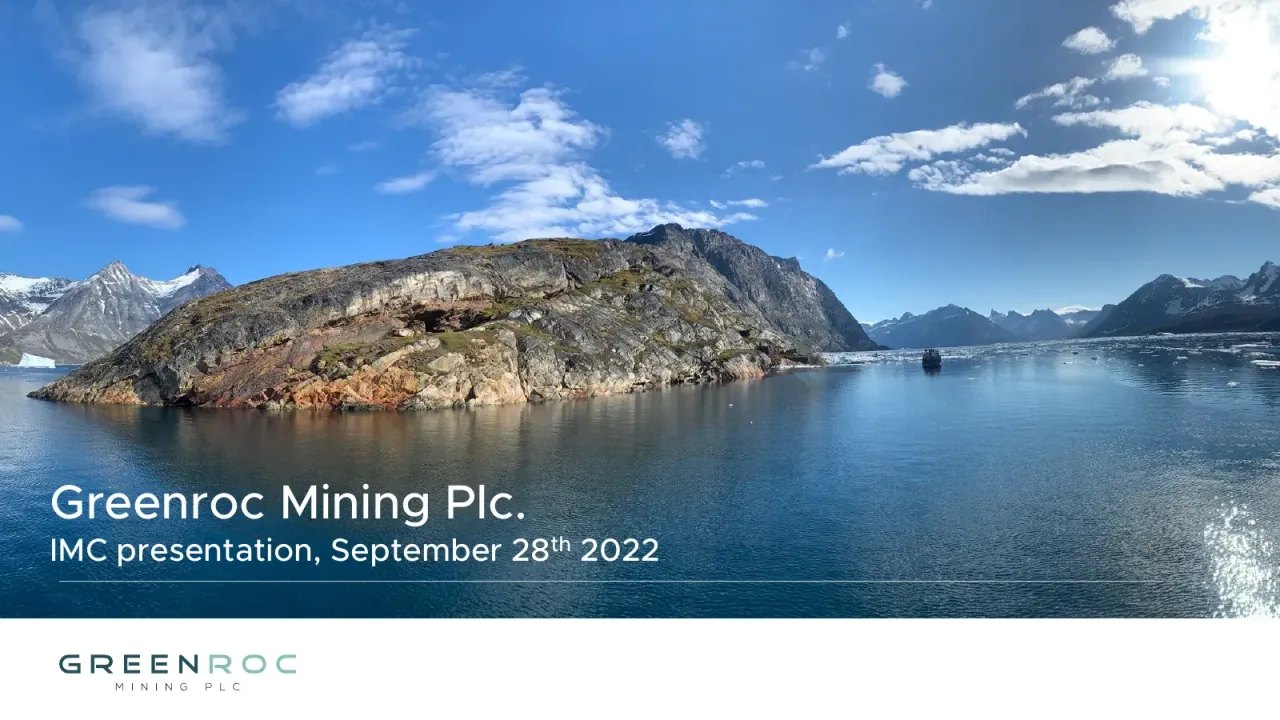
0:32 Before we begin, I would like to submit the following poll. And if you could give that your kind attention, I'm sure the company would be most grateful. And I'd now like to hand you over to c CEO, Stefan Bernstein. Good afternoon, sir. Good afternoon, everyone, and thank you for joining this presentation today. So I'm happy to be able to give you an overview of GREENROC Mining and share with you some of the latest developments on our projects and also some of the latest development on the, on the market, that we are addressing. And, also, I will, of course, be looking forward to sharing or to taking questions and having a dialogue with you after this presentation. So right. I will start this presentation, as you can see, with a photograph of Amisok Island in South Greenland. It is our graphite project, and it is really our most advanced project. And, therefore, most of this presentation will concern this this project.
1:36 And I think that you will agree with me after I've been through this presentation that the last two years of drilling, at AMITOC and also the way that the market is developing and looks to be developing, that, it really has taken a GREENROC mining, to another level, and we're now moving into a development stage, on the on the amitoc graphite. So let me just see here if I can sorry. Here is the next slide. So, the presentation here will be available after today on our website and also on the IMC website.
2:21 So I'll leave these two disclaimer slides for you to read afterwards and go on to the overview slide here that, as I said, the way that our recent development has taken us into MSOC, we now see an enormous value in pursuing this project. So, therefore, we can, in short, say the business objective for GREENROC Mining is that we will develop through to responsible production of graphite raw materials for lithium battery and load production in Europe. And, but we have other, assets also. On the map, you can see, four projects. One in South Greenland, that's a graphite. Then we have, three in North Greenland. There's the Inklefel multi element, project, and the titanium project at TBS, and then, finally, iron ore at Melville Bay.
3:20 I will use most of this presentation today to talk about the amisoft graphite, but I will also touch on the three other projects at the end. So with the conclusion of the drilling program, the second stage drilling program, just, about a week ago at Amitsoc. We are it has been very successful, and, I don't know whether you have seen the RNS that came out on on Monday. But, there, you can read that, about the, the results of the drilling. And it really looks like we would be able to increase our resource at the at the graphite project.
4:06 So that means that we also now probably are sitting with a resource that it has a has a size that allows us to, continue into development stage. There's also a very distinct market opportunity, coming, for us because the graphite demand in Europe is going to increase, compared to production or demand in 2022. That is this year here is gonna grow by 400% in only three years' time and 800% by 2030. So I will, discuss that a bit. And then, to undertake all this work here, you have a group of very, experienced, modestly, I will say, including myself, in the management team of GREENROC.
5:04 I can here, there's the the management team, and I'll also leave this slide for you to to to to read in the presentation about the the BIOS. But so AMITOC graphite project. I think I'll start out, discussing here a little bit about graphite because it is really an overlooked commodity. It's been used for, for a long time. It has a very, important application in the steels industry for crucibles and and also foundries and and other, applications. But there's a huge growing demand for graphite for the, battery industry.
5:50 And when people talk about lithium batteries, it's people mostly talk about lithium and the, supply chain, challenges there are about lithium, and sometimes also about nickel and cobalt. If you look at a lithium typical lithium battery, graphite really makes up the largest proportion of any single, commodity. Namely, 22% by weight is composed of graphite and only 2% of lithium. And then nickel and cobalt for the cathodes, make up, together less than the, what's made up by graphite. So it is so that for about one kilowatt hour battery, capacity, you need about one kilogram of, of graphite.
6:44 So an average electric vehicle battery carries about between forty and eighty kilograms of graphite. And it's not any odd graphite. It's a high purity spherical graphite. And so in the left hand side, you can see some some illustrations that show the natural flake graphite to the left that are processed into small spheres. These spheres are between only five and five 15 micron. That is five to 15 thousandths of a millimeter in diameter, and they have to be highly purified. So they are the so called high purity spherical graphite that are eventually coated with with carbon.
7:37 And in order to produce one kilogram of this high purity spherical graphite, you need two kilograms of flake graphite. So that really doubles the need for graphite to produce the graphite for the batteries. Right. So what we have at EMTOC is a graphite deposit. Actually, it's been exploited about a hundred years ago. So it was an active mine, a small one, but an underground mine,
8:09 taking advantage of the really high quality of of of the graphite. It was terminated about a hundred years ago after being in production for only about six, seven years, due to the fall in graphite prices, on the world market, after the, the First World War. So it was not like the the mind was exhausted or anything. It's, located, only 20 kilometers about north of the town of Nanautolik in the southern tip of Greenland. It favors a subarctic climate, so it's relatively mild here. So we have navigable waters year round. And
8:56 so there was a we we conducted several studies over the the past years here with the first diamond drilling taking place in 2021. And on the basis of that drilling last year, we were able to define a resource, job compliant, inferred, and indicated resource of more than 8,000,000 tons of graphite ore, with the, with the grade being nearly 20%, 19.75%. That puts us really, within the top two of a world, graphite deposits under development, as you can see on the bar graph. On the other side across the fjord, there's another area, called the that was discovered to contain, several layers of graphite also some some years ago. We haven't yet drilled that, but we can see that, this also contains high grade graphite ore. It's a bit more structurally complicated, but, so it'll still needs drilling, in order to constrain the the resources here.
10:08 So the more than 8,000,000 tons of graphite was, defined by last year's drilling. We conducted further drilling this year, and we accomplished to drill 19 holes for nearly 3,000 meters, and we hit mineable graphite in, layers in all of the, drill holes. As you can see on the right hand side panel, there's a satellite image of the southern tip of Emmetuck. Exposed at surface here are two graphite layers that you can see in brown colors. They stretch from the southern tip towards the Northeast along the coast, and this is where the old mine was situated.
10:59 There's been a lot of sampling, of course, at the surface, demonstrating that the width of the graphite layers here were in of several meters. But because graphite is very soft, the the rock here is not very well exposed, and therefore, we didn't know exactly what was hiding beneath the the mountain until we started drilling last year. And, with the drilling that took place from the blue drill pads, a, e, b, and c, we were able to define the two graphite layers, an upper graphite layer and a lower graphite layer, where the upper, has thicknesses between three and eight meters, and the lower graphite layer between five and fifteen meters thick.
11:48 And it's on the basis of the surface exposures and these drilling from the blue drill pads that we were able to define the resource of eight point nearly 8,300,000 tons. This year's drilling has been enormously successful because not only does it confirm the, the the the thicknesses of these two layers, it also vastly expands the, the the areas, or the extent of the, of the two layers. So that we found in eight of the holes, we, discovered or found the upper graphite layer. It has thicknesses between three and eight meters, and the low graphite layer, is present in all of the holes, and it seems to be increasing in thickness from about 2.5 meters in the southern tip, quickly becoming five to 10 to 12 meters in the middle part. And then in the northern part and western part, it becomes mostly between fifth, around 15 meters thick.
12:55 And in one of the holes, we we hit, more than 20 meters thickness of, of the lower graphite layer. And just judging on the visual inspection, we haven't received the assay results yet. They're still on their way to, to the labs. It looks like we have grades that are equal to those that we that the that the drilling last year, resulted in. So very, very positive result. Adding to this, the deposit is still open towards the West, where it dips, about 30 degrees to the west. It's also open towards the north. And in fact, you can see on this satellite image here that the graphite layers continue towards the Northeast. So we're quite confident that whatever increased resource that we'll be able to define on the basis of the drilling we conducted now, we will it it it will be a minimum. There'll be more graphite here to to explore in the coming years.
14:02 Okay. So that's really important. Of course, we have the the graphite. We have lots of it. We have at least 1,600,000 tons that we defined the resource last year. It's going to be extended. We are quite certain about that. We'll see once we get the assays back, and, of course, we'll be able to do our three d modeling. But then what about the quality? And to that end, we have conducted a metallurgical test work with a German specialist, Prographite, and it demonstrates that the amitoc graphite is a really high quality. Not only is it high grade, about 20%, but it can also easily be, purified to more than 95%, graphitic carbon.
14:55 And achieving that is possible through simple flotation. And you can further take this well, and and that's very important because there's a minimum, there's a requirement that graphite concentrate should have a minimum of 94%, graphitic carbon to for the anode manufacturers to produce the graphite that are used in lithium batteries. So we can easily achieve better than 95%. And, also, our, it's a requirement that the high purity spherical graphite needs to be at a graphite concentration of better than 99.95%.
15:43 So we took some of this graphite, concentrate and treated it, with a variety of chemicals, leaching chemical leaching, and we were able to, produce a high purity graphite product with 99.97%. So easily, fulfilling the requirements for production of eventually high purity spherical graphite. Presently, that same lab in Germany are conducting tests on some of the graphite in order to see how well it can be formed into the spherical graphite.
16:26 So one possibility for us, which I think is most plausible way to market our product here is that we we have a sale of the coarser grain flake graphite concentrate that can be shipped directly from a processing plant in Greenland. That is of the CORSA plus 150 micron. That is point one five millimeter graphite flakes because there's no further treatment needed. It just need to be flotated, and then it you can ship it out to the customers.
17:04 And then we would use the remaining about 85% of the production to as, the finer grain flakes as feedstock for, for spherical graphite for the lithium batteries. So what we're looking at here, in order to to estimate what the production would look like, and this is needed, of course, for us to be able to start thinking about, okay. So what would a production here look like, and where would we put the processing plants and the crushers and and all of that infrastructure? And we think that, it's quite possible here to have a production of between three hundred and four hundred thousand tons of ore. So with about 20% graphite, that would yield between sixty and eighty thousand tons of graphite concentrate per year.
18:02 Of that, we'll sell then be selling the 15%, which is about, nine to 12,000 ton, of the coarser flake graphite. And then we'll take the rest, the finer grain concentrate, and and and sell that for manufacturing of spherical graphite. And as you can see, the price difference is quite marked. It actually makes good business to sell the the the coarse flakes at about, which currently are traded at about €1,100 per ton because the flotation is is relatively, low cost processing. To produce spherical graphite, is a lot more complicated, of course, but the product, coated high purity spherical graphite sells presently between 8,000 and $14,000 or euros per ton.
19:06 And those prices are bound to go up with the, searching demand that we are going to see in the future. So there's an interesting business, opportunity also there, in, perhaps going part of the downstream here to produce the spherical graphite. I'll go on to that in a minute. So what would the next years bring for us at AMITAG? Well, we've been thinking about how could we get into production as fast as possible. We think that that would be very important for our company. It's important for GREENROC, it's important for the, European battery industry.
19:52 So we have conducted the drilling. We may need to do a little bit of drilling next year, maybe not. We'll see on the resource calculations. But, but, certainly, in 2023, we will have a new resource definition. We will start the scoping study and conduct the scoping study, and we will also conclude the environmental impact assessment and the social impact assessment studies. So by early twenty twenty four, we are hopeful that we can submit application PARTICIPANT:] for exploitation to the GREENROC We will, conduct a preliminary feasibility study and start pilot processing test work leading into 2025 of a DFS, definitive feasibility study, and, with the mine planning, for construction processing plants in port.
20:55 And that would lead us into 2026, in full construction leading to production start. Well, it'll be a wonderful Christmas present if we could, if we could start production in 2026. But but but if not '26, then early twenty seven. And I think that this actually has some merits, this quite fast tracking, to production because we're really looking at a relatively simple mine design and the mining operation. And, also, the the flotation is is pretty straightforward. Graphite is a nontoxic material, so, there's a there's a it's a pretty benign operation.
21:43 Also, we have this deep sea access deep sea access right to the the mine entrance, basically. So it's easy to both bring heavy machinery in. It's easy to export the products.
22:00 And then alongside with this development plan, we are also considering further getting into the processing techniques of, producing the high purity spherical graphite. It's something that requires, of course, some technical insights, but that is something that we presently are are are certainly looking into. So to that end, we took out 700 kilogram bulk sample from the lower graphite layer, here in in September that is presently being shipped. And we are intending to use that to explore the various avenues of spheronization and micronizing.
22:51 Okay. So that's good. We got the the graphite in in, and we have the quality. So then what is the market looking like? I mentioned the battery industry, in Europe. There certainly are, ambitions to have domestic production of car batteries. And, of course, it is European car producers, that are, pursuing this. And there's actually quite a few of these so called gigafactories already, either in production already or or in construction. So presently, about 21 of these are in production or construction, in Europe at the moment.
23:42 They will be producing between sorry. They'll be producing about 350 gigawatt hours per year in only three years' time and more than 500 gigawatt hours in 2030. Additionally, we have 17 gigafactories that are being planned for opening 2025. That means that construction must be starting very soon. And two further for 2030, bringing bringing the gigafactories in Europe up to about 40 operating in 2030. So that puts a range to the capacity that these gigafactories are going to produce, in in in in a few years time.
24:29 And if you translate this into the demand for graphite, it is so that in 2025, the demand is going to be just for feeding the European gigafactories between 700,000 ton and more than a million ton of graphite. And in 2030, between one and two million tons of graphite, depending on how many of these, factories that will be coming on stream. If you compare to the numbers today, the world global production of graphite is about 1,000,000 ton, and that goes for all applications. So this is a huge demand that is gonna to arrive here in in just a few years' time.
25:22 And so what's true for a lot of other commodities, what we've been talking about, security, our supply chains, such as for rare earth elements, such as for lithium, such as for cobalt, This certainly is true too for for, for graphite. Presently, there is no European graphite production
25:48 spherical graphite for these batteries. The European battery companies would have to source all of their spherical graphite from China. So that means that there's a huge market for domestic production of spherical graphite. And graphite in general, where is that produced in Europe? Well, there's only one mine operating, as of today, and that is the Skalen mine in Northern Norway. It produces less than a a 10,000 kilo sorry, 10,000 tons per year of of graphite. That graphite is of such high quality. It's really large flakes. It's very pure that it's used for a lot of other applications than batteries.
26:36 So they're probably not going to add a lot of material to the, their battery production. Then there are three other projects coming, potentially coming on stream in the coming years. Also in Scandinavia, there's Telgas Vitungi in Northern Sweden. There's Voxna by Leading Edge in Mid Sweden, and then Autolampi in Finland that GRATEGIC in is developing. And then, of course, we have AMITOC in Greenland. Together, these will be able to produce about, let's say, a 100 to a 120,000 ton per year in three or four years' time. And by 2030, perhaps 300,000 ton. But this is, as you can see, less than a third of the needs.
27:27 So there's a huge market that is going to be, only partly supplied by, even those, plant production European production. European production is also
27:48 welcomed by the fact that it would be, much, produced under much better regulated conditions, whereas presently production in China and in Africa are under questionable conditions, both socially and environmentally. So, that's one, you could say, competitive advantage. There's also the the the the security of the supply lines that is, that is certainly better, if we have domestic production. And then finally, there's actually also, a a financial competitive advantage, namely that it's much closer to the market. It's pretty basic, but, actually, when you look at it, shipping from Amitok to Northern Europe, it's only between 14 well, around 1,500 nautical miles, which takes about four or five days with a ship.
28:48 Now from Mozambique to Hamburg, it is about 8,000 nautical miles or about thirty days at seas. And from China to Hamburg, it's about 12,500 nautical miles or more than forty days at sea. So surely that's gonna be, adding to the competitiveness of graphite sourced in in in Europe. Right. And I just mentioned the some of the environmental aspects here. I think, I'm happy also to to be able to, to to show you this slide here, that, sketches out a potential how hydropower plant operation, or electricity production Northeast Of Nanotolik.
29:40 It's at Dasiosasuk, which has a planned hydropower production. It's not a huge hydropower plant, but it supplies sufficiently that we can run mining operation and processing plants and and other things from it. It's about, has a potential capacity of 17 gigawatt hours. That means that we would be able also to mark our graphite as a zero carbon dioxide production. Okay. That is the Amazon graphite. That is as you can tell, it's something that really absorbs a a lot of our resources at the moment. It has a lot of our attention because we believe also that's the quickest avenue to a positive cash flow in in in green rock mining.
30:34 But we do have three other projects. I'll just briefly go through them with you. We have the titanium ore at at Thule. So it concerns ilmenite, which is an industrial mineral that is found on a stretch of, coastal sands in in in in Northern Greenland. It's, next door, so to speak, to Blue Jay's Dundas titanium project. It's the same style of mineralization. This is ilmenite that is concentrated in beach sands. So we have three areas we're currently developing. There's a southern, middle, and northwestern area.
31:21 All three of them were drilled in 2018. In 2018, the drilling was partly successful. It was successful in the way that we were able to acquire a lot of sample material, but we were not able to penetrate the permafrost. Nevertheless, we arrived at a a JORC compliant resource of 19,000,000 tons, with in situ mill ilmenite that grades about 9% that for a resource of 1,700,000 tons of contained ilmenite. Excuse me. So in 2021, we conducted drilling with a sonic drill that was able to penetrate the permafrost.
32:14 So we have a resource upgrade, coming, and we also have embarked on environmental impact assessment and social impact assessment studies that eventually would lead to exploitation permitting. So ilmite is an industrial mineral. It's the main feedstock for producing titanium, which is a very high strength and and and lightweight metal. But most importantly is the production of titanium dioxide, which is which is a pigment, which is used in a huge variety of products in paints, plastics, and fillers, and and all sorts of things.
33:03 There's a huge demand for for titanium dioxide and a stay very stable market. The drilling we conducted in 2021 was, just carried out on the southern part, which contains some of the higher grade parts of the deposits. It is shown to the right here with the drill sites. We were able to, accomplish nearly 250 holes, and we are currently still waiting the, resource update. And that is because the first resource estimates that was attempted excluded the, material that was coarser than one millimeter.
33:51 So we are currently reanalyzing the material here to include the fraction between one millimeter and the five to 10 millimeters because there's a resource of ilmenite there that was not taken into account, and that is a mistake we're gonna rectify. But so that will take, a bit further time. But the positive side here is that we concluded the most of the field work for the EIA, that is the environmental impact assessment this year. There's only a little bit of follow-up work, namely to, collect the dust, collectors set up, were put out in the field. And then we will go on with the social impact assessment.
34:46 Good. The two last projects is the Melville Bay iron ore project. This is a project that is just a bit to the south of the Thule Black Sands, the TBS project. It was drilled in 2012 by the former owner, and they, were able to demonstrate a, jog in compliant inferred resource of 63,000,000 tons at 31% iron. More importantly, the work that was done then shows that there's a huge, geophysical anomaly to the northeast of this resource. That was part of the drilling took place there, for a variety of reasons. They weren't able to to to drill the, the geophysical anomaly at the center, but they drilled at the fringes, and it shows that there are intercepts that has better than 60% iron.
35:47 And there are also some surface samples that suggest that there is a potential here for direct shipping or, of more than 60% iron. Right. And that's something we are still exploring, and we have loads of data that just awaits, inferring and and consideration here in order to take this forward. And then lastly, we have the Inglefield multi element project. It concerns so called iron, iron oxide copper gold, IOCG, deposits, potential. It's, known to be huge, potentially huge deposits, but relatively low grade.
36:34 It's dominated by iron oxide, as it says, and then copper gold. But there could be other elements along with these type of of, of immunizations, including cobalt, vanadium, and nickel. Examples of such deposits would be the giant Olympic Dam in Australia, but also the Aitik in northern, in Northern Sweden. So it's a good big target. It's low grade, so they can be difficult to to identify. Also, it's in a place that requires, some quite, logistical planning. So I think that you will appreciate that with all the work that we have conducted on on AMITSOC, it's not been possible for us to to, to cover these two projects, this year.
37:31 But we have them in our portfolio, and we'll consider working on them in the coming time. I should also just, tell you that as of today, the has been conducted. There'll be a released a research report by L and B Capital that we have asked to undertake a research, on GREENROC mining, our assets, and they put out the report today. It's available on l L and B Capital's website and, also on, Greenrock Mining's website, under investors relations and broker, research.
38:18 As you will see in that report, they arrive at a very positive valuation of of, of our company. So I'm very happy to direct you to to that report. These are some of the companies here showing their logos that we have been engaged with, in the conduction of our of our fieldwork and development work. So, with this, I'll conclude this presentation, and I'll be happy to receive questions that I'll try my best to answer. Stefan, that's great. And if I may just jump back in there, thank you very much indeed for your presentation today. Ladies and gentlemen, please do continue to submit your questions just by using the q and a tab that's situated in the top right hand corner of your screen. But just while Stefan takes a few moments to review those questions that were submitted already, I would like to remind you that a recording of this presentation along with a copy of the slides and the published q and a can be accessed via your investor dashboard.
39:20 Stefan, we did receive a number of presubmitted questions ahead of today's event as well as as you can see in the q and a tab, a number of questions have been submitted throughout today's presentation itself also. If I could just hand back to you to respond to those questions where it's appropriate to do so, and then if I pick up from you at the end, that would be great. Thank you very much. Yes. Sure. So, there were some questions here that was posed that were posed, prior to the presentation. So I'll just read those. One here is how long will it be before GREENROC begins to monetize its assets in Greenland? And and, of course, the short answer to that is as soon as possible.
40:06 And as presented in here, we are hoping to be in production already in 2627. Second question is when exactly do you start mining graphite? And, well, I mean, I I just gave an answer, so to speak, but I will also elaborate a little bit to say that it's difficult to give exact dates because it's it's a fairly I wouldn't say it's necessarily a complicated process, but there's a lot of, different, tasks to undertake. For for instance, the EIA, environmental impact assessment, social impact assessment, exploitation permitting, impact benefit as agreements, and preliminary economic assessments and all of that. We'll do it, and we'll do it as fast as possible.
40:52 So I think 2026, '27 is a is a good estimate. Question three, will GREENROC personal be mining graphite themselves, or will you hire other companies to do it? Well, I think that, I mean, you can tell from our name that that GREENROC Mining aspires to be a mining company with our own production. That doesn't necessarily mean that we don't want to partner up with a with a company that already has the expertise. So a joint venture would, of course, be be welcome on on all aspects of the of the business here. Yeah. Question four. To whom will GREENROC sell its mined graphite?
41:42 Can you name possible business partners? So the graphite manufacturing industry in Europe is quite large and diversified. So we are already looking at several of these and have talked to them, and some of them are certainly potential customers for our coarse grained graphite material. For the finer grained flakes, that potentially could be used to manufacture spherical graphite, It's so that we presently don't have any European producers. So today, we'll have to sell it to a to a Chinese company. I think I think that we really should be thinking of developing our own our own production of spherical graphite.
42:40 And that leads me to question five. Will GREENROC STRATEGIC, supply, and sell raw materials exclusively, or does the company plan to refine extracted graphite itself? Well, as I presented here, we intend to sell the coarser grain fractions at about fifteen percent of the production directly to customers in Europe Because it's a minimum of processing, so it makes really good sense to sell that directly. I think that the business opportunities by manufacturing our own spherical graphite is so promising that, I think that we would try to first explore what actions do we need to take to to get into depth with the technical details of that and then find out whether we can either partner with another company to undertake this or perhaps raise sufficient funds to to do it ourselves.
43:49 And, I think I've been talking to a series of, of fund managers, including some of the, you know, the government funds about, about these these possibilities. And, and it's actually possible to to receive some public funding also on on, developing the the technical abilities to produce ferricle graphite. So I think that could be a wonderful possibility for us, to to conduct this alongside and parallel to developing the mining operation in Greenland. Okay. So, what sales do you expect in the first year of the graphite production? The first year well, if it is if we do come to production 2026, then we probably won't have full production.
44:43 So but I would say the first calendar year no. The first full year production, we would be hoping for about five to 8,000 tons of coarse flakes and about another 40,000 ton of fine flake concentrate, so about 50,050 tons. Present day prices, if we didn't go the route of micronizing or spherinizing the graphite, well, we could sell this, because of the high quality probably at a price of about €900 per ton directly off the, processing plant in Greenland, which would give us about a €40,000,000 turnover, per year for this type of production.
45:31 The production will then be ramping up to about 80,000 ton of, graphite per year in the years to come. Question seven. If a major company approached for joint venture, would you consider buying out Elba Rees Mineral Resources, which is a major shareholder at the moment? Would GREENROC be in a position to purchase Stallion Resources Greenland license or licenses held by George French's guides, who is presently our who is our, chairman, as these are also Greenland projects? And, it's a it's a little bit of a complicated question, but I think the short answer to that is that with the AMITOC project, we have such a great asset that looking at other projects at the moment outside our own would seem to be a distraction.
46:31 So no. Okay. So those are the seven questions. I have I have another one here. Can you explain why further testing required of drilling results from tulip black sands? Why why necessary to test larger than one millimeter? Well, it is because the resource estimate that was put out, last year was based on, on material between, point zero five three, that is the lower limit, and up to two millimeters of material. And and now the test work that's been done up to now or the assays have been conducted material that is only going up to one millimeter.
47:22 And that is, of course, it gives a lower tonnage, but it also excludes a lot of, ilmenite potentially ilmenite bearing material. So we need really to have comparable results with before we we can have a robust, resource estimate. So that is why we are still conducting test work or assay work. Another question. Sorry. That was from Martin Jay. Don't know whether I should read the names here. There's another question here. Is the chemical purification process at the graphite mine toxic and complicated? And how easy will it be to get a mining exploitation permit? Right. So, yes, I can guarantee you that the purification process is is toxic in a sense. You definitely don't wanna take a shower in it. It's not complicated.
48:18 There are two ways, that you can, purify graphite. One is by submitting the graphite concentrate to hydrofluoric acid. That is the traditional way that's been done in China. And it's not complicated, but it is toxic. And you definitely don't want to, if you can avoid handling hydrofluoric acid, you definitely wanna do that. The test work we have conducted shows that we can achieve 99.96% clean, ultra pure graphite by HF, the hydrofluoric acid leaching. But we have also conducted test work, by another method, which is a lot more, or a lot less toxic.
49:11 It's a it's a sodium fluore sorry, Sodium hydroxide that is an alkaline leaching, which is, basically what you clean your your your plumbing system at home with. Submitting the, the graphite concentrate there actually gives us a better even better result of 99.97% pure graphite. So that is the way we'll be undertaking. It's a lot simpler, a lot cheaper, a lot less toxic than the, hydrofluoric acid. How easy will it be to get a mining exploitation permit? Well, if we fulfill all the requirements, of course, if we conduct the EIALSIA and and so on, there's no reason why it should be very complicated.
50:04 It's it's a I wouldn't say it's a routine thing, but, but there are certain tasks that we have to undertake, and you can take them all. And I don't think from what I've seen up to now, there's nothing really that would be, a hindrance to us obtaining an exploitation permit. Whilst I think GREENROC is a great investment share, trade volume seemed to indicate my enthusiasm is not shared. What are you doing to get more investor interest? Well, we are holding this presentation, for instance. That's one thing. And then, we are also having this research report done.
50:49 We will be visiting, and talking to a lot of potential shareholders. We are also talking to companies both in the graphite industry and the processing industry and the mining industry in terms of partnering. And we will continue putting out, news in the coming time here that I really am anticipating will be positive. Very soon, we'll have the results of the of the how well our graphite products spheronizes, for instance. And we'll have the new resource update of, Amitoc graphite deposit here in, during November or early December.
51:37 Excuse me. Many mining projects in Europe are on hold due to local opposition. Is that a problem in Greenland, and how do you overcome it? Yes. First of all, it's a good question. I mean, there's a lot of quite good looking, mineral assets in in, in Europe that don't really seem to get beyond resource definition and planning and and scoping studies simply because people are opposed to the projects. Or permitting is really sluggish or both. In GREENROC, we are blessed with an environment where people are, very welcome to mining. They are used to exploit the the the country's natural resources, both the living and the, mineral, resources.
52:39 There's been a range of mines in Greenland over the, it's a it's it is actually an old mining country. And there's never been really local opposition to the mining, as long as, of course, as we are following the regulations and and and and make sure that we are are living up to the, to the best standards, then, we don't see that that should be a problem. And, of course, we are holding meetings with the locals, both in and also with the government in. Up to now, we've only been feeling very welcome.
53:30 There's one here. Do you have an estimate date for the assay return? So I would say that with some luck, we should have the assays back in mid November. And then we're hopeful that because we can already now make the calculations of the volumes, it should be relatively quick to arrive at a resource definition. And, and here we are in a very good situation that the amitographite is very clear cut deposit. You are either in white granite or gneisses, or you're in black graphite bearing rock.
54:17 So the the cutoff grade, so to speak, would be more or less, the grade of the the awl, and it's easy to lock. It's white or black. Let me just have a look here. There's a do you do you have a market in mind for the batteries? Are you going EV or another direction? And do you plan to work directly with manufacturers, or would this be through a generic supplier? Any companies in mind. Right. It's a good question. I mean, we are we are definitely well, we'll at least we'll we we we would like to go that, that way to produce eventually spherical graphite, for the batteries.
55:18 I think that that has to be carried out in close collaboration or coordination with at least one battery manufacturer in order for us to make sure and be certain that right from the beginning, we can produce a product that meet all the requirements for the battery industry. One thing is to make this spherinide graphite, but to meet the requirements to have consistent high quality, product, is is something else. So we will almost certainly have to, to to to be in in somehow, closely collaborating with, with at least one battery manufacturer. Then we have here at the as of the end of May, your reported cash position was £1,800,000.
56:13 How far would this take you on your road map to production? Yes. So we are, still an early stage exploration company. There will be a need from, along the route to production to raise further funds. For instance, a pilot plant is is gonna cost something, perhaps a further drilling, whatever that that requires. And and then certainly, production in itself, once we start looking at mine planning and and actual construction, we're looking at, of course, pretty hefty investment. But at that point, we hope, obviously, that we can partner with with either, mining companies or battery companies, or somebody else to to help us along that way.
57:14 Thank you for such a detailed presentation. Well, you're very welcome. Thank you. Okay. Thank you for for your nice comments here. So, yeah, I'm just looking for a question. What month is your next predicted fundraise needed? Well, I mean, I I can't be specific on that. We haven't decided yet on our forward program in detail. But certainly, we are also seeking, as I just mentioned, some other avenues of of funding. For instance, as I said, we are we are looking at government funds.
58:01 There are also potential funding to be obtained through the, through the EU. We, are part of the ARMA, that is the European Raw Material Alliance. We have submitted a proposal to the raw material lines that is presently being being considered. So we'll see how where that leads us. There are several ways that we can exploit. Yeah. I think how long do you think it would take to get I think we'll make this a last question. How long do you think it would take to get exploitation licenses? There's been a lot of pressure and also some expressed wish from the Greenland government to speed up the, the processing time.
59:01 Some of the some of the, the application process, has been held back for some other projects because of, for instance, radioactive minerals that are contained in the ore. We don't have an issue here with uranium in our ore. I would think because it's, again, it's a relatively simple operation that if once we have all of the requirements ready, we have conducted the required environmental impact assessments and so on, I would say it's a matter of months to have an exploitation permit, processed and not years for for sure.
59:49 And as I said, there's a growing or there's a lot of, of of focus from the Greenland government and from the current and past resource ministers to to speed up the process. Okay. Thank you very much. I will conclude this now. And any outstanding questions, I will, I will take a look at them after this, session here and see whether I can, I can answer them? Stefan, that's great. And thank you very much indeed for being so generous of your time there and addressing all of those questions that came in from investors this afternoon. And, of course, as you did behind, kindly just mentioned, we will make all the questions, available to you post the call for you to review and then add any additional responses where it's appropriate to do so. Stefan, perhaps before redirecting those on the call to provide you with their feedback, which I know is particularly important to yourself and the company, if I could please just ask you for a few closing comments to wrap up with, that'd be great.
1:00:52 Yes. So, you know, it's been a real pleasure, for me today here to be able to, to present to you, Greenrock Mining. And you could say our contribution to the green transition from Greenland and supplying the the the battery manufacturers in in the coming time with with high quality graphite mined in a responsible way in Greenland. Yeah. So I look forward to holding another presentation when we have some important news to to to present to you. Stefan, that's great. And thank you once again for updating investors today. Could I please ask investors not to close this session? It shall now be automatically redirected for the opportunity to provide your feedback in order the management team can better understand your views and expectations.
1:01:40 This will only take a few moments to complete, but I'm sure it'll be greatly appreciated by the company. On behalf of the management team, GREENROC Mining PLC, we would like to thank you for attending today's presentation. That now concludes today's session, so good afternoon to you all. Bye now.
Follow GreenRoc Strategic Materials PLC into a list and get an email when it puts out news.
Chairman at GREENROC STRATEGIC MATERIALS PLC
CEO at GREENROC STRATEGIC MATERIALS PLC