Stefan Bernstein
CEO at GREENROC STRATEGIC MATERIALS PLC
Replay available
Investor Presentation hosted by Greenroc Strategic Materials (LSE:GROC) on Investor Meet Company, held 2023-11-02.
On 6ix: 6ix.com/event/greenroc-strategic-materials-plc-groc-investor-presentation
Automated transcript · Written by software from the replay's audio. It can mishear names and figures; the replay is the record.
0:00 Good afternoon, and welcome to the GREENROC Mining PLC investor presentation. Throughout this recorded presentation, investors will be in listen only mode. Questions are encouraged and can be submitted at any time by the q and a tab situated in the right hand corner of your screen. Just simply type in your questions and press send. The company may not be in a position to answer every question received in the meeting itself. After the company, we'll review all questions submitted today and publish responses where it's appropriate to do so. Before we begin, I'd like to submit the following poll. I'd now like to hand you over to Stefan Bernstein, CEO. Good afternoon, sir.
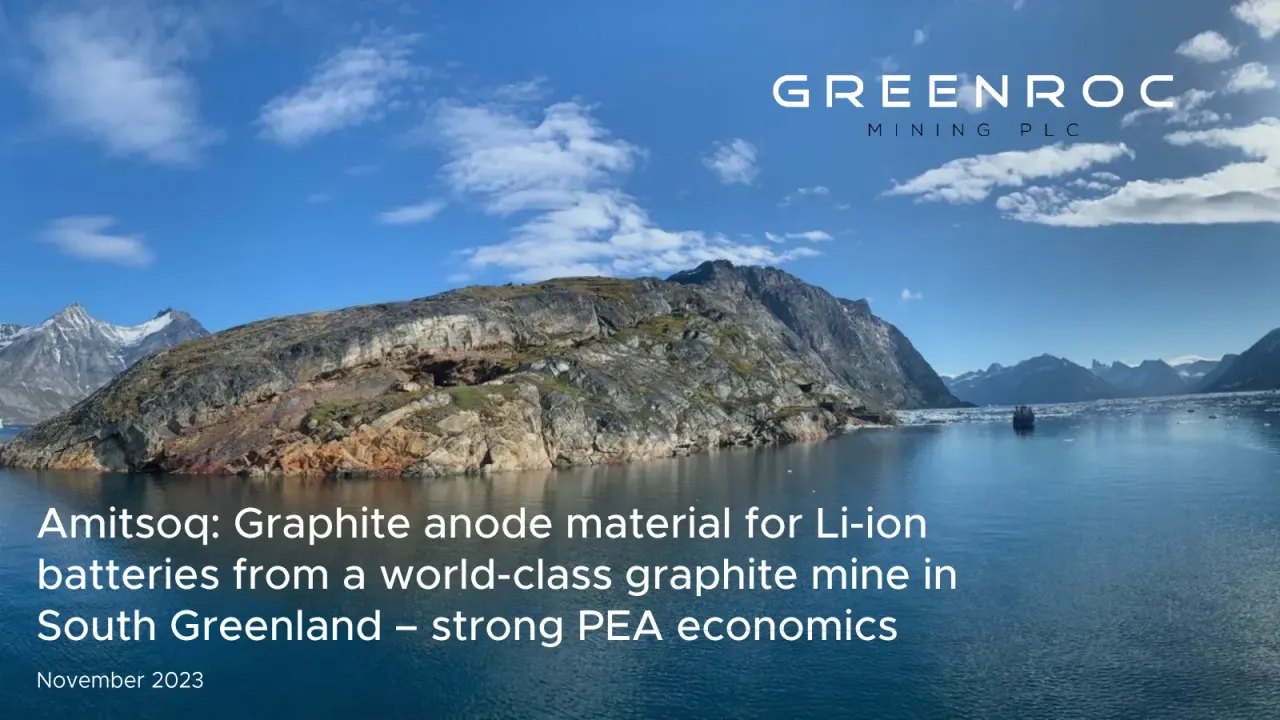
0:31 Good afternoon, and thank thank you everyone for attending, this presentation today. I've been looking forward to be able to present you with the result of the preliminary economic assessment of our AMITOC project in Greenland, which I will do, with this presentation. And I'll be, also happy to receive questions that I'll try my best to answer after this presentation. So, in the presentation, you will see there's a few slides that some of you may have seen before, but I think it's important, also to, be able to fill in some potential newcomers here about what the project is about. So AMITOC graphite project is GREENROC's flagship project. It's situated in Southern Tip of Greenland, and the project is about my reopening a world class graphite mine for production of anode material, which is an important component in EV batteries as I will disc discuss in a moment.
1:41 So I'll jump couple of slides here with disclaimer. Just a few few words about the company.
1:57 We have three projects in Greenland, two projects in North Greenland, iron ore project and the titanium sands project, and then the most important one, the the Amitsoc graphite project in South Greenland. Our ticket is GROC, and, we have about a 100 a little bit less than a 150,000,000 shares issued, which currently trades at a price of about 4.5 p. And you can see the major shareholders here on the table. So in the presentation here, I will first speak a few words about the graphite market itself, which is, of course, important as we are addressing the the the the battery market.
2:48 And then something also about how the AMITOC graphite project sits in the supply chain in general. And, and then some details about the amitoc graphite project itself, particularly then leading into the results of the preliminary economic assessment, and then on to the work plans, for the coming time.
3:14 So this hasn't changed, this slide, showing how important graphite transition is one of the most important components in EV batteries, making up more than a fifth of weight of a EV battery. And, China produces more than 70% of world's graphite, at the moment and process nearly a 100% of the graphite that goes into, the, EV batteries as anode material. So,
3:54 that processing is important because the graphite that is taken out of the ground as flake, natural flake graphite, needs to undergo a process of spherinization and purification and coating in order to make the anode material that goes into the batteries, which you can see on the right hand side panel here, if you can see my cursor.
4:21 About a kilogram of coated spherical purified graphite, CSPG, goes into these, batteries per, kilowatt hour. So that means a average car electric car contains about sixty, seventy kilograms of spherical graphite. And the market is obviously growing. There's more, nearly 40 so called gigafactories that produce these batteries for the EVs, underway in Europe that will be in production in by 2030 and, nearly 30 gigafactories in North America.
5:07 And, therefore, we see a demand which is rapidly rising from about 1,000,000 tons of graphite being needed this year to about 4,000,000 tons by 2033 that is in only ten years' time. Likewise, we see a forecasted price increase, which is also very significant. You see in this middle panel here, forecasted by, fast market, that shows a hefty increase in some of the anode material over the coming years. A similar increase is expected to be seen for the graphite flakes.
5:56 So certainly a strong market demand. Benchmark mineral intelligence has estimated that about a 100 new mines need to come on stream and in production by 2035 in order to fulfill the demands, from the the world production of batteries going both into electric cars, but also into, energy storage systems, which will take up about 10% of the market demand, in the years to come.
6:32 Given China's dominance, there was a very, worrying news the other day here that China, following similar news for other raw materials, is set to impose a export restriction on graphite. Not all graphite, but specifically graphite that goes into batteries. So so battery grade graphite of various of various qualities covering both natural, or spherical graphite from natural flake graphite, purified flake graphite, and also, synthetic graphite.
7:16 Of course, we don't know exactly what is behind this, but it certainly is something that can be seen as a potential, barrier for European and North American gigafactories to receive the all important anode material for future production of batteries. It stresses, of course, also the need to secure the supply chains. And in that respect, GREENROC mining plays an important role because we have this world class asset in Greenland situated geographically midway between North America and Europe, and we have very high quality graphite present that we can supply the market with.
8:03 So where we are in the supply chain, This shows our position with the whole supply chain from mining through concentration, spheronization, purification, coating into serving as anode material for the battery production. The first two links there, the mining and concentration to graphite concentrate will take place in Greenland from our AMETOP project. But we are also planning to take part in the midstream supply chain, namely by setting up a capacity to process the graphite concentrate into anode ready material.
8:57 More about that in a moment. First of all, a few slides about the AMITOC project. It was an operating mine about a hundred years ago testifying to the high quality of the graphite ore then, ore there and also signaling the viability of undertaking a mining operation in this part agreement. In the right hand side, satellite image, you can see the outline of our licenses. The blue one is the one that contains the Amitok Mine, that you can see with the red diamond. It is situated about 20 kilometers northeast of the Nanoptic town, which is the southernmost town in Greenland.
9:47 It was recently enlarged to also contain, a couple of lakes and land areas to the west of the Amitok Fjord, namely in this area over here, where that is prospective also for graphite, but also give us access to potentially important infrastructure.
10:11 Right. And you can also see with various red dots around here, that that signals the occurrences of other graphite deposits or mineralization that we have taken samples of and analyzed. And they common with these is that they, return analysis between 15 and up to 30% graphite. So, some of them are fairly large in extent. So what we are really sitting on here is a world class graphite district that we are slowly developing slowly developing in the sense that we are concentrating now on the Emmetok deposit, but there's certainly room for, for expansion in the future.
11:01 We have done a fair amount of sampling on the Galarc deposit just across the fjord, which seems to be a similar size of the Emitsok deposit. So
11:16 we have conducted two drill phases. And on the basis that we have defined a mineral resource. And, in short, there are two main ore bodies. This is looking at Ametok Island from the West towards the east. You can see two main ore bodies dipping towards you. The lower one is in yeah. The lower one is a lower graphite layer in red, and then above that is the upper graphite layer in yellow. The lower graphite layer is up to 20 meters thick, with an average of about 21% graphite across. And there's very little dilution of host rock. You go directly from a host, a wall rock that contains about 0% graphite into the full 20 something percent graphite in the ore body.
12:16 So there's no real dilution factor. And also important is to say here that the deposit as drilled now is open in three directions, so there's certainly room for further extending the discovery and, therefore, the mineral resources. So, based on those two drilling phases, we have arrived at a job compliant resource given here in the table with a total of 23,000,000 tons at more than 20% graphite. And you can see how we rank across the field of projects under development in the panel here. Excuse me. In the green dots, you see the average grade of the ore, and the bars signal the value of the company, the enterprise value, per ton of contained graphite.
13:19 As as you can see, we are the lowest amongst the lowest, valued companies compared to the amount of graphite we have in the ground. But also in terms of of of the actual numbers, we are the market cap here is about 6,000,000. So there's a huge range up to several $100,000,000, across, these companies. It just shows you how undervalued GREENROC mining is, and therefore, there's certainly room for a very significant upside here.
13:59 So on to the result of the preliminary economic assessment, which we just recently published. It was a quite serious undertaking, carried out by SLR Consultancy Company. So it's an independent, research, you could say. And it contains a lot of details about the mining plans and how we're gonna treat the the tailings and and other things. And I'll get on to that in a moment. The key metrics here is that if we take a realistic discount rate of 8%, we have an NPV, net present value, pretax of $235,000,000 and after tax NPV also at 8% discount of, about a $179,000,000.
14:58 And the internal rate of return is 31% pretax and twin nearly 27% after tax. So quite healthy numbers. This is based on a nominal mining rate of about 400,000 tons per year. The initial capital cost has been calculated at about a $131,000,000. Now that includes also a 25% contingency, so that is translated into 26,000,000 of contingency. So we feel that this is a a fairly robust and conservative number. The average operating cost is set at a 121 ton, sorry, a $121 per ton of milled ore.
15:48 And that does include shipping, so that is including, the cost of bringing eventually the concentrate, right to where the customer, sits at or at least, can, transport it further from a port in either Northern Europe or North America.
16:10 Yes. Other important metrics is, of course, the net revenue annual, of about nearly $19,000,000 throughout a twenty two year mine life. The payback period is estimated to be about four years, after production start, but, of course, that's also dependent on particularly the CapEx here. And, we expect that further research here will hopefully reduce the CapEx, even further, although the 131,000,000 is already a pretty good and low number. So we're quite happy with this. Obviously, it shows that certainly mining in at Amintoc can be a economically feasible undertaking, not mentioning the potential upside that might be provided from also processing this graphite concentrate into an already material. I'll get on to that in a second.
17:10 So the mining method is a drift and fill method, which is a relatively simple way of mining. There's a central decline that gives access to various, levels of the ore body. There's a there's a sketch here that shows how the ore body is attacked by several horizontal levels that you can drive your machinery in and then take out, the ore. Every time there's a stope that has been removed, it's going to be filled with, tailings mixed with concrete, as a so called backfill method. The mining takes place from about 10 meters above sea level to a level of minus 320 meters that is below sea level.
18:06 The mine plan presently only considers the lower graphite layer. It has a slightly higher graphite, content or concentration than the upper graphite layer, but it just shows, the robustness of the mining plan here. We leave the upper graphite layer for either data expansion or extending the mine life. And, yes, I'll go on. And a few of the details here It's a standard set of crushing, here with two crushers and three ball mills. It's really a simple setup. It's basically a standard, mining, technique. We expect that we can take advantage of some recent developments on the processing frontier, particularly in terms of the flotation devices, which may likely, reduce further the costs and also the energy, consumptions for the processing to graphite concentrate.
19:12 There's a backfill paste plant that we'll be putting in on-site here, that will consume up to 86% of all the tailings. That is in order to carry out the mining process here, you actually need to to take the tailings, mix it with concrete, and put it back in. That kind of makes the floor for the continuing mining, which is great because that means that only 14% of minimum 14% of the tailings that are produced need to go to a stating tailings storage facility, which is really, really small number. That means also, of course, that we will save on transportation costs.
20:00 And, also, it's good for the environment because, the tailings can simply be used to, fill the voids, so to speak, after we're taking out the ore. And therefore, in the future, it will be stored by the mountain. We have we're looking at several options for tailing storage facility. One of them is this nearby lake only three kilometers across the fjord where there's access. It's only at forty four zero meters elevation, so a short uphill drive. And as I said, it's only 14% of the tailings that need to go, to a tailings storage in the lake. So it's a it's a it's a very small number of material that needs to be moved.
20:52 The staffing here, about, 45 crew will be on-site at any one time, plus 19 support staff. They will probably be hosted in in Analta Lake, while the crew, of course, underground will be will be, living at Emitsok. We expect also to have a barge transport, frequent, barge barging between Ambitok and Nanotolik, both with provisions, of course, but also going back with graphite concentrate. And then onward shipment of graphite concentrate would would take place from Nanotolik Harbor to destination ports. In that in that way, when we we save ourselves from building a big expensive port at Ametok and, of course, make use of existing infrastructure.
21:46 So that is a mine with development. We are developing in in GREENROC. The next chain in the supply chain is the processing, which is an important, undertaking because presently, will have to ship our graphite concentrate to China. That's, of course, not a viable solution. So, yeah, several other that are planning to set up production or processing capacity in in Europe, but, but we believe that we are also fast tracking this, processing plant because we present we recently started a feasibility study, that will, make for a a business case for setting up such production and assess, of course, the economic, potential.
22:39 First of all, I have to say that we've already shown that the graphite that we can take out of the ground at Emmetok is really well suited to make anode material that has been proven by some test work, lab scale test work at ProGraphite in Germany. We're now working on this feasibility study where we are looking at all of the stages from taking the graphite concentrate through micronization, classification, dedusting, spherinization, purification, and coating onto the final anode material. We need to, of course, determine what kind of processing units that we will employ and also the purification techniques and so on, the cost of those, maintenance cost, establishment cost, and and a lot of these variables that go into the feasibility study so we understand exactly how profitable such an undertaking will be and also where will be the best sites for setting up such a such a plant.
23:48 In order to undertake this, we have received a grant of 200 about £250,000, from the advanced propulsion center. And, the feasibility start study started in September and will be concluded by May next year, and it is conducted, with the partners Benchmark Miller Intelligence, SLR, ProGraphite, and decision risk analytics. So, we're confident that this is gonna provide further upside to our Amitok project. Exactly how much we'll see, in in some months. But the the the, the price increase, the value increase is very significant when you go from graphite concentrate to anode ready material.
24:46 So we have taken are taking several discussions having several discussions with industry partners. They range, between car manufacturers, battery companies, also companies that are engaged in chemical, and engineering, undertakings, raw material traders, government agencies, both in Europe, in North America, in Japan. There's a lot of interest for our project, and I can see the news about the potential restrictions that China may pose on the graphic export has certainly also spurred more and higher interest from from these these various, entities. We have sent we have been requested by several potential offtakers to supply, samples of our graphite material from.
25:41 We have only up to now been able to provide one of them with with with the material to to have it tested by their own labs, and it's come out to be, very positive. It fulfills all the re requirements, from their side. And we they're certainly interested in going to the next steps of, receiving material and, finally, of course, entering at some point down the road here into a proper certification process. I can I can talk about that in a minute also what that implies? I've shown this slide before. Just stressing again, excuse me, the proximity of the Amitsar project to Northern Europe, but certainly also to North America where, you basically only have to add another day of sailing to to reach, Port Of Industrial sites in the Northeastern US.
26:44 Excuse me. My voice is a little rough. Right. And then something about the likelihood that we'll get to mind this. Of course, we are in, jurisdictions, in that being part of Europe in a sense, culturally at least, you know, there's often the the worry that there's too much local opposition that you will actually get to mine your your your your deposit. And this is not the case for Greenland. Greenland is very mining friendly. Obviously, we have to to fulfill all the requirements, in terms of, like, in environmental
27:38 control and and other things. But as long as we do that, then we are very welcome, and, there's also a lot of support from the local, communities. And we are on track with the environment environmental and the social impact assessments we are undertaking at the moment. They take time. So they were initiated last year, and they will be completed by next year. I've shown this again just to illustrate that mining in South Windland is by no means a an unviable undertaking. It's been done before. And in fact, our neighbor next door is Nalunak, resetting or reopening the gold mine, just across the fjord.
28:31 And it's an integral part, you could say, of South Greenland history. Next week, I'll be traveling to Greenland to have meetings both with the government in Newk. We'll be meeting with the commune and the mayor in Krakodok, South Greenland commune. And I'll also, very importantly, meet again with the people in Nanotelig, discuss with them, and, describe where we are, what our plans are, and so so so on. So they are kept well informed, and I hear also about what what their opinions are. We have support from the European raw materials alliance and also from the EU thereby that we expect or hope for will also materialize in some more tangible support in the future.
29:25 And then finally, this is a road map, that shows you where we are with regard to development. There are two roads here. One is the development of the production of graphite concentrate from the Amatok mine. The lower one is the setting up of this spherinization or anode material plant processing plant.
29:51 The white text shows you work program items that have not been started yet, and the green ones are either accomplished or ongoing. So, of course, there's a lot of work to be done in the coming years, but I think that we are in a perfect position to undertake this work, particularly on the background of the recent development, in terms of, like, what, the potential threats to the supply chain, but certainly also in terms of the increasing interest we see from potential business partners, industrial partners, and also offtakers about the way that they see AMITOC could be strengthening their business.
30:45 So I think the main milestones for the coming year here will be, concluding the environmental and social impact assessments, at AMITOC, and then that will lead on to the exploitation, application that we will submit next year. We'll also start the PFS that we hope will be concluded by end of next year. That hinges a bit on being able to conduct a bit more, work at AMITOC. We need some geotechnical drilling, and we also like to uplift the current a little bit of the current inferred resource to a higher category, perhaps also extending the the the inferred resource.
31:39 The feasibility study for the sterilization plant would be done, and we are hopeful also that we will be engaging a business partner here that we can, together with that partner, can set up a pilot processing plant so that we can start the quite lengthy process it is to, have our graphite anode material being a certified material that would that that would attract the, the the high prices on the on the battery market. More about that sorry. More about that later. So with this last slide, I just stress that we are on track with getting into production by '27 with the mine in Greenland. And at that time, where the first shipment goes out of Greenland with graphite concentrate, then we have a spherinization plant set up somewhere in North Northern Europe. Could be Norway. Could be Northern Scotland. Could even be in Denmark.
32:45 It could also be another one in, in Eastern United States ready to, go on with the processing to NORATEGIC MATERIALS. So thank you, for listening in today. And, after this, I will, go on to the questions. Perfect, Stefan. Thank you very much for your presentation. Ladies and gentlemen, please do continue to submit your questions just by using the q and a tab, which is situated on the top right hand corner of your screen. But just while Stefan takes a few moments to review those questions that have been submitted today, I'd like to remind you that recording of this presentation along with a copy of the slides and the published q and a can be accessed via your investor dashboard. Stefan, as as you know, we received a number of pre submitted questions and received a number of questions throughout today's live presentation.
33:32 If I could just ask you to read out those questions and give responses so it's appropriate to do so, I'll pick up from you at the end. Yes. That is indeed a lot of questions. Thank you for that.
33:50 Yes. Okay. I I'll start with those pre asked questions that I have in front of me. First of all first question is my question is with AMITOC taking all the limelight, will the other GREENROC projects be sold, especially with Bluejay downgraded ilmenite project in Dundas? Is there a future for the Black Sands project?
34:22 Well, right, MTUC rightly takes the limelight. That is certainly the most promising project. I also firmly believe, that it is a project that will be the, delivering the most value in the shortest possible time for all of our investors. So that's, of course, why we put so much emphasis on that. There is certainly some potential reward also from following the the other projects. I think, though, that we have to guard our resources very, financial resources, of course, very carefully. Also, time we're spending, particularly with the latest development in North Greenland.
35:09 Bluejay have had to reconsider their project, and say that it's no longer viable as an economic stand alone project, probably mostly because it's too small. Therefore, there might actually be some upside in considering whether there could be something, in conjunction with Bluejay. That's something that, I mean, could possibly be discussed. Obviously, it is a big combined. The the the stretches of sand available there is is huge. So so I wouldn't rule out that that that somebody would come in and discuss with us and discuss with Bluejay and perhaps would would take it over. I think that that probably what we would be seeking because we don't, at the moment, want to prioritize that over Amitok.
36:04 I can also say answering another question down the list here that we have now concluded the test work, that was kind of missing, for being able to finalize the competent person's report on TBS. And that will now be written up and is due later this year. It will be, provided before Christmas, we were promised by the Australian competent persons company. So next question. How much support has been provided to GREENROC by the EU to date, and how much has been applied for and awaiting a decision, both direct grants and subsidized loans? So short answer to that is none.
36:54 It's a little bit disappointing. It's a huge disappointment really up to now that there's been so much talk from the EU side, frankly, without too much action. But on the other hand, things do take time, particularly when you have 27, member states that need to agree and everything. I think it's a tremendous accomplishment that the, Critical Raw Materials Act was passed the European Parliament with overwhelming majority, early this fall. It's set to be finally approved in December. And after that, the EU, has basically an obligation to support so called strategic projects. And that is really important and raises some expectations, of course, also from our side because with the with the support letter we received from the European Raw Materials Alliance, we expect certainly that we qualify as a strategic strategic project.
37:52 And in fact, we have also been given, some indications that it is indeed the case. And, strategic projects, we're not looking into another, like, multiple month, year kind of period where these projects need to, qualify. It's the decision has to be taken within two months. So I expect I have high expectations that in next year that the EU actually will provide some form of economic support. And certainly with regard to eventual funding of the capital expenses, for instance, here, a 130,000,000 US dollars, that is certainly something where the European Investment Bank would be interested in in coming in and and and probably also very competitive interest rates, of course. So so that's what I would would expect from the EU.
38:58 And that also answers another question when how we're going to fund the the the capital expense of the construction of the mine. So yes, so here, the PEA assumes a graphite price of $1,250 per ton. What price would spheronized graphite coming out of your processing plant in Europe command? Where were you to build a processing plant? What impact might this have of project n p v eight? Obviously, we'll have to wait and see what the what the feasibility study shows on the spherinization plant or processing plant.
39:51 There's a fairly substantial value increase, I would say, up to about three times that of the graphite concentrate itself. The processing is relatively energy intensive, so this is why we are planning to set up the processing plant, a place where energy prices are low. I think that the all the forecasts that we are seeing have very, increased price for anode ready material that is ferronized graphite. So I think it's bound to have a very positive impact on our NPV. But, of course, I can't say any numbers on the until the feasibility study is complete.
40:46 How close are you to securing an off taker for your graphite? Weeks, months, years? What more information do they need that they haven't got already? At this point in time, the offtakers are just looking at potential supplies of sphenoid graphite or battery anode material. And they can buy that on the market. Therefore, what they're looking for is a supplier that has gone through all the stages of certification and can actually provide you with proven quality material. The certification process is quite lengthy. It takes up to two years, and it has this a, b, and c component that increases volume every time you have to deliver to to to the potential off taker.
41:45 So it's not only a lengthy, it's also quite costly process. But, of course, once you're through with that, then the whole world opens because then you can demonstrate that you do have a product that meets the various requirements. So the answer is it takes years, but then I think that it's important here to realize that that is just the situation that we see now. The battery companies are now starting to look also at projects that are earlier stages such as ours because they realize that the only place that they can currently buy the anode ready material is from Chinese companies. And some of them have already been banned of buying such material. So I think it's very likely that some of these companies will actually start actively working together with companies like us, GREENROC Mining, developing this capacity or at least helping out with the with the certification process.
43:01 There's a very good one here. GREENROC has limited cash. I challenge your strategy of raising a few 100 thousands, pounds on an ad hoc basis. Why are you doing this? You need a cash runway of at least two years to deliver and get to the point of making an investment decision and raising mind CapEx. What is stopping you raising the millions that this will require? You appear to have a good story. Yes. We do have a very good story. Unfortunately, graphite is not the flavor of the month. It hasn't been for a while. It's typical when you see, when you attend conferences and hear about people talking about battery raw materials.
43:52 If they do mention graphite at all, it's always mentioned at the end. Again, I think that's gonna change now because of the uncertainties that China's dominance has, introduced on the on the supply chains. It's simply a matter of capital costs. If we were to raise yeah. It'll be great to have £4,000,000 in the bank, then we can go out and do everything we need to now. But with a market cap of, what is it, 6,500,000, it's just not viable to raise that amount. So I think what we will do is to keep speaking to to groups that that has a long term interest in us and can see that by funding us, a bit of it at the time, allows us to grow These companies or investment institutions, they're not interested in in taking over the company. They they like to keep the expertise within the company and fund sequentially.
45:04 So I think that that might be one of the routes that we'll be going. Other routes is, of course, to look at the at the parallel listings either in Scandinavia or as one suggested here, TSX. Those are certainly also possibilities, and we'll explore every, opportunity that arises here to to make that, capital available for, developing our project. But, otherwise, I fully agree. We do need, particularly, like, cornerstone investors that are in for for the duration of this project until we have a positive cash flow. So what will be the key items of news flow over the next twelve months?
45:51 First of all, and I think that's a very important one, is the final feasibility study on this ferronization plant. It's gonna be similar to a PFS on a mining project. So only a little bit more work we can, we can take it on to DFS that we can then conduct in '25. So the feasibility study next year in May on the spherinization plant, May, June. Then, also next year, we have the environmental impact assessment complete. We have completed the social impact assessment. We have a approved, project description and plan approved by the by the GREENROC that will lead on to a a successful impact benefit agreement probably in the early fall next year. And then we'll have an finding our application for exploitation permit also, in the fall next year.
47:00 We in order to undertake the prefeasibility study on the Amatoc mine, we need to undertake a bit of the geotechnical drilling, also have a survey on the underground mine workings and and other things that all go into, the PFS that we're expecting to embark on in the fall of twenty four. Those are just some of them. We also have further test work being carried out now. We just sent a small sample, 160 kilograms, to FL Schmidt in The United States for testing some of the new flotation, devices there that could significantly also decrease our operating expenses.
47:50 Yes. Good. Next question here. How many car batteries does 77,000 tons per year make, which is the production of graphite concentrate? What percent of annual UK and European EV demand will this satisfy? So European EV demand. So this will roughly give us enough graphite to produce a million, a million and a half, they're about electric vehicles per year, which amounts to about 10% of the European electric car production in about five, ten years' time.
48:42 We don't see a lot of, market response to the RNS. Why is that? That's I don't know whether it's a million dollar question. I really like the answer to that. It doesn't matter what good news we publish. The market doesn't really seem to be recognizing us. It's not a complaint. It's simply just an observation. I think, again, I think it's something that is going to change. If you look at the market cap on the graph that I showed you before of other companies, peer companies, they have even for smaller deposits, for deposits that are situated in difficult places, troublesome jurisdictions, low grades, and so forth, they often have market caps that are a lot higher than ours.
49:38 So what is common with those is that they have been they have been, marketing their project for a lot longer time, many of them for over ten years, whereas we just listed, what is it now, two years ago. So I think it will come, it will change, and it's gonna change upwards, helped also by the market in. The indications that, for instance, first of all, the demands in the market, but certainly also the Chinese restrictions on on on graphite export. What potential is there to increase the resource tonnage and the contained graphite tonnage? Looking for a rough order of magnitude, I'd say this is just guess where, of course, because we don't know. We haven't drilled yet. But I would say the geological information that we have suggests that particular down dip, these ore bodies continue for at least the same distance. So, you know, 1.5 to two times the the the size, if not more.
50:53 And then we have all the satellite deposits around that we could also develop. And once we have the capacity and infrastructure in place, there's nothing really that hinders us for slowly increasing production by taking some of these satellite deposits into production. Sorry. That was the wrong button. What can you do to increase productivity about $77,000 tons of concentrate per year? That's something that we certainly will assess in the prefeasibility study, the PFS. Now we know approximately what it takes to get it to this production rate. I think it's something that we can achieve by a variety of measures. I think the presently, capacity of of the, of the some of the all treatment, facilities actually have a are higher than just what we are looking at here. So we could potentially increase the mining rate without changing very much, in terms of the infrastructure.
52:06 But, of course, there's a threshold at some point. If you want to increase it by 50%, you are looking at a different, plant or have to add certain other units. So all of these are pretty similar. I read that there are 3,000 junior minor mining companies and fewer than 15 major miners. The seniors are currently swimming in cash, whereas the juniors are starving due to a complete lack of investor interest in the sector.
52:54 Thank you for attending today, by the way. Again, there is some interest there. Is there any interest from the senior miners in what GREENROC is doing? And we've been talking to quite a few of the senior mining companies. They commonly regard graphite as being a niche project commodity and therefore not being particularly interested. They have their strategies that are set. Often these strategies stretch out, you know, into reach out into, you know, the next ten years or even longer. However, I so presently, I would say no. They're not interested. But then on the other hand, a few months or a couple of years back, none of the majors were interested in lithium either.
53:46 But now they can see it's actually a profitable undertaking to mine and explore for lithium. So so certainly that has changed now. So I wouldn't be surprised in the in the coming time that we also see a change, with regard to with regard to graphite. We already see the Rio invested in a project in Southern Africa. It's a combined titanium graphite project, but, yeah, I think we will see some change there. So thank you. Let me just go on here. We have a few minutes left, and there's more questions here. Battery chemistry is developing rapidly, particularly by Chinese companies. How is this affecting the graphite requirements for the new battery technologies?
54:38 Yes. I think you're particularly thinking of the LFP batteries that are slowly probably overtaking NMC batteries. Both of them are lithium based batteries, and both of them also employ graphite as the anode material. So I don't think that that's gonna affect. In fact, it's probably just gonna increase the the quest for graphite. There are some other technologies that are being introduced these years are not introduced, but are being sought to be developed. Toyota has recently announced that they are believing that they have a breakthrough or are near a breakthrough in terms of setting up or commercialization of solid state batteries. Solid state batteries don't use graphite in as anodes.
55:31 However, most experts are very skeptic about this. Maybe there is a breakthrough in terms of, like, being able to make batteries of the quality and and also avoiding the relatively short lifetime that solid state batteries have presently because formation of dendrites and other things, in the anodes. Most experts, and analysts expect that this will mainly apply to if it if it comes through that, and and and happens, then it will mostly apply to high end, cars. So has relatively limited influence on the on the global demand for graphite. The predictions I've seen recently says something at up to 10% market share of solid state batteries in by 2033.
56:35 So I don't think that that's a major threat. Also, one has to realize that it's not like these new technologies will replace oh, sorry. It's not like these new technologies are going to introduce, like, the possibility of having electric car. They are replacing or seek to replace a well functioning technology. So the, it has to be able to compete both with performance and price and everything lifetime. So I think that that is, or that that is what the, analysts at the moment are skeptic about. Is an ASX listing planned heavy dilution expected over time? Does it even make sense to invest early? What imp there's a lot of questions here. That's not that's not allowed. I was about to say, okay. Anyway, is an ASICs listing plan? There's no no. There's no planned listing, second listing, or anything. But as I said, we are considering heavy dilution expected over time. Does it even make sense to invest early?
57:46 Absolutely. Because what you as an investor should be worrying about is not your share of the company. The less that you hold, you know, 30% and wants a seat, you know, you should mainly be worried about the, the share price, and that is bound to go up in the future when the world realizes the value of of greener rock mining. So that should not hold you back. That, obviously, there will be some dilution, when it comes to investments in the development, agreement. Yes. We will need to raise funds, and therefore, there will be dilution the less that everybody follows their investments, of course. But then a significant value increase is also expected.
58:35 So you should definitely hold on to your shares. That would be my advice. What impact could would GROC's success have on GROC? I don't know. GROC is still a main shareholder. So so, obviously, they will they our success will spill over to them. Would GREENROC consider buying back shares from ALBA and thus bring liquidity to to ALBA in return for the shares? No. I don't think so. Certainly, that has not occurred to me. I don't think that that's anything we would like to do. What we would do with the capital that we are raising is definitely going putting into value by developing mTalk.
59:31 I recommend the mentioned answer that. So how is the Chinese government requirement How is the Chinese government's requirement for export permitting affecting the graphite sector? We're yet to see. It's not that there are any real restrictions at the moment that are, like, exerted. But we can certainly see that that is now becoming a possibility by that you have to have a central approval of any kind of export. And we have seen before that the Chinese are quite happy to to to issue such restrictions. For instance, there's one issued over Sweden. So presently Sweden can't buy graphite or battery grade graphite products from China, which is quite thought provoking, I think.
1:00:37 What would happen to shareholders' security shares if GREENROC would be taken over by a bigger company? I think that's a difficult one to answer. I don't think anybody would consider taking us over. GREENROC has all the expertise that you could dream of with regard to operating GREENROC. Why would anybody and and and in fact, the the companies that we've been talking to or rather the investment, potential investment partners, financial partners, they they're not interested in taking a majority interest, because they they don't have the expertise. They don't understand.
1:01:27 They don't have the technical expertise either. So I don't think that's a real threat. Am I going over time here? No, Stefan. Please do carry on. Okay. Okay. Good. After AMITOC flotation, there are three more stages required to get to being anode ready. The price for the final stage is, I think, over $8,000 per ton. Are there is that if that is processing cost, that's that's not correct.
1:02:16 But, anyway, are there risks to these later stages in terms of know how due to Chinese dominance of the processing? So, of course, there's some risk. That's also something we're looking to with the current feasibility study. But I I don't think that it's a it's a major one because, first of all, the actual spherinization is something which is, it's a mechanical process that we can certainly that we understand relatively well. There are certain European manufacturers of of of units. We have been talking also to some Japanese companies that are experts in in various stages of of these processing.
1:03:04 And I think that it's very likely that we could partner up with some of these. It's it's not all it's not all there's a Chinese dominance, but they don't have the what should I say? There's not they don't have a monopoly of the technical cap capabilities. I I don't think current prospective shareholders appreciate how much value there is in downstream processing. Can the company be more explicit about this? Yes. We we we will try to be.
1:03:51 It's just that I like to have a bit more background to speak about this. This is why we're now undertaking this feasibility. So there's no doubt that it's a very, as again, said, significant increase in value, therefore, also a significant upside to the company. And we can see that the couple of projects that have been undertaken are that has been that are under development now. I can mention one in North America. You can look up a graphite one in Alaska. You can look up Renesco in Australia. If you can see that there's a very significant value increase when you complete your feasibility study on this ferinization plant also.
1:04:37 Certainly, you don't quote me on this. I was about to say it, but there's definitely the NPV is going to be several times that of the the mining operation itself. Is there any indication from the exploratory drilling that the upper graphite layer or lower graphite layer are thinning out in the untested directions? Yes. There is. The upper graphite layer seems to be thinning towards the north, and the lower graphite layer seems to be thinning towards the south. But then again, the lower graphite layer seems to be thickening also towards the north. So we the last northernmost drill hole we drilled was 20 meters thick, true thickness of the of the ore.
1:05:40 Is there a power line plant to size? How big of a challenge is that? What other infrastructure is needed? What about roads, shipping docks? Where will the worker lives workers live? The workers will live on Amitok. There'll be a a three weeks on, two weeks off. A lot of them will be sourced in Greenland, is my hope with the relatively limited amount of, of people, employed there. Roads. No roads are needed, really. Of course, a shipping dock. Yes. There needs to be a pier so we can get smaller ships and barges up towards the the Amatok. Other infrastructure, the there's no power line planned. In fact, there is a potential for hydropower nearby, but I think within the timeline that we would like to see Emetag operating under here, I think that is probably not the solution.
1:06:40 I think more likely that what we'll start out is is more like, conventional diesel power plant, that will be replaced as soon as possible, either replaced or supplemented supplemented by, for instance, wind turbines, replaced by, similar generators but powered by, not nitrogen, ammonia ammonia, which is, being developed now for shipping, engines ship engines. So so and that's same technology as diesel engines, really. A bit more piping and and but, otherwise, it's a it's a similar similar, way, and that's Power two x, which are also plans of establishing in GREENROC.
1:07:29 Can you accelerate the external dependencies like assessment and studies given the increased urgency for Europe and US to be less dependent on China? It's really quite difficult to accelerate any of this. The only thing I will say is that, of course, we have a strong focus now on performance of the various things that we're doing. So nothing up to now has really held us back in any significant amount, few months, maybe. But, it is something that is becoming increasingly important.
1:08:17 So and I think that the PA we're undertaking here, it had a it had a bit of delay. There was some sickness with one of the with one of the experts. But, you know, we really undertook this. We had the competent person visiting in May, and we concluded the the study, here in October, which I think it's okay, because it's the first time. There's a lot of work to to carry out to to to make the right mind design and so forth. So I think the PFS would be would be, conducted in a timely fashion. Are the licenses being extended to over the road map? I I don't understand that question. Sorry. I I I keep going here. In future fundraising rounds, will current private investors be allowed to participate at the SIEM pricing Ts and Cs as institutional investors?
1:09:26 That would certainly be the plan. I don't see why why investors should be treated differently. They all have an interest in the company, and and and and their and their money is is worth the same. So so, yes, I would I would certainly strive to to to to that. Can you explain the apparent discrepancy between the current market share and the potential project value? I think I've mentioned that. Does the processing plant's capacity exceed the supply of graphite concentrate from GREENROC MINES? We we will be, I think, looking at having a certain overcapacity here.
1:10:18 I think the most likely scenario is that we are setting up a modular processing facility so we can start out with because also the graphite mining agreement is not going to have full production from year one. It's gonna ramp up to full production over two years. So I think it's it makes sense to to also increase production of processing capacity. But a modular design will meet mean that if the market is there and you make good money, then you also have the cash to invest in expanding that capacity as you go. Would it be a better option for the board to approach Tesla and be acquired so that Tesla can use its huge free cash flows to deliver the road map with fewer dependencies?
1:11:19 Tesla needs huge amount of graphite for its Berlin Gigafactory. I don't I don't think that it might be a better option. I think we are what our priority is to make value for our shareholders, of course. If we see an offer that is so good that we need to pass it on to you guys, we'll definitely do so. But we are quite determined to carry on with the work and get Emetok up into production and set up that processing plant. What we'll really like to have is an offtake agreement with Tesla, of course, so they can call us anytime.
1:12:09 We're talking, of course, to everyone, including a lot of the bad car manufacturers. Are all the mining licenses being extended to cover the road map? I don't understand, the road map, so I can't really comment on that. Yeah. I don't know. We don't really have any roads planned except for maybe a small service road up to the, to the, tailings facility. I think that is all of the questions that are here. So Perfect. Stefan, thank you very much for being very generous to your time there and address all those questions you can from investors. And, of course, the company will review all the questions submitted today, and we'll publish those responses on the investor meet company platform.
1:12:58 But just before redirecting investors to provide you their feedback, which you know is particularly important to yourself, Stefan, could I just ask you for a few closing comments? Yes. First of all, I'd like to thank everybody for attending this meeting again. I really enjoyed being able to answer some of your questions. Shows that there's interest for us. Maybe I didn't answer them all to your satisfaction, but I certainly tried to. And I will make sure that you're also being kept informed about the developments of the company. And we are across the board and the people that work for us here, we are striving towards making, AMITUC and GREENROC Mining a good investment for all of you.
1:13:49 Perfect, Stefan. Thank you once again for updating investors today. Could I please ask investors not to close the session as you now be automatically redirected provide your feedback in order that the management team can better understand your views and expectations? This will only take a few moments to complete, but I'm sure it'll be greatly valued by the company. On behalf of the management team of GREENROC STRATEGIC MATERIALS we'd like to thank you for attending today's presentation, and good afternoon to you all.
Follow Greenroc Strategic Materials PLC into a list and get an email when it puts out news.
CEO at GREENROC STRATEGIC MATERIALS PLC