Bud Brigham
Executive Chair
Replay available
Atlas Energy Solutions (NYSE:AESI) Q2 2026 earnings call, held 2026-08-04. Watch the replay and read the transcript on 6ix.
On 6ix: 6ix.com/event/atlas-energy-solutions-inc-aesi-q2-2026-earnings-call
Automated transcript · Written by software from the replay's audio. It can mishear names and figures; the replay is the record.
0:00 Greetings. Welcome to Atlas Energy Solutions Inc. Second Quarter twenty twenty six Earnings Call. At this time, all participants are in a listen only mode. A question and answer session will follow the formal presentation. Please
0:20 note this conference is being recorded. I will now turn the conference over to Kyle Turlington, Investor Relations. Thank you. You may begin. Hello, and welcome to the Atlas Energy Solutions conference call and webcast for the second quarter of twenty twenty six. With us today are John Turner, President and CEO Blake McCarthy, CFO Tim Ondrag, President of Power and Bud Brigham, Executive Chair. John, Blake and Bud will be sharing their comments on the company's operational and financial performance for the second quarter twenty twenty six, after which we will open the call for Q and A. Before we begin our prepared remarks, I would like to remind everyone that this call will include forward looking statements as defined under The U. S. Securities laws. Such statements are based on the current information and management's expectations as of this statement and are not guarantees of future performance.
1:13 Forward looking statements involve certain risks, uncertainties and assumptions that are difficult to predict. As such, our actual outcomes and results could differ materially. You can learn more about these risks in the annual report on Form 10 ks filed with the SEC on 02/24/2026, and our quarterly report on Form 10 Q for the first quarter and current reports on Form eight ks and other SEC filings.
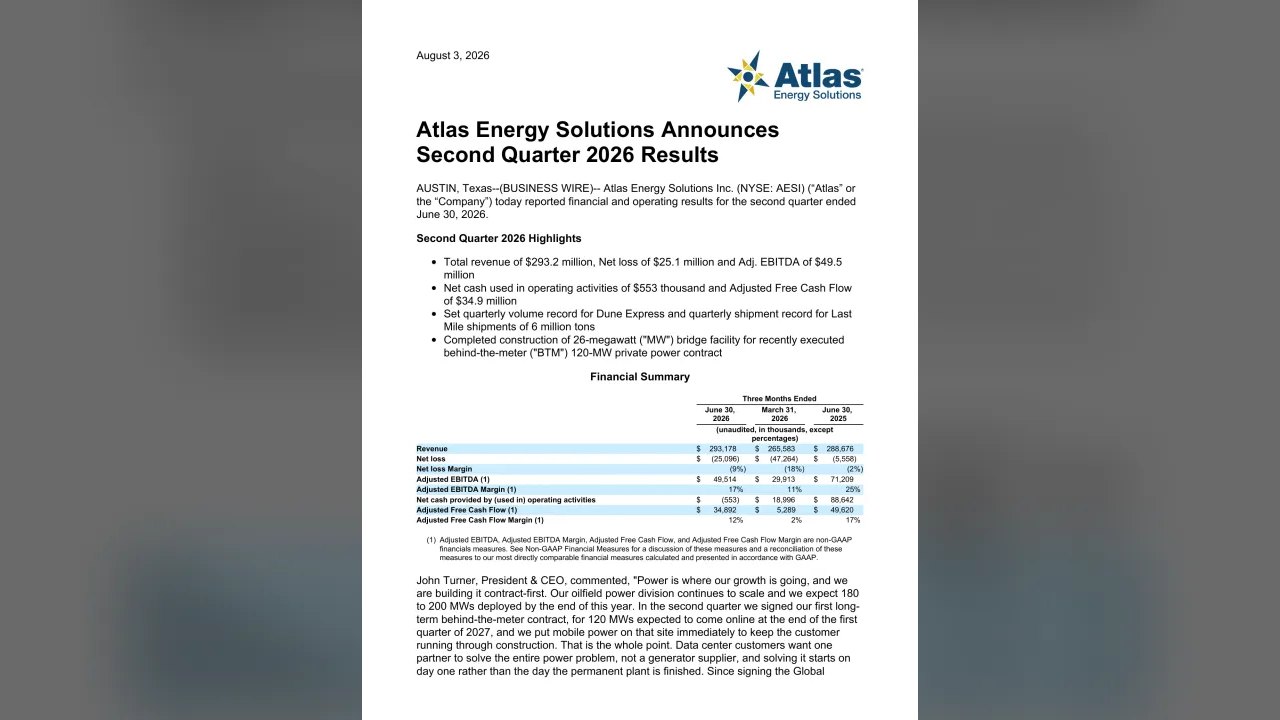
1:40 You should not place undue reliance on forward looking statements, and we undertake no obligation to update these forward looking statements. We will also make reference to certain non GAAP financial measures such as adjusted EBITDA, adjusted free cash flow and other operating metrics and statistics. You will find the GAAP reconciliation comments and calculations in yesterday's press release. With that said, I will turn the call over to John Turner. Thanks, Kyle. For the second quarter, Atlas generated revenue of $293,200,000 and adjusted EBITDA of $49,500,000 which represents an EBITDA margin of approximately 17%. Blake will cover the financial detail later on the call. Before I get into the quarter, let me lay out how our Power business is organized because we get a lot of questions about it.
2:30 We have two divisions. Oilfield Power sells generation of oil and gas operators across many basins, and we expect that fleet to exit this year with 180 to 200 megawatts deployed, the majority of which are under long term agreements. Long term behind the meter power sells primary permanent power to large scale users, principally data centers. We signed our first contract in that division this quarter and our global framework agreement with Caterpillar supports its growth. The second quarter was highlighted by the execution of our first behind the meter contract, 120 megawatt power purchase agreement with a subsidiary of an investment grade technology infrastructure provider. The economics are as follows: total project capital is approximately $190,000,000 We expect the contract to generate approximately $55,000,000 of adjusted free cash flow on an annualized basis once the permanent facility is operating.
3:28 This is a cash on cash payback of less than three point five years. These economics are specific to this contract, this counterparty and this site and should not be applied to future projects. Just as important, the capital required to build this facility sits inside the capital guidance we gave you last quarter. We are not raising our previously announced capital budget to fund this growth. The site is in Socorro, Texas and here is the full sequence. We have completed construction of a 26 megawatt facility that is powering the site today through the customer's construction and testing phase. We began installing Atlas equipment for the permanent plant in the third quarter, commissioning begins in the fourth quarter, the 120 megawatt facility electrifies at the end of the first quarter of twenty twenty seven and we began recognizing revenue on this new system in the second quarter of twenty twenty seven.
4:23 That sequence is the whole point. This project demonstrates Atlas' full solution approach to the behind the meter market, providing customers with a one call option to solving their power procurement issues in every phase of a project's lifecycle from powering the pivotal early stage ramp up to providing power through the life of the facility.
4:48 The commercial opportunity set for the permanent behind the meter power continues to expand rapidly. As demand for compute capacity explodes with the evolution of AI, we have seen the urgency of our commercial negotiations rise. As the frontier models grow in complexity and ability, the need to accelerate access to token generation rises. Priority placed on access to power is best exemplified by the hyperscalers continuing to build out their internal procurement teams where they have added seasoned power professionals that have accelerated and focused contract negotiations. Over the past few months, we have seen the nature of the power deals we are pursuing evolve from both a size and duration perspective.
5:38 When we entered into our framework agreement with Caterpillar, we assumed it would take eight to 10 projects to fully contract the capacity we placed on order. We were very confident we could do so, but we expected it would require significant commercial effort. As our commercial capabilities have become more apparent with prospective customers, we have found the scale of the projects on which we are engaged has grown significantly in magnitude. Thus, it is becoming increasingly more likely that two to four projects could contract our remaining uncommitted capacity compared with our previous assumption of eight to 10 projects. Additionally, we have seen an increasing appetite, even need, from our prospective customers for longer tenure contracts.
6:25 With grid access becoming increasingly difficult to secure on any predictable timeline, prospective customers are embracing island power as a long term solution for their sites. Initially, we were looking at ten year contracts as a sweet spot, but we are increasingly seeing a desire for fifteen to twenty year terms from our prospective customers as they look to derisk power supply to their facilities for the long term. With potential customers looking to execute on the prerogative of procuring long term island power quickly, we are finding that our strategy of providing a full service solution from early engineering through full lifecycle maintenance and operations is gaining traction.
7:11 Prospective data center customers are looking to us to solve the entirety of the power problem. They don't want to provide specifics on engineering or equipment. They want to provide a load quantum with productive load swings and a reliability metric. They want us to provide a system that achieves their goals in the shortest amount of time and with a partner they can trust to operate for the long term. Lastly, we are not seeing potential deals shifting to the right. There is a sense of urgency to get projects moving forward. We expect the industry to see additional contract activity over the coming weeks and months, and we believe Atlas is well positioned to compete for those opportunities. Outside of the 120 megawatts attached to our recently announced project, we have an additional 120 megawatts arriving at the end of this year and another three fifty megawatts scheduled for delivery over the course of 2027.
8:09 The availability of this four seventy megawatts for deployment in 2027 with a clear line of sight on a steady ramp phase lines up well with the request we are seeing from our prospective customers, putting Atlas in a strong competitive position. We believe our contracted backlog has the potential to evolve meaningfully in the second half of this year. We will announce new contracts when they are signed. A question we often get is what are the competitive advantages for Atlas and Power? And why is Atlas the right partner in long term private power solutions? Atlas has built over $1,000,000,000 worth of infrastructure projects, which includes many of the lowest cost mining facilities in West Texas, along with a first of its kind 42 mile conveyor with the Dune Express.
9:00 We designed, engineered, constructed, powered and now operate these projects. Large complex construction projects are in our DNA. That significant expertise is being called on in the markets today as our power customers are facing new challenges that demand precise execution. As customers like data center operators increasingly look to private power, they demand confidence that their power provider has the depth and experience to deliver on time and on budget. As our Power business grows, you will see how our engineering and execution expertise transforms the way companies obtain the critical power they need.
9:46 The equipment you choose and the construction partners you pick will matter. Innovation is the core to the Atlas culture. We're the only company to dredge mine in the Permian, the first to deliver frac sand autonomously in the Permian, the only company offering multi trailer sand deliveries, and we built the longest sand conveyor system in North America to change the way sand is delivered into the Northern Delaware Basin. We plan to bring that same outside of the box mentality to the private power market.
10:20 In our Oilfield Power assets, we continue to see strong contracting momentum. This quarter, we signed additional contracts and agreements for current and future megawatt placements and now expect total oilfield megawatts deployed to exit the year between one hundred and eighty and two hundred megawatts, the majority of which will be under our long term agreements. We are being very deliberate about the placement of our current oilfield fleet, prioritizing longer tenure agreements over near term deployments. We anticipate continued desire from our customer base to sign agreements to secure their power needs as traditional utility power timelines continue to slip. We are also seeing growing interest in microgrid systems utilizing Atlas' battery technology.
11:12 With this technology, we can hybridize customer locations to increase reliability. Our hybrid technology combines our portable generators, a robust battery system and a control software that manages site loads and power availability, which leads to a more robust service for our customers and our operating efficiencies for Atlas. Demand for private power is robust, and we believe we are still in the early stages of a major infrastructure growth cycle. We have the right equipment, the right strategy and most importantly, the right people. I will turn the call over to our CFO, Blake McCarthy, to expand on what we are seeing in our Sand and Logistics segments. Thanks, John. If I were to pick a word to describe the current West Texas sand and logistics market, it would be nuanced.
12:01 Macro conditions have improved significantly over the first half of the year, and while geopolitical events continue to drive volatility, we believe that the supply demand balance for crude oil has been dramatically altered and the fundamental floor for oil prices has been lifted. We are obviously not the only ones to share this view as the Permian rig count has grown 17% since the start of the Iran conflict. This growth has been led by the private operators who are the most apt to respond to changes in the commodity price backdrop. Assuming our view is correct, we would not be surprised to see the public E and Ps ramp activity next year once they have refreshed their capital budgets. Despite the growth in rig activity, completion activity has merely remained static, which is what drives demand for our business. This is due to a number of factors. For one, operator DUC inventories were already thin in early twenty twenty six, with well placement activity highly aligned with completion schedules.
12:53 As pad sizes have grown and even with today's efficient drilling operations, it takes extended time and planning for new pads to be constructed and wellbores to be placed to enable final frac operations. In addition, gas takeaway capacity in the Permian remains an issue. While this will be partially alleviated as more than 4.5 Bcf of incremental pipeline capacity comes on in the back half of this year, it has certainly put a cap on the activity of a few operators year to date, particularly in the Delaware Basin. As we mentioned on our last call, we don't expect frac fleet additions beyond the marginal view we saw in April until later this year as operators attempt to gain comfort with the Strip amidst the volatility. However, based on recent customer conversations, we expect activity levels to begin ramping moderately in Q4 in a counter seasonal way as customers look to hit twenty twenty seven running.
13:43 Pressure pumpers are displaying discipline in not bringing incremental equipment to market until pricing improves on their current utilized fleets. And with the lack of readily available equipment and crews on the sidelines, there's a significant lag approximately two months between when a customer can contract a fleet and when completion operations actually begin. Touching on the supply demand balance of the actual sand market, it is our view that the market is much tighter than current pricing and market sentiment would suggest. Sand is the ultimate commodity and that a little bit of oversupply quickly leads to the price falling to the marginal cost of production for the industry. And inversely, just a little undersupply can lead to a rapid spike in prices. While nameplate capacity would suggest that there's still quite a way to go before the industry comes into balance, we believe these figures dramatically overstate the true productive capacity of the industry.
14:30 Over the past three years, maintenance CapEx has been an afterthought to a broad swath of the market. And based on recent spot sales to customers experiencing non productive time due to waiting on sand, it appears incremental production in the Permian is still limited. This trend is likely to become more apparent as the broader industry moves closer to full utilization. We're beginning to hear more anecdotes of competitor facilities struggling operationally as they attempt to ramp production and it's causing us to reconsider our earlier math that it's going to take four to six net completion crew additions for the market to reach tight conditions. We believe the market is rapidly approaching a period of true capacity discovery. We think it's time to force the issue. Nonproductive time or NPT is likely to become a hot button issue for the industry before that point is reached, driven not by sand supply, but by truck availability.
15:18 Trucking rates have stabilized at much higher levels and with continued price increases in the national over the road freight market, driver shortages in the Permian have become more acute. To add on top of the higher hauling rates, the spike in diesel prices has dramatically increased the overall cost of hauling sand. While Atlas is partially insulated from some of this inflation due to the advantages of the Dune Express and our use of autonomous trucks, we are beginning to see our competitors who have been low to raise logistics pricing negatively impacted operationally from these developments. In June alone, we took over two wellsite jobs mid completion as competitors simply could not secure drivers at the rates they were offering. We expect this trend to become more common in the back half of the year and with oil prices where they are, delays in monetizing resources in the ground become significantly more punitive to operators.
16:04 To be blunt, we expect operators will need to pay higher rates to avoid NPT related to both sand and trucking beginning in Q3 and accelerating in Q4, which we expect to benefit Atlas. This commercial strategy is intended to reinforce the value of execution reliability. Atlas provides a superior level of execution reliability to our clientele, enabled by the investments we have made in our plants, our logistics infrastructure, and most importantly our people. However, at times, we can become victims of our own success. When we do our jobs well enough, customers can begin to take that level of service for granted. For more than a year, we've been willing to price our services at levels where our customer base can enjoy the operational efficiencies of the Atlas network and realize price savings, a strategy that has resulted in us gaining market share. We believe we have done what was needed to rationalize the market.
16:53 It is our belief that many of our competitors' minds have been severely impaired operationally and the market needs a period of true capacity discovery. Thus at this point, we are choosing to hold the line on pricing on certain tenders in the market. Some customers may prioritize the lowest cost option on paper, which in our opinion will highlight the difference between the service providers who can deliver and those who simply cannot. We expect this will test both the industry's true productive capacity and operators' tolerance for non productive time. Second quarter sand volumes were approximately 5,600,000 tons, which was below our expectations as rig moves and completion schedule changes negatively impacted volumes in late June. July volumes recovered nicely to approximately 2,000,000 tons. Full third quarter volume expectations remain a bit up in the air due to our aforementioned commercial strategy as well as some scheduled breaks and customer completion schedules. The current expectations range from approximately 5,300,000 tons to 6,000,000 tons, which is admittedly a wide range.
17:50 However, we believe this near term uncertainty is necessary to properly set the stage for the more important contracting season at year end. It's worth noting that our completion schedule for Q4 is already positioned for a strong close to the year, representing the highest volume quarter of the year on an already allocated tons basis as some key customers are positioning themselves to close the year with gathering momentum. Our last mile team set a quarterly record for shipments of 6,000,000 tons. During the second quarter, we made more than 4,600 autonomous deliveries, up 70% from the first quarter. Our partnership with Kodiak has begun to result in significant productivity gains, which we expect to accelerate as new operational milestones are reached that will expand the operational footprint trucks are able to reach. We are targeting operations on public roads by the middle of next year, subject to regulatory and operational milestones.
18:38 Additionally, we set quarterly volume records down the Dune Express. Moving to our financials. Second quarter twenty twenty six revenue was approximately $293,200,000 Total proppant sales volume was flat sequentially at 5,600,000 tons. Our average sales price per proppant for the second quarter was approximately $17.70 per ton. Second quarter cost of sales excluding DD and A were $221,300,000 consisting of $66,100,000 in proppant plant and logistics equipment operating costs, 1,400,000 from power equipment costs, dollars 140,700,000 of service costs, dollars 8,800,000 of rental costs and $4,300,000 of royalties. For the second quarter, our per ton proppant plant operating costs were approximately $12.39 including royalties, down from the first quarter.
19:26 OpEx per ton for the third quarter is expected to be flat to down depending on total volumes as our plant operational efficiency initiatives continue to bear fruit. Our logistics business posted strong sequential improvement in the second quarter on the back of record volumes, improving rate environment and strong utilization of the Dunes Express. Q2 Logistics margins were 14%. For the third quarter, margins are expected to stay solidly in the double digits. Our Power business also reported strong sequential growth with improved utilization in our oilfield power fleet and the startup of operations at our new facility in Socorro, Texas. Q3 contribution from this business is expected to display continued improvement as we deploy larger portions of that fleet under long term agreements. Q2 adjusted cash SG and A excluding extraordinary litigation expenses and other non recurring items was $24,300,000 SG and A is expected to average approximately 22,000,000 to $24,000,000 for the third quarter excluding legal fees from litigation and contracting activities.
20:24 Growth CapEx for the quarter was approximately $131,500,000 the majority of which was tied to our initial Cat Power Generation equipment order. Maintenance CapEx was 14,600,000 CapEx for the second half of year is budgeted to be approximately $200,000,000 which keeps our full year capital spending inside our full year 2026 guidance range of $350,000,000 to $375,000,000 The vast majority of that approximately 175 and $90,000,000 is attached to the build out of our private grid power business. It's worth noting that approximately $110,000,000
20:55 of second half growth CapEx is connected to the build out of our already contracted facility in Secura that will begin generating meaningful cash flow in Q2 of twenty twenty seven. As a reminder, we expect this to generate approximately $55,000,000 of adjusted free cash flow per annum. The remainder relates to purchase obligations under our Caterpillar Global Framework Agreement, which we announced in March. This is not new spending. It is the fulfillment of an order already on the books. Maintenance spending for our legacy business is expected to take a step down as we have completed the majority of our larger initiatives at the plants. Maintenance capital spending for our standard logistics business is expected to average approximately $5,000,000 to $7,500,000 per quarter in the second half of the year, supporting the free cash flow generation ability of that business. On the heels of our successful convertible issuance in April, the combination of Atlas' available liquidity and the positive free cash flow from our Sand Logistics business is more than enough to satisfy our upcoming capital needs.
21:50 Looking ahead to the third quarter, overall sand and logistics sales volume remain the biggest barrier, while we expect continued improvement in our production costs at Power Sink. The combination of planned customer breaks and exercising more discipline on outstanding tenders is expected to result in a temporary step back in overall volumes in order to drive longer term price improvement. For Q3, we currently expect EBITDA in the range of $30,000,000 to $45,000,000 As mentioned earlier, we expect the fourth quarter to show meaningful sequential improvement based on already allocated volumes and customer completion schedules that have been communicated to us with current expectations matching or exceeding Q2 results. I will now hand the call back to John. Thanks, Blake. I want to reiterate Blake's comments about the shift in our commercial strategy. This is an intentional strategic decision.
22:38 We are holding price on certain sand tenders rather than chasing volume, and we are willing to trade near term volumes to do it.
22:46 We believe this will drive the market to realize the rationalization and productive capacity and logistics capability that has transpired across the West Texas sand industry and serve as a catalyst for a pricing recovery. I will now hand the call off to our Executive Chairman, Fred Brigham for some closing remarks before we turn the call over to Q and A.
23:08 Thank you, John. In late July and early August across most of the country, everyone gets excited about the upcoming football season. At this point in the year, every football team is still undefeated. I call it the talking season. But in the case of Power, it seems the market hasn't appreciated the fact that Atlas has moved beyond the talking season. We've already begun putting points up on the scoreboard. It reminds me a bit of the cynicism surrounding our first company, Brigham Exploration, when we were pioneering horizontal drilling and multistage fracking in the Bakken nearly twenty years ago. Most people did not believe horizontal fracking would work in oil. Over the next five years, we not only proved them wrong, we led the way delivering superior production and economic performance.
24:00 About five years later, we did it again with Brigham Resources in the Permian. Eight years ago, we faced the same skepticism about the viability of local sand when we started Atlas. We went on to build the largest state of the art frac sand plants in the country and meaningfully improved economics for Permian operators.
24:22 Then again, just three years ago, many said we couldn't build North America's largest conveyor system to move proppant 42 miles into the heart of the Delaware Basin. Of course, we did.
24:36 We love these challenges. We're very, very good at them. Nobody builds large scale energy infrastructure as successfully as Atlas. And here we are again, this time with an extraordinary opportunity in private power. Even with our first contract, the skeptics are once more out in force. That's fine. We've been here before. I have complete confidence in our team, our strategy and the partners we've chosen. We look forward and are excited to changing the narrative. Thank you for joining us today. I'll now turn the call over to operator for Q and A. Thank you.
25:42 Our first question is from Jim Rollison with Raymond James. Please proceed. Hey, good morning guys. John, your commentary kind of around the pace of data center deals was interesting and maybe stands out a little bit from at least the color we've heard so far this quarter. Can you just maybe expand about what you're seeing in terms of project size, scope, timing, all those kinds of things? I thought it was interesting. Placing that capacity with two or three or
26:13 four customers is a departure. But I'd love to just get a little more color there and what we can expect coming through the second half? Yes. Sure, Jim. Thanks for the question.
26:27 Obviously, we're not seeing every deal that's out there, but what we are seeing is that there's an intense urgency from our potential customers to get contracts signed and things are moving on. I guess things are moving in order to get those projects derisked and those timelines derisked. The counterparties we're negotiating with are looking to move as quickly as they can and that makes obviously that's been months and not years.
26:58 Obviously, these deals don't happen overnight. They're billion dollar deals. They take very long duration with very long durations, it takes a long time to negotiate. And they are also running these deals and or for the power deals, they're also running those in parallel with these data center lease negotiations,
27:20 which are pretty complicated as well if not more complicated. So when you get all these contracts together and once we get our contract negotiated, there's multiple things that have to happen before a contract could be signed.
27:39 So there's a lot of moving parts there. But what we have been seeing is we have been seeing an urgency to get deals signed. We've been seeing the size of these deals increase. We've been seeing the tenor of these deals increase. But I'm talking about what we were seeing say six months ago. So obviously very positive from our on our standpoint. We haven't really announced any we won't be announcing any deals until we have a contract signed, but we are working on those. Got it. Appreciate that. And as a follow-up maybe for Blake. Can you expand a little bit Blake on the volume guidance like pretty wide range obviously for 3Q and I guess just trying to understand how much of that is the customer breaks versus kind of you electing to maybe hold the line on volumes to get better pricing going into next year? And kind of tied to that is how comfortable you are with the 4Q implied ramp?
28:41 Yes. Yes. That's a great question. I was expecting that one. I think it's completely fair characterization that it's quite a bit of variability there. So yes, as pointed out, there's a number of moving pieces in Q3. So first, we do have some key customers that are taking short crew breaks during the quarter as they prepare to ramp up in Q4. That probably represents, say, 50% of the variance.
29:09 And so that includes some customers that are transitioning pumping providers as they secure new equipment and they move to bigger frac designs. With the ramp in activity for some of these key customers, we are on course for a very strong Q4 and that's without incremental volume wins. However, the other impact is going to come from our shift in our commercial strategy and that's the one where there is a bit of question mark and that's why you have that wide range. So for more than a year, we've been following the playbook, which is a low cost provider
29:40 of commodity and service. So when the market is oversupplied, you got to price it at the marginal price production for the industry or slightly below in order to gain market share and force the market to rationalize. We've done that and we've caused a lot of pain in the market. Much of our competition is laid off crews. They cut maintenance spending to zero and to the point where some of them even have padlocks on front gates. So however, just because the mine is kind of limping along,
30:12 doesn't mean that it's theoretical sand, isn't being bid in the projects. So, all of this like theoretical nameplate capacity of what I call zombie mines is being bid into customer tenders for sand. And it's creating this perception that there's still an ample oversupply of sand in the market. And we just simply don't think that's the case.
30:35 But we think that doesn't really matter until our customer base thinks it too. So as long as Atlas is willing to match the competing bids in the market, customers can continue to hammer on price while still enjoying access to our service and our execution reliability. And so it's not until we got to draw a line in the sand and let them go test the waters elsewhere, So you kind of shine a light on the market and what's reality. So we have to create a catalyst for that light to get shown on what these mines can actually produce, what competing haulers really have to charge to deliver the sand and who can really orchestrate all the different moving pieces
31:14 to run these to get sand on-site because we make it an afterthought and we've made it easy. It's a little bit of victim of our own success. When you do your job well, sometimes it gets taken for granted. And so our expectations are that NPT, which we have tried to make a thing in the past in West Texas, it's about to become a pretty big issue for some operators.
31:37 So at the end of the day, this is going to allow us to obtain more value for our products and services. We think that it's going to set us up very well for RFP season for 2027 and the execution of the strategy that's going to give us a hammer when it comes to negotiations.
31:54 Our next question is from Stephen Gengaro with Stifel. Please proceed. Thank you. Good morning, everybody. Good morning, Stephen. Good morning, Stephen. So can I start with sort of the CapEx question? I mean, we hear a lot from companies this quarter as far as kind of CapEx per megawatt deployed in the Power business. And I think we hear numbers like around $1,000,000 for the generating equipment per megawatt and maybe like
32:25 1,600,000 to $1,700,000 for sort of all in balance of plant. What are you guys seeing? And are you seeing kind of inflation in those numbers?
32:35 Thanks, Stephen. I'm going to let Tim jump in with all the details because he's the guy at the coal face. But just to lead like this is something that we've been pretty vocal about for some time and that it's really customer project dependent. So, hey, like answer for me these questions, like what's the load profile the customer requires for their objectives? What type of system resiliency and reliability metrics do they insist on? Those all have knock on impacts to the overall cost of the system. And therefore, the price, which is why we've always said from the beginning that the best lens to which to review these projects is unlevered project IRR because the variables on the front end are they're apt to change and thus the cash flow stream has to change too.
33:22 Tim, do want to jump into the deets? Yes. I think to
33:27 Blake gave some good color to answer that question. The CapEx ranges we're seeing on projects can be anywhere from $1.5 a megawatt to $2,500,000 a megawatt. And again, are really informed by what is the system intended to do
33:45 versus cost inflation. It's really scope inflation. And I think we're seeing hyperscaler teams getting a little more in the weeds on what is engineering asking for versus what is procurement willing to put forward. And there's a lot of difference in a system that's designed to five 9s versus three 9s. And so we're seeing a little bit more thought go into what actually works, what's deliverable
34:17 and what's cost efficient in that case. So as they build out those teams, we're getting better answers from them on what they're willing to live with from reliability, availability and what they need on load steps. Okay. Yes. Think the key thing, Stephen, is that we're not necessarily seeing cost inflation as much as we're seeing like that scope expansion. And then I think you are the hyperscalers have gotten more sophisticated as Tim pointed out like they've added significant like dealprocurement talent, which is they're getting they are getting smarter about the dollars they're spending where they're like very much the, hey, what do we need versus what do we want.
35:07 Got it. Okay. That makes sense. When we think about and you talked a little bit about sort of your balance sheet liquidity and kind of how you fund the growth. Just remind us your planned deployments of power over the next couple of years and how you think about paying for that? And obviously, given the dynamics you just mentioned, it's going to vary a little bit by which projects are signed, but how do we think about that? Yes. Yes. So
35:38 during Q2, we did make some large payments for the initial order of cat generators we're receiving this year. So as I said in the prepared remarks, we still have another $200,000,000 of CapEx planned for the back half of the year And 90 plus percent of that is going to the rest of the cat deliveries, down including and then also down payments on our twenty twenty seven orders and ancillary equipment for our currently under construction deployment of Sicoro and some other longer lead time items for other projects.
36:10 So thinking about the liquidity, following the convertible rates in April and the Q2 cat payments, we currently have approximately $168,000,000 of cash on the balance sheet and approximately $125,000,000 of undrawn capacity on our ABL. Additionally, I think it's key to reiterate that the CapEx for our sand and logistics will now truly reflect the low capital intensity nature of that business. So we're effectively done with the major CapEx projects we had planned
36:36 for that business this year. So CapEx for that business steps down to that $5,000,000 to $7,500,000 range for that business moving forward. Additionally, CapEx cycle for our oilfield power business has also matured. So both of those businesses are going to start spinning off cash. So we're more than good when it comes to our near term obligations. That's not to say we won't need incremental capital for the projects we are currently negotiating. But we have already in fact made significant equity investments into those prospective projects. So funding for those projects is most likely to come in the form of debt financing, which we won't be putting on the balance sheet until we have hard contracts with counterparties in hand. Great. Okay. Thank you for the details.
37:24 Our next question is from Doug Becker with Capital One. Please proceed. Thank you. It seems like you're having some good success in the Oilfield Power side of the business. Just curious if there's any consideration to deploy some more capacity into that, presumably higher shorter term returns. But the power contracts, the longer term data center related contracts can take long term, take a while to finalize. Just wanted to get your thoughts on that balancing data center versus maybe some shorter term oilfield work? Yes. Go ahead, Tim. Yes. I think we'll continue to deploy assets into the oilfield power space. We've become a lot more selective about that over the last six months.
38:14 We want to deploy those with some tenor. We want to deploy them where we've got some density. And that's how we pick up efficiencies and continue to operate that business. But it's a great business. The levers to scale that business up are much shorter than the levers to scale a business that's supporting industrial power data centers. And so to answer your question, it's really continues to be opportunity driven. When we've got good relationships with good customers that have an outlook for meeting those assets for a period of time that we like, we'll continue to deploy into that space. Sounds good. And maybe switching gears to the logistics business.
39:04 Margins in March were kind of the mid teens, finished below 13% for the full second quarter. Everything seems to be lining up to really favor the Dune Express. So kind of curious why we're not seeing margins maybe improve more than just kind of solidly in the double digit going forward this year? Yes. For the Q2 moving pieces, you did have like there is a lag in terms of like as I talked about like third party carrier rates continue to march up. The over the road national freight market continues to strengthen and that starts to pull suck drivers out of West Texas.
39:49 And so your cost there's a lag in your cost going up on the third party carrier rates and as you start to amend your own hauling rates. So that actually is a tailwind on pricing. As you look ahead to the second half, it's more a knock on effect of that again, there's kind of some flex in that guidance and that's related more towards like tied to the volume guidance on the sand side where obviously there's a fixed cost absorption piece of that. So it's again, it's loose guidance based about more like, hey, we're drawing this line in the sand. We're like starting to move rates.
40:36 And we think that there might be a quarter of kind of a, hey, like this kind of pushing the market and an initial reaction and then finishing off with a strong Q4. But we are seeing tightening in the trucking market. Sure. Got it. Thank you. Our next question is from Scott Gruber with Citigroup. Please proceed. Yes, good morning. And I appreciate the pricing discipline here as demand improves. But I'm trying to get a sense of what this could mean for your average pricing. There's something like $4 a ton spread between some of the contracts you had coming into the year and more recent sales.
41:24 So just thinking through like if the market comes to meet you at your line, does your average pricing as you head into '27, does it kind of stay flat around the $18.50 dollars you posted in 2Q? Is it trending higher? Just trying to get a sense of kind of where the realized price could go given the dynamics you have in the book today? So thinking about '27 pricing, obviously, not going to guide that yet, but what we're trying to do like as you've touched on, we are positioning ourselves to strengthen our position come RFP season where it's like I said, shine a light on the true productive capacity of the market.
42:12 We do have a significant portion of the book turning over for 2027. So in the event that we are able to achieve the pricing move, the increases that we're looking for that would result in accretive pricing to the average price of sand. Got you. So the simple way to put it, like I'm not trying to pin you down on exact numbers around your strategy, but your strategy if successful, if the market comes to meet you, that would be to move higher in your realized pricing heading into next year. Is that fair? Yes. 100%. Okay. Okay. Just wanted to clarify that. Appreciate it. And then the progress with Kodiak and autonomous trucking is good to see.
43:01 Maybe you could just provide some more color. You mentioned 100 trucks on the road in a year or Kind of when does this start impacting the financials? What do we see in terms of your cost base with 100 trucks running? And then as you scale it up, ultimately, what could this mean for your financials? I guess, the first thing that we need to do is for us to start seeing the benefit from that. Thanks, Scott, that is we really need to start expanding the horizon for which these trucks, these autonomous trucks serve. They're serving in a couple of heat zones right now and activity moves in and out of those heat zones. But in order to maximize the benefit on autonomous delivery, we're going to need to maximize the number of wellsites we can serve with that. So, number one, the first thing we needed to do is we needed to be able to get those trucks into other heat zones. And the area. And broaden the area. The second thing we needed to do is to obviously is to increase the number of trucks.
44:08 It's by the middle of next year. I mean, that's a pretty aggressive I mean, pretty lofty goal. But I mean, Atlas is planning on being on over the road. As far as what it's going to mean for our margins. Yes. Mean, just as touching on Doug's earlier question, right, like there was that lag effect of the like cost of drivers going up and then the actual accretion into your calling rates. And so you basically eliminate that variability, right, where so as the trucking market tightens, you keep that cost stable and it just it becomes actual pure accretion. And so it also derisks our logistics operations and that as the number of crews expands, it's just one of the bigger risk is, hey, can we get enough can you get enough third party drivers? Can you get enough trucks? And that becomes less and less of like a smaller question mark when you've got more of the autonomous trucks on the road.
45:08 Yes. With all the initiatives coming around with commercial driver's license and foreign CDLs, I mean that's going to be a that's going to make a big impact on the trucking market going forward. Our next question is from Michael Scalala with Stephens Inc. Please proceed. Good morning. Blake, you said you wouldn't bring debt on the balance sheet unless you have contracts that underpin the new power requirements. I guess, I want to see how you're thinking about absolute debt levels or net debt or leverage, however you want to look at it? What kind of targets are you looking to stay below as you build out the Power business?
45:55 Yes. I mean, I think on the front end of this build out, the leverage ratios do start to blow out before like those first key projects start spitting off cash. I think that that's pretty common across the space. Once you get these projects online though, they significantly start to they delever themselves very quickly. You're looking at cash on cash payback on these projects and they kind of the five to six year range. And so it's like you're probably looking at standard project financing like equity to debt ratios of anywhere from 30% to 40% equity, 60% to 70% debt.
46:42 So when you think about those cash on cash paybacks, you quickly you get sub three times. And this again and that's the OFS guy in me is like, well, that's too much debt. But when you have these contracts that are we're talking fifteen, twenty years like hard concrete terms, like that's actually a very strong leverage position. Yes. Understood. Big trade off there. I guess also wanted to see on your third quarter guidance, EBITDA guidance, you obviously have a range in there. And I assume most of that range is because of the range you talked about on sand production, having a pretty wide range with that. Can you break down the EBITDA, how much you're anticipating from sand versus logistics versus power?
47:43 I mean, if you think about like all like 100% of that variance is going to be coming from the sand and logistics side. So power EBITDA will be up slightly as we get a full quarter of deployment of that temporary or that small facility that we put in place for the construction phase of the Scuaro project and then continued gains on the oilfield power side. The sand and logistics like sand and logistics, they're really very closely correlated. So again, on that variance, say 40% of that is due to customers have communicated to us like, hey, we're going to be taking a short sale.
48:38 Our next question is from Chuck Davor, Private Investor. Please proceed. Hey, I'm going go ahead and finish that question. Sorry, if our system muted. So about 40% of that is coming from those customer breaks. There's a thirty to forty five day breaks in the quarter, so in front of their ramps into Q4 into 2027. The rest of that delta is coming from the kind of unknown response that we're planning for in terms of the shift in commercial strategy. And that really sums that up. Sorry about the interruption. Yes, go ahead. Thanks. Our next question is from Chuck Davor, Private Investor. Please proceed.
49:25 Yes, thank you very much. I know that we don't often like to consider things like public policy and politics, but I noticed that Texas Governor Greg Abbott, think just yesterday, announced a pause for data center, construction insofar as data centers that connect to the grid. There's a lot of resentment in rural Texas. We got a midterm coming up. The other thing that happened this week was that the Lieutenant Governor and the key Chairman of a Senate Committee called on ERCOT and the PUC to delay the construction of the seven sixty five kilovolt lines heading into the Permian. This would seem to demand additional thermal generation in the Permian if you're not going to build those lines. Are things like this could these two public policy changes increase the demand for your power services in the Permian?
50:27 Yes. Thanks Chuck. Obviously, these are pretty new that are off the as far as policies go. Obviously, we don't agree with them. But I mean, yes, this is a tailwind that could happen for Atlas and any it's really any customer any I guess anybody, any company that has additional power or has power assets available that can be immediately deployed over the next couple of years. I think this is going to be a huge tailwind for. Look, I mean, we are already seeing companies I think a lot of the hyperscalers have already come to grips with this and are already starting to provide our look for their own behind the meter power solutions. And I think we're just going to continue to see that. I think anything I think it's also going to push a number of companies out into West Texas that are going to start locating data centers out there and their projects out there.
51:21 But yes, this is a very big tailwind and we've been seeing this. And I think you're starting to see the urgency from a number of customers, a number of users or folks that are looking for power that we really turn into those companies that have access to that power. Chuck, just to follow-up on what John said there, it's like we've really seen this come in for about twelve months now. We've touched on it on a few prior calls of like these kind of political headwinds with respect to the grid. And I would say that our prospective customer base like totally gets it, where they're no longer thinking about these projects. And I think that's why you've seen this increase in the tenure of the contracts where if you rewound eighteen, twenty four months ago, people were talking about, hey, five, seven year contracts.
52:12 We're talking fifteen to twenty because they're just paid like we're just not going to even think about the grid. Like, it's look at the backlog, you look at the requirements like the capital requirements that they have to post up on the front end of that with still question marks around it. It's just easier for them to just be like, you know what, like we're going to take care of this ourselves. And eventually, like on top of that, they get higher reliability, significantly better resiliency, a system that's designed for their uses. And when you think about that, the combination of that, you can't you're not getting four or three nines from the grid, right? You're like lucky if you're getting 98%. And so when you're thinking about what they're trying the applications that they're going for, it was never the ideal solution for them.
52:57 And now with these political headwinds, I think it's gotten even more significant. And so we see them thinking about these more as the permanent solution. Yeah. And that's precisely the reason why we signed the Global Framework Agreement with CAT. I mean, we realized that this power the demand for power was coming behind the meter and it's got the winners are going to be the ones that have the power to deploy. Our next question is from Alexia Brinno with Goldman Sachs. Please proceed. Hey team and thanks for taking our question. We wanted to ask as we think about the commercial pipeline of opportunities on the power side, can you just talk about what that split could look like in terms of the oil and gas and then some of those larger projects?
53:51 Yes. So the majority of our pipeline is going to be larger projects. In oil and gas, we know that universe. We've got roughly 40 megawatts that we could deploy into that space and those are megawatts that are on the ground or in process. In the larger power space, our opportunity set, it's roughly eight to 10 gigawatts. And that's where it was on our last quarterly call. There's been projects that have kind of moved in and out. And keep in mind, that's kind of pre Governor Abbott's announcement yesterday.
54:38 But those projects have grown in scale from the discussions that we had six months ago, nine months ago. And we're seeing the notes that customers are coming to us to solve in that kind of 500 megawatt and up range. And I think in a lot of those conversations, that's a start. That's kind of what they need to get off the ground. And some of those campuses have designs on one, two or even three gigawatts of behind the meter power for all the reasons that John and Blake just talked about in the last question. Okay. That's very helpful. And then maybe just a follow-up. Can you talk a little bit more this kind of pricing piece that you're talking about on the logistics side?
55:27 What type of margins are you targeting there? You kind of talked about a commercial strategy and part of the reason the 3Q guide might be a little lower than we anticipated. So how do we think about what you're targeting and what 4Q could potentially look like assuming those numbers come to fruition? Yes. It's more about like I think that it's bigger than just, hey, we're targeting this margin profile. It's more that like there is if you look at the nameplate capacity for the Permian, like if you just add up all the mines out there and based on like, hey, this is what this was built to for a nameplate capacity, like it would point you to, hey, there is a lot of sand available. And we know that like even at our own facilities where we've been spending significant maintenance CapEx, like there's a delta between our nameplate capacity and our effective productive capacity.
56:25 And like we're we know for a fact that like ours are the best maintained mines in the Permian Basin like Bar none. So then you look at all these other ones where like they've just been running at anywhere from zero to 20% utilization for the last two years. And like they're held together with duct tape and baling wire. And that nameplate capacity like it's just this like it's theoretical sand, but it's still being like bid into these tenders and used by the operators as a hammer on pricing. And we talk about this like, hey, you just need a few grains of sand of undersupply for pricing to really move. And when you talk about the incremental on that, right, everybody understands that pricing incremental margin is 100%.
57:12 And so it starts to move very quickly and have a huge impact on our income statement. And so it's really like this is a, okay, hey, we've got to like until we actually like just say, hey, you know what, like just go test it with those guys. Let's go see if it's real. And until you shine that light on the fact that, Hey, all of a sudden, like, you're starting to have well site NPT issues and things like that, that theoretical sand is always going to be there. And then you change that from, hey, it's no longer theoretical sand, it's just nonexistent sand and you actually have like hard data on what the productive capacity is of the entire industry. I think that there's a pretty quick tightening and it just changes the positioning when it comes to those negotiations quite a bit. On the logistics side, it's very similar. It's all tied together.
58:08 There is just a just in terms of traditional trucking, it's a very tight market. We have been insulated from that by our advantages, right? The Dunes Express reduces our reliance on third party trucks significantly. You move somebody else and they're doing it all through trucks, like you're going to 3x the number of trucks you need to service your wells. That creates a big problem that I think that and that's going to result in even more inflation on trucker rates. And if people are like if they're not willing to push the rates that they're charging the operators, they're just not going to have the trucks. And so this is kind of a grand experiment, but I think that it's going to result in quite some pretty strong findings.
58:57 Thank you. This will conclude our question and answer session. I would like to turn the floor back over to management for closing comments. Yes. Thanks. Thank you everybody for attending the call or sitting on the call. I'll just close by saying, we like where we are, where we sit today with Atlas. We have two good businesses and real advantages in both and a team that knows how to execute. There's work in front of us and we're clear eyed about it and we're going to keep our heads down, do the work and let the results speak for themselves. We look forward to reporting our third quarter numbers. Thank you.
59:43 Thank you. This will conclude today's conference. You may disconnect your lines at this time and thank you for your participation.
Follow Atlas Energy Solutions Inc. into a list and get an email when it puts out news.
Executive Chair
Investor Relations
President and CEO
President of Power
CFO
Analyst, Goldman Sachs
Analyst, Stifel
Analyst, Capital One
Analyst, Stephens
Analyst, Raymond James
Private Investor
Analyst, Citigroup