Kyle Turlington
Vice President of Investor Relations
Replay available
Atlas Energy Solutions (NYSE:AESI) Q1 2026 earnings call, held 2026-05-05. Watch the replay and read the transcript on 6ix.
On 6ix: 6ix.com/event/atlas-energy-solutions-inc-aesi-q1-2026-earnings-call
Automated transcript · Written by software from the replay's audio. It can mishear names and figures; the replay is the record.
0:00 Greetings, and welcome to the Atlas Energy Solutions First Quarter twenty twenty six Earnings Call. At this time, all participants are in a listen only mode. A brief question and answer session will follow the formal presentation. As a reminder, this conference is being recorded. It is now my pleasure to introduce your host, Kyle Turlington, Vice President of Investor Relations. Thank you. You may begin. Hello, and welcome to the Atlas Energy Solutions conference call and webcast for the first quarter of twenty twenty six. With us today are John Turner, President and CEO Blake McCarthy, CFO Tim Ondrack, President of Power and Bud Brigham, Executive Chair. John, Blake and Bud will be sharing their comments on the company's operational and financial performance for the first quarter of twenty twenty six, after which we will open the call for Q and A. Before we begin our prepared remarks, I would like to remind everyone that this call will include forward looking statements as defined under The U. S. Securities laws.
1:03 Such statements are based on the current information and management's expectations as of this statement and are not guarantees of future performance. Forward looking statements involve certain risks, uncertainties and assumptions that are difficult to predict. As such, our actual outcomes and results could differ materially. You can learn more about these risks in the annual report on Form 10 ks filed with the SEC on 02/24/2026, and our quarterly report on Form 10 Q for the first quarter and current reports on Form eight ks and our other SEC filings. You should not place undue reliance on forward looking statements, and we undertake no obligation to update these forward looking statements. We will also make reference to certain non GAAP financial measures such as adjusted EBITDA, adjusted free cash flow and other operating metrics and statistics.
1:56 You will find the GAAP reconciliation comments and calculations in yesterday's press release. With that said, I will turn the call over to John Turner. Thank you, Kyle. Before turning to the quarter, I want to frame where Atlas stands today. On the sand and logistics side, the West Texas market is turning. Trucking rates have moved meaningfully off their lows, logistic margins expanded from low single digits in January to mid teens by March, completion activity is building and our mining operations are effectively sold out. On the power side, we have signed a global framework agreement with Caterpillar securing 1.4 gigawatts of generation capacity and we have just announced our first private grid power purchase agreement, a 120 megawatt deployment drawn from our initial two forty megawatt November order with Caterpillar.
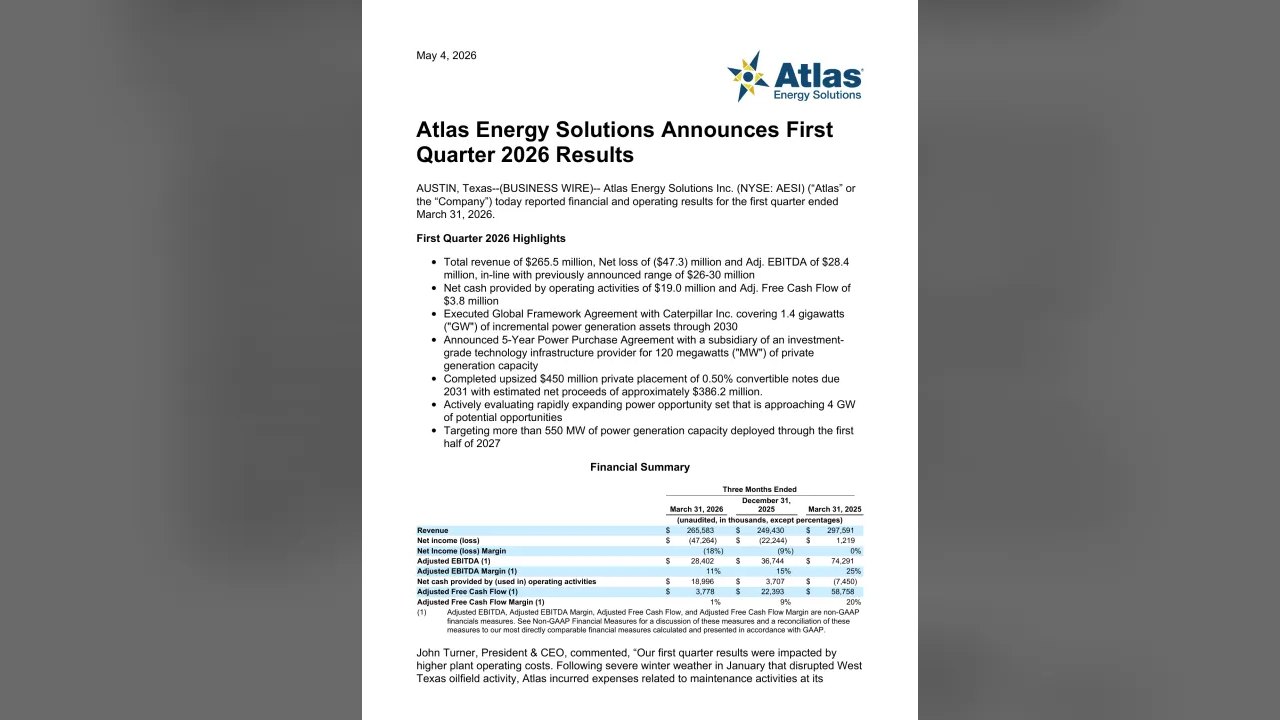
2:52 The strategic and commercial momentum heading into the balance of the year is the strongest it has been in some time. Turning to our first quarter results. Atlas generated revenue of $265,500,000 and EBITDA of $28,400,000 representing an EBITDA margin of 11%. Results were impacted by severe winter weather, elevated maintenance at our Kermit facility and higher third party logistics costs. Each of these items has been resolved and we expect underlying margins to normalize beginning in the second quarter as the headwinds roll off and contracted volumes ramp. The clear signal of the demand recovery is in our Bone book of business.
3:39 Customer volumes have moved our mining operations to a sold out position for the second quarter at current production rates, and we expect our plants to remain very busy for the balance of the year. As contracts roll off or if we elect to increase production, additional sand sales this year should come at higher pricing. The macro backdrop is supportive. WTI is hovering near $100 a barrel and the 2027 strip has moved higher, but we want to be clear that our outlook is anchored in customer commitments and completion activity we can see today, not in any single price level holding. While the West Texas sand and logistics market has been in a rut for the better part of two years, Atlas never stopped investing in our infrastructure.
4:31 When the markets get tight, our investment in our plants, logistics network and last mile equipment reinforce our position as the most reliable supplier in the Permian. Now let me turn to Power, where we are deploying capital with the same operating discipline that built our sand and logistics franchise and where we believe Atlas' industrial capabilities translate directly. We have intentionally structured our power strategy differently from some peers by pursuing full scope power purchase agreements in which Atlas owns and operates the complete solution, including balance of plan. This creates stickier, longer term customer relationships, provides significant advantages at contract renewal, delivers superior reliability compared to the grid in many cases, allows for greater pricing flexibility once equipment costs are recovered and creates high barriers for competitors due to the sunk cost and complexity of the facility.
5:31 With grid constraints likely to persist for years, we believe this PPA model is the right long term strategy for our shareholders. In November, Atlas placed an initial order with Caterpillar for two forty megawatts of power generation equipment, sized in response to specific customer projects. As commercial momentum built early this year, we recognized the generational nature of this opportunity and entered into a separate global framework agreement with Caterpillar that secures an additional 1.4 gigawatts of power generation assets for delivery between 2027 and 2029. Together with the initial two forty megawatt order, these commitments support our objective of owning and operating more than two gigawatts by 2030.
6:20 The announcement of the Global Framework Agreement immediately elevated our commercial position. Our commercial team went from hunting deals to being hunted. With power generation equipment in short supply, our secured supply chain and our ability to offer surety of delivery have moved us from medium sized industrial projects into serious contention for data center deployments. On April 1, we announced our first private grid power purchase agreement, 120 megawatt deployment that will be supplied from the initial two forty megawatt November order. The PPA carries an initial five year term with two additional five year extension options. Equipment delivery and construction are expected to begin later this year with commissioning targeted for the first half of twenty twenty seven.
7:10 We expect this 120 megawatt deployment to generate approximately 50,000,000 to $55,000,000 of adjusted free cash flow on an annualized basis once fully deployed. To support the customer during construction and commissioning, we have already begun providing bridge power with mobile generators. The combination of these bridge deployments and other recently executed microgrid deployments is expected to contribute approximately 35,000,000 in the incremental adjusted EBITDA over the remaining nine months of 2026, weighted toward the back half of the year as deployments ramp. Finally, in April, we successfully priced $450,000,000 of 0.5% convertible senior notes due 2031. Concurrently, we entered into a capped call transaction with initial cap price of $22.32 per share, a 28% premium over last Thursday's closing price of $17.38 We used a portion of the $386,000,000 in net proceeds to pay down our outstanding balance under our ABL and outstanding advances under our master lease agreement and interim funding agreement.
8:18 We intend to use a portion of the remaining net proceeds to finance the initial two forty megawatt order. On a cash coupon basis, this transaction reduces cash interest expense of this quantum of capital from high single digits to 05%. The cap call meaningfully mitigates dilution up to the cap price, though we recognize residual equity optionality remains embedded in the structure. In summary, Atlas is well positioned to grow our power business from expected deployments of roughly five fifty megawatts next year to approximately two gigawatts by the end of the decade. Combined with a recovering sand and logistics business, this trajectory would meaningfully transform our cash flow profile and create substantial long term value for our shareholders.
9:04 With that, I will now turn the call over to our CFO, Blake McCarthy, who will review our financials in more detail and provide an update on our Sand and Logistics operations. Thanks, John. At the time of our Q4 call, we were probably a bit more bullish about the prospects of oil than most industry prognosticators as we are forecasting global oil supply and demand coming into balance later this year. Regardless, we were aligned with most forecasts that called for slightly flat to down U. S. Activity levels in 2026. Well, as is par for the course in the oilfield, the backdrop has changed in a hurry. The turmoil in The Middle East and its impact on global oil trade flow have led to a rapid recalibration of oil prices. While none of us are sure how the current conflict will end, hopefully, peacefully and quickly, we're increasingly confident that the floor on oil prices over the medium term has risen significantly.
9:54 The commodity markets are signaling an increase in the call on U. S. Unconventional production. While we've seen some signs of customers bringing activity schedules forward, the number of true completion crew additions in the Permian remains in the low single digits thus far. The potential recovery in West Texas activity in 2026 will likely look quite different from the recovery post COVID. Customers aren't sitting on a massive inventory of DUCs like they were coming out with pandemic. And honestly, the service industry doesn't have the ready to go idle equipment stock it did at that time. Instead, ramping production will require rig additions, rigs that will need to be recouped, completion spreads that will require crew ups and likely capital upgrades, and ancillary services will need to be secured. Current pricing levels for all of these just don't justify the investments service providers will need to make to meet incremental customer demand.
10:43 Thus, we are likely at the front end of a pricing recovery across the North American services complex. It's still very early and the wild volatility we've seen in the commodity tape based on who's tweeting what certainly doesn't inspire extreme confidence, but the realities of the impact the current geopolitical events are having on physical global inventories are becoming increasingly self evident and the strip always eventually responds in kind. While we expect the larger operators to take a more cautious approach to activity additions in the near term, the universe of smaller operators will likely front run the big boys as they historically have always moved to maximize their value capture during bull markets. The West Texas oil patch is a small community that thrives on industry chatter and we're starting to hear the right things about activity increases in the second half of the year. Thus far, we have seen a few operators take advantage of an elevated strip to accelerate what remains at their drilled and completed inventory, which directly led to us adding 1,000,000 tons of incremental allocated volume through year end.
11:39 The limited response by most public E and Ps to date is not all that surprising as they will likely evaluate the 2027 curve around mid year prior to making capital allocation decisions. It's not going to take many crew additions for sand supply to get tight. Today, we estimate approximately 75 frac crews operating in Permian. Due to the increase in sand intensity of completion processes over the past few years, we believe a 10% increase in frac activity would conservatively add north of 7,000,000 tons of incremental sand demand. Based on what we know about the market, it's going to be tough for the industry to produce enough to meet that demand, much less transported to the well sites. While we haven't seen meaningful improvement in pricing just yet, you can feel the stage is getting set. While we remain cautiously optimistic on higher mine gate pricing, we have already witnessed higher logistics pricing.
12:28 Last year was the perfect storm for poor logistics pricing. Post Liberation Day, we saw both falling activity in the Permian along with weakening trucking rates nationally. Add in the impact of the June Express ramping midyear and trucking rates fell below the levels we saw during COVID in the second half of last year. Margins for third party trucking rates turned negative in the fourth quarter. That rubber band finally snapped in early January as a small ramp in activity exposed the fragility of the logistics network in the Permian. We saw a spike in trucking rates even before the Iran conflict and in late February higher diesel prices led to another round of rate increases. In the over the road market nationwide, tender rejection rates in March were approximately 14%, defying typical seasonal dips. This signifies a tighter, more expensive freight market with rates holding more than 800 basis points higher than twenty twenty five levels.
13:19 Rising rates nationally will pull rates higher in West Texas as carriers must now keep up with the over the road market. Although there was always a lag in passing those higher rates through to our customers, we did witness mid teen logistics margins in March compared to the low single digit margins in January and February. Higher trucking rates can also be a tailwind for higher mine gate pricing. Disadvantaged mines that are several mileage bands further away from activity sites are less competitive when hauling rates normalize. Higher rates also make the value proposition of the Dune Express even more obvious. Trucking rates in West Texas likely have more room to run as rates in the Permian are still about 10% below national over the road rates. Historically, Permian trucking rates are usually at a premium to over the road market due to the wear and tear of driving on lease roads.
14:05 Increased logistics pricing typically front runs increased mine day pricing, so the improvements we are seeing now are very welcomed. Moving to our financials. First quarter twenty twenty six revenue of $265,500,000 broke down to the following: proppant sales totaled $105,600,000 power equipment sales $3,300,000 logistics $139,100,000 and power rentals added $17,500,000 Total proppant sales volume was up sequentially to 5,700,000 tons, which does not include approximately 130,000 tons of third party sand purchases. Our logistics business set a quarterly delivered record of 5,500,000 tons. Our average sales price for proppant for the first quarter was approximately $18.19 per ton, not including shortfall revenue of $1,900,000 For the second quarter, we expect volumes to be up sequentially with the average sales price to be slightly below $18 per ton.
15:00 We are effectively sold out for Q2. First quarter cost of sales, excluding DD and A, were $214,000,000 consisting of $74,700,000 in proppant plant operating costs, dollars 2,100,000 from power equipment costs, dollars 127,000,000 of service costs, dollars 5,900,000 in rental costs and $4,300,000 in royalties. For the first quarter, our per ton profit plant operating costs were approximately $13.86 including royalties, up sequentially from the fourth quarter. Higher expenses related to maintenance activities following winter storm at our flagship current facility were the primary driver of the elevated OpEx per ton. Q1 cash SG and A, excluding litigation and non recurring items, was 23,300,000 SG and A excluding litigation expenses is expected to average approximately 21,000,000 to $22,000,000 for the remainder of the year per quarter.
15:54 Growth CapEx for the quarter was 7,000,000 the majority of which was tied to our Power segment and maintenance CapEx of $24,600,000 Q1 will represent the high watermark for capital spending in our sand and logistics business for 2026, as spending was primarily tied to essential equipment and preparatory work ahead of deliveries. We are adjusting our 2026 CapEx guidance to approximately $350,000,000 to $375,000,000 due to bringing the two forty megawatt purchase on balance sheet with the recent convertible offering. Maintenance CapEx of approximately $45,000,000 is planned with approximately $3.00 5,000,000 to $330,000,000 dedicated to growth, the vast majority of which is tied to the build out of our private grid power business. Looking ahead to the second quarter, we are forecasting sequentially improved sales volume. We are effectively sold out of our productive capacity for the second quarter as a step up in production would likely require incremental personnel that current sand prices do not justify.
16:50 Additionally, our visibility to second half activity levels and consequently volumes is improving rapidly. Due to the increased fixed cost absorption and improved production efficiency, OpEx per ton is forecast to decline in the second quarter to approximately $12.75 OpEx per ton is expected to continue improving over the remainder of the year as new operating processes have begun bearing fruit at our fixed mines. In the first quarter, our logistics business was impacted by a spike in third party trucking rates and a late quarter increase in diesel prices. However, as mentioned, logistics margins improved progressively throughout the quarter from low single digits in January to mid teens by March. We are currently forecasting mid teens logistics margins for Q2. Additionally, as previously mentioned, Atlas' power business is building contracting momentum rapidly.
17:40 During the first quarter, the company executed multiple contracts spanning upstream and midstream microgrid projects and bridge power deployments in the commercial industrial market. We expect to generate approximately $35,000,000 in incremental adjusted EBITDA over the remaining nine months of 2026 from bridge and microgrid deployments. Looking at the current run rate for March EBITDA and with the incremental contributions coming from our Power segment, we expect Q2 EBITDA to be approximately $50,000,000 I will now hand the call over to our Executive Chairman, Bud Brigham for some closing remarks before we turn the call over for some Q and A. Thank you, Blake. First, I'm going to start with some context for my comments. It was thirty five years ago as a young geophysicist that I stepped out on my own with a small amount of capital and founded Brigham Exploration.
18:28 Our plan was ambitious to leverage cutting edge technology to out innovate the competition and create lasting value for shareholders. By hiring exceptional people, aligning them tightly with our investors and empowering them in an entrepreneurial innovative culture that model delivered three IPOs and numerous successful exits. Along the way, our E and P companies drove several industry transforming advancements. In the 1990s, we pioneered the use of three d seismic delivering unprecedented exploration success rates leading to our first IPO in 1997. In 2004, we were an early mover with horizontal fracking in the oil plays and built a position in the Bakken.
19:14 In 2007 and 2008, we began outperforming peers in the Bakken in part by increasing frac stages. In 2009, we completed the first successful two mile long lateral with over 20 frac stages, which expanded the Bakken play more than 70 miles to the West and accelerated development across all the major U. S. Shale basins. And in 2014 and 2015, Brigham Resources successful wells extended the Delaware Basin significantly to the South. Then in 2017, we founded Atlas and brought that same innovative spirit to oilfield services with four more firsts. First, our team designed permitted and built the industry's first and only long distance sand conveyor system, widely believed impossible at the time, which reliably delivers premium proppant 42 miles into the heart of America's most prolific producing region.
20:16 We were also the first autonomously truck proppant. The first with double and triple trailer configurations in U. S. Oil fields and the first and only company to dredge mine proppant in the Permian Basin. As John and Blake have shared, we're only getting started. Our proven ability to innovate and execute large complex infrastructure projects gives us a unique advantage in addressing today's energy challenges. And of course over that thirty five year career, I've experienced many cycles and disruptions, but I've never seen demand inflections as powerful as the ones we're witnessing today. As the largest premier proppant logistic provider in the world, we stand ready to respond.
21:05 We are exceptionally well positioned to support the delivery of incremental oil supply to meet global demand, demand which is only intensified with the recent Middle East disruption. As in the prior up cycles, we are positioned to deliver strong cash flow growth via profit and logistics over the next several years. But what makes this cycle strikingly different for Atlas is that we're also optimally positioned to help meet America's rapidly expanding power needs. Our recently announced power contract combined with the global framework agreement we just signed with Caterpillar gives us both surety of supply and the scale to be a leading player in the fast growing private power market.
21:51 With these milestones and those still to come, we're clearly signaling our capabilities to both investors and customers facing acute grid constraints across Texas and The United States. The future for Atlas and Power is here and I believe we're emerging as a leader in this critical market. Thank you for joining us today. I'll now turn the call over to the operator for Q and A. Thank you. We will now be conducting a question and answer session. Session. The first question is from Jim Rollison from Raymond James. Please go ahead.
22:52 Hey, good morning everyone. John, maybe start with you on a question on power. If we go back just a quarter ago, you were kind of focused on the commercial and industrial space, obviously targeting a specific customer with the original two forty megawatts. And as you've upped that ante by a pretty large amount with the Global Framework Agreement with Caterpillar, and you guys mentioned that people are now calling you instead of the other way Yes. Thanks, Jim. I'll start and then Tim, you can add to this. Jim, you're right. I mean, the GFA or the Global Framework Agreement has had a profound impact on Atlas' commercial opportunity set.
23:40 Before the agreement, our pipeline was weighted towards smaller industrial deployments. The combination of secured supply and access to the premium equipment from Caterpillar has changed the customer conversation. It's really been overnight. Both the size of deployments we're being invited into and the quality of the counterparties has significantly changed as well. And then like I mentioned on my call, mean reverse inquiries are now active. We're having a lot of reverse customer inquiries now on a daily basis and that's a meaningful part of why we're so optimistic about our path forward with power. Ken, do you want to add anything to that? Yes. I think as John mentioned, we're getting a lot of inbounds.
24:30 The goal of signing the Global Framework Agreement was to secure power for the opportunity sets that we had in front of us, which were heavily weighted towards, as John mentioned, smaller industrial deployments. And when I say small, they're 50 to a couple of 100 megawatts. And since signing the Global Framework Agreement, we've started to get some inquiries from some of the bigger data center projects. So I think our queue going into that as far as an opportunity set was roughly four megawatt or four gigawatts. And I would say since signing that agreement that Q has grown to somewhere between probably eight and ten gigawatts.
25:17 And these are quality projects where we've gone through a stage of vetting to see if they're real and have determined that as the project moves forward, we would like to participate. Sounds like you could place a lot of equipment with a smaller number of customers. Then maybe as a follow-up, kind of switching gears over to sand and logistics business. Blake, you talked about incremental opportunities and kind of how we've heard this earnings season some of that early indication of recovery of activity in The U. S. Land and obviously the Permian will be part of that. But I'm curious as you think about incremental sand volumes where you're sold out today, what kind of price level do you need for sand to actually consider adding to your capacity mining capacity to actually provide that sand?
26:13 Yes. That's a good question, Jim. And I think that question basically assumes that at any one point a player has control over the price of sand, which as you know, I mean, is such a hyper volatile commodity, where as we talked about in the past, right, supply gets a little bit over demand just on a macro basis and it quickly falls to that marginal price of production for the industry, which is where it's been at for over eighteen months now. And the thing about sand is, as though it is the critical raw material to the completion process, it gets a little bit undersupplied and it doesn't just move three dollars four dollars It moves up in a hurry.
27:07 I think that as the largest player right now, like, there hasn't been a lot of movement in price. We've seen some stuff around the margins. I think one encouraging thing we've seen is some of the more astute operators have tried to move forward their RFP processes, where typically we're not talking about this stuff until November. And some of the smarter guys are doing exactly what I would do, which is like, hey, the writings on the wall on this, things are going to tighten up. If I could lock in now, that should be good for my well costs come 2027 and I going think that for where we stand is like, hey, we're more than happy to help you secure your volumes, but we're not going to lock in these prices for the long term.
28:03 So that's a bit of give and take. In terms of adding production, for us, like if you look at where we're at now versus what our nameplate is, like there's still some upside. But that really would require adding shifts and probably some minimal capital investment. And it's just something that we're not really going to be doing until you get to north of that $23 to $25 range on sand pricing, because that's really where the industry starts earning its cost of capital. In a perfect world, we keep sand in those type of normalized prices. That's really a sweet spot for Atlas and it doesn't encourage incremental supply. But sand always moves when it goes down, it goes down in a hurry. When it goes up, it usually goes way higher than we ever expect.
28:56 So it's something that we're watching very closely. Yes. I think one thing to note is back in 2021, sand was around $20 per ton. And we got to March 2022, it was north of $30 on its front of $40 a ton. So like Blake said, I mean, sand prices swing wild. I mean, they're obviously very volatile. So it's just something to and when that supply demand balance when that when we're under supply, when that shifts, it shifts quickly. Yes, I recall. Appreciate all the context guys. Thanks, Jim. The next question is from Derek Potheiser from Piper Sandler. Please go ahead. Hey, good morning, guys. So encouraging to hear all the comments around the logistics margins going from the low single digits to it's about the mid teens here and guiding that for the next quarter. On the trucking rate specifically, how should we think about what a 10% uplift in the Permian activity would do to those trucking rates, which appear to be already tightening? Blake, I think you said they're still 10% below the national average. So maybe just some additional color around where you think trucking rates can go if we do get an uptick in activity here?
30:07 Yes. That's a great question, Derek. Apologies in that trying to pin down where trucking rates are right now is like trying to hold on to a grease pig. There's a lot of moving variables. Yes, as I mentioned in the prepared remarks, the typical relationship with over the road over the road national freight right now versus Permian rates is inverted. Typically, you need rates at like a 10% to 20% premium to over the road to incentivize drivers and truck owners to beat up their assets in the oilfield. But currently, rates are still at a discount. The thing that we're really watching is diesel. That's a direct hit in the wallet for trucking owner operators. And while most of our customers have been quick to work with us on passing those costs through, we have heard quite a few anecdotes of certain operators refusing to accept those pass throughs or only accepting a percentage of that.
31:01 In my opinion, that's really shortsighted as trucking margins were already razor thin across the industry, so if not in the red for the smaller trucking companies. So forcing them to eat the rapid diesel inflation just invites a trucking crunch. And we're starting to see that as industry watchers can tell you that several trucking companies are choosing to park assets versus operating at a loss. That's continued tightening in the trucking market. That's something we're certainly watching. As the higher trucking rates go, the more important the location of your mines and the breadth of your logistics network, the more important that becomes. So the combination of our mobile mines and Midland Basin and, of course, the logistical advantages provided by the Dune Express for fixed mines and service the Delaware, that puts out Atlas in a really strong position versus many of our competitors' mines and actually probably adds to our ability to push mine gate pricing.
31:55 In terms of what it means in terms of like, hey, see a 10% move in trucking rates, what that does to our margin profile, that advantage, that margin advantage provided by the Dune Express, that just throws gas on that fire, right? Because if you're thinking those trucking rates are being forced by cost inflation to the owner operators, yes, get hit on that on the final haul from end of line or from the Stateline facility to the well site, but it's such a smaller percentage of the overall logistical haul because of how much of that chunk of that haul is covered by the Dune Express. And so it becomes it really starts to push our incrementals. We were encouraged to see the improvement from the low single digits into the mid teens.
32:45 We're watching that now and expecting it to kind of be that mid teens margins through this quarter. But as we move into the back half of the year, it's certainly something we're going to start pushing. Yes. And I think the diesel prices, I mean, that's obviously a big tailwind on the Dune Express because that's electric. Moving that sand 42 miles via an electric conveyor, that's also big. And I also think there's also a shortage of trailers, lead time on those trailers. A lot of your trailer manufacturing comes from Mexico, there's a tariff on it. So I think you're going to start seeing shortages in a lot of places here as we move through the as we move into the rest of the year. Got it. No, that's all really helpful color. Speak I'm sorry. So we talked about the demand side of problem. Maybe thinking about the supply side, I think in previous calls, we talked about the Tier two, Tier three sand mines out there. I think we've had something around like 20% of supply coming out of the market.
33:44 But if there's going to be this call on demand around, I think you said 7,000,000 tons for this year if we start adding completion crews back, how do you think about those mines being incentivized to come back to the market? Because when these mines shutter, they never truly shutter or come out of the market and they can come back to life pretty quickly. So have you surveyed and kind of looked around the supply stack to see which mines have the ability to come back, maybe some that have been truly taken out of the market? Just maybe some comments and color around the supply stack as you see it today and then what it could and how it could respond if there is a big call on demand? Yeah, I can start with that. I mean, we can only go by experience of what we've seen in the past back when prices really started when we saw this change flipping supply to the supply and demand balance.
34:31 I think a lot of a number of mines were that had been opened, had closed, were slow to open their doors and commit a lot of capital until they had longer term contracts. And so I think that's really going to impact that. I also think your proximity mines are going to be in a lot more advantaged position here, because of where diesel rates are and where the trucking rates are. Do you want add anything? Yes. That interplay between just the logistics haul, right? Like it's not just their cost to produce at the mine, but it's also how mines that are located at the kind of the fringes of the plays. If you got a mine that's to the extreme South or something like that, like with what you're seeing in terms of diesel inflation, those holes become really cost prohibitive.
35:23 And so you really need to see mine gate pricing move in a big way to incentivize those mines to really to gear up. And like John said, like it's it'd be a little foolhardy to do it like without, hey, I can get a spot sale here at this price x price, which would if I extrapolate that out two years, it incentivizes that capital investment. But if you don't have a contract that's a heck of a bet. And related to all that we should also mention personnel. I mean it's a real challenge to find labor that can operate these plants. And so that's going to be a challenge as well. And really the data center boom that's going on in what I would call Central Texas, maybe Central West Texas a little bit, around Abilene and places like that is really pulling a lot of workers out of the oil field right now. And so because there's all this construction trades and things like that, that typically where we go to pull our manpower from, it's making it difficult to hire.
36:32 So there's a lot of other factors going on here than just than there were back when these mines opened in 2022, right? Or I mean there's a lot more going on. Yes. It. Yes. No, a lot has changed. It should be helpful guys. Really appreciate it. I'll turn it back. Thanks, Jared. The next question is from Sean Mitchell from Daniel Energy Partners. Please go ahead. Good morning, guys. Thanks for all the color. Maybe turning back to Power. Can you guys talk about the specific equipment that CAT is providing to you in this global framework agreement? And why these units are probably well suited for the private grid versus other options? Yes. Good morning, Sean. This is Tim. I'll take that question.
37:23 The assets we're purchasing from CAD are really two engine platforms. One is a medium speed engine, one is a high speed engine. Those are both designed to operate in continuous duty. Medium speed is it's four megawatt unit. The high speed engine is a 2.5 megawatt engine. And we feel like these are assets that we want to own and operate for decades. And they each have different characteristics that help support our customer needs. So really kind of project specific on what units we would put on specific projects.
38:11 But our confidence is not only in the history of those engines, which I think one of them has not had the design change in twenty years, which tells us it's out doing the work and will continue to. And the others just had some design changes and there are some different models available to us under that agreement. And we can use those models to kind of match the customer demand just depending on what their load does on an operating basis. But I think what excites us about both of those is just the fact that they're with probably the most respected OEM in that space and really in several spaces in Caterpillar.
38:59 Just the backing that we get from that helps us to predict our maintenance costs, helps us to address issues quickly should they pop up and ultimately lend itself to us having a Tier one portfolio of assets that we're out operating for customers. That's helpful. Thank you. The next question is from Scott Gruber from Citigroup. Please go ahead. Hey, good morning. Maybe turning to the OpEx side on your sand production business. I want to double check the OpEx per ton guide embedded in the 2Q EBITDA guidance.
39:47 I think I heard $12.45 per ton, so I wanted to check that. And obviously improvement will come with the new dredges. Where do you think OpEx per ton lands now on a normalized basis? And when do you think you can get there? So correction on that, Scott. The OpEx per ton guide for Q2 embedded in the Q2 guide is 12.75 Okay. Thank you. Yes. Thanks for clarifying. I have a tendency to trip over my own tongue. Yes, I think that we're looking obviously, it's a fixed cost absorption business. And so, the more now that we're starting to get closer to sold out, that sold out for Q2 at the current production capacity, that's obviously a tailwind. We're still in the process of commissioning the new dredges at the flagship Kermit mine.
40:40 Once we get those on, that's going to lower our variable cost. And so that's that will start to flow through in terms of operating leverage. As we push forward through the year, that will continue to trend down. We'll probably get an 11 handle on it towards the kind of, I'd say, conservatively, kind of the September, October timeframe. Obviously, continues to be based around there's the volumetric aspect of that. But I think longer term, we're very much our mines have been operating kind of at an elevated OpEx for a while now. But we still got our goal is to get back to kind of the high 10s on a full run rate basis once we get them optimized and Across the company. Across the company. And we've got I think there's a lot of stuff going on under the hood that we're very excited about in terms of process improvements at the plants, more efficient maintenance and things like that. We're really making some real headway there. And so I think it'd be continue to be a positive trend as we work through the rest of the year.
41:54 Got it. I appreciate that. And then turning back to logistics, obviously encouraging trends on the trucking side and you mentioned how that will is there a positive influence on Dune Express pricing. I'm wondering kind of the timing around that pull, are you doing express volumes? Is the pricing on those volumes locked in for the year or could those reset at some point this year? A lot of those contracts have either biannual or quarterly pricing visits. Right now, like I said, it's still early. So you haven't seen much movement in terms of actual sand pricing.
42:43 You have seen movement in trucking rates. With the Dune Express volumes, we really look at those kind of as a total cost of delivered tons. So like we add those together and is through the lens that we want the operator to look at because that's certainly going to be to our advantage as we move through this cycle. It's probably more as later in the year, it might be a slight tailwind. For those bigger contracts, it's going to be a bigger tailwind as we move into 2027. But our trucking pricing resets a lot more frequently than sand pricing does. Yeah. It's quarterly on the sand pricing. I mean on the trucking prices, sorry. Yes. I got you. But with those kind of integrated deliveries, the upside really comes next year on the margin front.
43:37 That will probably be the biggest lever. Yes, yes. Okay. Appreciate the color. Thank you. Thanks. The next question is from Keith MacKey from RBC Capital Markets. Please go ahead. Hey, thanks and good morning. Maybe just sticking on the sand price theme. Can you just comment on your contract durations and contract amounts? Roughly how much of your sand could reprice between now and the end of the year based on the contract or agreement schedule that you currently have in place? Yes. We tend to try to contract as much as our sand as possible through the RFP process.
44:24 I think that there's probably in terms of stuff that's fully free float to spot, if you look at the back half of the year, we could probably reprice up to 20%, 25% of our contract portfolio. On top of that, as people look to lock in tons for '27, that probably opens the conversation to, hey, let's move the entire contract to a move levels there. So there is some upside to pricing as we move through the rest of the year, but it's really to reprice the entire contract portfolio. It's going to be of as you move into that full 2027 RFP season. Got it. Okay. Okay. Makes sense.
45:10 And then can you just run us through a little bit more on the dredge implementation and the timelines there for the new Twinkle dredges that you've got coming in? And just how that align with the OpEx per ton guidance that you've been running us through, Blake? On the timing, the first Twinkle dredge is on location. It's built. They're expanding that they're digging the pond right now. We would expect that dredge to be floated probably by the end of the quarter, when I say quarter, end of the second quarter. The other the second dredge arrives here, I believe starts arriving here probably in June sometime.
45:56 And then I think they've got to construct the dredge on-site and I would say that we probably won't see a full impact on our from the dredge probably until end of the year, fourth quarter maybe. I mean because I don't think while they'll both be floated probably in the third quarter, I think it's going to be get some time for us to commission them and get them running where they need to be. So I mean but the guidance that we've given, I don't think it incorporates this. So, there's no impact from that in Q2? Yes. And then, the way to think of that from a model mechanic standpoint is that, right now that variable cost of sand is probably closer to $550,000,000 to $575,000,000 When those dredges get running that number gets has a forehandle on it. And so that really starts to flow through in terms of, like I said, the variable cost operating leverage.
46:54 Got it. Appreciate the color. The next question is from Don Crist from Johnson Rice. Please go ahead. Good morning, Thanks for letting me in here. On the Global Framework Agreement, I just wanted to ask about the delivery schedule. Is it pretty constant over the '27 through '29 period? Or is it more back end weighted? Just kind of any color around the delivery schedule on that GFA? Yes, Don. So the delivery schedule on 2027 is kind of last three quarters of the year. We've still got 120 megawatts from our first order kind of pre framework agreement that we expect to be able to slot in there.
47:50 And then in 2028, it's fairly constant and accelerates as far as overall size of megawatts in our delivery to spot. Yes. So I think it's more weighted to '27 28 with a lesser commitment in '29. But as Tim and John talked so enthusiastically about like as we move forward and actually start to contract some of these assets, we'd probably be looking we have the ability to upsize that commitment at the later stages of the contract and it's something that we're going to be exploring. Okay. And just from a kind of contract timing, would your and I know it's very fluid and these things have to go through boards and all kind of things. But just are you is your goal to have that contracted that incremental capacity contracted, say, nine months before it is delivered? Or is that too aggressive?
48:53 Go ahead. I mean, I think what we found out with and obviously what others have found out is that talking about timing on these contracts is very difficult. But our goal is to get it contracted as soon as we can. But I don't want to put out any timelines out there they because take And these are very complicated contracts and it takes a while for negotiation. Because we're talking about fifteen to twenty year power agreements with counterparties. And so we don't want to put a timeline on that, what our goal is. I mean, we just want to make sure that it's contracted when we start deploying it. Yes. The one thing I will say is that compute power is a real bottleneck. And so there is a lot of urgency to move from this customer base. And so obviously, there's urgency on our end. It's like, hey, we want to get these contracts. There's a lot of urgency from them that's like, I need this power and I need this timeline.
50:03 And there is a considerable construction runway to where you actually go from, hey, we signed the contract to where they're actually providing power or getting we're providing power to them. And so it is to both parties' advantage for these negotiations to move as quickly as possible. But as John said, they're really complicated negotiations, big contracts. And so each one is like an M and A transaction. And so and when you're signing contracts of this term, it's infrastructure. You want to make sure you get it right because you got to live with those contracts for a very long time. Yes. And I think the other element that has kind of changed the dynamics around those discussions is just the number of inbounds we've gotten in the counterparties.
50:56 And so when we look to build a contracted business that's fifteen, twenty year commitments, I think we did a great job on asset selection in the Global Framework Agreement. I think we've got a great team. And the other part that makes a good deal is a good counterparty that we want to work with for that period of time. And given what's in our pipeline and how quickly it's expanded, we're in a very fortunate position where we've got a little more say in who our counterparties are going to be for those contracts. And so obviously something we're all looking forward to and we'll share details as they come.
51:45 I appreciate the color. When a 500 megawatt contract can be well over $2,000,000,000 it's understandable that it takes a while to get across the finish line. So rooting for you. Thanks for the color. Thanks. Thank you. Thanks, Tyler. There are no further questions at this time. I would like to turn the floor back over to John Turner for closing comments. Yes. Thank you, operator. And I want to thank everyone for all the questions today. And before we close, I want to step back from the quarter and tell you why I believe Atlas looks fundamentally different two years from now than it did or than it does today. Start with what we announced last month, the 120 megawatt power deal, the power purchase agreement that we signed on April 1, which is expected to generate 50,000,000 to $55,000,000 of annual adjusted free cash flow once it's fully deployed.
52:39 Returns on individual contracts will vary. They will depend on the customer and the market, term length, contract structure, etcetera. We would not expect every megawatt across our portfolio, our broader portfolio to deploy at these same economics. But this contract is a meaningful proof point of what the model can produce and it represents a small fraction of the two gigawatts we expect to own and operate by 2030. We're not a company adding power at the margin. We're building a long duration contracted cash flow stream on top of a sand and logistics franchise that is self inflecting at this time as well. And we are doing it with secured supply from Caterpillar at a moment when and obviously Caterpillar is a great counterparty and it's at a moment when generation equipment is one of the scarcest assets in The U. S. Economy.
53:37 Sandal Logistics business is the engine that funds this transformation. That engine is accelerating. We're effectively sold out as we've talked about for the second quarter. We talked about our logistics margins are now running in the mid teens with that strength expected to carry through the second quarter and we are guiding to approximately $50,000,000 of EBITDA in the second quarter, which is a 76% roughly 76% sequential increase from the first quarter. The conditions Blake described, limited completion crew availability, tight equipment and rising trucking market rates, historically, we're the most reliable supplier in the basin and that is Atlas. We've seen that in the past. We've also recently positioned our balance sheet to fund this growth without compromising returns. We talked about that through the convertible pricing in which I guess and then as Bud noted, in his 35 in the industry, he's never seen two demand inflections of this magnitude converge at the same time.
54:39 Surging global oil demand on one side and then the acute U. S. Power constraints on the other. And Atlas is positioned itself to serve both of those. And we have the assets, the contracts, the supply chain and the capital to deliver and we intend to. Thank you for your time and your questions, your continued support. We look forward to updating you guys on our progress next quarter. This concludes today's teleconference. You may disconnect your lines at this time. Thank you for your participation.
Follow Atlas Energy Solutions Inc. into a list and get an email when it puts out news.
Vice President of Investor Relations
President and Chief Executive Officer
Chief Financial Officer
Executive Chair
Analyst, Raymond James
President of Power
Analyst, Piper Sandler
Analyst, Citigroup
Analyst, RBC Capital Markets
Analyst, Daniel Energy Partners
Analyst, Johnson Rice