Transcript
Automated transcript · Written by software from the replay's audio. It can mishear names and figures; the replay is the record.
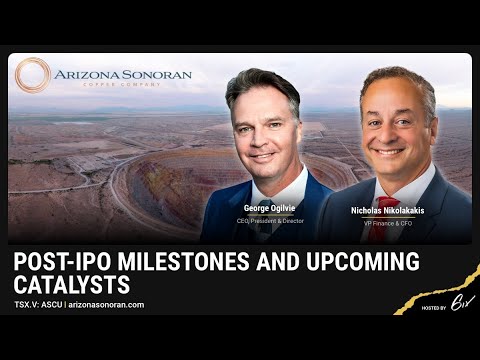
0:07 Well, hello, everyone, and welcome to Arizona Sonoran Copper Company's live summit today hosted by 6. I'm pleased to introduce our speakers for today. We have President, CEO, and Director George Algilvie. The company's CFO, Nicholas Nikolaakis. Director of Investor Relations, Alison Dwoskin. So George is going to walk us through a company presentation and then we will be accepting questions live. So as a reminder, you can submit questions at any time on the Q&A panel on the right-hand side of the screen, and we'll get to them after the
0:37 presentation. And as always, the summit is being recorded and will be available to watch afterwards on six.com. But without any further ado, I'll hand it over to you, George, to get us started. Excellent. Well, thank you, Dasha. Appreciate it. First of all, I'd like to welcome everybody on to the call today. Greatly appreciate you taking an interest in the company. Obviously, the title of our presentation today is Copper Invest in Sustainability, and it's Arizona Sonora Copper Company. We do make some forward-looking statements within the presentation. So obviously I'll draw your attention to the cautionary language. So why ASCU? Well, obviously it's a brownfield site. This mine was formally in production in the 1970s and 80s and was previously owned by ASARCO.
1:26 The mine is located in Arizona, which obviously is a Tier 1 jurisdiction. Today we have a compliant 43-101 consisting of 1.6 billion pounds of copper in the indicated category and 1.9 billion pounds of copper and the inferred category. And we're currently exploring on our own privately owned property known as Park Salier and we'll talk more about that a little later on in the presentation. When we produced our PEA last year, the capital intensity was extremely small when compared to our peer groups. We were looking at $124 million at that time to put this mine back into production. The asset is long left. We're currently showing in the PEA 56 million pounds of annual copper cathode production over an 18 year period.
2:22 And if you multiply those 2 numbers together, it's gonna give you about 1 billion pounds of copper is produced over that time period. Bear in mind, however, that the global resource is obviously 3.5 billion pounds of copper. So we certainly think with the PFS and the bankable feasibility study, there's definitely an opportunity for organic growth to see both the annual production increase and the life of mine go well beyond the current 18 years. When we ran the PEA, we ran it using a copper price of $3.35 a pound, which is obviously well below today's spot price of $4.35. But on an NPV 8 basis after tax, it gave us an NPV of $312 million US dollars and a post-tax IRR of 33%.
3:15 The other key thing about this project is it's all on private land, meaning that there is no federal regulators or federal nexus, no Army Corps of Engineers, no NEPA 404 requirements. So given that we're only dealing with the state and the local municipal authorities, it really does streamline the permitting process. Today we have a water permit to take water for the next 50 years at a rate 3 times greater than the current annual water requirement and we already have an aquifer protection permit for the surface stockpile. The application for the amendment has gone in which would allow us to mine not just the surface stockpile but the pet layback and also the underground component And we would anticipate that by the end of the first quarter, we should be in possession of the amended APP.
4:10 This year is an exciting year for further infill and expiration drilling. There's upwards of 125,000 feet of planned infill drilling. And most of that is going in at cactus east and cactus west. As we look to move the indicated resource up into the measured category. That's obviously going to be important when we come to the bankable feasibility study at the end of the year, as we'd like to see reserves in the proven category. We're also exploring at Park Salier. We've got about 22,000 feet initially scheduled there. The first 2 holes are completed and we would anticipate that they will come to market sometime in early February. We're also working with a company called Jetty Resources on the primary sulphide.
5:00 We've sent them a bulk sample to see if there's any possibility of leaching copper from the primary sulphide, which is a chalcopyrite. We're anticipating the initial results back by the end of this month. And then if they prove successful, we would move into a phase 2 testing, which would carry on throughout the end to the end of this year. Thank you, Alison. So a little bit on the share capital structure, as everybody's aware, we brought this company to the public markets in November of last year. Very successfully, we raised almost $47 million. Today, the company only has 71 million shares issued. And on a fully diluted basis, we're looking at close to 80 million shares issued and diluted.
5:49 Obviously the options and the warrants are in the money. We currently have 4 analysts covering the company with a consensus price of $3.15 Canadian. And for interest, when we conducted the IPO, I put in $2.3 million Canadian dollars of my own money. And right now I've got $2.8 million Canadian dollars fully invested in Arizona-Sonoran at a weighted average price of $2.48 Canadian. Thank you, Alison. So, since we last showed this slide, obviously we've added Nick Nikoloukakis to the executive team.
6:35 Nick brings 27 years of corporate finance and capital markets experience. Nick started his career with Placidome and then moved on to Barrick. He was heavily involved in the funding of Pepo Vallejo, which was over 1 billion dollars needed to be raised for that project in the Dominican Republic. Of course, Nick and I have a successful history together, recently working with Rubicon Battle North Gold, where the company was successfully sold last year to Evolution Mining for a 54% premium. Nick has raised over $2 billion throughout his career in the capital markets. And obviously at the end of this year on the production of the bankable feasibility study, we'd want to announce the project financing. So it's the main reason why Nick has been brought in, given his capital markets experience and the ability to de-risk the project through the project financing.
7:33 Thank you, Alison. Last year, we also spoke about strengthening the board, and we recognized that we had very little diversity. I'm very happy to say that we've delivered on that milestone as well. We've brought in a lady by the name of Sarah Strunk. Sarah is native to Arizona where she runs a very successful law practice. She's 37 years of experience. She's very well connected in Arizona and understands the state legislature and how the governor's office works. And of course, Sarah was previously the chairwoman of Brio Gold before they were ultimately acquired by Leogold. So we're very happy and grateful that Sarah has recently joined our board.
8:19 Thank you, Alison. So some of the things that we've completed, obviously, as we've said, we've added bench strength to both the management team and the board of directors. Last year, we completed a very successful infill drilling program at Cactus for the PFS, where we were moving inferred material up into the indicated resource. Those results are still pending assays, but they will be announced, obviously, over the course of the next 3 to 4 months. And all of that information will be going into a new updated resource model and made in reserves as part of the PFS. We recently announced as well in early January that the rezoning of the LKY lands that we had acquired last year was completed.
9:08 Remember those lands that we picked up were initially zoned for residential purposes. Now I'm happy to say everything at site has been zoned for industrial purposes. So that allows us now to start development and construction in the early part of 2023, pending project financing. We have also engaged a company by the name of Minviral, who've worked with many mining companies throughout the world. They've conducted recently a baseline greenhouse gas inventory of the project based on the PEA. The company in the last week just got the baseline audit And now we're in the process of developing our action plans, which will eventually be incorporated into the PFS and ultimately the Bankable Feasibility Study.
9:55 Our ultimate goal here is to get this
9:57 project to net 0 carbon emissions. Upcoming events for this year, obviously the PFS is due in the summer of this year. At the end of the year, early first quarter next year, we released the bankable feasibility study. In conjunction with that, we want to announce a maiden resource on Park Salier, hence the reason why we're currently drilling there. The amended APP is due at the end of the first quarter. Once we get into the second half of the year, we'll make an application for other permits related to construction and development which should be in place by the first quarter of 2023 and pending project financing it allows us to be shovel ready.
10:46 Once we complete the project financing the PEA is currently showing an 18 month construction and development period. And provided we can be shovel ready and have the project financing in place, If that were to occur in early 2023, we have the ability to put the mine into first production in the second half of 2024. Thank you, Alison. So a little bit on valuation and some benchmarking. Obviously, since conducting the initial IPO, which was done at $2.45 Canadian, we saw our share price wane heading into Christmas, but it's come back strong in the early part of this year. And this morning we opened trading at $2.34.
11:33 That gives us a multiple of 0.52 times price to NAV, which is in line with some of our peers at the lower end of the scale. And you can see where the peer averages at 0.7 times. So we still think there's significant upside in the share price, certainly over the next 6 to 12 months as we execute on our plan and obviously put out some exciting expiration results at Park Salire. I think the key thing to note here as well is when we compare ourselves to our peers, we're currently showing right now that we can have this asset into production ahead of our peer group and take advantage of the current robust copper prices in this cycle. Thank you, Alison. And then just lastly, if we look at the enterprise value of the company, we currently have a figure of around 130 million Canadian dollars.
12:25 When we compare that to our peer group, you can see they are substantially higher on an enterprise value basis. When we look at our production on the right hand side, peak production in the PEA gets us up to 80 million pounds of copper annually. We think we can grow that through the organic growth I spoke to earlier, north of 100 million pounds. And you can see that would put us in line with a copper mountain, and they currently have an enterprise value of well over 800 million US dollars. So we think over the next 12 to 24 months, as we continue to de-risk the project and execute on a plan, put the project financing in place, there really is some significant upside in the share valuation of this company, particularly considering the asset is in a tier 1 jurisdiction.
13:15 So I'm going to stop there. And I'm going to actually open up the floor for any questions that anybody has on the company and or the presentation. Great, thank you so much. Yeah, so feel free to submit any questions if you have, but there's actually a lot of questions emailed in. So I'm gonna start with some of those. Is in situ leaching anything that you're looking at outside of the main project area?
13:40 No, the answer to that is no. All of the leaching that we're looking at within our plan is all traditional leaching where it would be drilled, blast, haul the ore to surface and actually put it on properly designed and engineered leaching pads. We are not looking at in situ leaching in any way. Got it. Thank you. And at Park Slayer, there's a question when will the results come? Well the first 2 holes have been logged, they've been sent to the assay labs. As is typical with most assay labs, they have a hell of a lot of workload. We've received the results from the first hole back last week, and we're anticipating that hole ECP 045 will probably get those results in the next 2 weeks. So we would anticipate the first 2 holes of drilling at Park Salier will come to the market in early February.
14:38 Thank you. Next question is your tenors are not on federal lands. Please discuss the permitting you'll need to go through. Yeah. So when we're dealing with only state and local municipal authorities, once we submit an application and it is administratively accepted, there's a defined period of time of 180 days, which also includes a 30 day public consultation period. So once the application is administratively accepted, that clock starts ticking. That's why If I use the amended aquifer protection permit as an example, when we submitted that in mid-October of last year, within a week, it was administratively accepted.
15:28 So we knew at that point in time the clock starts ticking, and if you work out 180 days from that period of time it would take us through to late March early April is when the regulator must give us a response to that application. And it's the same process for any of the permits that we will apply for going forward on this project. And as we discussed, we already have a permit to take water for the next 50 years at a rate of 3,700 acre feet per year. And when we do our water balance from our mine plan in the PEA, the maximum water we use in any 1 year is 1,200
16:08 acre feet per year. Main permits beyond the amended aquifer protection permit this year are really related to construction and development, bonding and closure costs. And really we can't apply for those permits until we have a line of sight on the pre-feasibility study, which then has made in reserves.
16:31 And that means the mine plan and the scheduling and all the costing is built off of reserves, which obviously we have more confidence in, and is economically viable mineralization, i.e. Ore. So Once we have that better defined, then we can start applying for those permits. And the key one is the construction and development permit. If we assume that we apply for that in the second quarter, and it actually is administratively accepted by July the 1st, the 180 days starts ticking and that would therefore mean that by the end of this calendar year, we should be in possession of the mine reclamation and the construction and development permits.
17:18 Great, thank you. Alvin is asking, can we get more light on the capex number? Does the initial capex number include inflationary pressure? When we put the PEA together, which obviously has been out for almost 6 months now. There was no cost escalation built into the PEA. There was a contingency put in for the leaching pads and the SXCW plant, which was a 15% contingency, which took the total spend there up to just under $100 million. As is the case in all technical studies, all projects, when you move from PEA to PFS and ultimately up to a bankable feasibility study, there are always cost increases and we would expect the same with this project.
18:11 And as everybody on the call knows as well, we're also in an inflationary period. So we will see the costs escalate within this project. The good news, however, is that if we had, for example, a 40% cost escalation, the cost numbers are still, capital costs are still going to be well below 170 million US dollars. And when you consider that sum of monies, which obviously is a big sum of monies, but when you consider that versus other copper projects in the world that are in the development or exploration stage, and if they were ever to come to production, you're generally looking at hundreds of millions, if not billions of dollars to actually build these projects.
18:57 And if you have a $4 billion CAPEX project and you have a 20% blowout on CAPEX, suddenly you're looking now for $800 million of additional funding. That's the nice thing about this project, we would expect cost escalation, but at the end of the day, the project is still going to be very manageable. And with the organic growth that we have and some other bells, whistles and levers that we can pull on the productivity side, we believe there's still going to be significant margins for the shareholders of the company and therefore we should see a significant increase in the valuation of the share price over the next several years. Great, thank you. Our next question is what is the annual cash burn for 2022 and 2023?
19:48 Well, right now our budgets are in it, approximately 20 million US dollars as the burn for this year. We only have $3 million, however, allocated to Park Salier within that budget. If the results look promising, as we fully expect, we would anticipate that by the end of the second quarter, our budget on Park Salier and the actual monies would probably be spent. So there might be an opportunity there where we might want to increase the spending on Park Salire over and above what's currently in the budget. Right now, the company at the end of the calendar year in 2021 was sitting with just over 30 million US dollars cash in the bank. Christopher is asking how much drilling has been performed to date and what are the results, if any?
20:40 Well, the total drilling on this project is sitting at 75,000 metres of drilling over the last several years since Arizona Sonoran and our former name E.E. Lem Mining acquired the project in late 2019. And obviously, since that point in time, the company has been able to put out a 43-101 compliant resource, which we briefly discussed earlier, setting at £1.6 billion of indicated resource and £1.9 billion of inferred resource. What's allowed us to create such a large resource with 75,000m of drilling is that we have access to all the historical drilling that ASARCO did over the 15 plus years that they actually had the asset.
21:30 And believe it or not, we have access to the pulps as well. So the Stantec QA, QC resource geologist has obviously been on site. He's examined that historical core. He's picked some of the core out and the pulps. We sent it off to laboratories to have it verified. And when we've got the results back, we found a 99% correlation with the new assay data versus what ASARCO historically had recorded. And therefore it's allowed us to use all of the historical information, which is many, many thousands of meters of drilling and pulps, to put it into the resource model today in conjunction with the 75,000 meters that we have drilled over the last 2.5 years.
22:20 Great. Guido's asking, can you tell us a bit more about the project financing?
22:29 So right now we would anticipate in the second quarter of this year, we'll have a line of sight on the pre-feasibility study. So the company internally is going to have a new resource model, which would include reserves. Our current thinking is at that point in time, we would invite potential project financiers and strategics into the data room under confidentiality agreement. They would then start taking a look at that information, the resource block model, made in reserves, the mine plan, the mine schedule, the costing as part of the PFS. And it would allow them to conduct what we see as desktop due diligence. Then, from the second quarter through to the end of the year, obviously the company is going to be doing further infill drilling to move more of the indicated resource and to the measured category, which at the end of the year, as we said, would give us proven reserves.
23:30 We would work with those potential project financiers over that 6 to 9 month period. And the thinking would then be that at the end of this calendar year, early 2023, when we announced the bankable feasibility study, we would then also announce the project financing at that point in time. And the potential project financiers at that time would have been working with the company anywhere between 9 to sort of 12 months. So we think it gives them a hell of a lot of time to get comfortable with the project, understand the opportunities, understand the risks, come to site, get comfortable with the project and the management. And that's ultimately how we'll fund the project. We don't know the ratio right now with debt to equity.
24:18 Obviously, there will be a debt component. This mine life is 18 years. So we're going to have a long reserve tail. So in meeting some of those typical debt covenants, we don't believe there's going to be any issues when we look at this asset and base it off of the PEA. Nick, would you care to add anything additional there? Yeah, just to say, George, we're encouraged by the unsolicited inbound calls we've received from the different project finance banks and other organizations. We're gonna spend a lot of time to make sure that we have the right partners in place to fund this project. And We're encouraged by the fact as well that it's, the project itself is very amenable to project financing. It's got a long mine life. It's in a terrific jurisdiction.
25:10 And as we all know, copper has a very bullish prospects in front of it. So we're certainly very encouraged at this stage that the process will run smoothly. Excellent. Thank you. Great. Thank you. Fraser's asking, which engineering company are you working with at this stage? We're working with Stantec and in particular their Phoenix office. They did the preliminary economic assessment for us. And we've just rolled over and we're utilizing them for the pre feasibility study. There is another group known as Samuel Engineering. Again, they're also out of Arizona and Phoenix. They specifically have worked with us on the metallurgical side and are looking obviously at the leaching pads and the SXEW plant.
26:04 So again, they did that component within the PEA, and we've carried them forward as well into the pre-feasibility study. The next question here is, if I'm correct, you have over 3 billion pounds of copper resources and only 1 billion in the PEA. When will the balance get upgraded into an economic scenario? Yep so within that 3.5 billion pounds of resource and the ground There's about 2.5 billion pounds of that, which is what we call leachable material. So that would consist of oxide and enriched chalcocite material. And as the Lesnar has rightly pointed out, when you look at the Copper that we're going to produce over the 18 years, we produce about 1 billion pounds from about 1.2 billion pounds of contained copper, because remember, we'll only get about an 80% recovery, which leaves about 1.3 billion pounds of copper leachable material in the ground.
27:11 So the reason why that is, is when the plan was put together almost a year ago for the PEA, the current strip ratio, i.e. The ratio of waste to ore, is currently sitting at 1.4 tonnes of waste to 1 tonne of ore, which actually is very good. But As the company tried to make the pit larger, and we had to take more and more waste close to surface to get to the deeper leachable material, the strip ratio started to increase. And we were trying to optimize the pit shell for cash flow and therefore NPV. And the pet shell is actually ran at only $2.27 a pound of copper. And as everybody on the call knows, every ton of waste that you take costs you the same as a ton of ore to mine, but you get no revenue for it.
28:01 So since putting that plan together, the company has drilled around the periphery of the pet and we've actually found areas where there's near surface mineralization oxide, which previously was being modeled as waste. So what we think now is when we come to do the PFS and we upgrade the resource, we're going to be adding in additional resource material, but we ultimately think that we're going to be able to mine some of that newly discovered mineralization closer to surface, it keeps the strip ratio relatively low, and it then allows us to get access to some of the deeper leachable material, which we couldn't access within the PEA. And that's why we were saying that over time, we think with the PFS and bankable, and once we put this into production, there might be an opportunity to actually push the production beyond 50,000 tons or 100 million pounds of copper production annually, which obviously is almost double what we're currently showing within the PEA.
29:06 And then beyond that, there's about 1 billion pounds still remaining of chalcopyrite sulphide, which is the primary ore. And that's where we're actually now getting involved with Jetty Resources, who have a patented heat bleach technology that they believe will work on a primary sulphide chalcopyrite. And we sent them a bulk sample in November of last year. We're due to see the first results from the bottle roll tests and the column tests by the end of this month. I don't think we'll have any opportunity to build anything into the PFS, it's a little too soon. But if those results look promising, the company would commit to a phase 2 of testing where we send a bigger sample and we run the column tests over a longer period of time.
29:57 And if there was an opportunity there, We would then have the ability to build and to the bankable feasibility study at the end of this year, again as the opportunity section and some blue sky potential. Wonderful, thank you. Guido was saying that he sees that there is a small loan that was converted recently into a 3.18% NSR. Are there any other royalties or burdens on the project? No, there are no other royalties on the project. And the company has the ability to buy back, I think, 0.64% of that NSR, which we may very well do, you know, in the next 2 to 3 years once we put the mine into production.
30:45 Great, thank you. And so our other question here is, George, you put in 2.5 million in the IPO. When you did your personal due diligence, what was the one thing that made you want to take the job and invest? If there was one thing, I mean, I would say there was several things, but I was very excited about copper as a commodity. When I looked at the supply and demand equation, I really felt that with the drive for renewable energy and electrical vehicles and electrification and decarbonization, I really felt that the demand for copper over the next several decades is going to increase exponentially. And then when I started to think about the supply side, you know, there's been a lot of underinvestment in the copper space over many, many years.
31:37 And the mines that are in production, the grades are diminishing, they're getting deeper, the costs are going up, and they're in areas of the world that I would say geopolitically and socioeconomically are at high risk. So I like the fact that this was copper. It was in Arizona and it already had some significant permits and could be put into production relatively quickly to take advantage of this copper bull cycle that I think we're just beginning to see. Thank you. We have a question here. Do you anticipate any problems with attracting labor? I don't believe we'll have any problems in attracting labour. I mean, typically in the mining industry, salaries and wages tend to be at the higher end of the scale.
32:27 So I certainly think that we were going to have the ability to attract labor to the project. Obviously, we're in a great location. We're 3 kilometers west of the city of Casa Grande that has a population of 55,000 people, very well-educated, high net worth income. There's a lot of multinationals that have moved into that area and are moving in. And we're obviously 45 miles southeast of Phoenix with a population of 4.5 million and 100 miles northwest of Tucson, with a population of 1 million people. So we're in a great jurisdiction and we're wonderfully located to access, you know, resources, including a labor pool. But it would be fair to say that as far as the, you know, the wages and salaries are concerned, yes, the likelihood is that they're going to go up over the next several years. But as I said, mining already pays at the higher end of the scale.
33:27 Thank you. Christopher is asking, What is the plan? Is the plan for copper sulfide leaching or another recovery method? Yeah, no, the plan is to use a heap leach extraction operation. So for the oxides, we're applying sulfuric acid on a specially designed heat leach pad. We capture that pregnant leach solution so it doesn't make its way into the groundwater or into the water table. And then all that gets pumped across to a solvent extraction electro-winning plant. It's a very similar process for the enriched material, except in that situation, we're using more of a biological bugs to actually, you know, leach out the copper.
34:15 Got it. Thank you. Another question here is, so the property was acquired out of bankruptcy and has been frozen in time since 1997, almost 25 years ago. What would Cactus be today if it had been out of bankruptcy, say, 5 to 10 years ago? Years ago? Well, the mine closed in 1984 because it was uneconomical at that time and the copper price would have been around 60 cents US a pound at that time. So the mine closed and it remained in a Sarko asset for many, many years. And then I believe it was in the early 2000s, Sarko themselves as a company ran into administrative difficulties and a lot of their assets were acquired by Grupo Mexico.
35:06 This asset, because it then had been closed for plus or minus 15 years, was not acquired by Grupo Mexico. ASARCO then funded the asset with $20 million and it fell into a state managed trust that was managed by the Arizona Department of Environment and Quality, ADEQ. And they took that $20 million and essentially over the last 15 years, they've been reclaiming and conducting closure on the asset. Of course, in 2019, as we've indicated, the company was able to acquire the asset out of the state trust by paying the state of Arizona 6 million U.S. Dollars. And I think at that time the state recognized that here was an asset, obviously things had changed substantially from copper, there's a big drive for green energy and there's already a mine there.
36:04 So how best could they take advantage of that asset that was already there that would be good for the community and all the stakeholders? And fortunately, Arizona Sonora was able to acquire the asset. Thank you. A couple more questions here. What analysts are covering the stock and what is the analyst consensus pricing? Yep, so there's 4 analysts covering the company. That would be RBC, Haywood, Canaccord and Cormark. The range of pricing or valuation goes from $2.85 Canadian up to $4 Canadian. And therefore the consensus pricing is around $3.15 Canadian is the consensus price.
36:55 Emile is asking, George at what point will you entertain site visits? Easy access makes it attractive. Yep, well in actual fact we're planning a site visit for investors and analysts towards the back end of March. So again that's all with a viewpoint to project financing as we spoke about earlier. It's at that point in time, as I said, we'll have a line of sight on our pre-feasibility study, the new updated resource block model with Maiden Reserve. So it starts to make sense beginning early first quarter, second quarter, to start bringing in analysts and also potential finances for the project. Great, well I think that's a great place to wrap up. Thank you so much George, Nicholas and Alison for taking us through the presentation and the live Q&A.
37:45 And of course thank you to everyone who submitted all these great questions and joined us today. If you do have any other questions, feel free to reach out directly to Arizona Sonoran Copper, and they'll be happy to follow up with you and answer all your questions. There's Also, of course, more information on their website, arizonasonoran.com. But before we close out, I'll pass it back to you if you have any further comments. Well, thank you, Dasha. No, I'd just like to thank everybody for your valuable time today and taking an interest in the company. Obviously, we've delivered on some significant milestones since we last presented on this webinar just 2 months ago. Obviously, this year is going to be an extremely exciting and transformational and pivotal year for the company. We're putting in the proper pieces to allow that to happen. And I would certainly say if you're not invested in Arizona Sonora at this point in time, you should certainly put us on your radar screen and pay close attention to how the company is gonna perform over the next several quarters.