Transcript
Automated transcript · Written by software from the replay's audio. It can mishear names and figures; the replay is the record.
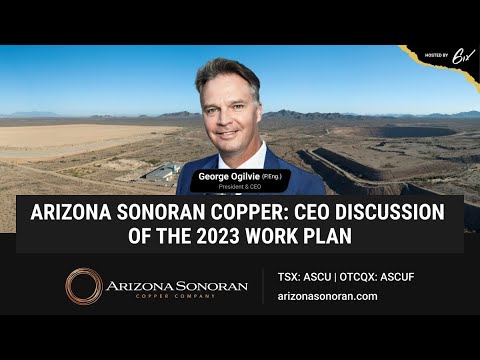
0:07 Hello everyone and welcome to Arizona Sonoran Copper Company's live summit today hosted by 6. I'm pleased to introduce our speaker for today, President, CEO and Director George Ogilvie. The team is gonna walk us through their latest news and after we're gonna be accepting questions live. So as a reminder, please submit your questions on the Q&A panel on the right hand side of your screen at any point during today's presentation. And as always, this event is being recorded and is gonna be available on demand on six.com in the coming days. Without further ado, George, I'd like to pass things over to you so we can get started. Great, thank you, Cam, and welcome everyone. I'd like to wish everyone a happy new year and a successful 2023. The purpose of the webinar today is really just to walk everyone through our high level plans for 2023.
0:54 There will be a Q&A session at the end. We do make some forward looking statements within the presentation. So I'll draw your attention to the cautionary language. This presentation is live on our website. So please review the forward-looking statements at your own leisure. We entered the year with a 10-year statute, fully diluted 99. The options and warrants are in the money. And I'm happy to say that one of our accomplishments last year was cleaning up the balance sheet and we're now debt free. The company started 2023 with 20 million US dollars cash in the bank.
1:46 Late last year, we saw Industrial Alliance pick up analyst coverage of the company, taking our total coverage to 6. Target price range from $2.75 to $4. And I believe the weighted average price now on the company is around $3.22 Canadian. We're currently trading at around $2 Canadian, given the company a market cap of approximately $175 million Canadian dollars. Obviously last year there was a significant investment by Rio Tinto coming in as a 7% shareholder and obviously that's quite a strategic move and accomplishment for us. Thank you, Alison.
2:34 So a little bit on our growth opportunity. Obviously our project is a brownfield site. It's located in Arizona, which as you all know is a tier 1 mining. The process is relatively simple given it's going to be a heap leach with an SXCW plant. We believe that the company's management and board is very experienced and has a very strong track record of delivering value for the shareholders of the company. You may remember that this project is all on private land, meaning that there's no federal nexus, and we're already significantly advanced with the permitting. The addition of Park Salier and the Maiden Resource last year was quite substantial and it now gives us the ability to build scale and continue to grow the project.
3:29 And of course, we believe the supply and demand fundamentals for copper over the next several decades still remain extremely strong. And in conjunction with that, we have a very strong ESG framework which ultimately we believe will give us a pathway to net 0 carbon emissions.
3:51 So very experienced management team, as I said earlier, there's over 170 years of experience here. We have experience in turning around broken stories and putting minds and projects into production. We've also done M&A transactions in the past, which have been extremely accretive. So there's no reason to believe as we move forward that this management team can't continue to deliver and create significant value for the shareholders of the company. It's also the same with the board. The board brings a significant amount of experience to the table. Obviously David Lang is our chairman and Thomas Bullhort was the ex-CFO with Kenross.
4:38 Obviously, we added in Sarah Strunk last year as the independent director and Mark Palmer would be the representative from Tembo Capital. And Alan Edwards brings a mining background to the table. So a multifaceted, multi-skilled board with a diversity of skill set which is well suited for where the company is currently at in its evolution. Some of our accomplishments for 2022. So we did complete a private placement last year, May, for $35 million Canadian dollars at a $2 Canadian share price. As we said, Rio Tinto today has a 7.5% ownership in the company. Sarah Strunk was added to the board in January of last year to bring in some diversity.
5:27 She also brings in a legal background and is very well connected within the state of Arizona. I'm happy to say that Nick Nikolakakis, my former CFO, and Kevin Canario, the former director of finance at Battle North Gold, where we all previously worked, decided to join me here at Arizona Sonoran. And I'm quite sure we can be successful with this company going forward. We also added to the operations team, we brought in Dan Johnson as a 30 plus year experience project manager. Dan was involved with the building of Carlotta and also spent time with Taseko and the Florence project. He actually worked there with Greg Phillips, who we brought in late last year as a process superintendent.
6:16 And we've also added to the technical team at the site with Graham Hendricks coming in as a senior mining engineer. John Peterson brings 30 years of experience working in the environmental field, including time with ADEQ, looking at closure and reclamation plans, which is going to be very important for us on a go forward basis. And we also strengthened our geological team with Jacob West joining us. And I believe in April of last year, we were listed on the OTCQX where we started trading. At the operation side, Park Salier was obviously extremely material. We added £2.9 billion to the global resource, taking it up to £6.5 billion. We conducted exploration drilling at Park Salier and started an infill drilling program.
7:04 At Cactus we completed the infill drilling program, both core drilling and reverse circulation to get move the resource up into an indicated category, which is going to be important for the pre-feasibility study later this year. We completed the metallurgical testing required on cactus for the PFS, and we're now in the process of moving over to Park Salire, and we drilled out the stockpile to 250 foot centres, being able to move that resource also up into the indicated category which is going to be beneficial for the PFS later this year. On the metallurgy side, the testing continues at Park Salier, We have 12 columns up and running, which we'll speak about later.
7:51 And of course, with Newton coming in, they're looking to deploy the Newton technology on the primary sulfide, which gives us some significant optionality on what we would classify at the moment as a stranded resource. We conducted a JDS or a jurisdictional determination survey through the US Army Corps of Engineers. They confirmed that there were no waters of the United States. Our aquifer protection permit was amended as it was only applicable previously to the stockpile. That now has been approved for Cactus West or the open pit and Cactus East, which is the underground component. And then we had about 1000 acres of land rezoned in an extremely short period of time with no opposition from the community, from residential over to industrial purposes.
8:45 And then late last year, I was extremely proud to announce that we received an award for environmental excellence, along with the ADEQ for the cleanup of the cactus mine site from the American Exploration and Mining Association.
9:07 So with respect to the location and the advantages we see there, obviously the location is some 40 miles south of Phoenix. We're very well connected to the local interstate and the Maricopa-Casagrande Highway is right on our southern border. As you all may remember, the main power line runs right through the site with more than enough excess power on it to provide all of our power needs. We're 75 miles north of Tucson, population there of just over 1 million people. Phoenix and the greater area there has a population of 4.5 million. And of course, we're about 3 miles west of the city of Casa Grande, with a population of 55,000 people and very strong local community support.
9:55 As you all may know, Arizona ranks highly on an annual basis in the Fraser rankings, always in the top 10. And of course, it supplies the US with over 70% of the domestic copper supply in the United States of America. So great jurisdiction for conducting our business. Just to recap, we did conduct a perception survey some 14 months ago now. This was the second one conducted on the site. At that time, we had 500 respondents from Pinel County in the city of Casa Grande. And at that time, we saw approximately 83% of those respondents in favor of seeing the mine coming back into production. So we maintain and continue to maintain a very strong social license on this project.
10:48 On to the permitting, obviously the project is substantially permitted. Late last year we did submit our permits for the industrial air permit, which is quite a material permit for us, and the Mindland Reclamation permit. Now, I'm happy to report that before the end of last year, those applications were administratively accepted. As you may remember, that starts the clock ticking. And we would anticipate probably sometime late first quarter, early second quarter, we will be in possession of those 2 permits.
11:26 Going forward, the other permits are basically administrative. We don't anticipate applying for those permits until we have the PFS substantially completed and that will probably occur sometime in and around the fourth quarter of this year, which still gives us plenty of time to have those permits in hand ahead of completion of a BFS in 2024 and a decision to green light the project and move forward with construction and development. Thank you, Alison. So with all the drilling that's taking place over the last 3 and a bit years since we've acquired the project, as we said earlier, we now have 6.5 billion pounds of contained copper in the ground. The discovery cost of that copper has come at under 1 cent a pound of copper.
12:16 So it's absolutely telling us that we need to continue to explore on the project, on the property, and we have some monies invested in exploration this year. We believe as far as independent copper projects are concerned, we now rank number 3 in the U.S. With the third largest private undeveloped copper project, and in and around 3 million tons of contained copper behind only Pebble and Santa Cruz, which obviously is Ivanhoe Electric, immediately on our southern border with 5 million tons of contained copper in the ground.
12:59 So on to the project specifically, as You may remember in the last couple of years we've significantly increased our land package to 4,800 acres. The key point to take away here is that with respect to our go-it-alone, stand-alone business plan, We have more than enough land to accommodate all of the infrastructure and leaching pads, which would be required for the oxide and the enriched material. And of course, we are in discussions with some of the other private landowners in and around the property to potentially increase our land package over the course of the next several years if the Newton technology itself were to prove successful.
13:47 I think the key point to take away from this slide is obviously there is some significant infrastructure on site. Obviously the water wells and the access to water is absolutely critical. There's also a rail line coming in on the site in the distance there. You can see the Maricopa-Casagrande Highway. We have power in on site. There's already a substation stepping the power down, feeding it into our core shed and administrative building. And we've also started some preliminary work there on the old tailings facility that ASARCO had. We've determined that it could potentially be used as a paste fill. And we're looking at potentially seeing if we can build that into the PFS as opposed to using unconsolidated rock fill to fill the mining voids, why not consider using paste fill? Again, if the Newton technology works, there's a potential to recover some of the historical copper left behind in those tailings, which currently amounts to about 80 million pounds of copper contained in the tailings.
14:54 Thank you, Alison. So when we conducted our PEA several years ago and put that out into the market. Remember at that time we were only really dealing with 3 specific assets. It was a surface stockpile, Cactus West, the open pit, and Cactus East, which is the underground mine. Since then we've now added in 2 additional opportunities. Obviously, Park Salier is going to be quite material. Plus, there's the optionality of Newton. That's one of the reasons last year we therefore decided to delay our PFS, which was only focusing on cactus, and give ourselves the chance to drill out the Park Salire into an indicated resource so it could be built into the Rescope PFS late this year.
15:45 And assuming that the Newton technology actually works and shows signs of success, there is the option to build that into the Rescope PFS at the end of the year as well. If Park Salium moves ahead, it certainly is going to add some scalability to the current project. As you may remember in the PEA we had 56 million pounds of annual copper cathode production over 18 years and we think that number could grow beyond 50,000 tons or 100 million pounds and potentially the mine life could go beyond 30 years. Looking specifically at Park Salire, you'll see that as far as the leachable material is concerned, there's 115 million tons at a total soluble copper of 1.06, giving us almost 2.5 billion pounds of copper in the ground. And what's interesting about some of the initial engineering work on Park Salier is that because it sets 2 kilometers to the southwest of the Cactus West open pit, we're not limited with respect to the mining method there. And what I mean by that is when we were looking at Cactus East, we really couldn't deploy any form of sub-level cave because we were very concerned that we would ultimately break into the pit wall and therefore cause ourselves problems there. But because we're so far away
17:15 from Cactus West, one of the mining scenarios that we're looking at is to mine Park Salia significantly with a sub-level cave and some long haul. If the sub-level cave were to work, we would certainly benefit further there from economies of scale and no doubt it would drive down further our operating costs particularly with respect to mining. So that's a big opportunity that we're currently pursuing with the pre-feasibility study. There's approximately 100,000 feet or 32,000 meters of drilling ongoing now at Park Salier, where we're drilling the deposit down to 250 foot centers. That'll be completed towards the end of the first quarter of this year.
18:02 And the second quarter through until the end of the year, we then move into a 30,000 approximately metre drill programme where we're then drilling the deposit down to 125 foot centers, which moves it into the measured category ahead of a bankable feasibility study in 2024.
18:31 So, with respect to Park Salier, you can see and the primary sulphides, you can see that in totality, we have 1.7 billion pounds of copper in primary sulphide, in this case chalcopyrite, which is currently a stranded resource. Interestingly, if you look at Park Salier where we have 454 million pounds of primary sulphide, if you look at the grade there it's actually running at 0.8% which is more than double the grade of the primary sulfide both at Cactus West and Cactus East, which is fairly significant.
19:12 Anyway, the Newton technology itself has now been deployed. The first columns are up and running as of last year, and we're anticipating sometime before the end of the first quarter of this year, we should be able to receive feedback from Newton, which will give us some preliminary viewpoints on just how successful the technology could be with the primary sulfides. Why are we interested in the Newton technology? Well, as we said, it's 1.7 billion pounds of copper in the ground, which we're getting no value for. And obviously, if we can get some value for that, it could be quite accretive for the shareholders of the company. And secondly, the Newton technology allows for the processing of relatively low grade deposits of primary sulfides.
20:04 There's no concentrator required. Therefore, there's no smell to and or refinery. So from an ESG perspective, this obviously is a much cleaner option as well when it comes to greenhouse gas emissions and trying to attain net 0 carbon emissions. Thank you, Alison. So just taking a look at the exploration targets for this coming year, So we do have just over 6,000 metres currently planned in pure exploration. Our first target will be the North East extension. We currently have a drill pad set up there and our drilling crews returned to the site from the holiday break this week. So we anticipate in the next week, we will begin drilling at the Northeast extension.
20:55 A sarco-like park salier did drill there many, many decades ago. They hit mineralization 1,000 feet below surface. Their best hole was 47 feet at over 3% copper, but they decided to walk away from it because at the end of the day it wasn't open pittable and they weren't looking for additional underground mining. So certainly some drilling there and we've also taken ionic drill samples from around the site And once we get those results back sometime by the second quarter, we would anticipate that we would start drilling in the gap zone, which is the zone between Park Salier moving to the northeast back towards the Cactus West pit, which has never really been explored to depth.
21:50 A sarco did drill there many years ago. The holes however were only 300 foot in depth. They basically never drilled therefore to depth and we know at Park Salier that the top of the mineralisation occurs approximately 1000 feet below surface. So there is the possibility that mineralisation could extend back from Park Salier all the way back to the Cactus West pit which is over 1 kilometre in strike length. Thank you, Alison. On to the metallurgical testing. As we announced this morning in our press release, Late last year we started up 12 columns, principally looking at Park Salier, both oxides and enriched material.
22:40 And this is met testing which is going to be required for the pre-feasibility study later this year. We anticipate that the leaching characteristics are going to be very similar for Park Salier when compared to Cactus and as a reminder there the oxides was approximately 90 days of leaching time and the enriched material of the Chalco site was anywhere between 200 and 220 days was the leaching time required. We do anticipate over and above the 12 columns which have started, starting up an additional 5 columns which are going to be 30 feet in height. And those are really more designed for the bankable feasibility study, which we'll be embarking upon in 2024.
23:28 And I should say that these 12 columns that we've started up are 20 feet in height, and they're designed at 20 feet because at the moment, our current stacking height on the leaching pad will be 20 foot lifts. So we wanna try and emulate as much as possible real live production conditions. Thank you, Alison. So a little bit on the timelines that we've been speaking to. So for Park Salier and the Enfield drilling to Endicated, that should be completed towards the end of the first quarter. It's taking anywhere between 4 to 8 weeks to get our assays back, so we think by the end of the second quarter we'll have all our assays back, allowing us to update our ParkSailor resource into the indicated category.
24:18 The testing for ParkSailor is up and running. By the time we draw the columns down and get the final tails assays, we'll probably enter the third quarter of this year. The mine engineering design is about to start up. We've invited some additional and new consultants to bet on the project. And we would anticipate that in the next week, we will have a kickoff meeting, bringing those new groups in and embark wholeheartedly on the new re-scoped PFS. We're anticipating that by the end of the year we would have news flow out on the results at a high level of the PFS and sometime in the first quarter, we would obviously file then the technical report to accompany those high level results.
25:10 That'll then feed into the permitting. Obviously the permitting is ongoing and we anticipate, as I said earlier, in the next 3 months or so to have our next 2 significant permits, namely the industrial air permit, mine land reclamation, and the other permits we would apply for those probably towards the end of this year with the pre-feasibility study substantially completed. Those permits would be in hand sometime in and around the middle of 2024, which is when we would anticipate finalizing our bankable feasibility study, which then allows us to make a construction and development decision based on the back of a robust BFS permits in hand and obviously project financing at that time.
25:58 Currently, there's nothing to suggest that the construction and development schedule wouldn't be more than 18 months. So if we extrapolate that forward, you can see that in late 2024, construction and development would begin and therefore in early 2026, we'd anticipate seeing first production coming out from the mine in copper cathode. A little bit of peer benchmarking. Obviously late Last year we saw a little bit of an uplift in the copper price as we all know inventories continue to slide late last year although they have grown a little bit coming into the early part of the year. Obviously China opening up despite obviously the significant COVID cases has given us a little bit of a tailwind with respect to the copper price. So we have seen our valuation move up. However, our immediate peer groups have also moved up and we therefore still see a substantial gap in the valuation of Arizona-Sonoran when compared to its existing and current peer group.
27:09 Thank you, Alison. That's also amplified Here, as you can see from an enterprise value per pound of equivalent copper in the ground, we're currently being valued at around 2 cents a pound of copper in the ground. If we compare ourselves to Maramaker and Ivanhoe Electric, they're currently at 9 cents enterprise value per pound of copper in the ground. So obviously we believe if we can continue to execute on our plans, there's some significant uplift to be seen here for the Arizona Sonora shareholders over the course of the next 12 to 24 months.
27:53 And again, just a more robust peer analysis. I would certainly say As far as jurisdiction is concerned, Arizona has to be one of the safest jurisdictions when compared to our peer group. I think as far as the capital intensity is concerned, you'll see that this is the lowest project compared to our peers as far as capital intensity is concerned. And I would also say that obviously, you know, with us growing the resource substantially, we've now brought ourselves up into the middle of the pack as far as the overall global resource is concerned. And I'm quietly confident that when we deliver the PFS, our production profile can rise substantially from what we had in the PEA several years ago now.
28:45 Thank you, Alison. So just to highlight, obviously, you know, we have strong core values, which are supported by an ESG framework. We remain very bullish on the fundamentals for the copper market, both in the medium and longer term. We still have a very tight share capital structure and importantly no debt. You have a proven management team here that's supported by a very experienced board with a track record of success. This is a brownfield site, minimizing timelines to production and CAPEX in a tier 1 jurisdiction. We've now added some significant scalability to the project. We maintain some very robust project economics despite conservative assumptions in our PEA.
29:34 And certainly we believe with access to water, water permits in hand and other substantial permits ahead of us, which we believe we'll be obtaining shortly, certainly there's every indication that this project will be permitted when required once the technical studies are completed. And I think longer term as we look to grow the company, we can look towards further M&A in the United States and particularly within the state of Arizona. There are other projects out there that are on our radar screen and we definitely see opportunities for growing this company into substantial mid-tier based out of the US of A. So that concludes the formal part of the presentation. I'm happy to stop there and hand back over to Cam as we then move into a Q&A session.
30:25 Yeah, absolutely, George. Appreciate the great presentation and I appreciate everyone coming on and asking all the questions. If you do have a question though, and you haven't asked 1 already, or you have another one, please do so in the Q&A chat found on the right hand side of your screen at any time. But George, let's dive in on it. We have had a bunch of questions come in. So the first one is this, assuming that Rio Tinto work is successful by the end of 2023, What are the next steps? How soon are you going to treat sulfides? And what's the cap investment? Yeah, it's a great question. So next steps with Newton would be to, first of all, see these preliminary results from the column tests, which I had said during the presentation we would expect before the end of the first quarter we would be in possession of those initial results.
31:15 If those results look promising, then we would want to enter into commercial negotiations on an agreement with Rio Tinto on just how we're going to distribute the profits and or attributable copper that comes from the primary sulphides between ourselves and and Rio. Assuming we could reach an agreement there obviously we still have to get the qualified person to actually get comfortable with the technology and be able to sign off on it on the PFS at the end of this year. And that work has already started because they have access into a data room. They will be going to view the columns and they're gonna be viewing a pilot plant which Rio Tinto actually ran at the Kennecott mine several years ago with this Newton technology. So they've got to get comfortable with the technology.
32:12 Assuming all of that comes together and we can build it into a pre-feasibility study, then that would then feed through into a bankable feasibility study, which we would anticipate would be completed sometime in the second half of 2024. Between the PFS and the bankable feasibility study, I think we would be getting into some hard discussions and negotiations with Rio on how they could assist us with the project financing. And that comes into the second part of the question, you know, what is the capex? We don't quite know what the capex is yet, given that we have to run through the PFS. But the beauty of this technology is it allows you to take advantage of the infrastructure that you would put in for a standard SXCW plant and for the leaching pads.
33:09 So all of the infrastructure that we plan on putting in for Cactus and Park Salier, the Newton technology would allow us to actually take advantage of that. And that's why, obviously, we'd want to have conversation with Rio as to how they would assist us in funding the project to move it forward to bankable feasibility study. All right, great. Speaking of the Newton technology, Joe wants to know, well, so the Rio Tinto Newton technology is proprietary. So is your discussion limited on the results and potential upside? And he believes that they're testing not only the sulfides, but also the enriched material. Yeah, that's correct. It is proprietary technology.
33:57 And they have tested not just the primary sulfides, but they've also tested oxides enriched. And as I stated in the presentation, they even tested some of the old tailings from the old Asarco mill, which were deposited on site. So there was preliminary results based on computer modeling, as we announced last year, are very much in line on the oxides and the enriched material with what we've achieved in our own column tests over the last several years. And Of course, the real opportunity here is that if you could reach a fair and reasonable commercial agreement with Rio Tinto, then you've got the ability to actually blend the enriched material and the primary sulfide on the same leaching pad.
34:47 At the moment, because we don't have any commercial agreement in front of us, we're proceeding ahead on the basis that there will be separate pads for the enriched material and for the primary. And That way, it's much easier to therefore track any attributable copper to re-ore or any revenue and or profits to re-ore based on the success of the Newton technology. All right, great. Joe says this. Copper is not considered a critical mineral by the US, at least currently. So does that preclude access to funding from the US government agencies for the project, similar to other projects that are getting funds? No, I don't think it precludes us. I mean, obviously, Joe is correct. It's not listed as a critical mineral at the moment.
35:36 But we do have people who are connected in Washington and who are lobbying for the company with respect to access to government funds, government grants. I think, you know, from our perspective, we really need to get the pre-feasibility study out there because that economic study, as we all know, is then built off of reserves, which at the moment on the PEA, we're obviously dealing substantially with an inferred resource, and there's no current reserves. So we are lobbying at the moment behind the scenes, but I think the tire kind of hits the road once we have a pre-feasibility study in hand and we've got something a little bit more substantial to argue a case that this mine is moving forward to commercial production.
36:25 John wants to know what grades of copper can Newton leach, and is it able to leach other minerals?
36:33 Well, obviously, the benefits of Newton is that it can reach relatively small copper grades, which are relatively low. So old tailings facilities, old stockpiles that could never be processed in the past because they were regarded as waste. Down to what specific grade, I don't know, but that's one of the beauties of the technology is that it can go down to extremely low grades and allow something that was sub-economic in the past now to be economically viable and profitable. Right. Shannon wants to know What will the approximate budget be for the Cactus PS PFS?
37:19 So for the PFS itself, we currently have a budget of approximately $2.5 million US. And as I alluded to earlier, we've invited various consultants to bet through a bet package that went out, a request for proposal bed package that went out in the fourth quarter of last year. So we've assessed those beds and we've started meeting with some of the consultants to advise them that they've been successful. We still have to advise some other consultants, but the game plan is in the next week to 2 weeks to actually have a kickoff meeting and move the technical studies forward. But the good news from what I've seen so far is that the bits have come in are actually in line, if not slightly under the budget that we currently have for 2023 on the on the technical reports for the PFS.
38:15 All right. Harry wants to know, does the Ivanhoe Electric property to the south have a similar geology as yours? Is there any chance for synergies or would you be competing for workforce, asset, et cetera? Yeah, it's a great question. And essentially, the Ivanhoe Electric Santa Cruz deposit, which is down plunge of us to the southwest, is basically part of the same overall copper porphyry system. So therefore, 1 would expect the mineralogy that we see at Cactus and Park Salier to be identical, exactly similar to what they will ultimately see at Santa Cruz. We certainly believe down the line that creates some significant synergies between both companies, although we're both in the very early stages of evolving our projects and moving them forward. So there's been no discussions between the executive management teams about trying to flesh out those synergies at this juncture in time. But I certainly believe there are will be opportunities at a later juncture in time to explore those with the Ivanhoe Electric Group.
39:26 All right. Cohen has 2 questions for you. How would you describe the relationship with Tembo? And what's Tembo's long-term plan or exit plan with the company? Yeah, I would say the relationship with Tembo, which is a private equity group out of London, is an extremely good one. Since they invested in the company a couple of years ago now, they've invested approximately 40 million US dollars of their own LPs money and they have approximately another 10 million US dollars sitting in dry powder to invest in the project if they so desire. The good news is that every time we've raised money, they've continued to follow their money and their preemptive rights.
40:15 Although I think also positively, they've gone from a 44% shareholder upon IPO to today they're a 35% shareholder. And I would anticipate as we continue to raise money over the next couple of years, they will continue to support the company, but I expect that they're ultimately going to be diluted down. And I think the game plan for Tembo is the good news is that their investment is in a 10-year closed fund. The fund is only 2 years old. Typically, they like to get out between year 5, 8. We believe we'll have another sort of 3 to 5 year runway ahead of them before they would potentially look to divest.
41:03 And typically they like to see anywhere between 3 to 5 times their return on investment. So I think that's good news for the Arizona Sonora shareholders and anybody looking to get into the stock at $2 because I think their weighted average price is around about $1.25. So if you look at those type of numbers, we'd have to see numbers in excess of $4 a share price before Tembo might even consider exiting the story. Right. Zach has a number of questions. I'm gonna ask them all at once, but if you need me to ask again, feel free to let me know. Could you elaborate more on the budget and schedule out to the start of production? Is it possible to put a number around the economic upside of the Newton technology, and how much of mine plan do you forecast is bulk tonnage?
41:56 Yeah. Well, it's difficult to extrapolate out the budget beyond this fiscal calendar year. So this year we're anticipating that with the programs we've put forward today we intend to spend approximately 25 million US dollars in the next 12 months. So that would mean probably sometime in the second half of the year or certainly before the summer, we're probably looking to raise additional monies to see us through until the summer of 2024. Certainly as far as the economic upside for Newton, I think for the Arizona Sonora shareholders, I think it's going to be quite substantial. As we said in the presentation and we showed, We currently have 1.7 billion pounds of copper in the ground that is a stranded resource that we're not getting any value for currently.
42:56 So if this technology does work and we can have Rio Tinto continuing to invest in the company and they would also assist us with project financing. That's going to be a huge de-risking event for a junior company with no other producing assets in moving forward with its first asset into production and eventually commercial production. And I think, you know, lastly, I think from a tonnage perspective, you know, the one criticism we've had on the project to date based on the PEA has always been that the production profile is relatively small at only 28,000 short tons of copper cathode production annually.
43:42 We certainly believe with Park Salier, potentially even without Newton, there's no reason why we shouldn't be targeting 50 million tons of annual production. And I would expect the mine life, just based on Park Salier alone, is likely to increase from 18 years to something in excess of 30 years. If you start to layer in the optionality of the Newton technology on top of that, you could be looking at something, again, if the technology is successful, that could be a 75 to 100,000 ton annual producer in the mine life would probably well in excess of 40 years in a tier 1 jurisdiction on private land with access to water at a time when the demand for copper is obviously going to go exponential.
44:32 And we know that there are major supply issues with respect to copper in the foreseeable and in the medium term future. Absolutely. Harry wants to know, does the Rio-Newton partnership mean that you're prohibited from testing other similar processes, for instance, JETI? And could you discuss the process in choosing Rio Newton? Yes, it does. When we signed the agreement with Rio, we entered a 1 year of exclusivity period, which has subsequently been extended through until I believe March of 2024, whereby with respect to the testing or the leaching of a primary sulfide, we can only conduct those tests with with Rio Tinto. So we're not able to you know experiment with other groups out there and obviously the one that everybody would know would be would be JETI.
45:33 Okay another question from Joe Does any potential deal with Rio Tinto Newton include access to acid generated from the Bingham smelter? Yes, Certainly that's something that's being raised with us with respect to a carrot, I suppose, if that's the right phrase to use, that's been dangled in front of us. If we've further developed this relationship and partnership with Rio, then there could be the possibility of bringing in sulfuric acid from the Brigham Canyon, the Kennecott mine in Utah. Obviously, there is a rail link there. And as we know, the Southern Pacific Union rail line is right on our southern border, we would probably have to reactivate the spur, which you would have to cross over the road and connect up to the line coming into the mine. But that would be relatively inexpensive and could be done relatively quickly.
46:33 And we also believe from an ESG perspective, it's definitely something we should be pursuing anyway, is to try and bring in as many consumables and materials via rail and ship out our cathode via rail, as opposed to using trucks on the road, which obviously are probably going to be diesel and therefore greenhouse gas emissions become an issue. Right. Harry wants to know regarding the Newton process again, when do you expect to report test results to the market? Well, we should have preliminary results at the end of the first quarter. Whether those results get revealed to the market or not is going to be really at the bequest or with Rio Tinto. We obviously have to ask permission from them to release results to the market. But that would be our sort of game plan would be to put something out late first quarter, early first quarter with respect to how the initial results are looking.
47:31 And I would say there I mean at the end of the day, you know, Rome wasn't built in a day. This is relatively cutting edge new technology. If the initial results aren't that great, or they're not particularly exciting, it doesn't mean to say the technology will not work. It just may mean that there may have to be a change in the recipe or the change in the chemistry to see if we can unlock that copper. Right. Joel wants to know, would any potential success at the Northeast extension or the gap zone impact the PFS mine play, leading to a deferral, as was the case for Parkes Salier? No, I don't think that would be the case at this juncture in time. I mean, I think with Parkes Salier now into the equation, with 6.5 billion pounds of contained copper in the ground, I think we have more than enough size of resource to generate some significant reserves and improve the economics, the scalability and the size of the project going forward.
48:32 The thinking around doing some exploration drilling this year was, as we all know, when you get into the technical studies of projects, sometimes the news flow that can come out from the project can be a little bit mundane, Maybe a little bit boring. So one of the reasons for doing the expiration drilling was to try and keep some sizzle in the story if we can have some success with the drill bit. Right. A couple more questions, both of them dealing with your cash balance at year end 2022. Could you talk about that a bit? Yeah, as I stated earlier, we closed out the year with 20 million US dollars cash in the bank. We're currently burning through 1 and 1 0.5 to 2 million US dollars a month. So we would anticipate at some juncture, probably before the summer second half of the year, we will come back to market. The budget for this year, as I stated earlier, is 25 million US dollars.
49:33 Okay, Well, listen, George, I think that was a great presentation, and we certainly had a very engaged Q&A session. That's all the questions we've received currently. So I want to thank you and thank everyone in the audience, especially those who ask questions, for coming on today. But before we wrap up, I want to pass things over to you for some closing remarks. Yeah, thank you, Cam. I'd just like to thank yourself and 6 for the opportunity of being able to put forward our work plans for this current calendar year. And I'd like to thank the participants for coming on and listening to the story and asking some really great questions and being really engaged. As you saw towards the end of our presentation, despite a significant uplift in our valuation in the last 3 months, I still believe we're very, very undervalued when compared to our peer groups.
50:20 And again, when you look at the supply and demand fundamentals for copper, I think we all know that the copper price is going to have to move substantially higher to incentivize new projects, incremental production to come online to meet that demand over the ensuing decades as we move towards decarbonization and green energy. And I think people that are investors in Arizona, Sonoran, and those that are considering investment, if they were to invest at this point in time, I think your confidence and faith in the company is gonna be significantly rewarded here in the next 12 to 24 months as we move through any recession and start getting into more of a bullish, growing economy and GDP.
51:08 So I'd like to thank everybody for your time and stay tuned to another successful 2023 for Arizona Sonora Copper Company.