Automated transcript · Written by software from the replay's audio. It can mishear names and figures; the replay is the record.
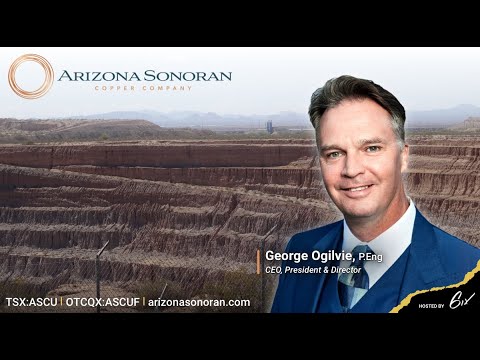
0:41 further ado, I'll hand it over to George to get us started. Great, thank you, Dasher. And thank you to 6 for the opportunity to present here today. Obviously, it's Arizona Sonora Copper Company, and the title of our presentation is Copper, Invest in Sustainability. We do make some forward-looking statements, so I'll draw your attention to the cautionary language. I just want to touch on some of the recently completed points that the company objectives that the company has delivered on. Obviously, I'm sure everybody saw several days ago we announced that Rio Tinto was making a strategic investment in the company of up to $10 million. On top of that, we also saw Tembo Capital, our large controlling shareholder, also invest $6 million.
1:34 And then we had some additional and current shareholders invest in the company, taking up the total non-brokered private placement to 35 million Canadian dollars. So that now leaves us in a position where we have no debt within the company, which is absolutely fantastic, obviously ahead of the bankable feasibility study at the end of the year, and starting up negotiations with the project financiers, particularly on the debt side. Having a very clean balance sheet is obviously important when it comes to the debt negotiations. We've also just announced this morning that we've received our DTC eligibility for the OTCQX, so we're now able to trade electronically.
2:24 I'll show you within the presentation that the drilling at Park Salee of the initial 12 holes that we committed to in December of last year have now just been completed in the last week and we're now on to the additional 14 holes that we intend to drill as part of this expanded program from the recent monies that we've just raised. Just as a reminder, from the PEA, it showed that once the project was fully financed, after the bankable feasibility study was out, there was an 18 month construction and development period. We would anticipate that early next year we'd be in a position to make that decision. And if that were the case, then we should be realising 1st copper cathode production at some juncture before the end of 2024.
3:15 Thank you, Alison. So a little bit now on the pro forma share capital structure following the closing of this private placement, which will close on the 13th of May. At that time, we'll still only have 89 million shares issued. The options and warrants are in the money, so that would take us to about 99 million shares issued and outstanding. The company will have 47 million Canadian dollars cash in the bank, so we're now well funded through the bankable feasibility study and won't have to come back to market and the good thing as I said is we're also now completely debt free. Tembo despite supporting the private placement did suffer a little bit of dilution.
4:03 They're now down to 35.5% shareholding from 38. And you'll notice that Rio Tinto now has a 7% shareholding within the company. The analyst target prices, some of them did move around. I believe at the low end of the range, we're looking at $2.65 Canadian share price up to a maximum of $4 share price as the target price from the 4 analysts currently covering the company. Thank you, Alison. So where is that money going to go? Well, there's $7.5 million which is going to go into Park Salier and the Bronco Creek property with an expanded drill program, which we'll touch on shortly.
4:51 We also now want to get underway with the initial metallurgical testing. So some bottle wall tests and no doubt some column tests on the Park salier mineralized material. We fully anticipate that through drilling on the Bronco Creek property we will find above 200 million pounds of copper over the next year to 2 years, which would then trigger a payment to Bronco Creek as part of the the royalty deal that we signed several months ago. We do intend to do some additional metallurgical work for cactus. There's some additional columns which are going to be done that are 24 inch in diameter and 20 feet high which is going to be the stack height on the leaching pad.
5:44 So this is more in tune of what we see when we go to a commercial operation. We have $8 million US in land payments to be made to LKY as part of the land package that we increased last year from 2,100 acres up to 4,800 acres. And obviously, we want to finish the technical studies, which is an additional $2 million. And there's about 5 million of G&A over the next 12 months to run the company, bringing us to a total of 27 million or 35 million Canadian dollars. So you can see that at the end of that spend, the company would be sitting with about 10 million Canadian dollars cash in the bank this time next year. Thank you, Alison.
6:33 So why is Rio investing? Well, Rio has been experimenting internally within their organisation for 20 to 30 years with the leaching of a primary sulphide. They now believe they're at a point in time where they want to try this on other deposits outside of their organization and they're doing that through a subsidiary known as Newton. We have sent them some initial samples across Cactus and Park Salea from our course rejects. Those went to Newton several months ago. They're now in Australia being tested and we should see the initial results from that phase 1 of testing sometime in and around late June, July of this year. If the initial results look promising, then we'll commit to a one-year program where we'll send them additional samples, much more quantity, and then we'll do the bottle roll tests and the column tests with their patented technology over the course of the following year.
7:38 Their technology has the ability, they believe, to leach copper from primary sulphides in tailings and surface stockpiles and also from either in situ ore which is blasted. So this could be a real game changer for the industry, but also for the company, as right now within our compliant resource, we have 1.3 billion pounds of primary chalcopyrite, which basically is a stranded resource. It is not part of the current PEA, PFS, or bankable feasibility study at the end of the year. So this really could be the cherry on the cake if we're able to extract, you know, economically some of that chalcopyrite from that stranded resource.
8:25 Thanks, Alison. So just as a reminder, the project's located in a very safe Tier 1 jurisdiction. We're 3 kilometers west of the city of Casa Grande with a population of 55,000 people were 45 miles south of Phoenix and 75 miles north of Tucson. As You can see there the project sits at the intersection of 3 main copper porphyry systems. As you're probably all aware, Arizona ranks very highly annually in the Fraser Institute rankings for mining investment. Arizona supplies about 70 plus percent of the US domestic supply of copper. And we think the demand for copper in the US is going to continue to increase exponentially over the ensuing decades, which bodes well for copper mines in the US of A.
9:16 Thank you, Alison. So here you can see a plan view looking down on the site. There's 21,000 meters of new drilling being planned for Park Salier and Bronco Creek, and that's in conjunction with about 18,000 meters of drilling, which is infill drilling going in at Cactus. That is specifically targeting the indicated resource to move it up into measured ahead of the bankable feasibility study in about a year's time. As the listeners may know, only measured and indicated resources can convert over to proven and probable reserves. So we're trying to set ourselves up here for the first 5 years of the life of mine to have a measured resource converting over into a proven reserve as part of the BFS at the end of the year. And there's a little bit of expansionary drilling as well, as we've showed on previous presentations.
10:11 The deposit's not been cut off to the north and to the west in the cactus pit and then at cactus east we're seeing further mineralization east of the current last known hole within the resource current resource block model. Thank you, Alison. So here on the screen you can see a plan view of Park Salier and Bronco Creek is in the red outlined box. On the left hand side you can see the 4 holes which the company has currently announced to the market. As I indicated earlier, the remaining 8 holes have now all been drilled and are either at the laboratory waiting in assays or the core is currently being logged and prepped for sending to the assay lab.
11:00 We would anticipate to put our next set of holes out for Park City. We're at some juncture in May in the next 2 to 3 weeks. And there you can see on the right-hand side in the Bronco Creek property, you can see our first 2 drill platforms have now been prepared. And we've now moved a couple of the drills over onto Bronco Creek and are currently drilling the mineralization on that side of the property boundary and we fully expect to see mineralization there extending to the north-northwest back towards the cactus pit. So just to recap, we've conducted geophysics, geochemistry, sonic soil sampling on Park Salire. When we look at the size of the signature, we did a volumetric calculation.
11:47 We reduced that calculation by 50%, and we came up with 40 to 90 million tons that could grade between 1 to 1.3% total soluble copper. This is for the leachable copper, both in oxide and enriched chalcocite material. That would give us in the ground 1 to 2.3 billion pounds of copper in the ground. And you'll notice Beyond that, we also estimate that there's potentially 150 to 750 million pounds of primary sulfide, which the real Newton technology might be able to take an opportunity off. And of course those numbers, if our original volumetric calculation were correct, all of those numbers could potentially double over the next couple of years as we drill this deposit out.
12:42 Thanks, Alison. So The numbers that you see here on the screen are some of the historical holes drilled by ASARCO, which would be hole S200, S201. You can see the enriched material that they went through. Hole 18 and 19 was drilled by the company 400 feet north of the original Asarco holes about 15 months ago. And then on this page you can see the 4 holes which have been released to the market, hole 45, 42, 65 and 57. And we've highlighted the best intercepts here. And of course you can see there's some fairly significant intercepts of many hundreds of feet of enriched and oxide material of some extremely good grades. And we believe that mineralization trend will continue to the north and northeast as it works its way back to the Cactus West pit.
13:34 Thank you, Alison. This is just a section showing some of the key holes. Hole number 45, I would say, is probably the best hole we've drilled to date. You can see it went through close to 600 feet of 1.29% copper. And then on the left hand side, you can see hole number 65 there went through 439 feet of 0.92% copper. And notice how at Park Salier we're drilling the full extent of the primary chalcopyrite sulfide to the bottom of the basement fault where the mineralization is cut off. And you can see there in hole 65 we went through almost 700 feet of much lower grade 0.23% copper but this is where this Newton technology could potentially extract copper from the primary chalcopyrite sulphide which is not in any of our current plans.
14:34 Thanks, Alison. This is a long section, and you can see here in the center of the page, this is over 4 kilometer strike length. Below the pit, Asarco only drilled 200 feet extensions below the benches that they were mining. Since acquiring this property in late 2019, the company has drilled below the pit. However, because We've only been focused in on the oxides and the enriched material. Once in primary sulfide, we generally shut the drills down. So the primary sulfide below the PET has not been drilled to the full extent to the basement fault. And therefore, there could be potentially tens, if not hundreds of millions of pounds of primary chalcopyrite sulfide sitting below the PET that is not currently in the 43-101 compliant resource that we have. So if this Newton technology were to show encouraging signs of extracting copper from the primary sulfide, the potential to increase the overall global resource and make it become economically viable obviously increases substantially.
15:47 Thank you, Anson. This is just a section of the PET, just to recap what was in the PEA. And the PET shell was optimized for cash flow, and therefore NPV. When we ran the model, we found that a $2.27 copper price was the best copper price to use because it kept the stripping ratio relatively low at 1.4 tonne of waste to 1 tonne of ore. What was happening was as we tried to expand the pit shell to get access to some of the deeper leachable material. We were taking more and more waste. Every ton of waste that you mine costs you the same as a ton of ore, but you get no revenue for it. And therefore, the cash flow in the NPV model of the PET was less favorable than the $2.27 copper price. Now, this PEA came out in August of last year. These plans are almost a year old.
17:50 of the pit. And you can see how we'll be hoping to convert that inferred resource over into an indicated resource. We just recently announced some drilling a couple of days ago, the last NFL drilling holes that were targeting the inferred to move up into indicate, which within the PFS we're hoping we can bring in as a probable reserve. Thank you, Alison. Again, this is just looking at inside the pet and you can see there in the northwest corner some additional holes that we drilled, also to the northeast and then at Cactus East. And then in the south, there's a group of holes which we drill. We go to the next slide, you'll be able to see these and their various sections.
18:36 So looking across section A here, you can see we've had the oxide material exactly where we anticipated based on the resource block model within the PEA. I think the good news here is that there were absolutely no surprises when we came to do this further infill drilling that we just recently announced. And again, I'll draw your attention at the very bottom of the holes. You'll notice how the drill bit has been stopped in the primary material. We've never drilled the primary material around the pit right to the bottom of the basement fault, despite as you can see one of the sections being 289 feet at 0.34% total percent copper of primary sulfide.
19:23 Thanks, Alison. The same is also true here on section BB. Again, no surprises, and the primary sulfide has not been drilled to the full extent to the basement fault. Thanks, Alison. And again, this is a section CC, which is within the cactuses. This is going to be part of the underground deposit. You can see how the grades significantly improve in the enriched material once we go underground and go deeper. So you can see there there's a 200 foot intersection of 1.28% total percent copper, 0.91% on a total soluble basis. Not much primary material at Cactus East between the enriched material and the basement fall.
20:11 Really the opportunity exists at Cactus West and heading southwest towards Park Salier for more primary material to be added if the Newton technology actually pays off. Thanks Alison. And this is just some of the highlighted core. Again this is the 200 foot hole at 1.28% but you can see within that core, we did have a very nice section of well over 2% over some 10 feet, about 1600, 1800 feet down the hole. Thanks, Alison. Same here, 90 feet of 1.56%, And you can see 2.5% over 10 feet, about 1,700 feet down that hole. And then lastly, 94 feet at 0.42.
21:00 But there was a very nice hit of about 7.5% over several feet, about 1,100 feet down the hole. And notice in each of the core samples that we're showing here, the core is extremely competent. It's in a granite monzonite porphyry, so extremely competent rock. And obviously, we're doing all the geotechnical work on the core to ensure that we get the correct mining method, sub-level intervals are appropriate. We're using the correct type of ground support. But I'm definitely very pleased and happy that we're working in extremely competent rock once we get into the mineralization. Thanks, Alison. So just a little bit on our value.
21:47 Obviously, we maintain a very low enterprise value of only $92 million US. We do believe that through the PFS and the bankable feasibility study, we can get the overall production up to 40,000 to 50,000 short tons, which would be 80 to 100 million pounds of annual copper cathode production. If we were to achieve that and we were to compare ourselves to Copper Mountain, Copper Mountain currently has an enterprise value of over 800 million US dollars. So you can see that with the company well financed now and it all depends on the project financing at the end of the year, we believe that there's significant upside for the company's share price over the next 2 to 3 years as we continue to de-risk the project and then look for the project financing, construction and development and put this mine into production in the next 2 to 3 years.
22:47 Thank you, Alison. So why ASCU? Well, as we've highlighted before, it's a brownfield site. It's a tier 1 jurisdiction. The company currently has a compliant resource of 1.6 billion pounds of indicated resource, 1.9 billion pounds of inferred. I'm sure you would have seen through as we went through the slides there's lots of opportunity for expansion at Cactus and obviously at Park Salier. We came out with the low intensity PEA last year. We do recognise those numbers are going to grow, but we still believe they'll be sub 200 million USD within the PFS. We're seeing an 18 year mine life at 56 million pounds of copper cathode production.
23:33 The NPV and the IRR of the project was outstanding despite using a $3.45 copper price. There's obviously been weakness in the copper price of late, given how copper is related to GDP and the economy. But still, at $4.35, the spot price this morning, We're still well below those numbers when we look at the robust economics of the project. Bear in mind the project is located on private land. We have significant permits in place, permit to take water, and now the aquifer protection permit, not just for the stockpile but the pet laid back in the underground component. We're doing the NFL drilling now on the bankable feasibility study. The PFS is due out in the late summer.
24:18 And of course, now we've got this exploration campaign that's now fully funded to bring Park Salire into a compliant resource before the end of the year, and then eventually inclusion into the Bankable Feasibility Study as a maiden resource. And if like ourselves you believe that the decarbonisation theme is going to continue and there's going to be further drive for renewable energy and commodities associated with that, obviously copper is going to be absolutely fundamental as the world drives for decarbonization. And we believe that the demand for copper, despite choppy markets over the longer term, is going to significantly increase. And having a copper asset in a very safe jurisdiction bodes well for the company and its shareholders.
25:04 So that concludes the formal part of the presentation. And I'm happy now to jump over to any Q&A that we might have at this time. Great. Thank you so much, George, for taking us through that update. We have a few questions here. What is the likely date of the full feasibility study? Well currently right now it's being scheduled for the end of this calendar year. So we'd be looking at late December. As everybody's aware, once we've put out the high level numbers in a press release, we typically have 45 days to then file the full technical report with the regulator and on CDAR. And that would probably occur therefore in late January, early February of 2023.
25:52 All right, thank you. Paul is asking what size of samples will you need to be confident of what the leachable copper sulfide percentage will be for the Park Salier? Yeah, if we go by the cactus deposit, we're probably looking at samples in and around, you know, 2 to 300 kilograms is ultimately what we would have to send, you know, for cactus. And then we'd probably be looking at the same type of quantity for park salier. Obviously at this juncture in time, the samples that we've sent have been only tens of kilograms so we'd be looking to increase that by a multiple of 10. Okay, thank you. And what's the current status of the current permitting? And what is the timing and next steps for permits?
26:43 Well, the next key set of permits we require are the construction and development permit and the mined land reclamation permit, which leads into bonding. We will only apply for those permits in the next couple of months. We really need to have the pre-feasibility study substantially completed and be confident in the mine plan based on mineable reserves, which will be in the PFS. So once we apply for those permits, let's say in June of this year, we give ourselves a couple of months to have the permits administratively accepted by the regulator. And then once that occurs, because there is no federal regulator required here, the state regulator then has 180 days or 6 months to give us a response to the permit those permit applications.
27:41 So that would therefore mean in early 2023 we should be in possession of the construction and development permit and the mined land reclamation permit, which is at the time when the BFS is then due to come to the market. And it's at that time as well, we would be announcing the project financing concurrently and assuming that we have the permits in hand, we're therefore shovel ready in the first half of 2023 to begin the construction and development of the project. Great, thank you. Stefan has 2 questions. Is the primary sulphide in Park Salier coarse or fine-grained? And he's also asking, will Park Salier require additional permits for the existing site, which I'm not sure if you answered already.
28:29 On the permitting, No, because Park Salier is contiguous with Cactus and because it will be using exactly the same infrastructure that we would be putting in place for Cactus, it's not going to require any additional permits. And the good news is, is that Park Salier is all on private 100% owned land by the company. So I can answer that question. I think we'll have to get back to Stephen. I don't know the size of the grains for Park Salier. So, Fallison, you can make a note of that and we'll get back to Stephen on whether it's fine or coarse grain. Yep, perfect. We'll shoot over Stephen an email afterwards.
29:16 What is the timeline for production? Well, the timeline for production as began construction and development in the first half of 2023, the PEA, if it comes out the same in the PFS, shows an 18 month construction and development period. And that would therefore mean 1st copper cathode would be produced towards the end of 2024. That wouldn't be commercial production. It probably takes another 6 to 12 months before we could declare commercial production. But first production is scheduled for late 2024. All right, thank you. Christian's asking, has new tube testing already begun and what do the early results show?
30:02 The answer to that is yes. Several months ago we sent samples off to Rio's laboratory in Utah and from there they then went down to Australia to be tested. It wasn't just samples for cactus but we also picked out coarse rejects from Park Salier. And those samples were selected not by just our own exploration geologist, but also with the guidance of Newton Rio, so that we got a very good cross section of the style of mineralization. We don't have any results back yet, but we should see the initial results coming in sometime towards the end of June, July of this year. So we're 2 to 3 months away from seeing those initial results.
30:52 Thank you. What are the drilling campaigns planned for the rest of 2022? Yep, so as we announced in the press release with the monies that we've raised, there's in total 21,000m of drilling going in at Park Salier between now and the remainder of this year. And then at Cactus, there's infill drilling which is occurring there now and that's 18,000 meters of NFL drilling to move indicated resource up into measured hopefully to come in as proven reserves as part of the bankable feasibility study and there's about 3500 meters of expansionary drilling also taking place at cactus and then around the pet and also to the east of of cactus east.
31:44 All right, well it seems like those are all the questions we have at the moment. However, if anyone on the line does think of a question following this event, feel free to reach out directly to the Arizona Sonoran Copper Company and they'll be happy to follow up with any of your other questions directly. Thank you so much George for taking us through this update and obviously the live Q&A. There also, of course, the recording of this will be available to watch today on six.com. So be sure to look out for that if you missed the beginning of this presentation. A question actually did just pop up, George. So just before I close out, I might just quickly sneak this one in from Grant. He says, I might've missed this, but can you discuss about how you are approaching the implementation of current higher sulfuric acid costs in preparation for the pre-feasibility study, does the potential exist for alternative sources of cheaper supply for acid?
32:40 Yeah, it's a great question. So obviously, as part of the PFS, we're going out to various potential suppliers of the sulfuric acid and we're getting quotes coming in. So that would be the likes of the Trafiguras of the world, the Glencores. There's another group called Satco that can supply sulfuric acid out of Asia. They bring it in through the West Coast. And it's also one of the reasons why, as well, we were keen to bring in Newton and Real, because obviously they have operating mines in Utah that do produce sulfuric acid. So there might be a strategic partnership there ultimately at the end of the day where we might be able to source sulfuric acid from some of the real operating mines very close to us in Arizona and the US of A. So that's how we're trying to deal with the sulfuric acid issue.
33:35 Great, thank you so much. So the contact information for this company is on the slide here. So feel free to reach out directly if you have any follow up questions. Before we close out, I'll pass it back to you, George, if you have any final remarks. Hey, thank you, Dasha. Well, I mean, obviously, we're absolutely delighted that Newton and Rio Tinto has invested US$10 million and taken a 7% stake in the company. Obviously, they've got a very strong technical team and after 20 to 30 years of testing this product internally, we're absolutely delighted that they've chosen us as one of their first companies to trial this potentially game-changing technology. I would say the company doesn't need this to be successful. We believe the leachable material, the oxides and the enriched, we can generate extremely robust returns for our shareholders.
34:28 But certainly if this technology were to take off, as I said, it would be a game changer for the industry and also, you know, would be absolutely enormous for the company and it really would be the sort of cherry on the cake. So we're delighted that Rio is working with us and has invested in the company. And again, I'll just state that if anybody is just, you know, tuning in and taking a look at this company, you should go back to the IPO in November of last year and just look at the news flow that we've put out over the last 9 months and see what management has committed to do and what we've actually delivered on. You'll be able to see very quickly that everything that we've stated we've absolutely knocked it out the park and you know there's no reason why that's not going to continue here over the course of the next several years as we de-risk this project and create significant value for the shareholders of Arizona Sonora.