Alison Howard
Chief Financial Officer
Replay available
Alvopetro Energy (TSXV:ALV) Q3 2026 earnings call, held 2026-11-06. Watch the replay and read the transcript on 6ix.
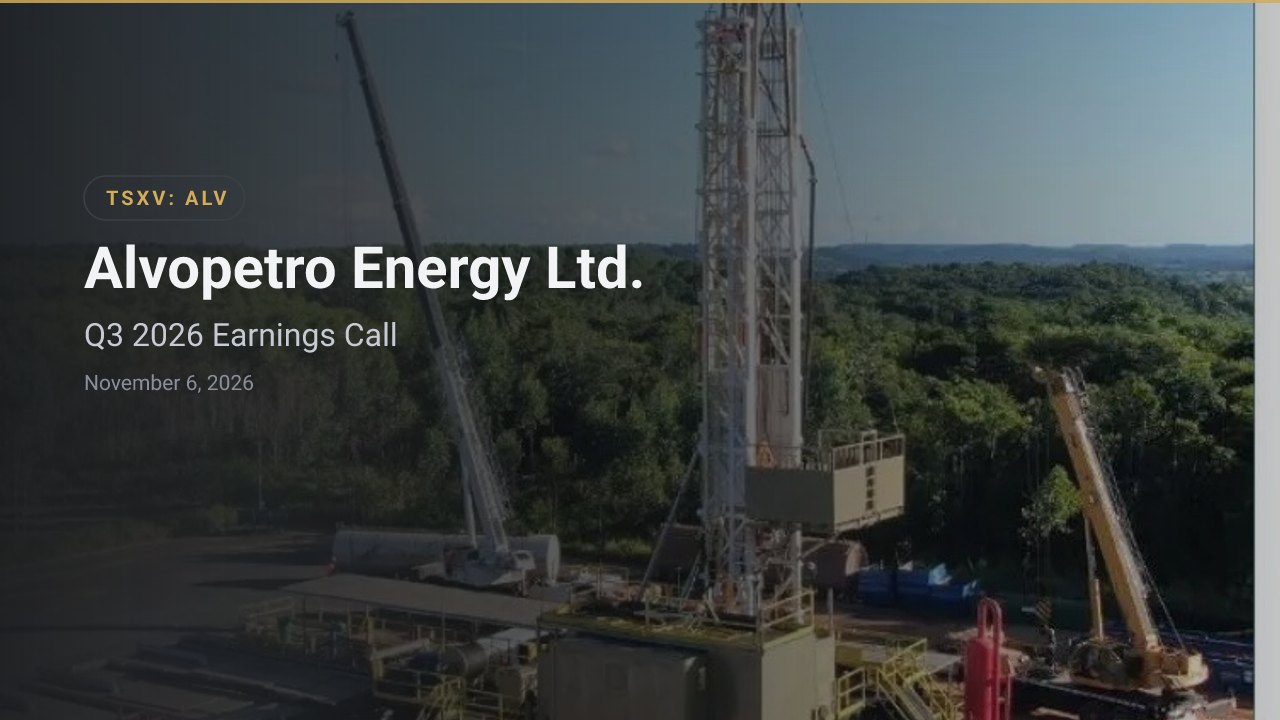
On 6ix: 6ix.com/event/alvopetro-energy-ltd-alv-q3-2026-earnings-call
Automated transcript · Written by software from the replay's audio. It can mishear names and figures; the replay is the record.
0:00 I'm joined by Alison Howard, our Chief Financial Officer, and Adrian Audet, our Vice President, Asset Management.
0:08 Hi, everyone. Thanks for joining us this morning. Just a few administrative points before we start here. We will be recording today's call and we will have our replay available on our website later on today. All attendees are placed in listen-in only mode for the duration of the call, but we will be hosting a Q&A session at the end of the presentation. You can start logging any questions you have now using the Zoom Q&A button that you should see on your screen. And we will get to those at the end of the presentation. If you dialed in by phone, you can send questions to socialmedia at alvopetro.com. Lastly, just a reminder, we do go through various forward-looking statements and have non-GAAP measures and some oil and gas metrics throughout the presentation.
0:53 So we do encourage you to read all of the cautionary statements and other disclosures that you can find at the end of our Thank you, Alison.
1:06 All right. So, you know, I think the third quarter was another good quarter for us. If you recall, just looking back, we had a pretty good year last year. Our production was up over 40%. We're off to a pretty good start for, well, we're getting most of the way through 2026 now, but we're tracking to be up close to 25% again. You can see our third quarter production averaged 2966 barrels of oil equivalent per day. We did have close to a five-day shutdown of our gas plant to finish the planned upgrades at the plant. All that was done in September. and then we also just announced our October production. So up to 3,200 barrels of oil equivalent per day after that expansion was done.
1:53 And just a reminder, if you look at the funds flow from operations that we've generated since our key project in Brazil came online in 2000, we've now generated funds flow from operations of $245 million 46% of that's been returned to our stakeholders, including close to $80 million of dividends. So I think to be able to generate this type of organic growth and have that type of discipline back to our shareholders, we're pretty proud of that. The last thing I'll make, a comment I'll make, we'll talk about our capital program that continues this year. But as we exit the year with the remaining facilities-focused investments that we have in Brazil, as well as a very busy program in Western Canada.
2:42 I think we're well-positioned to continue this growth trajectory as we move through 2027.
2:53 So the one key thing we like to highlight is our exceptional funds flow from operation generation, and it really starts with our operating net back. A reminder, this is one of those non-GAAP measures. It's our operating profitability. We express it in per barrel of oil equivalent, and that's the green bars. That's the profit that you see on our production. So in Q3, starting at the top of the bar chart, we had a realized sales price of just under $71. That included natural gas sales of $11.49 per MCF, up over 50 cents from our Q2 price. The orange bar, we deduct off our royalties. That's the orange bar, really attractive royalty rates. Our effective royalty rate overall is just over 5% in Brazil, just under 5% and in Canada, roughly 15%.
3:44 And then we also deduct off here the operating costs and we've combined our trucking costs in Canada as well. That's the gray bar, again, really low cost natural gas production in Brazil. Our operating costs in Brazil were about $5.50 this quarter and overall company-wide just over $6. So that allowed us to generate an operating net back of $60.87 per BOE. That's US dollars. That's up $1.79 from last quarter. And when you look at that relative to our realized price of $70.62, that's a net back margin of Thank you for joining us.
4:52 A tax incentive in Brazil that reduces our tax rate to just over 15% and we generated funds flow from operations of 14.3 million on that 19.3 million of revenue. So that's a 74% margin from a funds flow side. So it's really, really quite remarkable on this level of production, how much funds flow we generate. And we'll look at that next. So this chart just compares this quarter's funds flow 14.3 to Q2 of 14.1. You can see it's relatively flat. We did have that slightly lower sales volumes in Q3 that Corey touched on mainly due to that plan shutdown we had in Brazil. That was more than offset though by our realized prices.
5:37 Our royalties were a little bit lower. and other income was higher and G&A was also a little bit lower overall. That was offset by some marginally higher production expenses and current tax and we generated the $14.3 million this quarter. On the net income front, there's some non-cash things that go through our net income. So we did see a slight decrease, $1.2 million from Q2 to $8.5 million net income in Q3. The biggest driver of that was for an exchange, we had a gain in Q2 compared to very small loss in Q3. So overall, that was the biggest change in our net income there.
6:29 All right, so this chart just tracks our dividends since we started them in the third quarter of 2021. You know, we've been paying out 12 cents U.S. per share through this year, including our third quarter dividend. That represents a yield of 7.5% at current share prices. And I think I referred to this earlier, but since inception, we've returned U.S. $2.18 per share, close to $80 million back to shareholders. Just an update on our gas pricing formulas. I think everyone's seen this a number of times. As a reminder, about 80% of our gas right now is being priced under this QDC1 formula, which is the red line that you see here. 20% of the gas is being priced on the QDC2 line.
7:17 The detailed formulas are in footnote 5 to the presentation, but at risk of oversimplifying it. About a third of this QDC-1 formula effectively is fixed. About a third of it floats based on Henry Hub prices and another third of it floats based on Brent oil prices, whereas the QDC-2-1 floats entirely based on Brent. The weighted average between the two is the green line that you see here. As Alison noted, our Q3 average realized price was $11.49 per MCF. The November 1st reset that just happened is around $11 US and MCF, so fairly close. And if you look at the futures market as of, I think this was November 4th, so a day or two ago, this is what the forecast looks like as we move through next year.
8:11 So if you look at the green line, kind of averaging between that $11 and $12 mark, through to the end of next year. So certainly helps with our free cash flow generation capacity.
8:29 So far in 2026, we've been very busy with all of our technical teams. So we've been executing our capital program, which has been targeting the Mercatutu assets. First off, on the facility side, our gas plant upgrade was completed in September, which culminated in the shutdown that Corey mentioned earlier, that five-day shutdown in September. So this upgrade gives us the ability to process larger percentages of the richer Mercatucu gas. And then at the Mercatucu field level, our teams have been working to finish our pipeline expansion and the tie-in at the G location. and both of these projects are required so that we can complete and tie in the newly drilled G2 well and have the ability to put this on production.
9:14 So both of those projects you can see in the picture at the bottom right so the pipeline is there on the right with the line pipe laid on the right away and then the rig there on the left is at our G pad location so we're start the actual tie-in projects to the flow lines. So both of those two projects are slated to be done in the first quarter of 27. The teams are also finishing an expansion at the Mercatutu Hub facility, which is the picture at the top right. This will give that facility the ability to flow up to 600 E3M3 a day, and it includes a new separator, a flare, and some other equipment. On the drilling side, both the D1 and the H2 well were drilled, then completed in the last quarter or the last few months. And then both wells are currently flowing into our production system and into our sales system.
10:19 and then we finished this drilling campaign with that G2 well. This project was executed very efficiently. We were encouraged about the log results we saw on this well. We logged over 97 meters of net pay over for Karawassu sequences and the Upper Gomo sequence. And that well has now been cased and like I mentioned earlier, we need to wait for the facilities projects to be done before we finish the completion and then put that well Next year we're planning a follow-up drilling program at that same G location as well as an exploratory well at our 183 C1
11:09 All right. So moving on to our Western Canadian business unit that I think we've assembled a pretty impressive position here. If you recall, we did a couple of initial joint ventures with an initial partner. We'll call that the 2025 JV focused on the Manville Stack Heavy Oil Play Fairway. So that was Alvopetro Energy Ltd. We've started drilling the first of those five this morning, actually. And then as the terms of that are basically we earn 75% interest in those wells before getting payout. And then after payout, we earn a 50% working interest. And as we drill the wells, we earn a 50% interest in all the surrounding undeveloped land. So I think it's a A certainly a nice transaction for us. It gives us access to kind of an accelerated drilling program here in the fourth quarter.
12:22 And we're getting access to two of the leading technologies that are being applied to this place. So open hole multilateral wells and single leg horizontal wells with recirculation strings. We're drilling the five wells across five different core areas into some very attractive geologies. and then the other thing is with our initial joint venture partner here we actually did just finish drilling two additional gross wells 0.8 net wells those were brought on production in October that go through a cleanup flow period and then we fill the tanks and ultimately you'll start to probably see sales from those wells show up in our November and certainly December sales numbers that we announced but I think if you put this in perspective, you know, this is one of the leading plays in Western Canada.
13:12 And through these two transactions, we very quickly built, I think, a pretty impressive inventory of opportunities. After earning here, our land position will be over 133 square miles of gross land, over 175 tier one drilling locations. So we're pretty excited about the business here. And we've got a very busy fourth quarter ahead of us. So just to summarize again, Elmopetro certainly offers, I think, an attractive investment proposition, whether you look at it on a value, yield or growth basis. I think we've got some exceptional quality assets that are really That ratio of funds flow to revenue that we can generate really highlights the strength of our assets and we've got some highly strategic infrastructure and I think a pretty attractive and disciplined capital allocation model where we've been able to have some attractive organic growth and pretty disciplined return of capital to our stakeholders.
14:14 From a value perspective, we're trading at less than two-thirds of our 2p NPVs. I mentioned the yield, 7.5% yield. And from a growth perspective, I think this is a very busy time for us. And although we've had two successive pretty good years, I think as we move through into next year, we're very well positioned to continue that growth trajectory and unlock a lot of value for shareholders.
14:44 Okay. So we have some questions. We do have some from social media emails. Maybe I'll start with some of those. There are quite a few questions actually around facilities expansion and capacity. How are you managing facilities capacity constraints between your plans to increase America 2-2 field and pipeline capacity to 600,000 cubic meters per day and your existing UPGN capacity, considering the contribution of higher heat content and liquids-rich gas from America 2-2, along with your commercial offtake relationship with Bahia Gas.
15:29 Okay, so I think Alison's combined a few questions into there, but I'll try and cover them all off. So, you know, our capital program this year really was kind of dual-pronged. We had a facilities component and a drilling component. The facilities part of it really has been to address the levels of success that we've had at Merca 22. as Adrian mentioned the UPGN expansion was completed in September most of that related to improving the condensate stabilization process at the plant and we did add some additional redundant compression as well but the biggest reason we did that is it'll allow us to produce roughly about half of our gas from the higher heat content gas that we have at Mercatutu so 50 50 relative with with Mercatutu it also should give us the ability to grow the nameplate capacity of that plant up to about 600,000 cubic meters a day, which is just over 21 million cubic feet a day.
16:28 In parallel, as Adrian walked you through those facilities projects that are actively going on in the field right now, We're expanding the field production facility at Mercatutu and the related pipeline takeaway capacity to increase Mercatutu's field takeaway capacity back up to that same number. Longer term, if you look at those two things together, If we move towards an even higher percentage of gas coming from Mercury to our other hot gas, like for example, the 183 C1 exploration prospect that we're going to drill next year. To do that, we would have a next plant expansion at the gas plant to basically allow us to remove the propane portion of the gas stream from the sales gas. And that's something that's actually being engineered right now.
17:26 and we'll continue to work through that. But that gives us the next layer of flexibility. The last part of that was related to the interaction, I think, with Bahia Gas. So I think as demonstrated in the last couple of years here, in 2025, I think we increased our firm commitments to Bahia Gas by a third. In 2026, we increased them by another 25%. And then as these projects www.beheagas.ca commit these incremental volumes on kind of a one or two year period and that's kind of what we did. That QDC2 line that I reviewed in the presentation, that's about 20% of our sales right now. We had negotiated that I think near
18:33 the end of 2025. Okay, just following up on the capacity because there's some additional questions around if we have sufficient drilling inventory, but there's another question about You know, previously back in 2022, we showed a long-term vision of Brazil of 6,000 VOE per day. And, you know, now you've added on Canadian operations. Is Brazil, is the long-term vision for Brazil still 600, sorry, 6,000 VOE per day? Or are you going to be relying on Canada to get to that longer term? But maybe the first part is on the drilling inventories. you know, and filling this capacity that we're building for.
19:21 Alison's now come, I think that was three questions again, combined to one. So, okay. I'm going to try and go back to 2022 in my mind. So someone's testing me pretty well here, but as I recall, we had presented a number of kind of some stacking production charts that with success, particularly at America 2-2 on both the reserve and resource development side, as well as kind of a vision for what that business could grow to, which is basically kind of doubling what the original plant size was. You know, I think if I build on the response that I made to the previous question, I think you can see we've been growing our business in steps. So we're at 40% in 2025. www.nanaeleuk.ca Another good way to maybe look at how we think about what the right size of facilities capacity and gas sales capacity is maybe in a quantitative way is our reserve life index. So if you look at the end of last year, our reserve life index, I think on a 2P basis was about 12 and a half years.
20:38 So that's a pretty good number. But if we have continued success at Mercatutu and export nearby exploration and things like that, and that number starts to grow Higher than that, you know, we have a choice basically. Do we produce at that same level that we're building towards for longer or do we expand the plant and the gas sales again? And I would say if that reserve life index gets considerably longer than that 12 and a half, what it's pointing you to is that, okay, we should build more steps and continue the growth towards that kind of 6,000 number. And that's just in the area that we're talking about there. If the number falls below that, then it tells you we should be focusing more of our attention on drawing new opportunities and building the inventory and things like that.
21:24 And hopefully we're doing both of those things. I think the 6,000 goal is still a rational goal, especially when you consider things like the 183C1 exploration prospect that we're drilling next year. We just added over a 460 square kilometer exploration land position in the adjacent basin, in the Takano Basin. So although that's early stage, that has a lot of potential for a company our size. The Canadian platform we're not putting detailed production guidance out there, but if you look at the The type curves that we presented in the inventory that we have, depending on the levels of success and the pace at which we're drilling those wells, which is somewhat well-priced but dependent as well, we certainly think that that asset has the potential to grow to a couple thousand barrels a day without adding too much more to that inventory.
22:29 So I think things are looking pretty good. And then the drilling inventory, I think I just answered part of that. So I think that, you know, next year we'll have a little bit of a balance between exploration and ongoing development at America 2-2, which will, I think, help us position us quite well for that next stage of growth there. And then the Canadian program, you know, we've got a pretty deep inventory of opportunities there. We'll drill these next five earning wells, we'll get the results from those, and then we'll design a capital program for next year and the years beyond. But I think there's a pretty deep inventory there. And then I talked about the new exploration position in the Tucano. But, you know, we're always looking for new opportunities.
23:17 And, you know, we have a pretty long-term view on the business.
23:23 Maybe we'll just jump. We have a couple questions on Canada. So it looks like Canada activity is increasing now. but there was relatively little activity earlier in the year. Can you comment on why that was, especially in the context of the oil pricing being so high in that period?
23:43 Yeah, you know, with our initial partner, we're trying to work through our collaborative drilling program with that counterparty. So, you know, it ended up... the timing of the next two wells you know we just finished drilling them and then we're going to work to to design next year's program but with the addition of you know we just added this courser uh second joint venture the 2026 uh joint venture in September so I think we've pretty quickly um moved to uh to to drilling there and we we look to have we probably will get all five wells drilled in the fourth quarter they'll probably extend into the first quarter but hopefully at least four of the five will be drilled in the fourth quarter. So it's a pretty active program.
24:31 So in Canada, one of the questions is how many total wells are we drilling in Q4? So we've just finished the two with the original partner, the 2025 venture partner. And then we have five, these five earnings wells with the 2026 partner. And then, and as I mentioned, that could potentially, some of those could be into early 2027. and then the other question is how many in 2027 after that, I guess would be the question on that.
25:04 Yeah, I think we're going to define that based on the results that we see and yeah, stay tuned.
25:14 Staying on the Canada front, how have the existing wells in Canada produced relative to your type curve declines seem to have accelerated recently? and do you have an expectation of flow rate for the two wells that just came on production?
25:28 Yeah, so unlike maybe these kind of higher, individually higher impact wells in Brazil, partly because we have partners and partly because the data is a little bit delayed publicly, we're not going to, The other nuance with these heavy oil wells that we're drilling is you go through a cleanup period where you're producing back the drilling fluid and then you're slowly kind of ramping up the oil production. So the pace at which that starts to show up in our sales can vary. You know, if you look back, it's not in this presentation, but in some presentations we've had of late, The type curves, we've got kind of a range, but if we can be between 150 and 200 barrels a day gross per well and cumulatively produce upwards of anywhere above 100,000 barrels per well, ideally in the 120 to 150 or 180,000 barrels per well, these wells can generate some pretty impressive rates of return, especially with current oil prices.
26:38 Okay, let's move back to Brazil. We have a number of questions around our most recent wells that we've drilled there. So on a H2 well, we just announced initial kind of production results from that well. What weight do you expect once it's cleaned up and how does this compare to what you expected before drilling?
27:02 Yeah, so I think, you know, we've had This is kind of variable results from our Mercatutu project, which is a little bit to be expected. Geology is variable after all. Some of them probably below kind of what our expectations were and some certainly well above it. So maybe I'll talk about it all together. And it's a little bit difficult, like we announced net pay in our our presentations and things like that. It's a little bit difficult to contrast them apples to apples because petrophysics is more complicated than just the net pay, but I'll try and give you a little bit of a sense. And every well is a little bit different. The data that we get from each well is a little bit different, but like a good example would be Our D4 well, which was one of our better wells, we were only able to get that drilled to kind of the bottom of Karasu sequence 6.2.
27:58 We had some challenging hole conditions in the well. And as a result, we cased that very quickly without open hole logs. We had, you know, good gas shows while drilling and cased hole logs. So we basically defined the net pay and completed that well based on that. The H2 well, the good news is we drilled that into the prospective resource area so it looks like we were migrating resource to reserves here. That well was drilled in a kind of down dip orientation and the net pay that we had defined was just in the lower two sequences of the Karasu formation. So this is a lot of information. And then if we contrast the G2 well that we just drilled, we were able to actually drill that well very effectively all the way through up and tag the upper GOMO portion of the reservoir. So we got all four Karasu sequences into the upper GOMO. We were able to get sidewall cores, open hole logs, were able to do all that, I think, for about 10% under our AFV budget.
29:06 And we've got, I think, some pretty impressive gas shows while drilling. With the open-hole logs, we defined about 97 meters of potential net pay through all four of those Karasu sequences, and the upper GOMO sequence. And then that structurally, that G2 well is about 65 meters up dip or up structure from that good well that we drilled with the 183D4. hopefully that kind of puts some of that in perspective but don't know certainly we've had you know the H2 production results are below the D4 well but like I said it was only completed in two of those sequences and as far as cleanup goes you know we've recovered a decent amount of the completion fluid you know we'll see how the well performs all these wells we'll continue to monitor that and you know we also run production logging tools and try to improve our understanding of what's happening on the subsurface.
30:07 Great. Maybe a little bit more on G2 because there's a lot of questions around the significance of the 97 meters of potential net pay and also around the timing of the completion and, you know, will that be done in Q1 and, you know, why aren't we doing that right away?
30:28 Yes, so the first part of that I think I touched on in the earlier response. So, you know, we're pretty happy about this between the gas shows that we saw while drilling and the quality of the net pay that we see on the open hole log. So we're certainly looking forward to getting this completed. The timing is more driven. I think Adrian talked about that. That G well pad, unlike where H2 was drilled, That H2 well pad was already pipeline connected. It was off the 197-1 lease. So we were able to put that on production right away. The difference is that G pad was just recently constructed. That's the first well drilled off of it. And we always had this facilities plan to tie that back into the 183-1 lease, which was that upper picture that Adrian showed. So it really has to do with the fact that when we complete...
31:17 Are there plans for any further drilling in the area around the H2 well west of the fault? Yeah, well, the production results and the evaluation of that is just brand new. So we'll integrate that into our models and look at the drilling program over the next couple of years. And we'll have the benefit of seeing how that well performs.
32:03 But I would say We haven't announced our 2027 capital budget yet, but with that new G-pad that we've got, I would imagine that we would focus our attention on that. And as Adrian mentioned, we're also going to allocate some capital to that, joining our adjacent Karasu Exploration Prospect at 1E3C1, which just sits immediately west of Mercatutu.
32:29 Yeah, so there are a couple questions about how many MERC 22 wells are planned for 2027 and in what order?
32:37 Yeah, we'll probably come up with that in the next couple months as we firm up our rig schedule and yeah.
32:49 Yeah, and there also is a question about the 2027 CAPEX guidance, but as Ori mentioned, we haven't finalized that yet. That will be released when that is all final and approved. On to Cano, what does the first phase work program involve?
33:08 Yeah, good question. So, you know, I think the nice thing about this, we were able to, you know, at a pretty significant exploration land position at a very low upfront cost. The work commitments, there is one legacy field or pool. We have three years to complete that. And the work commitment is notionally a re-completion on a work over of an existing well. We have three years to do that. The bigger exploration blocks, we have six years to meet the initial commitments. and they're defined in work units. So it's not an easy answer to your question. It depends what we see, but there are 200 units per block. And the way it works in Brazil is we can fulfill those individually by each block, but we can also aggregate those work commitments.
33:57 If we have a prospect that we really like on one of the blocks, we can satisfy all the work commitments by drilling one well. But from a work perspective, what we'll do is there's a bunch of available seismic. We're going to reprocess that and firm up the leads that advance into prospects and then we'll license, you know, if we like what we see, we'll license those locations, construct the pads and then drill the wells. But practically speaking, that's not, you know, we'll be doing the technical work next year and that's something from a more meaningful capital exposure wouldn't be until 2028 or 2029, probably.
34:40 There's a couple of questions around gas demand. So one person noted that October sales volumes in Brazil were already above our firm gas contract. And, you know, once MERC 22 goes to 600,000 cubic meters a day, How much interruptible or spot demand is there? And perhaps you can touch on overall gas demand in the region and whether that will constrain us.
35:10 A lot of questions today. Yeah, so we can sell gas under the firm formulas and volumes that we have within our contract. We have Nanna Eliuk, Corey Christopher Ruttan and to be honest, our ability to do that is sometimes market dependent and dependent on what other peers are doing with their production during the period. We've typically locked these things in in steps by adding to our firm volumes, but we do have that flexibility. From a market perspective, you know, at our current production levels you know we're I think around 20% of the of the guests meet about 20% of the gas demand in the state of Bahia, Baltimore Park.
36:11 So I think between the facility that we have at our location that I touched on, the city gate and the pipeline capacity from Bahia Gas, we've got a big base of industrial demand that sits just 15 to 20 kilometers to the south of us. All that together, I don't think there's any huge constraints relative to the market share that we've got right now relative to kind of our business goals here.
36:39 With President Lula being re-elected, do you anticipate any changes in Brazil's energy policies, taxation, royalties that could affect Alvopetro?
36:49 Yeah, I think, you know, we've been operating in Brazil for quite a while, so we went through kind of more left governments, more right governments, the whole bit, and I would say overall the regulatory environment in Brazil has been quite stable. The other unique thing about Brazil is there's a lot of different political parties, so in the first round of elections, the composition of the lower house and the upper house of the government was already basically set. And those bodies of governments, I would say, are center right-leaning pro-business representation, which is a little bit different than the president right now. So what it does is it creates some pretty tight guardrails around what can happen. but overall I would say you know we don't expect a lot of volatility in kind of the regulatory and tax situation in Brazil and I think the energy industry is recognized as a pretty key industry in Brazil and to fund the social programs that you want to fund it's a pretty critical part of the economy.
37:58 With funds flow of Over $14 million this quarter and dividends of approximately $4.5 million, you have excellent dividend coverage. As your capital spending increases, do you anticipate maintaining the current dividend or could capital requirements influence future dispositions?
38:18 Yeah, we don't give guidance on what the dividend might look like a year from now, but what I would say is we did make a conscious decision to accelerate some capital that was originally slotted for kind of the first half or even into the first, say, the first half of next year. www.nanaeleuk.com but it's mostly related to that. So although we've grown production and cash flows through 2026 quite handsomely, we did increase the dividend by about 20%, but yeah, I think we certainly have room to grow that, but that's ultimately a decision for the board to make.
39:19 And sorry, there's one other question that I've just seen now on the social media email. So I think we've touched on this somewhat, but they're asking for additional information on the status of 183 D1 and whether we've seen any improvement in production since the initial flow test.
39:38 Yeah, I'd say that well has been pretty consistent and it looks somewhat similar to the H2 well.
39:45 And then a follow-up to that is, are changes being made to the completion approach on G2 based on D1 and H2 results?
39:56 Well, again, I talked a lot about the differences, I guess, earlier on. The main thing is that the G2 well is 65 meters up dip or up structure from the D4 well. You know, the gas shows look as good or better than any well that we've drilled. So we have put 13 sleeves in that well. I'm not saying we'll complete all of them, but I would imagine, you know, we've got the ability to complete all four Carousel Sequences and the Upper Gomo. And we're going to make those decisions here over the next probably 30 days and be executing that early in the new year.
40:38 Okay, and we just had another question, a couple questions come in. You're holding a lot of cash and equivalents on the balance sheet. Is there a reason to hold so much?
40:48 Yeah, no, good question. We did add a small tranche of debt at the end of last year. The way it works in Brazil is when you do that, you draw on it and you have the cash on the balance sheet. So yeah, good observation. We haven't effectively used that yet, but we wanted to have the flexibility to do things like accelerate this capital that I talked about. So I think it was a prudent thing to do to have that flexibility. And our capital expenditures are And then we have one question about the buttons that Corey and I are wearing. These are poppies and we wear them in recognition of
41:48 Military people that have served for us and died for us for the freedom that we have today. And it's for November 11th, but people generally start wearing them end of October to November 11th. And that's it. That's all the questions.
42:05 All right. Well, thank you again for everyone attending. Thank you for your support. And if you've got any questions, feel free to follow up with us after the call. We look forward to updating you next time. Thank you.
42:16 Thanks.
Follow Alvopetro Energy Ltd. into a list and get an email when it puts out news.
Chief Financial Officer
Vice President, Asset Management
President and Chief Executive Officer