Corey Rutan
President and CEO at Alvopetro Energy Ltd.
Replay available
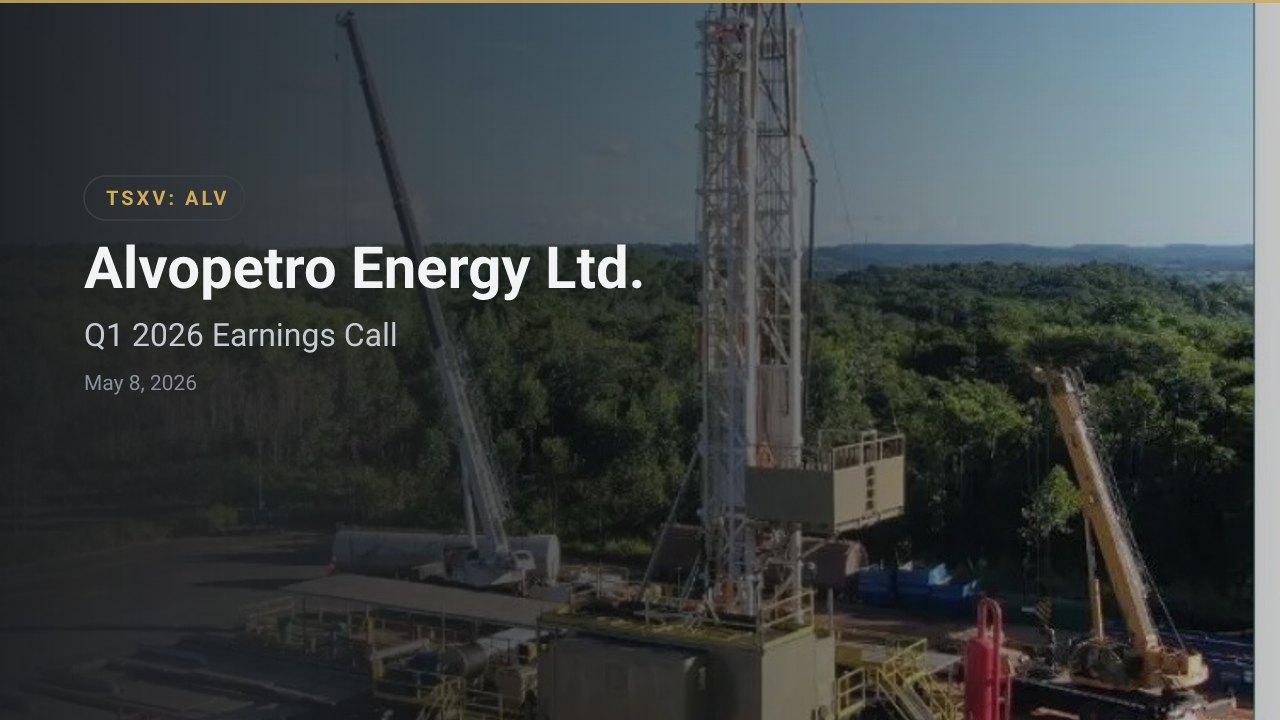
Alvopetro Energy (TSXV:ALV) Q1 2026 earnings call, held 2026-05-08. Watch the replay and read the transcript on 6ix.
On 6ix: 6ix.com/event/alvopetro-energy-ltd-alv-q1-2026-earnings-call
Automated transcript · Written by software from the replay's audio. It can mishear names and figures; the replay is the record.
0:00 Good morning, and thank you for joining us for our Q1 twenty twenty six earnings presentation. I'm Corey Rutan, President and CEO. I'm joined by Alison Howard, our Chief Financial Officer and Adrian Adet, our Vice President, Asset Management. Good morning, everyone. Just a few administrative points before we jump into our presentation. We will be recording today's call, and we will have a replay available on our website later on today. All attendees have been placed in listen in only mode for the duration of the presentation. We will have a Q and A session at the end of our presentation, and you can start logging any questions that you have using the Zoom Q and A button that you should see on your screen.
0:46 If you've dialed in by phone, you can also send any questions to [email protected]. Lastly, we will be going through various non GAAP measures and making forward looking statements throughout this presentation, so we do encourage you to read through all of the disclosures and cautionary statements that we have both in our corporate presentation on our website as well as in our MD and A that is also on our website. Great. Thank you, Allison.
1:18 So if you recall, at the beginning of twenty twenty five, we did upgrade our gas sales agreement. And then when you combine that with some of the strength that we demonstrated on our Merca particularly with the 183D-four well, we were able to deliver some pretty strong results in 2025. Our production was up 41% year over year, And we exited the year with a record quarter of 2,867 barrels of oil equivalent per day in the fourth quarter. And we're pleased to say that we had an even higher record quarter in Q1 of this year that we just announced along with the financial results here of over 3,100 barrels of oil equivalent per day.
2:03 We did upgrade our gas sales agreement again at the beginning of twenty twenty six, increasing our firm supply again by another 25%. So if you compare Q1 on a quarter over quarter basis, we were up 9%. If you compare Q1 to our 2025 average, we're up about 25%. So a pretty strong start. And you can see we just recently announced our April production as well, which continued at a pretty consistent level to Q1. Lastly, I think if you consider this growth that we've been able to generate over this period of time, I think it's pretty impressive, especially when you consider it in the context of the fact that we're paying out about half of our cash flows in returns to stakeholders.
2:54 Okay, so jumping into our Q1 twenty twenty six results that we released, starting with our operating netback, that is a measure of our operating profitability. We measure it in per barrel of oil equivalent. Just a reminder, to calculate that, we start with our realized sales price that's at the top of the chart. We deduct off royalties, that's the orange bar. We've combined production and transportation expenses, that's the gray bar. And then the green bar is our operating that back. So looking at Q1, we had a realized sales price of $61.77 That was up over $2 from Q4 twenty twenty five. Included in that are natural gas sales were just over $10 per Mcf at 10.14 Our royalties of $4.19 is an effective royalty rate of just under 7%, which is consistent with last quarter, 6.4% in Brazil and 13.6% in Canada.
3:56 Production and transportation costs decreased overall, both overall in terms of dollars and per BOE with that increased production, they were down $0.76 per BOE or about 12% from Q4. And our operating netback with all of those improvements was up $2.42 compared to Q4. Brazil netback just over $53 and Canadian netback just over $36 That translates into an operating netback margin when you look relative to our realized price of 84%. And again, when you compare that to other companies operating in South America and in North America, that's really industry leading netback margins.
4:44 If you layer in the fact that we qualify for the Sudini tax incentive in Brazil, which reduces our effective rate to just over 15% and we actually have no current tax in Canada right now because we have tax rules to offset our earnings here. That really allows us to generate funds flow from operations on this base level of production. So on the funds flow from operations, this chart here just compares our Q4 of $10,600,000 to Q1 of $12,500,000 So we were up $1,900,000 The bulk of that is increasing revenues, both in terms of our sales volume increase as well as our realized price increase.
5:31 As I mentioned as well, production expenses were down on a dollar basis compared to Q4. Our interest and other income was higher than Q4. G and A was down. And then partially offsetting that was higher royalties, you know, with those higher revenues and also higher current tax. But very strong quarter here at 12,500,000 funds flow. Similarly, on net income, we saw an increase of $2,500,000 That's again impacted by all those same things that funds flow was impacted by. Also saw an improvement on our FX, so there was higher FX gains this quarter of $1,700,000 or the change was $1,700,000 compared to losses last quarter.
6:19 Offsetting that, we did have higher depletion and depreciation, finance expense, and also deferred tax. But overall, net income of $8,100,000 this quarter. So as a reminder, we did declare, again, a $0.12 per share dividend in the first quarter. This just shows the dividend history since we introduced the dividend in the third quarter of twenty twenty one. That dividend translates into a current yield of about 7.6%. And in total, since inception, we've now paid dividends of nearly $2 per share or over $70,000,000 back shareholders.
7:04 This slide just highlights our more disciplined capital allocation model where we're basically trying to take roughly half of our cash flows and return it to stakeholders and take the other half and return it or and reinvest it in growing our business. The chart that you see on the left here, all the green lines with the black dots show all the cash unsold from operations each quarter. The cash inflows each quarter, as Alison just highlighted, 12,500,000 over the first quarter of twenty twenty six, which was up 18% over the fourth quarter of last year. And then all the stacking bars just show cash outflows in each particular quarter. All the various shades of green are the various returns to stakeholders and the yellow are the capital expenditures that we've been making in each individual quarter.
8:00 The pie on the right hand side just shows in total since July 2020, we've now had cumulative funds flow from operations of US217 million dollars Of this, almost just over half has been reinvested and just shy of half has been returned to stakeholders in these various forms.
8:26 We have announced some upgrades to our gas sales agreement recently. And this graph just kind of highlights the fact that we've got two different pricing formulas under our firm sales to Bahia Gas. Now the red line is the kind of historical contract that we've had. We're currently selling about 80% of our gas under this formula in red. And then at the beginning of twenty twenty six, we added another firm layer of gas sales under this QDC2 formula, which is this orangey brown color at the bottom here, about 20% of our sales on that. And then when we do a weighted average of the two, it's the green line that you see here, which becomes our weighted average realized price. You can see the price gets adjusted quarterly. So we most recently announced our May 1 price, which was using Q1 twenty twenty six commodity prices up to over $11 per Mcf.
9:29 And then if we use the futures market for the forecast period, so to the right of this dash line that you see here, you see another forecasted sharper increase forecast for August 1 up to on a combined basis of over US13 dollars per Mcf. And then we have also added the formulas down below. So the red line of the original contract we had, the way the formula works is we have a fixed component that does get indexed to inflation. And then the variable component is based kind of half on a function of Brent and the other half on a function of Henry Hub. So a premium to Henry Hub plus another fixed margin that also gets adjusted for inflation.
10:15 We calculate the U. S. Dollar per MMBtu price. And then for our gas, which is kind of hotter than average, we apply this factor to get to a U. S. Dollar per MCF price. And then you can see for QDC2, it's entirely a function of Brent, which is a little bit different. And I think that covers it. So we've established a strong platform in Brazil, and now our activity is focused on our next growth objectives. So our biggest growth opportunity is our 100% working interest Merca Tutu project, which is just north of Cabaret. So we made a significant discovery on this block with our 183A3 well and then the 183D4 follow-up well.
11:03 And 183D4 came on production last August, well ahead of expectations, and the production from this well continues to be strong through the first quarter of this year. So we have a facilities focused 2026 plan to unlock the potential of this asset and set the stage for the next phase of growth in this area. So first, we are going to quadruple the Merkatu II takeaway capacity for the field itself. And then we're also expanding our gas plants, so UPG and Cabaret, to add the processing flexibility to facilitate this Mercatoo II growth. So we have a combination of reserves and resources with GLJ that demonstrates the potential of this itutu asset, and we're working to migrate this into production and cash flow to support our longer term growth objectives.
11:58 So in the field itself, we're well underway with our 2026 development plan. So we're increasing the field processing takeaway capacity fourfold for this field. So we're in the procurement process of the main processing equipment for this field expansion, and we're looking forward to installing this equipment for the next coming quarters. And we're also expanding the field egress by increasing the pipeline capacity of up to 600 E3M3 a day. So to do this, we're going to loop the existing four inches pipeline with an eight inches pipeline. So currently, we're in the permitting process of this, and the line pipe itself is being manufactured in Brazil. At the field itself, we're also drilling a follow-up well, a 183D1 well, which is right where the cursor there.
12:51 So we started this project at the end of April, so we're right in the middle of the drilling project right now. And we're going to be completing this as soon as practical. So at least the rig leaves, we can bring on the completion equipment and tie that into the existing pipeline facilities. So this development will add additional production capacity for this field. Also currently, we're building a G pad, which is sort of where the cursor is there. And so this is a location that's going to support up to four additional Karowasu development locations. And this pad is going to be pipeline connected as we do our other looping project.
13:32 And so the second phase of development that we're focusing on in 2026 is our midstream project at UPGN Cabaret itself. So this year our plan is to optimize the processing capacity of this facility to improve the ability to increase additional amounts of MERCATU2 gas, which is hot gas. So the target capacity of this project is an overall gas plant rate of 600 E3 M3 a day, but will allow up to 300 E3 M3 a day of MRF-two-two gas to be blended with our Kapodeg gas. So this project has already been initiated with our facilities partner Enerflex, and we expect this to be online at the end of the third quarter. So this project will allow us to substantially increase the amount of offtake from our Merf22 asset.
14:26 All right. Moving on to Western Canada. I think everyone's probably aware that we announced a strategic reentry into the Western Canadian sedimentary Basin through two transactions last year, which culminated in an area of mutual interest highlighted in green on the map that you see here, which basically covers the entire Saskatchewan side of the Mannville Stack Heavy Oil Play Fairway with also with some recent land acquisitions that brings our land holdings to over 100 square miles of land on a gross basis. We're 50% interest in that. So over 32,000 net acres of land. We've now got 3.5 net wells on production. We did have some initial reserve recognition from our independent reserve evaluator, GLJ, at the end of last year based on the limited amount of activity that had happened to that stage, 735,000 barrels of oil equivalent to an NPV of just over $12,000,000 They were able to assign just eight gross or four net undeveloped locations to the asset based on the drilling at that point.
15:34 But you'll see on the next slide.
15:44 This just highlights that. So through the earning process, we also really helped delineate three core areas, Neelburg, Salvador, and Lashburn. That's where the eight undeveloped locations that GLJ assigned reside. But you can see we have an inventory of over 100 locations that we see. And the type curves that GLJ assigned on a 2P or approved plus probable basis for the three different areas are highlighted on the graph here with initial production rates somewhere between 110 and close to 150 barrels of oil per day on a gross basis and cumulatively producing over the life of the well between one hundred and one hundred and seventy five thousand barrels per well.
16:35 So we certainly think that we've built another substantial area for growth for ourselves here. If you use even just a $70 flat oil price forecast, the rates of return that these types of projects would generate, you know, we're targeting between 50% and over 100% IRR. So it's pretty compelling and gives us good exposure to oil prices.
17:04 So just to wrap up this part of the call, to reiterate, I think we had a pretty amazing year last year and we continued to deliver some pretty strong results to start off 2026. We continue to benefit from very attractive natural gas prices, industry leading operating netbacks and operating netback margins. So and in addition to the strong production growth that we had last through to even April of this year, just as a reminder, we also were able to generate some pretty substantial reserve growth. So over 43% increase in our 2P reserves, even after considering that we produced close to 1,000,000 barrels of oil equivalent last year and replaced production over five times. This strong free cash flow generation capacity that we have really does help underpin the more balanced and disciplined capital allocation model that we have.
18:00 For value investors, trading at about 60% or less than 60% of our 2P and PVs. For yield investors that $0.12 per share dividend translates into 7.6% dividend yield at current prices. And for growth investors, I think we have a pretty exciting capital program ahead of us and looking to unlock a lot of value, especially when you consider it relative to our existing enterprise value. And the nice thing is we now have growth opportunities both in Brazil as well as an attractive inventory of heavy oil drilling opportunities in Western Canada. Obviously, we had another record quarter to start off 2026 at over 3,100 barrels of oil equivalent per day, which was up another 25% from an already very strong year last year.
18:52 And then the capital program that Adrian walked through earlier really helps put the pieces in place to give us the opportunity to deliver another 20 plus percent year over year growth potential for 2027. So I think, like I said earlier, I think if you can consider that in the context of paying out half of our cash flows to stakeholders, it really is quite exceptional, especially when you compare it to virtually all of our peers. So with that, we'll start the question and answer period. If you haven't had the chance, please log your question into the Q and A portal. Okay. We have a few questions in here.
19:39 How much CapEx will you have in 2026, and how much in Brazil for infrastructure versus drilling? So we announced our capital plan, our capital budget in February for Brazil of roughly $21,000,000 We did kick off some projects in Q1, but there's probably still approximately $19,000,000 of that remaining. From the facilities and pipeline, I think we are forecasting approximately $7,000,000 And then we, of course, are drilling this 183B1 well right now, and that is what is included so far in the plans for Brazil, but obviously we are in a position to accelerate capital spending and accelerate wealth as we see fit with our strong cash position right now.
20:40 You have a very strong balance sheet position and we are in a positive macro environment. How do you think about capital allocation, in particular of the excess cash flow versus what would have been expected pre the Iran conflict? Yeah, so I think our capital program in Brazil in particular is pretty well established. Think the balance sheet combined with the anticipated, we've had a pretty big increase in production. If you combine that with the productive or sorry, the gas price expectations that I showed on the slide earlier, it's natural to assume we're going to have pretty strong cash flow projections as we move through the year. So we have a lot of flexibility from that and the balance sheet, which if we decided to accelerate some of our planned 2027 drilling into 2026 in Brazil, for example, we have the flexibility to do that.
21:41 And those are the types of decisions we'll make as we progress through the current drilling operation. In Western Canada, in particular, obviously those higher oil prices really help improve the rates of return that I alluded to earlier. So we are working with our partner to build out our next phase of drilling for the Western Canadian asset. And I think we have a lot of flexibility to expand that. Okay, this sort of follows on to that. What will determine the pace of investment into Canada as the returns should be very strong given the current oil price? Will you look to hedge to lock your returns if prices stay around current levels? And are there any constraints in terms of oil service drilling capacity to execute? No, think based on all the work that we've done to date, there's ample availability of services.
22:33 I think the natural drilling window, just the way Canadian breakup works and then all that would be a program that would be in the summer here. So we wouldn't see any real impediments. We are trying to work collaboratively with our partner to lay out that program. But like I said, I think we have a lot of flexibility as we move through the year. Okay. On the MERS-twenty two assets, can you explain why you think you experienced low reservoir inflow in the lower GOMO interval in your one hundred eighty three-one well, and any read through to future drilling? Yeah, we are continuing to evaluate results from this specific well. As we focus our development at the Curisu Reservoir, we plan to drill some of these wells into the Como Reservoir as well, and we will look to complete those wells similar to how we've completed the 183D4 well last year. We do remain confident that we have a large potential resource in in the Goma to develop.
23:37 For the 183D1 well that you're drilling right now, what are your expectations in terms of production rate? Well, this is the D1 is an offset to D4 and A3, so from a reserve perspective this is a development well, we expect to be similar to what our other wells came online at. Do you see any opportunities for M and A in both or either country in 2026? Well, the short answer is yes. You know, we don't usually talk about any detailed kind of business development plans. To be frank, there's probably a lot more opportunity in Western Canada, certainly a lot more operators.
24:25 You know, we're certainly seeing a lot more product, let's say, being offered. We continue to remain, you know, remain anything that's happening certainly in our basin in Brazil is, you know, an obvious strategic fit for us as well. Are there any plans to hedge prices this year? We've got a pretty strong balance sheet. So I think and the rates of return on the projects that we're talking about in Brazil, I don't think we really need to do that. But it's something we'll continue to evaluate. Okay. Let me just double check.
25:14 I think that's it for questions right now. All right. Well, as usual, if you have questions after the fact, free to reach out to any one of us, we look forward to updating you next time around after our Q2 results. Thank you again.
Follow Alvopetro Energy Ltd. into a list and get an email when it puts out news.
President and CEO at Alvopetro Energy Ltd.
Chief Financial Officer at Alvopetro Energy Ltd.
Vice President, Asset Management at Alvopetro Energy Ltd.