

12 February 2024
Metals One Plc
("Metals One" or the "Company")
Results of Drilling at Black Schist Ni-Cu-Co-Zn Project, Finland
Significant intersections of mineralised black schists identified at R1 Hook target
Metals One (AIM: MET1), which is advancing battery metal projects at brownfield sites in Finland and Norway, is pleased to report the laboratory results from its eight diamond drillholes at the R1 Hook target, located within the Rauta 9-11 licence area at the Black Schist Project in Finland.
Significant intersections of mineralised black schists were identified in all eight drillholes, whilst drilling has also demonstrated geological continuity with the Company's existing Resource at R1 which could support future resource expansion.
Highlights
· Hole RAU0002 intercepted 14.7m of mineralised black schists from 50m (0.18% Ni, 0.01% Cu, 0.01% Co, 0.57% Zn)
· Hole RAU0003 intercepted 11m of mineralised black schists from 199.5m (0.22% Ni, 0.01% Cu, 0.01% Co, 0.55% Zn)
· Established geological continuity between R1 Hook and the existing R1 Resource, supporting future resource expansion
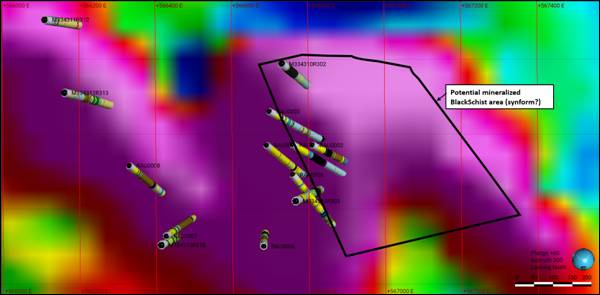
· Confirmed synformal structure, indicating significant potential to the east and prompting the Company to extend the current permit area in that direction
R1 Hook Drilling Programme
The objectives of the programme were to confirm the structure and its potential to host Talvivaara-type Ni-Cu-Co-Zn mineralisation. Talvivaara is one of Europe's largest and lowest-cost producers of critical battery metals, located 63km to the north of this target.
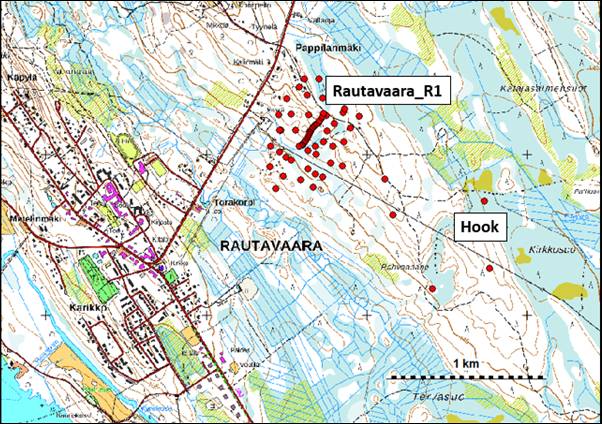
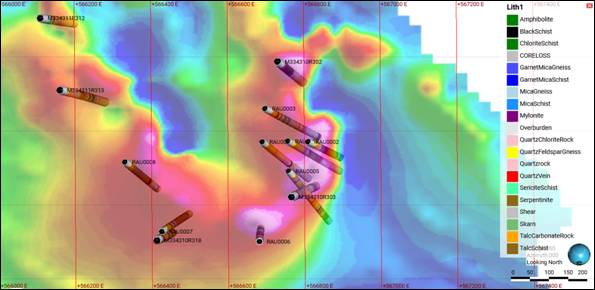
A total of 1,551.2m were drilled along what, according to ground and airborne geophysical surveys, appeared to be a fold structure to the east of the Company's R1 Resource.
All drillholes intercepted mineralised black schists, with the best thickness and grades intersected on the eastern limb of the main R1 Hook fold. This observation, together with confirmation of the synformal nature of the limb, dipping steeply to the south, suggests significant potential for further mineralisation to the east, beyond the boundary of the Company's existing permit. The Company has lodged a reservation to secure this area, known as Kirkkosuo, with the intention of confirming the extension of the structure and mineralisation with a limited diamond drill programme to follow in due course.
Metals One continues to update its prospectivity model with the valuable geophysical and petrophysical insights into the nature of mineralised black schists gathered during this programme.
Jonathan Owen, Chief Executive Officer of Metals One, commented:
"Leveraging new and historical insights and data, the Metals One team is pleased to identify this economically important Talvivaara style of mineralisation. The resulting prospectivity model developed by the team significantly reduces discovery risk as we continue to target high-quality critical battery metal resources across the Kainuu Schist Belt.
I would like to thank our exploration team for the perfect execution of the drilling programme, which we delivered on schedule, on budget, and with the close support of the local Rautavaara community.
I look forward with excitement to the further development of our R1 Resource, and its potential extension to the east through the R1 Hook and beyond."
Enquiries:
Metals One Plc Jonathan Owen, Chief Executive Officer Daniel Maling, Chief Financial Officer | via Vigo Consulting +44 (0)20 7390 0234 |
Beaumont Cornish Limited (Nominated Adviser) James Biddle / Roland Cornish | +44 (0)20 7628 3396 |
Shard Capital Partners LLP (Joint Broker) Damon Heath / Erik Woolgar | +44 (0)20 7186 9952 |
SI Capital Limited (Joint Broker) Nick Emerson | +44 (0)14 8341 3500 |
Fortified Securities (Joint Broker) Guy Wheatley, CFA | +44 (0)20 3411 7773 |
Vigo Consulting (Investor Relations) Ben Simons / Kendall Hill | +44 (0)20 7390 0234 |
About Metals One
Metals One is developing brownfield battery metals projects in Finland (Black Schist Project) and Norway (SRH Råna Project), with approximately £9 million of exploration carry exposure through farm-in agreements. Metals One is aiming to help meet the significant demand for battery metals by defining resources on the doorstep of Europe's major electric vehicle OEMs and battery manufacturers. Metals One's Black Schist Project in Finland, totalling 706 km2 across three licence areas, has an Inferred Resource of 28.1 Mt nickel-zinc-cobalt-copper and is located adjacent to Talvivaara, Europe's largest operating nickel mine. Metals One's fully carried SRH Råna Project in Norway covers 18.14 km² across three contiguous exploration licences, with significant opportunity for brownfield exploration of the Råna intrusion, and proven potential for massive sulphide nickel-cobalt-copper mineralisation.
Follow us on social media:
LinkedIn: https://www.linkedin.com/company/metals-one-plc/
Twitter: https://twitter.com/metals_one_PLC/
Subscribe to our news alert service on the Investors page of our website at: www.metals-one.com
Qualified Person Statement
Craig Moulton is an Independent Non-Executive Director of the Company and the Qualified Person who reviewed and approved the technical disclosures in this news release. Mr Moulton has over 30 years' experience in the mining industry, having worked for Rio Tinto, Cliffs and Wood Mackenzie, and is a trained Geologist and Mineral Economist. Mr Moulton holds a BSc (Hons) in Geology and a MSc in Mineral Economics and is a qualified person under the AIM Rules. Mr Moulton consents to the inclusion of the technical information in this release and context in which it appears.
Nominated Adviser
Beaumont Cornish Limited ("Beaumont Cornish") is the Company's Nominated Adviser and is authorised and regulated by the FCA. Beaumont Cornish's responsibilities as the Company's Nominated Adviser, including a responsibility to advise and guide the Company on its responsibilities under the AIM Rules for Companies and AIM Rules for Nominated Advisers, are owed solely to the London Stock Exchange. Beaumont Cornish is not acting for and will not be responsible to any other persons for providing protections afforded to customers of Beaumont Cornish nor for advising them in relation to the proposed arrangements described in this announcement or any matter referred to in it.
Table 1: Significant drill intersections (all depths are from surface)
Hole | From, m | To, m | Int, m | Co% | Cu% | Ni% | Zn% | Cutoff % |
RAU0001 | 106.50 | 122.00 | 15.50 | 0.01 | 0.09 | 0.13 | 0.36 | 0.1% Ni |
RAU0002 | 50.00 | 64.70 | 14.70 | 0.01 | 0.11 | 0.18 | 0.57 | 0.1% Ni |
RAU0003 | 199.50 | 210.50 | 11.00 | 0.01 | 0.10 | 0.22 | 0.55 | 0.1% Ni |
RAU0004 | 129.13 | 136.10 | 6.97 | 0.01 | 0.09 | 0.16 | 0.42 | 0.1% Ni |
RAU0005 | 144.30 | 148.00 | 3.70 | 0.01 | 0.08 | 0.13 | 0.40 | 0.1% Ni |
RAU0005 | 156.76 | 159.50 | 2.74 | 0.01 | 0.06 | 0.13 | 0.25 | 0.1% Ni |
RAU0006 | 120.00 | 122.20 | 2.20 | 0.01 | 0.04 | 0.13 | 0.03 | 0.1% Ni |
RAU0006 | 148.60 | 151.70 | 3.10 | 0.01 | 0.00 | 0.18 | 0.05 | 0.1% Ni |
RAU0008 | 108.86 | 115.50 | 6.64 | 0.01 | 0.07 | 0.16 | 0.24 | 0.1% Ni |
Glossary
Co | Cobalt |
Cu | Copper |
km | Kilometres |
magnetic survey | Geophysical survey method which identifies magnetic minerals |
massive sulphide | Metal sulphide ore deposit which consists almost entirely of sulphides |
m | Metres |
Ni | Nickel |
Resource | Metals One's existing Inferred Mineral Resource at the Black Schist Project of 28.1 Mt of Talvivaara-style mineralised material at a grade of 0.19% Ni (53,800t), 0.10% Cu (27,900t), 0.01% Co (3,400t) and 0.38% Zn (180,000t). Refer to the Company's admission document here for further information |
Zn | Zinc |
JORC Code, 2012 Edition - Table 1 report template
Section 1 Sampling Techniques and Data
(Criteria in this section apply to all succeeding sections.)
Criteria | JORC Code explanation | Commentary |
Sampling techniques | · Nature and quality of sampling (e.g. cut channels, random chips, or specific specialised industry standard measurement tools appropriate to the minerals under investigation, such as down hole gamma sondes, or handheld XRF instruments, etc). These examples should not be taken as limiting the broad meaning of sampling. · Include reference to measures taken to ensure sample representation and the appropriate calibration of any measurement tools or systems used. · Aspects of the determination of mineralisation that are Material to the Public Report. · In cases where 'industry standard' work has been done this would be relatively simple (eg 'reverse circulation drilling was used to obtain 1 m samples from which 3 kg was pulverised to produce a 30 g charge for fire assay'). In other cases, more explanation may be required, such as where there is coarse gold that has inherent sampling problems. Unusual commodities or mineralisation types (eg submarine nodules) may warrant disclosure of detailed information. | · A total of 8 diamond drillholes for 1551,2 m were completed. · Drill core was placed in order in wooden trays, with depth marker blocks at the drilling location. Trays were transported to Metals One Finland's core shed in Outokumpu where they were stored inside the secure shed for geological and geotechnical logging, mark-up for sampling and digital photography. · All samples retrieved are from diamond drill cores that have been cut longitudinally in half according to lithological and mineralisation intervals and prepared for assaying. The samples are predominantly 1 m in length. · All samples were submitted to ALS-Geochemistry Oy in Outokumpu, Finland for assaying. · A prepared sample (0.25 g) was digested with perchloric, nitric, hydrofluoric, and hydrochloric acids. The residue was leached with dilute hydrochloric acid and diluted to volume. The resulting solution was analysed by a combination of inductively coupled plasma-atomic emission spectrometry (ICP-AES) and inductively coupled plasma-mass spectrometry with results corrected for spectral or isotopic interferences. · Also assaying for gold was made by using Fire Assay Fusion (FA-FUSPG1 & FA-FUSPG2) and Inductively Couple Plasma - Atomic Emission Spectrometry (ICP-AES) |
Drilling techniques | · Drill type (e.g. core, reverse circulation, open-hole hammer, rotary air blast, auger, Bangka, sonic, etc) and details (e.g. core diameter, triple or standard tube, depth of diamond tails, face-sampling bit or other type, whether core is oriented and if so, by what method, etc). | · All drilling was made by diamond drilling, angled holes were planned and drilled. All the cores were drilled as WL76 (core 57.5 mm diameter). · Orientation markings on every core run. |
Drill sample recovery | · Method of recording and assessing core and chip sample recoveries and results assessed. · Measures taken to maximise sample recovery and ensure representative nature of the samples. · Whether a relationship exists between sample recovery and grade and whether sample bias may have occurred due to preferential loss/gain of fine/coarse material. | · Core recovery was calculated on a per drill-run basis (maximum 3 m). Core recovery averaged 95%, ranging from 0% to 100%. Only 96 intervals did not have a recovery of 100%, |
Logging | · Whether core and chip samples have been geologically and geotechnically logged to a level of detail to support appropriate Mineral Resource estimation, mining studies and metallurgical studies. · Whether logging is qualitative or quantitative in nature. Core (or costean, channel, etc) photography. · The total length and percentage of the relevant intersections logged. | · Drill core was logged in detail for lithology, alteration, mineralisation, geological structure, by geologists, utilising standardised logging codes and data sheets as supervised by the senior geologist. · Rock Quality Designation (RQD) logs were produced for all core drilling for geotechnical purposes. Fracture intensity and fragmentation proportion analysis was also gathered for geotechnical information. · Logging was both quantitative and qualitative in nature. All core was photographed in the core boxes to show the core box number, core run markers and a scale. |
Sub-sampling techniques and sample preparation | · If core, whether cut or sawn and whether quarter, half or all core taken. · If non-core, whether riffled, tube sampled, rotary split, etc and whether sampled wet or dry. · For all sample types, the nature, quality and appropriateness of the sample preparation technique. · Quality control procedures adopted for all sub-sampling stages to maximise representation of samples. · Measures taken to ensure that the sampling is representative of the in-situ material collected, including for instance results for field duplicate/second-half sampling. · Whether sample sizes are appropriate to the grain size of the material being sampled. | · Full core was split longitudinally using a rock diamond saw to create half-core samples that were taken at typically 1 m intervals or to rock contacts if present in the core run for both mineralization and wall rock. The drill core was rotated prior to cutting to maximise structure to core axis of the cut core. · Half core was taken for sampling for assaying, and one half remains in the core box as reference material. · Core samples were prepared according to industry best practice, with initial geological control of the half core, followed by crushing and grinding at the laboratory sample preparation facility that is routinely managed for contamination and cleanliness control. Sampling practice is considered as appropriate for Mineral Resource Estimation. · Blanks, duplicates and certified reference materials were inserted into the sample stream at a rate of 1 blank and standard for every 20 samples. · Sample sizes are considered appropriate to the grain size of the rocks and style of mineralization being sampled. |
Quality of assay data and laboratory tests | · The nature, quality and appropriateness of the assaying and laboratory procedures used and whether the technique is considered partial or total. · For geophysical tools, spectrometers, handheld XRF instruments, etc, the parameters used in determining the analysis including instrument make and model, reading times, calibrations factors applied and their derivation, etc. · Nature of quality control procedures adopted (e.g. standards, blanks, duplicates, external laboratory checks) and whether acceptable levels of accuracy (i.e. lack of bias) and precision have been established. | · Gold assaying was conducted by ALS-laboratories. · Assaying for Ni, Cu, Co and Zn was conducted by ALS-laboratories. · Each sample was geochemically analysed for the following suite of elements: Ag, Al, As, Ba, Be, Bi, Ca, Cd, Ce, Co, Cr, Cs, Cu, Fe, Ga, Ge, Hf, In, K, La, Li, Mg, Mn, Mo, Na, Nb, Ni, P, Pb, Rb, Re, S, Sb, Sc, Se, Sn, Sr, Ta, Te, Th, Ti, Tl, U, V, W, Y, Zn, Zr. · A variety of AMIS CRMs have been used for quality control purposes for all assaying methods. In addition, blanks and pulp duplicates have been assayed to assess the accuracy, repeatability, consistency of analytical methods and machines and for sample contamination. |
Verification of sampling and assaying | · The verification of significant intersections by either independent or alternative company personnel. · The use of twinned holes. · Documentation of primary data, data entry procedures, data verification, data storage (physical and electronic) protocols. · Discuss any adjustment to assay data. | · Significant intersections were verified by a number of company personnel within the management structure of the Exploration team. Intersections were defined by the exploration geologists, and subsequently verified by the Exploration Manager. · Metals One Finland uses Leapfrog GEO and Imago software for data entry, verification, quality control, logging data and core photography. The data is stored on the cloud and is also saved and stored in MS Excel and MS Access software on Metals One Finland´s internal data drives as a backup and for use in geological modelling software. · Data entry is supervised by a data manager, and verification and checking procedures are in place. The format of the data is appropriate for use in resource estimation |
Location of data points | · Accuracy and quality of surveys used to locate drill holes (collar and down-hole surveys), trenches, mine workings and other locations used in Mineral Resource estimation. · Specification of the grid system used. · Quality and adequacy of topographic control. | · Drillhole collars were laid out using handheld global positioning system (GPS). The rigs were aligned with survey control, or by compass. · A gyroscopic survey instrument (Devicore) was utilised by Northdrill Oy during the course of the Rautavaara R1 Hook surface drill programs. |
Data spacing and distribution | · Data spacing for reporting of Exploration Results. · Whether the data spacing, and distribution is sufficient to establish the degree of geological and grade continuity appropriate for the Mineral Resource and Ore Reserve estimation procedure(s) and classifications applied. · Whether sample compositing has been applied. | · Average drillhole density at the Rautavaara R1 Hook target is variably spaced dependent on the exploration target characteristics. · No Mineral Resource or Ore Reserve estimations are being reported. |
Orientation of data in relation to geological structure | · Whether the orientation of sampling achieves unbiased sampling of possible structures and the extent to which this is known, considering the deposit type. · If the relationship between the drilling orientation and the orientation of key mineralised structures is considered to have introduced a sampling bias, this should be assessed and reported if material. | · Diamond drillholes were oriented, wherever possible, perpendicular to the mineralized structures. |
Sample security | · The measures taken to ensure sample security. | · The drilling site is supervised by a Supervising Geologist, the drill core is placed into wooden core boxes that are sized specifically for the drill core diameter. A wooden lid is fixed to the box to ensure no spillage. Core box number, drill hole number and from/to meters are written on both the box and the lid. The core is then transported to the core storage area and logging facility, where it is received and logged into a data sheet. Core logging, and sampling takes place at the secure core management area. The core samples are marked with labels both in and on the core boxes, and data recorded on a sample sheet. The samples are transferred to the laboratory where they are registered as received, for laboratory sample preparation works and assaying. Hence, a chain of custody procedure has been followed from core collection to assaying and storage of pulp/remnant sample material. · All samples received at the core facility are logged and registered on a certificate sheet. The certificate sheet is signed by core facility supervisor (responsible person). All core is photographed, geotechnical logging, geological logging, sample interval determination, bulk density testing, and sample preparation. · For external assaying, Metals One Finland Oy utilises ALS-Geochemistry Oy in Outokumpu, Finland. |
Audits or reviews | · The results of any audits or reviews of sampling techniques and data. | · Ther have been no audits of drilling sampling techniques and data. |
Section 2 Reporting of Exploration Results
(Criteria listed in the preceding section also apply to this section.)
Criteria | JORC Code explanation | Commentary |
Mineral tenement and land tenure status | · Type, reference name/number, location and ownership including agreements or material issues with third parties such as joint ventures, partnerships, overriding royalties, native title interests, historical sites, wilderness or national park and environmental settings. · The security of the tenure held at the time of reporting along with any known impediments to obtaining a licence to operate in the area. | · Rauta 9-11 (ML2012:0169) are a extension to existing exploration permit and the applications have been lodged under Metals One Finland Oy. · Under Finnish legislation and in relation an Exploration Permit, as stipulated in the permit's conditions, the permit holder has the right to conduct geological surveying and other exploration works necessary for establishing the location, shape, orientation and exploitability of a mineral deposit. The extent of measures depends on the permit stipulations imposed by the Mining Authority and the measures may be undertaken without the landowner's permit, i.e. the exploration permit replaces landowner permissions. The permit stipulations may allow invasive drilling or test mining. The initial term is a maximum of four years, extensions applicable three years at a time to the cap of 15 years (4+3+3+3+2). "Claims" under the 1965 Mining Act correspond to exploration permits under the 2011 Mining Act which was renewed in 2023 (505/2023). The main difference between claims and exploration permits is that claims are initially valid for five years instead of four. Thus, considering transitional provisions in the 2011 Mining Act, claims are valid for 5+3+3+3+1 years. An exploration permit application in itself does not entitle the applicant to conduct exploration activities. However, exploration can be conducted with a landowner consent already. |
Exploration done by other parties | · Acknowledgment and appraisal of exploration by other parties. | · Two phases of exploratory drilling have been completed at Rautavaara. The GTK completed five diamond drillholes in 1979 totalling 879 m, and FinnAust Mining Oy has subsequently completed 43 drillholes totalling a further 5,425 m. · Between 2006 and 2008, Magnus Minerals (Magnus), a privately held Finnish exploration company, carried out a review and interpretation of publicly available airborne geophysics, regional geology and historical exploration data, in the Kainuu Schist Belt and Outokumpu-Savonranta Belt, central and southern Finland. · During 2009 and 2010, close-spaced ground magnetic data was acquired, and several phases of surface diamond drilling were undertaken with an Onram 1000/three rubber-tracked rig operated by SMOY. Six diamond holes were drilled between September 2009 and January 2010. |
Geology | · Deposit type, geological setting and style of mineralisation. | · The Kainuu Schist Belt is represented by remnants of rocks deposited into an oceanic volcano-sedimentary rift basin which developed from Early to Mid-Proterozoic the Archaean crustal Karelian Craton Boundary. It is mostly represented by basal siliceous rocks (interpreted as quartzites) and minor mafic volcanics, metalliferous black schists, wackes with intercalated calcsilicate rocks, ophiolitic ultramafic rocks, and minor serpentinite. · The Rautavaara Project is hosted within remnants of the southern Kainuu Schist Belt (Early Proterozoic) which consists mainly of quartzites, mica schists and black schists resting paraconformably on the Archean basement gneiss complex. The black schists are variably recrystallized carbon and sulphide-rich black metasediments. · The nickel-zinc-copper-cobalt mineralisation is stratabound, hosted within the high-grade metamorphosed and intensely folded black schist. The main mineral assemblage in the black schist is quartz, mica, graphite, and sulphides. · The origin of the black schist mineralisation is postulated to be a result of metal precipitation under a specific set of local conditions unique to that margin at the time of deposition. It is generally accepted that the black shales represent organic carbon-rich muds accumulated under anoxic and sulphidic conditions, and that the metals were derived by direct precipitation from the seawater column, settling out to the ocean floor onto the water-sediment interface. It seems that only the very uppermost part of the basinal water column was oxygenated. · Pyrite and pyrrhotite are the dominant sulphide minerals within the black schist deposits at Rautavaara, similar to the Talvivaara deposit. The sulphidic nickel-zinc-copper-cobalt deposits are hosted by highly sulphidic-graphitic muds and turbiditic wackes; which have undergone a high degree (amphibolite facies) of metamorphism. |
Drill hole Information | · A summary of all information material to the understanding of the exploration results including a tabulation of the following information for all Material drill holes: o easting and northing of the drill hole collar o elevation or RL (Reduced Level - elevation above sea level in metres) of the drill hole collar o dip and azimuth of the hole. o down hole length and interception depth o hole length. · If the exclusion of this information is justified on the basis that the information is not Material and this exclusion does not detract from the understanding of the report, the Competent Person should clearly explain why this is the case. | · The first phase of holes drilled were all angled between 45 and 60 deg. · All holes drilled, their collar co-ordinates azimuth, dip and final depths are tabulated below. 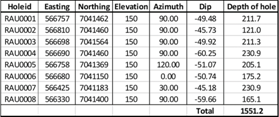 |
Data aggregation methods | · In reporting Exploration Results, weighting averaging techniques, maximum and/or minimum grade truncations (e.g. cutting of high grades) and cut-off grades are usually Material and should be stated. · Where aggregate intercepts incorporate short lengths of high-grade results and longer lengths of low-grade results, the procedure used for such aggregation should be stated and some typical examples of such aggregations should be shown in detail. · The assumptions used for any reporting of metal equivalent values should be clearly stated. | · Significant intercepts are reported using a cut off of 0.10% nickel. |
Relationship between mineralisation widths and intercept lengths | · These relationships are particularly important in the reporting of Exploration Results. · If the geometry of the mineralisation with respect to the drill hole angle is known, its nature should be reported. · If it is not known and only the down hole lengths are reported, there should be a clear statement to this effect (e.g. 'down hole length, true width not known'). | · All intercepts are reported as down-hole lengths |
Diagrams | · Appropriate maps and sections (with scales) and tabulations of intercepts should be included for any significant discovery being reported These should include, but not be limited to a plan view of drill hole collar locations and appropriate sectional views. | · Maps and sections are provided in the report |
Other substantive exploration data | · Other exploration data, if meaningful and material, should be reported including (but not limited to): geological observations; geophysical survey results; geochemical survey results; bulk samples - size and method of treatment; metallurgical test results; bulk density, groundwater, geotechnical and rock characteristics; potential deleterious or contaminating substances. | · A considerable amount of aerial and ground geophysical data has been collected. |