Replay available
Yatharth Hospital and Trauma Care Services (NSE:YATHARTH) Q1 2027 Earnings Call
Yatharth Hospital and Trauma Care Services (NSE:YATHARTH) Q1 2027 earnings call, held 2026-08-11. Watch the replay and read the transcript on 6ix.
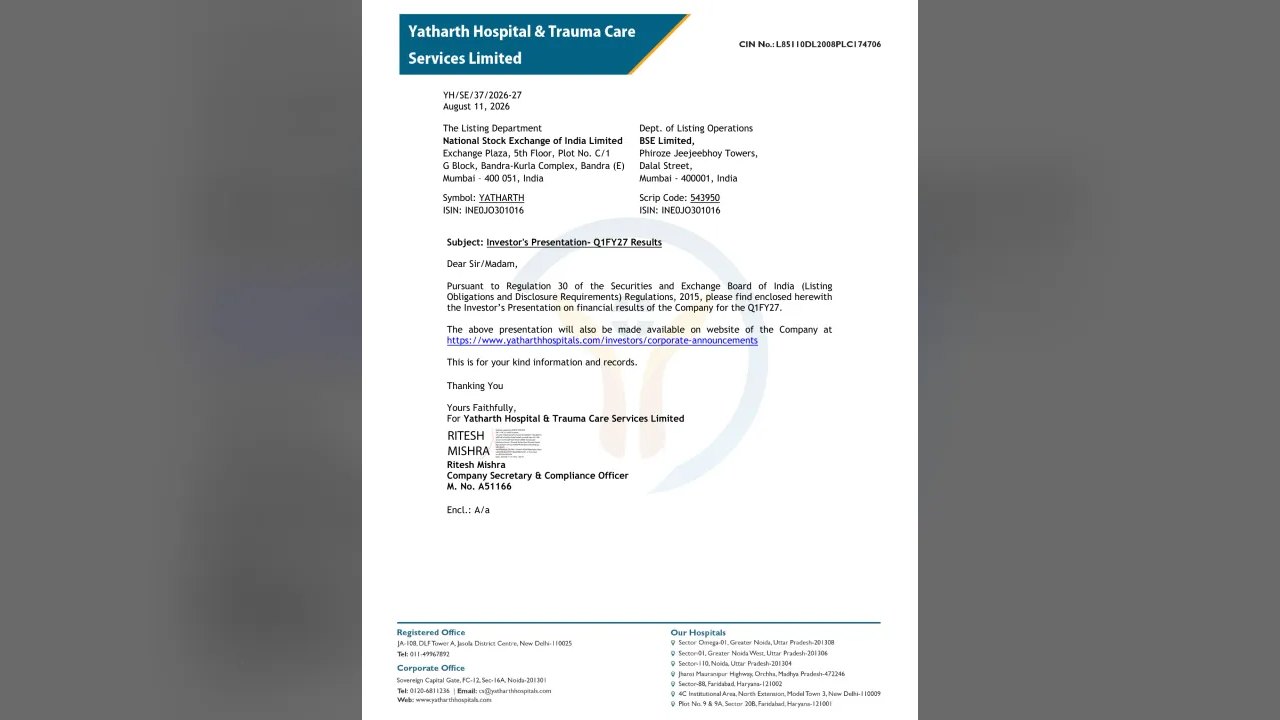
- Company
- Yatharth Hospital and Trauma Care Services Limited (NSE:YATHARTH)
- Period
- Q1 2027 earnings call
- Date
- Tue, Aug 11, 2026, 7:16 AM ET
- Replay
- Watch the replay on this page · 1 h 2 min
On 6ix: 6ix.com/event/yatharth-hospital-and-trauma-care-services-limited-yatharth-q1-2027-earnings-call
Replay
Transcript
Automated transcript · Written by software from the replay's audio. It can mishear names and figures; the replay is the record.
0:00 Ladies and gentlemen, good day, and welcome to Yatharth Hospital and Trauma Care Services Limited q one f y twenty seven earnings call. As a reminder, all participant lines will be in listen only mode, and there will be an opportunity for you to ask questions after the presentation concludes. Should you need assistance during this conference call, please signal an operator by pressing star then 0 on your touch tone phone. Please note that this conference is being recorded. I now hand the conference over to Mr. Vishal Manchanda. Thank you, and over to you, sir. Thank you, Yatharth. Good morning, everyone. On behalf of Systematics Institutional Equities, we welcome you all to the Q1 FY twenty seven earnings call of Yatharth Hospital and Trauma Care Services Limited.
0:47 We have it as a senior management of the company represented by Mr. Yatharth Tyagi, full time director Mr. Amit Kumar Singh, group chief executive officer Mr. Nitin Gupta, president finance and group chief operating officer Mr. Pankaj Prabhakar, group chief financial officer Mr. Ashutosh Kumar Jha, group chief strategy, M and A and Investor Relations. This is Anu Goyal, Group Chief Financial Controller. I now hand over the call to the Yatharth management for opening remarks. Over to you, sir. Hi, Yatharth. Yatharth. Good morning, and welcome to Yatharth Hospital and Trauma Care Services Limited's earning conference call for the quarter ended 06/30/2026.
1:32 Joining me today are mister Amit Singh, our group CEO mister Pankaj, group CFO mister Nitin, group COO and president finance and mister Ashutosh, group chief strategy, M and A and IR as well as mister Sonu Goel, group financial controller. Our earnings presentation has been uploaded on the stock exchanges and on our website, and we hope you have had the opportunity to review it. I'm pleased to report a strong start of FY twenty seven. We delivered our highest ever quarterly revenue and profits this quarter. More encouragingly, we achieved a record revenue growth of 51% year on year and an EBITDA growth of 59% year on year. This performance is a testament to the growth strategy we have been pursuing over the past several quarters.
2:22 Our newer hospitals at Greater Faridabad, New Delhi, Faridabad Sector Twenty, and Agra collectively contributed 27% to the mix this quarter. Especially our acquisition playbook has delivered signs of early success. A key highlight was our Faridabad sector twenty hospital turning EBITDA breakeven within a record period of nine months. The hospital is now contributing to a monthly revenue rate of rupees 12 to 13 crores with an ARPU of closer to rupees 40,000 and the potential to reach rupees 45 to 50,000 as we move ahead. Our New Delhi hospital has already approached the rupees 50,000 R Pop mark, positioning us among the premium hospitals in NCR.
3:11 The hospital is currently operating at a monthly revenue run rate of 8 crores. Importantly, the revenue mix at both these hospitals is 90% plus cash and private insurance patients. Our Agra Hospital, which was integrated last quarter, achieved a revenue run rate of 9 to 10 crores and delivered a strong 20% plus EBITDA within its first full quarter of integration. The Gurugram construction is progressing as per expectations, and we expect the hospital to go live by quarter one of the next fiscal with the potential to achieve an ARPOP of rupees 50,000 plus. Our performance across these hospitals demonstrates the group's ability not only to identify and acquire good assets, but also to integrate and turn around their operations within a very short span of time.
4:10 Over past couple of quarters, our profitability has also improved meaningfully with operating leverage kicking in as reflected in our adjusted EBITDA margin, excluding the impact of New Delhi and Faridavad sector 20 stood at 28.1% this quarter. In recognition to the above performance, the board today approved a maiden interim dividend of 5% of face value for all our shareholders, ensuring that shareholders benefit from the growth and investments being done by the group. Behind this execution is a significant effort by the entire organization. In reward to this effort by our people, we have also approved our first ESOP grant and launched a new ESOP scheme 2026 to attract, retain, and align quality talent.
5:07 These are meaningful steps for us, reflecting our confidence in the business that we are building and a commitment to sharing the value created with both our shareholders and our people. We're also in the process of identifying ESG priorities across our network of hospitals with the objective of building a more sustainable and future ready organization. Our focus on strengthening our international collaborations continued this quarter, expanding our global outreach. We opened the Yatharth Information Center in Uzbekistan, and I've also leveraged our partnerships with health care institutions as well as undertook many open initiatives across key markets across Asia, Africa, and Middle East.
5:56 With the infrastructure built over the last twelve months, we have expanded our network to 2,555 beds, setting the foundation for record growth this year. Looking ahead, we remain committed to a road map of doubling our bed capacity to 5,000 beds target over the next few years. The upcoming two fifty bedded Gurugram facility expected to commence operations by q one of next fiscal will further strengthen our positioning in the premium NCR market and add another high potential platform to the network. The opportunity now is to fill these beds, improve utilization, and allow earnings to catch up with the capacity we have created.
6:42 Overall, we believe Yatharth is entering an exciting phase. We are continuously expanding capacity. Our specialty and payer mix is continuously improving, and we have substantially installed capacity to utilize driver... A stronger cash generation in the years ahead. With that, I shall hand over the call to our CFO, Pankaj, for further updates. Good morning, everyone. I will take you through the financial performance for quarter one FY twenty seven and the key drivers behind the quarter. The group reported its highest ever quarterly revenue of 3,207 million, up 51 year over year and 15% quarter over quarter.
7:34 Our existing three hospital in Noida and Khasi, Odisha collectively contributed 2,862 million, growing 22% year over year. Our existing hospital occupancy reached approximately 75% as in patient volume improved 15% year over year. As far as hospital wide occupancy is concerned, Noida and Jhansihotra Hospital achieved 90% plus occupancy. Greater Noida Hospital is currently operating at 74%, while Noida Extension stood at 56%. We expect occupancy level at Greater Noida and Noida extension to improve further in coming quarter.
8:26 The Newell Hospital at Greater Faridabad, New Delhi, Faridabad Sector 20, and Agra collectively contributed 1,067 million in revenue, accounting for 27% to the group's revenue. This shift in revenue mix reflects the rapid scaling of our newer capacity alongside continued growth for our established base. The group's ARPA reached an all time high of rupees $34,007.58 in quarter one, up 7% year on year. Importantly, our premium MCR hospitals at Noida Extension and New Delhi crossed rupees $4,050,000 ARPU mark for the first time in quarter one.
9:19 Which is a strong indication of the improving case mix. This was followed by Greater Noida, which achieved an ARPU of rupees 43,000. Faridabad sector 20 approaching rupees 40,000. Greater Faridabad and Noida at 45,000, and Agra closer to 30,000. This performance is largely driven by the benefit of a stronger specialty mix across our network. We are continuing to invest in advanced clinical capabilities and infrastructure as we believe deeper specialty capabilities are essential to building a differentiated differentiated hospital network and improving the quality of our revenue over time.
10:17 Oncology has already started contributing close to 10% to the group's revenue with only one line neck machine currently at Noida Extension Hospital. We are in the process of adding another line neck at our Faridavad sector twenty hospital soon, followed by the New Delhi facility, which will meaningfully strengthen the on closing share at the group level in the coming year. With newer hospitals demonstrating higher ARPORB level, we expect a meaningful uplift in overall group's realization as these opportunities continue to scale up. EBITDA for the quarter was highest ever at 917,000,000 with cash stood at rupees $454,000,000, while the consolidated EBITDA stood at 23.3%.
11:15 The adjusted EBITDA margin, excluding the impact of New Delhi and Haridawarth Sector 20 stood at 28.1%. With newer hospitals progressively moving up, the profitability count at Agna delivers at 20% plus EBITDA margin, while Arilawarth sector twenty achieves EBITDA breakeven in q one. We expect our blended EBITDA margin to improve from the current level. The increase in depreciation and finance cost have been following the significant capacity addition made over the past twelve months. Despite which, our cash profit, which is staff plus depreciation, increased significantly by 32% year on year, largely reflecting a non cash impact on the cat growth.
12:12 With the upcoming Gurugram facility and brownfield expansion plant at Noida Extension and Greater Noida, our total bed capacity will reach over 3,200 beds. We remain confident of achieving our target of 5,000 beds over the next five years. FY twenty seven has started a strong note, and the early success of our our newer facilities gives us a confidence in sustaining this momentum. Thank you for your attention. I would now like to hand over the call to the moderator for question and answer session. Thank you. Thank you very much. We will now begin with the question and answer session.
13:00 Anyone who wishes to ask a question may press star and one on their touch tone telephone. If you wish to remove yourself from the question queue, you may press star and 2. Participants are requested to use handsets while asking a question. Ladies and gentlemen, we wait for a moment while the question queue assembles. Participants are requested to restrict their questions to two questions per participant. We have the first question from the line of Subhi Gupta from Tirinetra Asset Managers. My first question is that in the PPT, it's mentioned 5,000 beds target by three years. And you just mentioned five years. Is it three or five?
13:53 Also, second part of that question, we have, like, one big cluster, which is Haryana and Delhi, and second would be UP and MP. So are we targeting any more cluster, another cluster to add, or are we going to add beds in this cluster only? So I think, yes, definitely, the road map ahead is to, you know, double up the capacity. In fact, our announced capacity, which includes the Gurugram and the Grandfield expansions at Great North And North extension, is, you know, already upwards of 3,200 beds. So so from there, if you look at the 5,000 bit capacity, we feel that, you know, we would be even reaching it much earlier than the three years announced target. This would be primarily, you know, within the North, you know, the cluster that you mentioned. Yes. But, you know, we are also evaluating different clusters. One thing that, you know, we have done in the past, we have usually formed the clusters. So it's not a standalone independent assets. You know, we have have gone...
14:55 We have also leveraged the benefits by, you know, adding assets within that surrounding similar to what we have done here. So I think even, you know, we feel Gurugram is still, you know, a huge cluster for us to further explore and, you know, a new cluster, obviously, you know, within within the North, we identify... I think UP has certain cities where a good cluster can be formed. So I think we would still stick to the areas we very well understand, which is the North, the Delhi NCR, and the metro cities in the in the states that we operate in. And these will all be higher average bed pay. Right? Yes. So our would be much higher than the group average. In fact, the newest hospitals which we are doing, you know, is already clocking close to 50,000 rupees.
15:43 So so that that... That's clearly the strategy even going forward. No. Will will it be more than 50 k or mostly 50 k? Around around 50,000. Okay. Just my second question quickly. So we are focusing on improving payer mix. So I think we're focusing on international mix as well. So if you could just talk about a bit on that and what kind of benefit are we expecting to get from that? Like, if you could just quantify on this. Yeah. So, yes, definitely, we are working on how to improve the pair mix. And that's the reason if you see, in fact, there's a deep of, you know, two percentage in all actions and occupancy. This is a totally expert expected in because we wanted to restrict the, you know, government business.
16:36 And that's our thought process. Yes. International is concerned. That's the the various activities we are planning. In fact, this quarter, I think five opening centers... I mean, the information centers we are planning in the biggest countries like the CIS or a a a certain country. We have posted our senior marketing person also in in African regions. I think that's... They started showing the trends and and believe that I think this will help in a in a better business as well as, you know, the IPO as well. Even the new hospitals, you know, both the New Delhi model town and Sector 20 already is... Are displaying this playbook. You know? These hospitals are close to 90% cash and private insurance business. So we are able to demonstrate it.
17:22 You know?, we are glad that it has break even much before our target, but the way it has breakeven is also with less than 10% government business. So I think that the playbook is clearly evident, and it's being reflected in all the new hospitals. And as the volumes of these two hospitals continue to grow, significant changes will also be visible at the group level payer mix. Okay, sir. Thank you so much. Thank you. The next question comes from the line of from Seven Rivers Holding. Please go ahead. Hello, sir. Am I audible? Yes. Please go ahead. Yeah. So so my first question was on the... Your hostel in Delhi and.
18:09 What we've been seeing is the last, you know, two, three quarters, the occupancy has kind of stagnated around a similar area. I mean, when can we kind of see that occupancy go up in these in these hospitals? And what is the status of government and insurance entitlements for these hospitals? So I think occupancy is not stagnant... Significantly increased. The reason, you know, why you see the numbers is because the occupancy is counted on different bed capacity. You know, earlier, not all the beds were operational. The... So now quarter on quarter, we are increasing the capacity, and that's where the occupancy is being counted upon. So the IPD volumes occupancy is definitely increasing. That's the reason why the revenue is quarter on quarter increasing there.
18:55 As far as the impairment is concerned, I think a lot of impairments are already completed in these two hospitals. So it's not that, you know, we're waiting for government impairments and only that's why the government business is low. Even though we have majority of the government impairments already, you know, we are sticking to our playbook of not increasing the government pay in these hospitals. And, you know, if specific numbers, if you can tell them about the occupancy and the beds counted in Pridwan different to what we were counting last quarter. So if you see about it in the Delhi, the sensors bed is one fifty on which the competency has been counted in this quarter as compared to the 100 beds in the last quarter. So that's the thing we are... The overall percentage is impacting in that manner. However, the sensors bag at the new Prilhapad Hospital has been increased from 100 bag to 100 sensors bag. So that's the overall thing that that we have added one sixty bag, a new sensors bag in this occupancy accounting in this quarter.
19:57 Okay. And my second question was on the on the Delhi Hospital overall. So we started the hospital around three, four months before we did the hospital. And if you see after almost a year, so that hospital in terms of scale up, in terms of in terms of occupancy, you know, has been kind of slower than the Faridabad Hospital. So what is the strategy there to kind of achieve breakeven and then kind of, you know, grow from there? So I think Delhi hospital model down is as per our guidance. We are quite happy with the way it is progressing. In fact, you know, it's not that, you know, the numbers are slow there. It's just that Faridabad twenty has overperformed than our expectations. We were thinking of Faridabad Sector 20 to be breaking around twelve to fourteen months, but it has broken even earlier than we expected around nine months. Right?
20:48 As far as Delhi is concerned, we are sticking to our guidance. We expected that hospital to break even around fifteen to, you know, seventeen months, and it will a 100%, you know, it's it's it's on track for that as concerned. So we're quite happy with the way Delhi is progressing. I think we're quite happy with the hard work and the monthly revenue run rate that it has reached. And the same strategy is that, you know, similar to what we're following in the we're following in New Delhi, which is, you know, having one of the most reputed doctors in that area, having star doctors, you know, having a strong brand recall and community connect in those areas with strong, you know, visibility within within the communities. So I think both hospitals are progressing the right track. Okay. So if I can ask one more question, sir. On the other hospital now, since you reached 90% occupancy, are we planning to operationalize the other sensors as well out of the two fifty beds?
21:42 Yeah. As of now, on two fifty bed capacity, we are running on the sensors of 110 beds. Yeah. And we are planning to the stage of increasing the consensus bed capacity to take the full leverage of the occupancy in the coming quarters. I think the census beds in Agra will definitely increase, and I think there is definitely much room headway for Aggra Hospital to grow in terms of the numbers are concerned. Okay. Thank you, sir. Thank you. The next question comes from the line of Nishita from Sapphire Capital. Please go ahead. Yes. Hello. So I just want to understand this 3,200 beds that we are targeting.
22:29 By when is this going to be operational? 3,200 beds is our known capacity. So, you know, what we mean by that is it's already under our position. Only a bit of construction is left. So it includes a two fifty beds in Gurugram, which will be live in the quarter one of the new financial year, and in... It includes around four fifty beds of brownfield addition in the two cluster hospitals, which will be live in, you know, somewhere around next fifteen months. Okay. So the cluster will be operational in next fifteen months? Yes. It will start getting operational. Maybe, you know, the four fifty, 200 beds would be earlier, and two fifty beds will be probably in eighteen to nineteen months. Okay. Okay. Understood. So that's...
23:18 This SIM is not... So what is our current capacity? It's, I think, 2,800. Right? So 2,800 capacity includes the new acquisition of the Gurva. As I said, that the... That has to be happened in quarter one in the next year. Okay. Okay. Understood. Yeah. And my next question is on... So we've had quite a good revenue growth in Q1 for 24, 51%. Do we expect this growth to continue? What sort of growth can we see for the full year FY 'twenty seven? So I think for the full year FY 'twenty seven, we are on track for the guidance that we've already you know, as far as not just revenue. I feel even the revenue, EBITDA, and the past numbers are what we're guiding for '27.
24:04 You know, we will be, you know, on track for that. And I think certain parameters, we will also, you know, if things continue in the ramp up is expected, I think we should be surpassing certain of our guided targets. So I think, you know, the company is on track to meet our guidance. Right. Can you reiterate the guidance? I'm actually attending the call from full time. So I think we have said that last year, we grew 37% Y o Y. As you can clearly see this year, we will easily surpass that growth even the EBITDA is concerned. I think company is on track close to upwards of 24%, you know, yearly EBITDA margin for the full FY '27 is concerned. And I think similar is the, you know, ARPU growth and the parameters.
24:53 Right. So our growth, we can expect around 10, 15%? I think nine to 10% is the right estimation to be taken. Okay. Understood. Yeah. Thank you so much. Thank you. The next question comes from the line of Prenita from Ready Stock Capital Limited. Please go ahead. Hi. Am I audible? Yes. Please go ahead. Yeah. So could you please walk me through how the quarterly revenues arrived from the ARPOP occupancy and bed count? When I back calculate using these three metrics for the last few quarters, I'm getting a number higher than the reported revenue. I just wanted to understand if there's a component that I'm missing in this calculation.
25:48 So if you see about this quarter with the ARPU of nearly 35,000 on the census rate of eighteen and twenty with the occupancy of 68%, you'll be able to arrive to these numbers. When we calculate the ARPU, it includes the total revenue, IPD as well as the OPT revenues. Would you not recommend doing it for every single hospital separately or just one for the complete chain of hospitals? So I can give you the occupancy percentage of each of the hospitals. If you see about it out, the NODA... Greater NODA Hospital having a occupancy of 74%. NODA one hundred and ten secondtor have a occupancy of 91%.
26:33 Great... NODA extension having occupancy of 56%. Sector 88, that is Greater Fiddad having occupancy of 63%. Sridhar Bharat New Hospital having occupancy of 49. Moralton Neji having occupancy of 29%. Aadha having occupancy of 89%, and Ransi has occupancy of 91%. But to emphasize here, the census wide capacity has been 1,820, which in the previous quarter was 655. So it has increased by one seventy five beds. However, we... As we said that there is a... Enough headroom to increase the sensor bed capacity to build up the case to 2,551 on the existing hospitals. Could you also highlight the ARPPUB of each of these hospitals, please?
27:19 Yeah. Surely. So Greater Noda Hospital having a ARPPUB of nearly 43,000. North Extension Hospital have a ARPPUB of more than 50,000. Noda Hospital having a ARPPUB of 35,000. Greater Pridhapad Hospital having a occupancy ARPOP of 35,000. New Pridhapad Hospital having the ARPOP of nearly 45... 40,000. Moradown having a ARPOP of nearly around 50,000. Agra having the ARPPUB of 27,000, and Jahansi Hospital having a ARPPUB of 13,000 nearly. Okay. So just to clarify, it would be better to look at all the hospitals together when we are calculating the ARPAB occupancy and bed count when we are calculating the revenue instead of each one of these hospitals. Is that correct?
28:16 Yeah. On on... Can we calculate the hospital occupancy as well as a percentage overall? The the drivers comes to the overall occupancy percentage, and with the blended ARPU, we calculate the kind of the performance of the at the blended level. Alright. Done. Thank you. Thank you so much. Thank you. The next question comes from the line of Ashish T from UTI. Excluding this model down in Faridabad, our EBITDA margins are pretty high at 28%. But obviously, including the losses, they are lower. When do you expect the new assets to fall in line and, you know, possibly when shall we start clocking 26, 27% EBITDA margin again?
29:11 I think if we talk about these two specific hospitals, as we said, like, 100 and is already broken even, but EBITDA drag is there. Right? Because I think the EBITDA margin there would be around four to 5%. So it will take, you know, some time to catch up to the, let's say, a 20% EBITDA margin. Model down, we are expecting it to breakeven, you know, somewhere around between of q three, q four this year. So that will also, you know, reduce the drag on the EBITDA. Both these two hospitals from here, you know, we are targeting, let's say, around fifteen months. Once they get breakeven is... You know, the EBITDA, there could be somewhere around 15 to 20%. However, at the group level, even though, you know, that will significantly reduce the drag, we might have new hospitals continuing to start.
29:59 You know? So in fifteen months, Gurgaon will also be live. So I think the EBITDA drive from these two hospitals will shift to Gurgaon as well as certain other acquisitions that we do going on. But, however, you know, as we said, these two specific hospitals will be in line within fifteen to eighteen months after the breakeven and at a group level, even with the new additions of the continuing EBITDA drag of all the upcoming new hospitals, you would still be, you know, closer to 24% of the EBITDA margins. Yeah. And and see about if you see the kind of a performance we have delivered and demonstrated at the Agra, when we bought and started the operation at the Agra, it's having a EBITDA percentage of 11% yearly. Now we are already reaching a much near to around 24%, 25%.
30:46 So that demonstrate the kind of a performance and turnover of the kind of a performance of our group. Sir... And and, obviously, we are adding new assets. We are planning to double the bid counts to 5,000. So in the overall scheme of things, as we go ahead over the next three to five years, I specifically had a question on this panel recommending limiting the hospital room charges to three star hotel. Would you be worried about such recommendations? And if not, so what's your view on this? Some color would be very helpful. Yes. Since we recently got this news, so I think there's a recommendation about the stealing of the, you know, room rent. So as of now, there's no comment, but see, price increase.
31:35 There's a various, you know, reasons and various factors on this size we need there. So how this entire ecosystem gets managed, that's very, very important. So as of now, we didn't want to comment on it as, you know, industry moves on when we receive some frameworks, then probably it will be a good fit for us to, you know, come in and see that. Also, see, it's something not for the first time a certain recommendation has been discussed. There have been multiple incidences in the past where, you know, center or certain practitioners have said to, you know, look at the the room rents and the and the rates of the private hospitals. So far, you know, we've always seen that government, in fact, has always supported, you know, the growth of private hospitals. In fact, for the first time after a lot of years, cases rates were also revised. So we feel in the past, government has always backed the private sector as well. You know, if... I remember times when even the strength rates were capped for certain cardiac procedures, certain implants were capped for for, you know, certain orthopedic procedure and and as well as certain medicines.
32:37 I mean, this is not... You know? And also in the... Possibly in the future, wouldn't cause a significant impact or or something to worry about. In fact, you know, if certain optimization of the cost can be done, I think, will do it. They have continued to do it and always done it in the past. But, yes, you know, going forward, we'll get more clarity on this. And, again, it's just a a proposal. I think long way than, you know, even close to a certain part of it being implemented as of yet. Perfect. This is very helpful. Thank you so much. Thank you. The next question comes from the line of Satyam Kumar from AAA Holdings. Please go ahead. Hi. Thanks for the opportunity.
33:24 I have couple of questions. First, like, sir, can you help me to understand, like, as I see, every length of stay of patient has been fallen below four days. I think this has been the first time when it's below four days. So can you help me to understand, like, whether this is gonna be new consistent below four days, or how we should look at it? Is it one off? So if you can help to understand on this part. So I think it is reflecting in the overall strategy of us when, you know, when the new hospitals are, you know, ramping up. The ALOs in those new hospitals is, you know, lower than the group ALOs we used to have earlier. For the pure fact that, you know, there is very less percentage of government patients in these new hospitals, Government patients typically...
34:16 Traditionally tend to have had higher losses, you know, because they come for, you know, critical care. They come for a lot of medical management procedures. So I think as a new hospital ramping up and and also being reflected in the higher ARPU growth in the new hospitals. So I think it's a reflection of that, and I think going forward also, think it should be closer to the numbers, you know, of the ALOs that we've had this quarter. And to add on, the way we are moving towards the surgical mix to... In the new hospitals is actually demonstrated of all lowering of the a loss overall from lesser than four days. Understood. Understood. Sir, apart from this, like, how do you see competitive intensity with regards to your Delhi model town hospital?
35:06 As I understand, 100... I think 50 new sensor base based have been added in modern term hospital. But overall, how do you see this competitive intensity? And how you are seeing that you can increase your rates for procedures or any new procedures you are adding to that hospital since it is in the ramp up So Delhi, the area where we operate, there are two, three different areas within the range of, you know, 10 kilometers. But I'll tell you the, you know, Delhi population moves within two, three kilometers of range. And the area where we are is very densely populated and very affluent class are there. So it's a huge opportunity for us to have a complete tertiary for the. In fact, very soon, we're gonna have, you know, entire spectrum for oncology treatment, also the transplant program.
35:57 And, of course, team is working on, you know, still onboarding the few of the imminent doctors on the various specialties. So I believe we were confident the way Delhi is coming up. And as you stated, within, you know, fifteen to sixteen months, Delhi will be an operational breakeven. And then that thought process in Delhi is that's to pick up absolutely, you know, a different level as they're setting up a complete quarterly care center in that region. And, sir, just a couple of bookkeeping questions. So can you share PR mix for this quarter? The payer mix is, you know, government payments is close to 40% for the overall company for this quarter. Obviously, it's, you know, as I said, in newer hospitals, it is close to, you know, not more than 10% of the government business there.
36:49 Sir, has the government mix increased? Because last quarter, what I remember, the the the insurance and cash were $32.32, and that means government was 36. And now you said 40. So has government mix increased? So the volume has not increased. I think the the impact is 12% of the price revision of the series of rate that the government did recently. So because of that, I think there would be an increase of around 2% or in terms of the overall revenue of the government business, but the volumes are constantly decreasing quarter on quarter for us. So that's why ALS is... ALOS has decreased. Understood. Okay. And, sir, one last question, if if I can squeeze in. I'll just... This is the last one. So, like, just...
37:39 I wanted to understand that margins have impacted severely. So any one off or anything you would like to highlight the way we should look at that margins going forward? Because it has been severe deep. I understand we are in a ramp up phase, but no new hospital has been operationalized in this quarter. Yet, census beds have been added. So how one should look at the fat margin going forward? Thanks. So if you see if you see now, so we are adding hospitals. Okay. So this year, we have a plan to add a Gurgaon Hospital. Okay. So so there is a pressure of our interest cost. This this only will will add up to the PATHARTH margin. That's it. There's no other impact. If you see, if what the guidance we are giving for the EBITDA, we are touching above 24 to 25% EBITDA margin as per the guidance. So I think it's a... Yeah. So I think it's because we have done certain high CapEx over the last few months as far as the acquisition of Gurgaon and the construction is going on. Also, we are, you know, recently ordered for oncology machines for both Faridavad and Moritaon.
38:38 So lot of CapEx has been done in this quarter, you know, and, you know, a bit of a bandit increasing since f y twenty six. So that is why the interest cost is higher for that. And going forward, obviously, this will stabilize, including the depreciation, which was quite high for quarter one. So furthermore pressure on the margins or, like, this is the range we should expect going forward for for near term at least? I think the the pressure should decrease from here going forward because not... This much, you know, high CapEx is not being planned anytime for any of the coming quarters soon. Got it. Got it. Very clear. Understood. Thank you. Thank you. The next question comes from the line of Disha Parikh from Sunivi Securities and Finance Limited. Please go ahead.
39:33 Hello? Am I audible? Hello? Yes. Please go ahead. Yeah. I had two questions. Could you help us understand by when the recently acquired units are expected to turn margin accretive and start contributing positively to overall profitability? So I think we've already mentioned that as far as operational breakeven is concerned, Faridabad sector twenty has achieved it in this quarter, and model town hospital is on track to achieve it somewhere between h three... Q three and q four of h two. And we have also just said that in fifteen to eighteen months, we do you know, after breakeven, the hospitals will reach around, you know, 15 to 20% of EBITDA margins.
40:22 So I think the EBITDA of these hospitals will only reduce from here on, and, you know, the margins should expand further. Because even technically, Gurgaon Hospital will still not be live for the remaining of this financial year. So that's why we feel the the pressure on the margins would reduce from here on. K. And my second question was, separately, we've noticed the occupancy rate at the New Delhi unit remained on the lower side. Could you share the underlying reason for this? Like, was it driven by a specific demand generation challenge or any other, like, operational factors at play? I think it's a repeat of the earlier question. As we mentioned that the occupancy counted on Morrill Town of the number of beds, those types of beds have increased in this quarter. So, technically, occupancy has also increased. It's not decreased. That's one thing. Second thing is, you know, it is pretty much on a line as far as guidance is concerned. We're quite happy with the progress. We're quite happy with the payer mix and the high ARPU. Of course, sector for 20 has outperformed and, you know, overpassed their expectations, but model town also will be in line in the coming quarter as far as breakeven is concerned.
41:32 Okay. Thank you so much. That will be it. Thank you. The next question comes from the line of from CRK. Please go ahead. Vidy, can you hear me? As there's no response, we'll move on to the next question. The next question comes from the line of from AVN Capital. Please go ahead. Sir, congratulations on a wonderful set of numbers. I just had one question on the margin front. You've given breakeven per hospital, but I wanted to understand the group level picture. Now given that model down is guided to breakeven in h two and the other new hospitals are still ramping, at what point do you expect consolidated EBITDA margins to converge back to the 28% mark? Is that an FY twenty eight exit story?
42:38 I think there's never been a guidance for us at a consolidated level, the FY margins to be... The EBITDA margins to be 28% because as we already mentioned that we'll continue to add new hospitals. So once New Delhi and Faridavad 20, you know, are contributing significantly to the EBITDA margins, they would still be Gurugram, which is going live. Then there's a few more acquisitions, which will be happening in the coming years. So, you know, we have always mentioned that I think 20... Upwards of 24% is what we're targeting for the EBITDA margin this year. And I think going forward, yes, a percentage up or so in few years is expected, but we are not targeting a 28% EBITDA margin anytime soon even at the consolidated group level. So, sir, if you could, like, give a quantification on the possible operating leverage.
43:28 For example, for a hospital like Faridabad sector twenty, that just hit breakeven, as it goes from today's occupancy to, say, a mature 70%, roughly what incremental EBITDA margins do those additional patients carry? So so we will add a... And so let's say, whatever the occupancy is the hospital working right now. Okay. So incremental EBITDA, let's say we talk talk about the 70% occupancy, incremental EBITDA will be around 22 to 23% EBITDA. Okay. Okay, sir. Got it. And sir, on the CapEx front, now that we want to go to 5,000 beds, new geographies are we looking at? And do those geographies also have higher up of, like, the Gurgaon branch? Yeah. That's pretty much the strategy ahead that, you know, we will be looking for, you know, metro cities and and, you know, big cities where the potential to reach 50,000 ARCOP is there.
44:20 We are identifying assets. We feel that there's still room within within the NCR market and within the cluster where we operate to further add more beds there as well as, you know, identify new new clusters or a new metro and big cities. You know, let's say, UP has been coming up very well as far as that is concerned. There's there's capital cities of, you know, Rajasthan and and Haryana, but it still has huge potential. And that's that's what the upcoming areas for us expansion could be. Okay. Okay, sir. Got it. That's all from my side. Congratulations once again, and all the best. Thank you. The next question comes from the line of Anuj Kashyap from A3 Capital.
45:09 Please go ahead. Hello. Good morning, team. I'm audible? Yes. Please go ahead. Sir, I wanted to know, sir, that the... What is the attrition number regarding the doctors and the ancillary staff we have? Do we keep the record of it? So we have a decent rate of nearly seven percent overall at a group level. And even at the senior level Okay. Yeah. It is... Go on. Go on, sir. Yeah. The... The senior level, I think the attrition as far as, you know, senior doctor is concerned, it's even lesser than this because, you know, yes, there is certain, you know, movement of doctors, especially within the NCR, which is happening.
46:01 But in terms of the total number within a unit of the hospital, that's very less that that moves. So I think attrition within the senior doctors is not even, you know, three to 4%. And then the overall doctor level, it is 7%. This come down significantly for us, by the way, in in the course of few years because now we're doing, you know, D and D courses where, you know, let's say, even a junior doctor tend to stay in the hospital for three years or as part of his degree. Earlier, we were not having these programs, so we used to have lot of, you know, JRs, SRs, which constantly move. So today, that has helped us to reduce our overall doctor attrition of close to 7%. That is good for us. Sir, sir, why I was why I was asking this question, because we have come within options on esoft for our, like, senior teams of the doctors.
46:50 Sir, so what is the right way of, like, keeping the team intact? Like, how how is YATHARTH as an institution, rewards his doctors, rights, way of... Is it basic monthly or, like, ESOPs or something else it is? What works for us? So I think ESOPs is definitely something that we recently started, which, you know, does help in it. Because, you know, sometimes, you know, lot of star talent within the clinical and nonclinical, certain people are already on ESOPs within their other organizations. Right? So it's it's today, as age and age, it has become a necessity rather than, you know, a must to have... To attract and also retain top talent. Also, it's not so... Always about monitoring ESOPs. You know? What also helps us to retain star and clinical doctors, you know, it's about just pure freedom for them to, you know, govern the departments and practice the way they want. You know? There's no typical p and a pressures, you know, on certain of these doctors, which is quite contrary to, you know, the other organizations within within the regions where we operate. So that does help us, and we always pitch to doctors ourselves as a very doctor friendly organization, which easier said than done. It does mean a lot to doctors and clinicians of the level and the and the respect that that they deserve, and it does help us in philosophy to also retain them for a long time.
48:19 Thank you, sir. That was very detailed question. That's a plus for the future, sir. Thank you. Thank you. The next question comes from the line of from Centrum Broking. Please go ahead. Thank you for your opportunity, and congratulations on a strong Q1 performance. My question for those are the hospitals. The new hospitals are currently operating, getting out of the 50,000 with with the the increasing focus on international. But do you see our purpose Sorry to interrupt, ma'am. As your voice is not clear, may I request you to please use a handset?
49:07 One second. No, ma'am. Am audible? Is it clear? Yes. Please go ahead. Okay. Okay. With respect to the newer hospital, which is now our problem is around 40,000 to 50,000, and going ahead, the initiative is, like, focusing on international patient flow, addition of advanced technologies such as LeanAC. What you see... What... How do you see the ARPOP evolving over the next two to three years? I think we've maintained that ARPOP will continue to grow somewhere between, you know, eight to 10% y o y from each year. We are well on track for that, and, you know, that's also expected for this fiscal year.
49:57 Okay. And, additionally, what EBITDA margin level do you expect these hospitals to achieve by FY 2829? Like, most of them are at EBITDA break... Breakeven level. Yeah. So I think within two years from today, I think the the new hospitals should be even upwards of, you know, 25% of EBITDA margin, somewhere around 26, 27%, you know, just like our, you know, existing, you know, mature units. And, you know, we're quite confident achieving it with performances that we've already seen, you know, from the recent quarters in these new hospitals. I mean, Agri is already close to 20 to 23% of EBITDA margin. And so here, there, it would be even much earlier than the two year number that I just said.
50:46 Okay. And this strong growth from the newer hospital, can we take as a new base and expect to continue going there? Yes. I mean, it it it... There's still long room way to grow you know, there's huge occupancy ramp up, which remains. You know, these are good capacity hospitals. And, you know, each year, at least we are going to add one new hospital. Gurugram will be live very soon. So I think we want to continue with this momentum and still continuing to deliver on the high KPIs of higher and low government mix for all these new hospitals. Understood. And lastly, do you wanna give any revenue growth guidance for FY '28, twenty nine years?
51:33 I think, you know, what we said that, you know, the... This year will definitely, you know, be upwards of last year's revenue growth, and I think that also should be sustainable for the upcoming years ahead of that. Understood. Thank you very much. That's helpful, and all the best. Thank you. The next question comes from the line of from Equity Research Program. Please go ahead. Yeah. Hello? Am I audible? Yes. Please go ahead. Yeah. Yeah. Hi, sir. Congratulations on a great set of numbers. So my question was, you had given in last quarter's PPT that you have a target to reach 5,000 beds in the next three years. That is by f I twenty nine. So can you confirm the same? And... Or are you going to increase the time line to operationalize these beds? Like, will it be five years or will it be three years? That is by FY twenty nine.
52:27 I think it should be even less than three years. So, you know, we did mention last time around three years. So as we also mentioned that we will be, you know, surpassing that target much earlier as 3,200 bit capacity is already visible and is already announced. So I think the remaining capacity would be much faster. We've always, you know, in the past, you know, achieved in lesser time the capacity expansion that that we have planned. So definitely, it would be, you know, it would be lesser than, you know, three years. Probably somewhere around two and a half years, I think, would be a right estimation. Okay. Wow. That's impressive. And the other thing is, are we going to see any more acquisition in this year? We are in talks for certain assets.
53:15 We are in talks for certain good and premium assets with good and high potential. We've always maintained that it's not just the geographies that we want to stay in, but also, typically, in the cities where we operate. You know, we tend to have a largest capacities in those cities. And, know, in Agra, when we went, we acquired the best infrastructure of that city. So is the hospital. And outside NCR, all actions have been on that playbook. So we are in talks right now for capital cities within nearby states. We have always said in the past that we like to add one new hospital at least each year. So on that basis, I think this financial year should see an addition of one new asset. Okay, sir. Thank you so much. Thank you.
54:04 The next question comes from the line of Virat Panisuria from Sky Ridge Wealth Management. Please go ahead. Hello? Am I audible? Yes. Please go ahead. Yes. So over the last three years, your CapEx per bed has, like, gone up from 30.7 lakhs to, I guess, 61.4 lakhs. So I just want to understand what was the reason behind it and what should we project the CapEx per per bed to be for, let's say, for the next 1,800 beds that you'll add? For 18 to 100... 1,800 beds that we're going to add, I think the CapEx per bed should be around 75 to 80 lakhs CapEx per bed, which includes the greenfield, the brownfield, the acquisitions.
54:51 It also includes certain, you know, lease based asset light, you know, models that we are in talks with. In the past, why, you know, it was much lesser. See, those are the times when, you know, certain of these hospitals were not even fully equipped with the high end oncology machines or all the equipments started off small. So these hospitals slowly ramped up in CapEx. Even the land of the... Not a cluster of hospitals that we purchased was way back when the prices were much lower. The recent prices today in the cities where we operate has, you know, extremely grown. If we are to to construct a same hospital today that we did in order cluster around, you know, seven, eight years back, I think it would cost us similar to, you know, this amount of 70 or 50 lakhs CapEx per bed only.
55:39 I mean, Gurugram, we're constructing, and and that's almost a 1 crore CapEx bed for us. So I think that this is the reason, and, obviously, it's it's it's the equipment and the higher land prices and also the scale and size of the hospital today that the... What the brand deserves is the reason for this high CapEx per bed. And so what would be the mix of equity and debt structure going forward for the remaining CapEx that we have for the next May I request you to please rejoin the queue for any follow-up questions? Thank you. So I will be giving the answer. I would like to give the answer on that front. See, we... If you see about it, right, we have a debt in our books in the March of nearly around 210 crores, which is now being increased to around 300 CR.
56:29 Basically, it has increased because we have partly taken the acquisition fund from the debts around 80 crores. However, rest of the money we have paid to our internal approvals. So that has been utilized in that fund, and we believe that going further, we will be utilizing our internal approvals towards the acquisition and maintaining the... Maintaining as a growth CapEx, but so was the requirement in our existing hospitals. As far as, you know, we we quite comfortable with the debt. You know, we still have long, you know, room to to take debt. I think somewhere around, you know, two x of the trailing last twelve months EBITDA at the group level, you know, we are comfortable with that debt level even in the times ahead. So I think we have enough, you know, internal referrals.
57:17 We have cash. We have debt to to fund easily the CapEx for this 1,800 beds remaining. Thank you. Thank you. Ladies and gentlemen, you are requested to restrict your questions to one question per participant. I repeat, you are requested to restrict your questions to one question per participant. We have the next question from the line of Bhagwat from Prosperity Wealth Management. Please go ahead. Thank you for the opportunity. Just one quick question. So, touching on the addition of the assets from the recent acquisitions, what should be the expected decision for current year? Should we expect similar to c one number to continue for the year?
58:13 So if you speak, sir, the decision around the 20 to 30 c r. Okay? And the payment will maintain. So as in when we edit the program facility, then there's a margin increase in the fees at a group level, group consolidated level. So what the trend trend we are projecting right now is around 29 CR for a quarter. And that we expect to continue for the next three quarters of the year? Yeah. Yeah. Yeah. For next three quarters because we are not going to add in the financial year. Okay? It's it's it's more or less close to the March or or the first quarter of the... Ever 2028. Okay. Okay. And the... Sir, I mean, that we have around thousand 200 plus. So this is the expected depreciation. Right? Which one? Can you repeat the question? In the balances, so we have around INR 1,200 crores fixed assets considering the recent acquisitions. So considering that fixed assets, the estimated depreciation may be around INR 29.53 per quarter.
59:14 Yes. $29.30 per quarter. Okay. Including And the current year. Right. And the the increased cost is going to continue similar that we have in Q1 for the year? So if you see so if you've seen, so we have reported around the interest cost of last quarter is 5 CR. This quarter, we we we have reported around 6.6 CR. Okay? The same will continue as we are not going to take any fresh loan further. Okay. Thank you for that. Thank you. Thank you. We will take the last question from the line of from Guardian Capital. Please go ahead. Hello, sir. Congratulations on a great set of numbers. I had two questions. First, if you could please share progress on brownfield expansion in Noida extension in Greater Noida in their timelines, please, if you can reiterate.
1:00:11 I think the Great Noura construction, you know, is up and kicking. The the architecture drawings and the maps have all been approved. You know, as you can understand in Delhi, monsoons are happening right now. So, you know, the construction is bit... Just a bit delayed due to the rains. You know, as soon as that season ends, you know, the construction will be fully backlight. Similar the trend for node extension, we are evaluating all the final drawings and the structure layout. We feel, as mentioned earlier in the call, somewhere around fifteen to eighteen months you know, capacity will start coming live for the ground free capacity expansion. Great. Thank you. Sir, second question was, are are other expenses as a percentage of sales has increased? Is there some one off? Because our gross margin costs have declined, but other expenses have increased.
1:00:58 Is there some one off or change in accounting practice? So you're different for the q one. So if you see, our doctor cost has been increased by 2%. That's the only change. If you see, there's only change change of 2% quarter on quarter, and that is only because of the doctor cost. It it it is a component of other expense. Yeah. It is special That is all charges that you think. Yeah. Yeah. It's a special charges. They haven't they haven't generated doctors. Okay. Thank you so much. Thank you. We'll take that as the last question, and I would now like to hand the conference over to the management for closing comments. Thank you, and over to you. Thank you, everyone, for your questions and attending the earnings call of YATHARTH Hospitals. Thank you.
1:01:46 Thank you. On behalf of Systematics Institutional Equities and Yatharth Hospital, that concludes this conference. Thank you for joining us, and you may now disconnect your line.
Latest news releases
- NSE:YATHARTH — We hereby submit Press Release for Financial Results for Q2FY27. · Tue, Nov 3, 2026
- NSE:YATHARTH — Yatharth Hospital And Trauma Care Services Limited Press Release Sep 17 2026 · Thu, Sep 17, 2026