Lisa Amey
Vice President of Finance
Replay available
Xenia Hotels & Resorts (NYSE:XHR) Q3 2020 earnings call, held 2020-10-30. Watch the replay and read the transcript on 6ix.
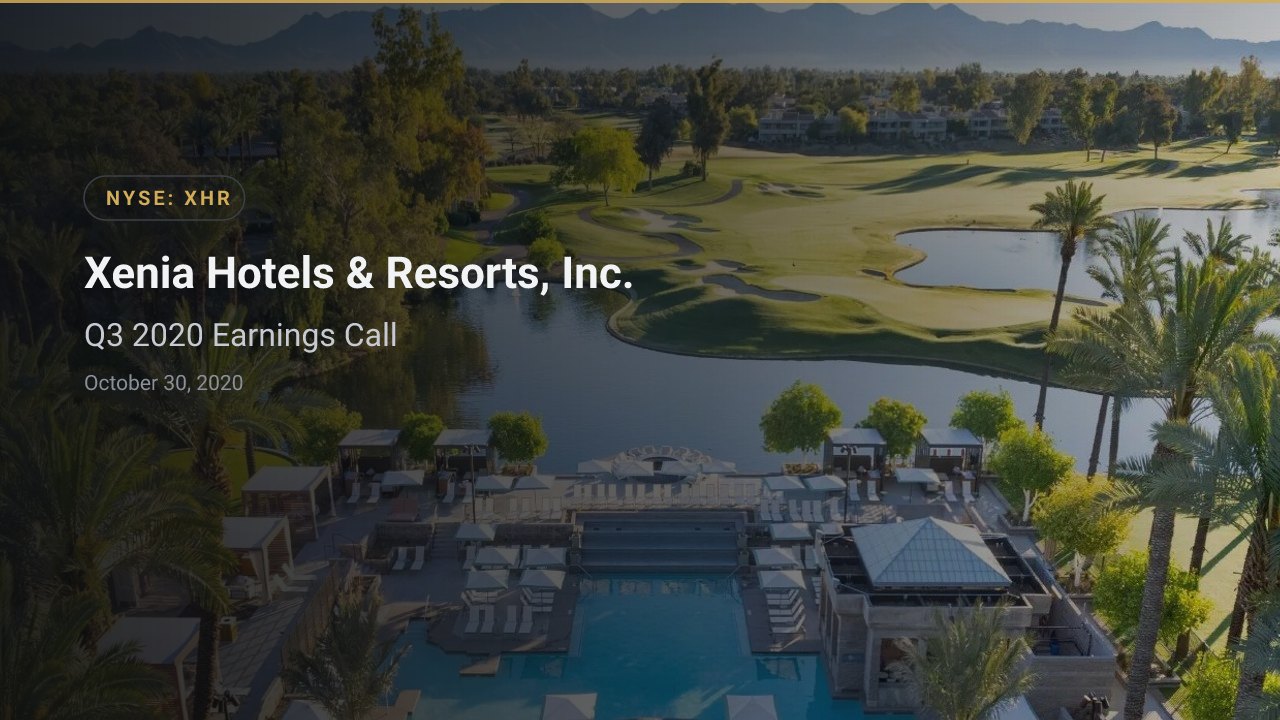
On 6ix: 6ix.com/event/xenia-hotels-and-resorts-inc-xhr-q3-2020-earnings-call
Automated transcript · Written by software from the replay's audio. It can mishear names and figures; the replay is the record.
0:00 Good day and welcome to Xenia Hotels & Resorts' third quarter earnings conference call. All participants will be enlisted on a note. If you need assistance, please signal a conference specialist by pressing the star key followed by zero. After today's presentation, there will be an opportunity to ask questions. Please note that this event is being recorded. Now I'd like to turn the conference over to meet Lisa Amey, Vice President of Finance. Please go ahead.
0:31 Thank you, Nick. Good afternoon, everyone, and welcome to the third quarter 2020 earnings call and webcast for Xenia Hotels & Resorts. I'm here with Marcel Verbaas, our Chairman and Chief Executive Officer, Barry Bloom, our President and Chief Operating Officer, and Atish Shah, our Chief Financial Officer. Marcel will begin with a discussion of our quarterly performance as well as recent transactions and capital markets activities. Barry will follow with operating details and an update on our major capital projects. And Atish will finish the call with a discussion of our balance sheet and various liquidity metrics. Following today's prepared remarks, we will open the call for Q&A. Before we get started, let me remind everyone that certain statements made on this call are not historical facts and are considered forward-looking statements. These statements are subject to numerous risks and uncertainties as described in our annual report on Form 10-K and other SEC filings, which could cause our actual results to differ materially from those expressed in or implied by our comments.
1:24 Forward-looking statements in the earnings release that we issued earlier this morning, along with the comments on this call, are made only as of today, October 30, 2020, and we undertake no obligation to publicly update any of these forward-looking statements as actual events unfold. You can find a reconciliation of non-GAAP financial measures to net income and definitions of certain items referred to in our remarks in this morning's earnings release. An archive of this call will be available on our website for 90 days. With that, I'll turn it over to Marcel to get started.
1:52 Thanks, Lisa, and thank you all for joining our third quarter 2020 earnings call. The lodging industry continues to be impacted severely by the COVID-19 pandemic and the resulting restrictions imposed by governmental authorities and consumers' attitudes towards travel. While the industry has seen encouraging levels of leisure demand since the relaxation of lockdowns and other restrictions over the past several months, demand from the corporate transit and group segments continues to be limited, particularly in the upper upscale and luxury segments. While these segments continue to be impacted most severely when comparing year-over-year results, we remain steadfast in our belief that the luxury and upper upscale segments will experience a robust rebound, particularly as COVID-19 treatments and therapeutics improve and effective vaccines are widely available.
2:45 Looking back on the previous few downturns in our industry, luxury and upper upscale rebounded very strongly. We see no reason to believe this time will be any different. Especially as new supply additions should be very limited in the next few years, particularly after properties that are currently under construction are completed. We also continue to believe that the quality of our uniquely positioned portfolio and our market strategy will benefit us greatly as the lodging industry will experience its inevitable recovery in the years ahead. was negative $21.1 million, and adjusted FFO per share was negative 27 cents.
3:34 With both numbers representing sequential improvements over the second quarter, when the majority of our properties were closed for a significant portion of the quarter. Like the second quarter, the third quarter continues to provide an extremely challenging operating environment. Yet we were pleased with the gradual improvement of our portfolio's performance, which has continued through the month of October. Our geographic diversification, with an emphasis on Sunbelt locations and a focus on key leisure destinations, has benefited us in the past, but it has become even more important in the current environment and as we look towards the future. Our market strategy, as well as our focus on owning hotels and resorts that appeal to various demand segments, has contributed to our ability to have 36 of the 37 hotels and resorts that we currently own open and operating.
4:28 with 12 of these properties achieving positive EBITDA during the third quarter. We have recommenced operations at our hotels and resorts in a very thoughtful and methodical way over the past few months, emphasizing the need to thoroughly analyze potential sources of demand and the competitive landscape as we projected operating performance compared to a closed scenario for each individual asset. As a result, we have been able to reduce our monthly cash firm while enhancing our ability to stabilize operations at each of our assets as quickly as market conditions will allow. Barry and Atish will provide additional detail on our operating results and cash burns later during this call. On the capital markets front, we have made significant strides in bolstering our liquidity through strategic capital raising initiatives.
5:20 In August, we completed our debut Senior Secured Notes offering raising $300 million at 6.38%, and we raised an additional $200 million this month through an add-on at a slight premium to PARP. A portion of the net proceeds from both offerings were used to repay outstanding balances on our various corporate credit facilities, with the remaining proceeds retained by the company for general corporate purposes. Following the October offering, we addressed all of our near-term debt maturities by paying off the remaining balance of our two term loans that were due to mature in 2022, as well as the mortgage loan related to our Marriott Dallas Hotel. As a result, we now have no debt maturities until 2023.
6:08 Our strong relationships with our lender group resulted in collaborative negotiations as we also were able to negotiate amendments to our corporate credit facilities, which include covenant waivers through all of 2021, Relaxed Covenants through the first quarter of 2023, and a two-year extension of our revolving credit facility, pushing this maturity out to 2024. Turning to our transaction activity, after the three transactions that were announced in the early part of the year did not close, we were able to collect a total of approximately $29 million in non-refundable deposits, as we have previously disclosed. After these transactions did not close as anticipated, we thoroughly analyzed our portfolio for opportunities to gain additional balance sheet flexibility and liquidity through the potential disposition of assets.
7:02 Our collection of high-quality, desirable assets has proven to be an efficient source of liquidity, as we have been able to negotiate a number of dispositions and attract a pricing, particularly given the current operating environment. We previously announced two of these dispositions which were both completed in October, and we recently entered into agreements to sell two additional hotels. We believe that these transactions, coupled with our recent senior notes offerings, are the most logical and cost-effective paths for capital raising at the moment. Our capital markets and disposition activities have bolstered liquidity, addressed near-term maturities, and we believe this has reduced any potential near-term needs for dilutive equity issuances.
7:49 We strongly believe that none of these dispositions alter our long-term strategy or negatively impact our growth outlook. While each transaction is unique, each disposition generally shared one or more of the following characteristics. Substantial near-term capital requirements without an appropriate projected return, significant directly competitive supply additions, projected difficulty in recovery, and or assets that are not closely aligned with our long-term strategy. These transactions further shape the profile of our company and we believe will further improve the quality and growth prospects of our company in the near and longer term.
8:35 On October 1st, we completed the sale of residence in Boston Cambridge, the only remaining select service or extended stay hotel in our portfolio for $107.5 million for $486,500 per key. The sale of this asset was a highly competitive process that resulted in a very attractive sale price. The price represented an 11.6 times multiple on the hotel's 2019 EBITDA, an impressive number in the current environment, particularly when considering upcoming capital needs of the hotel, which we were able to avoid through the sale of this asset. In addition to the purchase price, we retained the $3.8 million FF&E Reserve. In connection with the sale, the buyer assumed the existing $60 million Orange Loan, which, along with the net proceeds received in the transaction, further increased our balance sheet flexibility.
9:33 On October 22nd, we completed the previously announced sale of Marriott Napa Valley Hotel & Spa for $100.1 million. are $364,000 per key. We acquired this hotel in 2011 for $72 million and realized an unlevered IRR of 10.5% on these investments during our ownership. This was another competitive process, and we were pleased with the execution and pricing, which reflected a 9.8 times multiple on the property's 2019 EBITDA, which was the high watermark during our ownership of the hotel. We remain bullish on the long-term strength of the Napa market, as evidenced by our continued ownership of Ondas Napa, which is a high-quality luxury hotel.
10:20 However, the sale of the Marriott Napa allowed us to reduce our exposure in the market by selling this more group-oriented hotel in this high-end leisure-focused market. Similarly to the Residence in Cambridge sale, this transaction helped us eliminate a significant additional capital investment in the coming years. In addition to the net proceeds received from the transaction, we also retained the $1.5 million FF&E reserve. In this morning's earnings release, we announced that we recently entered into separate agreements to sell two additional hotels, Renaissance Austin Hotel and Hotel Commonwealth in Boston. We previously had Renaissance Austin under contract to be sold earlier this year.
11:16 After a thorough evaluation, we decided to re-market the Austin Hotel, as our views regarding the desirability of long-term ownership of this hotel had not changed, and certain characteristics of the asset, particularly its dependence on group demand and the outsized impact of COVID-19 on this demand segment, made it less appealing to delay potential disposition of this asset. Despite the discount in price as compared to the original sale agreement, we firmly believe the benefits of selling Renaissance Austin outweigh holding the asset, as it will allow us to continue our strategy of improving the overall quality of the portfolio while also avoiding significant near-term capital expenditure needs.
12:05 The Sales Hotel Commonwealth, upon completion, will mark our exit from the Boston market for the time being. We acquired this hotel almost four years ago for $136 million, but a sale price of $113 million represents a disappointing outcome for this investment. However, the sale price reflects an 11.8 times multiple on 2019 Hotel Ibadan, which is an attractive pricing level in this pandemic environment, and we are pleased with the results of this competitive process. As is the case with Ransom's Austin, We believe the benefits of selling this hotel at this price now outweigh holding the asset longer term. As we evaluated our liquidity needs and desire to shape our balance sheet to not only get through the current crisis but set ourselves up to be opportunistic as the recovery takes hold, we believe the sale of this hotel provides an opportunity to efficiently raise a significant amount of capital at a superior cost to other alternatives.
13:10 While both of these transactions are subject to ordinary closing conditions, there are no financing contingencies, and both buyers have posted substantial at-risk deposits. We currently expect each of these transactions to close in the fourth quarter. Successfully completing the two sales in October and signing these two additional contracts shows the liquidity of our high-quality diverse portfolio, as well as our ability to pivot when the need arises. If the two pending transactions are completed as anticipated, we will have sold these four properties for nearly $400 million at an approximately 10 times 2019 EBITDA multiple, an overall valuation that is significantly above the level where our shares are currently trading.
13:57 We have always prided ourselves on being transaction-oriented, and this is another indicator that even in difficult markets and unprecedented times, we are able to move forward, quickly make decisions, and through the strong relationships we have throughout the industry, drive these transactions to completion. Finally, we continue to appreciate the dedication and efforts of all of our operators associates at our hotels and resorts and our corporate employees during these difficult times in our industry. We continue to believe that our efforts before and during this pandemic to shape our portfolio and balance sheet have positioned us well to not only deal with these short-term challenges, I will now turn the call over to Barry, who will provide details on our third quarter and recent operating performance, as well as an update on our capital expenditures, including the exciting progress on the transformative renovation and the recent reopening of Park High at Avian.
15:01 Thank you, Marcel. As you mentioned, I will be discussing our property performance for the third quarter, our continued success in reopening and operating our hotels in this difficult environment, and an update on our recent capital expenditures. On the same property basis for the quarter, occupancy was 24.7% at an average daily rate of $169.77 resulting in a rev par of $41.95. This same property basis includes 38 of the 39 hotels owned as of quarter end, which excludes Hyatt Regency Portland, and is calculated as if all rooms were available for the entire quarter regardless of operational status. This reflects a decline in RevPar of 74.8% as a result of a 67.9% decrease in occupancy and a 21.5% decrease in rate.
15:49 RevPar was down 80.3% in July, 72.5% in August, and 71.5% in September. For all of our operating metrics for the quarter, I will now be referring to the 37 properties that were open and operating for at least some portion of the quarter, and these metrics include the two hotels we sold in October. These metrics are based on the number of days individual properties were open and operating. In the third quarter, our hotels achieved 28.5% occupancy at an average daily rate of $169.60 per rep are of $48.41. While the absolute amounts here remain unprecedented, we continue to be pleased with the cadence and continual improvement of results during the quarter, particularly as many projected a significant decline in performance following the Labor Day holiday, which has historically marked the end of the summer season.
16:41 July's occupancy was 23.9% and an ADR of $170.04. August saw significant improvement in occupancy of over 580 basis points to 29.7% and an ADR of $169.45. September occupancy further improved over August to 31.6% and rate was identical at $169.45 with a strong Labor Day weekend to start off the month and continued leisure demand and some early signs of slow improvement in corporate and group demand throughout the month. Currently estimate that for the month of October, our 36 open and operating hotels will have performed as we expected, running approximately 33% occupancy and an ADR of approximately $189, aided by a unique piece of business at the Park Hyatt Aviara, which I will discuss a bit later.
17:32 As we did last quarter, we want to share with you a few non-traditional metrics we have been tracking closely as business and consumer confidence shift from week to week. Overall, we continue to see strong performance in the portfolio from our drive-to leisure markets and resort hotels. We had 19 hotels achieve 30% or greater occupancy for the quarter, including eight that exceeded 50%. These included both of our hotels in Savannah, one of our hotels in Napa, as well as hotels in Mountain Brook, Key West, Alexandria, Charleston, South Carolina, and Santa Barbara. Our six hotels in Texas, which are primarily business-focused, were notable laggards but showed improving results from month to month as four of the hotels reopened in the third quarter. As we and our management companies continue to get experience operating in this new environment, we continue to refine the balance between services offered and cost structure.
18:23 For the most part, we recognize that guests in upper upscale and luxury hotels require some sort of food and beverage operation and continue to open restaurants and bars throughout the portfolio, albeit with more limited and Cost Efficient Menu Offerings. Similarly, we have reopened fitness centers, spas, and pool facilities as local ordinances allow and business conditions dictate. We have learned numerous lessons regarding how to encourage social distancing in these spaces while still providing outstanding guest experiences. As we continue to keep guest and employee safety at the forefront of our operating strategy, our hotels are learning how to be more efficient in dealing with guest requests, including bell service, housekeeping on demand, food and beverage, from Supply Delivery, and Trash Removal.
19:08 Overall, our hotel's ability to control costs in the current environment has been very good. While it is challenging from an HR perspective, payroll costs across the portfolio were reduced by approximately 65% in the third quarter of 2020 as compared to the third quarter of 2019. Other operating expenses were reduced by approximately 60% during the same period. These are material reductions on revenue levels that have declined approximately 75%. These efforts have supported a continually expanding EBITDA profile with 13 of our hotels generating positive hotel EBITDA for the quarter. These largely track the higher occupancy hotels that I referenced earlier and include each of our hotels in Savannah and Napa, and hotels in Mountain Brook, Key West, Alexandria, Charleston, South Carolina, and Santa Barbara from our high occupancy list, as well as hotels in Atlanta, Salt Lake City, Scottsdale, and one of our hotels in Portland.
20:04 Our customer mix has continued to evolve as well. There is no doubt that our leisure demand has continued post-Labor Day, as evidenced by our September and October performance. This segment continues to be stronger than expected throughout the portfolio, as hotels offer special packages and promotions, such as the Work from Hyatt program, that are specifically designed to encourage longer lengths of stay and provide some mitigation to softer overall midweek demand. Our hotels, especially our boutique hotels and resorts, have become experts in creative uses of social media and the development of innovative package offerings. We continue to confirm that this business has a very short booking window, often in the week for the week and even in the day for the day, although we are seeing earlier bookings for traditional holiday periods, including Thanksgiving and Christmas week.
20:51 On the corporate trading side, business is certainly coming back, albeit slowly. Overall, we are seeing a faster recovery of demand from smaller regional firms than from traditional large demand users, such as the big four accounting firms, Big Three Consulting Firms, and Fortune 500 Companies. On the group side, we can find the report that cancellation activity is slowing and that leads for future dates are increasing month over month. To date, we've experienced approximately $235 million in group cancellations for all future dates. We are starting to see groups cancel or move business schedule for the first quarter of 2021, but are seeing relatively few cancellations for the second half of 2021 and are seeing some increases in new booking activity for that period. We are fortunate to have a portfolio which is not overly reliant on citywide conventions due to our specific hotel locations and markets.
21:40 Nonetheless, group business has historically been an important part of our diversified portfolio. We are pleased with the efforts our hotels have made in pivoting and working aggressively to attract group business that is available in their respective markets. Sports business has been a standout in this regard, as five of our hotels hosted Major League Baseball teams this season. Several of our hotels have hosted college and NFL football teams. as well as production crews for football and golf events. We've also hosted several significant political fundraising events and other non-traditional government business. In addition, we can continue to see demand from youth dance, pageant, and sporting events as well as specially leisure-driven group business such as auto events. Our hotels have also done a great job in pivoting their service to these groups.
22:28 Completely outdoor meetings and events are now commonplace and our larger resort hotels in Orlando, Scottsdale, and Carlsbad collectively have available over 400,000 square feet of flexible outdoor space and are located in climates that, now that we are past the summer season, are ideally suited for outdoor events. In addition, many of our boutique hotels contain rooftop or other desirable outdoor space that can be utilized for meetings and events. Our hotels are also at the forefront in servicing part in-person, part virtual meetings in general, and weddings in particular, in partnership with our audiovisual vendors. Having this optionality will be a significant benefit to our hotels in the coming year as meeting planners learn to creatively think about how they design meetings and events. Transitioning to capital expenditures, during the third quarter we invested $18 million of capital into our portfolio, focused on the three major projects which were already underway and that we elected to continue despite the challenging environment.
23:26 At our largest project this year, the transformation of Parkhead Aviara, We have now completed the most significant and disruptive portions of our upgrades and we reopened the resort on September 30th. During the quarter, we completed the renovation of the lobby and reception area, including the lobby lounge and bar. The renovation and additions to the pool area and water amenities, including the addition of dueling water slides and an innovative splash pad, saw substantial progress during the quarter and are being completed as we speak. The remaining projects to the resort include the conversion of the existing specialty restaurant The renovation to the golf clubhouse, including a new restaurant concept, is expected to be completed by the end of the first quarter of 2021. We are excited that the resort announced this week that Richard Blaze, a renowned celebrity chef and former Top Chef All-Stars winner with a strong San Diego and national presence, will be spearheading this yet-to-be-named restaurant operation.
24:24 Overall, the property looks terrific and as we have said before, we continue to believe that it will be very well positioned to capture precisely the type and quality of business for which it has been created and which we envisioned when we acquired the property in 2018. Our first example of this was the reopening of the hotel on September 30th to an 18-day buyout by Major League Baseball for the American League Division and Championship Series. By all accounts, it was an amazing execution by the hotel team. and as a great indication of the quality and quantity of business, this five-star, five-diamond resort can continue to attract to this beautiful facility that has now been significantly enhanced to appeal to a broader group market. In addition, as we have mentioned before, the property is now better equipped to compete for high-end leisure business with its true peer group of luxury California coastal properties, which is performing very well in the current environment.
25:15 Also in the quarter, we completed the guest room renovation at Marriott Woodlands Waterway Hotel and Convention Center and have now completed the renovation of the existing ballroom and meeting space at High Ridge Sea Grand Cypress. With that, I will turn the call over to Atish.
25:29 Thanks, Barry. I will discuss our balance sheet and provide a reminder on our break-even levels of occupancy and cash flow. Through our action since July, we have strengthened the balance sheet, giving the company additional flexibility and runway. The three outcomes that are most notable are as follows. Number one, increased liquidity. Number two, no financial maintenance covenants through the end of 2021. And number three, no debt maturities until 2023. We achieved these outcomes through productive dialogue and negotiations with our lender group, as well as strong execution in the high yield bond market and the dispositions completed this month. Our liquidity at the end of the third quarter was $515 million, and our liquidity position today is approximately $600 million.
26:17 Today's liquidity reflects unrestricted cash of approximately $330 million and current undrawn revolver capacity of approximately $270 million. As to our high yield offering, most of the details have been announced before. Our debut offering in August was substantially oversubscribed, resulting in an attractive coupon. We also had strong demand for the add-on that we completed a few weeks ago. We welcome these new fixed income investors to the company and look forward to growing our relations with them over time.
27:02 Obviously, it's a transaction that hasn't been completed yet, so as I'm sure you can appreciate, puts me at a little bit less liberty to go into too much detail on these transactions that haven't closed yet versus the ones that have closed. In general, obviously, what I will say is that something that Barry obviously highlighted too is that we feel very good about having a portfolio that is pretty heavily focused on some of those locations that has the opportunity to generally attract some more meetings, hopefully as meetings are starting to come back. that are a little bit more focused on having a lot of outdoor space available and those type of things. So in general, we obviously see a little bit more recovery earlier on in some of those assets that have more of those type of characteristics as opposed to potentially some of the assets that are in those kind of urban, northern types of locations. But I'm saying that as a general comment.
28:06 Totally fair. Atish, I want to ask this in just the right way to make it clear that I am not predicting such, but is it fair to assume that you have sets of contingencies and strategies should things either stall or even reverse a little bit from some of the progress that's been made?
28:34 Yeah, I mean, I think that is a fair assessment. I mean, over the last six months, we've learned a lot, and the operating teams have certainly learned a tremendous amount. And so they have the ability to flex, and we're certainly mindful of trends as they take shape. So I think when it comes to hotel operations and expense structures there, as well as how we think about companies' positioning overall, those comments that I made were meant to indicate that Yeah, there are a range of scenarios or outcomes over the next several months, and we've prepared both the balance sheet and our thinking about those variety of potential outcomes and how we think about the strategy going forward. Got it. And Barry, I know you gave a fair amount of detail, and I'm going to apologize because I got knocked off for a moment while you were speaking and dialed back in.
29:32 With respect to providing solutions that may include rapid testing or other forms of therapeutic input, what kind of plans and provisions have you started to work on that may assist in that regard?
29:55 What I can tell you, and really try not to get ahead of, Anything that may have been said publicly, certainly the brands are all looking at and thinking about and learning how to adapt to what the needs of clients are. I can tell you that having done a little more than a handful now of complete hotel buyouts, every group has taken a little different, had a different thought process on what kind of testing or regulations they put on their attendees, requests they've made on hotel employees and things like that. So I think that's probably all that's safe to say on that at this point is we're going to do what the customers want and expect us to do with the brands taking the lead on how we're going to effectuate that.
30:53 Okay. That's it for me. Good luck and thanks very much.
30:58 Thank you. Thanks. Thank you. The next question is from Bill Crow of Raymond James. Please go ahead.
31:05 Thanks. Good afternoon, everybody. Marcel, as you sell out of Boston and reduce your exposure in Napa, sell Boston, it obviously has the other impact of increasing your exposure to the remaining markets, and that includes Dallas and Houston. I think I had read where some Dallas assets were maybe on the market. Just thinking about how you're How are you thinking about the portfolio overall and the perception of quality of the portfolio when you sell out of some of these big coastal markets?
31:39 Great question, Bill. As we looked at this and as we looked at which hotels were willing to sell in this environment, and I mentioned this a couple times in my prepared remarks, we are very focused on maintaining the quality of the portfolio and the growth prospects of the portfolio. As we're looking at selling these assets, in some ways you can look at these four and say that they represent a little bit of a cross-section of the portfolio. But as you can imagine, we believe very strongly that these four properties would be outperforming the remainder of our portfolio over the next several years. We probably wouldn't be too anxious to sell them. So clearly we have a view of that these assets aren't hampering us from a strategic standpoint to not have them in our portfolio anymore.
32:26 And we clearly have expectations of some other assets that will hopefully outperform these. And I think Atish kind of alluded to this a little bit in his remarks too, which is the fact that we are preparing for a number of different outcomes and other prospects going forward. We've significantly strengthened the balance sheet to deal with any kind of short-term challenges that could be out there. We've also really bolstered our liquidity and strengthened the balance sheet to hopefully be opportunistic coming out of this. Clearly our longer-term view is that assets that we would be selling today would be hopefully providing us less growth than assets that we could be finding out there when presumably there will be a good amount of opportunities out there over the next few years.
33:11 One of the additional things I'll say there, and you referred to it, obviously selling an asset like Austin, one of the considerations there is the fact that it helps us reduce our Texas concentration a little bit because we do still have exposure in Houston and Dallas, obviously. You mentioned it, so I'll respond to it. We currently don't have any other properties on the market. We are not looking to sell, you know, assets additionally as we sit here today. But that doesn't mean that, you know, going forward, we wouldn't look at some potential additional dispositions. But I just wanted to make that clear in response to your question.
33:56 Yeah, that's helpful. And one other question from me. It was discussed on this morning, a peers call this morning. that I think seasonally, you know, we're going into a slower demand period as you transition from the third quarter to the fourth quarter, get into the winter months. And I think that kind of extends through January, et cetera. Is there anything in your portfolio from a seasonality perspective, a locational perspective, that might change that? In other words, that the fourth quarter could be similar to the third quarter or we just kind of do for a pullback here?
34:36 Well, in general, and I'll let Barry speak a little bit more specifically to it as well, but in general, obviously, as you know, November and December are generally slower months in the industry, and the primary reason for that is because your corporate demand generally tails off in November and December. Clearly, at this point, a lot of the demand is being driven by leisure demand, so there is some hope that That holds up through November and December, but I would think that in general your thesis is appropriate to say that you're generally seeing a little bit more of a slowdown toward the end of the fourth quarter, whereas obviously the beginning of the fourth quarter is kind of your high-water mark because October is generally your strong month, particularly from a corporate perspective.
35:25 Nothing too specific in our portfolio, although I would say that we obviously do have a portfolio with a lot of fees, drives to leisure locations, a lot of assets that are appealing for people doing trips around Thanksgiving and Christmas potentially on the leisure side. But I wouldn't say there's any particular big drivers that would make it any different than you would expect.
35:45 Yeah, I mean, I think the only other point is if you look at our portfolio and seasonality in 2019, obviously we're in a very different environment than that. First and second quarter are a little bit stronger than a quarter each. They're a little closer to 30% just in terms of weighting of hotel EBITDA. So we've sort of had, because of where our hotels are located, Thank you. Next call question is from Michael Bellisario-Baird. Please go ahead. Good afternoon, everyone.
36:48 Good afternoon.
36:51 Marcel, I just want to go back to that last topic just on the transaction front and your comment about not marketing anything else for sale today. I suppose the question is, one, why is that, especially if you can get the pricing that you've gotten so far? What's the rationale there?
37:09 Well, as you know, we've obviously very significantly enhanced our liquidity on our balance sheet as we sit here today. And even before hopefully completing these two additional transactions here in the fourth quarter, we've got about $600 million of liquidity today. So from our perspective, there's not a particular need to further enhance that through transactions. Again, my comment about not having properties on the market today is exactly that, not today. That doesn't mean that in the future we won't continue to evaluate whether there's additional opportunities. It will really be with an eye towards what I also said in response to Bill's question, which is do we feel like a potential sale of some additional assets where there may not be quite as much growth potential versus potential acquisition opportunities If those opportunities exist, we'll certainly look at it very closely.
38:10 But there's obviously two sides to that coin. You have to be very confident that there are those kind of opportunities out there, and you have to look at your existing portfolio and feel that maybe some of those growth opportunities aren't quite there and that you're better off monetizing some of those assets. As you know, I think if you compare us to most of our peers, we've been always pretty active throughout the years coming into this pandemic. We've obviously been very active this year and taken all the very decisive steps we've taken to be where we are today. So transaction-oriented mindset is part of who we are and we'll continue to look at some opportunities like that. But as I said, my statement is true and correct as we sit here today.
38:56 Got it. That's helpful. And then maybe taking a step back, looking at the two deals that have closed and the two others that are pending. But can you maybe fill us in on what you've seen or what you've learned so far that was maybe surprising or how that informs your view of your remaining portfolio and the value you see there in those assets?
39:17 Well, I'm not sure if it was in any way surprising or not. We obviously felt that our portfolio has a desirable portfolio that can create a good amount of liquidity for a company like ours and that's part of our strategy that we've had over the years as far as building the type of quality portfolio that we have today. So we were fairly confident coming out with some of these properties that there would be a pretty competitive process for some of these assets and I think we somewhat timed that correctly and we obviously, like I said, we have the type of assets that there is a good amount of demand for. I wouldn't say that I've been particularly surprised by anything as it relates to that.
40:02 We've gotten obviously a lot of questions probably from YouTube and certainly from others about where are discounts post-pandemic versus where pricing was before the pandemic, which obviously is an enormously hard question to answer. We feel that the bulk of these dispositions we're doing, that that discount is You know, relatively small. Obviously a little bit larger on the one that you can actually point to, which was Austin that we had under contract before, and now we are selling it, hoping to close it later this quarter at a discount that's roughly 30% to where we had it under contract before. But that is certainly not something you can apply kind of a broad brush to, because as I mentioned in my comments, you know, Austin is obviously the type of property that you just have to acknowledge the fact that as an asset it is a little bit more group dependent than that obviously has some CapEx needs and is probably really on the high end of where you would expect some of those discounts to come out.
41:03 That being said, as I said in my comments, we still felt really strongly that that was the appropriate thing for us to do to sell that asset at this time.
41:16 Got it. And then just one last one from me, maybe for Atish. I know you mentioned the amendments and being able to use equity to fund acquisitions.
41:25 But as you think about other sources of capital going forward, what are the options out there that you have that you're thinking about?
41:30 And then do the senior bonds that you've issued, do those preclude you from doing anything differently on the capital structure front going forward?
41:41 Yeah, that's a great question. I mean, obviously, you know, we have multiple tools at our disposal, whether it's financing, Preferred, other types of capital raising tools. I think we spent a lot of time evaluating the different levers and reached the conclusion that the Senior Secured Notes made the most sense for us. I think they don't preclude us from doing other things. There are some incurrence tests and things like that we have to be mindful of, but for the most part, we have the ability and flexibility to do other things post having done that offering.
42:31 Thank you. You're welcome. Thank you. Next question comes from Thomas Allen of Morgan Stanley. Please go ahead.
42:41 Thanks. Just sticking on the transaction topic, you're obviously going to be sitting on a ton of cash after these dispositions. Can you just give us some more color on what you're looking for to buy? Is it bigger assets, smaller assets? I understand you want to be in growth. There are more assets with better growth trajectories than what you had, but I think it's still early days, to be honest with you. I think that we're confident that there will be a lot of opportunities coming over the next few years.
43:45 and some of our peers have, which just allows us to be opportunistic and to find assets that have the right kind of characteristics that we're looking for, which isn't different from what we've done the last few years, which is looking for assets that have, that can play into different types of demand segments, that have a component of leisure to it, that have a component of corporate transient, and obviously, even though group is a four-letter word right now, in the future that's gonna be an important component, again, of anything you're looking at. We're going to continue to look for the type of assets that you've seen us buy over the past few years. We do think that there undoubtedly will be some fallout over the next couple of years where there will be interesting opportunities available.
44:31 Marcel, how willing are you to be completely contrarian? Are you willing to go out and buy a big group box today and wait it out for a year because you assume that business is going to come back at some point? or do you want more safety and security and are interested in leisure assets that are doing decently well now but you think there's opportunity on them?
44:57 I think the obvious answer to that is we're always going to be taking a longer-term view at assets. We're not just going to look at what makes sense for the next six months or nine months. and it goes for both assets that we'd be looking to buy and for our existing portfolio. Again, we will look at the different characteristics. What I will tell you is don't expect us to buy any properties here in the next couple months. Your question is would you be willing to do anything today? I think there is a good amount of uncertainty still out there. There's not enough product out there. There should be more product out there that you can actually kind of pick your way through a little bit to see if there's some things that could be appealing going forward. and so we're perfectly fine sitting on the sidelines here for a little bit and then letting things play out a little bit and have a balance sheet that can withstand any kind of further downturns to the extent that anything to the negative side happens but also be prepared to be opportunistic coming out of this. So it really is a little bit early days to say this.
45:59 So I can certainly tell you that right now a big group box, no probably not, We're going to wait a little bit to see how things stabilize. Things could change pretty quickly and rapidly if an effective vaccine is rolled out and we're seeing some recovery in the industry, which hopefully will happen if we can believe the experts on this, if there really is a situation where we're more comfortable with treatments and a vaccine. That's helpful. Thank you. Again, if you have a question, please press star then 1. Our next question comes from Tyler Batore of Janie Capital Markets.
47:03 Please go ahead.
47:12 Tyler, are you there? Nick, I don't think we have him, so you can go to the next question if you have any. Again, if you have a question, please press star, then 1. We have no further questions at this time. I'd like to turn the conference back over to Mr. Marcel Verbaas for closing remarks. Please go ahead.
47:41 Thank you, Nick. Before I close, I'll just echo what Atish said earlier as he concluded his remarks, which is obviously we are certainly still in a very uncertain situation in the overall national and global environment, so we feel like we've put ourselves in a position to be able to to deal with any uncertainty over the next few months for sure, are encouraged by what we've seen operationally over the last couple months in our portfolio, and I am extremely pleased with the efforts that we have undertaken over the past few quarters to strengthen our balance sheet, bolster our liquidity, and really set ourselves up to get through this in the appropriate way and thrive coming out of this. So I thank everyone for joining us today on our call, and we look forward to speaking with you over the next few quarters.
48:34 Conference is now concluded. Thank you for attending today's presentation. You may now disconnect.
Follow Xenia Hotels & Resorts, Inc. into a list and get an email when it puts out news.
Vice President of Finance
Chairman and Chief Executive Officer
President and Chief Operating Officer
Chief Financial Officer
Analyst, Raymond James
Analyst, Morgan Stanley
Analyst, Baird