Transcript
Automated transcript · Written by software from the replay's audio. It can mishear names and figures; the replay is the record.
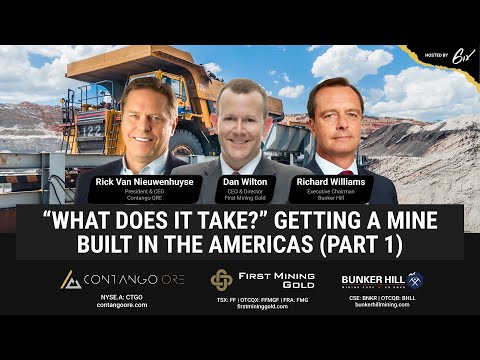
0:08 Hello everyone and welcome to today's event. What does it take? Getting a mind built in the Americas part 1. Please feel free to submit questions in the chat feature on the right hand side of your screen at any point during the conversation. I'll try my best to incorporate them into the conversation at hand. As a reminder, this event will be recorded and will be available at six.com in the coming days, so look out for that. Gentlemen, Why don't we start with your name and title, where you're from, and any previous mine building experience if applicable,
0:38 and then we can get further into the details as the conversation progresses. Why don't we start with you, Dan? Sure. I am Dan Rolton. I'm the CEO of 1st Mining Gold. First Mining is advancing a couple of major gold projects, 1 our Springpool Gold Project in Ontario and our DuParcay Gold Project in Quebec. In terms of mine building experience, I've been parts of teams that have helped finance mines. I've sold a lot of projects at that period where they're just about ready to get built.
1:13 So lots of experience in kind of going through the whole development cycle. Thank you. Richard? Thanks, Carl. And thanks, everybody, for dialing in. Richard Williams, the Executive Chairman of Bunker Hill Mining. We're bringing an old zinc-silver-lead mine back into production in November of next year, all being well, in the Silver Valley, Idaho. A mine that ran for 90 years and was shut down in 1981. So it's remained fallow for a while. We're fully funded and are advancing construction as we speak.
1:55 Funded off initially a PEA, then a pre-feasibility study for our final piece. In terms of mine, building experience as former chief operator of Barrick Gold, taking over at a time when we collapsed the capital markets and, forgive me, the capital projects and project management team, and having all of those projects suddenly report into me at that time in 2014 and 15, one's experience of both development projects and construction over multiple jurisdictions simultaneously comes from that time. But I have to say that the real practical business of building a mine rests with our CEO, Sam Ash, who again has multiple experiences with that, both in the Copper and the Gold dimensions while working for Barrick.
2:49 Thanks very much for having us. My name is Rick Van Ewenuizen. I'm the President and Chief Executive Officer of Contango Ore. We're developing our Moncho project in Alaska here in the joint venture with Kinross. This mine, which we actually just had our groundbreaking ceremony earlier this week, so we're actually mining right now, we'll be stockpiling ore and then for later transport up to the Fort Knox mill for processing. We're a little different story than your typical, we want to build a mine as a junior company, which has really simplified all aspects of raising the capital, not building a mill, not building a power plant, not building a tailings facility or permitting all those things.
3:38 As a result of that, we've been able to sort of shortcut. I'm an exploration geologist. Having a group like Ken Ross that operates many mines around the world and has operated here in Alaska at Fort Knox for 25 years, they're the perfect partner for a junior company like ourselves to do all the heavy lifting on a 70-30 joint venture basis.
4:05 We'll get into production, we'll average about 67,500oz of Gold a year for our share and an all-in-standing cost of a little over $1,100 an ounce, so a very, very good margin. So I'm sure we'll talk more about it as we go along here, but that's a bit of the background. Definitely, and this is gonna be more of a round table discussion, so I won't pick on each individual to answer a question. So when questions arise, if you wanna contribute, please feel free to do so. Let's see, the first thing I have prepared is, in the process of mine development, extensive studies like pre-feasibility assessments are typically conducted to ensure the project's viability. However, the real world situations can be complex. What are your thoughts on situations where companies might decide to start construction without completing a comprehensive pre-feasibility study? Can you share insights on the potential risks, advantages and ethical considerations related to such a decision?
5:03 And I'll jump in here, maybe just to kick it off. I think ethics has a lot to do with it. It's all about risk. If your mind was gold nuggets sitting on the ground, there's not a lot of risk. Maybe you don't need a full-blown feasibility study done by a large engineering group. But if you want bank financing, you're going to need to convince the banks. And typically that's a feasibility study and a feasibility study that's been third party peer reviewed at least once. So sometimes a couple of times. So it's all about risk and managing risk. And if you're not going to fund your project with 100% equity, you're going to need a loan facility from bankers.
5:56 And bankers are tough. I mean, that's their job is not to lose money. So they're going to make sure that your project meets a lot of criteria. And we just went through this. So it's even though our project is relatively simple because we weren't building a mill and a tailing facility and all that, it's still a complicated, detailed, hard work process to raise the financing, especially in this market. We don't have a fantastic market right now. So, bottom line, we couldn't do it with equity because the equity markets just weren't there. And so, when you have to go hand in hand to the banks, that's what you got to do. Yeah, Rick's answered it very well. I'll just give a little bit of perspective on ours. But firstly, Rick, I should have said right up front, congratulations on getting out to production. We've been on a couple of calls before, so that's just fantastic.
6:52 Look, I think there are 2 elements to the risk. One is the risk you're prepared to take. And the second is the risk that the banks or others are prepared to finance and at what cost. I'll go to the first point, is that we initially got financing to get moving off a PEA. That's a very, very low level of engineering and insight by the definition of the financiers.
7:19 But what it didn't take account of, obviously, was the amount of information and the infrastructure that existed at that time. But we were never going to restart the mine. I commenced the large pieces of construction and so on that has to happen until all the engineering is concluded, concluded to feasibility study plus level, because you're incorporating not just in the final engineering designs, but you're putting out the procurement orders and then confirming precisely what the estimate of the costs and the timelines that you're comfortable with and baking that into the capital program. You wouldn't really wanna start anything until you've done that, even if it's a very small project, because otherwise your costs are going to go all over the place. And, and frankly, going back to the market when your projects in trouble is in the experience of everybody who's been in that spot, a very, very bad place to be.
8:13 So I'd say that on the on the individual risk, either risk that one's prepared to own oneself, you've got to finance that level of understanding, in my view. And that's just in the sort of engineering and construction and operating side. But underpinning the whole thing, and obviously sitting on the call here, as people have done this 1000 times or 1 million times, and many people on the call too, is the quality of your geological, geotechnical and other understanding underground. So you'd really want to get that into a place that everybody's comfortable with. And as Rick said, testing your judgment against the capital markets is not a bad conversation.
8:59 Now, to make sure that you're in the right place. The problem is you find, or we certainly found, is in order to get moving, we wanted to develop this mine in stages. So the first bite size would be that which we could convert into measured indicator resources, get moving and then leverage cash flow to unlock the mine thereafter. So what you end up with is a relatively on the face of it as described at PFS or PFS plus level is a relatively short life of mine until you can convert a whole bunch of your inferred resources into M&I, blah, blah, blah.
9:35 And that actually is quite a challenge, because the capital markets today are very attracted to scale. We certainly found. And so that narrowed the field to us. So in one's answer, Kyle, and I hope it's been useful, I wanted to sort of give people dialogue on the call, the fact that it's the risks you're prepared to take, the risks that it's sufficiently covered to ensure finance. And that, you know, getting the balance right between both of those things, depending on your project, is difficult, shall I say, in any market, but particularly today. Thank you. And to bring Dan into the conversation as well as address the audience, and as a reminder you can continue to submit questions on the right hand side of your screen, there's a question submitted. Going through the mine building process, are there large differences between the provinces in Canada?
10:34 I think there are. You know, we're not in construction on mines, but I think, you know, we're discovering even just in the advancing work that we're doing in terms of contracting, you know, The reality is the province of Quebec runs on a bit of a different legal system than the rest of Canada. So there are things like that. There are cultural differences. There's difference in the proximity to suppliers. And we're in an interesting scenario where we've got 2 projects. 1, our project in Ontario, more advanced than our project in Quebec. So that's our project in Ontario, Springpole, is at a pre-feasibility study stage, and we've done about 80 to 85% of the work that you need to do to complete a feasibility study.
11:19 And we're actually just about to put out a PEA on our project, DuParcay project in Quebec, in the middle of the Abitibi. So we do see some kind of compare and contrast. And I think it comes a lot to, you know, when you're going to undertake a massive project like building a mine, particularly if you're not blessed like Rick has been with a lot of existing infrastructure, and Richard too for that matter, for a lot of existing infrastructure that's there, you're kind of starting on greenfields-ish
11:53 kind of processes. Those are big, big problems. One of the things that we're really finding in the Abitibi in Quebec is that there is just such an amazing proximity to contractors, to skilled labour, to people who know what they're doing. And that goes right on the environmental side in terms of drilling contractors. And It comes through not just in quality, but in cost. We were actually just having this discussion in our office yesterday. Jurisdictionally and permitting-wise, there are always idiosyncrasies. We're blessed in Canada and advanced, very far advanced in environmental assessment in Ontario.
12:40 Got great support, really all the way through the regulatory bodies, and all the way politically, very, very good support for infrastructure development in remote communities. And then in Quebec, same thing. I think we've got great support from Ministry of Environment and Ministry of Mines, in part because our project there is an opportunity to not only build a new mine, but also address a 70-year environmental legacy of a couple of past producing mines. I think there are great positives and I think every jurisdiction is different, but certainly I can speak for Ontario and Quebec. It's both great places to be developing mining projects.
13:27 Thank you. Now, as companies move from geological studies and interpretations to the actual development phase of a mine, exploration specialists often find themselves in leadership roles. It's possible for investors to be intrigued by a compelling geological narrative, yet the management's capabilities to successfully oversee mine construction might need strengthening. What key factors should investors take into account when they're drawn to a project primarily due to its geological potential, but are uncertain about the management's readiness to navigate the complexities of building and developing a mine?
14:02 Well, I'll jump in on that one. I think you need to look at the fact that this mine development process is multifaceted and it's very complicated. And I think you can take some comfort in the team that needs to come together to do this. And that team is not just the internal team of the company that's developing the projects. But where are they spreading or sharing risk in the kind of capital approach that they've taken to contracting that project, whether that's just an engineering procurement and construction management, or whether they actually pass some of the some of the The delivery risk of the project in an EPC contract off to contractors So, you know that comes when you're looking at advanced studies you do sometimes really need to look at the groups that have done those studies and understand their project delivery capabilities.
15:11 And you know, if it's a different group that's then coming in to deliver a project as opposed to a group that did the feasibility study. I think you just should be aware that in that handoff, sometimes it's an upgrade, but sometimes there can be risk in some of those handoffs as well.
15:29 Yeah, I think every team that's embarking on something like this, particularly, you know, from a development perspective, if you've been spending 5 years in really predominantly the studies, engineering and environmental assessment work, It's a different skill set to really kind of transition into construction. And certainly, you know, it's something that we've been very conscious of as we built our team. Our Chief Operating Officer, Jeff Renson, comes from a long background of having, you know, built and managed billion-dollar projects in big mine sites around the world. He's not intimidated by the process you have to go through to put that team together. But as a single, well, we're not a single asset company, but if you're a non-producing company looking to build a mine going into production, it's a big leap. It's a big leap, but I think you've heard Rick and Richard both kind of talk about that here.
16:29 I'm sure they can share more tangible and recent experiences around that too. That actually ties into the next question perfectly. No matter how much you prepare, problems can arise. So Rick and Richard, you guys can contribute to this. Could you share any specific examples from your experience or what you see in the industry, where a unique challenge arose during the process of getting the mine built?
16:54 I'll start with our Bon Chaud project, which is, from a mining standpoint, a development standpoint, fairly simple. A key part of making it work was the transportation of the ore from the Poncho Mine site to the Fort Knox Mill, which is using the existing infrastructure of the Alaska Highway, paved highway, passing lanes, 3, no, 3 lanes, 4 lanes all along the route, national highway system, all that. But there's a group who were not in favor of that transportation plan. We understood that that was going to be something we were going to have to address and answer questions, but it's not something you need a permit for.
17:43 You don't need a new permit to drive a legal truck legally loaded with a legal driver. So it was an interesting situation in that it was not something that was required a permit, but it is part of this social license that I think gets referred to a lot in all industry, but our industry in particular. And of course, the anti-mining crowd can then jump on that and amplify that message. You're busy trying to address the boots on the ground issues of safety, addressing safety and talking about the fact that you have extra braking capacity in the trucks and that you have fatigue monitoring so that the drivers aren't falling asleep. And you have GPS tracking so you know that they're going to speed limit and they're stopping where they're supposed to stop. All those things that we can now do with a microchip.
18:42 But that's not what the anti-mining crowd wants to address. They just want to talk about, this is something that's unprecedented or whatever. So, you have to be prepared for things that come out of left field. And like you said, in this case, we have strong support from the broader community. We have strong support from the government, from the state of Alaska, from the governor's office. So, you know, you have, you want to address the community's concerns, and they're legitimate concerns. But you have to, you know, you also want to just, you know, keep, keep to a timeline and keep to a process that you have to manage that. And, you know, kind of going back to the previous question, it really is all about managing. Elon Musk gets lots of credit, but he doesn't build rocket ships, he doesn't build satellites.
19:34 He manages a team of people who do that. He's a great visionary and he's a great executor. But then all that is done through management.
19:46 And as Dan was saying, you've got a team that may be focused on exploration at first, and you've got to adapt to becoming a producer. We're doing that with our Lucky Shot project now where we hired Chris Kennedy, a former mine manager of the Pogo mine. He ran that for 8 years and when Sumitomo sold it to Northstar, I grabbed him because he didn't want to leave Alaska. And so, he's the perfect guy for us to run our Lucky Shot project and pay attention to safety and make sure we're doing everything by the book and MSHA certified. And that's not a skill set that I personally have, but so you have to hire the right people to do the right job. So yeah.
20:35 Richard, before you share your experience with challenges, there was a question directed toward Rick and from Mark here in regards to the transportation. Did you not have legal weight limits for the trucks to consider?
20:49 Oh sure, absolutely. Yeah, again, you know, the legal truck carrying a legal load is, that's what you, what you strive for. You know, then you get into, there's lots of devil in the details here in terms of addressing that specific question in terms of bridge weights and they're not the same all year long. They're different in the summertime than they are in the springtime during breakup. So yeah, there's lots of devils in the details, if you will. But they're written down. We know what they are. And there are ways to adjust that by adding, for example, an extra axle in a vehicle. And if you look at the photo of our transportation trucks, transport trucks for the ore, they look like they have a couple of extra axles and that's obviously on purpose.
21:37 It does 2 things, it lightens the load if you will, the tire pressure weight on the highway, but also gives you extra braking capacity. So yeah, it's all part of the process And again, I think it's not a bad thing that the community has concerns and that you are given the opportunity to address them because it does Require you to sort of rethink, you know, do we, did we put enough. Breaking capacity in the trucks and, you know. It's part of that diligence period that, you know, you, you have a third party, another third party. So you take a look at that and say, okay, well, I just just to think about that. Did you incorporate this so that. Part of the process is a good part of the process. And Richard, as you explain your experiences, there was a question directed toward you in the audience as well. What do you think are the biggest challenges in bringing an inactive mind back into life? So this is probably gonna be incorporated in your answer.
22:36 Yeah, A lot depends on the nature of the mind. So it's a smart, smart answer, but I'll focus it more on mind. But I'd say that just echoing a couple of points that Dan and Rick made and folding it in—we all recognise that all of our plans, be it construction or operating, are based on estimates. There's variability in all of the inputs And there's variability in the external factors that come and come and hit your mind, be it things like inflation, be it prices, be it whatever it may be, not always to the downside, actually. And so you've got to remain you and your team to echo Dan's point, that's both the in-house team, the owners team, if you like, and the contractors, in our case, we've got an EPCM contractor, but with the E in brackets, we're doing most of the engineering in-house, and so on, need to have a working relationship or a mechanism that is as transparent
23:36 as it can be. So that very quickly if you discover that some of your estimates turned out to be wrong, you can compensate for that if you can. And you can get on to it very quickly. And so for that, many people have got many different processes and there's a sort of, you can read manual after manual about what needs to be done but I'd say that ensuring that the core team is reporting accurately on what they're seeing on a very, very regular basis allows you to make any adjustments along the way. Second thing I'd say that's transparency and coordination 0.2 is the degree of ownership. Much as I like a sort of collaborative approach to discussion, you do actually have to hold people responsible very clearly for outputs that you've all agreed to. There can be in certain management handbooks this idea of sort of shared responsibility and so on. In my experience, it doesn't work.
24:33 Whoever's responsible for key parts of the program need to really understand that, own it, kill themselves to deliver it, but also be the type of people that can put their hands up if they find their early estimates were turning out to be wrong. So there's a responsibility and let me see talent stroke character dimension to it. And we're pretty early on what we're doing, mind you. So if I was speaking to you in 6, 7 months time, perhaps some of those rather general points would flush up onto a specific related to bunker that would be interesting. Thus far, and we're very early on on it, having to restart after a pause created by the capital markets, not our own internal systems.
25:20 Things are moving as they should do. Our capital estimates have turned out to be correct over the last 2, 3 years. We're not eating into any contingency and we're on time. But as I say, let's speak in a few months time, I'm sure there'll be a little bit of twisting and turning along the way, but as long as we're alert and on it, we're key. To address the question related to an inert mine, Well, there's a whole bunch of things. And I'll come into the specifics of us. You've got all the advantages that Rick and I have, which is existing infrastructure. You know, in our case, we can plug in with a little bit of work to the Pacific Northwest 4.7 cents per kilowatt hour green power. That's pretty remarkable and different for being in a greenfield site.
26:10 We have population and skilled workers and industrial sites around us. All of those logistics are often available to, not in every case, but old mine sites. You have historical data to work with and in our case you have infrastructure, the processing facilities were all collapsed so we had to rebuild them.
26:32 But we're also on private land, not federal land, which permitting and construction purposes speeds things up. The downside, as always, with a closed mine is what is the environmental legacy or liability that's been left for you? And secondly, what is the condition in our case, an underground mine of the underground infrastructure, which is relevant to how long the mine has been inert, as your question described it, but also the ground conditions? We're in court site and actually we're finding, and it is faulted in areas and outside the faulted areas, we're finding actually the quality of the underground infrastructure is quite remarkable, but was used, but was designed for mining methods that were applicable in say the 1970s or in some cases, the 1890s.
27:19 So we actually have to do a little bit of work to get the whole thing into a position that will meet our mind plan.
27:26 So I'd say that if anyone was taking over, and Rick will know this, anyone's taking over an oil site, it's looking into the environment, the negatives, which are the risks, the environmental legacies, the quality of the infrastructure, how the community sees you, how the US case, the state or the federal agencies see you. And if the geology is good and those things aren't so bad, and you've got some other advantages
27:53 like Infrastructure then then you might have a shot one thing I'd add to the bucket Is that we took over not the immediate team we took over from, but previous to that, a group that had played the market in ways that were pretty disgraceful, a pump and dump scheme. And we had to deal with the reality of a brand, if you like, Bunker Hill brand that was very, very toxic in the market, courtesy of that mis, well, it's not a misstep, it was a chronic mistake back in the day. And funnily enough, that little issue, which is not related to the quality of the mine, wasn't a little issue at all. It was actually a very, very big strategic issue that's made our life a lot harder. We had caveat emptors on our stock in America, which we had to tidy up. You can tidy it up technically, but there's a lot of
28:46 people out there who lost money. You won't forget that. Although you're a new team, you've got to work pretty hard to persuade them that what hurt them last time isn't going to hurt them now. And therefore, it goes back to that point of transparency, honesty and all the things that we all aspire to. But again, I'm going to not get on my soapbox or my preacher's pulpit and say that. We all know that in the industry. If you do a good job and you're straight, you've got a good shot at this. But that long-winded, but I hope useful answer to a couple of points of your question, Brian. Most definitely. The next question is more about allocation of resources. Managing multiple mining assets requires a delicate balance of resources and strategic focus. Could you share your insights in how your company effectively allocates resources, both in terms of capital and human capital, to ensure the successful development and even just overall story of of your company?
29:50 Well, for Contango is, you know, we have the advantage of sort of having Ken Ross is doing all the heavy lifting at Mon Chaux. That leaves us free to do what we've traditionally done well, which is explore. That's what our second project at Lucky Shot is exploration. It is underground and it is a historic mine. As Richard was just referring to, you have certain advantages there, but you are an active mine site. Lucky Shot is hosted in a granodiorite. It's a mesothermal quartz vein, so there's not a lot of sulphide around. Because of that, there's not a legacy of acid mine drainage and all the things that can, environmental issues that can come along with that. So for us, that was sort of 1 box that sort of ticked.
30:46 There's no big environmental headache here. But it is an active mine site. So we are technically mining. We're under MSHA. And so that's why I want to make sure I have a guy like Chris Kennedy who knows what the process is from a safety standpoint and how to train a safety culture to a mining crew. Those are all the things you have to think about as a CEO. You know what you know, but you have to also realize what you don't know. And nobody can know everything and do everything. So you've got to get the right team in place and the right people in place who have the experience in the jurisdiction you're operating in, because they're all slightly different.
31:33 Someone who is used to working in West Africa,
31:39 I'm sure they've got lots of great skill sets, but they may not well apply to working in Alaska. And that specifically comes into play when you talk about the community and about community relations. And so you just, you know, you really have to have the right kind of people delivering the right kind of messages and hearing what the community is saying. Our mind's eye that
32:00 at Lucky Shot is, it's a nice area and it's, it's easily accessible to everybody in, in South Central Alaska. So people like to go hiking, and they like to go blueberry picking. Or in the wintertime, there's skiing or snowmobiling.
32:19 And we're kind of in the middle of that from a general recreation area, just because you can get to it. There's a road that accesses it. So, people like to go to the end of the road and then get on their skis or get on their snowmobile. We need to be aware of that and accommodate so that we're not interfering with their activities and vice versa. Right now it's moose hunting season, for example. Make sure you have your bright yellow, pink, or orange jacket on. Those are just things you need to be aware of. What's around you. The mining side of it and the exploration side of it is the easy part.
33:08 I think when we look at it, we're at an interesting stage where I think with Rick, there's a logical opportunity to pivot because you have a partner who's doing a lot of the heavy lifting with respect. Once you've got it financed to go into production, to have another project to continue to grow that value is very helpful. For us, 2 5Moz gold projects going through development, we get this question all the time. It's like, so every dollar you spend on that one, does it mean you don't like this one? And I think we're just blessed with the opportunity with 2 real world-class projects in jurisdictions.
33:54 But even going back to the origins of FirstMiningGold, which was Keith Neumeier picking up companies or projects in 12 months, we really had to allocate capital in that portfolio and have a strategy as to how to do that and a rationale for doing that. For us, when I started almost 5 years ago, the rationale was very clear that we had a couple of projects that were, A, significantly more advanced, B, didn't need a lot of money to be drilled, which is important because that, you know, we talked about going through pre-feasibility and feasibility studies and that transition from PEA to pre-feas, that's often the most expensive thing you need to do is drill a deposit out. So you're going from a discovery into a deposit, that can be $50-100 million. We had a few projects that didn't need that by virtue of a lot of the work that had been done on them before.
34:52 But then it's just looking at what are the opportunities to hit real value milestones. And for us at Springpole, It really was getting that environmental assessment move forward and getting to the point where this project, because the deposit sits under the bay of a lake, there's lots of opportunity for naysayers to say you're never going to get the project built. And I think there's a certain subset of the investing population that just needs to see that progress in order to believe it and start giving it more than $5 an ounce value to get up to something that should be more like these things have traded historically in the $50 to $100 an ounce value. So, can we resource that? How do we resource that? And most importantly, what are the teams you can put in place to really focus on that critical work?
35:45 And then while that's going on, project in permitting, everyone says the boring stage. I think it's actually the most exciting stage of a project when you take it from a concept and get it to the point where it's really executable. The projects we tend to have are projects that sometimes need to be made, not found, and the mining industry is full of those. We're now blessed with this, with the second 5Moz Gold project in DuParcay that we acquired last year for pretty attractive value that we think is, we're going to be able to demonstrate multiples and multiples of what we paid for it in terms of fundamental value. And we're drilling there now, and should have some drill results out shortly, that are going to show that the 5 or 6 million ounces we have in the district is really the starting point.
36:38 We need to allocate capital in some senses to demonstrate progress on both of these projects in order to surface the fundamental value. And it's helpful that we have regional exploration in the Bertucci at Springpool that shows this is now a bona fide generational mining district. And we're going to have drill results in the Abitibi that are going to show as well that these things can continue to grow. And as has been referenced a couple of times here, in more rational markets, Those are things that actually really get investors excited and add to your share price. Right now, we seem to be in a moment of kind of peak capitulation here, which I think is an outstanding opportunity for the investors who are on this call to be looking at advanced stage projects, projects that are fundamentally de-risked going into production, you know, as we're not quite there yet, but a couple of the other companies here are.
37:43 One of the questions here we've seen, have we ever seen resources this cheap in our careers. I've been doing this for 30 years, and I cannot think of a time that you've universally seen advanced stage resources significantly technically de-risked that you, as an investor, can buy for sub $10 an ounce. Because I will tell you right now, unless you are very, very lucky, your ability to explore and find and develop and prove those up to the point that you need to advance a real development. You got to remember, it's what I said before, the expensive part of the mining business really in the development is the drilling and resource definition. And if you can get all that work already done, and you're buying a de-risk where it's understood at sub $10 an ounce, and in some cases, you know, 5 and $6 an ounce, this is an unbelievable opportunity that's staring investors in the face right now.
38:42 Yeah, Rick and Richard, do you have Any comments about the 1 Dan addressed in the chat there about the resources being cheaper than they ever have been in your careers? Any thoughts or comments to add? I would agree with Dan violently. I mean, we're in the sort of buy, build and operate business, but we can't really do much more probably until we've got our operation up and running here. Going back to the sort of resource allocation question, The way I'm looking at it, we do have some other things in the portfolio, but Bunker, getting the mine started is our primary focus. But that isn't the real story. Maximising free cash flow per share is what we're really interested in doing. So I'm sitting here now with a fully funded project. What are we as a team looking to do every week? How do we increase our free cash flow per share? Now, the first thing we've got to do is deliver on budget on time. We'll do better than that. Obviously, we work to that. That's the standard answer.
39:47 But we've also got some pretty expensive debt in the capital stack and we've got a plan to actually refinance that. Now, how are we going to do that? Well, if you sit and think about it, how can we lower our cost of equity? Well, get a whole bunch of people buying our stock, believing in not just what we're delivering today, but also the upside beyond that. So if I had a few more dollars and I could find them somewhere in the budget, I'd be putting out some exploration stories that would show that. Or what we are actually doing at the same time is saying, we're starting at 1,800t a day. What happens if, what would be required to get it to 2,500t a day? And what would the economics look like that? We're going to be showing everybody that and that could lower the cost of our equity capital.
40:33 But in terms of lowering the cost of our debt capital over time, the further to the right we advance the project, the more certainty there is, the less risk there is. We could be in a position just simply by that in itself of lowering the cost of our debt capital. But as Dan said, these markets are sporty to say the least. So you can't guarantee that, but you have to sort of pull all those levers. In addition, and it does apply to Canadian projects, particularly those you've got a critical metals focus, is there is government money available from both the US and the Canadians to help you. We'll see about that. I slightly subscribe to the fact if you've got to go to the government to help you in a project, your project can't be that good. But If the government is giving money out, we may as well take it because if we can get hold of it, it's pretty low cost.
41:21 And then in addition to that, in terms of resource allocation, as we know, as public companies, the amount of money that goes out of the door just to sort of stay public and conform with all the regulations, many of which, most of which are obviously fair, can be exceedingly expensive unless you're very, very efficient at that perspective. So I find myself sitting here now on a resource allocation, in the answer to your resource allocation question, really working hard as Rick does, as Dan does, the whole time, saying, right, how do I get the best bang for my dollar, both when I get into production, but in terms of lowering my cost of capital on a go forward basis. And it's very, very dynamic. And any investors listening in on this, please be assured that just because we're financed and we're building, we're not just waiting for reports, we're seeking to optimize that outcome in that way. And that's really where my mind is when it comes to saying, where do I put the next marginal dollar if I have such a thing that isn't previously allocated?
42:29 So It's a good question you asked, Kyle. Do you have any further comments or? Yeah, let me just add a little bit, just picking up on what Richard referred to, cashflow for share, that's definitely the metric that we focus on. And we were robust with a high quality project at Bancho and Because we didn't have to finance the whole thing and build the mill and the tailings facility, we have a relatively small share count. We're just shy of 10 million shares outstanding. So I don't want, I mean, I think that's a great thing because on a cash flow per share basis, if we're generating over $50 million per cash flow a year, that's a great metric.
43:17 But it's what we do with that that was really going to add shareholder value. So you can't just look at, well, if I do something and that makes my cash flow for share go down to $3 a share, is that going to be viewed negatively? Not if it has a potential to generate 10. That's how we have to be thinking about it and communicating that with our shareholders. You can't just stand still. That's the nature of the mining business. You have to either explore and find more of what you're currently mining or you have to expand and bring on other projects. We're in a good position. We've got our second project. It's a relatively simple project because like Richard's project, there's a lot of the infrastructures there underground. We spent last year improving on that and getting it up to modern standards.
44:15 Now we just have to explore. That costs money. We want to be prudent with it. We don't need to do it all at once. We can pace ourselves and wait for the market to catch up. I think as Dan was saying, this has probably been one of the poorest markets that I've been through. Like Dan, unfortunately, I've been through a number. So, sometimes you just have to wait it out a little bit, be somewhat patient with the market. Thank you, gentlemen. I'm gonna address another question from the audience and I'm just going to read it exactly how it is so I don't miss anything. Can you all comment about what the real and ideal ratio of cost coverage comes from retail slash private investors bank slash commercial loans and other, such as government grants, tax advantages, et cetera.
45:05 If possible, please relate to your projects directly. Peter Lee MP I'll kick off, if that's okay. The ideal ratio, I find it hard to sort of pick an ideal that would apply to all projects. But from our side, what governs one's thinking, it goes back to the generation of free cash and at what range of possible commodity prices and TC's and RC's because we have to send off our concentrate to a smelter to get paid that you're content with relative to your asset in terms of the value that's in the ground and the cost it takes to overcome it. Now, and what return on for your equity holders you're seeking to describe and over what time frame.
46:03 The reason I produce a long list of things 1 thinks about is that each mine has multiple ways of playing that long simultaneous equation, which will deliver the optimal return on capital for your equity holders, your owners. And you have your ideal plan and what you want and you go to the markets and it's just not available. And then you've got to compromise and then come back again when you create more advantages. And I'd say that in our case, we've got quite a lot of debt on the books. And over time, we'd be seeking to reduce that quite significantly so that the business risk related to cash per share or interest coverage and so on and so forth reduces dramatically over time.
46:56 And so when you look at things like, as you mentioned in your question, government grants and tax advantages and so on, we'll take them every day of the week if we can apply to them. Because of course, what it enables us to do is reduce the amount of debt exposure we've got at this particular point. And in fact, that's a very, very good opportunity for all North American miners, given what is available today and the wish for the government to encourage mines to go into production. They are offering those things. In terms of the balance between debt and equity, it all comes down to how much equity dilution makes sense as you go forward in developing your project. And as I said, it kind of depends on each party.
47:44 And I think we've got ourselves a finance solution. And as I outlined in my previous question, is what we're working to now is to optimize that balance sheet so that we can deliver better return for our equity holders over time. I hope that gives you a bit of a feel for how 1 thinks about it. I certainly don't have the one answer fits all solution for you. And so I guess both Dan and Rick will give their view, which will be geared towards their projects and their experience. Over to you guys. Oh, maybe I'll just lead off here, or follow on, I should say.
48:30 I think it really depends on the time, where you are in the process, from exploration to development to production. There's very much a different set of shareholders for each of those. At the early exploration stage, you really need shareholders that are believers, that like your project, like management and understand maybe it's a management team that's performed before and it's back the horse, back the jockey sort of a thing. But that changes over time. And as you get a project that's closer and closer to development, you need more and more money. Looking at our situation back when we put the deal together with Kinross in the year of COVID in September 2020, based on the projections that Ken Ross had at the time and based on our very low share count, I thought, we'll just finance our share with equity.
49:33 And of course, that was year of COVID, 2021 didn't get any better. Equity valuations were all over the map. Sometimes they were good, sometimes they were terrible. Gold price was up and down. And even though COVID is behind us now, we still seem to be in that same sort of market where things are quite volatile. And long story short, it became very clear that we were not going to be able to raise balance of the funding through equity. And so that's a bit of a paradigm shift for a small company. So I got to go start talking to bankers. I'm like, geez, I don't really know any bankers. So you've got to start that whole process. And it takes time and it's a different mindset.
50:21 So there's a lot of adaptation you have to do. Our other issue is we didn't have a lot of liquidity because we didn't have a high share count. And that kind of goes back to that our initial funders were believers and they didn't trade the stock because they believe which was it's a good thing, but it was not a great thing from a liquidity standpoint. So attracting new shareholders into a not very liquid stock is a tough, tough thing. So there is not just about the money. It's about the, we're a trade. I mean, we're a public company, so we're a trade. You have to sort of keep that aspect of it in mind as well. But, that's a, It's a very complicated question to try to answer. I'd say there's lots of different, depending on the stage you're at and what the overall market sentiment is, it's going to vary a lot.
51:16 I think that you really hit the nail on the head in terms of the stage of development of the company. We get asked a lot, we have a couple of big projects that are going to be multiple hundreds of millions of dollars of capital when they get to the point where you can construct them. We get asked the question, how are you going to finance this? With a low share price and you need to raise 700 million US, how are you going to do that? And the answer we always give to people is that is not something we need to answer today. Today, we need to worry about getting this project to the point that we have the ability to really ask the people who have that money to give it to us, right? Because you have something that is executable.
52:07 And you know, it's one of the real advantages of investing in companies in this development stage is that you add an immense amount of value at the point before you need to commit construction capital. And that's taking these projects again from an idea, a concept, and a geologic model and some drill holes to a construction ready plan. And I think there's a lot of value that gets created in that process. But the bigger question I think that a lot of our peers face is they've kind of put these projects into production. Well, it's not really the question. It's just the harsh reality is The optimum scenario is whoever is there to give you the money, because it's been difficult in these markets where you've got to sell, I think, in some cases, relatively attractive values relative to your cost of equity. But you've got to look at things like royalties and streams. You've got to look at debt providers. You've got to look at convertibles.
53:11 You've got to look at all those different elements on a risk-reward basis, And I think try and just make sure that you are making that decision to raise equity in the in the best educated plan that you can. And I think there's also something that that, you know, is important in this industry. And I don't think it gets said enough, but there are times when the cost of capital is too high and you should not build a mine. If you have a permanent mine, it's not going away anywhere. And Sometimes there are time limits to that, but you need to continue to add value to it to the point where there could be someone else who sees that has better, lower cost access to capital that can come in and help you out.
54:00 And I think what Rick's done at Contango Horrors is not done nearly enough in the industry, which is make that rational decision of, you know, I would like to own 30% of something that has someone else doing the work on it. And it's going to get to cash flow. And I'm going to realize cash flow out of that. But the reality is the mid cap and large cap gold companies today and producers that are generating record levels of free cash flow. And yeah, they have cost inflation. But the reality is the industry has never been healthier from a balance sheet perspective than it is right now. Those companies do not have pipeline assets looking for. And that's where for us, and I know there's another question here that John's asked and I'll just kind of touch on it. What should these development projects be worth in a time when, you know, if you have a positive gold price environment, you think, you know, you can see gold going to 2,500, 3,000, you believe it's gonna outpace cost inflation, and that's the real question.
55:05 But if you get to a point where projects are sought after again, then I think you're going to see valuations in developers change radically because there is a scarcity. You know, and Rick will remember this particularly. He was a guy developing a couple of massive world-class projects in the last cycle. I can't tell you where they topped out in terms of dollar per ounce valuation, but it was a lot higher than it was now. And there wasn't the scarcity of those size and quality of projects that there is now. So I think the developer state, and particularly those transitioning to cashflow now, like my compatriots here, are in a great position to then think about like, that's what's next. I know you've both talked about it.
55:58 I think when you transition to cash flow, you have these really incredible opportunities to then look across the spectrum and say, how can I use my shares as currency or deploy that cash to continue to add value? Gentlemen, thank you. As we're running short on time here, and as a thank you, I'd like to just give you guys the floor for a quick elevator pitch of all your companies. Dan, why don't you kick it off? Keep it short and brief as we only have a few minutes and we'll go around. Absolutely. FirstMind and Gold advancing 2 really world-class assets in Canada, our Spring Pool project in Ontario, which we're targeting environmental assessment approval in 2025, and our DuParcay project in Quebec. Keep your eyes peeled for a PEA that should be out in the next few weeks that I think is going to demonstrate that this is one of the most strategic projects in the Abitibi.
56:51 And Richard, what should people be looking forward to with Bunker Hill? In production, coincident with the election or the re-election of the next US president, The first mine to restart in a US government Superfund environmental cleanup program since that program started in 1969. Between now and then, you should see us refinance part of our current package, as well as signaling or spotlighting some of the considerable upside that exists beyond our startup plan. Watch this space. Thank you. And Rick? Yeah, for Contango, we are now mining at Moncho. We're stockpiling. We'll be transporting over up to the Fort Knox mill and building a stockpile there. So the next big milestone is production, which we're expecting next year.
57:39 And then meanwhile, we'll be exploring our lucky shot project, which is a high grade underground mesothermal vein where we put out an initial resource of about 15, averaging about 15 grams per ton. And we're going to be exploring the, both on surface and underground and expanding that resource to somewhere in the neighborhood of 400 or 500,000 ounces and then building a mine plant around that. And That'll be our second mine that we'll be developing. As Richard said, keep this space in mind. Thanks very much. Gentlemen, thanks for your time. Audience, thank you for submitting questions. It was a nice and engaging discussion, but I thank you all for taking the time out of your day for this.