Chintan Jasul
Head IR at WESTLIFE FOODWORLD
Replay available
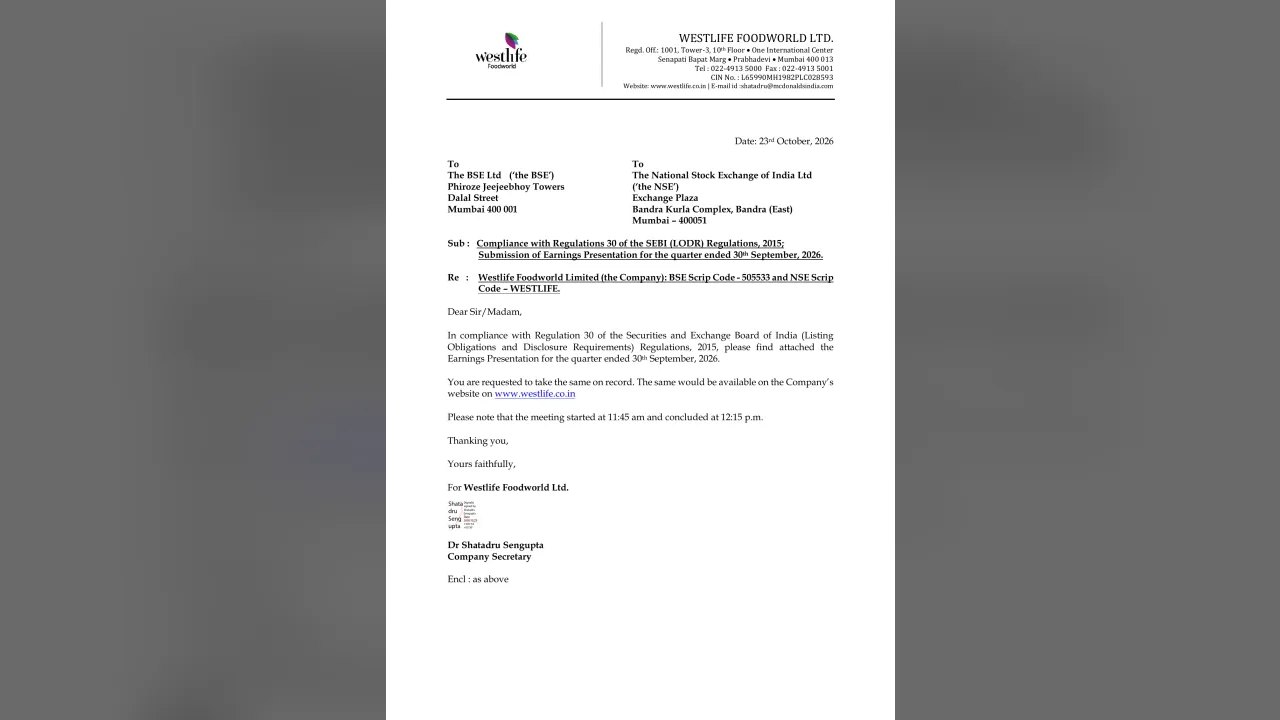
Westlife Foodworld (NSE:WESTLIFE) Q2 2027 earnings call, held 2026-10-23. Watch the replay and read the transcript on 6ix.
On 6ix: 6ix.com/event/westlife-foodworld-limited-westlife-q2-2027-earnings-call
Automated transcript · Written by software from the replay's audio. It can mishear names and figures; the replay is the record.
0:00 Ladies and gentlemen, good day and welcome to the WESTLIFE FOODWORLD LIMITED Q2 FY 'twenty seven Earnings Conference Call. As a reminder, all participant lines will be in the listen only mode, and there will be an opportunity for you to ask questions after the presentation concludes. We would like to remind you that the certain statements made by the management in today's call may be forward looking statements. These forward looking statements reflect management's best judgment and analysis as of today. The actual results may differ materially from the current expectations based on a number of factors affecting the business. Please refer to the safe harbor disclosure in the earnings presentation.
0:46 I now hand the conference over to Mr. Chintan Jasul. Thank you, and over to you, sir. Thank you. Good evening, everyone, and thank you for joining us on WESTLIFE FOODWORLD earnings conference call for the second quarter ended 09/30/2026. I am Sintan, Head IR at WESTLIFE FOODWORLD. From the management team, I have with me Mr. Akshay Kattiya, President and CEO Mr. Saurabh Kaldra, Managing Director and Mr. Sagul Doshi, Chief Financial Officer. As always, we will begin today's session with Akshay sharing his perspective on company's overall strategy and outlook. This will be followed by Saurabh taking us through the key operational and financial highlights. We will then open the forum for question and answer session.
1:32 Throughout the call, we will refer to earnings presentation and financial releases, which are available on the NSE BSE as well as Investors section of our website. With that, I now request Akshay to commence the session. Thank you, and over to you, Akshay. Good evening, everyone, and thank you for joining us. This is a significant quarter for us. October marks thirty years of McDonald's WESTLIFE in India. And next week, we'll be opening our five hundredth restaurant. These milestones are a reminder of how far we've come, but more importantly, they reinforce our confidence in the opportunity the market presents ahead. This quarter, we delivered our strongest performance in thirteen quarters with double digit growth in both guest count and same store sales.
2:26 Revenue grew 16%, reflecting broad based strength across markets and channels. What is particularly encouraging is that this growth was driven by more customers choosing McDonald's more often. At the heart of this performance is a strategy that remains simple and consistent. We are focused on strengthening our value leadership, staying relevant to customers and delivering a great restaurant experience every time they visit us. Our everyday value platform continues to resonate strongly, helping drive guest growth and frequency. Through our LET'S family at McDonald's platform, we continue to strengthen the emotional and cultural relevance of the brand, reinforcing McDonald's' place in the lives of consumers across generations.
3:20 The consistency of these results reinforces our belief that value, relevance and execution remain the right levers to drive long term growth. Importantly, we are also growing responsibly. Strong same store sales growth translated into healthy margin expansion with operating EBITDA growing 29% year on year during the quarter. Our focus remains on building a business that can deliver sustainable growth while creating long term value for all stakeholders. We continue to see significant opportunities ahead. Our restaurant expansion strategy remains disciplined and we remain focused on building presence in the right markets through the right formats while maintaining prudent capital allocation.
4:13 As we celebrate thirty years in India, our focus is firmly on the future. The momentum we saw through the quarter has continued into October, giving us confidence as we enter the festive season. Our priorities remain unchanged, strengthen our value leadership, grow guest counts, run great restaurants and expand profitably. With a strong brand, a growing restaurant network and significant runway ahead, we remain excited about the next phase of growth. Thank you. And with that, let me hand it over to our Managing Director, Saurabh Kalra, to take you through the quarter in great detail. Thank you, Akshay, and good evening, everyone. Also wishes for Dushera and the upcoming festive season.
5:04 Q2 marks expected acceleration in our business performance. Revenue grew 16% year on year to INR 7,470,000,000, our strongest top line growth in the last thirteen quarters, while same store sales grew also grew at a double digit 10.1%. Most encouraging, guest count grew in double digits in each month of this quarter, demonstrating the strength of consumer demand and effectiveness of our brand plus value strategy. Our Next Family at McDonald's and Everyday Value platform continue to be the key driver of consumer traffic, helping us strengthen frequency and drive higher restaurant sales. Both on premise and off premise channels delivered a healthy growth of seventeen percent and fifteen percent, respectively.
5:55 These results reinforce our belief that the customers continue to respond positively through a combination of brand, value, convenience and consistently strong restaurant experiences. Digital also continued to play an important role in our business. Digital channels contributed over 75% of sales during the quarter, increasing by around 60 basis points year on year. We now have more than 58,000,000 cumulative app downloads and approximately 4,200,000 monthly active users. As we have said before, we will we view digital not simply as a channel, but as an important enabler of convenience, frequency and customer loyalty. The strong top line growth also translated into meaningful profit expansion.
6:45 Operating EBITDA grew 29% year on year with margins expanding by 130 basis points to 13.1%. This was achieved despite absorbing over 190 basis points of inflationary pressure across commodities, utilities and employee costs. The quarter once again demonstrated the strength of our business model, with higher sales flowing through to the profitability through operating leverage and disciplined cost management. Restaurant operating margin remained healthy at 19.3%, while cash tax stood at INR52.526 million, representing 7% of the sales. We also continue to expand our restaurant network during the quarter, opening 11 new restaurants, taking our total footprint to four ninety two across 80 cities now.
7:37 As we approach our five hundredth restaurant milestone, our expansion strategy remains disciplined and focused on long term value creation. We continue to see significant opportunity across existing and emerging markets and remain on track for our targets of five eighty plus restaurants by March 2028. Overall, we are pleased with the progress we have made this quarter. Strong guest count, double digit same store sales growth, margin expansion and continued network development reinforces our confidence in the business. While operating environment remain dynamic, our strategy remains unchanged, drive discount growth through value and relevance, obviously having with us with a strong brand, execute consistently and deliver sustainable profitable growth.
8:28 With that, thank you. Now Akshay, Shardul, who is our CFO and myself will be happy to take your questions. Over to you. Thank you very much. We will now begin the question and answer session. Anyone who wishes to ask a question may press star and one on the touch tone telephone. An operator will take your name and announce your turn in the question queue. Participants are requested to only use handsets while asking a question. Ladies and gentlemen, we will wait for a moment while the question queue is assembled. The first question is from the line of Satish Deshmukh from IFL Capital.
9:20 This is Persi Kansaki here. So just wanted to understand this quarter, what has been the Y o Y movement in promotional intensity as a percentage of sales, which probably gets captured either in the COGS or the sales as well as the movement in the ad spends? Thank you very much for the question, but I don't think we operated like that. For us, is actually a strategy and a platform, which has got various aspects. And we have only strengthened the value platform without giving any extra discount over any of the previous quarters. So we have got the INR99 deal which you see. We have got GMA Lite and we have also got discounts which we do with the partners. I would argue we've actually reduced a lot of discounting and that's helped us improve some of the inflationary pressures we had without touching too much on the pricing. So that's how we have looked at it. I don't think any discounts have increased. But value remains a platform for us and you will see us continually improving and enhancing the strength of the value platform.
10:39 Got it. And secondly, would you be able to call out the impact of inflation either in terms of food cost or in terms of power and fuel or any other of the line items, wages, etcetera? The endeavor here being that if this was a normal inflation quarter rather than the high inflation that we are seeing in the economy right now, how much of extra EBITDA margin we would have been able to garner? Okay. The inflationary pressure, like I spoke in my when I was speaking, was around 190 bps. Needless to say, it was across line items. But when I look at inflation, we are always been living in India. In the last fifty years, 6% to 7% inflation is a given across commodities, line items, etcetera.
11:34 While there were a few extraordinary inflation, which came in, especially around employee cost, around one or two commodities, which were usually spiked, I wouldn't bother too much. But if everything if inflation wouldn't have fit and would have been working what it was last quarter, 190 basis points means we would have been better by 190 basis points. So that's what it is. Understood. And any line of price increase that we have either during the quarter or even on a Y o Y basis, is there any sort of price increase that we have taken? So pricing for us is a very, very strategic lever. There are a lot of sub levers under it, and therefore, we do not give out the direct pricing increase, where it happened, how it happened because we don't take a single day where there is pricing increase. We typically take around 3% to 4% price increase over the year.
12:34 We will continue to do so this year. Yet we haven't taken any big price increase for the year at all. We have worked on optimizing a lot of discounts, etcetera, more than taking price increases here. Okay. That's all for me. Thank you. Thank you. The next question is from the line of Devanshu Bansal from MK Global. Please go ahead. Yes, sir. Hi. Congratulations on a great set of numbers. Sir, just following up on the previous question. So this 3% to 4% price hike, whenever you sort of bake it into your P and L, so does that imply that we may sort of gain 190 basis points margins over the next few quarters? Is this the right way to look at it? Or your focus will still remain on passing that to consumer?
13:34 So that's not exactly how it works, Devanshu. I think we take a price increase to absorb half of inflation in terms of the pressures that we see as a principle. In addition to that, we have a lot of cost saving initiatives. But at the same time, in this dynamic environment, it's not exactly how that works because every quarter as well as year on year, you're seeing a lot of impacts, whether it's due to volatility of commodities, labor costs have just gone up substantially as an extraordinary impact. So I don't think that that's exactly how you can see it, but it will definitely help us cushion the impact of inflation. And through all our cost saving initiatives, we have given guidance and we'd like to maintain that, which would be around 100 to 150 basis points improvement in profitability year on year.
14:25 Okay. This is very helpful, Akshay. And secondly, sir, we have taken multiple interventions in terms of everyday value, merchandise based marketing, cafe monthly offer, and also from organizational restructuring point of view. The PPT also talks about some more consumer activations, which are in the pipeline. So I wanted to check if we have extracted the juice or this improving trajectory of SSG can continue in the coming quarters as well. So if you could just throw some light there. So as Saurabh said, right, we're going to continue to strengthen our value platform. And a lot of these interventions have been taken keeping the customer at the center.
15:14 Most of them relate to our value or everyday value platform as we call it, because it's about value meaning different things for different customers. So as we've always maintained, it's not only about price. Obviously, our $99 price point is an entry price point. But what stands out for McDonald's or differentiates McDonald's as a brand is that we can offer value to all different types of cohorts. So we're going to continue to keep intervening with the customer at the center to keep giving the customer value. And as a result, we're quite confident that which we're quite confident that this being a great guest count driver will continue to help us maintain the momentum of growth. Fair enough, sir. Lastly, sir, there was quite a difference between growth of West and South regions. So now the commentary mentioned that it was more broad based.
16:09 So have we... Have the... Has the growth converged across both these regions or there is still a gap between South and West? So as we've mentioned in the commentary, it's broad based growth. A lot of our interventions remain the same in terms of how to offer value for our customers at a high level. Obviously, each region has its nuances. So value could be slightly different for a customer in Bangalore versus Chennai versus Mumbai. But I think the levers still remain the same in terms of our menu and our pricing offerings. So I think that that is one clarity that we have. And secondly, as a result of our interventions, particularly even on the operating side, which is to ensure that customers get a great experience in our restaurant, as we mentioned in the past, we've strengthened our operating structure in the South. And as a result, we're seeing broad based growth now. I think that the growth numbers are converging.
17:07 We don't give out a detailed breakup, but it's not as stark as it was before, and it will continue to improve. All the best and festive greetings to the team. Thank you so much. Thank you. Thank you. The next question is from the line of Tejas Shah from Aventispa Constitutional Equities. Please go ahead. Thanks for the opportunity, and congrats on good set of numbers. So just broadly to start with, two results have come out from the sector, and both are indicating that there is some strong revival after a lot of some quarters. So at at the count level, how much of our I'm sorry to interrupt you, mister Shah, but your voice is not that clear, sir. It is sounding little muffled.
17:53 Can you please check? Yeah. This is better. It's still the same. If you are on a Bluetooth, can you please disconnect and connect on the normal handset mode? I'm actually not. But... Hey. I'll I'll I'll log in and ask question. Thank you. It was better, Nava, just when you spoke. I would request Mr. Tejusha to please rejoin the queue. We'll take with the next question, which is from the line of Hardik Kapoor from Investec. Please go ahead. Hi. Good evening, and congrats on excellent results. Just two questions. Firstly, if you look at quarter one, was transaction growth strong in double digits, guest count growth was also strong, But there was a gap between same store sales growth and transaction guest count growth.
18:41 Just wanted to understand, has it seems like that gap has partly been bridged this quarter, if not completely, between SSSG and the transaction discount growth. If you could just help us understand, firstly, is that the case because it looks like? And secondly, what has driven this? Because you've mentioned that price increase has not been a main material factor you know, going from q one to q two. Is it check size, you know, growth because of, you know, more product coming in? You know, this is in the context of the fact that value has probably share has gone up. And despite that, you've seen this convergence. Just some qualitative, quantitative comments on that would be helpful. Okay.
19:28 Very clearly, I think it is a classical case of how QSRs behave not only just in India, everywhere else. Again, we have seen enough cycles in McDonald's in India to know that the first thing we wanted to turn around was getting a lot of people back into McDonald's, the usage and penetration to come back. And if you remember, when we had talked about last year on after Q2, we had talked about that we are going to take a sharp turn towards value and be able to get a lot of consumers in. And we started seeing this momentum come from last year December onwards, and we talked about achieving a double digit guest count growth from December, January onwards. And after that, we said that it's quite easy to improve a little bit of check. The heartening thing is that that momentum of a double digit guest count growth is continued till now.
20:19 We do not see a problem. For us, that's number one priority. Because on the average ticket size, I think it's easier to do a far more easier job to do. And normally, it's not a very well sustaining platform if you're coming through what the if you're not getting volume growth, but only value growth. So for us, we are McDonald's and globally, when I look at McDonald's volumes in terms of the number of customers we serve, we are heads above everybody else. And that's what we exactly want to do in India. So if you look at it from that standpoint, we've been very, very focused on the volume growth. Needless to say, every quarter passing by, first guest count comes, then sales comes, then profitability also comes as operating leverage. So we have followed that path and we've been very disciplined around it. We are not we are like Ashi also mentioned, we are saying value is our key platform and we continue to work on that and continue to get customers in our restaurants through that.
21:23 Got it. Got it. Got it. And second bit was, mentioned value, think, but value, if I'm not wrong, is still kind of single digit share in in your overall overall mix. I just wanted to, you know, get your sense of when this number, you know, increases significantly over the next maybe, you know, two years or so, How it... How does it kind of impact your, you know, the the gross margin, the operating, you know, margins of the business? Or or do you believe that value brings the guest in and then, you know, check size can be managed post? So just wanted to get some sense of where we are now as a percentage of the business and an increasing number there. How, you know, how can... You know, how does it, you know, impact the unit economics?
22:13 So obviously, we do a lot of experiments before launching something in. So last year also, we started experimenting with the 99 back in July August. We exactly knew how it's going to play out because we have factored everything what it meant for us. And we believe in HRPL that everything has to give operating leverage. And to me from that standpoint, I don't think anything has changed. In fact, our belief on the value platform strengthening has become even higher. And we believe that it's not going to only give us top line, but also give bottom line growth, like even in this quarter, while the sale has grown 16%, if you look at the operating EBITDA, they've grown almost 26%. So there has been a the profitability increase is far higher than the sales growth. And you will continue to see that playing out. That's what we are seeing out here when we are seeing the value platform from our vantage point.
23:08 Got it. And one last question, if I may, was in the last six months, you know, there has been this inflationary challenge. There has been, you know, challenge of, you know, maybe some of the, you know, smaller players struggling a little bit either with gas costs or, you know, FSSI issues or or or any of those, you know, kind of challenges. I I was just trying to get your sense on how competitive intensity has paid out in the last, say, six months or so. Do you expect it? And and if it's a little on the lower side, do you expect it to stay, you know, this way? Can this be a further driver, you know, from kind of the the unbranded smaller players to the larger formats like you guys? Just a, a thought on how you're seeing this play out?
23:58 At the restaurant level, if you look at it, I don't think it's that complicated. We run our restaurant business. And we believe that if we run good restaurant, provide good entry affordable price point, and we've got to be value across our price points, right. So I would like to believe 100% of our product mix is value. Not so for example, a coffee can have a higher gross margin and yet can be valued at INR149, you can still make almost 80% margin, right, but it's still value. So value should not define gross margin or entry level price point only. So we've got to be value across the menu. I think our competitive advantages when we run great restaurant, when we execute with discipline on the value platform as a whole and we work on the brand simultaneously.
24:45 I think gotten some part of this right and there is a long way to go for us to continue on at this part with the numbers you've seen. Got it. Got it. I'll come back for more. Thank you very much. Wish you all the best. Thank you. Ladies and gentlemen, in order to ensure that the management is able to address questions from all participants, we request that you please limit your question to two per participant. The next question is from the line of Harish Advani from AXIS Capital. Congrats on a strong technology performance. My first question was on the quality of the guest count growth. So is this coming more from an increase in guest counts? Or with that, is it higher frequency?
25:37 Or is it that we are expanding customer base and then both of them can have different implications for the sustainability of the growth? That was my first question. Yeah. Sure. So I think that, obviously, when you have such strong guest count growth, you're doing a mix of the two. So we are definitely expanding our customer base because we're acquiring new customers and we are also making sure that across geographies as well as socioeconomic classes, people look at McDonald's as their first choice. And I think we've been able to do that quite successfully already, and we're going to continue to double down on this, which tells us there's a lot of growth in front of us. And secondly, we are working on increasing their frequency by continuing to strengthen our operating structure and our operating performance on the ground in terms of making sure that they come back by having a great experience in our restaurants. So I think that as a result, we're going to continue to see frequency to drive up as well.
26:37 So I think that's why you're seeing such healthy numbers continuing to sustain. Okay. Thank you. And my second and last question is on the regional value architecture. You mentioned that the value can be different things for different customers across the market. As we are increasingly tailoring our value proposition by market, are you seeing any meaningful differences in the frequency mix or ticket size between the two markets? That's my last question. So right now, I think we are pivoting on our everyday value platform as the foundation, which is our entry level price point, and we're seeing encouraging results across all regions. There are nuances in terms of what value means for different customers like I mentioned.
27:25 So we have a very robust framework internally where we have a standout everyday value platform and then force different segments of customers, we do different things in terms of levers of value. So whether it's segmented offers, whether it's different menu products in combinations and with value pricing, I think that we're still discovering what that means for different customers. But at the same time, we continue to use our foundation to drive guest count growth. So as a result, I think that we're going to continue to discover, but what it also means is that we're going to continue to have a lot of levers for growth because our everyday value platform has many levers to it. So I think that the two regions right now are being driven by the foundation of our everyday value platform, which is our entry level meal at 99.
28:15 But we are continuing to segment our customers and cohortize our stores to drive value across regions and trade areas using our diverse menu as well as our diverse pricing. Thank you and all the best. Thank you. Thank you. The next question is from the line of Ratika Chopra from JPMorgan. Please go ahead. I have a couple of questions. The first one, just circling back to comments on margins, and this is with regard to FY 'twenty seven. In first half, you have seen a 50 basis points improvement in C and D EBITDA margins. You talked about, you know, 100 to one fifty basis points, you know, annually over the medium term. So I just wanted to check whether this kind of a target is relevant or applicable for FY '27 as well. And more importantly, just trying to gauge what are you witnessing on raw material inflation trend incrementally.
29:17 Do you see this or gross margins, you know, given how the key raw materials are faring for you? Also, wage inflation and energy cost inflation, any specific initiatives you are undertaking to mitigate that? So just trying to gauge, you know, how should one think about the margin trajectory in the second half because some of these costs are in an inflationary mode? That's the first question. Thank you, Latika. I think like you've talked about, obviously, is some amount of wage inflation, especially in some of the states in South where Karnataka minimum wages went up quite dramatically more than what normal use case is.
30:05 And similarly, some commodities including oil went up substantially high. But I don't I think given all things constant, I would like to stick with the guidance which we have given around 150 basis points for this year for sure. Now unless something drastically, dramatically happens, we believe we are well equipped. In fact, even on the Bangalore minimum wage, we created a plan of how to mitigate that. So internally, we do a lot of work. Sharjil has got a team of cross functional people who work with him to ensure that all the inflation which is hitting us is mitigated in a structured manner without us impacting any consumer. Good news is when there is high amount of guest counts coming in, your volume increases.
30:53 And that also gives you some negotiation leverage even with the suppliers because not every inflation needs to pass on their fixed costs also fixed. So that helps definitely. So I'm quite confident that you will not see an adverse impact on gross margin from here on unless there is something dramatically wrong which goes answer, which we cannot predict. Sure. Thanks for that. Another way I wanted to check with you is we typically take minimum wage inflation as adverse for restaurant operators. But I wanted to check with you, do you think that also in a way, build a consumer base with better purchasing power, you know, at the market for you? And, similarly, in the broader economy, when you see a lot of inflation, do you think, you know, consumers moving to, a value format like yours?
31:49 I would like to believe so. Definitely, if I was to go with a lot of norms, which we look at it, normally, a person's minimum wage should be able to make him afford a good McDonald's entry level of proposition, which was which is not the case in India yet. They cannot not at the minimum wage level, to enter into a QSR is still not possible. In Bangalore, I think it will be possible. So it's an interesting it will be an interesting learning for us how we do this. But like I said, we need to keep our heads down, execute on value. There are things in our control, there are things not in our control, focus on the things which are in control and keep moving on. At present, as I see the business, we are very confident about making sure that we do fewer things better. And we believe that's the unlock for this growth momentum to continue.
32:40 Sure. And Yiren, one of the things that you're pretty focused on is your own delivery platform. I believe you were running some very specific initiatives in Mumbai in terms of quick delivery on your own platform. Just wanted to get some color on how has the scale up been, what's the feedback learnings been, and is it giving you more confidence to, you know, scale up this platform across all regions? And any any any flavor if you would want to share of your own delivery savings in own delivery platform savings in overall delivery sales versus aggregators? Definitely. It's almost we have brought back all the delivery rider into our fold.
33:25 We have done a lot of things in the West right now, especially Mumbai, like you rightly said, and we are seeing some amount of growth coming from there. But delivery largely has been broad based. I think our partnership again, has reignited quite well with both the third party operators too. So as I'm looking at the delivery, I think, is in a good space. We are quite confident. We are achieving double digit and we are confident of continuing to achieve this number. And as we are learning, we will roll out at some point in time. But right now, we want to be able to have a model in which we fully understand all the costs around it and then deploy to larger regions. Mumbai also has got a minimum threshold mass of delivery orders, which automatically come to us. So when I look at that growth, it is quite sustainable, which might not be the case for our own channel in some of the other cities. So we're working out all the logistics. We are not in a rush. We want to get it right. We don't want to do it by losing margin.
34:25 So that's definitely giving us a lot of confidence. But again, it is work in progress. Okay. And just one clarification. I think you mentioned you have taken 3% to 4% price hike. Is that what? No. I said we take 3% to 4%. Typically, take 50% of the inflation. Normally, inflation is 6% to 8%. Over the year, we take 3% to 4%. We don't tell that this is the month we take, this is the year we take because normally that price inflation includes reduction of discounts, etcetera, etcetera, etcetera. So there are multiple sub levers under any pricing strategy, so which obviously we don't give our details of. But cumulatively, weighted average, would like to take 3% price increase, 2% to 4%. We have actually taken around 2% in the last couple of years. So we don't like to take too much price increase because that's not in our DMA.
35:19 We would like to keep price increases as small as possible. But normally, our guidance is we take around 2% to 4%, 3% normally as price increase, and we will do that this year. Sorry to interrupt you, Mr. Dobram. Thank That was the last question. Thank you. Ladies and gentlemen, we would request you to please limit your question to two per participant. The next question is from the line of Rahul Agarwal from EQCISS. Please go ahead. Hi, Wili. Just a couple of questions. One is, you know, on the SSD 10%. What is the best way to understand this number better? Because one is, obviously, you mentioned in the PPT that guest count growth is double digit, which is what has driven this. Second data point is the average unit volume like for like stores, TTM is higher by 3%. I think that's not happened for a long time.
36:12 But if we break them down 10% into some cohorts, either bill cuts or average order value Or if we can combine it with average unit volume with something else to understand how this 10% getting constructed, that will help? That's one question. And secondly, on the CapEx. First half, CapEx in the cash flow, obviously, is not commensurate with how many stores we have done. So I'm assuming that a lot of the stores will come up in second half. There is some CapEx is already upfronted in the cash flow. Just two questions over there. How much is CapEx per store right now, both for new stores and refurbishments? And for the full year, I think the number is going to be about INR300 crores, if you could just confirm that. Yes. So in terms of same store sales growth, I don't think there's too much more that we break out. Like we mentioned, most of it has been driven by guest count growth and that's even higher than the number that we've reported. But same store sales growth has continued driving upwards as Saurabh mentioned because as we bring more customers into restaurant, we're able to retain them and trade them off, which is core to McDonald's. So as a result, our growth has been broad based. We strengthened our operating structures on the ground. And as a result, even across regions and channels, we continue to see healthy momentum.
37:27 So I think that's answering the first one. So the other one which you're talking about 3% is a trailing twelve month data. Our comp sales would reflect over a period of time in that other slide also. Right now, it is 10.1% for this quarter. And we do not make any changes. It's like to like, like for like sales, absolutely same store sales growth. So that is an absolute number. If I was to cut it for the quarter, it would be exactly 10.1%. Yes. And sorry, just to clarify, these are two separate data points. So I don't think that they can be correlated. And we can always explain that offline if needed. And secondly, in terms of number of stores, we will be delivering the guidance that we've given in terms of 60 to 65 restaurants per year. Our per store cost, we don't break down regularly, but it's within the range of INR3 crores to INR3.5 crores per store and we continue to optimize CapEx despite a very volatile operating environment where all costs both on the capital and operating side continue to go up.
38:34 So dollar also has impacted as well as duties as well as technology costs. So I think that's some great work that we've done in terms of first of capital costs. But overall, I think our CapEx will be within the range of $2.50 crores to INR 300 crores. Got it so much. Got it. Thank you so much. And festive greetings to everybody. Thank you. Thank you. We have the connection for Mr. Tejusha reconnected. We will take him as a next participant, Mister Tejusha from WESTLIFE INITED INITUTIONAL INITUTIONAL INITUTIONALIFE FOODWORLD FOODWORLD LIMITED. INITUTIONAL and I'm sorry if this question FOODWORLD was asked LIMITED in between, I locked out.
39:33 So the composition of this footfall increase, is it are we getting new customers in the fold? Or are these are the lost customers who have come back and they are consuming more? So just the character of the growth that we are seeing now. So what we don't do is we don't because we don't take every customer's individual ID, I cannot give you that bifurcation even we don't have. But what we do is through a survey look at a data known as penetration and frequency. We do it across key cities. The good news is it's very broad based. We're finally getting a lot of new trials penetration, which means that most customers who did not come to MacDonald for six months or more, there could be absolutely new customers or customers who come after six months, either of them.
40:18 The number of that has increased. Also our frequency has gone up in from our internal data. So that's where it is. So it's largely broad based, both combination of frequency and penetration has worked when you look at this growth. Very interesting. And sir, we have seen it in past, in our category, but in some other categories, consumer categories in the recent past that there are such false start there, which happens for a quarter or two and then again it fizzles out. And then based on your experience of converging or mapping micro cycle to QSR cycle, how do you see this quarter's number? Do you see there's a restructure turnaround at least for medium term, which should sustain? Or is it a bit early for you to confirm that?
41:12 I think I answered that a little earlier also because if you look at it, we spoke about it in December when we said what we want to do is create a value platform, which will give us both guest counts, which are driving penetration and frequency. And we are not really worried about sales at that point in time. We then gave it in January, February, March, saying the momentum on guest count has reached double digit. Then we said it will translate into sales next quarter. It did. And then we talked about high single digit growth, which we want to be at a sustainable basis, banking upon high consumer traffic. I think the crux of it is what gives me confidence. Nobody knows the future, but what gives me confidence is the structure. And whenever we have seen in the past cycles, when we are in good stead is when the number of consumers working in the restaurants and ordering delivery is increasing at a great number, not only value.
42:07 Value is easy. If you're going to get growth out of bill value, I think it lasts for two, three quarters and then fizzles. When it gets down momentum, normally it's an indication that there is a sustainable momentum underneath, which is improving the base amount of consumers you have in the brand. So that's what I would believe and I would like to believe that this shows that it's quite sustainable and we are actually quite confident and excited about it. And sir, last one on the recovery in South, and if I have to kind of converge or reconcile it with the macro news, which are around all the IT hirings and the slowdown there. Definitely, our numbers and other numbers also are not suggesting any such slowdown.
42:55 Any nuance there in terms of IT heavy centers or IT park centers, are the numbers too divergent from what we have reported or they are as strong as what the broader consensus shows? Yes. A beauty of a great value platform, whether you launch it in South or West, is that it will bring in customers because it's an invitation and it also makes them stay because even if in an adverse condition, you might not be earning as much. What do you know this is still great value. And to me a lot of it is a function of in a business like McDonald's, how strong is that value platform along with the brand. Now if people are doubting the brand, then value platform might not work. But if both brand and value and running great restaurant work in tandem, it works out quite well. We have not seen too much of difference in Bangalore, Hyderabad at all as far as these IT areas are concerned. In fact, they have grown quite in line with what we have seen as growth in WEST, too.
43:57 Sorry to interrupt, Mr. Shah. We will request you to please rejoin the queue. Thank you. Next question is from the line of Rudraks Rehaja from iThought Financial Consulting. Please go ahead. Yeah. Thank you for the opportunity, sir. I wanted to check if there is any base kind of effect in our SSG number because Q2 last year was Navratra. So any meaningful impact of that in our business? We have never seen Navratri as an adverse or an improved impact. It is business as usual. And we've always maintained festivals come. They shift a month here and there. We've never maintained that, that makes any difference for us because we've got enough portfolio of even vegetarian products to be able to have celebrate for all occasions. That's why we pride ourselves in being a multi occasion, multi daypart omnichannel brand because we are able to cater to all consumers' need across the year. So I wouldn't look at Navaratri as positive or negative at all.
45:02 Got it, sir. And sir, from a footfall point of view, how is October and this quarter coming along for you guys? While we don't give any forward looking statement, we talked about the momentum being strong. And like I said, we are very, very optimistic and we are very our internal belief is that we will we should continue the momentum we have been able to build July, August, September. So high single digit we have maintained is a minimum for us for the growth which we aspire to do. We will continue that. It. Sir, if we go by the global McDonald's commentary, there's a slight shift from value to quality kind of narrative. So should we expect something like that to flow to Indian franchise also going forward?
45:56 So I don't know which data have you looked at it. I think McDonald's always finds itself as a core value being the core platform. Quality is how we run business, quality hygiene and how we run off business. Sometimes we highlight it depending on the needs of the consumer, sometimes we don't. But for us quality hygiene, these are all table stakes and combinations of the business. And value will always be intrinsic to the Macronage brand because that's who we are. And just to add to that, I think quality service, readiness and value as we call it internally is our foundation. So we always offer altogether. So it's not either or, it's always and. Sorry to interrupt. Maybe request Mr. Raheja to please rejoin the queue. Thank you.
46:43 The next question is from the line of Siddharth Neghandi from TWC. Please go ahead. Congrats on a good set of numbers, and thanks for the opportunity. Just to understand, on on inflation that we're seeing on the CPI front, especially food inflation, right, How do you perceive that as having an impact both on, you know, consumer demand, especially considering this is discretionary? And in that context, your need to take higher than the two or 3% price increase that you'd... You earlier alluded to. That was question one. Question two was given the footfall is really what has driven growth, would it be fair to say that delivery growth...
47:35 Same store sales growth and delivery is significantly lower than the overall 10% number? And and if you could give some indication of that, that will be helpful. Yeah. Those are my two questions. So so I think that in terms of your first question, we've answered it a couple of times. I think we have a very strong approach in terms of pricing as well as cost optimization. So as a result, I think this guidance we've given in terms of price increase will remain constant. We will take 2% to 4% year on year to mitigate inflation and make sure that our business further strengthens from a profitability point of view, but at the same time continue to offer customers great value.
48:21 So I think that's one. And second, in terms of its impact on customers, I think in fact we are a business that does really well when inflation is high because we are able to absorb it and continue to offer great value to our customers. So actually inflation in that sense is our friend because McDonald's is the one place where you get great value for money even when times are tough. So I think that that's something we have in our DNA. And number two, sorry, could you repeat that? The second one was breakdown of the SSG into dine in and delivery, if you could give some indication. Yeah. Yeah. I got that. So thank you. I think in terms of your second question, I don't think I would look at it like that. Like, we maintain our growth has been broad based. In fact, on premise and off premise, as Saurabh highlighted in his commentary, have both grown heavily at similar numbers, in fact, of 1715%, respectively.
49:24 So that signifies that our delivery also continues to grow and so does our dine in business as well as channels that are beyond delivery as well as channel as well as across regions. So as we mentioned, we're very encouraged and pleased that this growth is broad based and hence we feel that it is sustainable and we will continue to build this momentum. Got it. Thank you. Thank you. Participants who wishes to ask a question, please press star and one. As there are no further questions from participants, with that, I now hand the conference over to management for closing comments.
50:17 Great. Thank you so much for joining us, everyone, and wishing all of you all a happy Diwali and looking forward to speaking to you all next quarter. Thank you. Thank you. Happy Diwali. Thank you. Ladies and gentlemen, on behalf of WESTLIFE FOODWORLD LIMITED, that concludes the conference call. Thank you for joining us, and you may now disconnect your lines. Thank you.
Follow Westlife Foodworld Limited into a list and get an email when it puts out news.
Head IR at WESTLIFE FOODWORLD
President and CEO
Managing Director
Chief Financial Officer
at IFL Capital
at MK Global
at Aventispa Constitutional Equities
at Investec
at AXIS Capital
at JPMorgan
at EQCISS
at iThought Financial Consulting
at TWC