Replay available
Vontobel Holding (SIX Swiss: VONN) Q2 2026 Earnings Call
Vontobel Holding (SIX Swiss: VONN) Q2 2026 earnings call, held 2026-07-24. Watch the replay and read the transcript on 6ix.
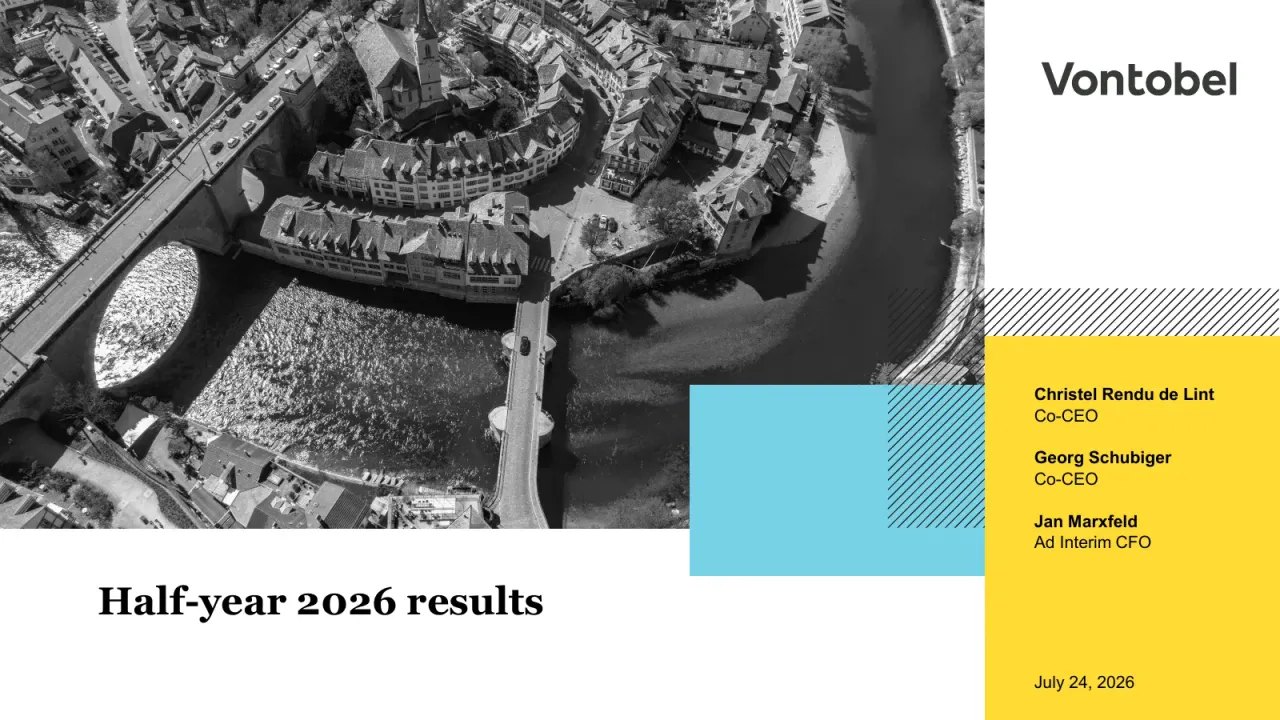
- Company
- Vontobel Holding AG (SIX:VONN)
- Period
- Q2 2026 earnings call
- Date
- Fri, Jul 24, 2026, 3:30 AM ET
- Replay
- Watch the replay on this page · 59 min
- Results news release
- Vontobel : achieves record half-year profit · Fri, Jul 24, 2026
On 6ix: 6ix.com/event/vontobel-holding-ag-0qke-q2-2026-earnings-call
Replay
Transcript
Automated transcript · Written by software from the replay's audio. It can mishear names and figures; the replay is the record.
0:00 Ladies welcome to the presentation of Vontobel's Half Year twenty twenty six Results Webcast. I am Atelio, the Chorus Call operator. I would like to remind you that all participants will be in listen only mode and the conference is being recorded. The presentation will be followed by a Q and A session. The conference must not be recorded for publication or broadcast. At this time, it's my pleasure to hand over to Georg Schubiger. Please go ahead. Good morning from Zurich and a very warm welcome from Crystal, Jan and myself.
0:48 Thank you for joining us for our half year 2026 call. We are pleased to report an excellent first half. We achieved record financial results and strong strategic progress. Chris and I will give you the highlights. Jan will then take you through the financials. After that, we look forward to opening the line and taking your questions. We had an excellent start to the year. We achieved a record net profit of CHF216 million up 87%. Assets under management reached an all time high of CHF252 billion.
1:36 We are delivering ahead of all our through the cycle financial targets. We maintain the strong liquid and well capitalized balance sheet. Our fast capital generation gives us flexibility to continue to scale our business and invest for growth. The strategic progress behind these results is equally important. We strengthened our investment platform by embedding quantitative and AI capabilities more broadly across investment solutions. In line with our strategy, we expanded our solutions offering to address growing client demand for more tailored outcomes. At the same time, the efficiency program is no longer just a program.
2:26 It is becoming visible in how we operate the firm. It is lowering our structural cost base, strengthening cost discipline and creating the capacity to invest selectively in areas of future growth. We are making targeted expansions in our focus markets in private clients. In Los Angeles, we are tapping into one of the largest and most sophisticated wealth pools in The US. In Dusseldorf, we are strengthening our presence in one of Germany's most attractive regions for high net worth clients and family offices. This is designed to scale a proven model and support our next phase profitable growth.
3:12 Taken together, this first half shows both the strength of our franchise today and the potential of our business model as we continue to execute this discipline. Let me briefly recap the backdrop against which we delivered these results. Markets were constructive overall but conditions remained complex and volatile. In addition, visibility on the political landscape and its economic implications was lower than in previous periods. The escalation in The Middle East created a sharp energy shock in the first quarter. By the second quarter, markets increasingly looked through the geopolitical quagmire and refocused on earnings and growth.
4:05 Investors focus remains highly concentrated on technology especially companies linked to AI infrastructure and semiconductor supply chains. Equities were positive over the first half. Bonds were more challenged by persistent inflation concerns and a higher for longer rate outlook. Currency headwinds continued to impact us especially the strong Swiss franc and weaker U. S. Dollar. In this environment, clients needed analysis, guidance and flexibility. This is exactly where Vontobel adds value through active management, trusted advice and custom solutions. We are an active investment firm serving two client segments, private clients and institutional clients.
5:00 These are mutually reinforcing in skills and business and complementary in their diversification benefits. Both segments draw on our dedicated experts and our signal investment factory investment solutions which also includes our structured product capabilities. The relevance of our unique model is increasing. Markets are harder to navigate and clients are demanding more tailored advice and solutions. A generational wealth transfer is reshaping client needs across private and wealth. Vontobel is well placed to benefit as we combine investment expertise and customization in one integrated setup.
5:47 Our priorities are simple because our model is clear. We help clients navigate complexity through advice, active management and customization. We grew in markets and client segments where we have a clear right to win And we operate with discipline so that revenue growth flows through to profitability. The first half shows that this model is working, stronger client activity, record profitability and a clear operating leverage. Investment solutions is at the core of Vontobel. We have flagship strategies across all major asset classes and distinctive structuring capabilities.
6:34 We are also expanding private markets including the next Ancala Fund and the first fund in '24 Asset Management. Vontobel Solutions builds on that foundation. The new unit within Investment Solutions is designed to connect and combine these capabilities to systematically turn them into scalable tailored outcomes for clients. There is clear client demand. Markets are more concentrated. Correlations have been shifting and macroeconomic and geopolitical drivers are harder to predict. More than before, clients are looking for solutions built around their own goals and constraints. They want portfolios designed for the outcome they need, not off the shelf products.
7:24 This is where Vontobel can win. We have the building blocks: investment expertise, quantitative tools, portfolio construction, risk management and structuring capabilities. We already know how to assemble them at scale, drawing on the systems and approach we already apply in private clients. We are now scaling it more systematically for institutional clients. For clients, Vontobel Solutions brings tailored portfolios to precise investment needs. For us, it provides access to an attractive and growing market that plays to our unique strengths with a clear strategic fit. And now over to you, Crystal. Thank you, Georg. Let me start with institutional clients where we see positive commercial momentum.
8:15 We have executed our institutional client strategy with discipline. The focus has been clear, sharpen our coverage, improve client experiences and ensure our best capabilities reach the clients and markets where demand is strongest. That is now reflected in how we operate. We holistically engage clients around the problems they need to solve, bringing the relevance and total capabilities into that conversation. We work more closely with our clients combining global reach with selective strong local coverage. Our client processes are more efficient and faster that is more consistently converting demand into mandates and flows. Indeed results are clear. In the first half, we saw improved flows, margins and revenues.
9:06 Reported net new money growth was minus 1.5% reflecting the known effects from Rifaizen and quality growth. However, the underlying picture is much stronger. Excluding these two known effects, growth was 7.4, well above our through the cycle targets. This shows that the underlying business is growing with solid momentum. This is particularly clear in fixed income where we achieved annualized net new money growth of 15%. Strong client demand and a healthy product pipeline position us well for the second half. Taken together, institutional clients is becoming sharper and ready to scale again, converting invested demand into profitable growth.
10:00 Turning to private clients where we delivered strong growth and continued to expand in our focus markets. Revenues grew by 32% and assets under management stood at an all time high of CHF132 billion by half year. The result was driven by strong client activity and demand across our offering specifically advisory and discretionary mandate as well as structured solutions. We attracted CHF2.5 billion of net new money. This represents 4.1% annualized growth within our through the cycle target range of 4% to 6%. Importantly, inflows were positive across all regions.
10:48 This confirms the strength of our investment led approach and of our focused market strategy. We win clients with investment expertise, not through balance sheet credit. More than 90% of our assets are in developed and Western markets. We selectively hire and develop top caliber relationship managers who can grow with our investment led approach. We are strengthening the foundations for future growth by expanding in focus markets where we see clear client demands. In Los Angeles, we opened our first West Coast office in one of the largest wealth markets in The United States. Through Vontobel's Swiss financial advisors, we can serve the demand for international diversification.
11:39 We give clients access to global portfolios and Swiss custody fully within The U. S. Regulatory framework. In Germany, we will open our Dusseldorf branch in North Rhine Westphalia, one of the country's most important economic regions. We will serve individuals, family offices, entrepreneurs by offering diversification and our unique investment expertise. In sum, Private Clients continues to deliver recurring high quality growth at conservative risk levels. We are excited to continue scaling this business. Let me now turn to costs. The efficiency program is delivering beyond its original targets.
12:28 We will complete the program by year end and realize further efficiencies as the remaining measures are implemented. I want to emphasize that we do not view this as a short term cost exercise. The program was always about structurally improving our efficiency and embedding stronger cost discipline across the organization. Our structurally lower cost base and stronger cost discipline are already clearly visible in our results. On an adjusted basis, our cost income ratio improved to 66% in the first half. That is 12 percentage points lower than three years ago and significantly better than our through the cycle target of 72%.
13:19 We achieved this while at the same time continuing to invest for growth. Our objective is to grow with scale. That scalability is what creates operating leverage, higher revenues would therefore in the future translate into higher profitability. Let me close this section with our targets. In the first half of this year, we operated ahead of all our through the cycle targets. Assets from the management reached an all time high. Operating income grew strongly. Return on equity and the cost income ratio were both clearly ahead of target. Our capital position also remains strong giving us the flexibility to continue scaling the business.
14:10 This is an excellent first half performance. It gives an indication of the potential of our differentiated unique business model as we continue to execute our strategy with discipline. And with this, let me hand over to Jan to cover the financials. Thank you, Kristel. Good morning, everyone. I am very pleased to report that the strong strategic progress set out by Kristel and Georg is clearly visible in our financial results. We delivered record profits, clear operating leverage and further strengthens our balance sheet and capital position. Looking at the chart on the far right, you can see that profit before taxes reached $273,000,000 up 84% year on year.
15:02 Net profit reached $216,000,000 up a remarkable 87%. The main driver was strong revenue momentum with revenues up $191,000,000 Of course, stronger performance means that we must accrue for variable compensation. But importantly, cost excluding variable compensation declined. This clearly shows the positive effects of our efficiency program and the scalability of Vontobel's business model. These results were delivered despite continued foreign exchange headwinds. We saw a higher average U. S. Dollar exchange rate when comparing the first half of twenty twenty five with the first half of twenty twenty six.
15:54 As a result, dollar revenues we earned translated into fewer Swiss francs. Without that effect, profit before tax would have been around CHF30 million higher. Let me walk you through the main drivers behind these record results starting with assets under management. Assets under management reached an all time high of two fifty two billion euros up 5% from year end. The increase was supported by positive net new money, market performance and foreign exchange effects. Over on the far right of this slide, private clients contributed $2,500,000,000 of net new money equal to 4.1% annualized growth.
16:41 This is within our target range. Inflows were positive across all regions with strong demand for advisory and discretionary mandates. This growth was investment led and not driven by lending. In fact, lending balances declined slightly which underlines the quality of the inflows and the continued relevance of our investment led model. In institutional clients reported flows were reduced by two known effects: the insourcing of the Futura Funds by Rifeisen until July 2027 and continued outflows from our quality growth boutique due to the current market trends that do not suit its distinct and defensive investment style.
17:30 Excluding these effects, the underlying picture is very strong with a net new money growth rate above our target range. Not on this slide, but I would like to mention that in fixed income our boutiques achieved an impressive 15% annualized net new money growth. Over both businesses PC and IC adjusted net new money for the group was €6,300,000,000 equaling a growth rate of 5.9%, which is at the upper end of our through the cycle target. That brings me to revenues. Operating income reached $852,000,000 up 24% year on year or 29% in constant currency.
18:18 We saw higher income across all major revenue categories. Net interest income increased despite the low rate environment. This was because the deposit mix shifted toward lower cost funding. Net fee and commission income benefited from the higher asset levels and better margins. Trading and other income reflected strong client activity in structured solutions which achieved a record year half year. Demand was exceptionally strong in the first quarter and remained strong in the second quarter. Vontobel's broad product offering, technology platform, distribution network and our ability to issue products swiftly allowed us to capture client demand across changing market themes.
19:09 Other income included an $8,000,000 gain from the divestment of Cosmo Funding announced in February. By client unit, private clients revenue grew strongly supported by structured solutions activity and higher asset levels. Institutional clients revenues also grew supported by higher margins and asset levels. Let me now turn to margins. In institutional clients, the margin improved to 35 basis points. This was supported by success in higher margin areas including fixed income. In private clients, the margin increased to 104 basis points. This was primarily driven by strong demand for structured solutions.
19:59 The recurrent fee margin in PC reflected two offsetting effects. Our success in the ultra high net worth segment has put some pressure on the recurring margin as larger clients typically deliver a somewhat lower margin. But strict revenue management has almost offset this. Moving to cost. This slide shows the operating leverage in our results. As mentioned before, operating income increased by 24%, but operating expenses increased by only 7%. And the increase in expenses was driven by higher variable compensation linked to the stronger performance. Crucially, cost excluding variable compensation actually declines.
20:49 This is an important point. It shows that the structural cost base continues to improve and our business model scales effectively. I'm very happy that our efficiency program is bearing fruit. It has now reached 116,000,000 of cumulative accelerate savings well ahead of our original €100,000,000 target. As a result, the cost income ratio improved significantly falling a full 10 percentage points to 67.9%. Adjusted for cost to achieve and M and A related items, it was 66.4%. Those numbers are well ahead of our through the cycle target of 72%.
21:40 Let me now shift from performance to resilience. Vontobel continues to operate with a strong liquid and conservatively managed balance sheet. Total assets increased to $8,300,000,000 This was mainly due to higher client activity and seasonally higher settlement balances. Our balance sheet remains fully mark to market and supported by a high level of liquid assets. Earlier this year, I was pleased about the issuance of a further $250,000,000 senior unsecured bonds which was met with high investor demand. This built on the success of last year's first issuance on continued to diversify our funding base.
22:26 We also maintained a very comfortable liquidity and funding position with a liquidity coverage ratio of 148%. As a truly investment led and not credit led firm, we view lending only as an offering to support client relationship in very strictly defined areas. The lending book therefore remains deliberately conservative and modest compared to peers. It comprises $2,200,000,000 of Swiss mortgages and $5,600,000,000 of Lombard loans. Structured Solutions continues to be managed with tight risk controls supported by careful treasury and liquidity management. This disciplined approach is also reflected in its long term track record with the business having operated profitably for every year for more than twenty years.
23:25 Our strong balance sheet is matched by a very strong capital position. The CET1 ratio increased to 23.2% and the total capital ratio reached 28.1%. CET1 capital increased to $1,500,000,000 while risk weighted assets declined slightly to 6,500,000,000 This mainly reflected lower exposure from hedging positions linked to client driven structured solutions. At 23.2%, our CET1 ratio is well above our 12% internal target. This reflects a strong capital generation and capital efficiency of our business model. This surplus offers us strategic flexibility.
24:12 It gives us the capacity to fund organic growth, acquire the remaining Ankala stake over time and absorb potential regulatory impacts. It also gives us options to pursue inorganic growth opportunities such as acquisitions with a strong strategic fit. Let me now turn to value creation. This is where the financial performance translates into shareholder value. The key point is the capital efficiency of business model. We can grow without significant capital consumption. That allows earnings to translate into tangible equity growth while still supporting our attractive payout ratio target of 50%.
25:00 Tangible book value per share increased by 8% in the first half of the year. And this is not just a first half effect. Since 2014, tangible book value per share including cumulative dividends has grown by 227%. Our return on equity was 16.9% clearly above the estimated cost of equity of 8.5%. And again, this is not a one off result. For more than a decade, we have operated above our estimated cost of equity. Put differently, Vontobel has consistently generated shareholder value in every single year. Let me close the financial section by bringing the key points together.
25:51 We delivered record profitability. We operated above our through the cycle targets. We achieved an all time high assets under management. Margins increased in both client units. Our efficiency program is visibly improving our structural cost base and is helping making our business model scale effectively. This translated into clear operating leverage and a cost income ratio of 67.9%. Our balance sheet remains strong and liquid and our CET1 ratio increased further to 23.2% well above our internal target. Finally, these results translated into shareholder value. Tangible book value per share increased to CHF 36.5 per share, up 8% in the first half.
26:44 Taken together, these results indicate the potential of our business model, the clear results of our disciplined execution and the strategic progress we are making. With that, I hand back to you, Kristin. Thank you, Jan. Georg and I would actually like to take this opportunity to officially thank you, Jan, for your outstanding leadership and commitment as Interim CFO over the past month. You successfully guided the finance function with dedication during this period. So thank you very much and we look forward to continuing working closely with you going forward. To recap and conclude this call, we delivered an excellent first half of twenty twenty six with record financial results, a strong balance sheet and capital position and clear progress across our strategic priorities.
27:35 Our unique integrated model remains a strength and differentiator for Vontobel. The results we report today give a clear indication of the value this model can create for our clients and for our shareholders. We will continue to execute with discipline and carry this momentum into the second half. Thank you for joining us today. We are now happy to take your questions. We will now begin the question and answer session. Participants are requested to use only handsets while asking a question.
28:25 The first question comes from the line of Carole Rodinski from Octavian. Please go ahead. Good morning. Thank you for taking my questions. I have three, if I may. So first one is around the Raiffeis and Futura assets. So if I'm correct, the outflow in first half of the year was associated with Raiffe and Futura was 4,600,000,000. And the total was, if I recall, 14 13,000,000,000. So could you maybe share some insights in terms of the timing of this outflow.
29:17 So it will stop at mid-twenty twenty seven, but how much should we expect for this year and how much should we expect for the first half of twenty twenty seven? And then the second question, more general. So 47% of your clients are domiciled in Switzerland, right, as a whole. And if you could maybe share some information what that this split look like between the two segments? I particularly am interested in the in this split by domicile in institutional clients division? And the third one is if you may show some insights into what the structured products look like in the second half of the year.
30:11 Thank you. All right. Shall I start with your first question, Carol? Maybe to put this into perspective because I don't think it's 100 correct. So we have reported net new money flows in our financial statements in IC of minus 0.8. And for the presentation, we add there the flows of institutional nature, which were plus 0.8. So, it's the flat which you have been seeing in our presentation or in my part. Now, in terms of these two known effects and how they are quantified. So, actually, there's EUR 1,300,000,000 of outflows for Reif, Eisenfutura, which we observed in the first half, not EUR 4,600,000,000 to EUR 1,300,000,000 on an asset base of around EUR 12,000,000,000, which is left, so just 10% of it. From the timeline perspective, you're right, this is going to be handed over fully by July 27.
31:18 So then obviously, by then all of these assets will be gone. And we will obviously also report like how much that is. I would think that the most of it will go out in '27. But that depends a bit on the decisions made by high prices. May I also then jump to your third question, products. So I mean, obviously, the macro environment, we have observed is actually very positive. But And also we have to see that from the way this business is set up.
32:04 So it's a very scalable, fully digital platform, very good distribution channels and the ability to swiftly issue products that also helps us to capture these flows. And we have a very good market position in our main two markets here in Switzerland and Germany. So, while there's obviously always an uncertainty about the prediction of the macro environment, we believe that the business itself is very sound and also over the last couple of years developed positively. And we think that this may continue. Let me say a few words about the client domiciles. I think first it's very important to be aware that we have a much higher share of Swiss domiciled clients as many of our competitors. And we believe that it's actually an asset because many risks associated with other markets, emerging markets are simply not present here. It gives a lot of stability.
33:06 Secondly, I think it's important to differentiate between the private client business and the institutional business. While we don't give a breakdown in assets, we do say that on the private client side, we are much more oriented towards Western and developed countries. So that several European countries that are our focus countries, that's The United States with Canada, very selective Latin American countries, and and South Africa. Whereas on the institutional side, we are truly global. In the usual side, we also cover Asia. Asia, we cover Japan, we even cover Australia.
33:53 But that has a lot to do with the risk appetite, with the risk involved in the business that are simply different. Thank you very much. The next question comes from the line of Nicolas Herman from Citi. Please go ahead. Yes. Good morning, guys. Hopefully, you can hear me okay. I I know that in the past you have struggled sometimes. So just wanna check if you can hear me first. Hello? We can hear you loud and clear. Super. Thank you. 3 from me, please, as well. So firstly, on the dividend, can I just ask why are you accruing at a payout of 40%?
34:47 And just if you could just remind us the dividend policy there. Secondly, you've got GBP 700,000,000 of surplus capital. You have outlined some capital needs. So could you just help us understand how much is true surplus? And it sounds like M and A is finally back on the table. So if you could help us understand what are you looking at. And then the final one is on equities in institutional clients. It looks like the equities AUM has fallen year to date despite super strong markets outside of the GBP 2,500,000,000 of quality growth outflows.
35:33 Am I correct that there was still net outflows in equities? And can you provide more color there, please? Thank you. Okay. Thank you for your questions. I may take the first two ones. So on dividend policy, we are committed to our cycle target of dividending out at least 50% of our profits. And obviously, the actual dividend is being set by the Annual General Meeting after the full year has closed and we have seen the entire results. So then we can discuss this further.
36:19 On your second question on the capital needs. So, yes, I mean, of course, you can say maybe you did that the difference between the 23.2% of CET1 ratio and our 12% minimum ratio. And I think for the capital, which we have there, we needed for the Ankala acquisition, which is close or the remaining stakes we will acquire in the next couple of years. That depends also on how Ankala develops. So the better it develops, the higher the price will be for that. And that's uncertain at the moment. Secondly, we are as you have seen our business is growing nicely. And although many of our positions are hedged and we are balance sheet light, we still need certain capital to fund and support this organic growth.
37:18 Then we have the discussion currently in Switzerland about certain regulatory measures, which are mainly targeted against at UBS, but also may influence us. We believe that these rules come into force in 2028. So, that's also a bit of an uncertainty we currently have. In terms of M and A, as in the past, we are looking selectively at targets, which bring us either scale or skills, which we need for business. But there are no concrete ones, which we can talk about at the moment. On to equities, you are right that we had outflows. They are however linked to quality growth and high fives. And so outside of these, the equity franchises actually did grow. So you have MPX on EM, you have Impact and Thematic and you had the Swiss equity business, which was broadly flat.
38:21 The other two actually grew. So yes, linked to the two themes that we have specifically mentioned. That's helpful. Thank you. If I could just return to the M and A point. You have addressed the one of the areas of white space for you, which was private markets. So is the kind of preference or I guess where do you see gaps in capabilities? And it always the present is the preference to increase scale on the private client side? Thank you. Well, Simon, we've said that both are interesting for us, scale on the private client side within our focus market and skills where they are complementary.
39:06 So that doesn't mean that you necessarily have a completely different space, but you can have additional skills bolt on around an area where you actually build around an existing boutique or bring complementary skills. So that is more the way we're thinking about it. But there's no obvious white spot as you are mentioning. But both remain interesting, the scale and the skills. Very helpful. Thank you. I circle back a bit later, but I have a couple more, but nothing helpful. Thank you. We now have a question from the line of May Thiemens from UBS. Please go ahead. Yes, good morning and thanks for taking my questions. I have three of them, please. The first one would be on costs.
39:55 It appears you are well underway with the cost efficiency exercise. And then I'm wondering what is the expectation from here given you've already achieved 160,000,000 gross exit savings. Do you expect the amount to rise further from here? Any indication on the magnitude would be helpful. And the second question is on structured solutions. There the revenues doubled year on year and they're up more than 40% from the second half of last year. Could you talk about the drivers of such a strong performance that also appears to be substantially stronger than what we're seeing from of the sector peers? Has anything changed in the business structurally or tactically?
40:41 Has the outperformance mainly come from the bond side? And also if you could put us into the context of market risk RWA is essentially flat at year end levels? And the third question would be the flow outlook in institutional clients. It sounds like '24 and fixed income boutique are generating strong inflows. You're still seeing outflows from quality growth and then some mixed trends in other areas. What is your expectation going forward from here? What do you see in the market? And then let's put back by then for the rest of year. Thank you. Okay. Let me go ahead with the first question. I think Georg and Chris will do the other ones.
41:31 So on the cost, yes, so in terms of expectation, first of all, I would say that a cost efficiency exercise never ends, right? So it's always important that you keep costs under control. And this is obviously something which needs and is embedded now in our cost culture. Now, with respect to the specific efficiency program, you're right. So, on the one hand side, we will realize these $116,000,000 of cumulative exit rate savings, which are compared to 2023. Of course, we have and we said this also in previous calls that we have reinvested some of this in growth.
42:18 And the other last element I would like to mention on this one is that the cost to achieve, which we have that obviously is something which directly falls away next year. On the structured solution, it's a combination obviously of markets and skills. The markets are structurally favorable. By that, I mean, in particular, the sort of air pockets that you see constantly around the trend that's actually positive. The skills we very clearly have them that is demonstrated in the pool position that we have in several of our markets, but also in the hit ratios that we see. Now it's hard for to speak versus competitors. You will have as much transparency as we do.
43:08 The success is your ability to quote and the diversification in underlying that you have. So we are very fast to market in bringing new underlying. What we can tell you is that in the first half, it was in particular on U. S. Equities and commodities that we saw a lot of demand. We think that our edge is there to stay very clearly, which are the skills, the time to market, the diversification in products and in distribution as is the type risk management that we have always had for this business, which brings me to the RWA is a reflection of that type management. But Jan, maybe you want to add something there? On RWA, I mean, despite the higher volumes which we have, you can really see that the RWA didn't move so much, which is actually, as you say, a reflection of our tight risk management.
44:07 And on flows, our target is 4% to 6% over the cycle and that will remain our target. We don't give any forecasts. I think what is known is right pricing and we just discussed it before. And for the rest of course demand varies. There are cycles. It's based on preference for asset classes and styles. But nevertheless, we think we're very well positioned here to move forward and develop the business given the broad variety of products and very well performing products that we're having. Thank you. That's very helpful. If I just make one more follow-up on RWAs. It looks like your current risk RWA actually declined in the first half. Is that simply driven by the lower lending balances that I can see on the balance sheet? Or is there any potential further hedging or capital optimization there?
45:00 Thank you. So on credit RWAs, you're right. So I think this is partly due to the slightly lower lending balances. Also, it depends on the mix of collateral, which we have for these lending mortgages, but also more on the Lombard side, what the mix is of the assets which we have there. But then also one thing to mention here is that FINMA requires that we show crypto related RWAs and credit RWAs. And that is these are products which are also managed by structured solutions. That's what we mean by that. As you know, crypto currently is not being sought after a lot. So, that was one of the reasons why this went down.
45:53 Very helpful. Thank you. The next question comes from the line of Daniel Regli from Deutsche Bank. Please go ahead. Yes, good morning. Thank you for having me for questions. And first, congratulations to the good set of results. I have four questions, if I may. First is again on the flows in institutional clients and thanks for the transparency on the flows from right size and quality growth. But then as you have done for the right size and part, could you also give us a bit of a feeling how much A1 is left in the quality growth boutique?
46:42 And what is your expectations regarding future outflows from quality growth? How far will this go? Then the second question is about margins. Can you talk a bit about the margins on these two products, quality growth and dry season? And the third question is inflows in wealth management. Obviously, wealth management inflows have been relatively stable and solid, but still they are at around the lower bound of the 4% to 6% target range. So is your expectation there that you will be able to improve this towards more the center of the range? Or is this kind of the the going concern assumption on these levels as you have seen now?
47:29 And then last but not least, and obviously, this is probably the most tricky question, and I think we all and it's maybe also a bit of a follow-up to to other questions from colleagues. We all wonder how much of the success in structured solutions is sustainable. Know we all know it's kind of a volatile business, but you still kind of beat my estimates at least in structured solutions for a couple of half years in a row now. So can you give me any kind of indication about what your expectations are in terms of revenues in H2 from structured solutions? Or maybe differently, what share of the kind of more than CHF 100,000,000 revenue increase is driven by the particularly good environment? And what share is basically driven by your success in building out or building up this product range?
48:27 Thanks. So on the flows on IC, quality growth specifically, we won't give further breakdown than what you see. You have already a lot in the sense with the percentage as well as what you can see on the funds out there, which are all public and listed. Of course, there's a difference between just the funds and the mandates that might be had. But that is as much as we disclose. In terms of the margin, Raiffeisen is much lower than our average margin, which is customary for a client of that size. So outflows are outflows, but they are margin accretive and it also fits with what we had declared, which was by 2027 a marginal impact on our net profitability.
49:20 Quality growth, you'd assume in a sense of what was higher margin was the emerging markets business, which was the leading business ten years ago for actually the firm as a whole and is now negligible. The rest of the business, equities tend to be higher but mandates tend to be lower so you can count it around the average margin that we currently have in our book just slightly above but not meaningfully above. I'll briefly take the structured solution and then pass on to Georg. So the expectations for the second half, we're just like the central banks, right? We don't give forward guidance. However, I guess what you're seeing is the right analysis that the trend it's the cyclicality of the market, of course, is always there for this business as it is for other business, by the way.
50:18 But the trend for us is indeed upward sloped and that is a function we believe of the competitive landscape and our own skills. And that for us is a sustainable edge that we have in this market. Predicting the market is obviously something altogether different. On private flows, I think it's important not to read too much into this. Fluctuates. We had now many, many half years where we were at around five, six, we were above six. Now we're a bit above four. I think what is important here is to remember a few things. First of all, we don't grow for growth sake. We are protecting our reputation. We are protecting our risk position when it comes to private clients. And hence, we have to be very selective with relationship managers that we hire. So that's a very important thing. The second thing also remember, if you compare it to competitors, we're literally in our presence in Asia and The Middle East, which has been a big driver of many competitors' growth and also that is by design.
51:28 The target stands 4% to 6%. That's where we want to be every half years. Of course, if you're above. Now we're at 4.1 and we're very satisfied with the result. Okay, thank you so much. We have a follow-up question from the line of San Nicolas Ceyaman from Citi. Please go ahead. Yes, thank you. Just I had one follow-up and two additional questions, please. As a follow-up on structured solutions, just what was the volume of structured solutions in U. S. Equities in this period? And how does that compare to normal? That be interesting. And then the other two I had, please, was firstly on solutions.
52:14 I mean, that's that you outlined that as a clear strategic priority a couple of years ago. Why are you only creating a stand alone unit now? And then clearly, excess equity income plus has been a success. But beyond that, could you just talk to both talk about the growth of your solutions offering over the past couple of years? And then the final one is on Ankala. Have you had a fast close yet on new fund? And I guess, I need to know what volume of capital do you expect to raise from Vontobel's broad institutional and wealth client base? Yes, that would be interesting. Thank you. Let's start from the last one. No, Ankara hasn't had a first close yet. It's for the end of the year. They started raising at the half year pretty much, so looking to close by the end of the year.
53:11 We're not going to comment specifically on what's going to come from them and then from us. Obviously, the success of the business means that they have a lot of repeat clients, which you do want to have in that business. Really is the cornerstone of a private market business. And given the performance of the previous funds, given the successful exits that they've done for their funds over the last few months, we definitely expect that they will have a lot of repeat customer. And similarly, we do see interest from our own customer base for clients that they were not necessarily covering themselves yet. And I'm thinking specifically about Switzerland there, which was for them and on the covered market.
53:56 On the solutions, yes, actually I'd say we put it forward really in our strategic priorities two years ago when we gave those priorities or little less than two years ago. It's because we set it up. We had really it was making it happen in a smooth seamless fashion at the right time as well and we made it happen at the same time as the integration of our quantitative skills. A lot around solution is bringing together leading capabilities, which in product term you would say leading product but it's not so much about the products, about the building blocks, the capabilities and how do you orchestrate them for clients to meet the specific needs. That is a lot also about how you assemble from a quantitative risk construction, etcetera, perspective.
54:49 So this is why the creation now. On the structures and the outlook, we've had obviously quite a bit of demand specific mandates to a large extent the Auckland future reserve fund mandates that we won is very much in the spirit of that. It is a multi asset mandate, but it's also highly customized. And this is exactly the type of conversation we want to be having with our clients. What do you need? Can we meet them? With what team? Do we need to assemble at our end? Yes or no? And the assembling could also be by the way with our structured solutions guys as well and that is definitely a strong edge for us. The volume on U. S. Equities, I'm looking at Jan, we don't have, I think, the specifics on that.
55:40 I just would like to also point out that, because I think the real benefit of our franchise is that we can very quickly react on product on underlyings and demand from that. So if it was silver at the year end, now it's U. S. Equities, It's important that we can capture these flows and these different likes and risk profiles our clients are seeking. And that's what we do. That's helpful. Thank you. If I could just follow-up on Carla. Is the 2,000,000,000 target in line with kind of your business case for when acquired the business? I guess I would have expected a little bit more given the potential for cross sell. Thank you.
56:31 No, think that is for the it's a fourth fund of Ankela and the first one once we have this minority stake acquired and that's part of the business case in that size. Thank you very much. We now have a question from the line of Anna Leifdol from Citi. Please go ahead. Good morning. Can you hear me? Good morning. Okay. Thank you for taking my question. I just have one, if I may. So on emerging markets has been very strong year to date. And I'm just wondering, at a high level, could you give us a sense for how much institutional allocations to EM have increased this year?
57:24 And for Vontobel specifically, how is the pipeline looking and where do you think this allocation could go to? Thank you. So we indicated about actually last year that we thought we had reached the bottom in terms of EM shares of assets for us in the book, which was linked both to what was happening to quality growth, EM franchise and that was performance driven. But most importantly, to the demand or lack thereof from clients and that we were expecting demand to return from fixed income first. So that has completely panned out basically. We've seen a lot of demand on the EM debt side, but we also see demand on the EM equities. And I mentioned before that amongst the franchises that are growing for us are MTX which is an emerging equity franchise is also growing. So clients are returning to the asset class, yes.
58:29 Thank you. That's very clear. Ladies and gentlemen, that was the last question. I would now like to turn the conference back over to Georg Schubiger for any closing remarks. Thank you all for joining us today and for your questions. We appreciate your continued interest in Vontobel. Should you have any additional questions, please do not hesitate to reach out to our Investor Relations team. We look forward to updating you on our progress with our trading update in October. Until then, we wish you a successful day, relaxing holidays and a pleasant summer. Thank you and goodbye. Ladies and gentlemen, the conference is now over. Thank you for choosing Chorus Call, and thank you for participating in the conference.
59:20 You may now disconnect your lines. Goodbye.
Follow Vontobel Holding AG into a list and get an email when it puts out news.
Latest news releases
- SIX Swiss: VONN — Vontobel appoints Liv Wyen as Head of Private Clients Germany and opens Dusseldorf branch · Thu, Oct 1, 2026
- SIX Swiss: VONN — Vontobel achieves record half-year profit · Fri, Jul 24, 2026
Companies on this call
More from Vontobel Holding AG
- Jul 24, 2026 Vontobel Holding (SIX Swiss: VONN) Q2 2026 Earnings Call
- Feb 06, 2026 Vontobel Holding (SIX Swiss: VONN) Q4 2025 Earnings Call
- Jul 24, 2025 Vontobel Holding (SIX Swiss: VONN) Q2 2025 Earnings Call
- Feb 07, 2025 Vontobel Holding (SIX Swiss: VONN) Q4 2024 Earnings Call
- Jul 26, 2024 Vontobel Holding (SIX Swiss: VONN) Q2 2024 Earnings Call
- Feb 08, 2024 Vontobel Holding (SIX Swiss: VONN) Q4 2023 Earnings Call