Ian McLaughlin
CEO at VANQUIS BANKING GROUP PLC
Replay available
FY25 Results hosted by Vanquis Banking Group (LSE:VANQ) on Investor Meet Company, held 2026-03-03.
On 6ix: 6ix.com/event/vanquis-banking-group-plc-vanq-fy25-results
Automated transcript · Written by software from the replay's audio. It can mishear names and figures; the replay is the record.
0:00 Good afternoon, and welcome to the VANQUIS BANKING GROUP PLC investor presentation. Throughout this recorded presentation, investors will be in listen only mode. Questions are encouraged and could be submitted at any time via the q and a tab situated on the right hand corner of your screen. Simply type in your questions and press send. The company may not be in a position to answer every question received during the meeting itself. However, the company can review all questions submitted today and publish responses where it's appropriate to do so. Before we begin, I'd like to submit the following poll. I'd now like to hand you over to Ian McLaughlin, CEO. Good afternoon, sir. Hello, Lily. Thank you, and hi, everybody. Welcome to our next episode of the evolving story of, the recovery of VANQUIS. Great to have you with us today. I'm joined with, by Dave Watts, our CFO, on my right. Dave from. Hello. And James, Cranston, our head of IR, is with us as well, who is right there. Afternoon, everyone.
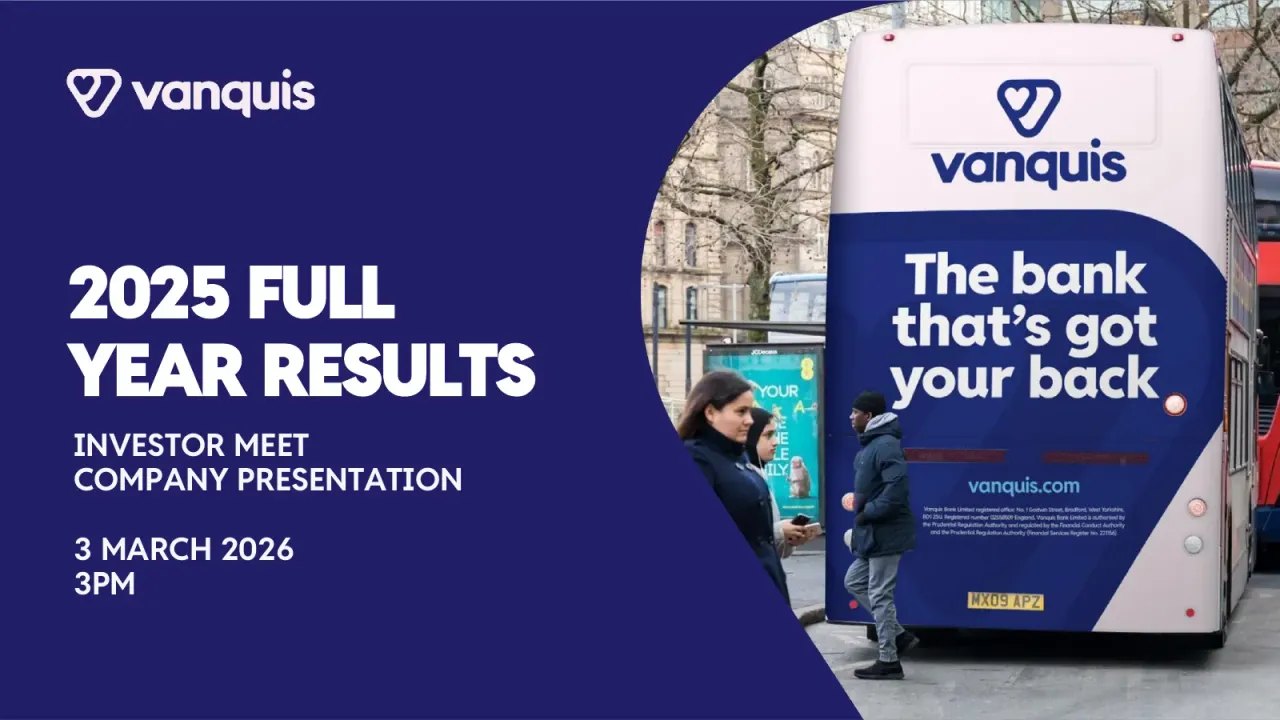
0:52 Thank you for joining me, folks. So look. I know some of you will be very familiar with this story so far, some possibly less. So so forgive me if I kinda try and pitch it a bit in the middle. The first thing I'd say on on the this holding slide is you can see our new brand, the slightly tongue in cheek, the bank that's got your back on the back of buses all around the country. So if you're Instagram or Meta favorites, then you'll you'll see the bus watch is alive and well around the country, but getting really good cut through on that as we get a little bit of chutzpah back into back into VANQUIS. In terms of what we talk about today, I'll give you a summary of the results that we presented last Thursday and a little bit on our evolving strategy. I'll then hand to Dave to take you through our financial guidance, and then I'll come back and conclude before we get into your your questions, which we're very much looking forward to. So if I skip to the the slide that I presented, this is my first slide last Thursday.
1:49 And and look, it's very simple. And for those of you that have seen it, I mean, basically, the story here is after a very challenging '23 into '24, when we sort of started as the new management team of this business, we laid out a set of guidance for, full year '25 that you can see, and you can see how we actually delivered against it. And my message was very straightforward. We we hit or exceeded every single metric that we put out, which is what you should expect from us. So, it has been there's a a lot of depth behind that, a lot of hard work and blood, sweat, and tears by our fantastic teams, but we're now on a path where we are aiming and delivering as a much more predictable institution where the inputs, throughputs, outputs of this organization are lined up and hopefully a lot less surprises.
2:38 In terms of the actual metrics, I will call out the balanced growth. One, that is one where we exceeded, what we had originally got in the markets, and and I think that's a sign of life. But we did that while maintaining our margin. If you look at the net net interest margin line, you can see the margin is contracting. That is 100% a mix effect of us writing more second charge mortgages, which naturally have a lower margin, but also a lower risk weight density to them. So a profitable line for us. And if you stripped out the new second charge mortgage line, our underlying NIM would actually have gone up in the year. So if you're trying to do a comparison to old VANQUIS, that comparison is very favorable. So so, look, we're we're we're on a path now. We we still have lots to do, but you can actually start seeing now the results coming through of of the efforts that we've been putting in. I'll let Dave talk a little bit later about capital, but you can see the tier one ratio as well there. But we have the capital that we need to deliver the growth that delivers our plan over there there this year and next year.
3:41 Let me drill into that a little bit then on the next slide. And, you know, I've touched on some of this in terms of the balance growth. A lot of that was cards and second charge mortgages. Vehicle finance, actually reduced the book by 8% over the year, but we did slightly strengthen the margin. So there's a sort of offsetting effect there. Why would we do that if we're growing our other lines, you may ask? And the simple answer is because that is still a very inefficient business in terms of the platform it runs on. It's very manual. It's very old. And we are building a new platform through our gateway IT transformation, which I'll talk about a little bit in a minute. But that will go live for vehicle finance in q three of this year. And until then, we're gonna have to do a migration of customers on the old system onto the new system. Therefore, we're we're trying to keep the the the flow into the old system under control while still maintaining the relationships with the valuable, finance mortgage finance brokers that, that write business with us. So we don't wanna switch off until the new platform comes, but nor do we wanna overdo the growth. So you'll see you'll see the growth going in the other areas.
4:47 And, look, gateway and the next point on cost savings kind of interplay. Gateway is a an efficiency play. You should think about it more as a business transformation than a technology transformation, but that business transformation starts with the new technology that, our our fantastic, IT team are bringing online for us. And and we talked last week about gateway is substantively delivered. So, you know, the the data lake, the the key functionality that we wanted to put in place was done through the back end of last year. We're now into the phase of getting benefits from that other than the vehicle finance system, which I've already said will will come through q three of this this year. On the other points, you know, we've done well on costs. We were about a 28,000,000 saving against the 15,000,000 that we had committed to for 2025.
5:39 So there's another bid on costs to go on top of the 64,000,000 we did in 2024 against the target we put out of 60,000,000. So there's a bit of a theme there about we are controlling our costs very tightly, but investing in the parts of the business that we know are critical for the future health and success that we will bring. So I think that's maybe something we can get into a bit as we get into q and a. And point four on this slide is around customer resilience, credit quality, and and really impairments, all of which are looking good. Now, again, a bank like VANQUIS will never be complacent about that. But so far, we are operating very much at the left hand side of our risk appetite ranges that we've put out, and and you should expect us to continue to do that for the foreseeable future. So, pretty encouraging story, I would say.
6:30 We talked a little bit at the bottom of this slide about our proposition, but let me turn to the next slide, and I'll drill into that in a little bit more detail. So the phrase I used, on Thursday's presentation was we got busy. We we launched in cards, for example, 66 different product variants, some of which we retired. We we have a a well trodden path now of what we describe as test and learn in this business. So rather than, you know, bet everything on red seventeen if we were a casino, which we're not, what we do is we do a little bit of experimentation on something, see what results we get from it, and then we decide to scale up. So of those 66, product variants and cars that we put out, 21 are still live, for example. Some of that is because of seasonality. So there was a travel card in there, for example, that we ran through June, July, and August, but there's not all as much point doing that sort of November, December, January. So we're we're constantly experimenting with the book to see where we get the best reaction and the best returns from our customers.
7:31 Exactly the same on savings. That is now contributing part of our p and l. We run the liability side of our balance sheet as as a business function, and we are expanding the offerings to our customers in there. So much more variable, shorter dated instant access type savings and products than previously we had where we were mainly one, three, and five year bonds, so rather inflexible. And we have opened an easy access account through SNOOP. A big part of what VANQUIS exists to do is build financial resilience with our customers, and therefore, you can deposit as little as a pint into Snoop, and you can do it almost instantly. It's a very, very slick process. So we're really pleased about how that's going, and it does mean our cost of funds is decreasing not just because of interest rates, but because we are getting more efficient.
8:20 And Snoop actually as a acquisition tool continues to perform very well. So we've seen a, as it says, a 12% increase in Snoop active customers, and we continue to penetrate into the VANQUIS customer base with the Snoop functionality. And we'll talk more about that as we talk about our new mobile app, which we're in the process of launching and having customers migrate to at the moment. And we will be increasingly surfacing this new money management functionality that we've already got in this new product into that app as we go forward. The other point here that I'll I'll touch on, because I think it's a really important one, is the fourth one down. And this is this goes to what we describe as our not yet proposition, which sounds a bit of a strange thing. So let me let me just pause on this for a second.
9:07 Even with our risk appetite as VANQUIS, we we can't take on every single customer that that applies to us. Some are just outside our risk appetite. But what we've worked very hard to do is never say no to a customer. So if if they don't fit our current credit risk appetite, what we do is we'll give them Snoop and say, look. Here's how you can help manage your finances better, and then come back to us down the line so that we've got them in our ecosystem, and we're adding value for them. The other thing that we've done is is opened up a partnership with one of the CDFI lenders called Fair Finance. We have a much wider risk appetite than any bank can have. And the first thing that Fair Finance, Faisal, and the team over there, who are fantastic partners for us, The first thing they do with a customer that we refer over is check whether that customer has any unclaimed benefits that they could be due, that they've either not asked for or tried to apply for, and the slightly labyrinthine processes has kicked them out. And and I I think this is one of our one of the stats that I'm most proud of, actually, from the innovations that we put in last year. 20,000 of those customers, we've identified £34,000,000 worth of unclaimed annual benefit entitlements through Fair Finance checking them for them and and showing them how to claim them. That's an average of £1,750 per customer per year. Now if you just imagine for a second, you're that customer that's
10:38 come to VANQUIS. You've probably tried a couple of other lenders. You've been rejected because of your credit background, by all. We passed you to Fair Finance though as part of this not no, but not yet. So let's get you to someone that might be able to help you in the meantime. We've given them Snoop, and the first thing that happens is that they get £1,750 on average so far of unclaimed benefits. For a customer that, you know, that's under financial pressure, that is a phenomenal contribution to their financial well-being and often their health and well-being generally. So we get fantastic feedback on that. So you should expect us to see us continue down that route of if anyone comes to us, we will help either through our own products if we can, or we will get them somewhere that actually they can get the help they need at the time. So very, very pleased about how that's going, and as I said, one one that you should expect to see going forward.
11:32 If I just turn to the next page then, which and and this is tech transformation, operational efficiency, which obviously interplay, as I said, and then our wonderful people. That new mobile app, we've got about a quarter of our existing cards customers migrated already onto that, and the feedback is very positive. So we'll continue that. We're doing a sort of phased rollout. We've also done a whole range of things under gateway starting last February with a significant migration from a range of legacy systems that we had scattered across VANQUIS and its various guises into one data lake called Snowflake, if you if you're familiar with such things, which was a significant amount of data moved across and categorized that we can then start getting business benefit from. So that's that's gone extremely well, and a huge thanks to to everyone in our tech teams. That was that was no small effort.
12:26 And it it drives that basis of operational efficiency improvements that we can then layer on top of the data. And, you know, there's a couple of examples on the slide there that shows we've reduced complaint handling costs by some 10% and fraud losses by some 25%. There's a range of other things also that we're experimenting with right through to Augentic AI as to how we use that data in a structured way to then layer technology on top, which gives us that benefit going forward. So, you know, that will be a continuous process for us. Gateway as a tech transformation isn't it's not like flicking a switch where it goes from off to on that you've done. It's a continuous process that you'll see us run through the next couple of years, but that won't be so much the tech heavy lifting and change.
13:12 It'll be the benefit realization and the layering of other technology on top of the base that that that we've now got. So we're very pleased about that. There's a reference to, you know, we're scrubbing every bit of this business. Our property footprint isn't is no exception. You can see that on the second last bullet. But I wanna dwell just for a a minute on that last bullet because none of what we've delivered through 2024 and 2025 would be possible without the efforts of our amazing teams. And it's been hard. Right? This is a business transformation. It's a turnaround that is very difficult for, particularly people that have been around here for a little while as as we're sort of resetting what good looks like, and to to to have our colleague engagement go up to 73%, that's a 13 increase in the year, and to be accredited as a great place to work for the first time ever is quite an achievement. So we're very proud of that. So in you can read into that that it's not just about delivering results at any at any cost. We're actually trying to do this in the right way that people feel engaged, feel proud of being part of our our purpose in what we do for customers, and therefore, with us for the, you know, the long term journey as as, you know, that's where we get real value, and that's where, hopefully, people get exciting opportunities to develop their careers.
14:31 So really, really proud of that as well. Next page, I've touched on some of, but I just wanted to pull out We one of the questions that we get quite regularly is, well, what actually is in gateway? What have we done and what have you still to do? So I'll draw out a couple of these, but, again, very happy to take questions in any of this. You can see on the left hand side, we basically got what have we done so far. Single view of customer in Salesforce is the one that I've just referred to. The fourth one down, the new customer security model, very simple sentence, but actually profound impact in terms of keeping our customers safe and and helping us make sure that there's not fraud and, you know, risk of data leaks, etcetera. So lots of the building blocks of a successful business already in place. And then on the right hand side, we're being very open about this is what we still got to do.
15:19 There is, you know, still new innovation to come through, but the main one is the the bottom of the gateway block there where it says new onboarding and servicing platform for vehicle finance, which is what I talked about at the top when I was referring that we'll have that in for q three. And then the very last one is that sort of little line of AI tools rolled out to all colleagues. There's a huge demand to come on that. We are not at the cutting edge of AI right now, but we are doing some really interesting use cases. And we're getting very good feedback from agent force, which is obviously part of Salesforce, about things like agents listening to calls in our call centers and then preparing a transcription of the calls so that the agent doesn't actually have to type up what the call covered to go on the CRM system so that when the customer calls the next time that there's continuity, that's delivered for them. They can scan it quickly, make any little changes that they need to, and that saves us a significant amount of time that can then be spent taking interactions with other customers. So just to give you some examples.
16:22 But look at it says it in like, here at the bottom. This is a modern, efficient, and scalable platform that that will create benefits across this bank for years to come. Is already showing that those benefits are coming through and that our people are very excited about and our tech colleagues, I think, are very proud of. So just a couple of highlights on that. I'll skip the next slide, which is around strategy and get into let's come come up a level then. So this is if you've not been with us on the journey so far, what, you know, what is VANQUIS? What are we here for? And and what I've covered is a lot of how are we doing it, but, actually, this is well worth a bit of time as well. So it is about serving the underserved in The UK, and I'll come to the stats in a second. But our purpose is something that really resonates here. It is about caring banking, and it's about helping our customers access life's opportunities, and that often is credit, which, you know, I've described earlier or being referred to something like Fair Finance. And our ambition that then comes out of the purpose is to be the most trusted and inclusive specialist bank by helping our customers to under unlock that opportunity and and get them on a a path to positive financial resilience backed up by a by a company that, like I said, that really understands them.
17:39 We've we've boiled that down into three main pillars that you can see here. So serve more, so reach more of the right customers that need us and deepen those relationships. Secondly, serve responsibly, so do it in a way that we're making sure that the affordability is calculated correctly. Obviously, that's good for our customers. It's also good for us because it means that we get less complaints or challenge down the line. So that financial resilience that I've talked about. And then the third one comes out of the first two. So if you're serving more and you're doing it in the right way, you can then scale this business profitably, which is what you're starting to see us do as we move from a, you know, a 136,000,000 loss in in 2024 to an 8,300,000 profit in in 2025. That's quite a swing, obviously, and, you know, we we expect to continue at that trajectory, so very exciting. And and then if we go to the next slide, which talks a bit about the actual breakdown. I mean, I get a lot of questions on what what is your target addressable markets, you know, how many customers are there in The UK. So we played back some of the research that that shows us. Now these numbers vary a little bit depending on which source you go to. But broadly, you can accept that there's between a sort of twenty and twenty four million opportunity pool for VANQUIS, I. E, customers who can't access credit easily from mainstream lenders at all times.
19:05 So so that means that, you know, we've got 1,770,000 customers at the minute. So no matter what way you cut that gross number, you can call it a 10 x opportunity for for VANQUIS, which which I think is very, you know, very exciting. And you can see on the right hand side some of the, you know, the the the sort of drilling to that from the various sources. But probably the third one, which is the most shocking, is there is in The UK just a a supply and demand, you know, inequality in this market at the minute. There is more demand for customers for less standard lending than there is supply from banks and lenders. And that's that's why we're so excited about the opportunity for VANQUIS. And the fact that, you know, there are some 3,000,000 people who've borrowed from an unlicensed or unauthorized money lender in the last three years according to Fair Finance, frankly, is shocking.
19:54 So that's something, you know, in the work that we're doing with financial inclusion, treasury, and and regulators. We're really trying to put ourselves in the map to be, you know, the poster child for trying to address this and and show that you can offer credit responsibly to to more of these customers so they don't have to bother borrow in in that way. And and look. Next slide is a bit of a detail on that, but, basically, the middle number is the key one. We we grew quite strongly last year. We will moderate that a little bit, for 2026, so but still a 14% CAGR, over the next two years. So that, you know, that we're we're very pleased about. We're guiding to 3,700,000,000 of a book by 2027. But the most important thing in that is it's not growth at all costs or or any growth. It's actually growth that hurdles at the right returns for deployment of capital, and Dave will talk a little bit more about that in a minute. In fact, we I'll I'll hand to Dave almost now to talk a bit more about that. So, hopefully, that's been useful. I'm conscious there's a lot in that, and, you know, we we as a team live in really this every day. So if there's anything that you want me to expand a bit on, then please do do ask questions, and we're very, very pleased to do so. We're very proud of this business.
21:07 We're proud of what it does for customers. We're proud of the way we're setting this business up to be a great place to work for our colleagues. And, you know, hopefully, you you can see the progress coming through and that that should continue. But Dave, talking about continuing, let me pass over to you to cover guidance. Thanks very much, Ian. I thought all those summary points you just made up in the look, three slides for me. The first slide summarizes our financial guidance out to 2027, and most important report from this is that we remain on track to deliver our statutory growth of guidance of low double digit in 2026 and mid teens in 2027. This has not changed. And one thing to say that we would expect profits to be higher in the second half of the year compared to the first half of twenty twenty six. Basically, balances mature and interest income build up over the period.
21:58 Now we believe over the long balances in 2025. We now balances in 2020 to exceed £3,300,000,000, mainly to decrease further to £3,700,000,000 by the end of twenty twenty seven. As we look at the balanced growth and the improved profits we require to deliver the higher royalties that we are now targeting. As Ian covered earlier, yeah, with a deliberate change in product mix with a greater proportion of second charge mortgages making up our portfolio, this could result in a reduction in NIM to around 15.5% in 2026 and around 14.5% in 2027. Just one new thing to add in here. Now we look very carefully on the cost of risk across our products and how we look to run the business internally.
22:44 We've introduced a risk adjusted margin guidance across the group. This is expected to reduce both in 2026 and in 2027, but remain above 9.59% in respective years. Once again, this is going to be driven by the increasing proportion of semi charged mortgages in our portfolio lending. Alongside income growth, we're going to retain the cost discipline we displayed over the last two to three years. It's been a key lever to improve the profit trajectory over the next two years and we expect that to grow quite significantly. This is going to drive the cost income ratio down from high fifties in 2025 to the high forties in 2026 to the mid 40s in 2027. Let's move on to the next slide please James.
23:34 Quite a complicated slide here, but this basically summarizes the statue RoTE the cost information ratio of guidance which are in place there. The bridge on the left hand side provides an indicative view of how we expect to do the mid teens ROTE by 2027. As you can see the big green bar on the left hand side, risk adjusted income growth is gonna be a meaningful contributor. A continued cost takeout is also gonna be significantly where we're meeting this this target we're we're looking to achieve. If you look at the costs, we've got ongoing transformation savings coming through, build on the £28,000,000 we did in 2025. We also expect to have an additional 23 to £28,000,000 on the completion of gateway, which will land in 2026 and 2027.
24:20 And then it's ongoing to cost efficiencies across the organization unrelated to the tech change, which we hope will deliver further efficiencies across the group. As importantly, we will continue to invest in the business. You see the bottom left hand red drop in there. We must invest in the business going further forward. We can't let the business get in a situation where it's underinvested. Capital management. Next slide. So what you see us doing 2025 is to be deployed capital growth in the near term. And we continue we expect to continue to do that in the in the in the coming period twenty six to '27 as we highlighted out there. A CAGR of 14% is quite a sizable growth year on year.
25:07 On the left hand side at the top, you'll see how we're moving from a tier one capital limitation to a CET1 capital limitation and we've to reset the guidance there to show that we operate above 14.5% in CET1 ratio basis. This is we're get it three ways. One, firstly, we've got the capital optimization transaction that we executed last year. We discussed in one of the prior calls. Secondly, the risk profile of the business is it's cleaner, it's steadier, it's more more more predictable. So we're comfortable in that position and trajectory. And then we've got the outcome of those recent regulatory review by a regulator, the triangle seizure review. Can't give any more detail and say it looks positive from there. So three big drivers behind why we're happy to come with the guidance of greater 14.5%.
25:56 Look, with the existing capital capacity we've got, there was a slide in the deck we put out there last Thursday, showing £107,000,000 of surplus capital over our CET1 related requirements. And with the profits we increasingly can generate next two years, this means we are well positioned to deliver the growth we are targeting. Now having achieved everything we said we're doing in 2025, we're to remain laser focused on the execution of our plan, and we're totally committed to delivering a sustainable and long term value for all our shareholders. Is that it? Back to you. Great. Thank you. Again, a lot in there, but very happy to to drill into any or all of that as we get into questions. So if I just go to the last slide, please, James. Look. You know, when you think about VANQUIS, what should you think about? This is sort of almost what's our investment case. And I and I guess, you know, it's pulling together really what we've heard.
26:50 There is a large underserved market in The UK that need what we offer. And, you know, we're we're tapping into that, but we're doing it in the right way. We've built the right proposition, and we believe we can deepen that to get credit to customers for the things that they they want to do and to help them build, you know, that financial resilience through savings habits and so on and through things like Snoop that help with money management. That we've got now a very cost effective funding model, and we've optimized our capital stack through the great work that they've been finance team and did in our 81 issuance last last year. And that that's technology platform is is all it's not a hope anymore. It's kind of a real thing. We can tangibly see the benefits of it. We still have more to do to monetize all of them.
27:36 But, you know, that is that is a real transformational underpin to to this businesses prospects as we look forward. And I I'd add three other things to to this list probably just to, you know, bring alive a little bit more. Engaged colleagues I've mentioned, supportive regulators, and some of the external challenges that we had. Many of you will remember the claims management company, spurious claims, false charging changes that have that have come in and really helped as as we've gone through this journey. That that is that combination of all those factors that gives us the confidence to to put the guidance out that Dave has just talked to. Of course, there will still be challenges. I'm sure there'll be bumps in the road in our own plans and delivery, but we've got a bit of momentum and a and a track record now, so we will find a way to navigate those. Of course, there's things, you know, you don't need me to tell you what's going on over the last couple of days. You can see the whole market is, you know, in a in a bit of flux as as that uncertainty works through. So there will always be those things. You've got the vehicle finance FCA redress scheme, to navigate. We'll get, hopefully, the conclusion of their consultation at the end of this month, but that's peripheral for us.
28:47 And, you know, we've gotta keep our great people and keep the great work that they and their teams are doing, and, of course, keep an eye on our competitors as well. So the banking is never a walk in the park, but if you compare where VANQUIS is now to where it was this time last year, it's a substantial move forward, which is, as I said, a a function of all that great inputs work that you can now start seeing coming through the business and into the numbers. So long will that continue? And with that, Lily, I will pause there unless, James, there's anything you want to add from an IR perspective? No. I think we can get back to Lily and, and tee up the q and a, please. Super. Let's do that. That's great. Thank you very much for your presentation this afternoon. Ladies and gentlemen, please do continue to submit your questions just by using the q and a tab situated on the right hand corner of your screen. Just while the company take a few moments to review those questions submitted today, I'd like to remind you that recording of this presentation along with a copy of the slides and the published q and a can be accessed via investor dashboard.
29:44 James, could I please hand back to to read out the questions and give responses where appropriate to do so, and I'll pick up from you at the end. Yep. Great. Thanks, Lily. Let us kick off with one about regulation because, Ian, you mentioned that we have a supportive relationship with our regulators. But the question is the fact that The UK subprime lending market, at least from a supply perspective, has contracted so dramatically. What's the regulator's view on that? Does the regulator think that's a good thing or or a bad thing? Look. I think, firstly, to our relationship, if I pick up on that first, you know, I I use the slightly hackneyed phrase of you get the regulation you deserve in the end. So if you do the right things, you get very supportive regulation. If you put yourself out of step with that, you you know, you you should expect the consequences of it. Our focus is to do this in the right way, and we've got very good engagement with with both FCA and and PRA and indeed with treasury and government.
30:38 And I think the the the mood music, and you can never quote this, but there is a general sense of understanding of financial exclusion is a real risk to The UK and therefore to voters in The UK. Therefore, there is, real desire to make sure that we and, you know, the the industry generally is doing everything that we can to help anyone who needs it to get access to the right solutions for the situation that we're in. I I don't think any whether it's government minister or regulator that you speak to would disagree with that. There's a bit of disagreement on the high, and, of course, you know, this is a fairly checkered market space that there were a whole range of businesses that ceased trading in the mid and late twenty teens. But we've moved on, and we've learned. And this is a new management team in VANQUIS with, you know, all of that experience to draw on, and the regulator that I think is pleased so far with the way we're doing things, but that's our responsibility to continue doing things in the right way, so that we continue to get that support.
31:42 Dave, anything you wanna add on that? No. I think you've covered it quite in detail. Anything from the the Prudential side? We've got a good relationship with the the provincial regulator. I think the outcome of the twenty year old Ctrip review is just a good test to find that, and we continue to work on a proactive basis with with the with the with the PRA in in the months and years to years to come. Yeah. So so, look, so far so good. I think we, you know, we're we're working hard to show that we're working hard to do it in the right way. That's the that's the way I would summarize it. Great. Thank you both. There's two questions here around SNOP. Yep. I think one for Ian and then one for Dave. First one's broader around the not yet proposition. So what's the typical unclaimed benefit? I think the question is in relation to Fair Finance. Yep.
32:36 But it also might be helpful, Ian, to talk about what's the sort of average benefit that customers are getting via the via the SNUP PAP and the the money management tools that are available there. Yeah. Look. Two two good good questions. I mean, as I said earlier, this is about helping customers if we can't immediately offer them credit, or in the case of Snoop, helping them even if we can offer them credit because we we were talking to some investors earlier, who were telling us that, a very wealthy fund manager had had managed to save himself a couple of £100 through downloading Snoop and having a look at it and and was delighted with that. So, know, you Snoop can help anybody at any stage. Dave, I think you said you'd see it significant in the minds. I'll not make you quote the number, but on on Sky and and, you know, various utilities just just by looking at the prompts that it offers.
33:28 I mean, it's a fantastic bit of kit and and really leverages both open banking and AI and machine learning and and, you know, that sort of processing to to surface opportunities. So, you know, on average, Snoop targets to save average customers about a £150 a month. As we all know, there's no such thing. I hate averaging customers because they're all unique and brilliant in their own way, but, you know, that that's sort of the number to hold in your head that's that it that, you know, it it has proven being able to do. And and that's really valuable if you think that the average VANQUIS customer earns about £2,000 a month. Suddenly, £150 every month of a buffer on that is six you know, substantial as a percentage and can make a real difference to their financial resilience, their ability to save a bit, or or even to access credit. So so Snoop is working really well.
34:20 But as part of that not yet ecosystem, if I can sort of just stray into kind of consultancy language, but, you know, there are a range of support mechanisms that won't directly be owned always by VANQUIS. But fair finances are sort of poster child on that. And as I said, it's £1,750 per annum per customer for the 20,000 customers that we've been able to find Social Security type benefits that they weren't claiming or didn't know how to claim or had tried to and it just hadn't worked, that that's an enormous difference. And if you add those two things together, you know, you're sort of getting to a significant amount of money for customers that don't always have a huge amount of disposable income that that can just make it an enormous difference in how they live their lives. So it's something that, you know, we we talk about ESG when it comes to, you know, listed companies.
35:15 Our chair said, our board meeting last week that, you know, we're we're more s e g, so we're social first, which is a really nice way to think about where VANQUIS fits in in the marketplace. We are helping customers that other people either can't or or won't, and we're doing it in a way that is creating great customer feedback. So long may that continue. Great. Thank you, Ian. Dave, this Snoop's question is probably for you. So how scalable do you think the Snoop savings channel is as a structural and as a structural savings advantage for or a structural funding advantage for VANQUIS? Before I ask that ask that question, James, I'll go back to the last question. I'm not shy about saving money. So my my consolidation of all my, you know, my BT, Sky, Netflix, etcetera, it's just saving £2,000 over the next couple of years. So if I'm looking to save some money, I'm sure it's helping me that with the same money.
36:12 What would get go to the stupid savings, James. I think it's worthwhile pointing out that, you know, our our retail we're having a banking license. It's a structured advantage for VANQUIS over some of our competitors, you know, and some good credit companies from there. Leave that that that perspective there. Over the last couple of years, we we built up our retail savings deposits to make up nearly three over £3,000,000,000 of our funding. It makes up 90% of our funding. This year, it was on one year, two year bonds. We now introduced ICEs last year. We introduced easy access accounts as well. At the same time, as well as the VANQUIS brand, we we use the technology capability of our Soup team to build on a a savings proposition. So it's the first time we're actually a financial product offered through Soup.
37:00 And that went live in December 24. And in less than twelve months, we've made from 0 to £250,000,000 in in deposits with with Stoop. So the idea is to create a tool for people using Stupid's money management tool to to put a bit of a rainy day fund aside so that you can save a bit of money on pound. You could do it straight away. It's insane to be almost. And should you cut need to have to use it, you can you can draw down it straight away. So going from 0 to £250,000,000 in in just over twelve months, it is definitely scalable. So I think it's a it's a great thing to add to our armory in terms of our retail deposit advantage. Great. Thank you, Dave. Next question is around vehicle finance, and I think Ian and Dave, you can both comment on this one.
37:53 When do you expect the vehicle finance business to turn profitable? So I think there's steps towards this. I think the I mean, it's it's the question because every single one of our product lines should be profitable on an ongoing basis, so that is absolutely the aim to get vehicle finance to join the other ones. I think one is what will the outcome of the FCA redress scheme consultation that I mentioned earlier would be, and we should know that within weeks. So that that will be interesting, but it is, as I said, it's relatively insignificant for us. But it's still something that I think will affect that market in terms of supply and demand again. Remember though in vehicle finance that VANQUIS through its money barn brand is is very much a niche player in that customer profile that I described earlier that, you know, our average car that we help customers to to to buy is a nine year old Ford Focus with 70,000 miles on the clock. So these are not luxury items in any way. These are essential parts of people's lives to get them to work, to get their kids to school, often both.
39:05 I was talking to a customer about six weeks ago. He was an occupational therapist who had trained for and studied for three years to get qualified as that, and have done brilliantly. You know, really done very, very well in terms of that effort and exams and have worked right you know, studied around her previous job. And when she came to actually start as an occupational therapist, she got turned down by three lenders for vehicle finance and couldn't get a car. So her three years worth of planning for a career change literally stopped in its tracks until she came to us, and we were able to lend to her. And now she's able to do that job. And, you know, you multiply that by millions of customers, those are the stories that really bring the purpose of VANQUIS to life. So vehicle finance, the demand in that niche is good. We've managed to strengthen our margins a little bit over the last twelve months. But until we get onto the new tech stack that I described earlier, which will be q three this year, our our cost income ratio is is still too high in in that product. So we that's the the key next step. But, Dave, do wanna pick up anything on that?
40:09 Yeah. I mean, we we we obviously, a loss of £13,000,000 in 2024, and the loss of 2025 is 12.7. We hope to make inroads on that quite a lot in 2026. We clearly want to have seen the business to be profitable including good returns in place, but sometimes you just need to have that during to get from there. We're persistent on the journey because we think it's just a fantastic opportunity for us in the future. So I'll specifically break even. It's not the first time we've been asked that question actually even today. But we'll come back and hopefully celebrate that when we get to that date. But that's the starting point. It's then going to drive them further forward from that one then. But we're taking the strides we want to take in terms of of making sure we're we're pricing for the risk we're taking on board.
40:55 And hopefully, they deliver an excellent product into the marketplace for our brokers and dealers for what you begin then it's about customer base who will then sort of move us up the the channel selection, and that should drive probably more greater growth in 2027 than, I say, 2026. It's it's the latest for '27 more than '26. I completely agree with that. And those numbers, obviously, that they quoted well specific to to vehicle finance. Great. Yep. Great. Thank you. Just keeping on the product themes, there's a question here on second charge mortgages. So can you explain a little more about the relationship you have with Interbridge and Salina? Are you an do you have an exclusive relationship with them as the origination partner? Obviously, the growth has been strong as the question the questioner calls out. But can you give a little bit more indication of the 3,700,000,000 plus of balances we have in '27? What proportion TCM is or second charge mortgages is likely to be? I'll maybe get Dave to pick up that last bit about, you know, what proportion and size do we think this book is. But, yes, as as your question has put, James, you know, this has been a real success story for us. We have two forward flow arrangements, which means we write the business onto our book, but it is underwritten by by our partners.
42:12 They have between them some 19% of the new business that's being written in the market, and that's that's quite an achievement. One of them is exclusive to the end of twenty twenty nine, the other one isn't. So, you know, we but we work equally hard with both, and we've got two really good partners there and a and a business that is running well, that has that has grown very nicely for us. As you can see, we're up to about 600,000,000 of the book, which is which is very nice from a standing start over the relatively short period that we've been running it. In terms of the market itself, it was about 2,150,000,000 of lending, 2025. That in itself is a high teens growth. So we're growing in a growing market, so we see this continuing to run. We're writing about 30,000,000 a month, of new business. And because it's mortgage and it's relatively new, it hasn't yet matured, we're not seeing much in the way of redemptions or any impairments in that book. So so so far, so good. It's it's worked exactly the way that it should.
43:14 And, you know, it is something that I inherited as an idea from previous management, and and it's, you know, we've implemented that very well, and and it is performing. So, we will continue with it. But I think the stepping back from the products specifically, you know, we have a certain amount of capital that we want to deploy into the market to get a return, and we will flex where we deploy that based on the dynamics of each of our lending products at any point in time. And some of that is competitor activity, which we're not directly in control of. So we we don't wanna be wedded to specific or guide on specific splits or volumes because we we will go where we think we can get the best returns and the best volume. So you should expect to see these things move around a little bit, but certainly so far, second charge mortgages has been a great success for us. Dave, do wanna add anything on most important point is it's where, yeah, we deploy capital where we get the best returns. Simple as that. And so therefore, there's what we've done is put on all new business being written with their their cards, big clients, and the joint ventures, clearing out mid teens, target road to year 2027, which is a good thing. So we've grown 30,000,000 per month in.
44:28 All things being equal, we should expect the same sort of growth to come through month by month as we go through 2016 and 2027. But we like the business. It's a growing business and a growing marketplace. Yeah. I guess all we'd say. Yeah. Great. Thank you both. There's two questions here on the cost theme. I'll take them in turn. So the first one is quite specific, but it might be worthwhile commenting on the broader trends we're seeing on complaint costs. But the the question reads, what's the status of the claim against the CMC that you have action against around unsubstantiated complaints? But as I said, it's probably worthwhile just commenting on what we've seen on complaints more broadly. Okay. It's a it's an ongoing legal case, so I'm not gonna say too much. You wouldn't expect me to.
45:17 What I would say factually looking backwards is that we obviously raised the case. There is a process then that you go through with any case like this where there's a strikeout hearing where the the the other party appealed to have the case thrown out. They did not win on that. We won. They then appealed that, which again is their right, and we won that appeal as well. So as it stands at the minute, that case is heading to court and quite rightly so. So but how long will that take? It's The UK legal system. I'm not gonna comment on that, but, you know, this it's an important point of principle as people behave badly towards us as an organization. They should expect consequences of that, that we're not just gonna roll over and take it. We we will punch back.
46:03 And, you know, we'll keep you posted as as we hit the various milestones as as this progresses. So I'll not say any more than that. I think I mentioned earlier, though, the false fee charging and and the changes, you know, that that has had a transformative effect for us. So, you know, well done, treasury falls and everyone that's been involved in in making those changes that came in from the first of April last year. Dave, do wanna pick up anything from that? Yeah. I mean, just just to build that last point here, overall complaint cost in 2026 was £26,000,000. It's been incurred £3,000,000 for the FCA notifiers dress scheme in place there. If you take that out and we book that in second half of the of the year, complaint cost of £7,500,000 in second half of twenty twenty five.
46:51 You start to think about how that plays into 2026. That's also my opinion sets us as high level high watermark number in place there. We like to obviously beat that given the business we're writing better technology and better underwriting should be situation where the outcomes of the customer should lead to less complaints going forward. So we hope that come down in in the future, but it's no longer the the the major step that existed back in the half days of 2024 when we've got quite a few superior superior superior superior superior security even complaints coming through massive CMCs. Great. Thank you both. We've got two more questions, as I say, one more on cost and then one on capital. So there's a little bit of preamble to this question, but the crux of it is how are you ensuring employees are appropriately incentivized as you go through your the transformation and and execute on your strategy?
47:46 Look. Great question. And, you know, we we haven't paid variable comp to our colleagues over the last couple of years. We did manage to do a little for 2025, not as much as we want. But there's a you know, so you you should expect to see us, you know, pay market rates for the great efforts and the progress that I've just described that those efforts are making or allowing us to make. But there's also a range of things about how employees feel rewarded. Financial is obviously a a major one, but it's also the culture of the place you work, know, what your line manager's like, what your operating model in terms of performance management is like, what the tech that you've gotta work on is, and most importantly, what's the purpose of the organization that you're working in. And, you know, we're very proud of the purpose of VANQUIS as we've refreshed it and are getting that out to customers. And I think the majority, if not all of our employees, are very engaged with that and want to see this through and be a success, but we wanna be fair to them as well. So, you know, you should expect to see us to continue to do that. But I I mentioned earlier the great place to work accreditation.
48:49 That is no small thing. It was one of the bigger leaps from where we've been in terms of engagement that's that, you know, the the great place to work team had seen, so that's always very pleasing. We don't take it for granted. You know, we're improving our, what we call, our employee value value proposition all the time. And we work through a very simple process of asking our colleagues what they think would make a difference and then taking that away and trying to deliver it back to them as quickly as we can. And we will continue to do that, but it it's also having a bit of fun at work. You know, there's nothing in I mean, you know, there's nothing in our employment contracts that says you can't have a laugh with your colleagues. And if you're working late, you know, that you you can't go to the pub afterwards or have a pizza or whatever it happens to be. So, you know, that that how it feels as well as what have you paid and what have you learned. It's it's getting that combination right that is, you know, usually described as your culture, but we work very, very hard on that to try and make this a a really enjoyable place to work and to learn and to build your career.
49:48 I mean, I think the value proposition is is actually crucial, and I think the team's done a great job enhancing that. There's other thing on financial side. Whilst we couldn't pay bonuses in 2324, we did provide salary increases to our culture. Yeah. So we do what we can when we can. I mean, James, you are one of those colleagues. What's what's your own answer to that question? I'm feeling free, obviously, to speak freely, says the CEO. He's slightly nervous. No. I I think I think all employees have have really appreciated the bonus being reestablished this year. So, you know, after a number of challenging years, but they also understand that VANQUS is on a journey. We need to improve the financial performance.
50:34 And, you know but at the same time, the the broader proposition of VANQUIS is is what attracts a number of people to the to the firm, I. E, the social purpose that Ian talked about earlier in serving the underserved. Great. And then finally, the final question is on capital, and I'll let this to the end because, obviously, it was a big story of last year. But do you feel that the capital base is now optimized having done the 81 transaction, or is there further that you can do to optimize your your capital stack? Dave, I'll probably let you lead in that one, and then I'll chime in, but tier two is the obvious one. Okay. So the starting point is not not to the cap optimization, but we're profitable in 2025.
51:20 So it starts to generate capital. With that, that's the most important thing. The profit's gonna increase in '25 to '26 sorry, '26 to '27. So we'll have more capital to deploy to then and to grow our our lending to marketplace. So that last year's change alluded to the 81 issue, it's a £60,000,000, increased amount of overall tier one that we could use to us lending to market And and drove it as a large part of the growth of the overall 19% growth of this credit card. I should have brought 22% last year in receivables. That's a big thing. At the same time, we bought back £58,500,000 of our tier two, which was basically capital, which wasn't being used for capital purposes.
52:06 It's just very expensive funding. So with the swaps involved over 9%. So that brought down the tier tier two issues down to a £141,500,000, which is still higher than the 60,000,000 we currently utilize that our cheap gas size now. But our current tier two call date is in October this year. Clearly, we look to run a transaction around that. I can't say any more about that. That would look to further optimize the amount of tier two we have the issuance and also the pricing we might have to pay for that at tier two. So more to come on that in the coming months. But so we're not done yet, but we're gonna do a lot in in in 2025, but most importantly, we're actually generating capital for future use of our.
52:53 I think that last point, David, like, generative is critical. You know, that's what gives you options to grow faster, to distribute whatever you choose to do. That's our focus is to continue that through this year and through 2027. But, you know, I a huge thank you, David. It was an excellent issuance last year and great feedback from, you know, specialists in the market on it as well. So I think that was that was another big milestone for us. Great. That's it in terms of questions. There's a few thank yous on the on the q and a. But I think with that, Alicia, we hand back to you, or should Ian close? Yeah. Of course. Thank you for answering all those questions you can from investors. And, of course, the company can review your questions submitted today, and they'll publish those responses on the investment company platform.
53:39 Just before we direct redirect investors to provide you their feedback, which are particularly important to the company, Ian, could I please just ask you for a few closing comments? Yeah. Thank thanks, Lily. And and just to echo that, you know, your feedback is critical to us. We learn a huge amount from your inter the interactions we have with you. So please, if you've got any thoughts, we are all ears. You know, we didn't turn up with a tablet of stone of how to fix VANQUIS. We're learning as we go. But as hopefully you can see, we are now benefiting from some momentum from the things that we've delivered. So it always makes you more confident looking forward when you can look back and see the things, you know, the 81 that that we just described, but all the things that I've talked about. You know, there's a there's a large customer opportunity here. There's a motivated team. There's some real discipline about both cost and pricing, and there's, you know, underlying process improvement all the time through the technology. So that's a really nice recipe for, I think, any business that you're looking at potentially investing into or or holding your investment with. So thank you for those of you that are already with us, and welcome to those of you that may wish to be. We will get on with running this business as best we can for our colleagues, customers, and and, of course, our investors. So with that, Lily, I think we'll pause there for today. That's great. Thank you for updating investors today. Now please ask investors not to close the session as you'll now be automatically redirected to provide your feedback in order that the management team can better understand your views and expectations.
55:05 This may only take a few moments to complete, and I'm sure it'll be greatly valued by the company. On behalf of the management team, we'd like to thank you for attending today's presentation, and good afternoon to you all. Thanks.
Follow Vanquis Banking Group PLC into a list and get an email when it puts out news.
CEO at VANQUIS BANKING GROUP PLC
CFO at VANQUIS BANKING GROUP PLC