Ian McLaughlin
CEO at VANQUIS BANKING GROUP PLC
Replay available
2025 Interim Results Update hosted by Vanquis Banking Group (LSE:VANQ) on Investor Meet Company, held 2025-08-07.
On 6ix: 6ix.com/event/vanquis-banking-group-plc-vanq-2025-interim-results-update
Automated transcript · Written by software from the replay's audio. It can mishear names and figures; the replay is the record.
0:00 Good afternoon, and welcome to the VANQUIS BANKING GROUP PLC investor presentation. Throughout this recorded presentation, investors will be in listen only mode. Questions are encouraged and can be submitted at any time via the q and a tab situated on the right hand corner of your screen. Simply type in your questions and press end. The company may not be in a position to answer every question it receives during the meeting itself. However, the company can review all questions submitted today and publish responses where it's appropriate to do so. Before we begin, I'd like to submit the following poll, and I'll now like to hand you over to the management team. Ian, good
0:31 afternoon, sir. Lily, thank you. Great to be with everybody today and to get a chance to either introduce you to VANQUIS or tell you a little bit more about VANQUIS depending on your your levels of current knowledge about us. We have a busy day today. It was our investor presentation for our interim results this morning, so hopefully some of you had a chance to see that. If you didn't, it will be on our, vanquis.com website later on today. I will use some of the same slides. So for the those of you that have seen them before, please bear with me. As I'm I'm very conscious that there's there'll be a range of familiarity with us for attendees on the call. So I will start with a brief overview of of VANQUIS and a bit of context and then get into the the detail of our current performance and so on. I should introduce James Cranston, our head of IR. James, do wanna say hi? Yeah. I heard of it. And my trusty sidekick that I'm not allowed to go anywhere without, Dave Watts, our CFO.
1:26 Good afternoon. Thanks, Dave. So look. Let me just do a little bit of context then. If we do, who is VANQUIS? We started back, thank you, James. We started back in 1880 as what became provident financial. There's a story there all on its, all on its own. A wonderful chap, if you read the history, called Joshua Wadelove, who was a fascinating com combination of of careers. He was both a preacher and an insurance agent. He didn't get much of that these days. But he actually invented a concept around Bradford mainly for the people that were working in factories in in sort of the mills around there where they got vouchers for essentials like coal, like food, like clothing that they could then repay in weekly installments. And out of that came, the the history of provident financial that has then morphed into VANQUIS. So I'm not gonna do any more of a history lesson than that, but we have a deep, affinity to that sort of part of the world. Our head office is still there.
2:26 And what we're doing as the new management team of VANQUIS is almost going back to those roots of identifying a very clear customer purpose. What do we exist to do? I always think when I'm looking at any investment, companies that have a very clear purpose and vision of what they want to be and who they want to serve often do better than those that are less clear. So what we did is, I joined in mid twenty twenty three. Dave joined November of the same year. And as we went through, you sort of getting to grips with what had we inherited, one of the things that really stood out for us was that VANQUIS has had been becoming more and more like a mainstream bank, just a small one. And what we wanted to do was was really reset back to that original purpose of the Joshua Wadelove startup of how do we actually help customers that other people maybe aren't helping as much as they could, and how do we do that better than any other organization in our space. So if you think of the traditional ESG type, you know, we would be a very, very strong capital s. You know, we have a very strong social purpose. It's deeply rooted in our history, and it's a big part of the government and regulators' agenda around financial inclusion and helping customers that otherwise might struggle to access credit, excuse me, or struggle to get on a savings ladder and and build their financial resilience or know where to find the tools that can help them do that. That's what we're really here to do. We we anchor that in our purpose of deliver caring banking so that customers can make the most of
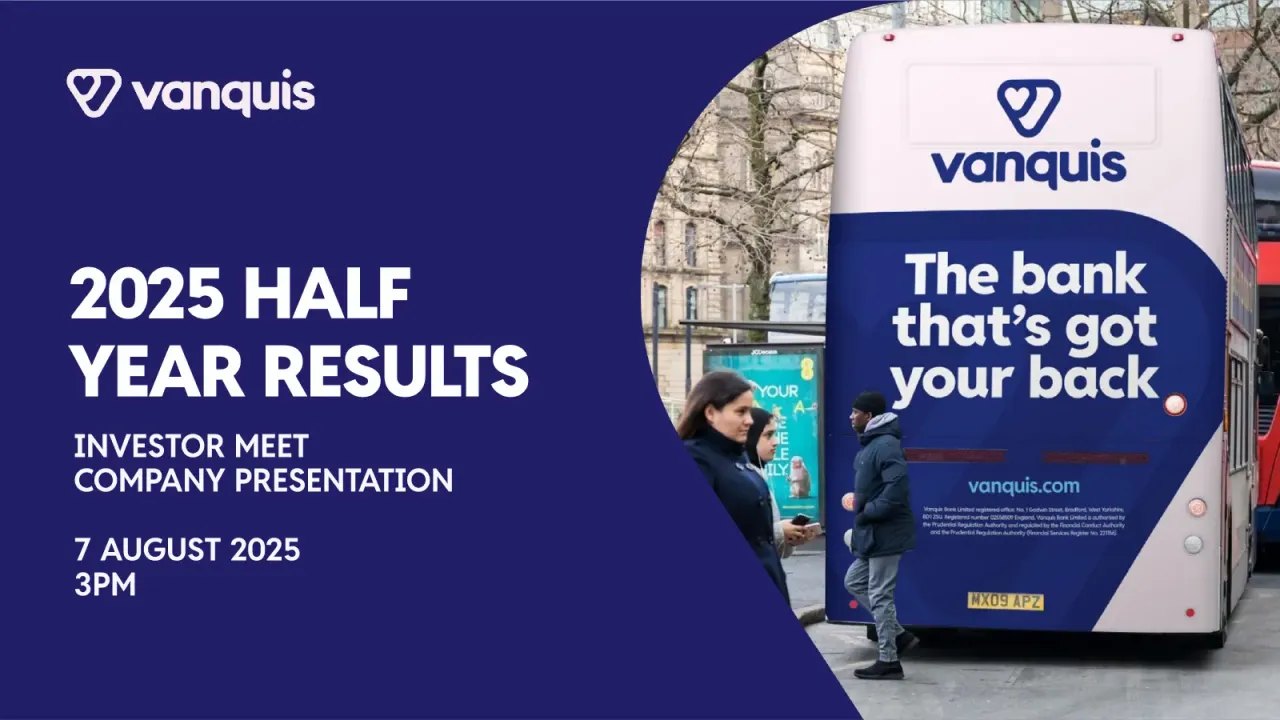
3:57 life's opportunities. And then more recently, we have refreshed our brand, with the bank that's got your back, which is landing very well. If you are in the Midlands, you will see that on the back of buses. Soon, you will see some signs on bridges and higher places saying, our bank will never look down on you. So a slightly, humorous, but very important set of messages about, you know, we we value every single one of our customers. They are often people that just do normal jobs. You know, these are the police constables, classroom assistants, social workers, bus drivers, people earning on average about £40,000 a year, that often have a bit of a a blip somewhere in their credit history and therefore struggle to access credits easily from the mainstream lenders. That's very much where we step in and where we try and help.
4:47 So, if you just fix the next slide, James, we've got 1,700,000 customers currently. You can see at the bottom of the slide the work that we did in early twenty twenty four to really understand where they wanted our help was around those three core needs of help me to borrow healthily. I borrow in a way that I can afford and is appropriate, which means we do say no to some people. I'll come back to that. Help me build a financial safety net. There is nothing worse if you, you know, don't have savings and your car breaks down or your boiler blows up and you can't heat your house or bath your children, and you need to borrow a couple £100 quickly. If you haven't got either savings or access to to credit easily, that's that's very challenging. And the third part that sort of underpins that is help me to feel in control of my money.
5:34 And, you know, personally, the reason that I joined this organization was I grew up in a family like that. There wasn't any spare money. I remember the the collection agent knocking on the door on a Friday. And, you know, it's very important to us that we help customers in that situation to be as well off as we possibly can. I'll talk about Snoop in a minute, which is our AI agent that does that. But the Snoop team had a fast, fantastic phrase, which really resonated with us that these are typically customers who've got more month than they've got money. So that last couple of days or week of the month is is often a real struggle, and, setting them up that they are better organized to handle that is very much what we're here to do. So if I just turn to the next slide of our proposition and some of the numbers, and again, many of you will know this, but predominantly, we are a credit card business.
6:25 We also have a strong vehicle finance business, so that's quite a a hot topic at the minute, so I'll come back to that. A growing second charge mortgage business, a much more mature over the last twelve months savings business. We're eighty four eighty four, eighty five percent retail funded now, which is a real strategic advantage. And then Snoop, which is that money management app that I've just talked about we bought in August 2023. I actually introduced it to the company as part of my interview process, and we bought it within a couple of days of me starting as CEO. So that was really nice. And it is open banking and AI to help customers connect all their accounts into one place that then helps them surface spend pattern changes or opportunities to, you know, switch utilities or broadband and save themselves some money. So we're genuinely helping not just, you know, provide traditional banking products, but actually provide the mechanisms and tools that help customers to build financial resilience by understanding how their money and their income and outgoing is really working.
7:26 If we turn to the next slide then, what have we been doing? Well, 2024, for those of you that have been tracking us, was a it's we describe it politely on this slide as a pivotal year. It was a very painful year for VANQUIS. We brought in a new management team, refreshed the boards. As I said, Dave and I started, at the back end of 2023, but this was a a pretty radical reset, because not only did we want to refresh the strategy and get back to that purpose, but we find some things in what we'd inherited that just weren't as we expected, and and we did have to work through that through 2024. That reset is now behind us. We have addressed all of the issues that were in our book, that that needed attention. That did cause some challenges in terms of profit warnings and so on through 2024.
8:14 But as I said, the main message for today is that we are that is now in the rearview mirror. We're very much looking forward, and and I'll come to our results and pass to Dave to share some of this. But, we're actually starting, you know, to really show the fruits of all that hard work in in the numbers that we're producing. So we have momentum. We have a lot more still to do, but we're on a good path. And that is anchored in, are we serving the right customers with the right solutions to their needs? Have we simplified the organization to get our cost base correct? And, you know, we've done a lot on on cost reduction. We've taken significant amounts. If you add it all up, it will get close to a 100,000,000 of cost savings made by the time we got into mid twenty twenty six. So that's a significant proportion of the customer base we inherited.
9:03 And but we're also investing in the business. I've talked a lot about Gateway, which is our tech transformation program. It is well progressed. We're spending about $77.00, million pounds on that, over over the period, and that will be completed in the mid, middle of twenty twenty six. And within that, we're also investing a lot in our credit capabilities, our data and analytics, and Snoop again, and and the sort of AI tools. So not just how we make the business more efficient, but how do we surface those for customers to help them, as I said, manage their money. And it is about profitable growth in the end. At the same time, the point five on this slide, we have had some external factors that have been very challenging for us that we've had to navigate as well.
9:49 It's well publicized. The claims management company complaint levels have been a real challenge for us again through 2020 back into '23 and into 2024. We are taking one of those claims management companies to the high court, as we believe that they have caused us financial harm. So we have a a court case, progressing on that. There may be some questions on that as we get into your q and a's, but that you know, I think that's the right thing to do. If people are behaving in a way that we believe is inappropriate, then it's our job as a management team supported by our board to stand up and say, sorry. We're just not gonna put up with that, which is which is what we're doing. But that is progressing well. But what has been a big drag on us as an organization, and you you'll see in our our numbers, in a moment that that unraveling as we go into this year and the first half of this year's performance shows that those costs are dropping significantly, which is very helpful.
10:44 And the other really hot topic is vehicle finance commissions. Many of you will be aware the supreme court handed down a ruling last weekend, and the FCA are now working through what a redress scheme on vehicle finance, may look like, for UK lenders, and and are gonna be consulting on that from the middle of October onwards. So as as well as, issues internally to address and and set ourselves on the right path, we've also had to deal with, as I said, some pretty challenging external issues, but that was 2024. If I turn to 2025 then, and if we go to just the summary of and, again, this is one of the slides I used this morning. We have now delivered three consecutive quarters of book growth. So we are back to growth. Q four, q one, and q two, all growing, and our asset products unmatched pretty much, as I've said earlier, by our liabilities on the savings side. So running the business as efficiently as we can, and we've now posted two consecutive quarters in the first half of this year of profitability, and all our products are profitable. So one of the really key themes that Dave and the rest of management team and I've driven is that pricing discipline about making sure that we understand the credit risk that we're taking on and that we're pricing appropriately for that so that we make a return that allows us to be sustainable as a business to accrete capital. And then in the end, to pay dividends, hopefully pay variable comp to some of our teams who haven't had a bonus for two
12:14 years as we've gone through this restructuring, but also invest in being able to serve more customers, which fundamentally is what we want to do. So back to our purpose. So balances are growing. Technology transformation is on track. Really happy with that. Cost savings are tightly controlled, and we've seen impairments look pretty good as well in the first half of the year. Our customers, again, because we are being careful in terms of the credit underwriting and what we're taking on, our customers' credit quality is good and suggest that that we are lending responsibly, which is very good. And then at the bottom of the slide, you know, we're starting to win some awards now for, our proposition, and getting good recognition from our customers as well, through, things like Trustpilot that we're we're looking after them in the right way. So not perfect.
13:00 Lots still to do, but good momentum and and lots to like in terms of what we put out in the first half of this year. And you can see that reflected. We've had a a nice bounce in the share price, since we put that out this morning. If I drop into a little bit more of the higher we're doing all of that, this first slide, I'll cover if you look down the left hand side, we've got five initiatives in total. I'll do the first two in this page. But getting the proposition right and making sure, as I said, we're priced correctly and we're targeting the right type of customers with the right type of solutions. I'll not do the detail of what we've delivered down the middle. You can read that for yourself. But, you know, we are growing each product, that each product is profitable, as I said, but we're also experimenting with varieties of products tailored to individual subgroups of customers, that are that, you know, we're doing we we describe it as test and learn, but this is just good experimentation of will a travel card work for VANQUIS customers? A lot of people might have said, no. Maybe they don't do that much travel. Actually, it's turned right to be very successful. So, you know, we are testing things, that we haven't done before.
14:05 On the savings or liability side, we've introduced a whole range of shorter dated or instant access products. That's better for us in terms of cost
14:15 of funds, but it does mean we're learning how customers use that type of product. And and I think, you know, a big theme of what we'll talk about with you today is that we are learning as we go. We're doing well. We're on the right track, but there's lots of experimentation going on, and that will underpin our future success, which I think is very healthy for us as a business. One thing I did really wanna draw it is that third from the bottom bullet that you can see in the middle, which is our not yet proposition, and this is a bit of an unusual one, maybe, until I explain it hopefully clearly enough. But there are still even with our risk appetite, there are still customers that we have to say, I'm sorry. We just don't think we can lend to you within that risk appetite right now. But rather than just say no to them, which is what we would have done previously and and and what banks tend to do, what we're trying to do is say not yet rather than a hard no. So we'll give them Snoop, and that will help them hopefully manage their money better and then be able to come back to us. But we'll also refer them to partners, and we're building a partnership strategy or a marketplace, if you like, where Fair Finance would be a very good example, but we talked before about H and T pawnbrokers as well.
15:25 If there are trusted partners and providers that can look after customers when we can't, then we are very happy to refer those customers over and let them get access to credit. For example, Fair Finance, we've 2,600 customers that we've referred to them, so far this year. And as I mentioned this morning, part of that process is they get a review of whether they're claiming all the government benefits that they're entitled to, and nearly 10,000,000 of benefits have been fined this year that weren't being claimed by those customers. So, again, in terms of helping support them to be more financially resilient, that sort of partner like Fair Finance is extremely helpful. So I just thought that was it's something that we'll talk more about over time as we as we add more people to the partnership strategy, but it's really important to even if VANQUIS can't help, we'll find help for our customers, and and that builds loyalty.
16:20 And and that that obviously helps us over time as they can come back to us down the line. If I turn to the next page then, the next three key initiatives where tech transformation have talked about operational efficiency, and then our people who are as always in any business, it's it's your motivated team that make the difference. If I if I just drill into the people bit for a second, we are seeing our engagement scores go up and up. I mean, we've just done a pulse survey for the half year. It's up our employee engagement is up another five points. And slightly amusingly, but maybe maybe not depending where your perspective in this, we had a 21 increase in the question management is competent at running the business. So, that's that's a lot of feedback for us as management, but we're really pleased that our people are with us. They're seeing the benefits of what we're doing. It has been painful for them, at at various stages, and and many have been made redundant and are no longer with us, and that's pretty pretty challenging for an organization.
17:19 But we've done the right thing to get our call space under control, and the colleagues that are still with us are are echoing that they also see that we're doing the right things. So that's really important. In terms of tech transformation, as I said, I'll I'll I've touched on that already, but this is really important particularly when it comes to vehicle finance. So it's it's there's a lot of AI usage being built in there, but, actually, we're we're doing the fundamentals first. I mentioned in my presentation this morning that we've moved 30,000,000,000 rows of data in February this year of 15 legacy systems onto one core data warehouse platform that we can now access speedily and efficiently and and and accurately, and that allows us to have a single view of the customer for the first time ever. So if we had customers with multiple products, we couldn't see that easily before. We had to go into each sub system, so that's a huge bedrock in place now that we can then start building clever activities on top of. And one of those will be a new vehicle finance, onboarding and management system that we will build between October and July next year, and that will allow us to scale that business up a bit more as well. But lots going on in there and a very capable tech team doing great things and driving that forward.
18:37 We are on track at the minute, and, you know, I have to have a lot of banking IT platform changes and upgrades over the years, and not all of them go exactly the way that, that you think they're going to. So, the team are doing a super job on that at the minute.
18:51 And in terms of operational efficiency, if I just touch on that, I mean, there's a whole range of things that we're doing, complaints I mentioned earlier, and claims management companies. We've had a lot of experience of handling high volumes of complaints. We've used artificial intelligence to triage that, and that's that's proved very successful. So there's a lot of embedded capability now in those teams that we can apply to more positive, opportunities across the business. So a lot a lot more to come on that as everyone is grappling with, you know, what AgenTic AI will will do, to our business processes. We're no different, and we're very excited that we've got some good learning to draw on as we go forward. I'll just touch quickly on external factors because I I referenced this briefly. You can read the slide and, you know, it's all over the press, so you don't need me to tell you about it. I think the key message from me on vehicle finance commissions and and potential FCA redress is we believe VANQUIS is differentiated from the market in a positive way. I we are better positioned against this. We never did discretionary commission arrangements, which is the core of, of this, challenge in for the industry and the redress scheme.
20:02 And also even in the nondiscretionary commissions, we were very clear with our customers the whole way through about our disclosures and that, you know, what the there was a commission that was going to be paid. We never operated what what was described as the first refusal type lending. We were actually at the other end that customers often would have been rejected by the first refusal lenders, and we would almost be the lender of last resort. And our amount of land is generally lower, so the amount of commissions associated are generally lower. So we we think we're in a in a pretty good position. But, obviously, we've gotta go through that consultation with the FCA that I mentioned earlier. And if I go to the next slide, one of the things that has been a drag on us but has really fallen away is the, financial ombudsman service introduced a fee charging on claims management companies. That means they've gotta pay up front £250 to submit a claim.
20:59 And on average, they would win less than that, from us if if their claim was successful. And a lot of the claims were not successful. So that has really reduced the flow of those claims and, we're you know, and therefore has had a very positive benefit on our on our costs. And as I said, we are suing one of the claims management companies that we didn't think validated those claims properly at all and cost us a very big amount of money.
21:25 So look. That's probably the main bit for me. I'm gonna hand to Dave now who will talk you through two things, our guidance and then our sort of key messages from CFO perspective, and then we'll be really happy to open up and get into, what you want to talk about, which is, the questions that you wanna ask us. So, Dave, let me hand over to you. Thanks so much, Yael, and to slide 14 next James. This is almost almost our scorecard. We we got some guidance out in the marketplace like in March 25 this year, what we thought we would deliver in full year '25 and full year '26 and in the middle column shows where we are in first half year. As Iain said, we've had a profit beat for the first half year, 6,200,000 after quite a sizable loss in the prior year, so that's a good achievement from there.
22:13 In terms of the five key metrics, the gross customer interest earning balances, this is where we generate income from. We got in a number GBP 2,459,000,000 of gross customer interest earning balances. What we have done as part of today's presentation, we've upped our guidance there from the year end being approximately 2,600,000,000 to just being above 2,600,000,000. So I think it's mainly quite well in the marketplace. We're not going to touch on '26 this time. We have further updates in the marketplace for '26 out to probably '28, probably coming in late February next year and we'll further guide on that one. Near interest margin is showing a 17.4% number. You may ask why that's coming down over our guidance period to greater 1716%.
23:04 In essence, what we've got, we've got three key lending products: Credit card by far, biggest book and vehicle fires and second charge mortgages. And second charge mortgages is a new initiative we kicked off in earnest halfway through '24. It's growing quite quickly but it's a business where the risk is low, capital requirements are lower, therefore there's a lower margin so that brings down the margin in place.
23:28 That said 70.4% we're still going that we'll be above 17% by the end of this year. Cost income ratio that's our measure efficiency you'll see a number of 62.5% there. We're still going to be into the high fifties by the end of this year. We expect to achieve that both from growing our income in the second half of the year and having a lower cost base in the second half of the year. So we're we're pretty comfortable with that one. What you will see as you go throughout our journey, we've got to high fifties in '25, the low fifties in '26 and then 49% or low in '27. In essence, we want a much more efficient organization. In terms of tangible equity, very much a common banking metric of success is the principal number one measure.
24:18 You'll see 3.1% may seem a low number but given the fact we've made losses in prior years, it's a good to see a positive number. And
24:25 that's how we've guided to low single digits in '25. '26 going to be low double digits and then the medium term goal is to get to mid teens row team '27. And we believe we are on track all of those at this point. Tier one capital ratio, key thing for any bank is how much capital you hold and how's that measured against your risk weighted assets. We're 18.5%, which is comfortably above our 17.5% guidance. This is to be an opportunity to grow our business as you go further forwards and we've actually got possibilities to actually optimize our capital stack which actually can sell even more growth on that range. We may go take a slide, please. So this is how we wrapped up the presentation this morning.
25:12 And we're here to focus on creating long term shareholder value. We're not running this to the next quarter or the next half or next year. We want to build something that's going be incredibly successful in the years to come. So please hold that thought from there. It says delivering for our customers to drive ongoing sustainable proper growth.
25:29 As he has touched upon proper in the first half, balance has grown, improved adjusted risk adjusted margin. It doesn't get any better than We've got sufficient catheters to grow our business which is great to see. The credit quality is getting better. For those of you familiar with ICOS nine, unfortunately it's a torturous accounting standard but what we got in was in stage one which is better quality, continues to grow and what's in stage three was viewed as the less quality as reduced the proportion of our book. So that is getting better and we have amazing resilient customer base for who we're currently ranking. We have to be focused on our cost base. It's the one thing you could always control.
26:07 We've taken as I mentioned, we took 64 well, we took £64,000,000 of the cost out in '23 and '24. We've committed to doing 15,000,000 out in '25 and fully attracted to that. And as we go through into '26 and '27, it's part of our gateway IT strategic transformation. We expect to take another 23 to 28,000,000 of cost out of the organization.
26:29 Complaint costs were a meaningful drag on our business last year, pounds 47,000,000 worth of cost. What we talked about this morning, there's £60,000,000 cost base of complaint costs. It's markedly down in the second quarter and we expect the second half cost for complaints to be lower from there. So that's so we see it now being in a rear view mirror, should we say. I hope that's the case. We talked about on the motor fines commission. Those of you who read press over Friday night, the supreme court rulings and the FSA's judgement from that one. Look, we believe we're differentiated in terms of the the Johnson pre court outstanding and case in place there having the fiduciary duty and the bribery ones struck out by supreme court. But we look to see what the FCA comes through in late October, early maybe late November on that one.
27:28 As I say, we put out we have very few a we think we have a very good position against that. That's what we're in the market this morning. How you manage your bank is your capital, your liquidity and your funding. We have a very good liquidity and funding profile, which I think is the envy of many other lending organizations of our size. So that's something we continue to develop over the last twelve to twenty four months. It puts us great stead. 84% retail funded 97% of that's covered by the FSCS scheme so it's very safe money for the investors who put deposits with us and it's continued to grow. Snoop is something they launch a deposit aggregator deposits with us. It's gone from nothing to over a £100,000,000 in less than seven months. So it's a great utilization of our Snoop app. And then the last thing is everything we do is to maximize our return on capital for the long term. So once you book a vehicle for instance, it's there for five years.
28:27 You've to make sure you book the right business and use use our capital the most accretive way possible. And that's the discipline we've been we've put on board ever since myself and Ian and the rest of the major teams come on board. So that's our overall goal. So our operational efficiency, deploying capital in less capital accretive way we can. Dave, thank you. One number I'll ask you to add just to the relativity point of, you know, 6,200,000 doesn't sound like a lot for a bank to make in the first half of the year. If you did the year on year increase from where we were last this time last year, you got that number? Last year, we lost a £135,000,000. So I think if I've got it right, it's a 53,600,000 improvement In the first. In in the first half.
29:15 So, you know, what I didn't wanna do was give any sort of sense that we think 6,000,000 of profit is in a half year is good. It's better than making a loss, but it's a step on a journey, and I just think that's really important to to reiterate. So look. If I go go to the last slide before we open for questions, because we said we'd sort of do thirty minutes of presentation,
29:34 the most important thing, if you're thinking why would I buy and hold VANQUIS, it's a new management team with a passion for this business anchored in the needs of the customers that don't get served well elsewhere, combined with a banking experience and discipline as Dave has just described because all three of us have worked in big clearing banks in The UK,
29:58 but we're bringing that level of discipline, to this bank and this customer base. And I think that, you know, that that should that should play out very nicely going forward. So we've got a clear purpose and strategy. We are differentiated both by being retail funded and with Snoop. We've got a a growth opportunity in it. We've got 1,700,000 customers. Total addressable market, depending how you cut it, somewhere between 15,000,022. So call it a 10 x opportunity in terms of customer. We've got momentum. You know, we are back to profitability. We are back to growth, but there's lots of upside still. We have a lot more to do to get this organization into the shape that we believe that we can do, which we're very excited about. So we're not at all complacent. We're very excited.
30:47 People are working flat out. We've just come off an old colleague call, doing a version of this, and they're very excited as well. There was, little emojis of rounds of applause and hearts on the screen, which is always nice to see from your colleagues. So, you know, we're we are on a bit of a bit of a journey here, not to use that hackneyed old phrase, but, you know, we are taking this business to somewhere much better than
31:08 we find it, and I think that's very exciting. And and hopefully, you guys will agree. So we will pause there and, open up for questions. Ian, Dave, James, thank you very much for your presentation this afternoon. Ladies and gentlemen, please do continue to submit your questions just by using the q and a tab situated on the top right hand corner of your screen. Just while the company take a few moments to review those questions submitted today, I'd like to remind you that recording of this presentation, along with a copy of the slides and the published q and a, can be accessed via investor dashboard. As you can see, we received a number of questions throughout today's presentation. Please ask you to read out the questions and give responses where appropriate to do so, and I'll pick up from you at the end. Great. Thank you very much. So I'll compile the questions. And just looking through the list that we've got submitted from Vanessa so far, the most common theme is around growth. So I'll couple few of those together and ask Ian and Dave to comment. So the first one is, what do you feel are the biggest growth opportunities within the current product set in your customer base? And I suppose on a more longer term view, what are the growth ambitions for the business in the in the longer term? Obviously, we've laid out our plan debt to 2026 and their growth aspirations there on the on balances, but if I could ask Ian to comment on. Well, look, why why don't I kick off on on on that and then Dave jump jump in? But I think for me, it's not just growth.
32:32 Right? I mean, anyone can send, you know, sell point coins for 50 p. It's sustainable growth at the right margin with the right risk appetite is what we're aiming for. So we have been cautious as we've understood what was in the book and and learned from that about what we want our flow of new customers to be, I, the growth going forward. So, you know, we could grow a lot faster, but we are growing in a way that we believe is safe and sustainable. And as Dave said, sustainable returns, the sort of boom bust type thing is is what we're all about as a management team. In terms of the aspect of the question around our in our existing customer base, we are doing a huge amount of work
33:14 with the new cards team to just take apart the the existing cards portfolio that we've got, and it broadly splits into a third, a third, a third. There's a a proportion of the book up to about 2019 that is very good, decent returns, and and we're very, pleased about that. There's then a proportion from 2019 to kinda 2023 that, you know, is patchier, let's say, and then 2024 onwards looks good again. So we're just going, well, what are the various treatment strategies and initiatives that you can apply particularly to that middle book to try and get them to the right price for the risk that we're taking on and and make sure that it is sustainable or that we have a debt sale or charge off strategy that is appropriate. So, you know, we are doing a great yeah. Presentation like this should do thirty minutes of what's your strategy, but, actually, that's not the key.
34:04 The key is the level of work and depth underneath that because that's what makes your strategy successful and sustainable. So we like cars. You saw 6% growth in the first half mainly in q two, so that is encouraging. Vehicle finance, we think there's a real opportunity there once the noise clears away, but we're not pushing that harder in the very short term because we've got a very inefficient platform that we're running that on. And until that gateway platform is in place that allows us to be scalable and efficient in that scalability, then we're not gonna move massively on volumes. And second charge mortgages, as Dave referenced, has been very successful for us. You know, we we built with our partners in that market a brand new tech stack, really good broker support,
34:48 and a and a, you know, a a really nice proposition that allowed us to get to pretty much number one by volume in that market from a standing start within a year, which is great. You know, that's not easy to do. So it shows that we can develop, launch, and and be successful with new propositions, in this team, which I think should give us great confidence for the future. And savings we've talked about, I mean, equally, we've expanded that pro that prop, that proposition, significantly over the last year. So, you know, we're feeling pretty good that there's upside in our existing
35:21 product range, but we actually we're also looking at where the other areas that our customers are using financial services products and should be looking at trying to serve them there as well. But I'll pause on that. Dave, anything you'd to add? Just two or three points. Second Charge Mortgage is, as you say, they're the great success of start for that and it's a growing business and a growing marketplace. Mid teams grow for the last two or three years, so it's a good place to be. Even with VANQ files, we've been sort of free of all holding you back a little bit the growth because of the new tech stack we're waiting to come through '26. The income from that business has actually gone up half on half, so we shouldn't lose sight of that. Then come down to credit cards. There's lots of different varieties of credit card replaced. One the things we launched in the last couple of months was the travel card for example. You wouldn't think our people got all it, they took all of it, they want to spend it. It's it's suited to the actual needs so that's been a very successful
36:15 successful development in our product suite. Yeah. Great. So with that was catching on the asset side, this next question is on the deposit side and obviously very topical given the right decision today. And the question is, how's customer behavior shifting across our deposit products given the evolving rate environment? Okay. Let's do the same order again. I'll I'll give you some headlines. I think we're learning on this, being really frank. There there wasn't a great deal of experience. Deposits here, liabilities were were really seen as a kind of treasury activity, whereas we're now running it as a proper p and l. We brought in a very talented team leader from one of the big clearing banks and a and a bunch of new people into that team, and they are they're learning really quickly and bringing great experience to us.
37:09 We're up we're about 2,400,000,000 of deposits. So as I said, 85% retail funded as as a bank overall to to our assets. But about 40% of that book now is not the traditional three, five year fixed term bonds that we were doing in the treasury function. We're now moving into, I think, where our our questioner is coming from, the the shorter dated or instant access products where that behavioral economics of the customer, you've gotta really understand that for our customer base. But so far, we're really pleased. It's looking good. Our cost of funds is coming down. Our customer retention is good. People do use us for the financial services compensation scheme cover.
37:56 You know, we're another bank. If you've got lots of deposits with the main banks, then using VANQUIS for that cover is is is good as well, and maybe they're a little bit less price sensitive. But that that side of it, the business I think is working really well. Again, Dave, anything you wanna add?
38:10 We just want things right. A big lot we've been doing in the credit cards portfolio would be testing and learning new offers in place there to see see how something works out. We're doing the same things in our savings and deposits. We look at bank rate changes as comfort today. We see how customers react. We adapt on the new business. We look at our back book looks from there and and and and we move on from there. It's being managed as a pure business. The overall goal to reduce that cost of funding, and that is proven successful. We had 20% reduction cost of funding this year. Yep. And the and the only thing I'd I'd come back on that is we're also testing and learning from the customer's perspective as well as our own funding costs. So, you know, a Snoop savings account will take from a pound of a deposit. You know, we're just trying to get customers to get into the habit of putting some money away so that when those events happen as they do to us all in life, that they they've got a bit of a buffer.
39:05 And, you know, Snoop has gone from from sort of nothing because it was brand new with a different deposit provider than than VANQUIS had been using, so we're testing there as well, to over a 100,000,000 of deposits very quickly. So, you know, again, lots of experimentation going on, drawing on the skills and experience and knowledge of the people that we brought into the team, but applying that to how it works in VANQUIS so that we're learning our customers as we go, and we're really pleased with what we're seeing so far. Hey. Just head on that Yep. The Snoop point. Everybody's cool. Go look at Snoop. Go and use it to deposit application. You'll see the technology in page. You're looking to build it come out very shortly in our credit card space, and it it's it's quite silly. And it'll save you money. I mean, I'm not to pitch our own product in these things, but, it is well worth using. I use it. It's fascinating to see.
39:58 You don't realize sometimes where you are spending money that you could probably be more efficient on. So it targets saving a £150 a month for each user. So that's not nothing. So maybe we could challenge some of the listeners on the call to go and download it, have a look themselves. It is amazing. Great. Thank you. And they so segue from from that, obviously, Snook uses the open banking technology quite effectively, but, again, very topical AI. I know you mentioned in your scripted comments that we are using AI across our gateway or or, you know, as opposed to enabling AI through the gateway technology transformation and we're using it in our ops functions. But can you bring it a little bit more to life on how AI is driving efficiency across the group and how we're looking to to build on that?
40:55 Look. It's it we think about this in two ways. It's it's functionality and then efficiency. So the first thing is how do we use it to create insights for our customers that is a a part of the functionality they can use and benefit from. So, you know, the Snoop is the the poster child for us on that. I mean, that's that Snoop team are fantastic. And, you know, as I said, we brought them in in August 2023, and they are determined to make VANQUIS into the biggest fintech in The UK. And I think they're doing a pretty good job of it, actually. So they're they're a really dynamic, very entrepreneurial, hungry, inventive team and and deploying AI for the benefit of customers and let's go and have a look. But, you know, they they they they've been able to surface spend patterns in ways that it would be very hard for customers to look across all their spend across all their products. Snoop, on average, customers connect between three and four products, to to Snoop itself and through Open Banking and then the AI looks across all of them and looks for trends.
41:58 And if I give you a a really, quick little anecdote, I I spoke to a customer probably four or five months ago now, who was a scaffolder, who lived out just outside Colchester in Essex that was working in London on a contract for three months, and he rang me up. I thought it was a complaint call, and he rang me up to tell me I'll not use his exact wording. You can you can imagine the average wording of the average scaffolder, but it was it I learned some new phrases. But he basically said that Snoop thing is amazing. It's it it pointed out to him that he was spending in total what was more than his monthly rent in while he was in London working for those three months, and he had no idea. And we ended up in a conversation about money's not money anymore. You just tap and go. Whereas in in his rather fruity language, he said if I'd given a tenner to someone and they'd given me sort of £5 back for a coffee, I'd probably have punched them.
42:51 Well, Snoop is a slightly politer version of that because was already spending your money wisely. And Phil, the the the chap I'm talking about, had basically changed his spend pattern and was then bringing a flask and sandwiches into London with him rather than just spending money that he hadn't realized. So it does a whole range of things like that. So AI on that is, I think, really helpful. The other thing that I mentioned before is just applying it to big volume tasks that human beings can do, but human beings aren't brilliant at repetitive or slightly dull tasks. They they get bored and, attention wanders. AI loves that stuff. So complaints and triaging complaints into what type of complaint is it and who should it go to to be dealt with was, a really big success for us. So, you know, we had in, in our q one results, we used to start that our complaints, through 2024 were up 26%, but our cost of handling, it was down 1%.
43:47 The difference was AI. So, you know, really interesting and lots more we can do. One thing I would say though being very open about VANQUIS is we're not trying to be cutting edge on anything at the minute. We're trying to get into the pack and learn to then give us a platform to move forward for. So, you know, don't look to us for the, maybe, the most advanced application of AI. We'll be using it to create efficiencies in the business. That's kind of the stage that we're at at the minute. And then from the learning we get from that, then we'll go again, and we'll talk more about that when we when we do a strategy update, which will be February next year. Dave, anything you wanna add on the front? No. I think we probably covered it. So super exciting. Any any CEO that tells you that they know exactly what they're going to do with it and what how it's gonna apply to their business, I would respectfully say probably doesn't understand it properly. I think we're all learning as we go, but it is it is you know, it's another industrial revolution, and we're all gonna have to learn and adapt to that. I've got four kids under 14. I'm wondering what on earth I'm going to encourage them to do as jobs because the traditional kind of accountants, lawyers, even doctors, you know, is that gonna be appropriate if your computer is able to provide all the knowledge that you'd have spent years at university otherwise learning? So lots of change for everybody.
45:05 Great. Thank you, Ian. So just shifting gears a little bit, but, again, very topical following the developments on the on the weekend, but touching on the finance commissions at times. So the investors who's asked the question is acknowledging that we're, you know, differentiated versus up is. But what his or her question is is if BSCA ends up putting in an industry wide redress scheme, what's the risk to bank this that we get forced into participating in it? Could we simply opt out or are there legal ways of avoiding being part of the redressing? Yeah. Look. That's a that's a well informed question, whoever asked that one.
45:53 Honestly, at the minute, we don't know. The industry doesn't know. The FCA hasn't started consultation yet, but the Supreme Court judgement was fascinating from lord justice Reed. We have spent with our legal team, an inordinate amount of hours picking it apart. And I think there's a really interesting contradiction here that that I think the FCA are grappling with and and, you know, the industry needs to help with as well. And and it's around fairness or unfairness of contracts. So, that Johnson case where the, Lord Reed said that the full commission should be, paid back, because it failed on a a range of facts in terms of fairness, the most obvious one being the percentage of the credit that the commission was.
46:39 But the actual wording used was that the question of an and I'll read this to you, just because I think it makes it very succinctly. The question of unfairness is highly fact sensitive and takes into account a broad range of factors with no single one of them being determinative. So what does that mean in normal language? And unfairness is not a tick box thing of it it either is if it's this or it's not if it's that. It's actually a combination of factors on a case by case basis. And, normally, that would be heard by a district court and by a judge. Whereas what the FCA is trying to do, which I think is very well motivated in terms of creating simplicity and certainty for the industry and for customers, is to create a simple enough scheme that can put this behind us and where redress is due to be paid, it is paid. And if it's deemed to be a fair contract, that there isn't redress paid.
47:34 That's pretty tricky to create a simple scheme that addresses a range of factors with no one of them being determinative as as the Supreme Court have said. And I think that's one that we've all got to work together, regulators and industry, to to to try and sort of square that circle if you like. But no matter what that turns out to be, I think we are relatively well positioned, as I as I described and as I put on the slide earlier. I think the question's very smart though because I think it includes the phrase, do could you be sort of compelled into it? It depends what regulatory powers the FCA choose to use. If it's a section four zero four, not to get overly nerdy about this stuff, then they can bind lenders, and they can bind the falls as well.
48:19 But there's a range of ways they could go about it, and I think that's what the consultation through October is is going to be determining. Again, I don't know if either of you two want to add anything to that. It's a it's a tricky one. But, look, you know, we start from a position of being well positioned. Our commission amounts were lower. Our percentage commission was much lower than in the Johnson case, and our disclosures to customers, we believe, were amongst, if not, the clearest in the industry. But we'll have to wait and see. Very good. So this investor has two questions, so let me touch on each intent. I'll give you the first one. And, again, you mentioned this in your in your script comments. But the expected timeline or the for the legal proceedings against TMS legal and my solicitor and, you know, your expectations around the the top type of a query in a sense? Do want me to do that one first to get you? Yep. So so look. This one's quite straightforward. As I said earlier, we we feel that we were treated very badly by some of the high volume, poorly validated claims management company practices that that we experienced, and therefore, is right for us to stand up and say, we think that's wrong, we're we're going to fight back and and take this particular one to court.
49:41 We had the the league the legal proceedings in The UK can be quite torturous and can take quite a long time, and you have to do them step by step. So the first thing, and many of you will be aware of this, the first thing is that there's a strikeout hearing, where TMS, pleaded to a, to the court that there was no case to answer, so it should be struck out. Our case should be struck out. We won that and won that pretty emphatically. No surprise. They have the right to appeal, and they are appealing that judgment. So that's what's happening at the minute. We would hope to hear that the result of that appeal, but, again, it depends on on on timings and court availability. And then assuming that that appeal is rejected and, therefore, we can proceed to the actual high court, which is what we're anticipating the outcome will be, then it's a matter of when when the court date is likely to be set. That could be well into 2026.
50:36 It could be earlier. We just don't know. But these things don't tend to move that quickly. And it is quite a novel legal argument. You know, we're lose we're using the law of torch for those of you that are experienced in such things. I'm learning as I go on it, frankly, but, you know, we we think we've got a very strong case, and we, you know, we will we will proceed on that basis. Great. Thank you, Ying. The other question from these investors around capital distributions, and, obviously, as all investors will know, capital distributions are to suit it for board, but they do pull out the comments we made around it in the r and s and I'll just read it for people so everybody's aware. So the board intends to revisit the capital allocation framework and didn't post the following fully deliberate strategy in 2026.
51:28 Now what their question is, VANQ can provide a little bit more clarity on this is, Should this be interpreted as the issue will be revisited during 2026 or post the 2026 year end results, I e, you know, in 2027? Sorry, you know? I'll I'll I'll do you wanna lead on that one, Dave? I'll I'll I'll lead on that one. So the intent would be we we're publish our full year '25 results currently towards the end of February twenty twenty six. Following that, we tend to do a scratchy update where we'd probably guide out to marketplace out to 2028 where we think the business is gonna go through. And it's during that presentation, we we we would intend to provide guidance on the capital distribution policy going forwards from that stage here. The one wrinkle in in that is the Basel 3.1 is a new capital regime comes into place on the 01/01/2027.
52:27 And there's various things that the regulator has to set in terms of new single capital buffer, what's the operational risk requirements etc. That may not even be known to us on that stage so therefore we won't be able to fully guide unless we've got information at hand in but that's the intent. So really into it that we intend to provide the the capital and distribution guidance on February 26. Yeah. Look. That's exactly right. And, you know, the the sort of more layman's view of of that from, you know, I I like to try and keep things simple is our job at the minute is to create the capital so we got choice about what we do with it, and that's what you're seeing us really focus on, hence, our our focus on our trading performance and being capital accretive with through the right margin and profitability. And then you have the nicer conversation that says, well, okay. You're creating capital. Do you want to invest it in the business to go faster? That's an option. Do you want to distribute it? That's definitely an option. Do you want to do share buyback? There's a whole range of things that you can do with that capital. You can't do any of those things if you haven't created it. So for the foreseeable future, you will see us heads down doing what we're describing to you today, which is getting this business back to full health.
53:33 And then as quickly as we're able to and depending how quickly and well we do that, we will be back to a board discussion about what are those options and and how do we want to what do we think the right way to to deploy that capital that we're creating is. Okay. Thank you and for Dave. I've got two more questions that I'd like to to run through, and the second one, I think, is a good one to conclude on. So the first one, though, it's around confidence in the probability flight path. So, obviously, having delivered one return to profitability in in h one and both quarters of h '1, what's our confidence in sustaining that into h two and obviously beyond that? Do that one first? Yeah. Well, look. I wouldn't be doing an investor meets company session if I thought the answer was I'm not confident. So, you know, for me, though, it's it's the devil's in the detail in this, and it's what I said earlier that what we're presenting is the tip of the iceberg, if you like, the strategy and the results of a huge amount of efforts, decisions, and, you know, actions taken day in, day out by our wonderful teams. So the the reason that I'm confident is I can see that level of grassroots effort, and I think it was Newton's third law that says every action has an equal and equal and opposite reaction.
54:55 Well, if you do all the right things, the right things emerge from it, and I believe our teams are doing all the right things. We're not complacent about this, though. We're learning every day. We're eyes wide open as as we go. We've talked about, you know, some of the behavioral analytics and test and learn on our cards business and so on. So you will continue to be very fresh on that, but I think that's very healthy and very exciting. But our people are doing the right things, and that will produce the right results. The slight challenge with that Newton's third laws in banking, you have to put brackets eventually that the right efforts create the right returns eventually, but you've gotta hold your nerve and keep your people motivated. And, and and that way, you you build confidence over time because confidence fundamentally isn't based on rhetoric and words.
55:42 It's based on delivery and proof points, and that's what that's what we're that's what you're seeing us do through h one. Dave, anything on that? I just wanna figure. I mean, with profit in the first half of this year, it's done the quote Delta 2024 is a terrible year. Profitable in the first half of twenty twenty five. We expect to be profitable in the second half. We can manage our cost base. We we do believe complaints issues behind us on that one. Got confidence in where we think the cost is going to be. We're growing our income per month as we lend out more to market base. There is the nuances behind lending growth with the IFRS nine. You take it out front in terms of your TAM, that number is a place there. But as Ian said, we are confident in delivering profit for the second half of this year to build on what we delivered in the first half of the year based on all the hard work of our team.
56:33 Great. Thank you both. And I think, as I say, this is a nut question to end on, and probably you can sum up your closing remarks through this question. Yeah. So, Zensu, your question is, what are your top strategic priorities over the next, quote, twenty four months, and how we will you measure success? Yep. Look. As we've touched on a few of them, definitely landing gateway, our tech transformation program. That's the underpinned to everything, not just the cost savings associated with it for 2026 and beyond, but the efficiency that it gives in our ability to be cost effective and scale this business. So that's that's number one. Number two, how well we service our customers, whether it's through, you know, human colleagues or agentic, or AI colleagues over time, that that's critical because, you know, it's not we're not in business just to, you know, make a buck at all costs. We're in business to serve customers that don't get served well.
57:33 And then number three is to make sure that if we do those things right, which we will, that everybody benefits from it. You know, we have a bunch of very long suffering shareholders that it's not just what's happened in '23 and '24 since I've been here. It's what they went through before that that I'm very mindful of, and and that's why we talk about sustainable returns. So we could make a huge amount more money next year if we choose to mortgage the future. But as Dave said, with IFRS nine, you gotta balance your volumes, and your returns. But we really wanna be a, you know, a poster child for the banks if you look around, you know, globally, banks that look after customers in this space. I'd like our, you know, VANQUIS to be recognized as the best at that. I don't think it's worth turning up to work unless you choose you know, you're you're there to be the best at what you can you can do, but you can only do that if you've you're looking after your customers well, you're looking after your colleagues well, and you have to do that on on really good technology and and leveraging colleague skills and experience, and and that's exactly what you're seeing us do. So, look, I'll as you said, James, I'll probably wrap on that. You know? My my summary would be a lot done already in terms of getting the fundamentals in place, some momentum, you know, a good h one. That's always nice to see, but lots still to do.
58:53 But if you're looking at VANQUIS as an investment or to hold it or, you know, put more in, our differentiator is in that social purpose. It is in the fact that we are a high margin, yes, bank because we have to charge more for the rest we're taking on. But, actually, we're serving customers that otherwise, in many cases, don't have anywhere else to go, and it's that purpose that inspires us, that allows us to recruit talent from other organizations, and I think makes us a really interesting, part of any portfolio. So so, like, hopefully, that's been useful today. We've re you know, we've really we love our story. We could talk about VANQUIS all day, but I'm very conscious of everyone's time. So I think there, we'll say thank you for attending. We're we're very happy. If you want to go on to our website, you can see other presentations and a bit more of information.
59:42 But, we will now get back to delivering what we've talked about because it's the actions that count, not the words, and we'll end the presentation there for today. Ian, Dave, James, thank you for updating investors today. Can I please ask investors not to close this session as you'll now be automatically redirected to provide your feedback in order that the management team can better understand your views and expectations? This will only take a few moments to complete and I'm sure be greatly valued by the company. On behalf of the management team of VANQUIS BANKING GROUP PLC, we'd like to thank you for attending today's presentation, and good afternoon to you all.
Follow Vanquis Banking Group PLC into a list and get an email when it puts out news.
CEO at VANQUIS BANKING GROUP PLC
CFO at VANQUIS BANKING GROUP PLC