Replay available
Urban (NSE:URBANCO) Q1 2027 Earnings Call
Urban (NSE:URBANCO) Q1 2027 earnings call, held 2026-07-31. Watch the replay and read the transcript on 6ix.
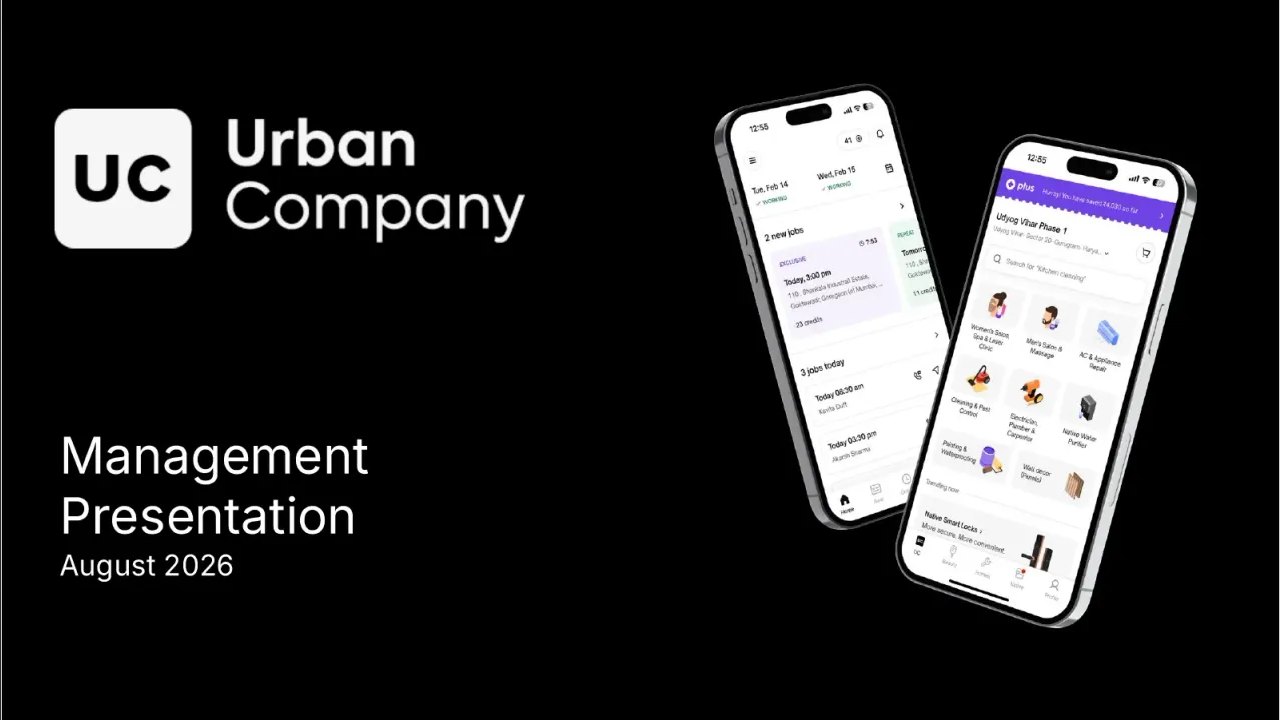
- Company
- Urban Company Limited (NSE:URBANCO)
- Period
- Q1 2027 earnings call
- Date
- Fri, Jul 31, 2026, 10:44 AM ET
- Replay
- Watch the replay on this page · 1 h 2 min
On 6ix: 6ix.com/event/urban-company-limited-urbanco-q1-2027-earnings-call
Replay
Transcript
Automated transcript · Written by software from the replay's audio. It can mishear names and figures; the replay is the record.
0:01 Good evening, ladies and gentlemen. Welcome to Urban Company Limited's Q1 FY 'twenty seven Earnings Conference Call. We have Mr. Abhirat Singh Bhal, CEO and Co Founder and mister Abhay Mathur, chief financial officer from the Urban Company Management team on the call today. As a reminder, all participant lines will be in the listen only mode, and there will be an opportunity for you to ask questions after the management's remarks. Please note that this call is being recorded, and the audio call and the transcript will be available on the company's website. Additionally, this earnings call is scheduled for a duration of sixty minutes. If you wish to ask a question, please use the raise hand feature available on your Zoom dashboard. We will announce your name on the call and unmute your line, post which you can proceed with your question.
0:50 Our results and shareholder letter has been published to the exchanges and uploaded on the company's IR website. Before we begin the call, I would like to remind all the attendees that some statements or comments made on the call today by the management can be deemed as forward looking and hence may involve certain risks and certainties... And uncertainties. Such statements or comments are not guarantees of future performance, and the actual results may differ. Over to mister Abharat Singhal for the opening remarks. Thank you very much, Bhavya. Good evening, ladies and gentlemen, and welcome to Urban Company's q one FY twenty seven earnings call.
1:37 Let me start by saying that q one was a very strong quarter for us, one of the best perhaps in the history of the company. Growth was broad based across the business, and our core business became even more profitable. Getting to the specifics, on a consolidated basis, q one MTV grew 42% year on year to reach 1,465 crores, and revenue grew 44% year on year to reach $5.28 crores. Total orders reached 13,200,000, which is up 79% year on year. We also added around 1,200,000 new customers crossing the 1,000,000 mark for the first time in the quarter, and our annual transacting user base grew to 9,300,000.
2:30 Now I'd like to highlight four important takeaways or points before we start the q and a. The first is that our core India services business, ex of InstaHelp, is accelerating, and it is accelerating with margins improving year on year. India consumer services grew 29% in NTV year on year to reach 1,056 crores, the first time it crossed a thousand crores of NTV in a quarter. This is the fourth straight quarter of acceleration, up from 10% same time last year to 19% to 21% to 26% to now 29% year on year growth. Adjusted EBITDA margin was 6.9 of NTV, up from 5.2% the same period last year.
3:21 Our core business continues to compound well based on consistent quality, customer trust, increasing partner earnings, and densification of our micro markets. The second point I want to highlight is that our international business is now scaling fast and profitably and will become the second core profit engine of Urban Company in the coming weeks. NTV grew 76% year on year to reach 237 crores. Both UAE and Singapore delivered profitable growth. Our JV in The Kingdom Of Saudi Arabia also grew very well with margin improvement. The third point that I want to highlight is that native continues to demonstrate strong growth with improving margins.
4:12 NTV grew 51% year on year to reach a 119 crores, and net revenue grew 60% year on year to reach 95 crores. Adjusted EBITDA loss narrowed to 7.3% of NTV from 11.4% a year back, so an improvement of four ten basis points. As a early water purifier cohorts complete their first replacement cycle, about 75% of them are renewing filters to us, which adds a recurring high margin revenue stream. Fourth, InstaHill is our largest investment today, and this business continues to scale. We delivered 3,820,000 orders, up 43% quarter on quarter. The adjusted EBITDA loss stood at 132 crores.
5:03 Loss per order improved from INR $4.47 in Q4 to INR $3.46 in this quarter has micro market density built up. We are investing aggressively in InstaHelm to cement our leadership for a category that we believe is of strategic importance to Urban Company. We have also articulated in the shareholders letter a better view on the size of the price. We believe the addressable market in the top 15 cities ranges anywhere from 7 to 12,000 crores in India. Given the competitive dynamics, we have shared what we can on InstaHealth in the shareholders letter and will not go beyond that on this call. The consolidated p and l, if I talk about that, adjusted EBITDA loss stood at 65 crores, but this was almost entirely driven by the incident loss of 132 crores.
6:02 Excluding incident, the rest of our operations delivered an adjusted EBITDA profit of INR67 crores, which is more than 100% growth from the same period last year, specifically about 116%. I also want to highlight that we ended the quarter with 2,019 crores in cash and treasury investments on our balance sheet, which is only about 2 crores lower than where we ended the last quarter. So our balance sheet remains very strong, and we continue to have a very strong and core profitable engine even as we invest in instead. We continue to retain our guidance of consolidated adjusted EBITDA breakeven by Q3 FY twenty twenty eight and 1,000 crores in adjusted EBITDA by FY twenty twenty one.
6:56 With that, I will hand it back to Javier to open the q and a. Thank you, Abhiraj. We will now wait for the question queue to assemble. As a reminder, if you wish to ask a question, please use the raise hand feature available on your Zoom dashboard. We will announce your name on the call and unmute your line, post which you can proceed with your questions. The first question is from the line of Mr. Gaurav Rateria from Morgan Stanley. Please go ahead. Hi. Hope I'm audible. Yes. Yeah. Hi. Congratulations on a great performance. My first question is on your proposition around cheaper, faster, better you talked about, and that flywheel is working visible in the last two quarters in acceleration.
7:54 At what point in time we can make a, you know, a very bold statement that the growth trajectory has shifted, North side, from a India consumer services and TV growth, perspective, because this flywheel is suddenly now, you know, giving you results, that we have been waiting for some time. Yes. Good question, Gaurav. I think the the... You know, I'll just take a minute to talk about this slide that you referred to. See, as we've articulated in the letter as well, our Indian consumer services business is not a single marketplace.
8:39 It is actually 50 plus service categories across hundreds, if not thousands of micro markets. And therefore, we have to build up this density across all of those service micro market combinations while ensuring that our quality is not just consistent, it actually improves year on year. Earnings for partners improve year on year, and the overall fulfillment types keep coming down. Now this is a flywheel that starts to rotate better with densification. As the category cross micro market combination densifies, partners end up getting utilized much better. Consequently, their earnings improve and their churn comes down. Partners tend to then spend a lot longer on the platform. They become more tenured.
9:29 And because their earnings are improving and they're more dependent on the platform, our ability to invest behind their quality, their training, the SOPs, the tooling, the technology, all of that improves further. This improves the end user quality, builds on trust, and very interestingly also brings down the fulfillment time. And this has allowed us through the last two quarters to roll out UC Instant, which is basically getting all our core services, be it salon cleaning, easy repair, nutrition's plumber, carpenter, etcetera etcetera between thirty to sixty minutes. So users won't have to wait and plan any. And that, you know, further improves the word-of-mouth, improves user ship, improves user retention, and frequency.
10:16 Now this is what we're seeing play out. It has been playing out for the last few quarters. At what point can we go out there, take a bold statement around our group? I think as management, we've always refrained from giving any forward looking guidance on this business. We believe the business is compounding really well. We believe the growth is accelerating. And more importantly, this is not coming as a trade off with margins. It's actually coming with improving margins. Our long term guidance of this business was nine to 10% adjusted EBITDA margin as a percentage of NTV. And this quarter, we've already demonstrated that we are at 6.9.
11:05 So we feel very confident of reaching that long term guidance. I do wanna highlight a couple of things so that we also don't get very ahead of ourselves. One is that the 21% year on year growth that we are seeing. The the base, which is in the previous same quarter last year, the growth was a bit muted because of one seasonal rains and monsoon. So there's a little bit of that impact as well in the acceleration. Yet we feel on the whole, the acceleration is broad based, secular, strong. The second point I do wanna highlight is that our margins in this business tend to have a a certain spikiness in the AMG quarter as well as new one d quarter.
11:55 And therefore, margins are best visualized here. Year on year also, the business has delivered a very healthy 170 basis points improvement in adjusted EBITDA margin. So overall, I think we are very happy with where things are. We wanna continue to focus on what is in our control, which is focus on user quality, focused on fulfillment times, focused on partner excellence and enablement. Growth is an outcome of that. It's not really in our control, and we are obviously chasing as fast growth as we can. Thank you for the detailed answer, Abharat. My second question is on the Insta segment. You know, I saw that you have put out a TAM estimate this time, and you also made transparent and prudent comments around, you know, structural why should margins be lower in this business compared to the core India consumer business. Right? And so just trying to understand why the segment should deserve this much of time and attention and bandwidth of the management.
13:03 Is it also the fact that the competition using this segment can start venturing into the other core categories that we have? Do they get any right to win in the core categories just because they are present in this segment? So just trying to understand various strategic aspects of how we are thinking through from a medium term perspective on this business. Yep. Yes. Well, so, a, we think it's the help is strategically very relevant to our platform. It is a high frequency category, allows us to enter the home on a weekly basis rather than a monthly or quarterly basis, which is the frequency that our core consumer services business enjoys.
13:55 And if we invest ahead of the curve in this category, I think it creates a very strong volume mode around our core business, allows the user to use the app multiple times a month. And long term, we think that will be very beneficial for the overall class. So the first point I wanna make is that our investment in InstaHelp, we see beyond just the ROI from the category itself because we visualize the category in the larger scheme of the platform that we are building. The second point is our view of the TAM, and we've given a bottom up assumption on on where we think the TAM is in the top 15 cities, and our views, it's anywhere from 7,000 crores in NTV to about 12,000 crores.
14:56 Given that view of the TAM, I think it is even more important for us to be aggressive and capture that TAM and capture a disproportionate share of the profit pool of that TAM. And that's one of the reasons why we have been aggressive, and we will continue to be aggressive with with the scale up of this time. Well, last question from me on capital allocation framework. By three q f I twenty eight, you would get to close to breakeven at the console at just your EBITDA level. Right? So would that be a time when you would start thinking about, you know, allocating more capital to new segments within the existing categories like native or trying to figure out, you know, what could potentially help you to further expand the overall addressable market in each of the places, like, maybe new geographies in the international business. Just trying to understand, like, at how are you thinking through from a capital allocation perspective from a, you know, two year perspective.
16:07 Yeah. So from a two year perspective, if I go segment by segment, I think the India consumer services business will continue to remain profitable and will cash out. We will continue to be disciplined in our execution and grow with sustainable margin improvement. We are not looking to squeeze all the margins out overnight. We wanna be disciplined and maximize growth while ensuring that there is steady steady improvements in margin. Some quarters, it'll be up. Some quarters, it'll be down. But, directionally, I think the India consumer services business will be a cash generating business going forward. We hold the same view for international.
16:53 Both UAE and Singapore, which are wholly owned subsidiaries are profitable, and we think they will continue to be profitable. We wanna maximize growth there. Again, we don't want to maximize profits in the short term. We think the market run rate is tremendous, and these are growing at a very, very healthy clip as you could see. So we wanna maximize the growth there by making sure that these businesses remain profitable. Our joint venture in The Kingdom Of Saudi Arabia is also growing exceptionally well, and we now believe that we have line of sight of profitability the coming quarters in that JV as well. Coming to native, I think native has done exceptionally well in terms of growth and margin improvement. Again, something similar, I would say, for native, where we now have line of sight of profitability in native over the next few quarters. Any incremental capital between now and when native starts to generate cash, in our view, will not be very substantial.
17:54 So the real area where we are investing today is InstaHelm. I think InstaHelm, fair to say over the next two years, if not longer, we'll continue to take investments. Instead, we are evaluating quarter on quarter. What is the right level of investment? And as our view of the market of the competitive intensity and the size of price is evolving, so is our view on capital allocation. I think you're right. When we get to that overall adjusted EBITDA breakeven stage, hopefully, latest in in the next eighteen months or so, then it's... Will be an important point in time for us to step back and start to organize, you know, basis our capital allocation framework where to deploy the capital on our balance sheet to grow faster.
18:50 I don't see us entering any new international markets. I think we are focused on India and focused on deepening our penetration in India, and I think that'll be where most of the effort will go. Thank you. All the best. Thank you. Thanks, Karav. Our next question is from the line of Mr. Manish Adukia from Goldman Sachs. Please go ahead. Hi, good evening. Thank you for taking my questions. And again, a great set of results.
19:46 My first question actually is, Abhiraj, a follow on to your last comment that you made to Gaurav's question, where you mentioned that no plans to enter any new international markets. Now given just your track record in the three markets where you operate in, particularly UAE and Singapore, which not only have continued to accelerate growth or continue to grow really fast, but have also now shown a proven model of profitability. Why should you not be able to export that same model to a few other markets and expand it, particularly when your India core services is generating cash, your native UC will become profitable in a few quarters. And InstaHelp, I'll come to in a bit as my second question, but just trying to, you know, understand that part a bit better as to why would you not enter new geographies when you already have a playbook of making them profitable while growing.
20:46 Thanks for the question, Manish. Manish, parts to your... Two part answer to your question. One, I think, purely from a management bandwidth standpoint, we have our hands full with the India business opportunity as well as actually doing justice to the opportunity in UAE, Singapore, and the JV in Saudi. We believe these markets are only getting started. As you can see, the growth rate is extremely heavy. 76% year on year growth in NTV terms. Even if I remove the currency impact, it's a very healthy 58% year on year growth. And the opportunity size is large in these three geographies as it is extremely large in India.
21:36 So we wanna make sure that all our attention as management goes into doing justice to these opportunities. That's the first and probably the most important reason. The second is, I I think I also wanna trivialize what it actually takes to enter and win in the market. It takes much more than, you know, just great execution. Often, the playbooks have to be customized for that particular market. And you need, to be honest, a little bit of good luck and timing and fair wins on your side as well. We've had that with us in UAE and Singapore along with just, you know, exceptional execution by our teams there. But we've also seen the flip side of this in Australia and The US back in the day when we had launched them pre COVID and around COVID. And we didn't have, you know, the fair... Fairness of that love on our side.
22:37 So we've seen, you know, the the story of our internationalization play out over a few years. And I think what we've concluded is that the markets where we are present are very large, and we are better off as management focusing all our attention and energy on these markets, particularly in India. Maybe in a few years, we may change that thought process. But at least for the next few years, I think we have our hands full with the opportunity that's available in India and UAE, Singapore, and The Kingdom Of Saudi Arabia, and we will be sharply focused on this. Thank you for that. That makes a lot of sense. Thanks for answering that. My second question is on India core services and the margin profile of that business now. Given that in 1Q, you're already closer to 7% of NTV and you've guided for nine to 10% of NTV, which now seems a lot more, let's say, near to medium term than where it was maybe earlier.
23:37 Do you think and given that growth is still accelerating for the business, do you think now there is a probability that you may actually do better than what you've guided on that 9% to 10% margin profile and exceed that number? Or would you intend to cap that margin at 10% or thereabouts? And beyond that, whatever the margins are, you will just look to reinvest in growth. So any color there would be helpful. I think our goal right now is to get to that number. Not be in a rush to get to it, to make sure that we do justice to the market opportunity and the time and prioritize growth above all else. Thankfully, this business, growth and margins are not at longer ends with each other. The faster you grow, the more margin you unlock.
24:28 And we've demonstrated that consistently in the past few quarters and years. So I think, probably number one, very, very clearly in that business is to grow fast. And probably number two is to continue to show margin expansion. I think once we get to that 10% stage, we'll have the optionality to then decide, do we wanna take it up further? Do we wanna start reinvesting back to grow faster and keep it at that level, etcetera. And we'll take the right call for the business at that point in time. I think we're still, you know, some distance away from that. So right now, the focus remains doing justice to the opportunity ahead of us in terms of growth and ensuring this improvement in margins year on year.
25:20 Very clear. My last question is on in style. And, again, maybe just delving a little bit deeper to your response to Gaurav's question earlier. Firstly, from a market position and profit pool perspective, like you said, you think you should be able to capture disproportionate part of the profit pool at some point in time. But given that you have revisited your TAM assumptions this time around and are also calling out explicitly that margins here would would be structurally lower than the core businesses. At least now, do we have enough comfort and confidence that this segment can be profitable at all? And without assuming material consolidation, let's assume that there are two players in the market. Even in that scenario, do you think that the segment could at all have any profit pull in the foreseeable future?
26:09 And second, even if in a scenario where it does not have a profit pull and given what you articulated earlier about this segment being strategic and how it drives for your core business. As long as the business continues to operate in a narrow loss range, would you still be okay to continue to operate it in the medium term even if the profit pool is not large enough? Like, your thoughts there. Thank you. Yeah. So let me let me delve a little bit deeper into both the TAM and emerging from the TAM, our view on the the profit pool and how we're going to execute. So the TAM has has been articulated in the letter and our view is between seven to 12,000 groups.
27:01 There is a base case assumption which assumes seven to 8,000,000 monthly transacting households doing three transactions a month at the full price of 300 rupees, $0.01,200 rupees per hour. And just to put things in perspective, that already assumes, you know, that the annual transact on user should probably be around twenty million hours because that's usually the ratio in which the monthly transacting users interplay with the annual transact users. We've seen that in our core business. We've seen that in other categories like food, etcetera. And then in the bull case where we are able to unlock a model that goes beyond the working model that we have right now and and do it profitably, the time in the top 15 cities can perhaps expand to 10 to 12,000,000 monthly transacting households.
27:57 And that automatically translates into a 10 to 12,000 crore NPV. Now, I would also want to call out one specific thing around this time and the nature of it. If you actually look at the... And there's an old adage, right, that gauge someone by their actions, not by their words. So if you actually look at the actions of the three players in the market over the past six months, actually, all of us have limited ourselves to micro markets where the household coverage that we are covering today is only about three and a half to 4,000,000 households.
28:45 Most of the investment today is actually not going into expanding coverage and expanding lots of new users into the TAM, but it's actually going into artificially subsidizing orders largely of repeat users. And Urban Company has guilty of doing this as everybody else because there's a certain competitive dynamic, and we are prioritizing leadership right now about everything else. So we believe it's a matter of time before the market... The broader market is able to see what we already see in our most penetrated micro markets. Our assumptions on the time that we've laid out because we have a full understanding of all the micro markets that can be served well in the top 15 cities coming from our core business, etcetera etcetera.
29:40 The bull case assumption that we've given you of 10 to 12,000 crores is actually that now. It is a bull case. And it's... We're not being conservative in this range of time. Our base case assumption is 7 to 8,000, and the aggressive assumption is 10 to 12,000. Our conservative assumption would be even lower. And that conservative assumption would assume that usership falls as the prices go all the way to 300. In this time assumption, we have assumed that usership does not... It retains at that three orders per day level. So that's just the view on that. Now given this view, we believe that it is even more important for us over the next few quarters to be aggressive.
30:31 We are opinionated about which micro markets within the overall addressable time matter, and how do we win this proportionate share in those micro markets, and how do we win this proportionate share in this early time. We think this battle will largely play out in the next few quarters, which is why we wanna be very aggressive right now. So that a, we capture this proportionate share of the time, and b, we capture this proportionate share of the profit. When will the pricing correct to its full potential? Very difficult for us to see. But whenever it connects, the player that has disproportionate share of the TAM and the more profitable segments within that TAM is likely to enjoy the maximum share of the profit.
31:17 That player will see the least correction as far as all the volumes are concerned when pricing goes up fully. That player has maximum likelihood of breaking even and eventually running this business slightly profitability at a very low margin. We also articulated that we don't think the margin profile of this business given everything we understand of it will reach anywhere close to India consumer services. It will be, all, like, due to low single digit category. We certainly have no intentions of making any money from this business over the next five years. In our assumptions, this business has to break even by 05/31. We'd be happy if it gets there. Very comprehensive. Very clear. Thank you, all the best. Thanks, Manish. Next question is from the line of mister Sachin Salgowkar from Bank of America.
32:09 Hi, Abhira, Jabari. Congrats on a great set of numbers. I have three questions. First question, let me start on InstaHelp. Both your competitors in this space are actually of the view that AOV of the segment is not going to increase, and it might remain low. What gives you a comfort that the steady state AOV could be eventually at 300 if both your competitors actually believe that directionally, we will be relatively low. Sachin, we've articulated that the AOV has to get get to around 300 for this business to break, and let me explain why. Today, on average, our view is that sustainably, the service professional has to be paid about anywhere between 130 to 160 rupees per hour.
33:11 Let's take a rule of thumb of about $1.50. Why $1.50? Because at best, even if you achieve incredible utilization at full potential, You can utilize the service professionals in a month by about one one forty to one fifty hours. One fifty hours assumes that they are working twenty five days in a month, and you're utilizing them for six hours of utilized time on a base of maybe eight to nine hours of time that they give you, which is around 65%. At that point, then net earnings clear the threshold of about 20 to 22,000, which we feel is the minimum required net earnings for this category to be attractive to be able to get supply side from offline where they are making around 15 to 17,000.
34:05 So that's why there is a range of $1.30 to $1.60. One fifty is sort of the bare minimum sweet spot in our view. Unlike quick commerce, beyond the point, like, this category, there is benefit of utilization and densification. But beyond that, that benefit taps out at a certain point in time. So it's not that you can keep utilizing this individual more and more and more. And if you squeeze the payout too much, then it shows up in other ways, which is more churn, therefore, more onboarding costs, more training costs, etcetera, etcetera. To one view or the other, our views that sustainable pricing and sustainable earn out is at that level. We have a view based on eleven years of operating across 50 plus categories having seen this play out many, many, many times over. I would not like to comment on how prudent the view of our competitors is.
35:02 If the category has to clear gross margin breaking it at $1.50 rupees an hour, Then for all the other costs that we incurred, which is customer support, marketing, team costs, training costs, etcetera, etcetera, we believe that the pricing has to at least be at 200 rupees per hour. Whether the category will get there and at that point in time, how will user behavior evolve? We've seen evidences of category getting there in micro markets that are not that competitive. Obviously, the rate of growth and the rate of penetration does take an impact, but enough users are willing to get there. So that gives us the confidence that eventually the category can get there.
35:49 And we also believe that we need that 50 on top for this category to break even to meet all our costs. How soon will it get there? Will it take a couple of years? Will it take five years? We don't know. We're taking the worst case here, which is five years, that this will be a very, very gradual build up to that point just given the competitive intensity, which we think is likely to sustain for a while. Pretty clear, Biraj. Second question is on the core business. As rightly pointed out, it continues to surprise on the positive side. And I do understand management doesn't want to give any guidance in this. But, you know, the way we look at it is there's no real reason why the growth, you know, may not even further accelerate from these levels?
36:40 You are expanding more into tier two cities where eventually growth will pick up. You mentioned beauty as a category, but I'm sure other categories are also sort of, you know, scaling up as you densify out there. So, you know, when we think about, let's say, the TAM for this space, is there a rethink that this TAM might be larger than what you guys thought? And, you know, in the call, you earlier articulated there is perhaps a positive read through from my InstaHelp. And, you know, one can't notice that since you guys accelerated InstaHelp, you know, if anything, your core business has also started to sort of, you know, move up in a meaningful manner. So when we think about the TAM, when we think about the opportunity out out here, here, and clearly competition is hardly anything in this space, how big could this market be and how, you know, how should we think about a medium term opportunity for this space?
37:37 Yes. Sachin, we we also believe the time here is very large. And if anything, we... Every year, we feel we will be under... Have... We underestimated the time. For instance, it's quite visible that our tier two markets are performing even better than tier one. And, honestly, I think we're only beginning to do justice to that potential in the tier two markets. So I think the TAM is large. I think we are only getting started. If you look at the size of the TAM and even in our most penetrated, oldest cities like Delhi and CR, for example, and so far, oldest categories. We have fair amount of headroom to do. And that's one of the reasons why our oldest micro markets in these cities continue to perform very well.
38:28 Can it grow faster than 29%? Look, I, again, would agree. I agree that I don't wanna get ahead of ourselves. I don't wanna set the wrong expectations. I think the 29% does have a little bit of, you know, margin there because of the low base last year. And it is... We're only a few quarters back that we agreed 19% or 17%, etcetera. So, you know, yes, we've seen acceleration. 19 has gone to 21, has gone to 26, gone to 29. We at our end will continue to do whatever is in our control. Focus on the basics, focus on bid quality, focus on supply sufficiency, focus on better fulfillment times, focus on customer excellence. I think the growth rates are an outcome of it.
39:15 I would not get too caught up with a quarter here or a quarter there. I think, secularly, we would like to grow at a very, very healthy pace and do justice to this opportunity by improving customer trust and customer quality. That's our focus. And I think if I take a five year view, there's no reason why this business can only significantly larger than it is today. Pretty clear. And last question on AI and how you guys are using AI. And the question is from point of view that, you know, you did mention one of the reasons for the margin improvement, what you're seeing in core and across businesses is AI. I just want to understand how much of the AI led benefits are already getting factored at, and how much is the room to further improve margin as you continue to leverage more AI?
40:06 Yes. So I think AI... I would say we're still early in the... In fully leveraging the benefits of AI across all aspects of our business. I think we we believe we are making the aggressive push to be an AI native company. And just to give you a few examples, a lot of our support on the supply side as well as the customer side, if not all of it is now AI. Significant efforts go into supply side onboarding through AI. We are now leveraging AI in training for the supply side as well. Quality control, quality audits inside the job across millions of jobs through proof of work audits, etcetera, are happening through AI.
40:55 We started to leverage AI very meaningfully in fraud detection and fraud control across the marketplace. More than 90, 95% of our code now is written by AI, and we are seeing a lot of leverage in our engineering cost and headcount there. And all our other teams are also aggressively deploying AI. For example, our entire marketing team today is leveraging AI end to end from creative creation to campaign deployment to optimization of those campaigns to learnings and redeployment. Our finance and HR teams are using AI end to end. So I think this is a huge technological shift. We wanna be at the forefront of it.
41:41 In terms of, you know, know, impact to margins, I think we've started to show up, but there's a long way to go. And we are also thinking about AI not just from an efficiency and cost improvement lever, but more importantly, as a lever that can help make our marketplace significantly healthier and improve our quality of service and experience for the end users. That's the primary goal, and we believe, yeah, you can help us get there. Very clear. Thank you, and all the best. Thanks, Sachin. Our next question is from the line of Ms. Karima Mishra from Kotak. Please go ahead. Thank you so much for the opportunity, and congratulations on the results.
42:27 First question, Abhiraj, is on the India business itself, and it has shown meaningful acceleration over the last few quarters. This quarter, in particular, you've called out the beauty segment as one of the important contributors to growth. What specifically has driven faster growth in this segment, and is this growth sustainable? I also add this in the context that competition in this vertical also seems to be fairly high. Thanks, Arun, for the question. Where are the beauty segment? I think has definitely seen an resurgence in growth in the last two, three quarters, and we've been hard at work to do that. I think one of the things that that we've done in this segment aggressively is work with our supply side to improve the overall quality of service retraining...
43:17 Retooling for a lot of them. And that that we felt was was some... Was an area where we perhaps had under invested a couple years back. So last, I'd say, year or more, we've been hard at work there. We've been driving a mobility program as well to make sure that all our service professionals in the beauty space, but most of our women have access to a two wheeler. That number was... A minority of our professionals had two wheelers about a year back. Today, that number is a majority. And, you know, we're working hard to make sure that that number gets closer to a 100% over time. What that means is simply put better quality of service for our end users and better fulfillment times, especially as the mobility solutions start getting unlocked along with densification.
44:08 We've also expanded our our assortment quite meaningfully. This year, we've launched, for example, set of Japanese facials in our cell loss category. We've launched, you know, in in partnership with Forest Essentials, a new line of Ayurvedic facials and solutions. So we're constantly waiting on the assortment as well to stay one step ahead of the curve. My team tells me that, you know, Korean facials and Korean beauty is now a trend of the past. One of the areas where we hadn't waited back in the day, you know, the new trends are now around Japanese facial, etcetera. So the idea is to stay one step ahead of the curve as far as assortment is concerned, as far as quality of service is concerned, and as far as fulfillment times are concerned.
44:56 Competition, I think, is always going to be competition. So I think that's everything. Keeps us on our toes, helps us improve, and we have to, you know, make sure that we're waiting on our proposition for the user, which is which is faster, cheaper, better. Got it. Next question that I had was on InstaHelp, and this is on the TAM assessment. And I understand your point of household clusters and how that limits how many households can potentially be customers of this service. But do you think in your assessment, there is possibility for the frequency that you have pegged at 30 to 40 times annually to be ultimately higher? I think for that to play out, the category has to go from being a backup to a main service.
45:52 We have not necessarily seen adequate evidence of that happening at scale. Sure. There is a subsegment of users who are doing that, and it's a stage of life point. Generally, bachelors and and younger users, you know, not wanting to commit and use this service every single day. So they're okay to get instant help two, three times a week. And consequently, their user ship can look more like eight to 10 times a month. That's a new... It's not tremendously large. And we feel that offline pricing at about anywhere from 18 to a 100 or highest 120 rupees an hour is very, very competitive for the full month subscription use case.
46:49 And it's it's really hard for us to honestly compete. Also, the 30 to 40 transactions in a month is data that we're seeing right now at the highly compressed UVs. In our experience, building marketplaces and having learned from others rarely does larger future cohorts behave better than early cohorts. Usually, the usership of future cohorts only deteriorates. So all things considered, we think if the category can actually land at three transactions a month, funds the pricing fully corrects.
47:36 For 10 to 12,000,000 monthly transacting households, it'll be a whole run. Got it. Got it. That's clear. Last question from me, maybe again on the InstaHelp vertical. We do see that often existence of multiple players offering similar services and also incurring cash burn. It results in some eventual consolidation. Are you seeing any signs of this happening in the InstaHelp type vertical anytime soon? I think the, you know, the the category is still very... I mean, the competitive intensity and the category evolution is still a bit early for for some of that to play out.
48:30 Our sense is that what we are seeing the market will eventually see. Capital market, especially on the private side, will go beyond narrative to look at actual health of the business, size of the price, and what can become here. And we would like to make sure that we continue to sustain the pressure on our private friends, continue to remain in leadership, and increase our market share so that we are the eventual winners of this category. We've made our point clear in the last earnings call as well that we are playing to win. We're not playing to look elegant. We don't wanna give an inch away.
49:17 We think this market, like most home services, is a winner take all. Trust compounds to the number one player. We don't think it's a very large, unbounded market which can support multiple winners. We wanna be the eventual winner here, and that's what we're guiding for. Perfect. Abharat, thank you so much, and wish you the best. Thanks, Karima. Next question is from the line of mister Srinagvi from Belvedere Capital. Hi, Abhiraj. Just want to, you know, hear your thoughts. There's been a significant, you know, incremental addition of annual transacting users in the core India services piece as about 5 lakhs quarter on quarter, which is a significant step up. Wanna understand, you know, is this largely organic in nature?
50:16 What kind of app downloads are we seeing? How how are the upper funnels playing out, you know, as the growth acceleration is, like, visible in India services? Anything that you can call out or share on that, that'll be great. Hey, Sheena. Thanks for thanks for the question. Yeah. I think, you know, we we have been... We're fairly happy overall, I would say, with the pace at which the... Both the users... Transacting users has grown in this quarter as you rightly articulated more than half million. And also, you know, their expense.
51:02 Now I do wanna call out that this is a seasonally exciting quarter. And so some of that is also seasonal, Sheena. But otherwise, also, think, secularly, the trend is looking solid. I think all the funnel metrics are moving in the right direction, Sheena. So we've seen an improvement in traffic in MAUs, NDAUs, and consequently, the MTUs. And if anything, the conversion rates are only improving as trust improves. Our fulfillment rates have improved as well, which is, you know, from order placement to fulfill, and there's a little bit of benefit of that as well. So all of this is coming together. I do wanna highlight that this is not on the back of more aggressive marketing.
51:52 In fact, see year on year in the India consumer services business, the marketing spends same period last year were 24 crores, and this year, they'll be 25 crores. So actually, more or flat marketing, but we've been getting a lot better on why for our spends there. Fantastic. If, you know, in the next shareholders letter, if you could share an indexed value of some of these, you know, traffic figures or something like that just to, you know, get a feel. If you would just share it one time, that would be interesting. And, just going to my next question on training, two parts, both for InstaHelp and for India core services. Could you kind of help us understand, how are our training capacities playing out in InstaHelp?
52:37 Have you been able to, you know, significantly increase it? Because, say, in in the location I stayed last weekend, you know, I couldn't, you know, get get the InstaHelp because it was all, you know, sold out. So how are the training capacities playing out? And the same question for core services. Again, as we see a gradual acceleration of growth and and factoring in that our existing professionals, have better utilization, I think still we would need some sort of growth, in in training. So how is that playing out given the more diverse services, under that basket? Yeah. No. Good question, Sheena. So on coaching, think we are...
53:22 You're definitely definitely very mindful that we need to make sure that we have adequate training infrastructure and also capacity of our trainers and equally leveraging AI to make overall training more efficient. It's a big and important focus area for the company right now and for me. I would say we have, you know, we have the engine running smoothly and and well oiled right now. So we are able to cater to the growth. And even for the next few quarters, I think we have a clear plan in place. So I think we... We're in a comfortable spot, I would say, in the call, but we could be able to focus on that meaningfully. On InstaHenpa, I think it's all hands on deck right now. The pace of supply addition has been very high, And consequently, keeping pace with our training infrastructure and our trainer capacity and making sure that our training efficacy also improves.
54:21 And we're not just throwing, you know, more training groups and more trainers in the problem, but actually making sure the trainings become more efficacious and the ROI on those trainings improve. I think all of those are a work in progress. That category will take a little bit longer to settle down. So, yes, I think there is... It's all hands on deck right now. Thanks a lot, Abhilaj. Fantastic. Thanks, Srinath. Moving on to our final question of the evening, I call mister Pranav Shatria from MK Global. Yeah. Hi. Thank you for the opportunity. My question is on native. So if I look at... You know, we've seen a good scale up despite operating only in two categories.
55:13 And and I see some of the products you are launching are more premium. Is that shift, you know, basically, is, you know, on the back of more premium customers what you have? And second part of that question is that, you know, how should we see this as a number of categories pan out over a medium term? Because the two categories where you are present are fairly small categories, and, you know, how how should that sort of play out over a bit of time? Thank you. Thanks for the question. I think on native... You know, our goal has been to make sure that the quality of our products are truly exceptional and world class.
56:05 That's the bar and the benchmark that we have maintained from day one. I think back in twenty twenty three, October, when we launched our first set of water purifiers, m one and m two, they completely changed the language of the category. The category which had largely focused on a razor blade model and convincing customers to get their water purifier service every few months. We came out with a very innovative high performance device that needed no servicing or filter changes for two years, And it was smart. It was fully integrated with the Urban Company app and backed by the exceptional service fee that we have, which allowed us to rapidly gain share in that category and serve consumers better, more importantly, also chain on the where some of the existing incumbents and new players have somehow managed to try to live up to that promise As the rest of the industry has barely caught up, our view is that we have taken that language to the next level. With m three, we are now launching a three year, no service needed, very high quality machine with a stainless steel tank, adaptive mineralizer, and pH balancer, etcetera, etcetera. So this actually cheap...
57:35 Takes the category to the next level. Yes. It's a premium product. But if you look at the life cycle ownership cost, that actually is much lower. Because for three years now, you don't need any servicing. You don't need any filter changes. So the cost of ownership comes down, and more importantly, the headache comes down. Consumer durable is supposed to remain durable. That's what we're trying to do here. Even after three years, we have one comprehensive service for Urban Company, and you're again set up for three more years. So I think this is a completely different paradigm altogether in the water purifier business. Similarly, if you look at our native log on trial, the most recent smart log that we have launched, It comes with an inbuilt camera feature, which is extremely seamless. And therefore, the moment you come in front of, you know, the the smart lock, it automatically unlocks the door. It It has many other features like a local alert so that if somebody is looking around your house, it alerts you, etcetera, etcetera.
58:43 And very, very comprehensive state of the art build out security features, etcetera, completely tamper proof and so on and so forth. It has been very well received by the market, highly needed on online platforms. And we are very pleased with the progress of these two categories. We think there's a lot of work to be done in both the categories. If at all, we have to venture into another category over the next five years. Maybe we will enter one more category. That's about it. We don't wanna proliferate too much. We think there is a lot of work to be done in water purifiers and smart door locks. We'd like to do justice to that. And maybe, over a period of time, look and see if there is one more category that native would like to enter. That's more.
59:37 Will, you know, the future product, whenever you enter that category, would you want to constrain yourself to some premium products, or you would, you know, want to sort of be there across the entire gamut? Yeah. It's a it's a good question and and goes back to the strategy of native. So So let me start by saying what native... What we're not trying to do in native. In native, we're not trying to build a consumer deal with this company or trying to be a consumer deal with this player. That's not our strategy, and we certainly don't think we can compete by being everywhere for everyone. What we're trying to do, Nathan, is serve an underserved market, which overlaps with our core users on the open company platform and enter categories which have very strong adjacency to our core services business with superior tech first new age products that can capture a disproportionate share of the profit pool of that industry even if they don't capture a disproportionate share of the revenue.
1:00:56 It is our view and a considered view that a meaningfully larger share of the profit pool sits on the top vis a vis the revenue. Therefore, we want to remain in the premium segment. We want to serve our users. We have 9,300,000 annual transacting users. These represent the top 9,300,000 households or more than 8,000,000 households of the country. And we wanna serve them more deeply. Through it as an extension of our core services. This allows us to work from being a real business services company to a whole platform of services and solutions. That's how native is deeply intertwined with our overall own platform.
1:01:44 Whatever fits into the strategy, we will. And whatever does not fit into the strategy, we will not. But we are certainly not really consumer durables play in native. The idea is to build a strong solutions play, which is extremely synergistic with our services business and our platform. Thank you for such a detailed answer. Wish you all the very best. Thank you, Pranav. Thank you, everyone, for your participation. You may now disconnect your clients. Thank you, and enjoy your evening.
Follow Urban Company Limited into a list and get an email when it puts out news.
Latest news releases
- NSE:URBANCO — Urban Company Limited has informed the Exchange regarding a Media release dated October 16, 2026, titled "Media release on the financial results (standalone and consolidated) of the Company… · Fri, Oct 16, 2026
- NSE:URBANCO — Urban Company Limited Press Release Aug 05 2026 · Wed, Aug 5, 2026