Jose Garcia
CEO at Silver X Mining
Replay available
Join us for a great event!
Automated transcript · Written by software from the replay's audio. It can mishear names and figures; the replay is the record.
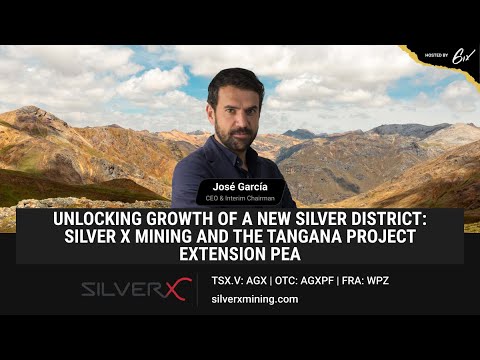
0:07 Hello everyone and welcome to SilverX's live summit today, hosted by 6th. I'm pleased to introduce their speaker and CEO, Jose Garcia. Jose will actually take us through a company presentation today and after that we will be accepting questions. As a reminder you can submit the questions in the Q&A panel on the right hand side of your screen at any point during the presentation. And If you'd like to contact the SilverX team, feel free to fill out the survey linked in the chat. It should be there. As always, this summit is being recorded and
0:37 will be available on SIX.com to watch afterwards. Without further ado, Jose, feel free to share your screen now and we can get the presentation started. Hi, Kyle. Thank you for having us. Very excited to be here presenting our recently published PEA and all the developments that SilverX has had over 2020 through and what's happening in 2023. I think it's gonna be a very exciting year and every investor in the Silver space should be keeping an eye on SilverX for a number of reasons but let's jump on to the presentation. So again thank you everyone for joining us today we are very excited to share not only what we've done over the last year but actually what we just published which is the first growth project of SilverX in the last couple of years since we went public, right? I think that's actually something we committed to doing and we've done very
1:31 successfully. Most of you are familiar with SilverX, but SilverX is a silver company that is currently focused on Peru. And we intend to be that Latin American silver company, growing with production and exploration. We like the idea of taking these historical districts, looking at them with a different exploration view, getting to production quickly, and building value in that solid way. We've proven to do it once on a large silver district, and our mission is to actually replicate that over time. SilverX is a good investment thesis at the moment for a number of reasons, and mainly on these 3 pillars.
2:19 We've proven that we had a very interesting district, but that we can provide organic growth on it. We went public in 2021 with, at the time, a large inferred resource, very high quality. Within less than a year of going public, we more than doubled the resource with very successful exploration. That was in mid 2022. And we already had a mind plan at the time with a small measure and indicative resource. And now the PEA that we launched last week provides not only a growth case, but actually a resource update. And we've increased our measured and indicated resource to 3.6 million tons, which is a terrific success.
3:08 On top of that, we have a second project. We call it PLATA. It's equally large as TENGANA. Still there's no economic analysis on it. It is a large vein field of high grade, and that's our next target. Our district is very prolific. With more than 200 veins and 100 kilometers of outcrops, we have, let's say, a resource that exceeds potentially 200 million ounces of silver equivalent. It's a historic mining town or mining district where millions and millions of ounces have been produced over the last few hundred years. And on top of that, we are in a position to consolidate more properties in the neighborhood and in central Peru as well.
3:55 Since we went public, we achieved a number of milestones. We built a mine while having very successful exploration. We announced commercial production in January 2023, just a month ago, and we've launched the PEA that we promised. Now, we are proposing that from the current mill, which is 700 tons a day, we move onto a growth scenario with a new mill of 1,500 tons a day, keeping the current one. So that means a combined capacity of 2,200 tons a day. And that, in the scope of things, means that we can go from approximately a 2 million ounces silver equivalent production to basically 6. That's organic growth.
4:41 And if you are here on this call is because you are interested in silver, obviously we are bullish on silver. We believe that we are in the face of a silver bull market. Not only is silver as a monetary metal, or as a currency, or actually a financial asset, But most of the aggregated demand for silver will come from its consumption as an industrial metal, particularly in solar panels. Just looking at the plans that China is actually proposing in terms of building solar panels, we believe there is going to be a dramatic crunch in the silver market over the next few months. Peru has produced a lot of silver over the centuries. We are in central Peru, not far from the capital city, Lima. We are up in the Andes.
5:30 And we can identify a number of historic mining districts, including this of Huancavelica, where silver production has been taking place since the 1500s. Peru is today the second largest producer of silver, but the largest reserve-based for this metal. And as I said, we are in central Peru in a department or state called Huancabelica. Within that state, we are in the district of Huachacolpa, And we own a large package, basically 20,000 hectares of concessions that we've divided on 2 flagships or 2 projects, right? The geology of this part of the world is quite astonishing. We are next to a major regional fault, the Chonta fault, where some of the best silver and polymetallic deposits of the country have been found over the centuries, right?
6:27 We have a processing facility, we have all the infrastructure that is required to operate. We have a community agreement, and that's been done not recently because we built this company privately since 2017. So that means that every piece of the puzzle is being put in place. We started with the first project, Tangana. We are tracking the ore to a mill, which is centrally located. At the moment, our capacity is 700 tons a day. With the new PA, we propose that Tangana goes with a new mill to 1,500 tons a day. And there's a second project called Plata. For those who don't speak Spanish, Plata means silver. And that talks a lot about the high grade we can find in that area.
7:15 And the current mill is going to be allocated to that project. So again, 3, 4 years time, you want to see this district producing potentially more than 6 million ounces of silver equivalent. It's a very simple growth thesis. And we are achieving it. Over 2022 we were building the mine. Q1, Q2 were slow because production was short. But as long as we got to Q3 and Q4, we managed to actually keep a true speed. We achieved record production in August. We achieved very good cost, really competitive for a company of our size. And we've done thousands of meters of underground development, preparing the mine for both production and development, expansion, more drilling.
8:07 In Q4 we had some disruptions in the supply chain, hence our production dropped a little bit. We were partially affected by the social unrest in the country that you all have seen and is coming to a more calm status. In our region, in Huancavelica, we haven't had major disruptions and we haven't had any friction with the local communities. In 2023, you are gonna see basically 3 things happening. We already published the PEA, and it's important to highlight that Alongside that, we are doing an environmental impact statement or assessment. And that means that in parallel to the technical reports that we do on our growth, we are doing everything it takes to be able to build the mine when it's due.
9:02 We anticipate that these new environmental impact statements will be approved in 2023. So in other words, Tangana is in motion. And after that, we're going to put the second project in production. And that's Plata. You're going to see some drilling in 2023, some mine preparation 2024, will be a year of resource definition. And we hope we can be in production for having the first cash flows in 2025. But let's talk about the PA, which is what brings us all together here. We had a really successful resource increment. Not necessarily in the total amount, as the overall inferred resources stays the same, but we managed to convert a large amount of resources into measured and indicated.
9:57 Actually 4 times what we had before. We have now 3.60 million tons of measured and indicated resources, 3.42 are just on Tangana. And it is only on 3 veins, which is probably not even 0.25 or 0.2 of the number of veins we had in that area. So that's very promising. Step by step, we keep on developing the asset and we prove that Tangany is gonna be long in my life, is gonna be profitable. With what we have, We've proposed a life of mine of 12 years at 1,500 tons a day, which is somewhere near 6 million tons of mineral that's being processed with very good grade, with average annual production of 4.2 million ounces of silver equivalent, and with very solid economics.
10:51 At the 8% discount rate, we are looking at practically $200 million US. And that's a very compelling IRR. The beauty of vein in production is that not only the mine is going to be partially developed at a time, but we can do things relatively cheap and relatively quickly. Our consultants have proposed an initial capex of $61 million, which actually is a very conservative approach accounting for more than 20% contingency, for a dry-tag, very modern dry-tag tailings facility, and for some aggressive mine development. We'll get into the details in a few minutes. But overall, the economics are really solid.
11:38 If you want to see the details of the financial analysis, you can see that the payback is 4 years. And that's really competitive as well. We are looking at sustaining capital of $143 million over the life of the mine. But more importantly, you want to look at the cash cost that we are projecting, which is less than $9 per ounce of silver equivalent.
12:03 And that's really competitive, again, especially for a company of our size. They only sustain cost, and that includes not only CapEx, but actually corporate DNA and taxes is around $16 per ounce of silver equivalent. Again, that's very competitive. You want to review the initial capital expenditure, we are allocating basically $11 million U.S. To mine development, $30 million U.S. To the new processing facility. It's going to be a very conventional flotation plant with 2 circuits, 1 obtaining a concentrate of silver, gold, lead, and the other one obtaining a zinc concentrate. We're also projecting a very modern dry stack tailings facility.
12:50 And obviously on top of that, you've got the EPCM and owners cost and contingencies. I think it's a very generous budget, however, still on the lower bottom of the industry, and you can see that has obviously a, again, it's a very solid number. When you want to look at the financial analysis that we did, You can see a display of basically those 12 years, from year 0 to year 11, with all the production in terms of concentrates, in terms of silver equivalent. But also you want to look at the NPV analysis. In terms of NPV, we're proposing, again, $200 million, at 8%, $193 million US, or 175 at 10%.
13:40 But when you play the sensitivities around that, especially on metal prices, capital cost, the mine throughput, or even the operating cost. Some of them are just not independent variables. They are related to some degree. But you can see that the NPV is very solid. Our grades are pretty stable. We are not having dramatic changes in grades over these veins. Our economics are really well adjusted. I think we have very competitive costs at the moment. And there is still ample room to improve that when we move from PEA to feasibility and to the real life. But The most interesting thing is that when you look at the cash flow, and you want to look at the upside, not only because we are bullish on silver, because we are bullish on the asset. We can find better grade, we can find more veins, and we have better economics.
14:27 I think the $193 million NPV is on the lower end. The Tangana mining unit is large. It spans over almost 11 kilometers. There's lots of veins that go on a strike for several kilometers. The main veins are in between 2 and 4 kilometers. There's many of them. And as we say, we already built a mine over there. And we're only focused on 3 veins at the moment. And the main target of this PA has been those 3 veins, even if some other production has been allocated as well. In Tangana, we have more than 7 structures already identified. We are now on 3. We've identified the Gold Corridor. Many of you have seen the news over the last few months.
15:15 And we are going to expand northwest to Tangana West, because it's very high grade of silver. We might call it bonanza grades. And as we expand underground, we are going to get there within the next few months, hopefully within 2023. On that picture, you can see that we are proposing a new mill next to the mine portal. And the new dry stack tailings facility, about 500 meters from that new mill. Tailings are going to be dried on a filter press and tracked by surface. I mentioned a number of times that we've upgraded our resource. As I said, we went from 7.4 million tons in fair resources a year and a half ago to basically 14.9 million tons with some measured and indicated.
16:10 And now we're having 3.6 million tons of measured and indicated. And that's really appealing because more than half of the production that has been included in the PA already comes from those measured and indicated. And we've done that within 18 months. Going forward, when I put more measured and indicated, when I find good grades, I want to make sure we can actually prove in 12 or 15 years of my life we just measured and indicated the resources. Then we can call it feasibility and we can build the plant.
16:45 A 4 times increase in resource is quite attractive. And again, the fact that we have an overall resource that you could qualify in excess of 150 or 200 million ounces of silver equivalent tells you that there is much growth to come. And our job now is to continuously increase the resource and to define mining strategies to have a very compelling mine plan. This is only on 1 project. This is only on Tangana. Tangana is in a very hilly area, as you can see. Our mine portal is around 4,600 meters above the sea level. It's very high altitude and it's all very hilly. That's why our development takes place underground. Our drilling takes place underground.
17:31 Our veins are kind of like that, sub-vertical. Those are the 3 veins that we are now exploring and mining. And there is tens of them going left and right. On this slide, I'm showing a long section of what's happening today in Tangana. Tangana number 1, 1st vein, with some mining taking place, had very successful drilling. Down below, wood crates. You could check all our news releases in 2021 and 2022. And as I said, we've done between 5,000 and 6,000 meters of underground development. As we identified a Gold Corridor, we are now, again, exploring the asset, what we produce, and hopefully identifying areas where we can bring better grades, increasing profitability.
18:23 At the moment it's exciting. This is just the beginning, because it's only one of the many veins we have, like this one, Cauca, which is only a few hundred metres from it. And we already crossed those 500 meters or 400 meters and intersected the vein. And we're starting to prepare the vein for production. The surface values are really exciting. We had some underground drilling and we already identified blocks for production. In other words, the mine is growing on its own. And when you look at this portion of the district, you can see on that blue square that the main area of Tangana, the area that is being considered for production, is still not that large. So we're going to run along those veins. We're going to get to Tangana West.
19:09 But very quickly, we want to expand left and right. That golden arrow represents somehow the gold corridor. Not only because it brings gold and good grades of silver, because it connects all the veins in a perpendicular way, so it allows or enables quick production, but more importantly, exploration and resource update. That's something you are gonna continue to see over the next 12 months. The next few years, we also propose to go right or northeast and get into the Positivas area. Again, these cross-casts that go across several veins and put all of them together, and they are single-mine infrastructure. But there's 1 project I would like to highlight, and you will see news in the next few months, and that's disseminated gold on surface. A project called Hazawasi.
20:04 It's next to Tangana. We already identified a few hundred meters of very interesting gold anomalies on surface. We believe that Gold might be related to a gold copper porphyry system. Still too early to state that, but it's certainly exciting that we are having hundreds of meters of gold anomalies on surface. You will see the exploration results in the next few months. Now, quick summary. I wanted to refresh your memories on our ramp up, our organic growth and potentially growth beyond Guachacolpa. In Q1 2023, we already announced commercial production.
20:50 We had a budget for 2023 that is quite compelling, haven't provided any guidance yet. We might provide guidance around Q2 once the company is more comfortable with the production level and with everything around our operation. We deliver our PA and we are more than doubling capacity in Tangana. Overall in the district we see this north of 2000 tons a day. That's a really exciting project. And the EIA or EIS is taking place this year. So it's been filed or is about to be filed or should be approved in 2023. What I like about our district is because we have a really competitive discovery cost.
21:36 We can double, we can triple resources in a span of months with very low budget, and we've proven to do that. Once we have 2 projects up and running, that's going to happen even in an amplified way. And if we continue to drill, which I believe is probably the most profitable money we have at the moment because we have a really high rate of success. It's not that we have a successful drill hole every 10. We probably have 2 successful drill holes every 3. Beyond that, SilverAX seems to be a company for growth. We listed the company because we wanted to grow. And having said that, as we keep on proving that we are a competitive team, we might take on other opportunities. Why not? I think that idea of consolidating silver assets throughout the Americas is very appealing to us.
22:28 And if you ask me today about the launch in BU, I think that we're going to be able to consolidate a production that will play SilverX as a mid-tier producer and obviously one of the prime silver producers in Latin America in particular. Finally, we are a company that has sustainability very close to our heart. We build this company privately. And we did so with the communities around us. Most of our workforce comes from the local communities. Every service from more transportation to hospitality and many other sectors we hire with the so-called community companies. And we've been coexisting now for a few years And so far it's very good.
23:18 We anticipate many years of stability. We are behaving as a very good citizen. And even recently we've created a foundation to be able not to deploy our own initiatives, but actually to attract initiatives from other sources, right, external to the company. I do believe that Silbrex is going to be also a remarkable company in terms of sustainability. And having said that, I wanted to do some final comments on our team. I think you know most of us, but we have basically 5 directors, including myself. I will start in order of importance.
24:05 We have Francis Johnstone of Baker Steel Capital. And I say that because Baker Steel is one of the largest shareholders of the company. They are also on the board. They are insiders. They were our cornerstone investors since day 1, so we extremely appreciate that. Just among Baker Steel and the 2 co-founders, which are Sebastian Wahl and myself, we basically control approximately, in very good terms, a third of the company. And that means a lot to our investors. We also have Darryl Carty, known to those in Vancouver, a mining executive with terrific experience across many deals. And Mike Hoffman as well, former chair of Trabali, is based in Toronto.
24:52 Our CFO, Ronald Marino, is based in Toronto, also bilingual, as you know, we are a Peruvian company. So that's the team. And one final comment on the capital structure. We have approximately 156 million shares outstanding, fully diluted is 175 with all warrants, stocks and things like that, and a third of the companies inside their ownership. Some of the institutional capital we have, other than Baker Steel, we have US Global in the US, we have Earth Resource Investment Group out of Switzerland, and we've got Sprott Asset Management in Canada. If you want to see some of the analyst reports, I would encourage you to read both Echelon's Gabriel Gonzalez and Red Cloud Security's Timothy Lee.
25:45 Both provided updates on SilverX last week, and both are extremely excited about that re-rating of our company in the next few months. And with that, I just wanted to say that SilverX is not fully valued. I believe that, well, every investor has got his own theories or their own theories, right, or thesis. Not only going to compare SilverX in terms of price per NAV, I think the fact that we are in production, the fact that we've proven to do so much in so little or small period, makes us a very solid vehicle for investment. Not only that we want to revalue on our existing assets, I believe our team is building a story to make sure that over the next few years we grow organically and inorganically.
26:41 And I would like to see SilverX at some point on the upper part of the chart compared to Endeavor Silver or to Fortuna Silver. There is a long way to go, but I think we are placing the right foundations for that. That's all I wanted to say today. Thank you so much for your time. And I'm pretty sure we're going to have some questions. So there are quite a few questions in the queue and there were some pre-submitted questions. I'll start with a couple of those. You just recently released your PEA, your Pre- Economic Assessment. How do these results stack up to your team's expectations? The team was very happy with it because they live on Dynana every day and they wanted to see that new resource and those economics.
27:30 We believe really that the economics are very solid, and we believe we can do better than that, especially on controlling costs, especially the initial CAPEX. Consultants have lots of expertise, and we need to assume those CAPEX estimates. But the moment we have to build the project, we might thrive in actually reducing that CAPEX and doing it faster and doing it more than a local cost if you like. Okay, other than that, we are excited because as I said, most of the resource comes from 3 veins and the gun is really large I mean do you see veins everywhere so the moment we expand our underground operation we're gonna be able to increase resources substantially I believe yes and like this PA like you said it doesn't cover the whole district it's just a part of it And going off the capital expenditure topic or question, Roy had one in the audience. He said, how and when are you going to finance this US $61 million capital expenditure?
28:38 It's hard to say at this point in time. We need to get a larger resource statement before making a decision on construction. So you ask me today, OK, when are you going to have 5 or 5 and 1⁄2 million tons of mesh, and then they get it? It might happen within 12, 18, 24 months. We don't know yet. In my most aggressive estimate, we'll say a year time. In the most conservative, 2 years time. But it's happening immediately anyway. In terms of the decision to build that, We believe we'll be able to finance that with a project finance with debt, most of it. If we do that in 2024, I think at that time we'll have very solid economics to do so. I would like to raise some funds, some debt to build that project. Okay.
29:37 Perfect. Thank you. And then another question that was pre submitted. Silver is less than 25 percent of the measured and indicated resources. Is that at or below average for a silver producer in this space? I really don't know, to be honest. What's changed our silver resource a little bit is that over the last few months we focus primarily on that so-called gold corridor, because it brings good grades of silver and gold. Now, you see that silver grades are not as high as they were on the inferred, and that's a consequence of the resource modeling, okay? We've used, for those who are interested, we actually have 2, how do you call it, estimation techniques embedded in this model.
30:31 What we had before, which is a much larger package, with a traditional polygonal estimates, very conservative, just taking basically the outcrops of the veins. And now what we had on those veins, which is a proper reverse of the distance, or reverse distance techniques, where the inclusion of gold is punished the silver crates to some degree. How does it compare to other silver producers? I really don't know. What I believe is that it's going to be not only a much larger resource, but that actually the silver grade should be better than that. I'm particularly excited about Tangana West. Tangana West, as you go northwest, is a system, it's an epithelial system, it's entirely preserved, And there is very solid evidence, not only surface sampling, we're going to have really high silver grade on top of it.
31:30 So the moment we get to mine there, I think you're going to see the so-called primary silver mine being built. Okay. But that's something I can't promise yet. I will say that it's going to happen within the next few months. Thank you. And it's not bad having Gold as well as Zinc and Lead. But the resource estimate shows good Gold values as well as Silver, right? So how will the earnings profile look with the rising precious metals price? Well, Obviously, in the event of uprising in metal prices, we're going to increase our profitability. Our PEA is used, a consensus from, actually from a Canadian bank, a consensus from January 2023, is relatively conservative, as you could see on those long-term prices.
32:23 And any sensitivity, obviously, the sensitivity on Silver prices will change dramatically, especially on Silver and Gold. And we've placed our bet on those 2 metals Thank you pretty direct question and Roy has another question that a lot of people ask about Producers and explorers in Peru, but he says how is the situation for silver X in Peru Is the plant on full capacity now? The situation is relatively okay. Now, we're extremely concerned about what's happening at a country level. Those almost 3 months of social unrest have put the country in a difficult situation. Some of the larger mining operations have been blocked or they have put on hold.
33:11 However, in central Peru it seems relatively okay. We had disruption in the supply chain because some of the main highways or roads of the country were blocked temporarily for demonstrators against the government. As I said earlier, we haven't had any friction in our area and we believe we have the support of our communities. However, we remain vigilant and we work daily, hand in hand with them, because relationships are like that. You can't just sit on it and wait. I think we've done a great job. My outlook for the country is not pessimistic. I believe that the situation is difficult. I believe that people have the right to demonstrate against the government. I don't think it's licit to do it with violence at all.
34:01 But I think Peru will find its way. Peru is a country that has lived periods of instability over history, but will always remain as a great mining jurisdiction. There's no doubt about it. And it's not only because our geology is outstanding. It's also because the society wants mining. The government wants mining. And basically everyone around wants mining. We just need to find a better climate locally. Well said, Jose. And we have another question in the audience here from Martin Trader. Could you speak to how the future productions are hedged or pre-sold? What percentage is pre-sold and at what price structure and for how long?
34:50 We are not hedged. Thank you, Martin. That's a good question. We sell 100% of our concentrate to a trader. This is Trafigura. The price mechanisms are the so-called international benchmark. So in other words, the London Metal Exchange prices, there's a quotation period. Depends on the contract, typically it's a month or 3 months, in our case it's a month. But we get paid on an international price. It applies also the typical payability. So you get paid 95% of the lead, 95% of the silver, 95% of the gold, 85% of the zinc. And it's got the number of treatment charges, rollback, and refining charges like any other concentrate on earth. The Peruvian market is really good, not only because we have plenty of mines and lots of production, but actually every trader is in the country. So it makes it a really competitive environment.
35:50 So when you compare the terms you get in Peru with some other countries, they are, in general, rather competitive, okay? But we are not hedged. So we'll enjoy any upside in the prices. Perfect. Perfect. That's great to hear. Can you explain the timeline for the 2,200 tonnes per day? Expected timeline, anything you can share with the audience? At the time, it's very conceptual. As I said earlier, there's a moment, a point in time, when we'll make a decision on construction, the new mill at Tangana. That might happen in late 2024, early 2025. It's difficult to say at the moment, perhaps even earlier, right?
36:35 Will depends on resources, will depends on market, hopefully sooner or later. At that very moment, we want to have our second project splatter up to speed to fill up those 700 tons a day. When you look at our district, and we are trying to make it simple for everyone, including investors, right? We have just 2 big projects, but reality is that many targets, many targets. It's just, it's almost crazy, right? So we're also working with some local contractors to allow them to take some sort of lease, but use some of those targets. In other words, in 2025, we want to have a district which is, let's say, largely activated.
37:21 I'm going to only going full speed and doubling up capacity, but platter, catching up to 700 tons a day. On top of that, you have some of the smaller contractors providing a few hundred tons a day. I do believe that's achievable. And we have such a big district and a little bit of financing, we can accelerate that much faster. Perfect. Thank you. And go ahead and continue on with the exploration. There's many different options of exploring. Why don't you touch on 2023 specifically and your exploration strategy for this year? Well, thank you. That's a good question. As I said during the presentation, most of our, actually all of our development is underground. It is an extremely hilly area.
38:10 I mean, you can barely drill on surface. So you basically develop the mine, And you should drill holes a few hundred meters, cut the next vein down below, up horizontally, just everywhere. You're going to see lots of exploration underground this year. So basically the expansion of Tangana. From Tangana number 1, we have Tangana, Cauca, and Tangana 2, we go to Tangana 3, from Tangana 3, we go to Tangana 4 and 5. Between X vein, a few thousand meters of drilling, next block, you move. Next block, you move. So we'll see NEOs this year. And on top of that, we, as I said, we are targeting this gold on surface, disseminated gold on surface, that's Hazag-Wazi.
38:57 I can't speak up yet, but you'll see results in the upcoming weeks. And I believe it's going to be a very exciting project. Excellent. And just to continue on with that, Roy had a question very similar. Maybe it's a nice way to summarize that. How many percentage of the property is explored? Well, hard to say. With modern techniques, definitely a small portion, not even a 10%. The properties of the area, the district has been known since the 1500s. And there's been lots of small mining activities or small mines around, always artisanal or mostly artisanal, high grading and things like that. But I think that when I went to that in the past, they owned part of this district since the 60s through the early 2000s. I think they did a good job in identifying all the targets.
39:50 I think with modern techniques we can find not only veins on surface, but all those veins that are just not necessarily outcropping. And the most exciting part going forward is that all these epithermal systems that are massive proportions come from much larger systems. Not big pore-free systems have been discovered in this part of the world yet. But I do believe that Huachacolpa is a very fertile ground for discoveries. We are already spotting high-sulfidation gold on the surface. We actually have in mesothermal gold. Yeah, We could qualify that. But next to our epithermal veins, and at some point, we want to find the bigger targets, right?
40:38 Still far, perhaps, we don't know yet. That's speculation. But we certainly feel we're explorers and we're going to have success. But to your point, it's probably 10% of the district that we explored. Thank you. And you're not just explorers, you're a producer. And there's a statement you made, more beyond a one-mind status. Can you tell us more, add a little more context to that, on what terms are you more than a one-mind status or expect to be more beyond a one-mind status? It's an intention, it's a vision for us. When we listed the company, we wanted to be a growth vehicle.
41:24 And we believe we can achieve that because we have the technical capabilities. We've got also the business acumen and the team to achieve that. As I said, the fact that we've proven that we can do this in this part of Peru, in the highlands, with many more this CapEx, I would challenge most investors to find a company that has done this much with the amount of money we've raised. I don't have the precise numbers, but I would challenge anyone to find more than 1 or 2 companies able to do this. And we want to do that over and over. So we've been looking at projects. Yes, we've been looking at projects. We want to have a better currency. That's why I talk to my investors, because I want to have a $1 share price to a $1 share price. Because the moment we have a $1 share price, we're going to take some other assets, right? And not necessarily in Peru. We love Peru. It's our home turf.
42:18 But I think we'll feel comfortable throughout Latin America as well. So there's no solid plans yet, but we have certainly big intentions, big intentions to buy more silver assets going forward. Thank you. And Philip has a good question here. He says why is the PEA PEA size for a total of 2200 tons per day if the ESIA is for 2500 tons per day. Sorry. May you may you say that again Kyle. No worries. I'll say it one more time. Why is the PEA sized for a total of 2,200 tons per day and the ESIA, the environmental assessment, is for 2,500 tons per day. Okay, thank you, thank you, got it.
43:09 The environmental impact assessment acts as an umbrella. It covers more area than just what we have on the PEA for Tangana. It covers the new mill, it covers the current mill, and the expansion of the current tailings as well. So that's why I've referred to the concept of umbrella. The PEA fits within that because other than Tangana, we have some other targets, as I said. So we can see more capacity beyond. We want to be prepared for that. It doesn't have to necessarily match in terms of quantity or tonnage. So you want to have your impact assessment a bit bigger than your actual mind. Right. So you have some room for growth. Right.
43:55 Because I would like to have the beautiful problem that in a year time, I'm talking to all of you saying, well, It's got to be bigger. It's not 1500, it's 2000, because we found more resources, right? That would be a beautiful problem to have. Great. And take this question how you'd like. Juan has this question. Could you explain more about cash cost and the all-in sustaining cost in the future? I'm assuming is it going down or staying the same, but the floor is yours. Actually, when you look at our presentation, I displayed, I know it was very quick, but for those interested you can write me privately. I'm happy to give details about the PA. Within the next few weeks you will see the report on SILAR and like any other company and you can see all details of that.
44:46 What we have in terms of cash cost, I think is 8.8%, which is really good. Honestly, it's really good for our size. Obviously, the first year is a little higher and the last few years are a little higher as well. But when you reach cruise speed in some years actually with more than 5 million ounces of silver equivalent produced, it goes down below 7. The moment we are able to increase the life of the mine, I think we will compete even better. We will have better cash costs, but we're extremely happy with less than $9 cash costs. I mean only big silver companies can say they are below that. Excellent and I have a question here from Pioro. Can you please discuss your balance sheet, your thoughts on debt, and more options and warrants?
45:36 What is the value cost of the mill? Okay, my balance sheet. We are accompanied with some debt. Actually, You'll see the Q1 finances in a few months, obviously, but you'll see more than $10 million US in debt. We're working to improve that, first by accessing some alternative sources, let's say debt locally, refinance some of that debt, perhaps negotiate some debt at a discount as well. But more importantly, we are planning to serve much of that debt from profits. OK. So I think the company is starting to perform since Q3 last year and we are now having some optionality on the table to quickly amend the balance sheet.
46:25 Your second point, you asked 2 questions, sorry, I think 1. Yes, I can repeat them. He touched on options and warrants and the value slash cost of the mill in terms of your market cap. OK. Options and warrants, I think I gave all details about this year's structure, like options are outstanding. So in total, basically, we have 156 million shares with options and warrants. It's 175. So basically, it's 20 million options and warrants outstanding. Some money we raise in October with a warrant at $0.33 should be in the money over this year. So we expect warrants money to come in obviously over 2023. In terms of the value of the mill, you are thinking of the replacement value for our property.
47:14 I think a mill of the cavern mill, okay, at 720 tons a day, is a mill whose market value would probably be around $12-15M for sure. And that would be on a liquidation value, right. When you look at the value of our properties and our mine, I would say that is a value, a company, in terms of replacement value that exceeds, well, the $100 million, okay? Just in terms of properties. Perfect, thank you, Jose. I think we got all the questions answered. A couple of them were rather similar. So with that being said, I'd like to thank you for your time and your presentation for today.
48:05 I'd like to also thank anyone who has submitted questions and if you have questions for Jose or get in touch with Jose feel free to email them reach out to their IR division but they'll be happy to answer any questions you have. Today's recording will also be available to watch on demand in the coming days at SIX.com. So thank you, Jose. If you want to close us off with anything or any closing remarks, feel free to do so, but thank you. Thank you, Kyle. It's been a pleasure as always. We love being in touch with our investors, not only on webinars, but those who really want to follow us closely, feel free to get in touch. We reply calls, we reply emails, we get in touch with people, we read explanations. And more importantly, you have the sensation that things are happening, right? I like that. So keep in touch and keep buying shares.
Follow Silver X Mining Corp into a list and get an email when it puts out news.
CEO at Silver X Mining