Transcript
Automated transcript · Written by software from the replay's audio. It can mishear names and figures; the replay is the record.
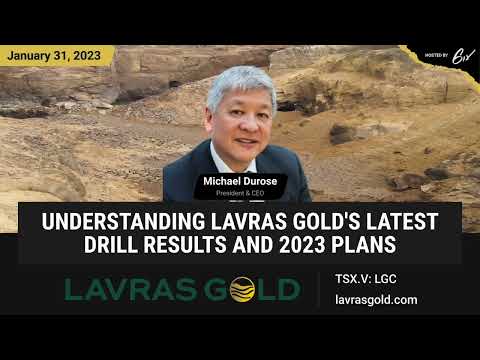
0:08 Good afternoon, everyone. Welcome to today's webinar, Understanding Laverse Gold's latest drill results and 2023 paylands on January 31, 2023. My name is Anne-Marie Brisson-Din, and I am the head of investor relations for Lavar School Corp. Our speaker today is Mike Durow's president and CEO. Please note that we will make forward-looking statements during this webcast. For full details, please refer to the risks and cautionary information in our most recent MD&A and financial statements, which are available under our profile on CDAR. All dollar amounts are in Canadian dollars, unless noted. We are also recording this webcast, and it will be available on our website and YouTube channel.
0:55 You are welcome to put questions in the chat function of the platform, and we will answer them during our Q&A session. In today's webinar, you'll get a brief introduction to Laveris Gold, hear about our achievements since we launched in April last year, and learn a bit about our royalty.
1:14 We'll move through that pretty quickly and then get into the LDS project. We'll give a general overview, review our understanding of the unique system that is evolving, and then discuss our most recent exploration results. After that, we'll preview what to watch for this year, and then move into Q&A session before concluding. As I mentioned before, please type any questions into the chat function of the platform and we will answer them during our Q&A session. And with that, I will turn it over to Mike, who will start with an overview of the company. Mike. Thank you, Anne-Marie, and thanks everybody for taking the time to listen to the Lavris Gold presentation. We're excited about what we've achieved in the last 8 or 9 months since we've gone public, and we'll share with you what we hope to achieve in 2023.
2:02 For those of you who are unaware, Lavris went public in April of 2022. We were spun out from a company called Amarillo Gold, which was bought by Hothchilds Mining in April of 2022. We are led by a team of exploration professionals and capital markets people. So we have a good sense as to the technical side of the mining business and the exploration business as well as capital markets. On that we have a very tight capital structure and cash to, we're well-funded to meet our short-term goals. We have a very large land package that consists of 23 known gold showings on our property, and we're an area of excellent infrastructure. And we're proud to announce that We've made 3 new gold discoveries since launching in April of 2022.
2:49 We also have a royalty on the Mira Rosa property, which was a legacy property that Amarillo Gold had. There's a mine there that's being built to production for the first half of 2024. And we also have 1 million ounces of 43-101 gold resources. In terms of the leadership team, I'm the President and CEO. My background is in a combination of geology, mineral economics and environmental engineering. I previously worked as an exploration geologist in Canada looking for base metals and gold and then ended up as a South Side mining analyst for many years and then transitioning into the corporate side. Our chairman is Roli Uloth. He is president and co-founder of a trucking company called Rosedale Transport.
3:38 Previously, he was a president and CEO of Westone Gold and really understands the need to drill to create value, which is really the essence of what Labris Gold is all about. In terms of Brazil, we hired our country manager Paulo Serpa. He's a mining engineer with an MBA with a lot of experience both at the operational level as well as permitting. He is from Rio Grande do Sul state and he has relocated down to the town of Labras and is really the face of the company in Brazil. Very great addition to our team. In terms of our capital structure, we currently have 41.1 million shares outstanding. And as of September 30th, we had 6.6 million Canadian in cash.
4:25 We have a good mix of retail and institutional shareholders and our anchor investor is Eric Sprott. And I should mention that Insiders and the board, we own about 24% of the company. So our interests are strategically aligned with all stakeholders. We also have a 2% net smelter return royalty on all of the expiration ground around the Mira Rosa property. From a valuation perspective, we calculate that we're trading at about $4 an ounce in the ground. That compares with an average for the expiration companies of between 25 and $30 an ounce in the ground, US. So we think we're relatively undervalued. We think this is an excellent opportunity to get exposure to our company because you're essentially getting the expiration upside and the royalty for free.
5:17 This slide just shows discovery costs. Historically, to define the million ounces of gold that we have on our property, we've spent about 14 million Canadian to date. So that works out to be about $11 an ounce in the ground. That compares with a worldwide average of the discovery cost of about $30 an ounce. And in Latin America, the average is about $132 an ounce in the ground. So what this really tells us is that we're very efficient with our exploration spending. And the money that we do put into the ground results in the binding gold. I just wanted to comment now on our successes in 2022. As I mentioned, we really just launched the company in April of 2022.
6:03 So in that 8 month period, we basically have achieved quite a lot. We doubled our gold mineral endowment. We started the company with 500,000 ounces. We had our boutique prospect. We were able to double that to 1 million ounces with a 43-101 compliant resource at our Cerrito project. We launched a 16,000 meter drill program, which we're in the middle of right now, with 2 drill rigs on site. We drill tested 5 priority targets that resulted in the discovery of 3 new deposits so far. We launched an investor outreach program where we participated in both virtual and in-person conferences. We've hosted webinars and we've presented to various sales desks as well.
6:50 And we have created a community outreach program in Brazil to develop a strong relationship with the local community that we're working in Labras. In terms of the Mera Rosa royalty, this is something that's a nice asset to have in our back pocket. When we did the spin out with Amarillo Gold, we retained a 2% net smelter return royalty or revenue-based royalty on all of the expiration concessions on the Mara Rosa property, this I should point out excludes what they call the posse pit, which is the million ounces that Hothchilds is building to production. That will be in production in the, according to them, the first half of 2024. However, we do have the royalty on something like 6,000 hectares of exploration ground surrounding that posse pit, plus regionally something like 65,000 hectares of ground, or sorry, 59,000 hectares of ground totaling 65,000 altogether.
7:48 What's important to note though is that we did make a discovery when we were with Amarillo, a project called Pistino, which is located about 3.1 kilometers to the north of the Posse pit. And we defined a gold bearing system that measured about 1.7 kilometers in strike length. We drilled it down to about 200 meters. We got some good sort of intervals as shown here on the slide, 8 meters of 1.24 grams per ton of gold, for example. Defining this gold system, our view is that ultimately Pestino will go into that posse mill and in this way, this creates value for that royalty, which we think is an important strategic asset for the company. Moving on to our LDS project in southern Brazil.
8:36 Generally speaking, just to locate everybody, we're in southern Brazil. We're not in the northern jungles of Brazil. We're in the south. Rio de Janeiro is here. The large city, Porto Alegre, 1.5 million people is in Rio Grande, the sole state. If you drive for 4 and 1 1⁄2 hours down tarmac roads, such as what's seen here in this slide, It gives you a very good sense as to the infrastructure we're dealing with. It's excellent infrastructure. We've got roads, we've got power, we've got water, etc. And we're located near a town of Labras, which is about 7,000 people, a sort of a farming community. And Most of the people that are working with our company, the geologists and field crew and so on, are basically from the region and from the area.
9:25 In terms of the mineral system that we're dealing with, it's a very complex mineral system but potentially world class. What this slide shows, it just really compares the physical size of the gold mineralization or the distribution of gold mineralization that we're seeing at the LDS Gold Project compared to some other world-class deposits. So on the left-hand side, I pointed out Porgera. The outline here shows that Porgera has a gold-bearing sort of structures in the range of 3 to 4 kilometers in physical dimension. Olympic Dam is in the range of 4 to 5 kilometers, that's 90 million ounces. Porgera is 26.3 million ounces of gold. Cripple Creek is something like 5 to 6 kilometres in diameter, hosts about 25.6 million ounces of gold.
10:12 And our Labris project shown here on the right hand side, we have a very large intrusive complex with gold showings that span a distance of something like 10 to 11 kilometers. So physically very, very large gold system. We just need to figure out where are the economic concentrations of gold.
10:32 This map just shows our contiguous claims. We have 29 claims now shown in red. And it also shows all the various 23 known gold showings that we have on the property or that we know about on the property so far. And then we also show in these bigger balloons, some of the key projects that we've been focused on. Basically, Buccia in the Southwest is A0A million ounces of gold 43-101 compliant. To the Northeast is our Cerrito prospect, 500,000 ounces of gold 43-101 compliant. Last year, we announced the discovery of a new deposit called Zecca Sousa. We drilled 14 holes, about 2,800 meters. We're following up on that discovery. We also announced the discovery of the Matilje Gold Deposit. That's about 10,000 meters of drilling, 33 holes. And then just last week, we announced another discovery called Matilje Extension.
11:24 That's the copper gold rich zone, 7 holes, about 3,100 meters of drilling. Historically, our predecessor company announced another discovery called Canolera, about 10 holes they put into a structure, 2000 meters of drilling, and I'll talk to that as well. So you can see that the gold deposits that we found so far are distributed throughout the property and we have contiguous claims which is the first which allows us to actually integrate all the geology and put a proper systematic technically based exploration program on the ground and really trying to unravel what's going on down at Labrys. How has our understanding changed or evolved? Or is evolving?
12:11 Basically, this is a very unique system. It's an intrusive hosted gold system. And basically what's happening is this is a volcano. We're looking at a cross section of a volcano. We've got some high temperature fluids that are working the way up through the rocks and leaching out metals and depositing metals as those fluids cool. 1 theory is that there's actually a bunch of groundwater that's percolating from the surface, hitting these magmatic fluids, and that's helping to also precipitate out the gold. So we're kind of tossing between these 2 different models in terms of what we have, but certainly what we're doing is we're using our geology, our knowledge of the geology and controls on the geology to guide us in terms of our drilling and we've been quite successful so far.
13:01 This is a plan view, in other words, if you're sitting in a helicopter looking down. On the left-hand side, it shows this very circular feature, which is the Laverste Sol Intrusive Complex. This would have been the remnants of an old magma chamber, basically. On the right-hand side, this green stuff is overlying volcanic rocks that are there. And you can see all these little names here. These are the 23 known gold showings scattered throughout the intrusion and into the volcanic rocks. Zooming in on what we've done, I just put names to all of the various deposits that we know about so far. The town of Laverus is in the middle here in the center of the complex, but we have again, A0A million ounces at Bouchia in the Southwest area, Cerrito, 500,000 ounces, new discovery at Zaccasusa, new discovery at Matilje, new discovery at Matilje Extension.
13:53 The thing to note here, in addition to the kind of circular features of this intrusive complex are also the complicated structural setting. These structures and these cross structures are very important because essentially what they're doing is creating the channel ways or the conduits to concentrate and focus the gold. And so this is something that we pay a lot of attention to. And yeah, so a lot of work to be done, but certainly it's complicated, but we're slowly, systematically unraveling it.
14:25 In terms of specific exploration results, this shows basically a zoom in on our Zaccasusa and Canolera targets. As I mentioned, we announced this new discovery at Zecca Sousa, I guess it was in about June of last year. Basically, we drilled 14 holes, 2 parallel holes, about 375m north-south. We hit gold in pretty much every hole and bottomed in mineralization as well. What's really interesting is about a kilometre to the south-east, We have another gold system that we know about historically. This was drilled in 2007 by Amarillo Gold. We know that we've got a gold bearing structure, this structure shown in blue here, that needs follow-up work. Our thesis is that these 2 deposits may in fact be 1 deposit that's joined together. So we need to follow up and basically see if we can prove that out and see if it's actually one big gold system. But really the key takeaway is there's intersecting structures, there's this kind of northwest trending structure shown in this blue then there's this northeast trending structure this way and it's where they intersect is where you're finding gold.
15:45 This is just zooming in a little bit more on Zaccasusa and really just highlighting what I just described, which is that we drilled 2 fences of holes, we hit gold in each of the holes, we bottomed in mineralization and we need to follow up on that. In fact, we are doing that now. We're mobilizing a drill to Zaccasusa as we speak and so we should hopefully have results out in the next couple of months as a follow-up.
16:10 What does this look like? Well, basically, these are altered granites, granitoid rocks. The best hole that we drilled at Zaccasusa was hole number 11. We hit 15 meters of 5.8 grams per tonne gold. This is what it looks like. It's these micro fractures with visible gold in them. In fact, there was a zone of 3 meters grading 28.2 grams per tonne gold. It's really important to understand that this stuff is sitting right near surface. It's only 115 metres down the drill core, so it's very shallow and that's what you want to see in these types of projects. We also got some nice wider intervals as well, 5 meters of 1.73,
16:54 36 meters of 0.5 grams per tonne gold. So we're seeing sort of, what we're starting to see actually in the mineral system is we've got this kind of lower grade halo of gold mineralization, 0.5, 0.6 grams per ton, but then we've got these intervals of higher grade in between. So based on some of the petrographic work that we've been doing, we know that there's at least 2 gold events, kind of a low-temperature, what we call a low-temperature form and a high-temperature form. So again, this is really just speaking to the complexity of the mineral system. It's a long-lived mineral system with multiple sort of pulses of mineralization. So we're trying to unravel that. But certainly, these are the sorts of things you want to see in these big systems. Moving down to the southern part of the property, about 4.5 kilometers south of the town, we announced a Matilje discovery and then our Matilje Extension discovery.
17:46 And what this map really shows is the amount of drilling that we've done so far at Matilje and then also at Matilje Extension. The other thing to note is this blue sort of line that goes across the slide, that's an East-West structure. There's also these Northeast trending structures. And so it's, again, it's these intersecting structures that we're looking for to increase the chances of making gold discoveries. And that's certainly what we're starting to see. The other thing I should point out is based on the result from our Matilje extension that we announced last week, we're starting to see some kind of a vectoring going on where over at Matilje extension, definitely getting more primary copper in the fluids compared to what we were seeing at Matilje. That's telling us something about potential grades. Definitely what we're seeing is higher gold grades associated with that copper. So more work to be done, but certainly encouraging results so far.
18:41 Just to zoom out a little bit, this shows Matilje, Matilje extension, Matilje here, Matilje extension to the northeast. This kind of green and yellow outline shows a golden soil anomaly that we've defined. Basically the guys go in the field and they just take soil samples and then we can measure the amount of gold in the surface
18:59 soils. You can see there's a very large East-West struck golden soil anomaly that measures about 3 kilometres from east to west and probably about 2.5 kilometres north-south. So we know there's a hot spot here and there's definitely, It's not surprising that we're starting to find that the sources of the anomaly, but we still have a lot of potential to the obviously to the west and to the north as well.
19:26 This is just looking at a cross section and also giving some results in the bullets. I won't go through all of this other than to say what we're finding is this is looking east. And so the deepest hole we drilled was hole number 34. I think we drilled it down to a little over 550 metres or so. We're getting these very long intervals of, again, of mineralization with these higher grade spikes in between. And so this is important because it's going to be the high grade sort of intervals that carry the economics, but it's the lower grade kind of a halo of mineralization that's going to give us the size. And if you look at these very large kind of intrusive host of gold systems, that's exactly what you see. And so, you know, we're not surprised to see this, but clearly if we can find more high grade, that's a good thing. But certainly volume is a big component to what we're seeing in the system.
20:21 And the other thing to note is that this mineralization is basically starting right at surface, so that's good from an economic perspective because it's potentially open-pitable type targets, which is what you want when you're starting out. This is what the rocks look like. Basically at Matilji we're seeing kind of a cerusite,
20:43 pyrite and then quartz basically. It's what we call philic style of alteration and that's kind of in the middle of the deposit, sort of maybe 100,150 to 200m below surface. We also find zones where we find some visible Gold popping out. In this case, it's right beside what we call a lamprofere dike. When we see visible gold, we get very high grades. In this case, we got 31 grams per ton over 0.6 meters. And then at depth, we're starting to see what we call potassic alteration, kind of a lower temperature filical alteration overprinting that original pink looking rock. And then we've got these open space textures, these quartz veins, which actually have some visible gold in them. And this sample, which was down about 420m, graded 13g over 0.7m or so.
21:37 So very interesting rocks.
21:40 Moving over to Miltilge Extension, this is the deposit that we announced last week. This is the copper-rich zone. Basically, getting very high grades. I think we got 13 grams gold, we got 26 grams silver, and 0.22% copper, and some higher grades and intervals within the best hit that we had over 10 meters. And yeah, it's basically still work in progress, but something is developing here. Key thing to recognize again is this east-west structure and another of this Northeast trending structure. It's right at the intersections where we're finding this deposit. And so we're gonna follow up and see what we can find. But in terms of what is, you know, it's not unique in the sense that this is showing a copper anomaly in soils.
22:32 This is Matilda's extension, this is Matilda's. So we know there's a very large copper footprint in the soils, and so there's a lot of room here to see if we can expand the size of that Matilde extension. What does it look like? Basically, this is a very interesting series of slides, especially for the geologically inclined, but we're going from the left-hand side is deep, it's about 300 meters or so, the right-hand side is shallow, about maybe less than 100 meters below surface. When we're sitting at surface, what do we see? The geologists are basically seeing this fresh granite. This is the kind of stuff you'll see on your countertop in your kitchen or your bathroom or whatever. But as you go deeper, as we go deeper, this is when we're getting into the mineral system. So basically, this rock on the right-hand side, this granitoid, if you like, has been converted into this completely altered rock with the copper and the high-grade gold and the high-grade silver.
23:30 So what's happening is these fluids are hitting these rocks at depth, depositing the various minerals, altering the original textures in the rocks. As we get closer to surface, you see a narrowing of these veinlets to the point where we get these little micro veinlets where we're getting a little bit of quartz and a little bit of sulfide minerals, in other words, the copper and gold in there. And they're actually, where we assay
23:52 them, we're getting very high-grade values. So it's kind of, the best way to think about this is kind of like a tree. So this is kind of like the tree trunk, the thicker stuff at depth, and as you go up the tree you're getting into narrower branches and so the branches are still telling us that we're getting a very high grade metal values in these little narrow veinlets both in terms of copper, silver and gold but we just haven't got the size yet. But as we go down, it starts to balloon out. So the idea is that we need to figure out where a lot of this stuff is ballooning out, which is going to give us the tonnage. So we've got the grade. We've got some really interesting results here. And we're very optimistic that we'll be able to follow up on this and find a nice jewelry box of mineralization if you like.
24:39 So what are we going to do in 2023?
24:41 As I mentioned, we currently have a 16,000 meter diamond drill program going on. We've drilled about 6,000 meters of that 16,000 meter budget so far. So this will take us probably till the end of July. We have 2 drills on sites and right now we're testing targets at Matilje and then another area just to the south of Zaccasusa called Galvaux and we are just about to mobilize one of the drills on to Zaccasusa where we have a plan to sort of follow up on the results from last year and then we also will be testing at Matilje extension. In terms of regional program we have an ongoing sort of regional soil sampling program that's underway. That's very helpful in terms of helping us to find other targets because we're quite convinced we will find more. We just have to do the work.
25:29 In terms of corporate activity, We are completing an over-the-counter OTC QB listing, which hopefully should be done imminently. And that would certainly help with respect to creating some liquidity, especially for US investors. We have an ongoing investor outreach program. We'll be participating at a conference at Whistler. We'll be doing the OTC presentation, corporate presentation there. We'll be down at Miami with Minds and Money. We'll also be doing the PDAC in March, and then we'll be in Quebec City in the summertime.
26:07 We are also launching a new website. In terms of the Labrys to Sol itself, we have a community outreach program where we're embedded in the community and have an open door policy and certainly want to promote mining and explain what mining is all about in the town of Labrys. And that's the bulk of the presentation. Certainly open it up to questions at this point, Annemarie. Thanks, Mike. So just a reminder, if you could type your question in the chat window of the platform, we'll be happy to answer as many as we can. Our first question is what part of today's presentation do you think will have the most impact on our story or our shareholders? Well, I think the slide that shows just the upside potential on the property is probably the thing that, one of the key takeaways to take from this presentation.
27:04 What I really tried to emphasize is that we have a very large mineral system at Lavras. We know that because we have 23 known gold showings and what's important is that they're not just in 1 location, they're actually scattered throughout this intrusive complex and then also into the volcanic rocks on the eastern side of our property. So we've been able to consolidate all of
27:24 that ground and so from a geological perspective, we can kind of really consolidate the geology and try and use the most modern geological concepts in terms of what we're looking at and trying to figure out where we should target to find more gold and potentially more copper. I guess the other really exciting point that I would leave people with is the results from our Matilde extension drilling. The fact that we found very high-grade copper, silver, and gold is very, very noteworthy because what it's telling us is that whatever was going on with this mineral system, which was big, it certainly has areas where it's contained very, very high concentrations of those minerals, of those elements, copper, gold and silver.
28:12 And so, you know, that opens up the opportunity for a lot of other targeting, maybe at depth, maybe laterally, we don't quite understand yet completely where everything goes from here, but we know we have that kind of mineralization, that kind of fluids in the system, and that's really quite exciting. Another question is, what does the path to permitting look like? Are there any anticipated roadblocks?
28:39 Well, I guess the best way to answer that is our approach to permitting is to start local and move outwards from there. So we set up an office in Labras, the town of Labras. Our country manager, Paul Serpa, and his family have actually moved to the town. So we've got a local presence within the community. And like I was saying, we have very much an open door policy where we encourage people to come to the office to meet with us so that we can explain what mining is all about. I have met with the mayor of Labrador's to Seoul and he's very supportive of creating a gold mining project in the area. It's an impoverished region in many respects, and a lot of the young people leave and go to the bigger cities, and he wants to try and stop that trend.
29:27 In terms of at the state level, We've got a great relationship with the A&M and the environmental agency that we're developing. There's a series of steps that you have to take to permit any mining project in this state and we're following those steps. Do we anticipate roadblocks? I think the honest answer is of course we do. I don't think any mining project in the world doesn't get any kind of roadblocks or pushback, but our objective is to keep a very open dialogue with all stakeholders and explain the positive benefits that investment in mining can bring to a community, to a state and to a country. And so that's very much going to be our strategy. We have a question around, what is your current cash on the balance sheet and cash runway and how many of our milestones will that cash cover?
30:22 Right, so as of September 30th, we had $6.6 million in cash. A little bit less obviously at the end of December that our financial statements will be coming out shortly. So I'll just wait for those until we actually put out that number. But we have enough cash on hand to certainly get us through our existing program. And so we're in a good position in that sense. Certainly, we will have to raise capital at some point. We haven't quite decided when that will be. We have that royalty that I mentioned earlier in the presentation. So certainly that's 1 option if we want to use that. Or if the markets in the junior resource space start to pick up, they seem a bit firmer, really since the gold price started to increase in November, we'll also look at that. But We have a tight capital structure, we're gonna be very disciplined about how we raise money.
31:22 And as I was pointing out, our discovery cost right now is about $11 an ounce in the ground, which is incredible. It means that every dollar that we raise is being invested very efficiently to find gold. We I feel very strongly that we'll be able to keep up with that. And so, you know, we will raise money at some point, but certainly it's efficiently spent money. And then there was a follow up, and I think this might be a little early for this question, but I'm going to ask it anyway. As you map out the next 2 to 3 years of exploration, what are you planning in terms of CAPEX and OPEX, and how far does that take you from an exploration standpoint? Yeah, well look, I mean, our immediate goals are primarily to just understand the geology. So we're going to be very, very focused on exploration and drilling off priority targets to really understand the geological baseline of the project. That's where you have to start with any mining project.
32:23 You know, as I was saying, if our average discovery costs are $11 an ounce, you can kind of do the math, right? It's basically costing us $11 million for every million ounces that we find. So we're at 1 million ounces right now. If we can get to 3 million ounces, that would suggest that we've got to spend another $22, $23 million US to basically get to that threshold. So once you get to 3 million ounces, if you look at a lot of gold deposits around the world and look at just what's the average size of a gold deposit, the average size of a gold deposit is about 3 million ounces. But that includes the big, big monster deposits, the 20 plus million ounce gold deposits as well. So you strip those out and then the average deposit size is actually about 1.5 billion ounces. So we're almost at X the big, big ones. We're already almost at that average deposit size. But based on what we have, the size of the mineral system, I think we're going to grow it significantly.
33:27 So that's our goal over the next 2 or 3 years, really focus on the geology and see what we have. We are also starting to de-risk on the permitting side. So there's some baseline environmental studies that we're starting to initiate. And so really it's de-risking on 2 fronts, de-risk the geology, de-risk the permitting side. At the right time, we'll start to move into a more intense sort of engineering sort of scoping study, but that's a few years away, I would say, couple of years anyway. We have a question around the currency union. What effect do you feel that a currency union between Brazil and Argentina, if it occurs, may have for LTC? Well, we'll see if it happens. I mean, obviously, Brazil and Argentina have very, very different sort of economics and very different sort of dynamics that drives their currencies.
34:22 What would it do? I think it would be probably a net-net benefit for Argentina and probably a net-net negative for Brazil, truthfully, but that's just my uneducated opinion. What would it do? I don't know. I mean, we basically finance in Canadian US dollars and then we remit funds down to Brazil. If their currency went down in value, it's a net benefit from the outside, I guess. But we'll see if that happens. I mean, it's hard to say really. It's not my area of expertise. And we have another question. At what probable reserve level do you start hitting the radars of the larger mining companies?
35:10 Yeah, I would say 3 million ounces. Yeah, okay. 3 million ounces and then the ability to see the expiration upside is kind of what I think personally. And I think that there's a question about caldera, but I think we mean canolaera. Can you give some guidance around the size and how open it is, that kind of thing? Yeah, I mean, it's been drilled off about a strike length of about a kilometre, and it's still open to the east and it's still open to the west. And yeah, so that's what we know about it so far. But it's definitely part of a bigger gold system, we believe, but we have to do the work to really understand the true upside.
36:02 And my apologies, the question was the volcano caldera. Can you talk about the size of the caldera and how open it is on strike and up depth? Yeah, so that caldera is probably in the range of 9 to 10 kilometers in diameter. What we're probably looking at, on the east side of the property, we still have volcanic rocks, which I believe are coeval with the intrusive as well. Then on the west side, it's basically been eroded from what I understand. So we've got a fairly well-preserved intrusion, and the volcanics package off to the east is still preserved as well. So I don't know if that explains your question or answers your question, but that's the best I can do, I think.
36:52 So it's about 8 to 10 kilometers in size, really. Okay. Okay. So we have a question from a legacy Amarillo shareholder, which was their first exploration investment. Thank you so much for trusting us. He's saying that he believes this is the right team to move the project forward, but he's curious about Timeline and he also wondered if this would start as an oxide project or only work as a sulfide? Yeah, we don't see a whole lot of oxides so it's probably going to be more of a sulfide type of processing based on what we see so far. So we're not getting like a huge, like oxide blanket or anything like that. So yeah, it's not gonna be heat bleach. It's gonna be traditional milling for this project.
37:48 Okay, so I think we are coming to the end of our questions. I don't see any more coming into the chat. Okay. Mike, why don't you just go back and sum up our day and we'll call it an afternoon. Sure, yeah, so just to sum things up, thanks again everyone for your time, but basically we think the expiration potential of Labros is very significant. And we've been able to consolidate that land package and sort of apply a very systematic expiration approach to the project. You know, we believe this is an, well, We know it's an intrusive hosted Gold system that may be of, and it's most likely of alkaline affinity. These things can be very, very large, as I tried to point out. We're starting from a Gold base of 1Moz.
38:33 We think we can certainly do much better than that. That's starting to bear out with respect to the exploration results that we've been generating. We have 2 drills on site, so We'll have a lot of news flow that we'll get out to the investment community as soon as we get those results. So stay tuned and thanks for your support, everyone. You