Matthew McHale
at THOR ENERGY PLC
Replay available
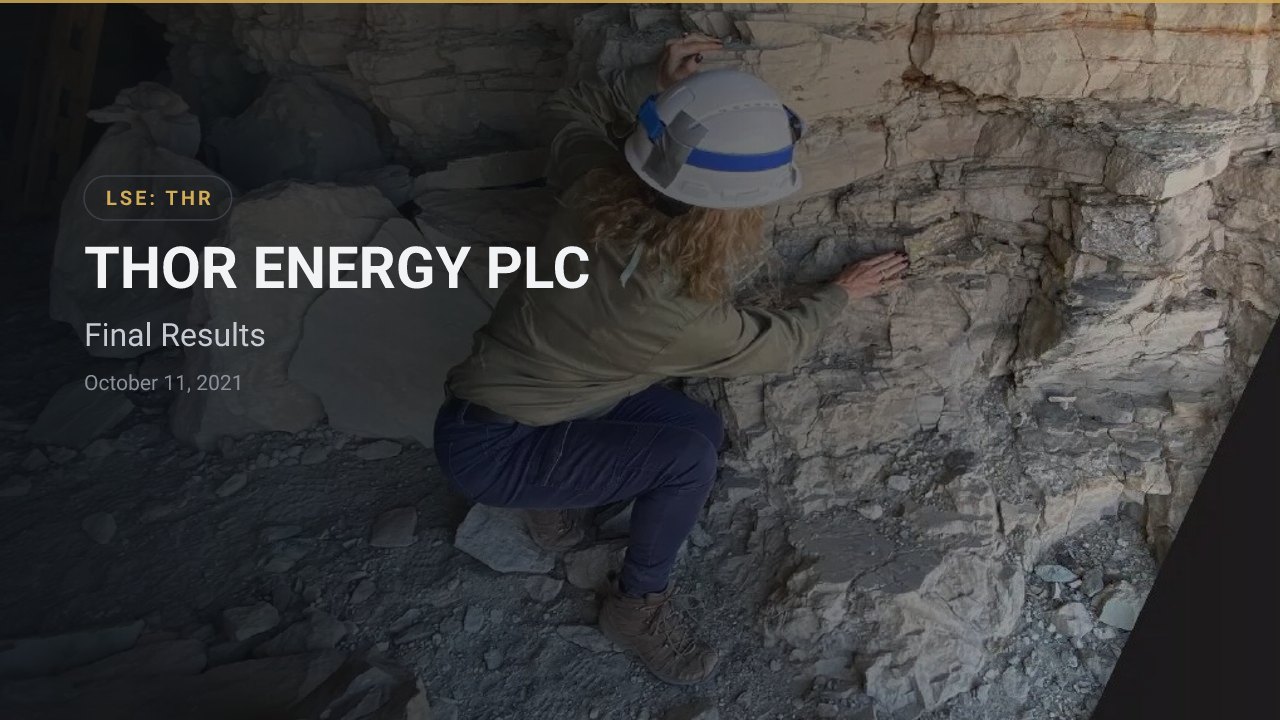
Final Results hosted by Thor Energy (LSE:THR) on Investor Meet Company, held 2021-10-11.
Automated transcript · Written by software from the replay's audio. It can mishear names and figures; the replay is the record.
0:01 Good morning, ladies and gentlemen. Welcome to the THOR Mining PLC final results investor presentation. Throughout this presentation, investors will be in listen only mode. Questions are encouraged and can be submitted anytime via the Q and A tab situated on the right hand corner of your screen. To click q and a, scroll to the bottom, type your question, and press send. The company may not be in a position to answer every question received during the meeting itself. However, the company review all questions submitted today and publish responses where it's appropriate to do so. These will be available via your investment company dashboard, and you'll be notified once these are ready for your review. I'd also like
0:33 to remind you this presentation is being recorded. Before we begin, we'd like to submit the following poll. I'd now like to hand you over to Nicole Galloway Warland, managing director of THOR ENERGY PLC. Good morning. Good morning, Paul. Good morning, everyone, and thank you very much for joining me in the investor meet company webinar. Before I start my presentation, I'd just like to give you a bit of a snapshot of myself. As I know for some of you this is the first opportunity you've had to meet me. So I joined THOR approximately twelve months ago as the exploration manager transitioning into managing director in April this year. I'm a geologist with thirty years industry experience, and I've been fortunate to work across the full cycle of our sector. So exploration, project evaluation, project development, and into open cut as well as underground mining.
1:26 I've got a commodity focus in gold, copper gold, base metals, uranium, and lithium. I've worked with both with some of the larger mining houses as well as junior exploration companies on projects in Australia, Eastern Europe, South America, and The US. I'm also a director of the Australian Institute of Geoscientists. Education and transparency and compliance regarding the JORC code is very pertinent to me. I'm a passionate geologist, and I believe I've got the right credentials to really drive THOR's projects towards discovery and development success. So that's enough about me. So let's move into our presentation. Whilst I'm presenting, I'm just going to switch off my camera so you see the slides in a larger format.
2:21 Standard disclaimer, including the competent person statement.
2:26 So a few investor highlights on THOR. THOR has a very diverse portfolio of in demand commodities. I see this really as a huge positive. It means that whilst we're waiting on results at one project, we can be in the field exploring at another. It allows us to keep our exploration momentum up as well as continuous news flow. Our primary focus is on copper resources and gold and uranium discoveries. Our projects are all in favourable proven mining jurisdictions. This is really critical for de risking our projects. Over the coming months, we're really trying to develop and hit some milestones with some upcoming drilling programs at at least two, if not three of our projects.
3:19 I'm not afraid to divest non core assets, and I'm happy to discuss our recent sale agreement for the Pilot Mountain project at the end of the presentation. We're fully funded for our upcoming quarter four program, cash reserves and no debt. And probably most importantly, we have a strong board and management team with exploration success behind them. So looking at our portfolio, gold project, our Ragged Range gold project over in WA, you may have recently seen our high grade soil and stream sediment results, identifying at least eight continuous anomalous gold zones. And I'm excited to say that we've commenced our maiden RC drilling program on these targets.
4:10 Copper projects, we have direct and indirect interest in three projects, the Alfred East and then Kapunda and Alfred West through EnviroCopper. These projects are a lot more advanced, and they're being assessed for in situ copper recovery. Over in The US, we have our US uranium vanadium project. And at our California sorry, Colorado wedding bells, we're assessing going through the permitting phase for drill testing of three prospects. One of them in particular is Section 23, and this area has never been explored or drilled. So we're really excited about this and it has significant potential for high grade uranium and vanadium. And last but not least is our molecule Tungsten Molybdenum project in the Northern Territory.
5:01 We'll be commencing diamond drilling program in October, and this has the potential to increase the tungsten resource with the interceptor tungsten mineralisation, but also extends the mine life.
5:17 So a quick corporate snapshot. We're listed on the AIM as well as the ASX and the OTC market with a market cap of around £16,000,000, Cash in the bank sitting around 1.6. Top shareholder top 20 shareholders about 56%. Directors, point 3%. And our share price is sitting at about 0.9 p based on the price of on Friday. We have a strong technical and financial board and management. You've heard a bit about me, but Mark Potter has just moved into the chair role. And we have Mark McGough and Alistair Clayton as our non executive directors, and Ray Ridge as our CFO joint company secretary.
6:06 So a diverse but technical and financially strong board to really progress our projects. So moving into our projects, our Ragged Range gold project is a 100% owned by THOR Mining. This is located in the East Pilbara, and it's a project that I'm most excited about. And why is that? It has the potential to be a really large scale gold deposit based on proximity to other large deposits, but also we've got prospective host rocks as well as favorable structural settings. If you can see on the map, you can see our orange star and its proximity to Novo Resources, Calladus Resources Waruna project, 1,500,000 ounces, and then Degray's Molina Gold project, the Hemi project, 9,000,000 ounces to the Northwest.
7:00 So we're certainly in the right jurisdiction for high grade large tonnage deposits. We have an upcoming maiden RC drilling program, which I'll talk a little bit more about, but also some geophysics over our Nickel Gawson, and we'll be continuing soil stream and rock chip sampling programs.
7:24 So over the course of the last eighteen months through systematic soil and stream sampling, we've identified the Stirling prospect. This is a 13 kilometre gold corridor sitting on a large regional structure between the Dalton Suite ultramafix and the Euro basalts. This is a thrust faulted contact which was picked up in airborne magnetics, but also can be ground trufed, and there's sub parallel structures associated with this. So the streams were up to 2.2 grams a tonne. And then based on that, we did some soil sampling programs at Stirling Central and Stirling South. And these identified up to eight continuous
8:10 anomalous zones with grades up to three fifty ppb gold. We were able to sort of do a field check on some of these high soils, and we're able to do some stream sediments and pan concentrates up to 74.1 grams per tonne. So we feel we're very close to that gold source, and hence we'll be drilling and you should see results soon. In addition to that, we have a gold target up to the north along the granite contact. We have the nickel target, and recently we have acquired the tenement in the Northeast, which is prospective for porphyry copper gold targets. There's some historic copper workings with grades up to 20% copper, so we're excited about getting on the ground at this area.
8:59 There's been a little bit of news about lithium. The prospect or tenure is perspective for lithium. I'm not so sure about the large pink area, the Corona Downs granitoid in the North, but certainly in that Northeast area where there's some porphyry intrusions, and we'll certainly be following that up with mapping out any pegmatites present and looking for spodumene. We control a 100% of this Kelly greenstone belt. As I mentioned, we have a nickel gossam. This extends over approximately two kilometres. It was originally identified by the Geological Survey, and we've recently collected rock chip samples along this with up to 0.2% nickel, 0.18% chrome.
9:49 So we'll be following up this up with a fixed loop EM survey. I'm not sure exactly on the timing of that, but hopefully in the next few months. So as I mentioned, we've literally just commenced our maiden RC drilling program. Approximately 3,000 meters are designed, and the drilling is designed in a series of jewel lines drilling towards the west across these high grade anomalous soils. We have a government grant up to 160,000 of co funding towards this, and this just really validates the government's thought of the prospectivity of this region as well. I should highlight that this area has never been dual tested, so we're very excited about what we're going to find in this first phase of drilling.
10:45 As I mentioned, we'll also be doing some regional soils and streams as well as an EM survey over the Nickel Gossam. So copper in South Australia, we have our Alfred East project, which is a joint venture with Spencer Metals where we're earning up to 80%. And then indirect interest through EnviroCopper where we have 30% equity at Kapunda as well as Alfred East. I'm not really going to talk about EnviroCopper's projects. I'm just going to focus on Alfred East for this presentation. The project is located on York Peninsula, the southern area of the Gauler Craton, or Olympic Domain as some of you may be familiar with.
11:31 And it's been heavily explored in the past for IOCG style targets. And in that process, they've identified a large oxide zone of mineralization. And you can see this on the map, the large green banana shape, if you like. And this is a deep oxide weathered zone around the ticker of granite. And we're assessing that for in situ recovery, and you can see our tenement is the one to the north and it extends into the EnviroCopper Alfred West to the South. So why in situ recovery? As the world moves to low emissions and sustainability, we believe this is a favourable alternative to traditional mining.
12:21 It's low cost, low environmental footprint. And I think, you know, for our community engagement as well, there's no open cut. There's no tailings dams, hence no noise, dust, etcetera.
12:40 In situ recovery is not new. It's been extensively used in South Australia, particularly in the uranium space, so we have the right permitting expertise in South Australia to move this forward. We have, $300,000 of funding from the South Australian Government to progress this project with proof of concept studies including drilling, hydrometallurgical work, and groundwater studies. For those of you who are a little bit unfamiliar with ISR, I have just a short video, so I'll just ask Paul if he can start the video for me, please. ISR or in situ recovery is an innovative low impact mining technique that is sometimes called the invisible mine. Unlike traditional mining practices, which rely on excavation and blasting to recover the ore, ISR has such a minimal impact on the surrounding environment that it can even take place alongside farms and communities.
13:39 Let's take a closer look at how it works. The process is relatively simple. Once an ore body has been identified and proven to have the right geology, a series of wells are drilled. The key ones are these ones, the injection wells.
13:58 They pump a specially formulated solution directly into the targeted rock. That used to mean a weak acidic solution, but thanks to the pioneering works of the CSIRO and Curtin University, we now have new options that are 100% nontoxic and biodegradable known as lixivides. The solution slowly permeates the targeted layer, rinsing the copper out of the rock. It's a similar process to what happens when you make a cup of tea. As the copper rich liquid spreads out, the recovery wells kick in, pumping it back to the surface for processing.
14:35 Surrounding the area are a number of monitoring wells. These collect groundwater measurements and other data to make sure that nothing escapes the area being mined and further minimizes the risks to the surrounding environment. Once the copper has been recovered, the rock is flushed with groundwater. The wells are removed, and the landscape quickly returns to normal
15:01 as if the mine had never been there. Thanks, Paul.
15:18 So as I mentioned, at Alfred East, it has been extensively drilled over 500 drill holes into the project. However, no one really looked at the oxide material. Were just focused on the primary sulfides and obviously didn't find anything of economic value. However, with the oxide material, when we acquired the project, we did a mineral resource estimate and identified up to 177,000 tonnes of contained copper and 71,000 ounces of gold. This is certainly a very positive start to the project
15:53 with significant growth potential along strike as well as at depth. We have just completed our first phase of diamond drilling and that's over area AE5, which is the grey sorry, the green mineralised domain on the image.
16:10 And we will be doing more drilling further in the future. So at the end of this year, we hope to be drilling to the north as well as the south. With our recent drilling over AE5, so the image on your right is the brown area is the domain, the mineral resource area. We completed nine drill holes totalling approximately 1,000 metres, and we were able to get a much
16:39 clearer understanding of the geological model, and you can see that there's a large dark green north south trending structure, and this is what we believe is controlling the mineralization. So when we positioned our drill holes, in particular 21 AED005, we intercepted broad high grade gold mineralization. So 73 metres at 1% copper and 0.2 grams per tonne gold,
17:08 including 20 metres at 0.2% copper and 0.34 grams per tonne gold. These are exceptional high grade results and perfect for in situ recovery, but perfect for any style of mining in that case. We also continue to drill towards the north, extending our mineralization outside the domain. So I'm still waiting on the results for hole six and hole seven, but hole two continues the copper mineralization to the north with up to 16 metres of 0.3 copper. So the mineralization extends beyond the known resource, so in due course we will upgrade this resource covering our new high grade zones.
17:56 We have a clear pathway to copper production. We're currently on track for being in the feasibility development phase for 2023, so a two year timeframe. We're obviously undertaking our resource drilling and our pump testing, and then we will move into a site lixivian test and then into feasibility study.
18:19 So we've currently just completed our first pump test. So looking at water characterisation and permeability, these are critically important for in situ recovery, as well as our lixivian trials. So we're looking at a glycine, which is essentially a food additive. It's used in fish fingers and other such things. So benign lixiviant, which can be used to recover both copper and gold. So stay tuned on those results. As we move over to The US, we have a project in Utah and Colorado, which is 100% owned by THOR. We will be focusing initially on the Colorado side in the Eurovan mineral belt. This is a high grade historic province for uranium and vanadium.
19:11 It's close to infrastructure, including a toll processing facility, White Mesa to the south. And as I said, it's been extensively mined during the twentieth century. We're targeting salt wash style sediment or sandstone filled paleo channel uranium and vanadium, and our field sampling returned high grade gold, sorry, uranium and vanadium up to 1.25% uranium and vanadium 3.5%. These are really high grade results when you think most uranium deposits sort of average about 0.2% uranium. So very encouraging sampling.
19:58 We have designed a drilling program to cover three prospects, rimrock and groundhog as well as Section 23. Rimrock and groundhog are both following mineralization along stripe from historic workings. This style of mineralization seems to be continuous not only over metres but kilometres, and we'll be following that up with those two prospects. Section 23 is the one that we're most excited about, and this area has never been tested or drill tested. So as the directors, we believe it has strong potential for high grade uranium and vanadium mineralization.
20:44 We've completed our environmental surveys and all of our federal government permitting, and we're just working through the Colorado permits at the moment. Unfortunately, thought this process would have been completed by now, but we still have a few meetings, etcetera, to complete. So I hope to have some updates to the market on the status of this permitting process in due course. At Mollie Hill project, this is again 100% owned by THOR. It's located in the Northern Territory, 300 kilometers Northeast of Alice Springs.
21:27 Tungsten is a critical metal. China holds 51% of the resources and accounts for about 82% of the world production. Production. The US, although has resources, doesn't have any production. So with a geopolitical situation, tungsten's now declared a critical metal and Australia has, or the Northern Territory has granted this project to major project status. The mineralization consists of a magnetite skarn with economic mineralization of shear light and molybdenite.
22:02 In 2018, a feasibility study was undertaken, and this demonstrated that it was profitable production at a low operating cost with an early payback on CapEx. We earlier this year undertook a new mineral resource estimate based on drilling continuity and confidence, and we're able to take it to measured category. Before we do a reserve update and revise the feasibility study, we've identified a magnetic target adjacent to the mineralization, which we're going to be drill testing in the coming weeks. If you look at the particularly the cross section, the red body is magnetic
22:53 target or is a magnetic body, and we believe it's potentially magnetite, which is the host to our mineralization. So we'll be testing the area with the red circle, and you can see it also on the planned view to the south of the known mineralization. This not only has the potential to intercept tungsten libden mineralization, but also the potential to increase the mine life. So take it from a seven year to potentially a ten year mine life. So we're pretty excited about drilling this in the next few weeks. Once again, we have Northern Territory co funding up to $100,000 towards drilling this project. So just as a little conclusion or highlight summary, we're fully funded. We're focused on our copper resources plus our gold and uranium discoveries.
23:53 As I've mentioned, we've commenced our RC maiden drilling program at Ragged Range, and this has the potential to be a large mineralized gold system. The drilling itself should take approximately four to six weeks, so should have the results in early November. So certainly stay tuned on that one. At Alpha to east, we're waiting on our final diamond drilling drill results as well as our hydrometallurgical studies. At Wedding Bells, as I've mentioned, we're working through our permits, so should have an update on the status of those in the coming weeks. And last but not least, Molly Hill will be diamond drilling to potentially upgrade our resource in October. So a busy period up in the next few months, with THOR very much leverage for exploration success.
24:44 So thank you all very much. That's fantastic, Nicole. Thank you very much indeed for your presentation. Ladies and gentlemen, do please continue to submit your questions using the Q and A tab situated on the right hand corner of your screen. But just wanted to call takes a few moments to review those investor questions submitted already. I'd like to remind you that recording the presentation along with a copy of the slides and the published q and a can be accessed via investor dashboard on the Investor Meet company platform. I'd also like to remind you that your feedback is important. And immediately after the presentation has ended, you'll be redirected the opportunity to provide your feedback in order that Nicole and the team can better understand your views and expectations. Nicole, perhaps before we go into the live q and a, we did receive a number of pre submitted questions. And if I may, I'll just read out the first one. The first one reads, Ragged Range seems to be located very close to some prospective lithium focused projects.
25:35 Has the lithium potential been assessed on this project area? Thanks, Paul. Sorry. I'm just so in essence, no. And I briefly touched on that. Look, the focus at the moment is very much on our sterling prospect and following up with that 13 kilometer gold corridor that we've identified. So as I've mentioned, we'll be RC drilling and that's our focus. Concurrent to that, we will be assessing other areas within our tenement package. And this does include looking at the potential for lithium, particularly over in the Northeast where we feel it's potentially favorable for pegmatites and spodumene.
26:20 So we will be following that up in due course, but the focus at the moment is on our gold and the potential for large tonnage gold system. Fantastic. Thank you, Nicole. And the next question we've got here is the Pilot Mountain project has been described as the largest tungsten deposit in The USA. Can you reassure and satisfy shareholders that we're getting a a good or at least fair deal on the disposal? In follow-up, why dispose of such a strong asset? Look, it is an excellent project. However, we felt that the shareholder value was potentially better used at our other projects. And we feel that this is a very good deal for the THOR shareholders. To hold these projects does cost us money.
27:07 And as I said, at the moment, to take it to the next phase or to take it to development and into production will require a large capital. And so that's where we felt at the moment that that money could be better utilised with better shareholder value at Ragged Range, Molyhue or at our Outford East or uranium projects, hence the decision to divest. That's fantastic. Thank you, Nicole. The next one we've got here is the uranium permit applications due date at state level have been moved back three months to December, just one week after the investor presentation that stated drilling would occur in q four. Why was this? And what is the current expectation for drilling as this has been revised? Look, I think we felt that the permitting process would go a lot faster than it has.
28:01 We undertook all our environmental surveys and baseline studies, received our permits through the federal or BLM. And so we thought the same would be for Colorado. Unfortunately, we've got a lot more permitting to go or did at that time. And so we just felt that it would be quicker than what it has. The extension just gives us a little bit more time to ensure that we do get the permitting through before expiring. So I hope to keep the market updated on the permitting process. We have engaged a new company, Geosyntech, to assist us with this permitting in Colorado. They're very familiar with the Colorado, sorry, I've got tongue tied on that state name, and also county permitting. So hopefully this can expedite the process.
28:59 Thank you very much. Thank you very much, Nicole. The last question we've got here, is the company anticipating grant funding towards the ISR program at the Alfred East copper project? Yes. So we received a South Australian accelerated discovery initiative funding of up to 300,000 for proof of concept. So this means that we can claim that money through drilling, through hydrometallurgical work, as well as hydrogeology, which really validates this project. Also the state government is behind us with the in situ recovery concept. So very pleased to get this validation from the State Government. Fantastic.
29:45 Thank you, Nicole. That concludes the pre submitted questions. Obviously we've had a number of questions submitted during the presentation itself. If I may just hand back to you just to click on that Q and A tab, and where appropriate to do so, just read out the question and give you a response. That'd be great. Thank you. Okay. So how soon can we start ISR if everything goes to plan? As I pointed out, we have a two year timeframe or pathway to development and feasibility. We would like to think that we can move into a pump test, which initially is a tracer test, and then we move into a SELP test, which is a site lixivient trial, hopefully next year. This is obviously based on permitting and then move into a feasibility study by 2023.
30:35 This is fairly ambitious, but I feel is quite achievable. Based on meetings with the department and community consultation, this is all going to plan. Okay. So moving on to next question. And I've sort of touched on this one. This is regarding the uranium permitting. When do you expect to receive the required permitting and drilling commence? Look, I I can't really say when when we will be drilling. We're just working through the permitting as we speak. I'm reluctant to sort of say a time because I I sort of made that mistake based on my knowledge a few months ago.
31:22 So at this stage, I'm just going to wait till those permits come through before I sort of share with the market my expectation on drilling. But certainly hope to keep the community and the market informed on that status. So and the next question is, what are the near term value creation milestones that we should be looking for? So I really think it's at ragged range with this maiden RC drilling program. Although this is just testing Stirling Central and Stirling South, it's really going to give us a great idea as far as the style of mineralization and the extent of gold mineralization.
32:10 If we intercept gold, we've then got a 13 kilometre strike length to then follow-up. In addition, there's highly prospective areas to the North and Northeast, as I've pointed out, for not only gold, but copper gold and potentially lithium. And then we also have our nickel. And then, you know, at Alfred East, being into copper production within a two year timeframe with in situ recovery is certainly creates value for our shareholders. The demand of copper is ever increasing as we move into a renewable, sustainable future. I think as most of you know, a wind turbine itself contains four tonnes of copper, electric vehicle four times more copper than a standard combustion engine. So the demand for copper is ever increasing. So if we can be in production within a two year time, this certainly creates value for our shareholders.
33:11 So when do you expect each of your prospects will enter production phase? I suppose our Mollie Hill deposit is the closest to that, but essentially, we're ready to switch the light on if you like to move into development phase. The feasibility study has shown that it's a twelve month development phase to move into production. And then, obviously, I've mentioned the Alfred East and ISR project and the turnaround for that to move into production. And then another question is about the wedding bells permits. Is this project now a tick boxing tick box exercise? Look, I don't think so. Well, yes, essentially it is. Like any permitting, there's a series of meetings that we need to attend.
34:06 And so hopefully it is a matter of just attending these, and then we will receive our permits. Like I said, we have all our baseline environmental studies completed, and there was no issues or concerns regarding these surveys. So, yes, in essence, I do think it's a tick box process. And next question. Should we expect a resource upgrade for Alfred East before the end of twenty twenty one? Look. I'm going to say no on that. I'd like to move into drilling our northern area, so Domain 8, as well as the South before I do a resource estimate, as I'd like to be able to do an overall upgrade and also take it to the next confidence level.
35:03 So at this stage, I would like to think that we could be out drilling again in December, January, and then there would be a resource following that drilling program. Nicole, thank you so much indeed. You've actually addressed every question that we've had through from the investors this morning. If there are any further questions, of course, that come through, and Nicole will have the opportunity to review those. And we'll publish responses where appropriate to do so on the investment company platform. Nicole, perhaps before I send the attendees to give you some feedback, just ask you for a closing snapshot and we'll redirect them. Right. Thanks, Paul. And I want to thank you all for joining me this morning. THOR's had a busy year building really strong exploration momentum and identifying key exploration targets over our diverse and excellent suite of projects.
35:53 We now move into what I call the exciting phase and that's drill testing. And for me, the highlight is definitely our maiden RC drilling program at Alfred East in the Pilbara, which has literally just commenced. And this has the potential for a large scale gold mineralised system. So this is certainly my highlight. In addition, we'll be drilling at Molecule as well as be able to give updates on the uranium status. So lots of news flow over the next few months with THOR very much leveraged to discovery success. So please follow. That's fantastic, Nicole. Thanks again for updating investors today. Could I please ask investors not to close this session as you'll be automatically redirected for the opportunity to provide your feedback in order that the management team can better understand your views and expectations.
36:46 This will only take a few moments to complete and is greatly valued by the company. On behalf of Nicole and the team at THOR ENERGY PLC, we'd like to thank you very much for attending today's presentation. That concludes today's session. Thank you very much indeed, and good morning.
Follow Thor Energy PLC into a list and get an email when it puts out news.
at THOR ENERGY PLC
Managing Director at THOR ENERGY PLC