Transcript
Automated transcript · Written by software from the replay's audio. It can mishear names and figures; the replay is the record.
0:07 Hello everyone and welcome to Bunker Hill Mining's live event hosted by 6. I'm pleased to introduce our speakers today, Sam Ash, CEO and Richard William, Executive Chairman. We are expecting their CFO to be joining us here shortly, I believe, Gerbrand Van Herden. But this will be a presentation focusing on the financial and operational groundwork late in 2023 and how it set the stage for 2024.
0:35 As this is a live event, we are accepting questions. So please feel free to submit them in the chat at any point during the conversation, just in the bottom right corner. This event is being recorded, so it will be available to watch in the coming days. But without further ado, I'll kick things over to you, Sam. Thank you very much. And it's a pleasure to be speaking with everybody at the start of 2024. Today, we wanna start and talk just a little bit about 2023, have a bit of a recap, and really set the stage for what is going to be a very exciting year for Bunker Hill Mine and Bunker Hill Mining Company as we move fully into construction, move through the construction process, and bring the mine into operation. So, in start, I thought a good place to start would be at the corporate level, pretty active year in 2023, kicking off with the upsized and improved $67 million financing package, which allowed us to be fully funded for a restart at Bunker Hill.
1:39 Now, there was a bit of delay in that as we had advanced technical work and had conversations with our primary financing partners, Sprott Royalty and Streaming, but we got that across the line. And the great news is, is that when that financing came in and we achieved that milestone, we were ready to go here at site. And we've moved really quite quickly from that point on. In addition, the achievement of that milestone allowed us to upgrade an uplist to the TSX Venture Exchange, which we're really quite very excited about. It's great to be maturing as an organization and moving to a more mature exchange. Late in the year we had a fantastic recognition.
2:30 We received the ESG Developer and Explorer of the Year Award at the Resourcing Tomorrow and Investment Conference. Now that's really a recognition of the unique nature of this project and the work that we've done. We are restarting this mine on a Superfund site, and which is a very, very challenging effort, but also speaks to the focus that the organization has, and our company has, and we all, all of the employees of the company have on creating a mining company that is very focused on delivering positive outcomes for the community and positive outcomes for the environment. And finally, right near the end of the year, we finalized the zinc offtake with TEC's Trail Smelter in British Columbia.
3:24 And on the bottom right, you see a picture on why this is such an important milestone for us. So we are an American zinc producer who's transporting and shipping its concentrate in North America to the smelter in Trail, British Columbia, making all of the product that is mined here at Bunker Hill very locally sourced from a full supply chain perspective.
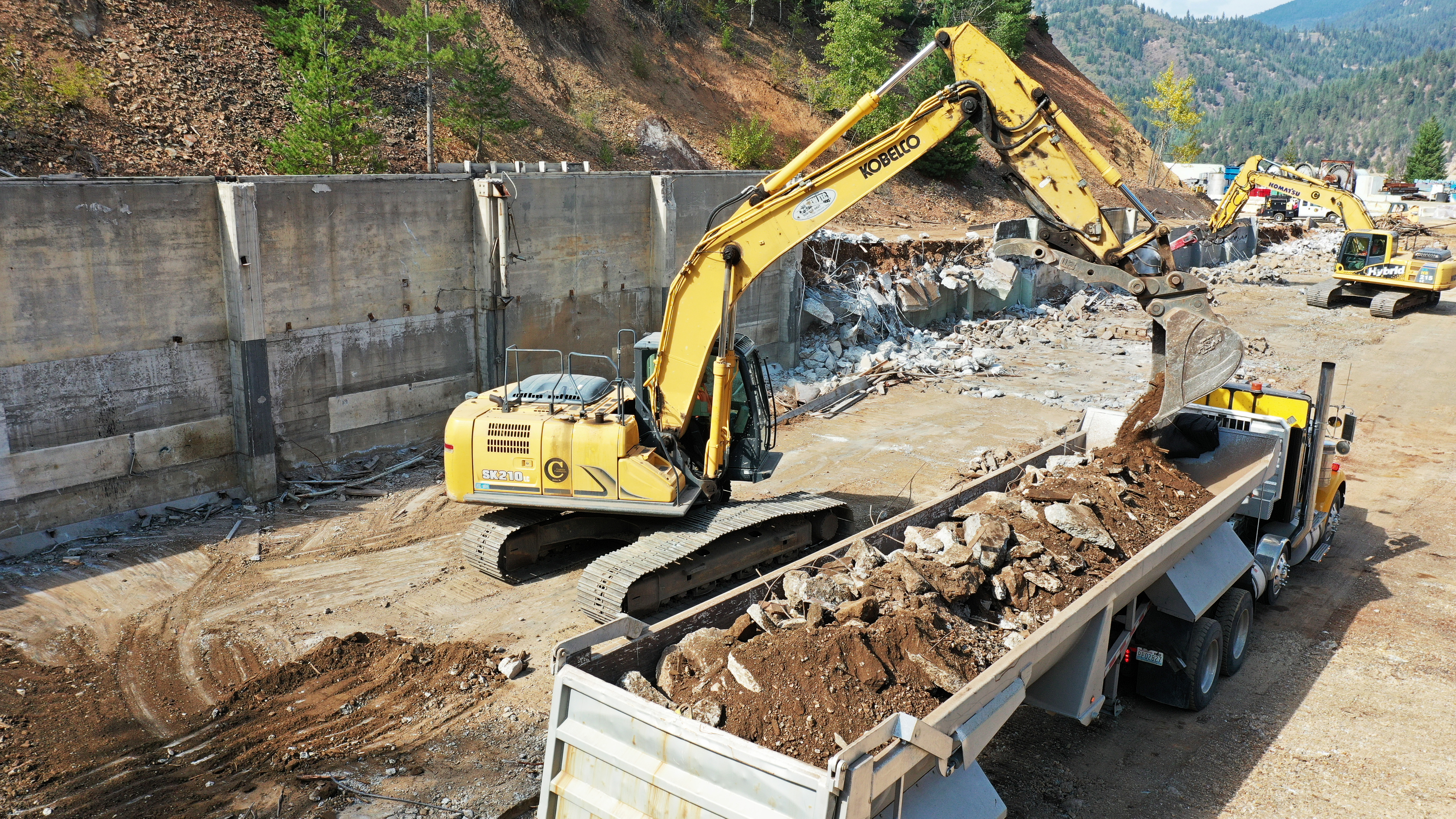
3:53 On the mining side, the signature achievement of 2023 was the enlargement and refurbishment of the Russell portal. Now, originally that portal had a dimension of 10 foot by 10 foot. It was just too small to support the production profile that we are looking to build and we'll be building here at Bunker Hill. And so we excavated that portal and expanded it to 16 feet by 16 feet in dimension. And you can kind of see the scale of that portal on the bottom 2 slides on the right. And that really sets us up to be able to achieve the production rates initially at 1,800 tons a day and potentially up to 2,500 tons a day as we move into operation.
4:48 In conjunction with that, there was a lot of work that was done on the yard and the lay down area in front of that portal to make ourselves operational ready. We were able to connect the underground up to the main power grid. And in addition, we were able to enlarge the lay-down area, build a surface shop, and install a new compressor to feed the underground with compressed air. So really quite a spectacular amount of achievement in the second half of 2023. Just to remind everybody, on the mining side, it's actually more advanced and it's not the critical path to restart at Bunker Hill.
5:40 The ability to leverage and use the existing in-place underground infrastructure means that most of the development is done to support mining through the first 3 years of startup. And really, we're looking to leverage that potential with the opportunity around pre-production or sales, if that becomes possible. That's a work stream that could have a very positive benefit over the next 12 months. On the processing plant, we've re-imagined and continued to optimize and revise the site layout for with an eye towards improved operational efficiency. And what you see here, this is the final site layout that we will be building and are in the process of constructing.
6:30 You see the process plant on the top, and then that new piece of infrastructure on the left, that's the filter and tails processing facility. That's been relocated and placed in that position to provide the optimal onsite operational efficiency as a part of that, we've also, we will also be relocating the administration offices off of the industrial site, which will be an improvement from a safety perspective as well. Final engineering is nearly complete and we're well advanced on tails and backfill, on pace backfill plant engineering and procurement.
7:18 And in addition, we've initiated on-site mill equipment rehabilitation, which is really advancing and achieving the cost savings from a capital perspective that we have, we're in our cost estimates and budgets. You know, just this morning, we had another win, one of the
7:46 concentrate filtration units was projections have come in that rehabilitation of that will be about $100,000 less than anticipated and budgeted. And that's just an example of the wins that we're seeing on a fairly regular basis right now, as we begin the process of mill equipment rehabilitation in-house on-site and the benefits that that is having for us. Kind of moving on to 2024, what you're going to see is focusing in 2 areas. Certainly there's gonna be the execution of the Bunker Hill restart. You're going to see us move and continue to move forward on underground infrastructure.
8:37 Early in the year, we'll be bringing the main ventilation fans
8:42 online, finalizing and finishing secondary development and stope setup in anticipation of production. On the process plant, you're going to see us continue to build the processing plant, looking to have construction complete in Q4 of 2024. We're going to be providing regular updates on that. The important thing I think that to understand there, and that what we're seeing is that our capital cost estimates for the construction of the process plant are on budget. We've been saying for quite a long time that the process plant is the largest capital component of the Bunker Hill restart. And we've also been saying that because we've been able to acquire the process plant from Ponderay, that we think that our cost estimates are really quite accurate and very accurate in quantum. Now we're seeing that. There's areas that we're doing a little bit better. There's areas where it's costing a little bit more. But on hold, when you look at the capital costs for the process plant, we're definitely on track and on budget at this point, which is a great thing to see. On the corporate side, You're going to see us finalize the lead concentrate offtake over the next few weeks.
10:07 We're also hard at work strengthening, integrating digitized systems to assist in operational effectiveness and operational readiness. And we're continuing to build out what we see as a world-class operating team.
10:25 Then there's another work stream where you're going to see us really double down and begin to do a lot of work. And that's articulating and unlocking the value potential here at Bunker Hill. Now the pre-feasibility, we all know what that looks like. And I'll just remind everybody that that is really just the first step and the first piece of the puzzle. You know, what we see here is the exceptional value beyond that pre-feasibility study that we're going to unlock, and we're going to begin that process in earnest in 2024. That starts with strengthening the balance sheet, but it also moves and it is quite focused on expanding the existing measured and indicated resource through resource conversion of the inferred mineralization.
11:19 Now that's really exciting because as we convert and inferred resource and bring it into the mine plan, you not only get mine plan extension, but you get a reduction in the intensity of capital development required throughout that mine plan. So you really get
11:42 value creation from 2 aspects. 1, from mine life extension, but 2, from a reduction in the intensity of sustaining capital throughout that mine plant. And that's before we get into expanding the resource through exploration. We've identified multiple near mine exploration targets
12:05 within the mine. And we also plan on advancing the exploration work that we've been doing on the geophysical target within our larger claim block. We're also actively seeking and looking at pre-production ore sales opportunity to improve and generate pre-production revenue. And we're also looking at what the full upside potential of Bunker Hill can be. Now we're referring to that as Bunker Hill 2.0, but certainly the potential to expand to 2,500 tons per day is very real. We're working on that. We're doing work on that. And in conjunction with the resource conversion of inferred mineralization, we're looking to articulate that and deliver that value.
13:04 And just to speak, what is potentially the value that we're talking about? Well, it's really quite substantial. When you talk about a throughput increase coupled with new technologies like ore sorting, and a conversion of just the existing inferred mineralization, you can see the value creation potential that exists at Bunker Hill, and that's before exploration. And certainly a focus in 2024
13:34 is going to be to bring that value into reality. And then just to, you know, before we move into the, to any questions that anybody have, just wanna have a really just a brief review of what we see as a very effective and very exciting 2023. We brought on our new CFO, delivered an upgraded listing to the TSX-V, received a very prestigious award, ESG Developer of the Year, and advanced the project on-site in very meaningful, tangible ways. With the Russell portal expansion, getting a surface maintenance shop in place, optimizing the mill, finalizing a zinc offtake, and really working on bringing in full project financing.
14:35 As we move forward into 2024, you're going to see us hit and deliver construction milestones and share that with you, our shareholders.
14:46 Finalize the offtake on the lead and silver concentrate, continue to enhance the operating team and prepare for operational readiness, and pretty importantly, look at opportunities and ways in which we can strengthen the balance sheet, and largely through delivering and refining and articulating the upside value potential that exists at Bunker Hill. And with that, I'll see if there's any questions and be happy to have a conversation and answer any questions that our audience might have. Thank you, Sam. And during your presentation, just shortly after you started, Gerberin entered the room. So Gerberin, if you wanted to say anything before we get into Q&A or...
15:36 No, apologies for joining late. Always a little bit of a grain pains with a first session. Apologies for that. No, I'm super stoked to have joined the team.
15:48 Really, really excited about what's happened on site after my 2 first visits. The progress that's been made, the exceptional performance by the mine team, the team that's been built and the quality of the team. Yeah, just super stoked to look at the next year and what we're going to try and achieve, especially around driving the cost of capital down, reallocating some capital and a couple of really exciting objectives and optimizations that we're looking at. So, super, super happy to be part of the team and looking forward to this year and unlocking the great value in the Silver Valley.
16:36 A bunch to do, a team that's growing and significant upside for existing and new shareholders. Excellent. Thank you so much. We will get into the Q&A right now. If you did come in a little late, you can find it just in the bottom right corner of your screen here. I'm going to give people a chance to pose some questions. I did write a couple when I was listening to the presentation. One was, I was just wondering about, you mentioned converting resources. I'm just wondering what we can expect from that. Is there a timeline for that? Or are you focusing on the development for now? Yeah, absolutely. So there is a couple of key pieces of underground infrastructure that we need to put in place to make sure that as we begin the resource conversion process that we can do it efficiently.
17:31 But we expect that to kick off in the next couple of months, initially focusing on converting resource in very close proximity to our restart mine plan, but then moving further afield, I would expect us to be able to consolidate all of that resource conversion work into an updated resource near the end of the year this year. Thank you for that. And you're talking about further exploration, is that within the structure right now, or is it going to be all within the underground work as I'm assuming?
18:11 There's a portion of it that's going to be in the underground, near mine exploration opportunities, but the one opportunity that we're looking at that could be truly game changing is the exploration associated with the geophysical survey that we've done. And we're looking at interpreting those results. They're looking really quite interesting. Winter is set in here in Northern Idaho. So once winter is behind us and we can get back into the field, there's some very specific surface mapping work that we want to do and then the the idea is and the plan is that that will then lead into some an initial drilling campaign of a couple of preliminary holes perhaps later in the year Q3 Q4 But that has the potential to be truly game-changing for us from an exploration target opportunity.
19:12 And if I may, Sam, talk about our new geologist and the fact that he's going to be briefing both the market on the other side of the board on his plans to unlock all of this. Absolutely. And I'm glad you brought that up, Richard, because in the next couple of weeks, I would encourage everybody to stay tuned and we're going to have another 6 media event where we where we have an opportunity to introduce our new chief geologist Mark Crowder to you know to our to our audience and he will lay out in some specificity the exploration potential and the resource conversion potential that we see in the mine and talk firsthand about what his plans are and subsequently what our plans are as an organization to move forward and begin to unlock value at Bunker Hill through the drill bit.
20:12 Great, thank you. Let's go to the chat here now. T.I. Molson is wondering if you could comment on workforce development, then he puts hyphen water treatment and waste management. Yeah, thank you, Tim. So on the workforce development front,
20:32 We're certainly looking and bringing in initially skilled talent, but quite quickly, as we begin to grow to our ultimate employment levels of around 200 to 220 as we enter into production. We're gonna be working with the local community. We're gonna be working with the state of Idaho
20:59 and ideally with some of our neighboring mining operations to really look at and work on skills development. There's a tremendous opportunity in the Silver Valley to have a positive impact on the community from an employment perspective, but that's gonna require some hard work on the ground for skills development, and skills development is certainly part of our plans. Yeah, I'll just sort of touch on that a little bit because you've got 2 other parts to that question, as I understand it. One was water management, the next was waste management. But on the labour piece, strategically, it's a very good question, because people tend to look at how are we going to secure at this time of geopolitical uncertainty, our own metal supply chain for critical metals, for industrial reasons, for defense reasons, and for obviously the connected economic reasons.
21:57 And people look exclusively at the metal and whether you can get permits to extract it, and whether you can get the money to do that. Those are all very important parts of the puzzle. But the one part of the puzzle that your question touches on that's really important is can you get the workforce
22:16 from this generation and future generations to be excited by mining and participate in mining in ways that deliver national missions, if we call it that. And We see it as a very important part of our ESG vision, but actually, let's speak in broader terms, our business vision is to generate for young people coming into the workforce here in the Silver Valley and in the United States, opportunities to participate in modern mining. And that's a critical part of what we're doing. Now, you're not gonna see that roll out in minute 1. Our priorities are to get the mine up and running. But you will see in terms of the longer term strategy that that for us and for the whole of the American mining industry, to be frank, is a very, very high priority. So it's a great question and thank you very much for asking it. But Sam, could you touch a little bit on the 2 other dimensions to that question, which was waste management and water management.
23:27 Any key points there? Yeah, absolutely. When we're talking about waste management, I'll just remind everybody that
23:35 our tails and our tails management plan is going to be the redeposition of the majority of our tails back into the underground as a geotechnical fill. Now there's also a significant portion of our tails, which is going to go into the mine and refill historic mining voids, which is actually the Genesis point for the acid mine drainage challenge that Bunker Hill has historically. So that will reduce the intensity of water treatment over time, which leads to water treatment. So just to remind everybody, The water that leaves the Bunker Hill mine, as it has for the last 40 years, reports to a water treatment plant that's owned by the Environmental Protection Agency and operated by the State of Idaho Department of Environmental Quality.
24:33 That will continue to be the case. And Bunker Hill will continue to pay its proportional cost associated with the operation and maintenance of the water treatment facility. Now That's a fantastic solution from an environmental perspective. It takes the mine effluent, the acid mine drainage, treats it to a quality level that allows it to be discharged back into the environment. Now, our role in that going forward is to reduce the intensity of that water treatment demand over time, which we will do and to pay our proportional share of the water treatment expenditure, which we are doing and will continue to do going forward.
25:25 Thank you, gentlemen. We don't have many questions in the audience right now. I don't know if it's shy or if it's just a rather pretty straightforward company here. You guys are an execution story. So far, you're saying you're on time. We'll see if you're on budget shortly here. Maybe I want to bring it up. I want to bring up the 2024 election. Is there any issues or pros and cons or what can we look forward to in the year of an election? Is there a macro view and an operational level if you want to touch on politics at all? I think I'd say having just sort of flown into Idaho here is regardless of how the elections go, the thing that's going to be delivered here into the local community is jobs, income, and both of those things over a very long period of time.
26:25 And the second point I'd make is when People are trying to double guess the way the geopolitical fractures will remould the world and they are trying to double guess this. There's these estimates not based on certainties. Whichever country you're in, whether it's the United States or Taiwan or United Kingdom, or you pick a country, is the ability to generate from the safe modern exploitation of your own resources, jobs and inputs to downstream manufacturing is a premium economic activity. It's consistently supported by all governments around the world.
27:12 Here in the United States and here in Idaho, we have a low tax opportunity created by the economic circumstances. And as Sam also outlined, we're not shipping our concentrate globally. It is going locally to a local smelter here in North America. So there's a long way of answering does 2024 elections interest us? Of course it does and it's our workforce and interest the world. But is it likely to have a positive or negative impact on what we're doing now, we would say it's neutral. Makes no difference to us here. But it is certainly an area that when we're trying to guess what's gonna happen geopolitically and globally, is an area that we as individuals and business-wise will be looking at.
28:07 Now there is another dimension to all this of course. It's associated with equity participation in a story such as this. The more uncertain the world is, the more nervous people are in investing in equities, and more nervous they are in investing in mining equities. What we are able to present to a potential equity partner at a time of geopolitical instability is a secure business in a secure country producing at a very high margin critical inputs to downstream manufacturing, downstream power transition, downstream infrastructure investments, and downstream defense requirements.
29:02 In other words, we're an essential metal and an essential business. And so whichever way you look at it as an equity holder or potential equity investor, getting involved in bunker is a relatively low risk thing to do in the geopolitical environment we're in at the moment. However, for those equity holders, current equity holders such as ourselves all on the call, but also those who may be looking to getting involved in bunker, watch the upside. We will get some form, and I hope it's going to be exceedingly large, re-rating in our equity value as a result of bringing the mine into production at a lower cost of capital than we're currently projecting.
29:51 Watch the refinancing story, Herbrand's piece. Watch the delivery of the project, Sam, Tom's and the collective piece. But also tune in very soon on what we're going to be saying about the geology and our ability to unlock that. Watch the 2,500 tonne a day bunker 2.0 value uplift. That waterfall chart that Sam showed is not wallpaper. It's a conceptual vision of where the levers are that we're going to be pulling that will take this project from a $50 million NPV restart into a greater than $200 million consistently over a long period of time of value in one of the safest jurisdictions to mine on the planet.
30:48 And that is the equity upside story that everybody on this call and those on this call that you talk to should be presenting to potential investors, current investors, and those who look at Bunker from the outside and are pondering whether they should participate. Thank you for that, Richard. That was well spoken and answered a question in the audience wondering about price catalysts for the upcoming year. If anyone else wanted to add to Richard's comments there. Herbrand, because you're a new member of the team in finance, what would you say the critical price catalysts are over the next, give it 12 months and obviously everybody reports in on quarters, but we do much more than that. Over to you Herbert.
31:37 Yes, thanks Richard. Essentially, if we look at the commodity price deck that we are currently sitting on, From a Zinc production point of view, there's definitely potential for prices to move early on in the year. And it's a matter of time for movement, especially on the zinc front with closure of the Nerstar zinc mines, essentially in Tennessee, the care and maintenance exercise on Vancouver Island with Myra Falls, Wallyden, there's a couple of other operations that's basically tightening up operations and shutting down and putting operations in care and maintenance.
32:29 From that perspective, we are seeing a positive movement on Zinc prices. There will be further strengthening in terms of the Silver price that we're expecting, just basically due to the tightness of supply, the opening up of new mines, and especially the time that it takes for mines to be permitted. Looking at Bunker Hill, the first superfund site that's reopening with the full support of the Idaho government and the federal government and the US, the full support of the communities, which is really in earnest looking at economical growth, jobs and income in the north of Idaho and supporting the community in a real tangible, sustainable, environmental responsible way. So the whole thing in terms of commodity prices is sometimes, well, completely out of, outside of our control, although we're expecting positive movement.
33:43 The biggest support from a project point of view and from a financial point of view is looking at the potential of Bank Heal. And by saying that it's focusing on the strengthening of the balance sheet, and as mine projects go, it takes a long time to get these projects over the line permitted into production. We are literally 12-months away from production. We are on budget. We've counted most of the inflationary pressures over the last couple of years. As shareholders would know, in maintaining the capital, which is hard work, there's more levers for us to pull. So, yes, the unlocking of the value of Bank Hill being a new restart in the near future is the biggest catalyst in terms of equity value and price expectations.
34:46 What we can do from a management team is to basically scrub our model, to scrub the balance sheet, to scrub the financials out there for better terms, for better price decks. And that's what the management team is focusing on. And that is what the strength of the team has been built out on. There's essentially individuals that continuously look at these optimization opportunities, both from a macroeconomic point of view, as well as a microeconomic view within the Silver Valley and then within the operation as well. And I think that's sort of in a nutshell where as a new team member seeing the objective and the strategy of the companies in terms of the next phase in growth.
35:37 It's a big nutshell. You provided a lot of information there. Thank you. We do have a couple more questions in the audience here. Philip's wondering, without understanding, without a specific date in mind, when might ore sales start, the significance of them, duration, et cetera? So is that pre-commissioning ore sales? In other words, if we were gonna do some mining and sell it locally before we commissioned our plant? Is that what he's asking for? I would assume so. I would assume so based off the conversation. Sam? Yeah, I'll speak to that. So, you know, so let's talk about where we are, you know, from an underground perspective right now and how close we could be to that. So that's the first constraint.
36:25 And where we stand right now, to be a sustainable producer of ore out of the underground mine and have that available for pre-production ore sales, will take us about 3 months to be in position to do that. At the end of that 3 month period, you're gonna see that we have our main ventilation underground up online. We'll have advanced some of our initial secondary development and stove access development. We'll have compressed air, the electrical infrastructure in place, And we would be in an operational ready state to begin the mining of ore for sale. Now the other part of that is the commercial side and the commercial discussions.
37:13 And we are out there working on that right now. But you know, all going well and In a perfect world, it could be as soon as 3 to 4 months. Again, what I'd also say, Karl, a couple of things to take away from that. I know there's some very experienced people on the call here. One is this is a very thoughtful, deliberate, careful move to mining. This isn't rushing in. Everything's got to be in place. You know, safety, good order and efficiency is vital. So that that will come from Sam's answer. Secondly, there is spare capacity in the Silver Valley when it comes to processing. But everyone is not going to open their doors to us if our all doesn't suit their business plan.
38:03 And that's the second part of obviously ongoing discussions associated with looking at those opportunities. If it suits the user, if you say, of our all, and we could get a price in the right place, it would obviously suit us. And these are discussions that the team is looking to work to a conclusion that will benefit both parties, as would always be the case in a business arrangement. And we'll see how that goes. Good question. Thank you. It looks like the last question from the audience here is from Sean inquiring about 43-101 reports. If there's any to be expected in 2024, and if so, the timing on that. Yeah, absolutely. So from a 43-101 perspective, our pre-feasibility is based on our existing resource right at 7 million tons of measured and indicated material and another 7 million tons of inferred material. So Sean, when we look at when we expect to see a new 43-101 report put out, that is going to be a result of additional information and resource conversion.
39:22 And of course that resource conversion is going to be dependent on resource conversion drilling and some exploration drilling. So that we have a larger resource in which to do that technical work. Now, we're planning on starting that resource conversion drilling process in a couple of months' time. We're in final discussions right now with the drilling service providers. And as those drill results come in, as I said, we'll be looking to publish an updated resource Q3, Q4. A lot of that's gonna depend on the results and how the results come in.
40:09 And that will be in conjunction with an updated 43-101 compliant resource at that time. Thank you, Sam. Gentlemen, appreciate you updating the market on everything happening with Bunker Hill. Hope you guys had some good holidays and ready to hit the ground running here in 2024. But for anyone that came in late, this is being recorded and will be available on YouTube probably today, if not, most certainly tomorrow. I'll leave it for you gentlemen for any closing remarks though. I think I would say, thank you. First of all, thank you everyone for tuning in. We really enjoy talking about the project, giving project updates. This is a project that has an incredible value creating story behind it, an incredible story for the community. It's an incredible story from an environmental perspective.
41:04 And I would leave everybody just, you know, please stay tuned, take a look. We'd love to see you back in the next week or 2 on a more fulsome discovery discussion about the upside potential, our plans around exploration and how we're going to unlock the real value potential that exists here at Bunker Hill. And 2024 is going to be a very exciting year and look forward to sharing that journey with you