Richard Belcher
Managing Director at TERTIARY MINERALS PLC
Replay available
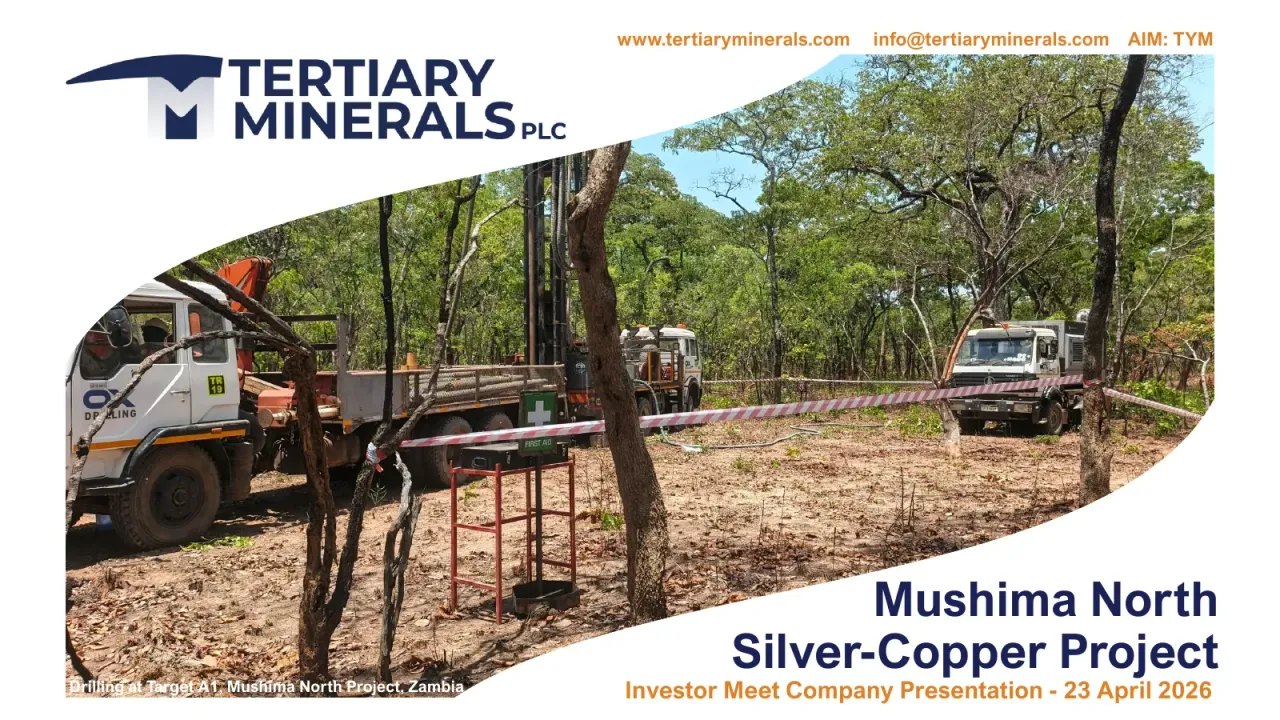
Mushima North Silver-Copper Project, Zambia hosted by Tertiary Minerals (LSE:TYM) on Investor Meet Company, held 2026-04-23.
On 6ix: 6ix.com/event/tertiary-minerals-plc-tym-mushima-north-silver-copper-project-zambia
Automated transcript · Written by software from the replay's audio. It can mishear names and figures; the replay is the record.
0:01 Good afternoon, and welcome to the Tertiary Minerals PLC Investor Presentation. Throughout this recorded presentation, investors will be in listen only mode. Questions are encouraged and they can be submitted at any time using the Q and A tab situated on the right hand corner of your screen. Just simply type in your questions and press send. Before we begin, I would like to submit the following poll. And I would now like to hand you over to Managing Director, Richard Belcher. Good afternoon to you.
0:27 Hi. Good afternoon, and good afternoon, everyone. Thanks very much for joining this live presentation on Tertiary Minerals' exciting Mishima North silver copper project in Zambia. The presentation is gonna take around about thirty minutes, and I will then answer questions. Just before we go into the presentation, the company standard disclaimer and forward looking statements. Just a brief summary. Mashima North Silver Copper project, we have made our recent silver oxide discovery called the Targa Tey-one silver oxide. This now has a JORC exploration target range of between fifteen and thirty million tons at a grade range of 40 to 60 grams a ton silver equivalent.
1:17 That's predominantly silver in terms of metal value, silver, copper, and a little bit of zinc. And this upper range gives us approximately about 58,000,000 ounces of silver equivalent. This is near surface and is in the oxide zone. And as we all know, these have potential for favorable economics, and I'll go into these in a little bit more detail on the following slides. It's also worth noting at this stage, the discovery and the advancement was made on a very limited budget. This has been less than £450,000 in terms of expenditure related to the Mishima North project as a whole. But that's not all in terms of this project. There's significant potential upsides going forward. Target A1, where we have this JORC exploration target, is still open in several directions, to the Northwest and the Southwest.
2:10 The depth extent is not fully tested. There's the potential for underlying sulphide mineralization beneath the oxide zone as we see in other deposits and occurrences within Zambia. And we also have several other drill ready targets within the Mishima North project. And these were all within around about 20 kilometers of Target A1. So there's potential upside for other discoveries within this license itself. So this leads to several potential milestones and catalysts for rerating in our share price. Going forward, we're looking at infill drilling and test work, basically to work towards this maiden mineral resource. There's also the potential for expansion drilling, only at target A1, but at these other targets I've just mentioned.
3:01 And these all relate then or feed into potential re ratings for what we believe is a very undervalued project at this stage.
3:14 Before I go into some of those slides, I just wanted to provide a quick overview of the project for those who are not as familiar with the project as others. Mashima North, located in center the left of the slide there, is located within the highly prospective IOCG, that's the iron oxide copper gold region of Zambia. This is located only 20 kilometers to the east of the Kalengwa copper silver mine, which is currently under redevelopment, in a region with multiple historic occurrences, discoveries and mines. We have a large license package, three fifty square kilometers, large for Zambia, in a country where picking up new licenses is currently very difficult.
4:08 And this is very perceptive ground, we believe. And we believe that because of our proven exploration concept, where we've made our target day one discovery, and this proven concept targeting near surface silver oxide within this region. That's the basis for our exploration model. So we're targeting these near surface oxide ounces, but we mustn't forget the potential for deeper sulphide mineralization as seen elsewhere within Zambia.
4:43 Why are we chasing these sort of oxide ounces? So these ounces within the sort of near surface oxide zone. Well, there's several significant benefits for this. And these can involve low cost mining. It's weathered. It's near surface. So this often equals to low stripping range shows, the potential for free digging ground, and they're open to the bulk tonnage open pit style mineralization. It can also lead to often low cost of processing, often simple metallurgy. The weathering helps break down often many of the ore forming minerals, so these can often be leachable or free milling. They often have high recovery rates and simple or simpler technical flow sheets.
5:28 Development costs are generally lower, lower CapEx and sustaining CapEx, and they tend to have shorter lead times as well, not only from the exploration stages, but often into development and first production and being cash flow positive. So all of these add up to making these projects generally lower risk and therefore normally can command higher premiums in terms of their enterprise value ounce per ounce in the ground values. So how do we compare to some of our peers? Well, as most of you are aware, there's not that many silver oxide bulk tonnage deposits and mines around the world.
6:14 When we think of silver occurrences, we often think of high grade, narrow vein deposits, for example, the ones in Mexico. And where they are silver deposits, bulk tonnage, oxide zone, they tend to be polymetallic and not necessarily silver is the main metal. We've managed to put together a peer group of polymetallic projects where silver is the dominant metal within that mix, similar to what we have at target A1. And as you can see from this peer group, based on our exploration target, which is a range that's why it's at two points, we can see that we sort of fall there somewhere in the middle, where we have essentially somewhere between about fifteen and thirty million tonnes at a generally consistent grade range of 40 to 60 grams. And that's certainly one of the benefits of positives for this project. From that initial drilling that we've been undertaking, we do have consistency in grades.
7:16 This is just taking into account obviously the exploration targets as it stands at the moment. The other aspects of there not being that many silver oxide occurrences is it's often very difficult then to look at this and decide, well, could this become economic viable in the future? If this was a, for example, oxide gold project in West Africa, then for most of us, it'd be quite easy to look at the value of the grade and the tons and quite quickly come to an idea of wherever it fits in terms of its economic viability. So to help everyone sort of understand that a little bit more, what we've done is a simple sort of the silver equivalent convert to to gold to provide a little bit of context and a comparator for what we currently have out in in Zambia.
8:10 So a simple ratio of converting the the silver to gold gives us somewhere between three hundred and nine hundred thousand ounces of gold equivalent at a grade of somewhere between point six and point nine four. So just under a little bit of a gramaton gold equivalent. And in a West African context, which would such a similar occurrence would have many of the similar characteristics as we see at TIGER A1, for example, being near surface as we target A1 within the oxide zone, simple geometry, amenable to bulk tonnage and stuff, then such an occurrence would as you can see here with some of the pairs we're pulling from, predominantly from from West Africa, you can see again, Target sits comfortably in in the middle there, and it sort of helps give a little bit of an impression of the potential viability of Target A1 potentially in the future.
9:08 This is why we really think that target a one is a fantastic discovery for for TERTIARY in Zambia.
9:18 In terms of potential valuations and sort of forward looking of of where we sit, so we've just used a a very sort of conservative value of looking at, say or using 50¢ US cents per silver equivalent ounce in the ground. And at this sort of value based on our target range, then we are looking at somewhere between our current market cap of the company, sitting somewhere around about £4,500,000. Then in terms of comparing that then to the value of target day one, looking at between two and five times, should be two or five times higher, our market cap purely based on target day one. And that's not taking into consideration any potential value of expanding that project, some of the surrounding targets, and not taking into account the rest of our project portfolio.
10:13 So and this is why we believe that Targeted One is or Mishima North as a whole is significantly undervalued at this stage. What this graph also helps show is that as we advance our project along that pipeline and derisk and understand the project more, moving from this early exploration target through to, for example, a minimal resource, and then on the further stages, there is great potential for then rerating that project and adding significant value. And that's certainly why we're very focused at the moment on advancing towards that maiden mineral resource. What's the sort of the the take home point for this then is, well, we believe we now have a well defined pathway to add additional value to target a one by going by advancing this project towards mineral resource, and this can be done within a very well constrained timeline and budget.
11:22 So in terms of how does this feed into our current share price and market cap, well, as for many of the long term shareholders, Toshiya has an overall declining share price for many years. However, we believe that certainly with our discovery
11:43 at Mashima North that we are able now to move into a value creation phase again. And we've certainly seen this reflected in the share price over the last twelve months or so. Well, certainly the share price as all junior explorers is a little bit of a roller coaster at times. From this graph, hope you can see that we are seeing an overall upward trajectory in the last twelve months, 80% increase in the last year or so, up about 200% from our low in June when we had a market cap down to about 2,000,000. During that period, we've also got two significant shareholders with just over 10% between the two of them, and we've been moving our market cap up in the right direction. So hopefully you can see from that, and I've put on there our different drill phases that while it does sort of go up and down, we are seeing sort of a stepped increase in our share price as we move this project forward.
12:44 And one would like to think this will continue as we move now from an exploration target through the next phases of drilling and working towards a mineral resource in the future. I'd like to say, don't just take my word for it. SP and Angel have recently given us a buy rating with a target price of $0.26.0.26 p. That's about 200% increase on our current share price. While this is non independent research, the arguments they put forward in the news flash are certainly compelling. I've just added a couple of the points there on the slide for those who have not read this. But certainly, the conclusion is very interesting.
13:35 And I'll just read the last part. We make two key points regarding Shimon Earth. First, the target remains open in multiple directions, leaving ample scope to expand on tonnage. And secondly, the primary source of mineralization in the project remains unknown, suggesting potential for discovery at depth. So again, leading to the potential many upsides to this project where we currently stand. And again, now this project is currently undervalued as it sits at this stage. So what are our next steps for this project? Well, we now have, as I said, we have our DUC exploration target at target A1. Our main focus now is to move forward towards a maiden mineral resource. And this will involve additional drilling and then running alongside this, our technical studies, particularly around metallurgical work, understanding potential processing pathways, and also potential recovery of the different metals.
14:43 There's also the potential for expansion drilling. This is both expansion at Target A1, which remains open, also the depth testing at Target A1, and there's also the potential for targeting some of our other targets within our license. And I'd just like to go into a little bit more detail about those. So if you look at the map there on the right of my screen, targets A1 down to the bottom right there. And we have the five kilometer rings radiating out from targets A1. So we have numerous targets all situated within at least 20 kilometers of target A1.
15:30 And within that, two targets, target B1 and target A2, which sit within only five kilometers of target A1. And these have very similar characteristics to target A1. So it certainly would be a priority for future drilling. All these targets and what's sort of leading to is the potential for this sort of hub and spoke style model where we could potentially have a main occurrence with several satellite occurrences around all feeding into the same one the same area. And this has the potential then to certainly increase our ounces if, for example, we make further discoveries at any of these targets around target a one. We should also forget that essentially from the center of target a one to the mine gate at Kalengua is only 28 kilometers. So again, within viable, everything else being equal, trucking distances to these locations. So there's a real potential for this area to become a hub for mining some place in future.
16:37 And this is really why we're so excited about our recent discovery and the potential well, the direction now that this license is heading in.
16:51 Before I wrap up, I just want to go through a couple of summary slides just to drive home some of those key points that we've been making. So in terms of Target A1 and Mashima North. So we've managed to advance from discovery through to an exploration target with just over a little over 3,000 meters. So this has been generally quick and certainly efficient exploration process. The spend so far on the entire license is less than $450,000 And when we base that on our sort of in the ground value or sort of thumb suck in terms of using our exploration target range, then even at the very low value using the 0.5 a dollar an ounce in the ground value, then this is a significant return on investment for the money spent so far.
17:47 There's plenty of upside for target A1. It remains open both in the Northwest and the Southwest, and it also remains open at depth. So there's potential to expand on our current tonnage and ounces with additional drilling exploration expansion drilling. There's also the potential for some sulphide mineralization underneath as seen on other occurrences in Zambia. And this is certainly a very exciting and enticing proposition to be exploring for as well. There's also the regional potential of Mishima North. On the previous slide, those several targets that we have are all within easy trucking distance of target A1, which could have the significance to make this project a regional play, certainly in an area which is now with a mine coming online in the near future, makes this a very exciting area to be exploring in.
18:46 In terms of our potential milestones, as we've said before, the plan is to get out drilling as soon as we can. We are coming to the end of the rains. We have done some reconnaissance or recce work previous weekend to see whether we can get back out onto sites. Still not possible yet, but we'll be monitoring that over the coming weeks. And the plan will be to get out drilling as soon as we can. And once that drilling is underway, also initiate some of the technical studies that are run alongside using samples from that drilling to help support work towards the mineral resource. As we said before to the markets, the aim would be to work towards our maiden mill resource by the end of this year, and we should certainly see then over the next six to eight months a significant amount of news flow coming out of those drilling programs, those parallel studies as we start to work closer to that to that resource.
19:48 So potential lots of potential to gain momentum again and looking good re ratings within this this project in terms of the the value the market gives it. To to summarize then and the the first part is just really a summary of what I've done now for the Machine Earth project, really just to to to hit home the undervalued nature of our recent discovery, but the potential now to derisk this and advance this quickly and efficiently to a major mineral resource. There's also lots of opportunity for upside in terms of potential to expand the tonnages and therefore the ounces that we currently have not only at target a one, but also within the project as a whole by testing some of these other targets that are close close by.
20:43 There is also our other projects both in in Zambia and Nevada. And I just wanted to provide a quick summary of those just to help highlight that we have while there's potential lots of upside just in Mashima North, there's also lots of catalysts that could potentially come about from our other projects elsewhere. So we have our Cobalt Metals joint venture. That's on our Conkola West project located adjacent to the Conkola Deeps Mine, where it's 344,000,000 tonnes at just under 4% copper. The aim of this exploration is to explore for the continuation of the ore horizon from Cancola West underneath into our license.
21:30 Stage one on this project is complete. Cobalt have now earned 51% into the project. We're currently moving the project out of our subsidiary into a a new subsidiary so the equity partners can have their their stake. And then next stage for this project requires exploration expenditure cumulatively of 6,000,000. First, QUANTUM MINERALS on our Mackay project, which is located only 17 kilometers from FQN's Trident project, where we have both Sentinel Enterprise. Sentinel, a very large low grade copper occurrence, almost 600,000,000 tonnes at 05% copper.
22:16 That is now in its second year of due diligence. That requires FQM to spend a total of 1,500,000 on exploration during that period. And if they complete that, they then have the right to earn into the project and then 51% of the project by defining a mineral resource containing at least 80,000 tonnes of copper. We also have our other projects in Zambia, as well as our projects in Nevada, and also our sort of sleeping projects in a way in Sweden, our storm and flu spa project. Our other projects, and we understand, you know, we are a small junior, limited market cap, raising money is very dilutive, that this is a large portfolio to be able to service properly to advance.
23:09 And therefore, we are working on a prospect project generator style model where we bring in joint venture partners to help advance those projects. And our aim then is to identify the right joint venture partner for the right project, someone who's fully funded, are able to quickly advance that project and potentially manage that project as well. So then they're taking essentially all of the risk and the time and the effort to advance, where we can focus on, for example, our flagship project, the Machine Manorf project. And that's something that we've certainly been successful on in the past, both with the setup of the Cobalt and First Quantum agreements. And that's something that we're looking at on our other projects going forward. And certainly, we bring in other partners, that reduces the potential capital that we need to advance those projects ourselves.
24:05 So that's certainly a model that we are continuing to try and advance forward. And that also allows us, as I said, to focus on our machine in earth where we believe we can essentially, in simple terms, get the most bang for our buck in terms of exploration expenditure.
24:24 Essentially, that's the last slide here. So before we go to questions, just want to say I really hope that showcases Tertiary's current position, our very exciting recent discovery at Target A1, and our clear pathway for adding additional value to that project, but also the several other opportunities we have, not only on the machine and health project itself, but the surrounding projects through our joint venture partners and our wider portfolio as a whole. So at this point, I will leave it there, and we'll look at moving into some of the questions. Thank you very much. Fantastic, Richard. Thank you very much indeed for your presentation. Ladies and gentlemen, please do continue to submit your questions using the Q and A tab situated on the top right corner of your screen. While the company take a few moments to review those questions submitted today, I would like to remind you that recording of this presentation, along with a copy of the slides and the published can be accessed by our investor dashboard.
25:28 And Richard, as you can see, we have received a number of questions from investors. And if I may now hand back to you and kindly ask you to read out the questions where appropriate to do so, and I'll pick up from you at the end. Thank you. Thank you very much. Sorry. I've just quickly jumped through some of the questions just to to get a feel for them. We did have quite a few pre submitted. We've sort of covered a little bit of some of those with the recent conversation or from the recent presentation, but there are some others which sort of half cover in some ways. And so just to sort of run run through then
26:16 so I suppose from from top to bottom. I'll work through the questions initially on Mishima North and then carry on some of the some of the questions on the on the wider portfolio. When do you expect to have the metallurgical reports on the upside zone from Ashima North? And will these include details of likely recovery rates and processing pathways? So as as I said, so the the early work we did over the this rainy season was looking at mineralogy, not metallurgy. We did do specific gravity work as well, all to support the exploration target and to give us a a baseline for for further studies going forward.
27:03 We will be looking at starting that metallurgical work in the near future. Over the last month or two, we've been speaking to potential external contractors to look at doing that work. And essentially, that work will be looking at the processing pathways, grind sizes, optimization, the likely route that we will need to follow to extract both silver and copper, looking then at recovery rates and given us that initial work around that metallurgical work so we can understand the potential technical flows flow paths for the future work. So that's something that's going to be ongoing.
27:51 We're going to be initiating that very soon on some of the samples that we were coming out from previous drilling, but part of the flow sheet will be to now we have our exploration target, we've got an idea of the morphology, so the shape of the project, the sort of internal domains, though as I've said, the the grades are very consistent, we can start to pick which areas we'll we'll use as the sort of type domains. And then when we're drilling that during the infill drilling, we can then use those samples for that test work. So that will run concurrently with the with the drilling going forward. Just running through some of these presubmitted, so we have covered a little bit this. But into next question. What is the primary aim of the next phase of drilling?
28:39 Is it gonna be looking at natural extent? Will we be testing the potential for sulfides at depth or a combination of the two? As I've said, we believe that the sort of the main value creation pathway is to work from this exploration target to a maiden mineral resource. So it's going to primarily be infill drilling, but we do have that opportunity to also expand do expansion drilling at the same time. That will probably be focused if we do, and that's depending on the amount of meters we have to to drill with and and progress towards that towards the getting enough drilling completed so we can derisk the project to a maiden memory resource during this field season would likely focus actually on target day one, but there is the potential for looking at some of the other targets as well. In terms of the sulphide drilling, yes, it's a very tantalizing proposition.
29:42 This would require deeper drilling, particularly core drilling as well, those depths. In terms of what depth, our deepest hole is less than 150 meters so far. This project, as I say, is very near surface, shallow in the oxide. So we haven't undertaken any real deep drilling at all on this project. One thing we've been looking at recently is undertaking early on in the drill season is some ground geophysics to help potentially identify some targets at depth, we can then target with some of that deeper drilling and potentially de risk the deeper drilling before we undertake it. So yes, certainly something that we're looking at going forward. How soon will you drill?
30:33 Did we targeting? Okay. So that's another question regarding will we be deliberately targeting for the proof of continuously mineralized underlying sulfide zones, or what sort of meterage is required to do this and how deep are you planning to go? Yes. So we're not sure how deep, for example, some of the sulfide mineralization could be if it's there. And that's why we're proposing undertaking ground geophysics to identify where that if there's targets and how deep and where those targets are. That would be the process. As I said, drilling so far has not been deep at all, less than 150 meters. So one would imagine we would need to drill potentially well, we would need to drill deeper than that. How deep?
31:24 We have no idea at this stage. We are early stage exploration position at this moment, and we've only undertaken shallow drilling so far. With the drilling season in Zambia fast approaching, are you expecting to conclude any deals on the company's well placed licenses? Well, obviously, can't comment individually on any discussions we're we're having at the moment. But as I I mentioned earlier on, we are using a sort of prospect generator style model, and we are keen to bring in joint ventures on projects as and when it most provides the most benefit in terms of bringing value back to our our shareholders. So it's we're certainly been having discussions about various projects.
32:18 And as and when we have updates, we'll be notifying the the market. Next question. Apart from the exploration target for Mashima North, there's been little progress since drilling stopped due to the heavy rains. Can you explain why, for example, work was not done on the metallurgy? Yep. That's a great question. As I said before, we did do some initial work, not on the metallurgy, but just mineralogy and specific gravity work to help support the exploration target but help us with the baselines going forward. In terms of why we haven't started the metallurgy, we wanted to have our exploration target completed first, so we had a much better control the on morphology of the deposit, potential grade variations, and the different domains within that.
33:17 So therefore, when we do the metallurgical work, we are doing that work on, I suppose, type zones within the deposit or within drill holes that represent the wider area. And we didn't have the confidence or didn't have the data set to support that before the exploration target came out. And therefore, if we started to do some work, we might have to repeat it or do additional work. And one of the aspects that we're following is trying to keep our costs as low as possible. So that's why we didn't do the metallurgical work before, but that process is starting now. However, do take the point, the rainy season, it does halt exploration, and that's something we're looking at of generating enough data during the field season so we can continue essentially the sort of studies behind the scenes or the non field based studies during that rainy season. And that's certainly something that we tried to do last year to fit in that additional drilling.
34:29 We built up a lot of momentum in the project. We started to get it back out with that phase three drilling. As we saw from the results that came out in February, we'd hit our best grades so far in terms of the width of the intersects, in terms of the grades of both silver, and we had copper grades up into the percentages. So we're really getting some momentum on the project, and that was unfortunately stopped with a very heavy rainy season this year. But it did allow us to have some additional results that came out then seven months afterwards. And that that will be approach that we'll be looking at this year. And that's sort of our our well, that is our plan. Get it back out to to drilling as soon as we can, drill as much as we can, generate as much data as we can. And then by the end of the drilling season, have everything in place that we can then work towards that medium mineral resource during the the next rainy season. Right? And then hopefully have everything completed towards the end of the year.
35:40 Is there any work going to be done on Jack's this year? So all our projects we have internally budgets in place to to to continue work. That's obviously subject to funding and how we deploy the capital between our projects. As I've said, Mishima North is our flagship project. This is where we believe we can get the best return on investment for every exploration dollar spent in in the ground. So that's certainly our our focus at the moment. Our other projects we sort of are looking at in potential terms for joint venture partners, and we sort of balance that. We're trying to advance the project to a state to the sort of the sweet spot where advanced where we advanced the project enough to be sort of derisked enough for an a joint venture partner to come in, but for a joint venture partner to come in in a deal structure, which is is beneficial to the company. So the more advanced the project is, the higher the value of the joint venture that that comes in in terms of likely milestone payments, expiration expenditure, and so on and so forth. So it's really trying to find the the sweet spot on those other projects. But JAX is certainly a project that we're very excited about. The historic drilling has has proven that there is copper mineralization on the project, and it's proven this this copper mineralization
37:10 both near surface, sort of the lower grade oxide copper near surface as well, you know, the sort of 0.4%, 0.5% that we see with other projects around Zambia, as well as the higher grade sort of greater than 1%, 1.5% copper sulfide mineralization at depth. So it's a project that we've been currently relooking at during the rainy season, and that's another aspect of what we do during the have been doing at the rainy season is reviewing all our data, trying to re identify targets, look at our projects differently, and see if we can add additional value through that. When do you expect update the market on our existing joint ventures with First Quantum and Cobalt.
37:57 I'll a little bit update of where we are with those projects. As and when there's additional news on those projects, we will be updating the market. As I said, we're coming up to the field season now, and something we'll be looking at is providing an update at the start of the field season in terms of an operational update to the markets on our plans going forward. When do you expect to update the market, I. E, the Storium And Flusar project? Yep. Great question. For those of you not aware, our Storan Flusar project in Sweden is currently under appeal. We're appealing the for our mining permit.
38:45 That last appeal went in little over a year ago now, and we're sort of expecting essentially the feedback now any time really. We are in in touch with the the government department in Sweden that is dealing with the request. I think provided we've tried the last update on the back of the our AGM. But, essentially, all we know is that the appeal is in is in review, and we will hear back as and when it's finalized. But, unfortunately, we've not been given a concrete timeline when we can say, well, it will definitely be done by x date. So we'll just have to wait and see. But it's now been in review a little over a year, so one hopes that this should be completed in the near future.
39:52 So the other one, could we have an update on the other projects, the joint ventures, and what we can expect in the coming season? Well, I've mentioned the the joint ventures just just now. The presentation, I hope given you an idea of our our plans for this this field season at at Target a one and and and Mishima North. As I said before, we are running a prospect generator model, so, you know, we are in discussions regarding the other projects and potentially advancing them. If and when they get to a point where we where there's something material, we will provide that information to the to the market.
40:38 But certainly since our discovery at Mashima North, it has increased our profile of the company in in country, and we're getting a lot more interest in in tertiary and the work that we're doing. Let me just have a look. Just see. Is it what have we got? Another question. Have you had interest in the project from other companies? As I said, we have had discussions regarding the the project, and nothing material at this stage to report. Another question about starman. I think we just sort of covered that.
41:36 Question here. Do you see the processing of the ore at Kalengua as a realistic assuming mineralogical test work is favorable? Yep, that's a great question. As I said in the presentation, all things being equal, target A1 and even the surrounding targets are all within viable chucking distance from Kilengua. We're not in discussions with Kilengua at this stage, worth noting, but that that is a potential opportunity in the future, whether sort of toll treating on-site, potentially selling at the gate. This just having Kalingua essentially on our doorstep really increases the optionality of this of this project.
42:24 And it's great timing in terms of, you know, well, we've just made this recent discovery. There's a a historic mine currently back in in redevelopment just just down the road. So perfect timing in in many respects there. There's a couple of questions here. Question. Right. Couple of quite technical ones here. So there's a one regarding one of our earlier drilling to set. So the 58 meters of 4.9 grams a ton silver, 72 grams silver equivalent from eight meters downhole.
43:22 Is this result noteworthy significant? And if so, can you partner at TYM just since you have the the potential to partner? And do you believe we have the money or the manpower to develop the asset? Yes. I think that insect is is significant. It is noteworthy. This is why we've been able to advance that project to a joint compliant exploration target undertaken by an external independent consultant. And in terms of future pathways, well, then we, as I mentioned, working towards mineral resource now. I think we've proven that we're able to explore and we're able to advance projects forward quickly and efficiently, and that's certainly something well within our capability of advancing the project towards that main admin resource.
44:23 In terms of potential bringing in partners, we are have an open door policy in that respect. We are always happy to talk to to other companies, but certainly someone coming in on our flagship project will have to be in a deal structure, which is brings the most value to our to our shareholders. Because, certainly, we see this project as, at this stage, incredibly undervalued and has the ability to really rerate as we advance forward. So we'd really be looking for a quality joint venture partner to come in to to support that project. There's a question here. BP have just announced an intention to commit considerable finance to Zambia that source deep copper similar to what Cobol are doing.
45:09 Are you aware of any planned deep drilling or progress around machine Maki, or Jax? Great question. Yes. As just coming the news, BHP have decided of committed to moving back into into Zambia after leaving about fifteen or so years ago. And, certainly, our Moshima North project sits within the general region, which was the focus of BHP's main exploration back during that time. And actually, of the regional datasets that we've used to help support our initial exploration are datasets that were generated historically by BHP and some the other companies doing regional exploration. We're not aware of what their plans are or what they'll currently be doing, but naturally, it's great to have them back in country.
46:03 All the majors are now back and active in in Zambia, and that just goes to show the real importance of of of Zambia as an exploration and mining jurisdiction and the phenomenal support that we've been having from the government, from the present president presidency all the way down supporting mining and very much a country open to to business in terms of of mining. And they have a plan to reach 3,000,000 tons of copper per annum, a very ambitious target, but they are providing phenomenal support to our industry so people can explore and advance as quickly as possible.
46:50 So, yeah, it's a great great jurisdiction to to be working in it at this stage. Question, what are the key risks to target a one? What are the likely timelines, funding amounts? So key risks, expiration the expiration target has provided a little bit of derisking, but there's still still a lot of risk around potentially being able to fully define this target around, for example, processing and recoverabilities. And these are things that we're going to be addressing in our upcoming studies. In terms of timeline, then we do have a clear pathway now to go towards the maiden mineral resource. This is something that we want to be able to complete in terms of all the drilling now during this field season and then working on the technical further technical studies, so the behind the scenes in the early rainy season. So we have mentioned to the markets that we were looking at trying to have all this in place towards the end of the year.
48:03 So that's a a six, eight month timeline. Funding wise, obviously, at this point, we'll, you know, can't discuss potentially any future fundraising. But as with all juniors, there will be some funding required to advance projects forward. What I'd like to say is, assuming what we've been doing or like hope that we've proved is that we're able to explore and advance on tight budgets, and we do well constrained focused exploration, and we'll be bringing that sort of rigor to our future work on Mashima North, and we'll be looking at keeping expenditure down as much as possible. In terms of potential dilution on other projects, that's where potentially bringing in the joint venture partners comes in as well.
49:03 Couple of questions here about have we tested for rare earth rare earth minerals on the project as well as looking at what about the testing of some of the the critical metals. Previously, we we have provided limited information on sort of elevated amounts of, for example, bismuth, gallium, antimony that we have on the on the project. Yes. We were looking at we have been looking at the critical minerals within within the project. We now assay while we do to keep costs down, we do initial on-site assaying for copper and and zinc with a portable XOF.
49:52 All the mineralized insects go to an external independent laboratory for a full multi element suite, and that includes all these critical minerals. One thing we haven't looked at is the potential for rare elements, particularly and probably where the question is coming from, this is within the historic iron oxide copper gold region, and these occurrences or IOCG occurrences can often be associated with rare earth elements. So it's something that we did have an initial look at. We decided in terms of the rare earth elements it was a low priority at the moment, so we haven't been testing for that at this stage, primarily because while we are in the IOCG region, the style of mineralization we believe at the moment is more akin towards sedimentary copper as opposed to that IOCG type affinity. And therefore, it's unlikely to be enriched in in rare elements. But it's something that we'll keep an open mind about in the future.
50:56 Just see if we've got time for one or two last last questions. Question about the slide value to shareholders. Appreciate the sentiment about where the market cap, but as the market cap has been in sort of below 5,000,000 range for considerable time now, almost ten years, when is this likely to change? Well, I believe there is the potential for this to change now. I think we have a clear pathway to adding value through target a one and advancing this project as well as the potential on the surrounding project.
51:46 Now we are moving away from just early stage exploration across this portfolio of projects, and that's a natural a natural progression and something that we, you know, we needed to do. We picked up very early stage projects, which very prospective grounds in key areas, and it was a phenomenal portfolio to pick up. But we've now advanced Mashima North to a point where we now have a clear valuation pathway towards that maiden mineral resource. And we could potentially do that in in quite a short time frame. So I believe this is a very exciting time for the company and a great great opportunity. I think time wise, we might have time for one or more questions.
52:42 Question regarding the actual more details on the the plan for drilling at Mishima North, how many meters of of of drilling. This has not been finalized yet. We've got a rough rough program in place of, you know, first phase of somewhere in the roundabout two to 3,000 meters of of drilling. This will be sort of finalized based by our independent consultant to make sure that the sort of data density fits their requirements for transferring from an exploration target to a an inferred inferred resource. As I said, you know, our our project sort of is amenable to being explored quickly and and efficiently in that it is near surface.
53:32 So within a couple of meters of drilling, we're normally into the mineralized zone. The general morphology, flat line, tabular is consistent grade so far. So this all means of being able to have more wider spaced drill holes than needing more close data density points. So hopefully, we'll be able to advance forward with less drilling required than necessarily say more drilling than than other other projects. I think maybe one more. Let's see. The question about c one, which is another target we have on the other side of the machine and auth license, which great technical question, this one. So c one shows more potential, I believe, with an area showing both the copper and solar anomaly associated gravity anomaly on a nearby magnetic feature and EM anomaly.
54:42 Seems more perspective than even a one. Even just one cheap wildcat, cheap arsid drill hole probably won't make the share price go down. Yep. It's certainly something as part of our our our sort of wider sort of exploration plan for Moshima North. We know it it is a very compelling target. I I agree. From the earlier work done, there was an old historic hole done in the 1970s by the Rowan Selection Trust. They started to intersect string of sulphide mineralization, I believe from just over 100 meters or so. And from looking at some of the geophysics regional geophysics work by people like BHP Billiton, from the remodeling of that we've done, then the sort of the sort of gravity anomaly potentially there is starting at, we think, around about maybe a 150 meters or so. This regional data, so it's difficult to to narrow down.
55:44 So we're potentially looking at a a 200 meter plus plus hole. Probably would have to be mostly we're mostly core in this from RC rigs in in country going down to those depths, particularly with the the deeper water table. And also after the rainy season, the water table is very high. Anyway but, yes, a compelling target, and certainly one we'd we'd love to be able to to drill as well. And I think in terms of time, I think that's probably all we're gonna have time for, and I think we've covered just just check. I think there's no more no questions that we've not covered. Yes. Richard, if I may just jump back in there. You have addressed a lot of questions for today. And, course, if there are any further questions, the company will be able to review those, and we will publish them where appropriate on the investment company platform.
56:36 But Richard, before we direct investors to provide you with a feedback, which is particularly important to yourself and the company, could I ask you for a few closing comments? Yes. Certainly. Thanks so much. Well, I just hope that this presentation has showcased Tertiary's current position. I think we've got a very exciting discovery under our belt recently, and now we've got a clear pathway for value creation at Target's a one. But there's also several other opportunities, both upside, not only at Target's a one, but I hope you now agree with the surrounding targets within the Mass Human Health project, as well as our potential joint ventures and other projects, not only in Zambia, but also in Nevada. So certainly a very exciting time for the company and looking forward to getting back out to the field very soon. Thank you. Excellent, Richard. Thank you once again for updating investors today. Could I please ask investors not to close this session as you now be automatically redirected to provide your feedback, which will help the company better understand your views and expectations.
57:38 On behalf of the management team, we would like to thank you for attending today's presentation, and good afternoon to you all.
Follow Tertiary Minerals PLC into a list and get an email when it puts out news.
Managing Director at TERTIARY MINERALS PLC