Transcript
Automated transcript · Written by software from the replay's audio. It can mishear names and figures; the replay is the record.
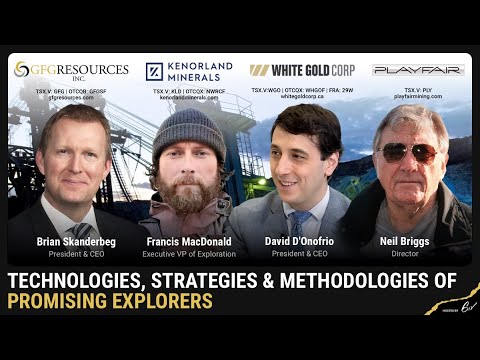
0:07 Well, hello everyone and welcome to technologies, strategies and methodologies of promising explorers hosted by 6. I'm pleased to introduce our speakers for today. We have Francis McDonald, President of Knorland Minerals, David D'Onofrio, CEO and Director of Y Gold Corp, Neil Briggs, Director of Playfair Mining, and Brian Skanderbeg, President, CEO, and Director of GFG Resources. Before we begin, I want to remind you all that you can submit your questions at any time on the Q&A panel on the right-hand side of the screen, and we'll make sure to get to them after the discussion. And as always, this event is being recorded and will be available to watch afterwards on six.com. But before we begin, just to kick us off, if each of you could just introduce yourself and your company, starting with you, Francis.
0:54 My name is Francis McDonald. I'm president of Kynorland Minerals. And Kynorland is an exploration company, and we're really focused on greenfields exploration opportunities. We have a number of projects that we are sole funding and exploring ourselves, and then we have a number of projects that we've partnered out with companies like Sumitomo, Newmont, Barrick, and Sentara currently. And we have a large exploration portfolio with about 6 or 700,000 hectares of ground. And we are progressing all of that in the next year. Thank you, David. Nice to be here, Thank you. CEO and part of the co-founding group of White Gold Corp. We have a very large and pretty unique portfolio of properties up in Canada's Yukon, focused in what's known as the White Gold District, also the Klondike. And this was the epicenter of the infamous gold rush from 120 years ago.
1:55 And what we've been able to do, over the last several years is basically compile the majority of the claims in the district. We're now the largest landholder there and put together a very unique package that we partnered with Neko Eagle and Kinross to help us continue to explore. And it's an interesting situation as you had this prolific district with all this rich plaster mining that's been happening over the last 100 years,
2:26 producing over 20Moz of Gold, but nobody really had gone there to do any modern day exploration until Sean Ryan went there with the thesis that with this much Gold on surface, there's got to be more. It was a tricky place to explore. A lot of this innovation that we're going to speak about, I think it plays a part to why we exist today. He was remarkably successful right away in making multiple large, multi-million ounce discoveries taken up by majors. And we've now partnered with Sean and other companies we met to continue to work there. We have a couple million ounce deposit and this huge portfolio that we're deploying some of these methodologies on currently. Great, well I'm excited to learn more. Welcome.
3:12 And Neil? Yeah, my name is Neil Briggs. I'm a director of Playfair Mining. We're currently focused on an old copper mining district in South Central Norway, about 100 kilometers south of Trondheim. Been a copper producer for on and off for 400 years, but hasn't had much recent exploration, has a lot of data. What we think is a novel way of looking at the old data and focusing down on the many, many targets that are available on the property to the ones we think are the best.
4:00 And we're in the midst of a drilling program, which we started last fall, and we'll be picking up again in the next few months as the weather permits. Additionally, Playfair, I should point out, Playfair has a tungsten deposit on the south coast of Newfoundland.
4:22 Great, thank you so much. And Brian. Thanks, Dasha. Brian Skenderbeg, I'm the president and CEO of TFG Resources. And we're a district scale exploration vehicle. We're focused on 2 core assets. One of them is a portfolio of early stage properties in the greater Timminsville. The other one is an Algalen Gold district in central Wyoming, where we are partnered with a private company called D11, which is attempting to bring in Sitchi mining to Gold. So I think we're a vehicle that looks to apply unique technology to the assets we control, some of them at an exploration stage and other ones that are more on development stage. So very much in terms of our capital and I think in terms of the dialogue today, we're most focused on the Timmins portfolio, where we're holding 3 main land positions, both east and west of Timmins.
5:14 And all this year would be advanced materially at Montclair property and lesser work on both the Penn and Doric properties. Great. Thank you. Well, so to jump right into the discussion, what unique technologies, strategies, or methodologies are you using and what do they mean for the industry? If I can just go in the same order starting with you, Francis. Well I guess, you know, I think it might be good to just kind of go higher level for a minute and just talk about the objective, you know, The objective of what we're trying to do is find new mineral deposits. And what I think is that there's really 5 data sets that we use, and that would be geochemistry, geophysics, lithology, structure, and alteration. And then when we think about those data sets, when you talk about technology and strategy, it's really about how we collect those data sets and how we interpret those data sets.
6:11 So thinking about those things, there's always new technologies that are coming along about how we collect data and how we interpret it. And so I guess, you know, when you dive down into each of those data sets, that would be, I guess what we're talking about is those technologies. So to answer your question, some of the technologies or strategies that we've been using. One would be drilling for till and so typically
6:39 in in Canada you would collect a till sample from surface but there's vast areas of Canada that have a more transported material on top, so glacial, the custrian clay a lot of the time, and you can't get an actual till sample within that surficial unit. So you have to drill down below it. So that would be 1 strategy. And the purpose of that is to get a geochemical data set. I'll pass it off to somebody else before I talk for too long about that. All right. Thank you. David, what about you? Yeah, well, glad to pick it up. White Gold really only exists because of innovation in exploration technologies.
7:25 You look, we're in this district that's had this prolific history over 100 years, all this Gold on the surface. Why was it that nothing from a modern day exploration point of view was done there for so long? It's in Canada. This mining exploration is what we do. And the answer is the terrain environment there is a little bit different. It was actually not glaciated, believe it or not. So unlike how Francis mentioned talking about the effects of the glaciation, this didn't occur there. And because of that, there's also not a lot of outcrop. So the typical prospecting methodologies that have been deployed across the majority of Canada and many parts of the world just really don't work. So when someone's tools don't work, they will avoid that area. So this is where Sean's big breakthrough came. He was there, he had this thesis. He said, okay, well, how can I innovate to improve these methodologies to test these theses? And it was through his time there, he was able to innovate and develop a number of different unique approaches to be able to evaluate the prospectivity of finding these different mineralite systems. And it started with the soil geochemistry,
8:38 and he was able to tune into different pathfinder elements. Obviously, we're searching for Gold, but sometimes you have to look for these other pathfinder elements to give you a sense of what that indication is. So a big part of that is the reason that led to all the success and our continued success and the recent new discoveries we've had. But the other part of it is, the area is a little bit remote, it is seasonal, you have to find ways to be able to do things more efficiently and more cost-effectively. And the junior companies in this industry are great for that because they have limited resources. So they are forced to innovate a lot of the time. And it's through this evolution that we're able to continue to sort of have this success in our industry. So credit to him for all these things. Are these replicable, these technologies?
9:28 They are. And part of our ethos is to share our innovations with everyone else. We're 1 player in a district. The more success that we'll have in our district will lead to more investment in the district. And I think that'll sort of help the industry and our local partners as a group. So it's something that we look to do. It's evolved now. And we will get to a little bit later. It's become quite a sophisticated methodology.
9:55 The term is drones to drills. So if you can think from 120 years ago, the prospector and all the pictures with his panning in the river in his boots, now that process starts with a drone. So a lot has changed, but it's great to be a part of that. Yeah, we'll absolutely get into that. Thank you. Neil, what technologies and strategies are you using? Well, just to take a slightly step back, we took on 300 square kilometers in southern Norway. It's an old mining district. Several old mines, the oldest started in 1629, operated for 150 years on and off, and there are others. There's probably 40 or 50 showings of 1 type or another on the property.
10:47 There's existing MAG and EM airborne data from 2004. It hasn't really been explored recently. It was explored for nickel last in 2004 regionally. For copper, in 2004 regionally. For copper, it was last regional exploration was 1977. So it's full of airborne MAG and EM conductors, way too many to test and the question is how do you sort them out to better areas. And with a lot of existing data,
11:28 we determined to do a two-stage filter on this. With the first stage of grading and examining and comparing the old data using an AI system operated by a company called Windfall. And we did that. We had lots of data available to us. And then we narrowed it down, focused it down from 300 to less than 3 square kilometers and we then decided to do a
12:10 geochemical filter on that to see which was the best because Our intention is to get to drilling as quickly as possible because drilling is the way you find things. So we, in fact, in this case, it's all covered in till and in places the stratigraphy
12:30 of the till is reasonably known, but a lot of it is very far transported. So we did a modern method called MMI, mobile metal ion, soil sampling, where the metal ions are mobilized vertically from the source. But the source might be in rock or it might be in the soil. So, but we narrowed it down to about 7 drill targets in 5 areas and made us top last year. Great, thank you so much. And Brian, what technology strategies, methodologies is GFG resources using? Yeah, thanks Dasha. I think it's important as Francis started with was to stand back and think bigger picture and strategy. And maybe that's best how to understand our philosophy.
13:23 We want to work in belts where obviously we think we can make a relevant discovery and our filter for that is high endowment belts. Big mines, probably have big mines around, but no secret there. But most of all, we want to find the deposits that haven't been found yet. We're working in areas where we understand there's complex cover, where the cover is quite extensive and where, if we look back at history, exploration methodology hasn't done a great job at seeing through that cover and has thus preserved the opportunity. So when we think about our journey with GFG and the Timmins, it's the recognition that 10, 20, 30, 50, 80 meters of till is opportunity.
14:04 And that your philosophy needs to understand how you can succeed with that. So we use a blended approach. We would call it geological structural framework, building on a macro scale across the belt. We would look for a very good and effective geochemical regional filter. I think that's a good analogy between all of the teams here, is that we're using a regional geochemical technique to see if we can cover. For us, it's till. We're looking at either a combination of pit dug till or sonic-based till drilling to get an effective sample over large areas. And I think with our group, we've been able to screen hundreds of square kilometres. GFD would hold about 800 square kilometres and boil that down to drill targets.
14:53 And really our philosophy is more empirical, less model-driven, very strong regional geochemical filter that's able to see through complex cover and unravel the history. It's still certainly as far from simple, but I think when you look at our success at finding new Gold systems, which is the first step to finding a new deposit. I think our technology at Timmins is quite effective at that. The other side to our story is with our partners, G11 in Wyoming. This is a good example because there's a marginal deposit present there and It's really about how to make the best value and build value with that deposit. We've brought in a partner in this project, Rattlesnake Hills. They're looking at in-situ mining for Gold and they have a cyanide replacement technology.
15:46 I think Looking for partnerships that can bring new technology and ideas to build value for the company is a very strong way. I think it's something that GFT is effective in doing, to get a few irons in the fire, all of which are using new technologies. I would just jump in there and add, you know, most of Canada has been glaciated and it's really, there's only about 1% outcrop in Canada. And so David and people working in the Yukon are in a very unique situation where it hasn't been glaciated. But so the rest of Canada, 1% outcrop. I think a lot of exploration in Canada has really focused on outcrop in the past and when you go to places like the Abitibi in Quebec or these other known gold districts, pretty much every outcrop has been walked on and sampled.
16:36 And so we really need to do something differently and like Brian said, you know, we have a very similar kind of strategy where we're using glacial till and, you know, some glacial materials that have been transported in the last glaciation, and trying to use those materials to work backwards to a source and look in areas where people haven't necessarily looked before because they've been focusing on lower hanging fruit, which would be outcropping deposits or showings. I can comment on that a little bit on that experience in Norway. The area we're in has been intensively prospected for probably 400 euros and All the deposits and showings have been found by prospecting. It's till covered and you have to find a different way.
17:27 Playfair probably differs from the other 3 companies here in that our initial focus, our initial filter, if you like, was not geochemical. Our initial filter was AI technology using all available data, and then the geochemistry was a secondary filter
17:52 in our case. So I'm just wondering if all these methods that you've brought up are primarily for efficacy or is it efficiency or ESG reasons? Brian? I can start with that. I had to go look at this and I'm like, okay, let me understand the difference between efficacy and efficiency. And in the end, I was like, you know what, it's a bit of both for us because obviously, efficacy is effective and efficiency is how effective is it? You kind of answered the same thing. When I think about our methodology,
18:28 it does really revolve around both those factors. I think the tool we're using, which is ultimately till-based exploration with a geological structural framework overlay, it is one of the tools that has a reasonable chance of succeeding in these blind and extensively till-covered belts. I can find something new. You're going to find new Gold systems. I think any of our methodologies would have found Great Bear 20 years ago if we could have run a till survey over that. Less model-driven and more empirical.
19:05 So I really think it's, it is efficacy. It has a strong chance to succeed in finding something new. And that's my view of it. Right, Neil. I think all of them in our particular case, I don't know if 1 stands out, they're all important in different ways. In terms of the efficiency, I mean, we were able using AI to reduce our target areas by 99 percent, you know, from original 300 square kilometers to something less than 3. And it's kind of a method that uses all available data, which was freely available in Norway, you can download it all and process it and see what you come up with.
20:03 Again, it's kind of empirical because
20:07 we divided the 300 square kilometers into 40 meter cells. And we had over 400
20:22 variables calculated, primary or calculated for each cell. And then we compared all the results on 100 and, I don't know, 170,000
20:39 cells, 7 and 8 all the results on 170,000 cells, 7 and 8 million data points, but compared them to known mineral occurrences, good or bad, positive and negative points, and then look for similarities. It's kind of a way that geologists work, but I can't keep that much data in my head anyway, I don't know about you guys, but then we went to that with geochemistry. But a part of that for us too is the ESG part, because in Norway they really haven't done much mineral exploration for 50 years. They've been concentrating on offshore oil and gas. And it's a rich country and people are used to going out in
21:29 parks and just in the mountains to enjoy themselves, so they don't really like other things happening. So you have to appreciate this sensitivity and so we're doing, you know, low impact kind of exploration AI, you're not even going on the ground. MMI you take digging little pits, walking and digging little pits. We then did drone mag. So all these things are not really impinging on people very much and makes it more acceptable. Meanwhile, you're trying to get the message that, yes, think green, but if you want to be green, you're going to need minerals to do it. You know, if you want an electric car, Norway has the most per capita in the world, there are metals in it, and you've got to find the metal somewhere.
22:23 For our drilling, we're using man portable, and again, with low impact on the environment, And it's helping with our relations with local people. So, but all these things are equally important but in different ways. Right, absolutely. Maybe I'll jump in there because it's really going to be a set up for David.
22:55 And so I think, you know, exploration is almost like it's a capital efficiency exercise. And what we're trying to do is collect as much data as possible that's effective for as cheaply as possible. And so, you know, we're always, as technology evolves, there's different data that we can collect, different ways of collecting it, but really that's what it comes down to is how much does it cost and how much data can we get out of it that's effective. And this is the pass off to David because this is something that White Gold and Sean Ryan have done extremely well in the Yukon. And it's just amazing to see how much data has been collected up there through the multiple passes of exploration that have gone on.
23:43 Thanks, Francis. And yeah, Francis is exactly right. And kind of how I mentioned earlier, junior companies have limited resources. And before junior companies exist, it's the prospectors that are out there doing it on their own dime to try and come up with something with good enough prospectivity that someone else is willing to invest in it. And that's first and foremost. Obviously, there's other
24:06 reasons to innovate. And as Neil mentioned, I think most likely it's all 3 of these reasons are part of why people want to innovate or need to innovate. And as Francis said, that's certainly been the genesis of White Gold. It was Sean up there 20 years ago on his own dime with this theory, trying to figure out how to do things. And I'll give you a little bit of an example of part of our protocol, how it works, and you'll see the innovation and the evolution of the innovation over time and the continuing evolution, which is nice about innovation, right? That there's always something you can do a little bit better. I mentioned the geochemical sampling and Sean started doing that on his own and he grew his team and he figured out how to do that efficiently.
24:59 And basically at the early days, it was just him. And he tied up all these claims, the majority of which are now in Whitefold, other than the ones that had the big discoveries early on like the coffee, which Newmont now owns. And so we have this million acre land package. How do you go and get a sense of what that could look like?
25:20 He started with the geochemical sampling and built up this massive database. I think we have somewhere near 500,000 samples. It's a true district scale approach where we're looking at the entire region. But from there, you need to start filtering down the prospectivity. Now, where you want to go from early stage prospecting and the end goal is your diamond drill, right? That's sort of the real truth teller in our business. And how do you get there as efficiently, effectively and being as sensitive to the environment as you possibly can. And the typical protocols are there, but how can it be done better and how can it be done more cost-effectively? So the approach that's been developed by Sean and in use with WIPO, so once you've identified this mineralized system with the soil sampling, you need to start to look at what does the bedrock look like under that?
26:12 Typically that's been done with a lot of trenching. It's effective, but there's significant disturbance. You're carving up the side of this pristine country. Of course, there's reclamation involved and most people will be good about that, but There's a lot of incidences where that doesn't happen, but we've actually developed an approach which avoids all that together. It's basically a geo probe. It's called the GT probe. And what that does is basically, it's a hammer drill that will just go deep enough to get into the interface or the bedrock. Now you're pulling up what is the size of a pop can versus carving up the size of the concrete. These things are rubber track mounted.
26:59 The disturbance is absolutely minimal. And one other benefit there is there is less of a tendency for invariability of sampling. When you're in a trench and you see 1 rock versus another, maybe the geo in there might pick up the better one that you know, taking a sample bag or something else. This is totally random. Whatever comes through the ground, comes through the ground. So that's our step of getting that first indication of what the bedrock might look like. If the results from that continue to show prospectivity,
27:31 typically the next step would be drilling. Diamond drilling is often the case. Of course, this needs to be supported by geophysical type work. That stuff is kind of done either before or during. A lot of this is helicopter or fixed wing flown. We've been able to start to actually integrate drone technology to perform some of these. Now, you're talking about the carbon emission reduction significantly by using a rechargeable drone versus an airplane or a helicopter. So again, something that's really resonated well with ourselves from a cost perspective, from an ESG perspective.
28:06 But before the diamond drilling, this has really been, I think, the big game changer for us and for Sean is we've started to use the track-mounted rotary air blast drill. These are much smaller and they're much less expensive than diamond drilling. And in our case, because this is such an underexplored territory, we're really starting to look for indications of mineralization right at surface. So This can let you test the first 100m of the bedrock very quickly and very efficiently. That gives you a great idea of what's there. Now, how can that be improved further? What's happened in the last 2 or 3 years, a couple of things, and this is some really great technology. There's a tool called an XRF gun, and that'll give you an indication of what the mineralization is on a real-time basis in the field.
28:57 So when you have a short season like we do in the Yukon, normally you'd have to send some stuff back to the lab. Who knows how long that's going to take. In the last couple of
29:05 years, we've all experienced tremendously long lab processing time. Well, now at least we have an indication of what's there. Now for certain minerals, it works better than others. Not the greatest for Gold, but for example, on the Uly's Ridge drilling we did this year, we know that there's a high correlation with arsenic. So if we're getting great arsenic numbers in this samples, that's going to give us confidence to continue to drill in that area and chase down this arsenic, versus having to wait 2 or 3 months, maybe run out of time to put down the seed. So that's been a great. And once you're there, once you're set up, that investment is made. So the more work you can do while you're there, obviously more cost, that's ideal.
29:42 And another thing that Sean's been able to implement, which has been even more, I think, of a game changer is the criticism with grab drilling is you don't get core. So the geologists need to see the core to see the structural orientation. What they've been able to do is use a down hole optical televiewer. So basically you don't get the core itself. You're able to drop this camera into the hole and you get a picture of what the outside of the hole looks like. That gets fed on a real-time basis through Wi-Fi and the satellites back to the geos in the camp. And by the next morning, they can get an interpretation of what that looks like. So we're able to harness a tremendous amount of data in a very short period of time to advance these targets a lot more quickly than we've been able to. And obviously, if you're checking all the boxes through that process, the last step is to bring in the diamond drills.
30:31 Thank you. I think most of you have actually answered my question, which was, you know, how effective is this and what are the results been so far? But I'm wondering what upcoming catalysts might prove your case for each of your respective companies. Francis, you want to start? I guess so for results, I didn't really talk about this much but we can only I made a new goal discovery with our partner Sumitomo at our Frotet project and This was a completely green fields program where we went from regional till geochemistry down to a drill target within 2 passes of exploration. And we hit 29 meters of 8.5 grams gold on the first drill program and now we've defined multiple structures with, you know, excellent mineable grades and and so it's, you know, been an exploration success. And I guess the approaches is what we've been talking about is using till geochemistry or glacial materials and tracing backwards to where they came from.
31:33 So that would be the results. And then in terms of the catalysts, I guess we have a number of other programs where we've been using till geochemistry and we have an upcoming drill program at our Shikabee project, which will start in March. And that is after about 2.5 years of doing drill for till programs using a sonic drill rig. And then we have a number of other greenfield programs that are that are working up to drill target this summer. I'm using the same approach that we used at our ProTec project to make this new discovery. Thank you. Brian, what about you? With CFT, we've got a couple of irons in the fire. I think probably the most relevant catalyst is the results from Montclair where we acquired a property last October.
32:20 It does have a little more advanced area in terms of some of the historic work. We were able to datamine 40s and 60s vintage work and put together a drill program pretty quickly. We executed in that Q4 and just last week we announced an intercept that was about 4.8g over 25m. I think a pretty solid intercept and we have a number of assays and holes that are pending around that and further exploration planned for the Timmins area. If we looked at some of the more greenfield work around there or even on the Penn property, we're doing more Sonic work this year. And ultimately, in some cases, this is iterative where you realize your methodology works on about 80% or 70% of the area, which is what I would say ours did historically. And now we're looking at a smaller chunk where we would go back and do Sonic on a small piece. We're doing that on PIM. The other piece of catalyst for us is with our partners at G11 down in the US now.
33:18 Ultimately, when you're trying to bring a completely new metallurgical and mining process to an industry, it's no small step. And what they're trying to do is bring in CG mining to Gold. And the initial metallurgical test results from Rattlesnake Hills should come to market here in the next few weeks. It's been a long wait, but I'm optimistic we're getting close to publishing those. And that's really going to tell us if we've got a chance with this new technology at dissolving Gold and looking at in-situ mining from a gold perspective. So those would be our key catalysts, drill results from Montclair and our T11 results from Rattlesnake Hills. Great, thank you. Neil, what about you, any upcoming catalysts? Yeah, we'll be back drilling in Norway shortly, might be a couple of months, but we just started last fall, but we experienced lots of delays, mainly because of COVID, difficulty of getting people moved around the world and equipment moved around the world, slowed us down considerably.
34:23 We didn't actually start drilling until the end of September and managed to do about a month and we'll just pick up that program and be back at that as soon as we can. Ultimately, the catalyst is you hit something in your drilling, you know, the truth machine, as people like to call it, and That's the ultimate thing. The other thing that we are doing is looking for other areas where we can apply the same technology. We have identified 1 and made some applications for exploration rights. We're continuing that search. So we'll see where that takes us.
35:11 Wonderful and David, upcoming catalysts that prove your case? We were actually been very fortunate over the last couple of seasons. These techniques have been really successful. Last year we actually had 2 major brand new discoveries. Probably the one that got the most press was on our Betty property. This is contiguous to Newmont's Gold deposit. It's also just north of the casino deposit, the large Copper Gold porphyry that Western Copper owns. It's on a target called our Betty property. This is our first ever diamond drill. We've gone through this whole protocol that I mentioned, and we were able to have some incredible results. The highlight hole was 50m of 3.5g. So we will certainly be going back there to do a lot more work. What's even more exciting about that area is it sits right on the same fault system that holds that coffee deposit. We have 6 other targets that we've identified through the soil sampling and then the drones to drill protocol that will be on deck to do some more work this year. We were able to get fully financed after announcing those results. Our partner in Niko Eagles topped up to 19.9%.
36:22 So keen to get back out there and start working on that. We also had another discovery on our Yulee's Ridge target. This is just a couple of kilometers west of our flagship Golden Saddle deposit. We just announced that last week, actually, where we have about 20m of 7g. So, very high-grade, near-surface, brand-new discovery. This target is actually contiguous to one of our other targets called the Orion Surprise. We've done quite a bit of work over the last couple of years with the goal of trying to increase our total resource base. We're at about 1.8Moz now across all the categories. And as opposed to just trying to delineate our flagship deposits, systematically grow them as a junior, we feel we get our best bang for our buck and return on our investor dollars by going out to find new zones of mineralization, especially in the close proximity to deposits, the best place to find that. So great success there.
37:20 Very keen to follow that up. And we think that they may even connect together. So that's exciting to do. And in the background, we are continually working up this early stage protocol on the balance of our big portfolio to bring up new targets that will have even more discoveries. Lots going on. Sounds like it. There are so many attendee questions. I want to make sure that we can address as many as possible. But I have one last question. Do you think that the mining industry is slow to innovate? Why or why not? I'll start with Neil, perhaps. Yes and no. I think there are 2 things about it.
38:08 People say, well, we're finding things. And if you think broke, don't fix it. And there's certainly a number of people in the industry who will have that, who do have that mindset. And anything new is considered unproven and therefore extra risky. And people feel that exploration is risky enough already without doing new untried things. And there's certainly a whole bunch of people who feel that way, whether they're involved in mining in the exploration industry or directly or as investors, you know, who feel that way. There's a definite group of people who feel like that. And you explain something new to them and they say, well, show me.
39:06 You know, and but I think people are working in the industry. And we've heard lots of it today. Look at an area and say, look, this area has been worked extensively for years. For on the every piece of rock that is visible, people have looked at multiple times. In Playfest case, you know, it's been prospective for 400 years. And there are tens of kilometers of EM conductors and mag features. Where do you start? You have to do, if you want to make a new discovery in an area that you know is a favorable area because there are existing mines, you have to do something new. And I think most people in exploration are much more open-minded to trying new things.
40:09 Great. David, what do you think? Yeah, I agree with Neil. I think that, you know, in the last little while, though, there's probably been an accelerated advancement. Now, part of that is just the general acceleration in technology we've seen across every industry. A lot of that's being worked into existing operations, but we're also being forced to do it to some degree as well, which is not a component of it, but people may otherwise not want to, they have to. I think in tier 1 jurisdictions like Canada or the US or Norway or Europe, there's great places you want to be operating, there's stable economies, there's well-known legislative protocols for being able to advance. If you want to work there, and a lot of times the lowest hanging fruit has been found, you've got to figure out ways to be able to do it better. Right? I think that's a part of it.
41:06 And so you're forced to sort of do that if you want to be competitive in that environment. And there's just a lot more out there that in terms of opportunity, you know, Now you're starting to see modular nuclear reactors. Well, you know, that could be game changers. There's a lot of big deposits that may not be in the greatest place for accessibility. You got to bring energy there. But you put a small nuclear reactor there that can be a game changer altogether. So I think it's picking up. And I think the market is starting to demand a little bit more, which is good too. And that'll push things a little bit further. And again, big companies will do things either because they want to or because they think they'll be rewarded for different reasons. And hopefully it's for the former and from an altruistic perspective. But now we're seeing personless electric vehicles being used in mining, for example. That's the benefit. It's safer, reduces carbon footprint, etc.
42:05 So there's a lot more happening, I see, I'll say in the last 5 or 6 years. And I saw maybe 5 or 6 years before that. Brian, what are your thoughts? Yeah, I think innovation and this path within the exploration landscape has moved significantly in the last 10 years. I do see that it's being led in 2 fronts. And I think this panel is a good example of the smaller groups and juniors that are trying to lead innovation in the exploration space and you have some really strong candidates here that are being technical successes and I do think can find new minds. And the other aspect of innovation is the majors. So We partnered with Newcrest down in Rattlesnake Hills, and we have a very strong relationship with Newcrest, and obviously lots of dialogue with Newmont and the barracks of the world, too. So I do think that that's the other side of the pendulum in terms of innovation is what the majors are doing. We don't always see or hear, or the public doesn't always see or hear what those groups are doing. They don't, it's not necessarily in their interest to disclose what they're doing from an innovation perspective.
43:07 But I see this as 2 groups that are really pushing the innovation space. And I personally feel that discovery trends have dropped so materially that you really do have to innovate if you want to find the new relevant systems out there today. I think teams here have a very, very strong chance of finding world-class deposits by applying some of the innovation that's taken place. And I know you're looking through some of the questions on machine learning and how to work through these data sets is one of the key pieces in terms of interrogating the massive amounts of data that we all generate. And I think that That's an aspect that we all use variably and to an extent in our targeting. So that is such an important piece. And I know that the majors are really driving that aspect of it all, even in a camp like Timmins where machine learning is understanding relationships in how gold forms and why it is and where it is in 100 year old camp like Timmins. So I'm quite impressed with the degree of innovation within the space. I don't think we always see it and I do think it's very much a necessity.
44:16 All right, Francis, your thoughts? I would agree with Brian on the point that we don't always see it, and I think there's a couple things to think about. In terms of innovation in the mining industry, is it junior explorations' place to drive innovation in the mining industry. I'm not sure it is. I think it's our job to use the technologies that have been developed and brought to market by others and use them as effectively and efficiently as possible. And like Brian said, you know, the majors are developing new technologies behind the scenes, and eventually those come to us in the junior market. And not just the majors, but also research institutes as well. And one example is because David brought up the use of XRF, would be a technology that's been spun out of CSIRO in Australia, which is called Portable PPB.
45:09 And they've developed a methodology to analyze for gold in XRF. So that's not necessarily the place of a junior exploration company to be developing those technologies. But it's definitely our place to be utilizing those technologies and really keeping up with the curve and understanding what's out there and how we can use it in our exploration programs. I would add one other thing. I probably could have talked about it with my segment was the industry research partnerships and that role of understanding the bigger picture architecture controls that we all seek to understand to target. And in the landscape we play in, which is Timmins, Merck and the Lawrence University are playing an extremely strong role in understanding that bigger picture architecture of what are the structures of controlling gold?
46:02 How are they reflected in the deeper crust and how does it translate to mine? So this innovation can be at technology, it can be through AI, it can be through partnerships at the University of understanding the really big picture controls of our mineral systems. So I think That's another piece of innovation that's key to our success. I would tack on to that as well. Brian was talking about Merck and Laurentian, and that was through a research program called Metal Earth. There was about $100M that was spent on fundamental geologic research in the Canadian Shield. And I think one of the most amazing things that came out of that was the Magneto-Telluric surveys that were done. And it basically shows that every gold controlling structure in the Canadian Shield is a major conductor down to 10 kilometers depth. And Kynorland was one of the participants in that program.
46:57 We ran an MT line over our Shikibi project And what came out of it was that this is a major conductor similar to the other major goal controlling structures in the Habitubi. All right, thank you so much. There's so many questions here. So I'm gonna try to jump right into some of these attendee questions. Our first one is from Steven. Feel free anyone to jump in, whoever has an answer. Not everyone has to. What is your experience with AI in generating exploration targets? It seems that AI is good at generating exploration targets where there is existing data, but not when there is a lack of data. Well, I can jump into this. If you don't have the data, you can't use AI. It's as simple as that. So If you don't have existing data, you have to generate your own data.
47:49 Really AI, as far as I can see it, is largely an exercise in data processing of data, either that already exists or that you yourself have generated and using it in some way to filter that data to generate targets, drill targets, because ultimately you need drill targets. And that's the way you're going to find things, particularly in areas which have been explored for many years. I'll jump in and add a little to that. So when Kinoorland started in 2016, the 1st thing that we started out doing was running a prospectivity model of the Abitibi, and this would be, I guess, what people are calling machine learning today, but it's really a GIS exercise where you're looking at attributes of different data sets and overlaying them on each other.
48:52 And this has been something that's been done since I think 1994 and all of the major mining companies have been doing it since the early 2000s, so It's not necessarily something new. But what I find useful about that is that we've used it as another dataset and it's not the be all end all, but it's an effective way of looking at multiple datasets at the same time and making a nice, you know, beautiful heat map. And you go, you look at the hot colors and it's like, okay, maybe we should look there a bit more. But the limitation is that these models are really dependent on the data that goes into it. And so I think the scale of data is very important. And when you have multiple data-rich areas and then you pair that with other areas where there's not much data, the models are fundamentally wrong most of the time. And so you really have to look at what's going in into the model before I think you put too much weight on it.
49:57 Hans asking, would machine learning help to analyze and group more drill core data and have you used automated core logger? I can. I guess I can answer this a little bit in terms of some of our experience with automated core logging, run true scan and core scan with our partners down in the US, Creston, you know, very useful for, you know, holistically summarizing some of the alteration indices as you go through and creating a 3D model for your alteration. So some of that can be very, very useful and the automation of it in terms of moving it to directly coming out of the rig is probably a relevant new technology in terms of real-time data. I do think it still comes back down to your geologist has got to look at the data and look at the picks and the output and make his impression to them.
50:50 It still comes back down to the geologist looking at the output of the AI and saying, what do I think of this? Where do we want to go with this as a next step? Yes, very relevant. It's just another way to build another layer to make our geologists more effective and efficient at getting to that drill target stage. And when we do get to the drill target stage, how do we make the most of it? Thank you. Stephen's asking, he's saying many major mining companies are sitting on some of the best land packages available, but haven't completed any significant exploration on them in a while. What can we do in the mineral exploration industry to see more exploration on these land packages? Do juniors need to approach the major companies or should the major mining companies be reaching out to the juniors?
51:43 That's a good question. I can touch on that to some degree. In our case, we actually approached the major. When White Gold was first formed in 2016, we had Sean Ryan who tied up this incredible package in the White Gold district and the other 2 large landholders, 1 was Gold Corp at the time, which was then bought by Newmont. And the other one was Kinross, who had the deposit, the Gold and Saddle deposit and the other properties that were owned by Underworld Resource, which it had acquired in 2010. And we approached them with that exact offer. It was like, you know, they are a big company. They're good. Sort of just bought Redback. A lot of their attention was focused there. And our pitch to them was, listen, we're here.
52:32 Our team has been doing this for over a decade. Actually, most of the people who made that original discovery were now working with White Gold. And we asked them, you guys like this district? And I said, absolutely. Do you like our properties? Absolutely. So what we ended up doing was they rolled their properties into white gold for equity stake in the company to allow basically, you know, the guys that knew the area the best to continue to work on it and help build the value of those properties for them. I think it's a good idea. I think that knowing the way big companies operate, the owners would more likely than not have to be on the junior to go make a proposal to the major for something like that. And there's lots of ways you can do it. Obviously, you know, ours is one example, but it could be joint ventures, it could be option agreements, et cetera. And it's a really great idea for, you know, these major companies to be able to advance some of these assets. You know, what the one reality is, And I think maybe Brian touched on it earlier. There's been a terrible underinvestment in exploration in the last decade. And we're sort of have a little bit of a cliff coming ahead of us, especially some of these critical elements that we're going to need to take global development to the next level, especially if we want to embark upon a greener economy. And a lot of work needs to be done. And it's companies like the people sitting on this panel here today that do that.
53:58 And you're starting to get a flavor of how difficult it is and what it takes to be able to make a successful economic discovery. So any idea that can help accelerate that process is a good one. And that is an example of 1 way to accelerate new discoveries or on these packages that are maybe otherwise sitting idle is not getting the attention they deserve because of limited resources. And we've become so many people also. Thank you. It's not always easy to get major mining companies to part with their pet projects, even if they're not high on that list anymore.
54:45 When I worked for a major, one of the things someone said to me, they compared it with a kid with a new toy. They get the new toy and they play with it all the time and they're doing lots of work, i.e. Lots of exploration on their wonderful new project. And then eventually kind of fizzles out or is replaced by the new latest and greatest. And the kid throws the toy over in the corner where it sits and gathers dust and never gets any work done, never gets anything done, doesn't get played with, doesn't get picked up. And it's standing over there, and it's fine, but let another kid come in and try and pick it up and play with it, then there's a big reaction, you know? Get off my toy!
55:33 And it's a little bit the same thing sometimes with with majors and property and projects, you know, they may not be working on it, but they want to keep it just in case. I would say that I kind of think that the majors have relinquished a lot of ground in the last while and that they're really going to the juniors for these kind of exploration ideas. And at least in Canada, I would say that, you know, there's some places, let's say in Nevada, where it's, you know, you have patented claims that you can sit on forever. And in that case, I would agree. But in Canada, where you have to keep spending money in order to hold the ground and keep standing.
56:20 I think the majors have kind of relinquished a lot of that and they come to companies like us for these kind of exploration ideas. Yeah, I think it's, you know, your relationship with that group and GFG certainly spends a lot of time trying to work on the corporate development side with the majors and understanding we need to show them that we can do something as effectively or better than they can, and that we're gonna ultimately do something and make a discovery that will benefit both parties. So this comes down to the nature of the deal and then the relationship and trust between the 2 parties. So I think there's been some relinquishing of ground. I think it's still a continuity where there's probably much more opportunity to do that.
57:09 And as you see more consolidation within the majors and the mid-tiers, this will continue to be an opportunity to find some of these tracks of ground, whether something like the New Agnico, which is an amalgamation of so many different historic companies that now comes under 1 huge umbrella and what becomes relevant to them. So I constantly look at opportunities to partner with groups that have tenements that we think are under-explored. Thank you. There's a lot of forward-looking questions. We have 1,100 years from now, will exploration data storage be an issue and machine learning is standardized for data capture via very high resolution images?
57:57 I think 100 years from now things are gonna look very different and we're not really gonna know what that's gonna look like. But one thing I've been thinking about is the oil and gas industry and how core logging goes in that space. And geologists in the oil and gas industry don't do anything until they have a well log. And I think as we go forward, mineral exploration and let's say hard rock geology will become a lot more standardized where there'll be a lot more analytical data. And I think we're really seeing that in the last 10 years, where things like XRF are coming along. We are routinely doing, let's say, four-acid ICP-MS downhole to get a complete data set.
58:45 And like David was talking about, the televiewer, you know, and when you start putting all these things together, I think that core logging and mineral exploration will probably look different than it does. It'll look different in 10 years than it does right now. I agree. I don't think you need to look out 100 years to see what the demands are going to be in terms of data and storage of data. I think just generally the amount of data for storage is increasing at exponential rates and more like it never has before. And obviously, that's why your Amazon and your cloud businesses are doing so well. And that's going to continue. And, you know, that's going to favor AI and the utilization of these newer technologies, which is great.
59:32 So it's only a part of it. Yes, 100 years is a long time when we think of 5, 10, 20 of how long some of us have been in the business. I saw an interesting technology that I think is really relevant a couple of months back. We so archaically still drill diamond drill holes and the cost per meter is astounding. It is one of our biggest challenges in this industry. I saw somebody that's wanted to use a laser to drill a hole and the productivity was 100-fold over drilling with the diamond drill hole. When we think about where our industry goes, it will be more data dense, for sure. No question about that. AI will play a bigger role. The geologists will have much more data in hand. And hopefully we can get through one of these hurdles, which is an anchor to us, which is still diamond drilling at 50m a day. How can we turn that into 200m, 300m, 400m, 500m a day to actually get better efficiencies?
1:00:33 I think those step changes in our technologies will come, maybe not 5 or 10, but I don't think they're actually 20, 40, 50. I do think they are in this sort of near to medium term And that will very much revolutionize the space. And you will see the majors push on that kind of new technology because it could be very revolutionary to the efficiency of exploration. All right, well, so that is all the time we have for today. There's still a lot of questions. So what I will do is make sure that I email all the speakers your questions, and I'm sure they'll be happy to answer you directly. I also think this probably calls for a part 2 since it was such a great discussion. So thank you so much to Brian, Neil, David, Francis for joining me today and for all your incredible insight. And thank you for everyone who attended and asked all your great questions.
1:01:22 As a reminder, this was recorded and will be available to watch afterwards on SIX.com. And if you're interested in any of the companies presented today, feel free to reach out to them directly and there's of course more information on their website.